XRP Price Move Below $1: Analyst Warns That Another Crash Is Coming

bitcoinistPublicado em 2026-04-02Última atualização em 2026-04-02

Resumo

Technical analysis by CasiTrades indicates that XRP, after holding above $1 for over a year, is at risk of a significant decline. The analyst warns of a multi-stage bearish structure based on Elliott Wave Theory. Recent weak bounces, consistently rejected at the 0.382 Fibonacci level, signal strong seller control and lack of buyer momentum. XRP is currently in a Wave 3 decline, projected to drop to around $1.09–$1.06. A brief Wave 4 relief bounce may push the price to $1.22–$1.31, but the bearish trend is expected to continue. The final Wave 5 could drive XRP down to a major support zone near $0.87, based on a larger Fibonacci retracement. Despite this bearish outlook, the analyst suggests that a larger Wave 3 recovery could eventually push the price back above $2.

XRP’s price action has managed to hold above $1 for over a year, but technical analysis shows this could be over soon. Notably, technical analysis from crypto analyst CasiTrades warned about a bearish outlook on the token, with the outlook that there’s still a multi-stage decline in play, which could cause the price of XRP to fall to as low as $0.87.

Weak Bounces Signal Sellers Still In Control

CasiTrades flagged the character of recent relief moves as a bearish signal. According to the analysis, XRP’s recent price behavior is showing clear signs of exhaustion on the upside. This is because every bounce has been cut short around the 0.382 Fibonacci retracement level, which is a clear indication that sellers are still in control of the price action.

This repeated rejection at shallow retracement levels is a reflection of another broader issue the XRP price is currently facing: buyers are not stepping in with enough strength to change momentum. Instead, each bounce is being sold into quickly, keeping the altcoin locked in a downward structure.

The structure outlined in the analysis follows a clear Elliott Wave breakdown, with XRP playing out a Wave 3 move to the downside. In the context of Elliot Waves, Wave 3 is the most intense part of both bullish and bearish wave cycles.
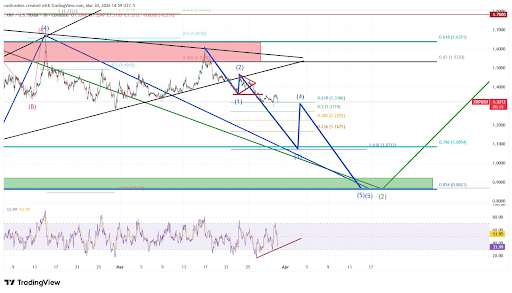
Source: Chart from CasiTrades on X

Based on this count, XRP is projected to drop to as low as $1.09 during Wave 3, with intermediate subwave targets around $1.06. These levels are based on previous liquidity zones and Fibonacci retracements at 0.786 on a larger cycle and 1.618 on a lower cycle.

A temporary relief bounce is expected afterward, which would create the next impulse Wave 4. Wave 4 is expected to push the XRP price back into the $1.22 to $1.31 range. However, this move is going to be a brief correction against Wave 3, and the broader bearish trend will still be in place.

Sub-$1 Scenario Comes Into Focus

After Wave 4 comes Wave 5, which is a continuation impulse wave in Elliott Wave theory. The most notable part of the forecast lies in how XRP ends up in Wave 5, which is the final leg of the structure. After the projected relief bounce, the analyst predicted a continuation lower toward a major macro support zone around $0.87. This price target is based on the 0.854 Fib retracement on the larger cycle.

Interestingly, the chart above shows that these five impulse wave counts are subwaves of a larger Wave 2 (labeled in green in the chart above), which is also a corrective wave in the Elliott Waves Theory. A bottom around $0.87 is not the end, as the next move would be the larger Wave 3, which is predicted to take the XRP price back above $2.

XRP trading at $1.34 on the 1D chart | Source: XRPUSDT on Tradingview.com

Criptomoedas em alta

Perguntas relacionadas

QAccording to the analyst CasiTrades, what is the primary reason the recent price bounces of XRP are considered bearish signals?

AThe recent price bounces are considered bearish because they have been repeatedly cut short around the 0.382 Fibonacci retracement level, indicating that sellers are still in control and that buyers lack the strength to change the momentum.

QWhat is the projected lowest price target for XRP during the Wave 3 decline as per the Elliott Wave analysis?

AThe projected lowest price target for XRP during the Wave 3 decline is $1.09, with intermediate subwave targets around $1.06.

QWhat price range is the temporary relief bounce (Wave 4) expected to push XRP into?

AThe temporary relief bounce (Wave 4) is expected to push the XRP price back into the range of $1.22 to $1.31.

QWhat is the final price target for the larger Wave 5 decline, and what technical level is this target based on?

AThe final price target for the larger Wave 5 decline is around $0.87, which is based on the 0.854 Fibonacci retracement level on the larger cycle.

QDespite the bearish short-term forecast, what is the predicted long-term price target for XRP after the completion of the larger Wave 2 correction?

AAfter the completion of the larger Wave 2 correction, the subsequent Wave 3 is predicted to take the XRP price back above $2.

Leituras Relacionadas

Upbit is Anxious: A Hasty Counterattack Aimed at Regaining Stablecoin Market Share

Title: Upbit's Rushed Counterattack to Reclaim Stablecoin Market Share Facing a dramatic shift in South Korea's stablecoin market, leading exchange Upbit launched a promotional campaign from July 26 to August 9, waiving the 0.05% trading fee for stablecoins paired with the Korean Won (KRW) and rapidly listing new stablecoins like RLUSD and USDG. This move is a direct response to its plummeting market share in this sector. Historically a duopoly with Bithumb, the market has been reshaped since October 2025 when Coinone permanently removed fees for USDC trading. By June 2026, Coinone led with 34.8% of stablecoin volume, followed by Bithumb (31.1%) and Upbit (30.1%). This contrasts sharply with the overall crypto market, where Upbit commands 60%. The data shows stablecoin demand is highly sensitive to fees, as users primarily buy them to transfer capital overseas for derivatives trading or forex arbitrage. South Korean exchanges have seen a net outflow of stablecoins for 18 consecutive months, totaling approximately 14.9 trillion KRW, underscoring their role as a cross-border capital conduit. Upbit's limited-time promotion initially boosted its daily stablecoin volume by 162%, but the surge was almost entirely in USDT (98.1% of volume). The newly listed stablecoins saw negligible, fleeting interest. Furthermore, the promotional effect quickly waned in the second week, with volume dropping 33% on weekdays. A concurrent weakening of the KRW also contributed to the trading spike, independent of the fee waiver. The analysis suggests that once the promotion ends, Upbit is unlikely to retain its temporary gains unless it matches Coinone's permanent zero-fee policy, forcing a choice between market share and fee revenue. Upbit's strategic push may be less about immediate profit and more about preparing for future regulatory shifts. With South Korea's *Digital Asset Basic Act* on the horizon, which will regulate KRW-backed stablecoins, and following Dunamu's (Upbit's parent) integration into Naver Financial to build a payment ecosystem, securing a dominant position in the dollar stablecoin distribution channel holds long-term strategic value. However, potential regulatory conflicts could prevent Upbit from listing a future Naver-issued KRW stablecoin, making the current fight for dollar stablecoin flow even more critical.

marsbitHá 41m

Upbit is Anxious: A Hasty Counterattack Aimed at Regaining Stablecoin Market Share

marsbitHá 41m

Michael Saylor Compares Bitcoin and Gold!

Michael Saylor, founder of MicroStrategy, argues that Bitcoin fundamentally changes how wealth is stored and transferred by transforming digital scarcity into economic value. He describes Bitcoin as the first digital monetary network, combining computers, digital networks, and cryptography. It digitizes monetary assets, allowing their supply to be controlled by public protocols rather than institutions, thus converting economic value into information transmissible over global networks. Comparing Bitcoin to gold, Saylor states that while increasing Bitcoin's supply is harder, its integration with software and transfer is easier. He highlights Bitcoin's proof-of-work mechanism, which ties it to the physical world by consuming real energy to secure the ledger, making past transactions immutable. This creates a shared security system involving miners, energy companies, and investors. Saylor suggests "digital monetary energy" is a more accurate term than "digital gold." He emphasizes that the Bitcoin network is an adaptive ecosystem of miners, nodes, developers, and users. Its core design is intentionally simple, focused on maintaining a secure ledger for scarce digital assets, with complex functionalities built in higher-layer applications. This architecture allows Bitcoin to serve as a foundation for transmitting value and fostering innovation in payments and financial services. Saylor notes Bitcoin's deeper impact lies in creating digital sovereignty, where private keys give individuals permissionless control over their economic power, with ownership verified mathematically, not by institutions. He concludes that while gold's physical scarcity makes it money, Bitcoin's digital scarcity does the same, characterizing Bitcoin as the monetary energy of the digital age.

cryptonews.ruHá 1h

Michael Saylor Compares Bitcoin and Gold!

cryptonews.ruHá 1h

Trading

Spot

Artigos em Destaque

Como comprar MOVE

Bem-vindo à HTX.com!Tornámos a compra de Movement (MOVE) simples e conveniente.Segue o nosso guia passo a passo para iniciar a tua jornada no mundo das criptos.Passo 1: cria a tua conta HTXUtiliza o teu e-mail ou número de telefone para te inscreveres numa conta gratuita na HTX.Desfruta de um processo de inscrição sem complicações e desbloqueia todas as funcionalidades.Obter a minha contaPasso 2: vai para Comprar Cripto e escolhe o teu método de pagamentoCartão de crédito/débito: usa o teu visa ou mastercard para comprar Movement (MOVE) instantaneamente.Saldo: usa os fundos da tua conta HTX para transacionar sem problemas.Terceiros: adicionamos métodos de pagamento populares, como Google Pay e Apple Pay, para aumentar a conveniência.P2P: transaciona diretamente com outros utilizadores na HTX.Mercado de balcão (OTC): oferecemos serviços personalizados e taxas de câmbio competitivas para os traders.Passo 3: armazena teu Movement (MOVE)Depois de comprar o teu Movement (MOVE), armazena-o na tua conta HTX.Alternativamente, podes enviá-lo para outro lugar através de transferência blockchain ou usá-lo para transacionar outras criptomoedas.Passo 4: transaciona Movement (MOVE)Transaciona facilmente Movement (MOVE) no mercado à vista da HTX.Acede simplesmente à tua conta, seleciona o teu par de trading, executa as tuas transações e monitoriza em tempo real.Oferecemos uma experiência de fácil utilização tanto para principiantes como para traders experientes.

562 Visualizações TotaisPublicado em {updateTime}Atualizado em 2026.06.02

Como comprar MOVE

Discussões

Bem-vindo à Comunidade HTX. Aqui, pode manter-se informado sobre os mais recentes desenvolvimentos da plataforma e obter acesso a análises profissionais de mercado. As opiniões dos utilizadores sobre o preço de MOVE (MOVE) são apresentadas abaixo.

活动图片











