XRP Price May Decline Due to Slowing Inflows into ETFs

cryptonews.ruPublicado em 2026-08-10Última atualização em 2026-08-10

Resumo

XRP is underperforming in August compared to leading cryptocurrencies like Bitcoin and Ethereum. A significant slowdown in ETF inflows is a key concern, with recent weekly inflows dropping to just $1 million, far below earlier figures. This follows a consistent decline in monthly ETF inflows since May. In stark contrast, spot Bitcoin and Ethereum ETFs continue to see substantial investment. Further pressure comes from Ripple Labs' stablecoin, RLUSD, which has seen its market cap decline and its holder base shrink by 8.5% over the last month, despite increased trading volume. Meanwhile, the XRP token itself has fallen from its 2024 peak and is testing crucial support near the $1.00 level—the lower boundary of a descending triangle pattern. The price is currently below key moving averages, indicating a sustained bearish trend and suggesting the path of least resistance remains downward.

In August, $XRP is showing the worst performance, especially compared to leading cryptocurrencies like Bitcoin and Ethereum.

Data shows that ETFs for $XRP have lost momentum over the past few months. Last week, these funds received only $1 million, significantly less than the $14 million attracted the week before.

In July, the funds attracted $27 million, which is less than the $59 million in June and $131 million in May of this year. This indicates that fund inflows are shrinking. The assets of Bitwise $XRP, Franklin XRPZ, and Canary XRPC are $303 million, $245 million, and $237 million, respectively.

Spot Bitcoin ETFs, in contrast, attracted over $800 million during the week of August 3-9, while funds for Ethereum received $244 million.

Regarding Ripple Labs' stablecoin, it has also lost momentum. The market capitalization of $RLUSD has fallen from $1.81 billion in June to the current $1.58 billion. According to Artemis, trading volume over the past 30 days has increased, but the number of holders over the same period has decreased by 8.5% to 26,200. This divergence suggests that although activity around $RLUSD has increased, the user base continues to shrink.

Meanwhile, the Ripple token continues to fall from its peak of $3.6575 in November 2024. Currently, $XRP has reached a significant support level, below which it has failed to drop several times since June. It is also at the psychologically important level of $1.0, which is the lower boundary of a descending triangle.

The token has fallen below the 50-day and 100-day exponential moving averages, indicating a sustained bearish trend. Consequently, the path of least resistance is downward.

end-content
Perguntas relacionadas

QAccording to the article, what is a major reason for the potential decline in XRP's price?

AThe potential decline in XRP's price is attributed to the slowdown in capital inflows into XRP Exchange-Traded Funds (ETFs). Data shows that these funds have lost momentum over recent months.

QHow does the capital inflow for XRP ETFs compare to Bitcoin and Ethereum ETFs in early August?

AIn the week of August 3-9, Bitcoin spot ETFs attracted over $800 million, and Ethereum ETFs attracted $244 million. In contrast, XRP ETFs attracted only $1 million the previous week, showing significantly lower inflows.

QWhat trend has been observed in the assets of major XRP ETFs mentioned in the article?

AThe article notes that the assets of major XRP ETFs (Bitwise XRP, Franklin XRPZ, and Canary XRPC) are $303 million, $245 million, and $237 million respectively. It also highlights that monthly inflows have been declining from $131 million in May to just $1 million in a recent week.

QWhat key market indicators currently suggest a bearish trend for XRP?

AXRP has fallen below its 50-day and 100-day Exponential Moving Averages (EMAs), which indicates a sustained bearish trend. It is also trading near a crucial psychological support level of $1.0, which forms the lower boundary of a descending triangle pattern.

QWhat contradictory data is presented regarding the Ripple Labs stablecoin (RLUSD)?

AFor RLUSD, trading volume over the last 30 days has increased, but the number of holders has decreased by 8.5% to 26,200 during the same period. This suggests that while trading activity has risen, the user base is actually contracting.

Leituras Relacionadas

Stock Price Doubles Within the Year, Plummets 20% After Resumption, Baolai Medical's 'Chip Backdoor Listing' Script Ends

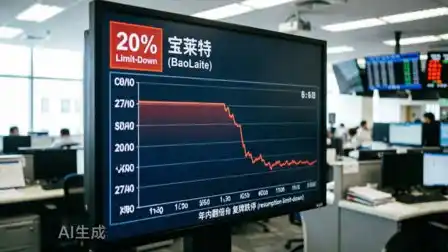
On August 10, 2026, BPL (300246.SZ) resumed trading after a nearly week-long suspension and immediately fell by a 20% limit-down. This plunge was triggered by the termination of a planned controlling stake transfer, dashing earlier market speculation. In January 2026, Zhejiang Quwei Zhihe Partnership entered as a significant shareholder, sparking hopes. Investors speculated that its backer, Weigu Information—a specialized "little giant" company in high-reliability solid-state storage chips—might be seeking a backdoor listing through BPL. This "cross-industry restructuring" expectation fueled a strong rally, with BPL's stock price more than doubling in 2026 prior to the halt. However, the deal was called off on August 7, directly causing the sharp sell-off. Underlying BPL's vulnerability is its fundamentally weak business. The company, a medical device firm, is mired in losses, having reported three consecutive years of net losses totaling over 200 million yuan. Its core hemodialysis business is squeezed by government procurement price cuts, while growth in its patient monitor segment has stalled. Furthermore, BPL faces imminent debt pressure with convertible bonds worth approximately 218 million yuan due in September 2026, and its current stock price is far below the conversion price. The failed control transfer may represent a delayed release of negative news, but BPL's core challenges remain: reversing operational losses and addressing its urgent liquidity crisis.

marsbitHá 4m

Stock Price Doubles Within the Year, Plummets 20% After Resumption, Baolai Medical's 'Chip Backdoor Listing' Script Ends

marsbitHá 4m

Moore Threads, Having Just Raised 8 Billion, Is Already Planning a Hong Kong IPO

On August 9th, Moore Threads announced plans for a Hong Kong IPO alongside a strong first-half 2026 earnings report. Listed on the Shanghai STAR Market in December 2025 as the "first domestic GPU stock," the company raised 8 billion yuan. Its stock price initially surged but has since fallen 40% from its peak. This decline followed market concerns over its use of substantial idle raised funds for low-risk financial products instead of promised projects. The company's H1 2026 revenue reached 1.74 billion yuan, a 147.4% year-over-year increase, already surpassing its full-year 2025 revenue. This growth is attributed to strong demand for AI and full-feature GPUs, particularly its Kuae AI computing clusters. Despite the revenue surge, Moore Threads remains unprofitable on a non-GAAP basis, with a net loss of 115 million yuan after adjustments. R&D and sales expenses grew significantly. The proposed Hong Kong listing aims to support its global strategy, attract international talent, and improve corporate governance, following the path of other Chinese tech firms pursuing dual listings. However, its港股 IPO valuation may face challenges as international investors could benchmark it against peers like Biren Technology, potentially demanding a discount. In summary, while Moore Threads is expanding rapidly and strategically seeking a港股 listing for global growth, it continues to face profitability challenges amid high costs and market skepticism about its capital allocation and valuation.

marsbitHá 26m

Moore Threads, Having Just Raised 8 Billion, Is Already Planning a Hong Kong IPO

marsbitHá 26m

Hassabis Predicts: AI's 'Move 37' in Mathematics is Only a Matter of Time

Demis Hassabis, the co-founder of DeepMind, predicts that AI achieving a "Move 37" level breakthrough in mathematics—solving a major unsolved problem like a Millennium Prize problem—is only a matter of time. He draws a parallel to the pivotal "Move 37" in the 2016 AlphaGo vs. Lee Sedol match, where AI's unconventional play challenged human understanding. Conversely, Lee Sedol's "Move 78" victory highlighted human resilience and the potential for human-AI collaboration. The article details AI's rapid progress in mathematics. Starting from basic arithmetic errors in 2023, AI systems like AlphaProof and Gemini Deep Think reached gold-medal levels in the International Mathematical Olympiad by 2025. The shift from problem-solving to genuine research began in 2025, with AI (e.g., GPT-5, Claude Fable 5) contributing key ideas to solve or refute long-standing conjectures like the Erdős problem 848 and the Jacobian conjecture. In 2026, AI achieved breakthroughs such as OpenAI's solution to the plane unit-distance problem and DeepMind's Aletheia agent autonomously tackling multiple open problems. Hassabis envisions a "centaur" era of science, where human intuition guides AI in complex, less-verifiable fields like biology and drug discovery. While AI can enhance human creativity and efficiency, as seen in post-AlphaGo围棋, there is a risk of over-reliance diminishing human judgment. The core challenge is for humanity to find its own "Move 78"—leveraging AI while maintaining critical insight and direction.

marsbitHá 29m

Hassabis Predicts: AI's 'Move 37' in Mathematics is Only a Matter of Time

marsbitHá 29m

Trading

Spot
活动图片