Hassabis Predicts: AI's 'Move 37' in Mathematics is Only a Matter of Time

marsbitPublicado em 2026-08-10Última atualização em 2026-08-10

Resumo

Demis Hassabis, the co-founder of DeepMind, predicts that AI achieving a "Move 37" level breakthrough in mathematics—solving a major unsolved problem like a Millennium Prize problem—is only a matter of time. He draws a parallel to the pivotal "Move 37" in the 2016 AlphaGo vs. Lee Sedol match, where AI's unconventional play challenged human understanding. Conversely, Lee Sedol's "Move 78" victory highlighted human resilience and the potential for human-AI collaboration. The article details AI's rapid progress in mathematics. Starting from basic arithmetic errors in 2023, AI systems like AlphaProof and Gemini Deep Think reached gold-medal levels in the International Mathematical Olympiad by 2025. The shift from problem-solving to genuine research began in 2025, with AI (e.g., GPT-5, Claude Fable 5) contributing key ideas to solve or refute long-standing conjectures like the Erdős problem 848 and the Jacobian conjecture. In 2026, AI achieved breakthroughs such as OpenAI's solution to the plane unit-distance problem and DeepMind's Aletheia agent autonomously tackling multiple open problems. Hassabis envisions a "centaur" era of science, where human intuition guides AI in complex, less-verifiable fields like biology and drug discovery. While AI can enhance human creativity and efficiency, as seen in post-AlphaGo围棋, there is a risk of over-reliance diminishing human judgment. The core challenge is for humanity to find its own "Move 78"—leveraging AI while maintaining critical ins...

AI in Mathematics, Ushering in a 'Slap-in-the-Face Moment' Similar to What the Go World Experienced a Decade Ago.

Holding a similar view is none other than Demis Hassabis, co-founder of DeepMind, who spearheaded the AlphaGo project ten years ago.

Although Hassabis recently underwent a series of role changes—transitioning from CEO of DeepMind to Google's Chief Scientist and Chairman of DeepMind.

When it comes to how AI is changing human cognition, he remains one of the most authoritative voices.
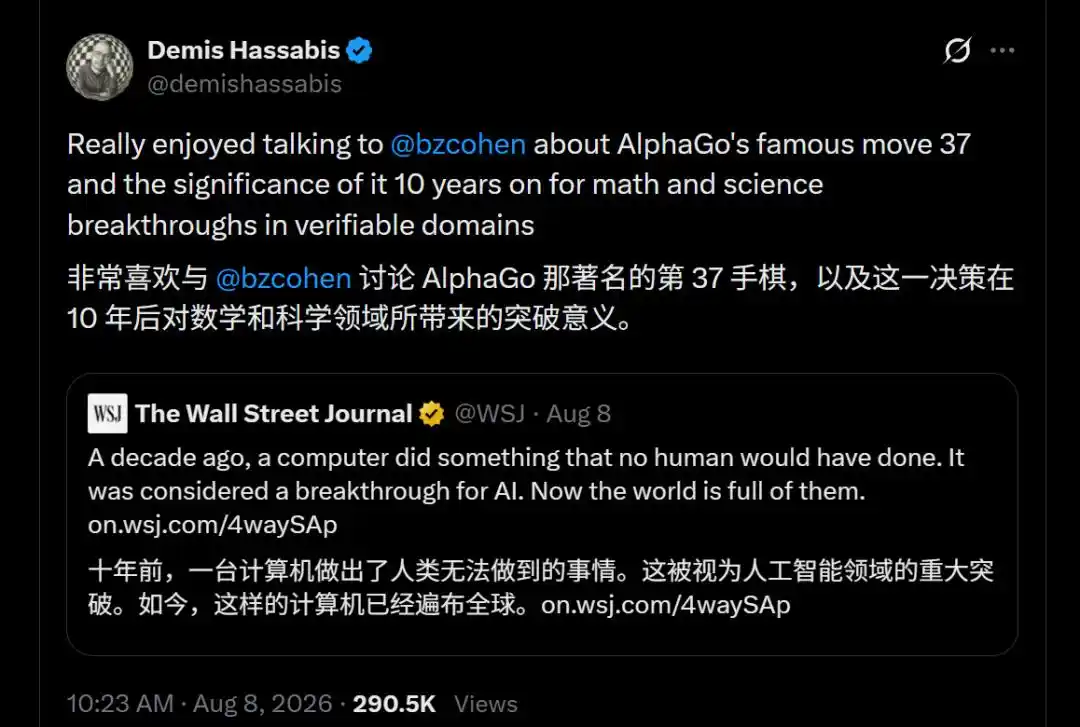
A decade ago, he witnessed AlphaGo's earth-shattering Move 37 defeat legendary Go player Lee Sedol.

A decade later, now at the forefront of AI's push into mathematics and scientific frontiers, he offers another new assessment:

If AI can solve one of the Millennium Prize Problems in mathematics, that would be a 'Move 37-level' breakthrough. At present, it seems to be only a matter of time before AI reaches that level, I see no reason why it wouldn't happen.

Move 37, a moment representing the first time humanity was collectively humbled by AI, is thus remembered by the world.

But few remember that Move 37 was not the only answer left by that man-machine battle.

Two matches later, after losing three games in a row, Lee Sedol played Move 78.

This move also had a probability of only one in ten thousand of being played by a human, yet it successfully disrupted AlphaGo, helping Lee Sedol secure the only human victory in the five-match series.

Looking back at this man-machine battle ten years later, one can't help but marvel:

The relationship between humans and AI is precisely like these two numbers.

One made humanity recognize AI anew, the other made humanity recognize itself anew.

The Face-Slapping Move 37

Turning back the clock to March 2016, the five-match series between AlphaGo and Lee Sedol was taking place in Seoul, South Korea.

In the first game, Lee Sedol lost to AlphaGo, an inauspicious start.

Arriving at the second game, the whole world awaited a counterattack from this legendary player.

Midway through the game, Lee Sedol temporarily left the board, had a cigarette to calm his nerves. But when he returned to the board, a black stone had already been placed.

Move 37.

Lee Sedol did not sit down immediately. He stood there staring at the board, hardly able to believe his eyes.

The reason was simple: this move was too inhuman.

AlphaGo placed the stone on the fifth line, deviating from centuries of positional intuition held by professional players. In conventional human Go understanding, stones should occupy higher positions to control the board, but AlphaGo placed it in an area with no immediate fighting.

The live commentators initially even suspected AlphaGo had made a mistake.

Professional 9-dan Michael Redmond, serving as commentator, stared at the black stone for a long time, unable to judge, could only say:

I don't know if this is good or bad, it's very strange.

His co-commentator was more direct:

I thought it was a mistake.

The DeepMind team later calculated the probability of a human player choosing this move at one in ten thousand.

But as the game progressed, people gradually realized this was not a bad move; it was a brilliant move that changed the course of the battle on a larger scale.

About 100 moves later, this seemingly misplaced black stone became the key to AlphaGo's victory in the second game.

Later, this moment of collective human misjudgment was gradually dubbed the 'Slap-in-the-Face Moment'

Originally thinking AI was wrong, but in the end, it was humans themselves who were wrong.

Beyond the slap, this move also made the world realize for the first time that AI could not only mimic human play, but also make moves humans had never considered.

And just ten years later, 'Move 37' indeed re-emerged, and this time it's linked to an ancient discipline:

Mathematics.

For AI, Go and mathematics share a major commonality: verifiability.

Because the logic and rules of these fields are sufficiently clear, AI can repeatedly run a simple process:

Try an idea, test it, learn from the results, then try again until it succeeds (the reinforcement learning approach).

This mechanism also explains why mathematics is the first discipline to be 'bombarded' by AI's 'Move 37'.

In fields like drug discovery, biology, etc., whether an idea works often requires lengthy experiments to verify.

Mathematics is different; a proof can be checked step by step, right or wrong, so AI can tirelessly search.

And so, as AI capabilities grow stronger, change began accelerating on a yearly basis.

Starting with ChatGPT's birth in 2023, large models still stumbled on basic arithmetic problems; flubs like "Which is larger, 9.11 or 9.9?" once caused amusement.

But by 2024, DeepMind's AlphaProof and AlphaGeometry 2 had already stormed into the International Mathematical Olympiad (IMO).

The two systems solved 4 out of 6 problems, scoring 28 points, reaching silver medal level (just 1 point short of that year's gold medal threshold).

And merely a year later, Gemini Deep Think solved 5 problems within the official contest's 4.5-hour limit, scoring 35 points, reaching IMO gold medal level.

In two years, AI advanced from novice to IMO gold medalist—astonishing speed.

But this was just the exam hall.

What really made the mathematical community feel the tide rushing in was AI starting to move from 'problem-solving' to 'research'.

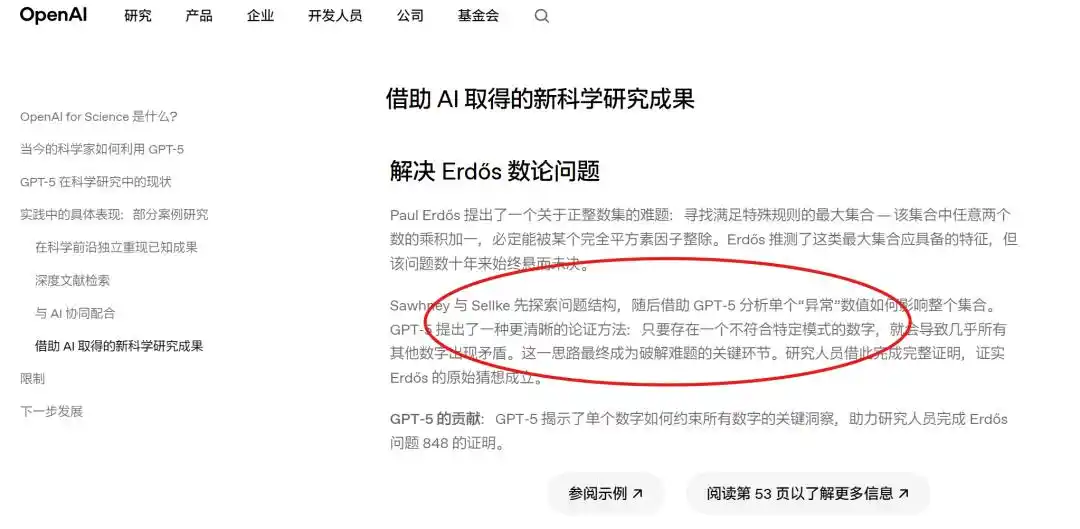
In 2025, GPT-5 participated in solving Erdős Problem 848, proposing a key estimate required for the proof.

Mathematicians refined and tightened it, ultimately completing the full proof.
The same year, UCLA mathematician Ernest Ryu used GPT-5 to find a breakthrough for an open problem that had puzzled optimization theory for 40 years.
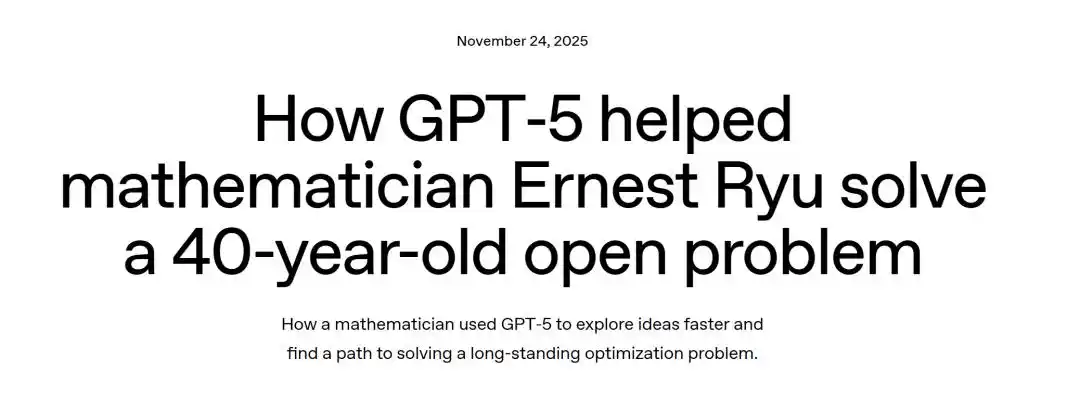
At this stage, AI was no longer just calculating answers; it began contributing key ideas.

Then, as time came to 2026, a series of major mathematical problems began to see breakthroughs.

Leading the charge with a bombshell was again OpenAI.

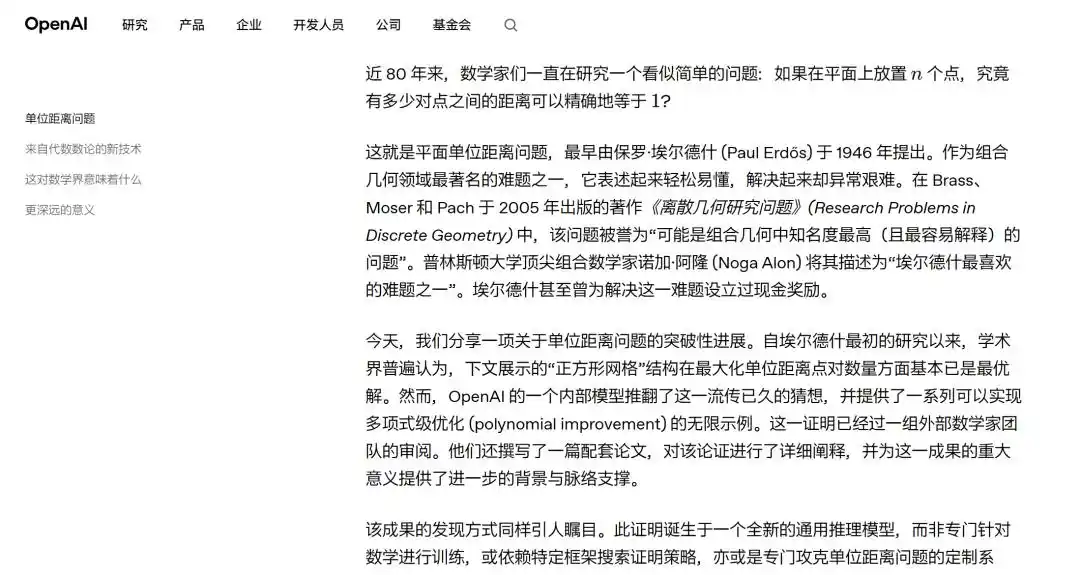
An internal general-purpose reasoning model set its sights on the Unit Distance Problem in the plane. Posed by mathematician Paul Erdős in 1946, it asks: given n points placed on a plane, what is the maximum number of pairs of points exactly distance 1 apart.

For nearly 80 years, the mathematical consensus was that constructions like square grids were near-optimal.

But the AI directly borrowed a set of tools from seemingly unrelated algebraic number theory, constructing an entirely new set of points, overturning this long-held conjecture.

The entire proof was subsequently verified by external mathematicians.

OpenAI stated that this was the first time a general-purpose AI autonomously solved an open problem of significant standing in a mathematical subfield.
Following closely, Anthropic also made its move.

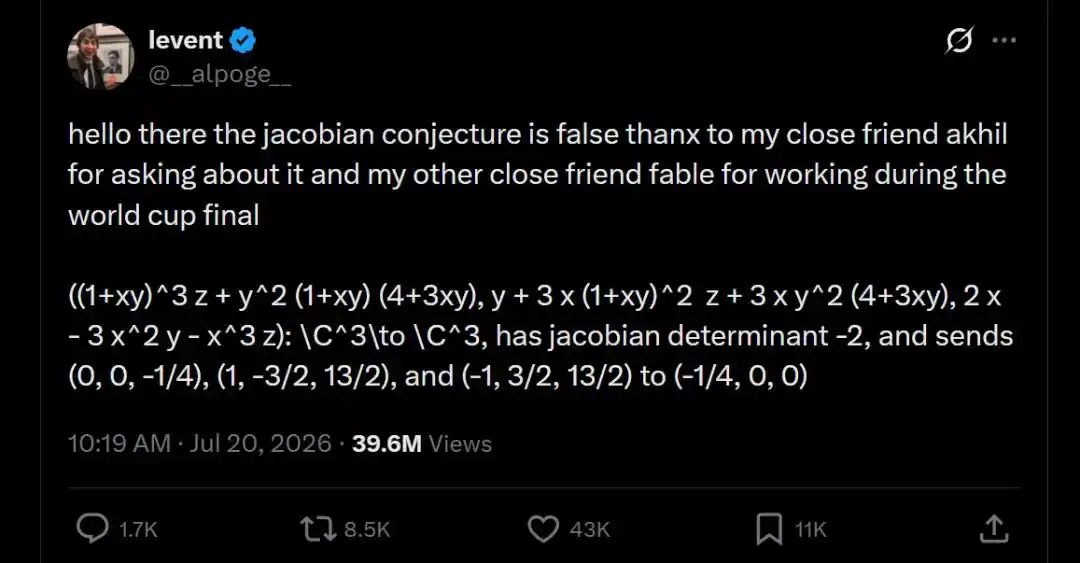
In July 2026, Anthropic mathematician Levent Alpöge, using Claude Fable 5, found an explicit counterexample to the Jacobian Conjecture.

A conjecture that had puzzled mathematicians for 87 years was thus disproven by AI overnight.
There were even instances of OpenAI and Anthropic joining forces.

Just a couple of days ago, GPT-5.6 and Fable 5 teamed up to solve a mathematical puzzle that had been open for 25 years.

(There are plenty of similar stories...)

But perhaps the most astonishing is Google, as DeepMind is turning such breakthroughs into an assembly line.

Its mathematical agent, Aletheia, no longer just generates one answer; it repeatedly proposes proofs, checks for flaws, refutes itself, and then searches for new paths.

DeepMind used it to scan 700 open problems in the Erdős conjecture database.

Among them, AI autonomously solved 4 unsolved problems and contributed to multiple mathematical results of publishable quality.

This attempt demonstrates that AI has begun systematically exploring the blank spaces in the mathematical world.

So it's not hard to imagine:

AI solving more major mathematical problems is truly just a matter of time.

From problem-solving to research, from reiterating known knowledge to proposing unknown answers, Move 37 in mathematics is being played one after another.

Searching for Humanity's Move 78

And facing this moment that is most likely approaching, humanity will undoubtedly confront a soul-searching question:

If AI will keep making novel moves humans have never considered, what should humanity do?

Move 78 from that decade-ago match might be the answer.

In the fourth match of the five-game series, Lee Sedol, having already lost three in a row, wedged a white stone into the center of AlphaGo's formation.

This move was also unconventional; AlphaGo estimated the probability of a human playing it at one in ten thousand.

Subsequently, the machine lost its composure.

Lee Sedol ultimately secured the only human victory, and Move 78 was thus dubbed the 'Hand of God' move.

This victory did not mean humans had overcome AI again.

But it at least showed that humans, after understanding the machine, could find a next step the machine did not anticipate.

This is precisely the lesson Move 78 leaves for today.

As AI becomes increasingly adept at providing answers, human value will shift more towards asking questions, judging direction, and deciding which answers are truly worth seeking.

Borrowing the concept of 'centaur chess' from chess, where human players cooperate with computer engines.

p.s. After IBM's 'Deep Blue' defeated human world champion Garry Kasparov in 1997, Kasparov advocated and organized the first 'Advanced Chess' (Centaur) tournament in 1998 to explore the potential of human-AI collaboration.

Hassabis believes science is entering a similar 'Centaur Era':

We are entering an era of collaboration between humans and computers. I don't know how long this cycle will last. But for very complex fields, it might be quite long. For instance, in drug discovery, biology, chemistry, etc., these fields are highly complex, dynamic, and not everything can be verified. That's where human intuition and insight are needed to decide the direction forward.

Subsequent developments in Go have proven this point.

After AlphaGo emerged, AI quickly became a review tool for professional players. Players could use AI to re-examine past joseki, discover which experiences were actually unreliable, and study new moves once deemed unreasonable.

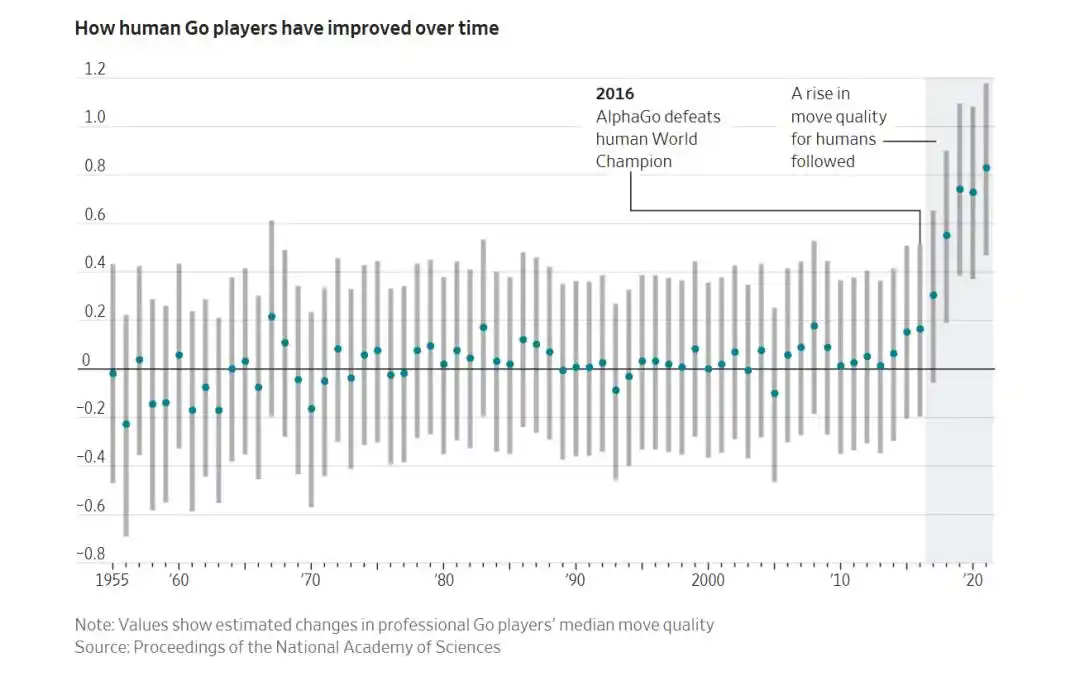
An analysis of over 5.8 million professional move decisions found:

After the advent of superhuman AI, the quality of human players' moves significantly improved, and novel moves also became more frequent.
However, there's another side to the story, namely:

People began relying on AI for answers, gradually losing the ability to judge the answers themselves.

As Lee Sedol said upon retiring, facing an undefeatable opponent made it hard for him to continue enjoying the Go he once loved.

This might be the most cautionary issue in the AI era.

As more fields beyond mathematics are impacted by AI, will more powerful systems make us more creative, efficient, and more human?

Or will they cause people to give up striving?

In the future, AI will keep playing Move 37.

The remaining question is, can humanity find its own Move 78.

Reference links:

[1]https://www.wsj.com/tech/ai/move-37-ai-demis-hassabis-google-deepmind-alphago-ec832a41?st=9XMAjn&reflink=desktopwebshare_permalink

[2]https://x.com/demishassabis/status/2085914742414061886

This article is from the WeChat public account "QbitAI", author: Focus on Frontier Technology

Criptomoedas em alta

Perguntas relacionadas

QWhat is the significance of 'Move 37' in the context of AI development according to Demis Hassabis?

A'Move 37' refers to a groundbreaking move made by AlphaGo during its 2016 match against Lee Sedol, which defied centuries of established human intuition in Go. According to Demis Hassabis, it represents the moment AI demonstrated it could find novel solutions beyond human thinking, and he believes a similar level of breakthrough is imminent in mathematics, where AI could solve a Millennium Prize Problem.

QWhat major shift in AI's role in mathematics does the article describe between 2024 and 2026?

AThe article describes a shift from AI 'solving problems' (like achieving IMO gold-level performance) to AI 'conducting research' and contributing key novel ideas to solve long-standing open conjectures. Examples include AI disproving the Jacobian Conjecture in 2026 and autonomously tackling significant problems like the planar unit distance problem.

QWhat does the 'Move 78' from the AlphaGo-Lee Sedol match symbolize in the human-AI relationship?

A'Move 78', the unexpected move by Lee Sedol that led to his sole victory in the match, symbolizes the human ability to find novel paths even after understanding AI's capabilities. It represents the hope that humans, by collaborating with and learning from AI, can maintain their creative and strategic value by asking the right questions and finding unexpected solutions.

QWhat concept does Demis Hassabis use to describe the future of scientific discovery with AI?

ADemis Hassabis describes the future as entering a 'centaur era' for science, drawing a parallel to chess. This concept refers to an era of human-computer collaboration, where human intuition and insight are crucial for guiding direction in complex, less verifiable fields like drug discovery and biology, while AI handles vast computation and pattern recognition.

QAccording to the article, what is a potential risk of increasing reliance on powerful AI systems?

AA potential risk is that humans might become overly reliant on AI for answers, leading to a loss of independent judgment and the ability to critically evaluate solutions. The article cites Lee Sedol's retirement sentiment, where the dominance of an unbeatable AI opponent diminished his enjoyment of Go, illustrating how reliance could potentially stifle human motivation and creativity.

Leituras Relacionadas

Stock Price Doubles Within the Year, Plummets 20% After Resumption, Baolai Medical's 'Chip Backdoor Listing' Script Ends

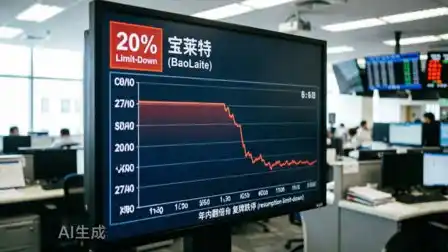
On August 10, 2026, BPL (300246.SZ) resumed trading after a nearly week-long suspension and immediately fell by a 20% limit-down. This plunge was triggered by the termination of a planned controlling stake transfer, dashing earlier market speculation. In January 2026, Zhejiang Quwei Zhihe Partnership entered as a significant shareholder, sparking hopes. Investors speculated that its backer, Weigu Information—a specialized "little giant" company in high-reliability solid-state storage chips—might be seeking a backdoor listing through BPL. This "cross-industry restructuring" expectation fueled a strong rally, with BPL's stock price more than doubling in 2026 prior to the halt. However, the deal was called off on August 7, directly causing the sharp sell-off. Underlying BPL's vulnerability is its fundamentally weak business. The company, a medical device firm, is mired in losses, having reported three consecutive years of net losses totaling over 200 million yuan. Its core hemodialysis business is squeezed by government procurement price cuts, while growth in its patient monitor segment has stalled. Furthermore, BPL faces imminent debt pressure with convertible bonds worth approximately 218 million yuan due in September 2026, and its current stock price is far below the conversion price. The failed control transfer may represent a delayed release of negative news, but BPL's core challenges remain: reversing operational losses and addressing its urgent liquidity crisis.

marsbitHá 35m

Stock Price Doubles Within the Year, Plummets 20% After Resumption, Baolai Medical's 'Chip Backdoor Listing' Script Ends

marsbitHá 35m

Moore Threads, Having Just Raised 8 Billion, Is Already Planning a Hong Kong IPO

On August 9th, Moore Threads announced plans for a Hong Kong IPO alongside a strong first-half 2026 earnings report. Listed on the Shanghai STAR Market in December 2025 as the "first domestic GPU stock," the company raised 8 billion yuan. Its stock price initially surged but has since fallen 40% from its peak. This decline followed market concerns over its use of substantial idle raised funds for low-risk financial products instead of promised projects. The company's H1 2026 revenue reached 1.74 billion yuan, a 147.4% year-over-year increase, already surpassing its full-year 2025 revenue. This growth is attributed to strong demand for AI and full-feature GPUs, particularly its Kuae AI computing clusters. Despite the revenue surge, Moore Threads remains unprofitable on a non-GAAP basis, with a net loss of 115 million yuan after adjustments. R&D and sales expenses grew significantly. The proposed Hong Kong listing aims to support its global strategy, attract international talent, and improve corporate governance, following the path of other Chinese tech firms pursuing dual listings. However, its港股 IPO valuation may face challenges as international investors could benchmark it against peers like Biren Technology, potentially demanding a discount. In summary, while Moore Threads is expanding rapidly and strategically seeking a港股 listing for global growth, it continues to face profitability challenges amid high costs and market skepticism about its capital allocation and valuation.

marsbitHá 58m

Moore Threads, Having Just Raised 8 Billion, Is Already Planning a Hong Kong IPO

marsbitHá 58m

Trading

Spot

Artigos em Destaque

O que é $S$

Compreender o SPERO: Uma Visão Abrangente Introdução ao SPERO À medida que o panorama da inovação continua a evoluir, o surgimento de tecnologias web3 e projetos de criptomoeda desempenha um papel fundamental na formação do futuro digital. Um projeto que tem atraído atenção neste campo dinâmico é o SPERO, denotado como SPERO,$$s$. Este artigo tem como objetivo reunir e apresentar informações detalhadas sobre o SPERO, para ajudar entusiastas e investidores a compreender as suas bases, objetivos e inovações nos domínios web3 e cripto. O que é o SPERO,$$s$? O SPERO,$$s$ é um projeto único dentro do espaço cripto que procura aproveitar os princípios da descentralização e da tecnologia blockchain para criar um ecossistema que promove o envolvimento, a utilidade e a inclusão financeira. O projeto é concebido para facilitar interações peer-to-peer de novas maneiras, proporcionando aos utilizadores soluções e serviços financeiros inovadores. No seu núcleo, o SPERO,$$s$ visa capacitar indivíduos ao fornecer ferramentas e plataformas que melhoram a experiência do utilizador no espaço das criptomoedas. Isso inclui a possibilidade de métodos de transação mais flexíveis, a promoção de iniciativas impulsionadas pela comunidade e a criação de caminhos para oportunidades financeiras através de aplicações descentralizadas (dApps). A visão subjacente do SPERO,$$s$ gira em torno da inclusão, visando fechar lacunas dentro das finanças tradicionais enquanto aproveita os benefícios da tecnologia blockchain. Quem é o Criador do SPERO,$$s$? A identidade do criador do SPERO,$$s$ permanece algo obscura, uma vez que existem recursos publicamente disponíveis limitados que fornecem informações detalhadas sobre o(s) seu(s) fundador(es). Esta falta de transparência pode resultar do compromisso do projeto com a descentralização—uma ética que muitos projetos web3 partilham, priorizando contribuições coletivas em vez de reconhecimento individual. Ao centrar as discussões em torno da comunidade e dos seus objetivos coletivos, o SPERO,$$s$ incorpora a essência do empoderamento sem destacar indivíduos específicos. Assim, compreender a ética e a missão do SPERO é mais importante do que identificar um criador singular. Quem são os Investidores do SPERO,$$s$? O SPERO,$$s$ é apoiado por uma diversidade de investidores que vão desde capitalistas de risco a investidores-anjo dedicados a promover a inovação no setor cripto. O foco desses investidores geralmente alinha-se com a missão do SPERO—priorizando projetos que prometem avanço tecnológico social, inclusão financeira e governança descentralizada. Essas fundações de investidores estão tipicamente interessadas em projetos que não apenas oferecem produtos inovadores, mas que também contribuem positivamente para a comunidade blockchain e os seus ecossistemas. O apoio desses investidores reforça o SPERO,$$s$ como um concorrente notável no domínio em rápida evolução dos projetos cripto. Como Funciona o SPERO,$$s$? O SPERO,$$s$ emprega uma estrutura multifacetada que o distingue de projetos de criptomoeda convencionais. Aqui estão algumas das características-chave que sublinham a sua singularidade e inovação: Governança Descentralizada: O SPERO,$$s$ integra modelos de governança descentralizada, capacitando os utilizadores a participar ativamente nos processos de tomada de decisão sobre o futuro do projeto. Esta abordagem promove um sentido de propriedade e responsabilidade entre os membros da comunidade. Utilidade do Token: O SPERO,$$s$ utiliza o seu próprio token de criptomoeda, concebido para servir várias funções dentro do ecossistema. Esses tokens permitem transações, recompensas e a facilitação de serviços oferecidos na plataforma, melhorando o envolvimento e a utilidade gerais. Arquitetura em Camadas: A arquitetura técnica do SPERO,$$s$ suporta modularidade e escalabilidade, permitindo a integração contínua de funcionalidades e aplicações adicionais à medida que o projeto evolui. Esta adaptabilidade é fundamental para manter a relevância no panorama cripto em constante mudança. Envolvimento da Comunidade: O projeto enfatiza iniciativas impulsionadas pela comunidade, empregando mecanismos que incentivam a colaboração e o feedback. Ao nutrir uma comunidade forte, o SPERO,$$s$ pode melhor atender às necessidades dos utilizadores e adaptar-se às tendências do mercado. Foco na Inclusão: Ao oferecer taxas de transação baixas e interfaces amigáveis, o SPERO,$$s$ visa atrair uma base de utilizadores diversificada, incluindo indivíduos que anteriormente podem não ter participado no espaço cripto. Este compromisso com a inclusão alinha-se com a sua missão abrangente de empoderamento através da acessibilidade. Cronologia do SPERO,$$s$ Compreender a história de um projeto fornece insights cruciais sobre a sua trajetória de desenvolvimento e marcos. Abaixo está uma cronologia sugerida que mapeia eventos significativos na evolução do SPERO,$$s$: Fase de Conceituação e Ideação: As ideias iniciais que formam a base do SPERO,$$s$ foram concebidas, alinhando-se de perto com os princípios de descentralização e foco na comunidade dentro da indústria blockchain. Lançamento do Whitepaper do Projeto: Após a fase conceitual, um whitepaper abrangente detalhando a visão, os objetivos e a infraestrutura tecnológica do SPERO,$$s$ foi lançado para atrair o interesse e o feedback da comunidade. Construção da Comunidade e Primeiros Envolvimentos: Esforços ativos de divulgação foram feitos para construir uma comunidade de primeiros adotantes e investidores potenciais, facilitando discussões em torno dos objetivos do projeto e angariando apoio. Evento de Geração de Tokens: O SPERO,$$s$ realizou um evento de geração de tokens (TGE) para distribuir os seus tokens nativos a apoiantes iniciais e estabelecer liquidez inicial dentro do ecossistema. Lançamento da dApp Inicial: A primeira aplicação descentralizada (dApp) associada ao SPERO,$$s$ foi lançada, permitindo que os utilizadores interagissem com as funcionalidades principais da plataforma. Desenvolvimento Contínuo e Parcerias: Atualizações e melhorias contínuas nas ofertas do projeto, incluindo parcerias estratégicas com outros players no espaço blockchain, moldaram o SPERO,$$s$ em um jogador competitivo e em evolução no mercado cripto. Conclusão O SPERO,$$s$ é um testemunho do potencial do web3 e das criptomoedas para revolucionar os sistemas financeiros e capacitar indivíduos. Com um compromisso com a governança descentralizada, o envolvimento da comunidade e funcionalidades inovadoras, abre caminho para um panorama financeiro mais inclusivo. Como em qualquer investimento no espaço cripto em rápida evolução, potenciais investidores e utilizadores são incentivados a pesquisar minuciosamente e a envolver-se de forma ponderada com os desenvolvimentos em curso dentro do SPERO,$$s$. O projeto demonstra o espírito inovador da indústria cripto, convidando a uma exploração mais aprofundada das suas inúmeras possibilidades. Embora a jornada do SPERO,$$s$ ainda esteja a desenrolar-se, os seus princípios fundamentais podem, de facto, influenciar o futuro de como interagimos com a tecnologia, as finanças e uns com os outros em ecossistemas digitais interconectados.

330 Visualizações TotaisPublicado em {updateTime}Atualizado em 2024.12.17

O que é $S$

O que é AGENT S

Agent S: O Futuro da Interação Autónoma no Web3 Introdução No panorama em constante evolução do Web3 e das criptomoedas, as inovações estão constantemente a redefinir a forma como os indivíduos interagem com plataformas digitais. Um projeto pioneiro, o Agent S, promete revolucionar a interação humano-computador através do seu framework aberto e agente. Ao abrir caminho para interações autónomas, o Agent S visa simplificar tarefas complexas, oferecendo aplicações transformadoras em inteligência artificial (IA). Esta exploração detalhada irá aprofundar-se nas complexidades do projeto, nas suas características únicas e nas implicações para o domínio das criptomoedas. O que é o Agent S? O Agent S é um framework aberto e agente, especificamente concebido para abordar três desafios fundamentais na automação de tarefas computacionais: Aquisição de Conhecimento Específico de Domínio: O framework aprende inteligentemente a partir de várias fontes de conhecimento externas e experiências internas. Esta abordagem dupla capacita-o a construir um rico repositório de conhecimento específico de domínio, melhorando o seu desempenho na execução de tarefas. Planeamento ao Longo de Longos Horizontes de Tarefas: O Agent S emprega planeamento hierárquico aumentado por experiência, uma abordagem estratégica que facilita a decomposição e execução eficientes de tarefas intrincadas. Esta característica melhora significativamente a sua capacidade de gerir múltiplas subtarefas de forma eficiente e eficaz. Gestão de Interfaces Dinâmicas e Não Uniformes: O projeto introduz a Interface Agente-Computador (ACI), uma solução inovadora que melhora a interação entre agentes e utilizadores. Utilizando Modelos de Linguagem Multimodais de Grande Escala (MLLMs), o Agent S pode navegar e manipular diversas interfaces gráficas de utilizador de forma fluida. Através destas características pioneiras, o Agent S fornece um framework robusto que aborda as complexidades envolvidas na automação da interação humana com máquinas, preparando o terreno para uma infinidade de aplicações em IA e além. Quem é o Criador do Agent S? Embora o conceito de Agent S seja fundamentalmente inovador, informações específicas sobre o seu criador permanecem elusivas. O criador é atualmente desconhecido, o que destaca ou o estágio nascente do projeto ou a escolha estratégica de manter os membros fundadores em anonimato. Independentemente da anonimidade, o foco permanece nas capacidades e no potencial do framework. Quem são os Investidores do Agent S? Como o Agent S é relativamente novo no ecossistema criptográfico, informações detalhadas sobre os seus investidores e financiadores não estão explicitamente documentadas. A falta de informações disponíveis publicamente sobre as fundações de investimento ou organizações que apoiam o projeto levanta questões sobre a sua estrutura de financiamento e roteiro de desenvolvimento. Compreender o apoio é crucial para avaliar a sustentabilidade do projeto e o seu impacto potencial no mercado. Como Funciona o Agent S? No núcleo do Agent S reside uma tecnologia de ponta que lhe permite funcionar eficazmente em diversos ambientes. O seu modelo operacional é construído em torno de várias características-chave: Interação Humano-Computador Semelhante: O framework oferece planeamento avançado em IA, esforçando-se para tornar as interações com computadores mais intuitivas. Ao imitar o comportamento humano na execução de tarefas, promete elevar as experiências dos utilizadores. Memória Narrativa: Utilizada para aproveitar experiências de alto nível, o Agent S utiliza memória narrativa para acompanhar os históricos de tarefas, melhorando assim os seus processos de tomada de decisão. Memória Episódica: Esta característica fornece aos utilizadores orientações passo a passo, permitindo que o framework ofereça suporte contextual à medida que as tarefas se desenrolam. Suporte para OpenACI: Com a capacidade de funcionar localmente, o Agent S permite que os utilizadores mantenham o controlo sobre as suas interações e fluxos de trabalho, alinhando-se com a ética descentralizada do Web3. Fácil Integração com APIs Externas: A sua versatilidade e compatibilidade com várias plataformas de IA garantem que o Agent S possa integrar-se perfeitamente em ecossistemas tecnológicos existentes, tornando-o uma escolha apelativa para desenvolvedores e organizações. Estas funcionalidades contribuem coletivamente para a posição única do Agent S no espaço cripto, à medida que automatiza tarefas complexas e em múltiplos passos com mínima intervenção humana. À medida que o projeto evolui, as suas potenciais aplicações no Web3 podem redefinir a forma como as interações digitais se desenrolam. Cronologia do Agent S O desenvolvimento e os marcos do Agent S podem ser encapsulados numa cronologia que destaca os seus eventos significativos: 27 de Setembro de 2024: O conceito de Agent S foi lançado num artigo de pesquisa abrangente intitulado “Um Framework Agente Aberto que Usa Computadores como um Humano”, mostrando a base para o projeto. 10 de Outubro de 2024: O artigo de pesquisa foi disponibilizado publicamente no arXiv, oferecendo uma exploração aprofundada do framework e da sua avaliação de desempenho com base no benchmark OSWorld. 12 de Outubro de 2024: Uma apresentação em vídeo foi lançada, proporcionando uma visão visual das capacidades e características do Agent S, envolvendo ainda mais potenciais utilizadores e investidores. Estes marcos na cronologia não apenas ilustram o progresso do Agent S, mas também indicam o seu compromisso com a transparência e o envolvimento da comunidade. Pontos-Chave Sobre o Agent S À medida que o framework Agent S continua a evoluir, várias características-chave destacam-se, sublinhando a sua natureza inovadora e potencial: Framework Inovador: Concebido para proporcionar um uso intuitivo de computadores semelhante à interação humana, o Agent S traz uma abordagem nova à automação de tarefas. Interação Autónoma: A capacidade de interagir autonomamente com computadores através de GUI significa um avanço em direção a soluções computacionais mais inteligentes e eficientes. Automação de Tarefas Complexas: Com a sua metodologia robusta, pode automatizar tarefas complexas e em múltiplos passos, tornando os processos mais rápidos e menos propensos a erros. Melhoria Contínua: Os mecanismos de aprendizagem permitem que o Agent S melhore a partir de experiências passadas, aprimorando continuamente o seu desempenho e eficácia. Versatilidade: A sua adaptabilidade em diferentes ambientes operacionais, como OSWorld e WindowsAgentArena, garante que pode servir uma ampla gama de aplicações. À medida que o Agent S se posiciona no panorama do Web3 e das criptomoedas, o seu potencial para melhorar as capacidades de interação e automatizar processos significa um avanço significativo nas tecnologias de IA. Através do seu framework inovador, o Agent S exemplifica o futuro das interações digitais, prometendo uma experiência mais fluida e eficiente para os utilizadores em diversas indústrias. Conclusão O Agent S representa um ousado avanço na união da IA e do Web3, com a capacidade de redefinir a forma como interagimos com a tecnologia. Embora ainda esteja nas suas fases iniciais, as possibilidades para a sua aplicação são vastas e cativantes. Através do seu framework abrangente que aborda desafios críticos, o Agent S visa trazer interações autónomas para o primeiro plano da experiência digital. À medida que avançamos mais profundamente nos domínios das criptomoedas e da descentralização, projetos como o Agent S desempenharão, sem dúvida, um papel crucial na formação do futuro da tecnologia e da colaboração humano-computador.

928 Visualizações TotaisPublicado em {updateTime}Atualizado em 2025.01.14

O que é AGENT S

Como comprar S

Bem-vindo à HTX.com!Tornámos a compra de Sonic (S) simples e conveniente.Segue o nosso guia passo a passo para iniciar a tua jornada no mundo das criptos.Passo 1: cria a tua conta HTXUtiliza o teu e-mail ou número de telefone para te inscreveres numa conta gratuita na HTX.Desfruta de um processo de inscrição sem complicações e desbloqueia todas as funcionalidades.Obter a minha contaPasso 2: vai para Comprar Cripto e escolhe o teu método de pagamentoCartão de crédito/débito: usa o teu visa ou mastercard para comprar Sonic (S) instantaneamente.Saldo: usa os fundos da tua conta HTX para transacionar sem problemas.Terceiros: adicionamos métodos de pagamento populares, como Google Pay e Apple Pay, para aumentar a conveniência.P2P: transaciona diretamente com outros utilizadores na HTX.Mercado de balcão (OTC): oferecemos serviços personalizados e taxas de câmbio competitivas para os traders.Passo 3: armazena teu Sonic (S)Depois de comprar o teu Sonic (S), armazena-o na tua conta HTX.Alternativamente, podes enviá-lo para outro lugar através de transferência blockchain ou usá-lo para transacionar outras criptomoedas.Passo 4: transaciona Sonic (S)Transaciona facilmente Sonic (S) no mercado à vista da HTX.Acede simplesmente à tua conta, seleciona o teu par de trading, executa as tuas transações e monitoriza em tempo real.Oferecemos uma experiência de fácil utilização tanto para principiantes como para traders experientes.

1.7k Visualizações TotaisPublicado em {updateTime}Atualizado em 2026.06.02

Como comprar S

Discussões

Bem-vindo à Comunidade HTX. Aqui, pode manter-se informado sobre os mais recentes desenvolvimentos da plataforma e obter acesso a análises profissionais de mercado. As opiniões dos utilizadores sobre o preço de S (S) são apresentadas abaixo.

活动图片