XRP Is No Longer Dormant: Flare Data Reveals Over 120 Billion Baht Locked in DeFi

bitcoinistPublicado em 2025-12-31Última atualização em 2025-12-31

Resumo

The article highlights a significant shift in the perception of XRP, moving away from being seen as a passive asset. Data from the Flare Network reveals that over 80% of FXRP (a 1:1 representation of XRP) is now locked in DeFi protocols, representing over $125.8 million in value. This indicates a substantial increase in user activity, deeper liquidity, and renewed positive momentum for both XRP and the XRP Ledger (XRPL). Key metrics show nearly 67.8 million FXRP tokens are utilized in DeFi, with over 5,800 active users. Transaction activity is robust, exceeding 1.2 million DeFi transactions, including over 1.12 million FXRP swaps. This engagement is described as being driven by long-term conviction rather than short-term yield chasing, as capital remains locked and user numbers grow steadily even in a weak market. The article argues that XRP's historical lack of DeFi adoption was due to a lack of infrastructure, not demand. Flare's FAssets system is unlocking this previously inaccessible utility by allowing XRP to interact with EVM-compatible DeFi applications without requiring trusted custodians. Additionally, the piece introduces "Bitcoin Hyper" as a new Layer-2 solution designed to bring Bitcoin into practical DeFi use. It aims to solve Bitcoin's limitations in speed and fees by leveraging the Solana Virtual Machine, positioning itself as a crucial bridge between Bitcoin and the growing DeFi ecosystem.

Data indicates that XRP is shedding its image as a dormant asset, with the majority of FXRP being locked in DeFi. This is a sign of increasing user activity, deeper liquidity, and a return of positive momentum for XRP and the XRP Ledger via the Flare network.

Data from the Flare Network supports the hypothesis of a stronger upward trend for XRP and XRPL.

Momentum around XRP and the XRP Ledger (XRPL) is strengthening, as on-chain data reinforces the case for continued DeFi adoption. Blockchain infrastructure provider Flare Network shared insights on social media platform X on December 29th, arguing that XRP holders are actively engaging in DeFi, citing detailed FXRP metrics that point to increased usage, higher user activity, and deeper liquidity tied to XRPL-linked assets.

XRP holders are often perceived as a passive group and not DeFi users, but FXRP data tells a different story, and it remains a compelling cryptocurrency investment.

Over 80% of FXRP is locked in DeFi, representing over $124 million in real utility deployed on Flare. More interestingly, this growth occurred during a weak market. The number of users is still increasing, capital remains locked, and adoption is growing steadily, not driven by a chase for short-term returns. Ultimately, the issue was never about demand, but about infrastructure. Flare is unlocking XRP's DeFi, the team added.
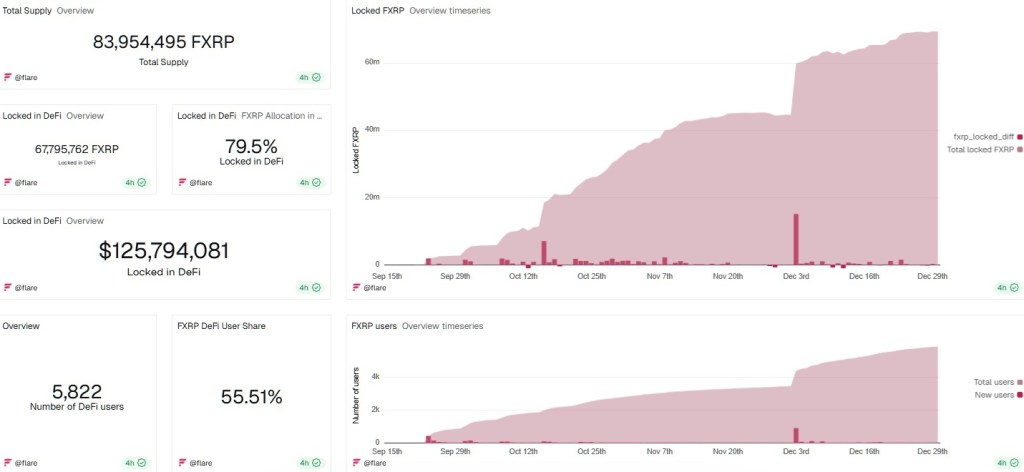
According to Flare's data as of December 30th, roughly 80% of the total FXRP supply is locked in decentralized finance, representing approximately $125.8 million in utility deployed in protocols on Flare. In a weak market environment, the network dashboard shows the total FXRP supply is about 83.95 million tokens, with nearly 67.8 million FXRP tokens tied up in DeFi applications.

User participation continues to expand, with over 5,800 DeFi users, and FXRP users account for more than 55.5% of all FXRP holders. Transaction activity also remains strong, exceeding 1.2 million DeFi transactions, including over 1.12 million FXRP swaps, alongside tens of thousands of liquidity additions and withdrawals. Flare's message frames this behavior as conviction-driven engagement, not opportunistic yield chasing, emphasizing that capital remains consistently locked while the number of users shows a steady upward trend.

Additional data further supports a positive outlook for XRP and the XRP Ledger by showing that the infrastructure has unlocked previously inaccessible utility. FXRP serves as a 1:1 representation of XRP minted through Flare's FAssets system, enabling interaction with EVM-compatible DeFi applications without the need for a custodian, while remaining economically linked to the liquidity of the XRP Ledger.

Beyond core DeFi, related products like stXRP are also gaining traction, with over $4.17 million locked in Sparkdex, over $1 million in Enosys, and additional allocations in Kinetic and other platforms. Within the Kinetic protocol alone, FXRP liquidity exceeds 37.4 million tokens, the total FXRP supply is valued at over $72 million, and lending activity is approaching $2.7 million. These figures reflect growing interoperability and capital efficiency directly tied to XRP. The data clearly reiterates that XRP's historical DeFi limitations stemmed from a lack of infrastructure, not a lack of demand. As the Flare Network expands smart contract capabilities and DeFi access, XRP and the XRP Ledger are increasingly positioned as a scalable liquidity layer capable of supporting the sustainable growth of decentralized finance.

Bitcoin Hyper: A New Shortcut for Bitcoin to a Functional DeFi World

Bitcoin Hyper is designed to unlock Bitcoin's traditional limitations regarding speed and fees. With its Layer 2 structure harnessing the power of the Solana Virtual Machine, Bitcoin can support fast, low-cost transactions and genuinely expand into dApps and DeFi, not just as a concept on paper. The HYPER token acts as the heart of the system, facilitating transactions, staking, and network governance, helping to transform Bitcoin's role from merely a store of value to a ready-to-use financial infrastructure in the decentralized world.
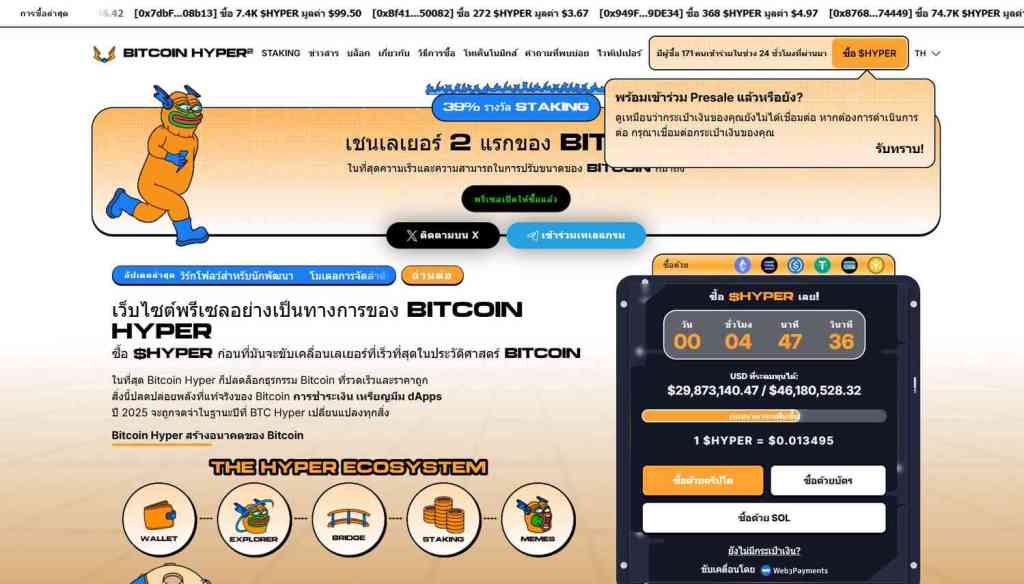
Looking at the DeFi trend where real capital is flowing in, as seen with XRP on Flare, it's clear the problem is not user demand, but the unprepared infrastructure. Bitcoin Hyper is stepping in to fill that gap, paving the way for Bitcoin's liquidity to enter DeFi more efficiently. For investors looking for projects that play into the real demand of the market, not just temporary trends, Bitcoin Hyper is one option to watch, as it is positioning itself as a crucial bridge between Bitcoin and the continuously growing world of DeFi.

Go to Bitcoin Hyper

Criptomoedas em alta

Perguntas relacionadas

QWhat percentage of FXRP is currently locked in DeFi according to the Flare Network data?

AApproximately 80% of the total FXRP supply is locked in decentralized finance (DeFi).

QWhat is the estimated total value of FXRP that is being utilized in protocols on Flare?

AThe estimated total value of FXRP being utilized is over $124 million USD.

QHow does FXRP function on the Flare Network in relation to the native XRP asset?

AFXRP is a 1:1 representation of XRP minted through Flare's FAssets system, allowing it to interact with EVM-compatible DeFi applications without requiring a custodian, while remaining economically linked to the liquidity of the XRP Ledger.

QWhat key limitation of XRP in the DeFi space does the Flare Network claim to be solving?

AFlare Network is solving the historical limitation of XRP in DeFi, which was a lack of infrastructure (like smart contract capabilities), not a lack of user demand.

QBesides the main DeFi protocols, what other FXRP-related product is mentioned as gaining popularity, and what is its locked value on Sparkdex?

AThe product stXRP is mentioned as gaining popularity, with a locked value of over $4.17 million USD on Sparkdex.

Leituras Relacionadas

If It's Not a Clear Yes, It's a No: A Nine-Year Retrospective by a VC Who Survived Four Cycles

**"Invest Only When Certain": A Nine-Year Retrospective from a VC Across Four Cycles** IOSG founder Jocy shares hard-earned lessons from nine years and over a hundred investments in Web3. The core challenge isn't identifying successful founders, but understanding why talented founders with solid ideas still fail. Through building a "failed founder database," IOSG identified six recurring failure patterns. **Founder Trait Red Flags:** 1. **Emotionally Unstable:** Founders who react defensively to criticism or publicly lash out under pressure (e.g., 80% drawdowns) often fail. Resilience is key. 2. **Lacking Hunger / Having a Fallback:** Founders with significant safety nets (family wealth, cushy fallback jobs) may lack the "do-or-die" commitment needed to survive crypto's brutal cycles. 3. **Unchecked Ego:** Includes "polished execution machines" who excel in known frameworks but struggle when paradigms shift, and "professor-types" who are technically brilliant but resistant to commercial feedback or coaching. **Project Structure Red Flags:** 4. **Token-First, Not Product-First:** Treating the token solely as a fundraising tool with no real utility or connection to product value is a major warning sign. The project should have value even if the token goes to zero. 5. **No Day-1 Exit Thesis:** Founders must have a clear, staged capital strategy from the start, understanding what each funding round needs to prove to unlock the next. "Exit before entry" is crucial. 6. **No Full-Cycle Experience:** Founders who haven't lived through a complete crypto bull/bear cycle (e.g., 2018, 2022) often underestimate their vulnerability. IOSG limits initial checks for such teams to $250k, sizing for risk. **The Positive Flipside: Desirable Founder Traits** The ideal candidate exhibits: obsessive problem-depth, being a second-time founder with a non-consensus vision, strong communication skills with *controlled* ego, relentless perseverance, and a global perspective with agency and taste (increasingly vital in the AI era). **Three Survival Tips for Founders:** 1. **Cash Flow Over Narrative:** Real revenue is what sustains projects, not vanity metrics. 2. **Tokens Are a Liability:** Avoid issuing a token unless absolutely necessary. The hidden costs (market making, liquidity, compliance) are immense, often a multi-million-dollar burden. 3. **Respect Liquidity:** Sell during peaks to build treasury, buy back to support the protocol during troughs. Be realistic about valuations and your ability to deliver for the next round. The final principle is simple yet paramount: **"If it's a borderline 'yes' or 'no,' don't invest."** In an industry that reinvents itself every few years, the discipline to consistently say "no" is the ultimate secret to longevity.

Foresight NewsHá 23m

If It's Not a Clear Yes, It's a No: A Nine-Year Retrospective by a VC Who Survived Four Cycles

Foresight NewsHá 23m

SemiAnalysis Deep Dive into CXMT: $50 Billion Revenue, An IPO Amidst a Supercycle

SemiAnalysis' in-depth report on ChangXin Memory Technologies (CXMT) details its rapid rise as China's largest upcoming semiconductor IPO. Founded in 2016 by Zhu Yiming, CXMT built its DRAM foundation on acquired patents and talent from the bankrupt German firm Qimonda. It achieved its first annual profit in 2025 after nearly a decade of significant capital support, primarily from patient Hefei municipal investors who fostered a local supply chain. The company is now capitalizing on a strong DRAM supercycle. Its revenue soared from ~$3.3B in 2024 to ~$8.6B in 2025, with Q1 2026 alone reaching ~$7.3B. SemiAnalysis projects full-year 2026 revenue could exceed $50B, driven by soaring ASPs rather than massive market share gains. While CXMT is closing the capacity gap with Micron, its product mix remains heavily focused on commodity DDR/LPDDR, which currently offers higher margins than its nascent HBM business. CXMT faces significant challenges in HBM, struggling with yield and stability for HBM3 8-Hi stacks while lagging behind the big three (Samsung, SK Hynix, Micron) in advanced nodes. However, strategic national priorities for AI self-sufficiency may push it to accelerate HBM capacity. Its complex IPO structure reveals heavy state-backed ownership and voting control over its fabs, with Alibaba appearing as both a key cloud customer and a minority shareholder. The IPO aims to raise ~$4.1B, primarily to strengthen its core DRAM manufacturing base.

marsbitHá 43m

SemiAnalysis Deep Dive into CXMT: $50 Billion Revenue, An IPO Amidst a Supercycle

marsbitHá 43m

From Corning to Ciena: The 10x Opportunity in the AI Optical Communication Chain

The transition from copper to optical communication in AI data centers is creating significant investment opportunities beyond just chipmakers. The entire photonics supply chain, from glass and fiber to connectors and test equipment, is critical. Corning, a key fiber supplier, has locked in multi-billion dollar, multi-year contracts with major cloud providers (Meta, Amazon, Google, Microsoft, OpenAI, NVIDIA), demonstrating pricing power and scale. Its profit growth is outpacing revenue growth. In the interconnect layer, Amphenol benefits from high growth in AI data centers, driven by strategic acquisitions and operational efficiency, while Credo Technology acts as a bridge between copper and optical solutions, though with high customer concentration risk. At the systems level, Ciena enables higher data capacity on existing fiber lines, with a strong backlog and cloud customer adoption. Further upstream, AXT is a bottleneck supplier of key indium phosphide wafers for lasers but faces geopolitical supply chain risks. VEO Solutions provides essential testing equipment for the entire photonics industry. A new pure-play photonics ETF (FOTO) offers a consolidated investment approach. The core thesis is that the physical limits of copper are driving an inevitable shift to optical technologies, with wealth flowing to essential, often overlooked, suppliers across the photonics value chain.

marsbitHá 55m

From Corning to Ciena: The 10x Opportunity in the AI Optical Communication Chain

marsbitHá 55m

Trading

Spot
Futuros

Artigos em Destaque

O que é XRP 2.0

XRP 2.0: Uma Nova Fronteira no Landscape das Criptomoedas Introdução ao XRP 2.0 No reino em constante evolução das criptomoedas, novos projetos surgem continuamente, lutando por atenção e adoção. Uma dessas iniciativas promissoras é o XRP 2.0, um novo projeto de criptomoeda concebido para aproveitar a tecnologia de blockchain avançada e as metodologias de criptografia robustas. Embora o nome tenha paralelos com o XRP da Ripple, é crucial notar que o XRP 2.0 opera de forma independente, focando em melhorar a segurança das transações, a privacidade e a escalabilidade. À medida que o panorama financeiro digital abraça cada vez mais soluções descentralizadas, o XRP 2.0 visa contribuir de forma significativa para a web3 e a expansão global dos projetos de criptomoedas. O que é o XRP 2.0? No seu núcleo, o XRP 2.0 é um projeto de criptomoeda que visa criar um ecossistema de moeda digital seguro e descentralizado. Sua tecnologia fundamental integra princípios de blockchain sofisticados com técnicas de criptografia de ponta. O objetivo abrangente do XRP 2.0 é estabelecer-se como uma plataforma confiável e eficiente que possibilita a execução rápida de transações, priorizando a proteção de privacidade aprimorada para os seus usuários. O projeto é promovido como uma solução para muitas limitações enfrentadas pelas criptomoedas existentes, propondo um sistema que pode lidar com um volume maior de transações com velocidade e privacidade melhoradas. Esta versatilidade posiciona o XRP 2.0 como um concorrente significativo em um mercado repleto de várias moedas digitais. Quem é o Criador do XRP 2.0? A identidade do criador por trás do XRP 2.0 foi identificada como 'Wilbur.' No entanto, detalhes abrangentes sobre Wilbur ou a sua entidade associada permanecem elusivos. O anonimato de muitos criadores de criptomoedas não é um fenômeno incomum na indústria, muitas vezes concebido para manter um grau de privacidade e segurança. Quem são os Investidores do XRP 2.0? Até agora, informações específicas relacionadas às fundações ou organizações de investimento que apoiam o XRP 2.0 não estão disponíveis publicamente. No setor das criptomoedas, o apoio de investidores reputados pode influenciar significativamente a credibilidade e o sucesso de um projeto, no entanto, a transparência em relação aos apoiantes financeiros do XRP 2.0 não foi estabelecida. Como Funciona o XRP 2.0? O XRP 2.0 destaca-se por empregar uma combinação de tecnologia blockchain e algoritmos de criptografia avançados que asseguram transações seguras e descentralizadas. Sua estrutura inovadora inclui características únicas projetadas para fomentar o envolvimento dos usuários e ampliar as funcionalidades além das transações convencionais de criptomoedas. Entre essas características, o XRP 2.0 incorpora capacidades potenciadas por IA, como funcionalidades de texto-para-imagem e texto-para-fala. Estas adições são projetadas para melhorar a experiência interativa dos usuários, promovendo uma maior aplicabilidade em vários setores. Ao unir avanços tecnológicos com um design centrado no utilizador, o XRP 2.0 pretende captar a atenção de uma diversa gama de indivíduos e empresas que procuram integrar soluções de criptomoedas em suas estruturas operacionais. Cronologia do XRP 2.0 Compreender o XRP 2.0 requer examinar os marcos que definiram sua jornada até agora: 23 de Julho de 2023: O XRP 2.0 é apresentado como um novo projeto de criptomoeda, visando revolucionar as capacidades de transação seguras e descentralizadas no domínio do blockchain. 8 de Setembro de 2023: O lançamento de outro projeto, XRP20, ocorre, marcando o surgimento de um token ERC-20 na blockchain Ethereum que permanece não relacionado ao XRP 2.0. 13 de Novembro de 2023: O XRP Ledger passa por uma atualização significativa com o lançamento da versão 2.0.0 do software do servidor rippled. É importante notar que este desenvolvimento está desconectado do projeto de criptomoeda XRP 2.0. Pontos-chave sobre o XRP 2.0 Para destilar a essência do XRP 2.0, vários fatores críticos emergem: Características Únicas: A inclusão de características como texto-para-imagem e texto-para-fala potenciadas por IA diversifica ainda mais as aplicações potenciais do XRP 2.0. Tecnologia Blockchain: A estrutura utiliza mecanismos de blockchain avançados e protocolos de criptografia, assegurando um ambiente seguro e descentralizado para transações. Escalabilidade e Privacidade: O XRP 2.0 prioriza proteção de privacidade aprimorada nos processos de transação e a escalabilidade necessária para acomodar uma base de utilizadores crescente. Sem Afiliação com a Ripple: Importante, apesar do seu nome, o XRP 2.0 não tem qualquer lealdade ou colaboração com o XRP da Ripple, distinguindo sua estrutura operacional e objetivos dentro do ecossistema das criptomoedas. Conclusão O XRP 2.0 representa uma empreitada ambiciosa no domínio das criptomoedas, visando oferecer uma combinação de segurança, privacidade e eficiência em transações digitais. Ao integrar tecnologias sofisticadas e características amigáveis ao utilizador, o projeto propõe-se a ampliar os horizontes do que as criptomoedas podem alcançar na economia digital atual. Embora o anonimato do seu criador e a falta de investidores divulgados possam levantar questões para alguns, o foco do XRP 2.0 em funcionalidades avançadas e descentralização aumenta seu apelo num mercado de criptomoedas cada vez mais congestionado. À medida que o panorama das criptomoedas continua a evoluir, o XRP 2.0 pode ainda emergir como um jogador crucial na expansão de soluções de blockchain seguras e escaláveis.

102 Visualizações TotaisPublicado em {updateTime}Atualizado em 2024.12.03

O que é XRP 2.0

Como comprar XRP

Bem-vindo à HTX.com!Tornámos a compra de XRP (XRP) simples e conveniente.Segue o nosso guia passo a passo para iniciar a tua jornada no mundo das criptos.Passo 1: cria a tua conta HTXUtiliza o teu e-mail ou número de telefone para te inscreveres numa conta gratuita na HTX.Desfruta de um processo de inscrição sem complicações e desbloqueia todas as funcionalidades.Obter a minha contaPasso 2: vai para Comprar Cripto e escolhe o teu método de pagamentoCartão de crédito/débito: usa o teu visa ou mastercard para comprar XRP (XRP) instantaneamente.Saldo: usa os fundos da tua conta HTX para transacionar sem problemas.Terceiros: adicionamos métodos de pagamento populares, como Google Pay e Apple Pay, para aumentar a conveniência.P2P: transaciona diretamente com outros utilizadores na HTX.Mercado de balcão (OTC): oferecemos serviços personalizados e taxas de câmbio competitivas para os traders.Passo 3: armazena teu XRP (XRP)Depois de comprar o teu XRP (XRP), armazena-o na tua conta HTX.Alternativamente, podes enviá-lo para outro lugar através de transferência blockchain ou usá-lo para transacionar outras criptomoedas.Passo 4: transaciona XRP (XRP)Transaciona facilmente XRP (XRP) no mercado à vista da HTX.Acede simplesmente à tua conta, seleciona o teu par de trading, executa as tuas transações e monitoriza em tempo real.Oferecemos uma experiência de fácil utilização tanto para principiantes como para traders experientes.

1.7k Visualizações TotaisPublicado em {updateTime}Atualizado em 2026.06.02

Como comprar XRP

Discussões

Bem-vindo à Comunidade HTX. Aqui, pode manter-se informado sobre os mais recentes desenvolvimentos da plataforma e obter acesso a análises profissionais de mercado. As opiniões dos utilizadores sobre o preço de XRP (XRP) são apresentadas abaixo.

活动图片