Xiaomi and MiniMax Unleash Major Upgrades Simultaneously, Officially Kicking Off the Agent Pricing War

marsbitPublicado em 2026-03-20Última atualização em 2026-03-20

Resumo

Chinese AI companies MiniMax and Xiaomi's MiMo have both launched major Agent-focused models, M2.7 and V2-Pro, respectively, within two days in March. Both models rank in the top tier globally on Agent benchmarks but are priced significantly lower than leading Western models—MiniMax at $1.2 per million tokens (1/21 of Claude Opus) and MiMo at $3 (1/8 of Claude Opus). The two represent divergent technical strategies. MiMo-V2-Pro adopts a scale-driven approach with over 1 trillion parameters and a hybrid attention mechanism optimized for long-context and multi-tool agent tasks. In contrast, MiniMax’s M2.7 uses a self-iterative optimization method, autonomously refining its architecture over 100+ cycles to improve performance without disclosing parameter count. Their release rhythms also differ: MiniMax iterates rapidly with four versions in five months, while Xiaomi releases fewer but more substantial upgrades. Notably, Xiaomi debuted V2-Pro anonymously on OpenRouter as "Hunter Alpha," topping the platform’s usage chart before revealing its identity—a first for a Chinese AI model gaining global developer traction through pure performance.

On March 18 and 19, two Chinese companies successively released their major models in the Agent direction. Domestic AI startup MiniMax launched M2.7, while Xiaomi's large model team MiMo introduced V2-Pro. Both models have entered the global top tier on the Agent benchmark, but their API output pricing is 1/21 and 1/8 of Claude Opus 4.6, respectively.

They played their cards in the same week, but with completely different hands. They represent two截然不同的 technical routes, betting on two different futures for the Agent era.

The Same Exam, 1/17 the Tuition

First, let's look at the most直观 comparison.
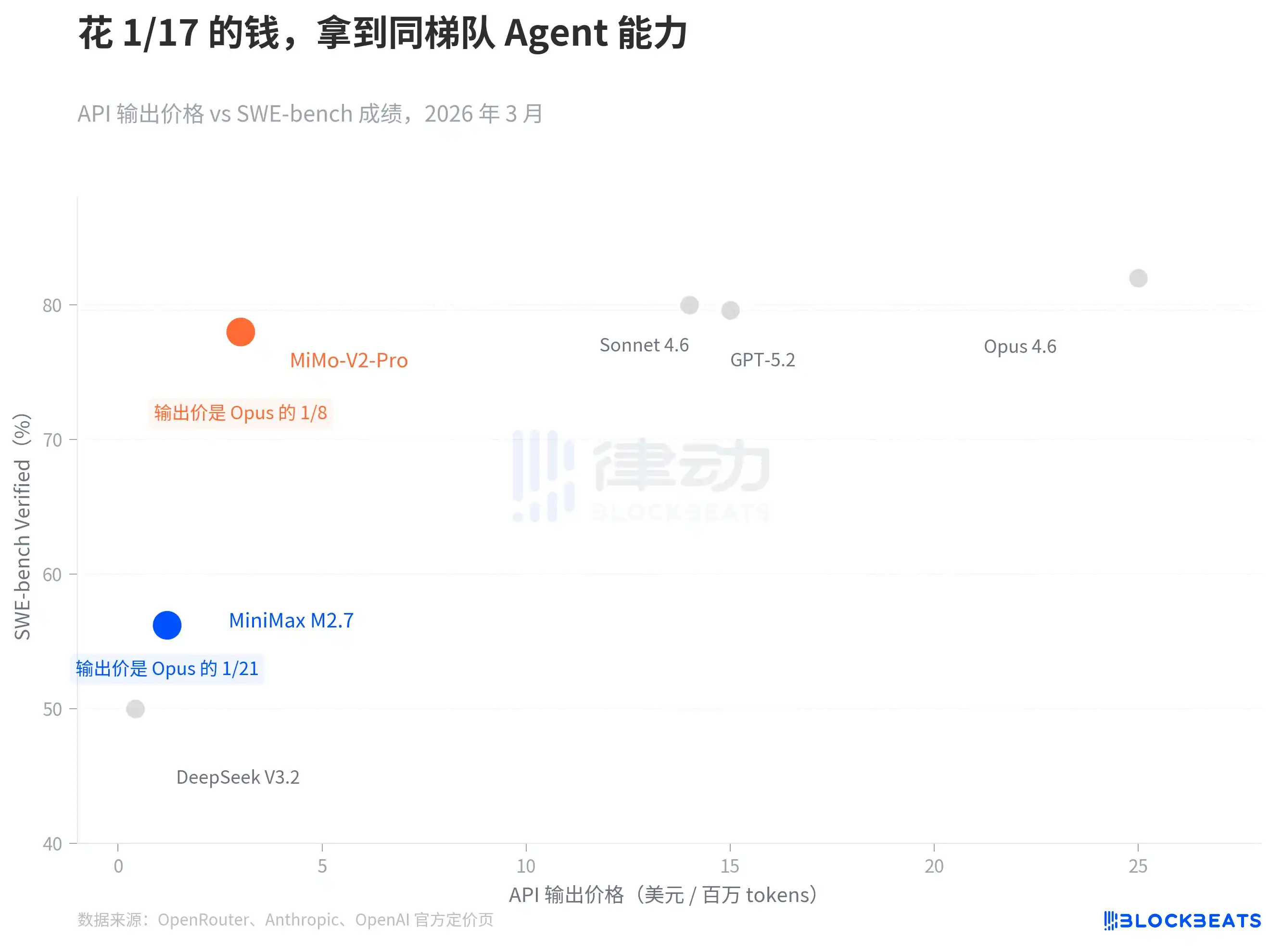
According to data from OpenRouter and the official pricing pages of various companies, based on API output price (per million tokens), MiniMax M2.7 is $1.2, and MiMo-V2-Pro is $3. As a reference, Claude Opus 4.6's output price is $25, GPT-5.2 is $14, and Claude Sonnet 4.6 is $15.

The price gap is by an order of magnitude, but the capability gap is not. On SWE-bench Verified (the current mainstream benchmark for measuring code engineering capabilities), MiMo-V2-Pro scored 78%, while Sonnet 4.6 scored 79.6%, a difference of less than two percentage points. M2.7's SWE-Pro score was 56.22%, on par with GPT-5.3-Codex. On VIBE-Pro (end-to-end project delivery capability), M2.7 scored 55.6%,接近 the level of Opus 4.6.

The key point of this chart is not who is higher or lower—the benchmark systems of various companies are not fully aligned, so direct comparisons should be made cautiously. The key point is that "price-performance剪刀差": domestic Agent models have already挤进 the same capability band but stand in completely different price ranges.

Trillion Parameters vs. Self-Evolution

Price is only the表象. The two companies have revealed two completely different底牌.

MiMo-V2-Pro follows the "more is better" route. According to Xiaomi's official announcement, V2-Pro has over 1 trillion total parameters, 42B activated parameters, and supports an ultra-long context of 1 million tokens. Its core innovation is the Hybrid Attention mechanism, adjusting the ratio of Sliding Window Attention (SWA) to Global Attention (GA) to 7:1—the previous generation V2-Flash was 5:1. This architecture makes the model more stable when handling long documents and multi-tool parallel calling Agent scenarios. On PinchBench (Agent tool calling capability evaluation), MiMo-V2-Pro scored 84%.

M2.7 takes a completely different path. According to the official technical blog released by MiniMax on March 18, M2.7's parameter count is not公开, but it demonstrates a "self-iterative evolution" mechanism: the model autonomously runs over 100 rounds of optimization cycles, including analyzing failure trajectories, planning modifications, modifying its own code architecture, running evaluations, and cycling again, ultimately achieving a 30% performance improvement on the internal evaluation set. On the MLE Bench Lite (machine learning competition difficulty evaluation) with 22 high-difficulty problems, M2.7 won 9 gold, 5 silver, and 1 bronze, with an average medal rate of 66.6%.
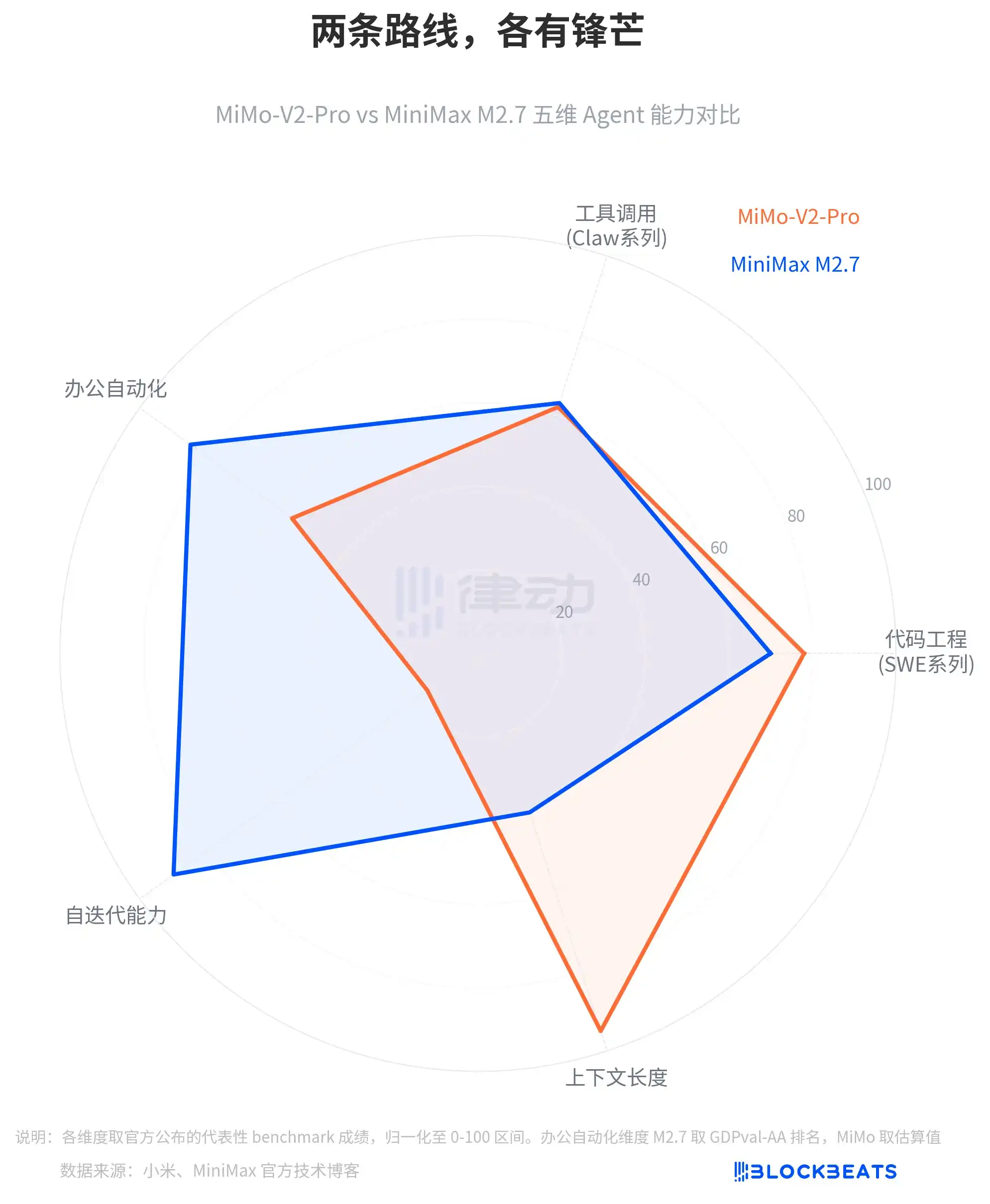
Looking from five dimensions, the锋芒 of the two routes朝向 completely different directions: MiMo-V2-Pro has obvious advantages in context length and code engineering dimensions, while M2.7 pulls ahead in office automation and self-iterative capabilities. According to the same MiniMax technical blog, M2.7 scored ELO 1495 on GDPval-AA (office document processing evaluation), ranking first among open-source models, and maintained a 97% skill adherence rate in the MM-Claw test covering over 40 complex skills.

Four Versions in Five Months

The two companies not only have different technical routes but also completely different iteration rhythms.

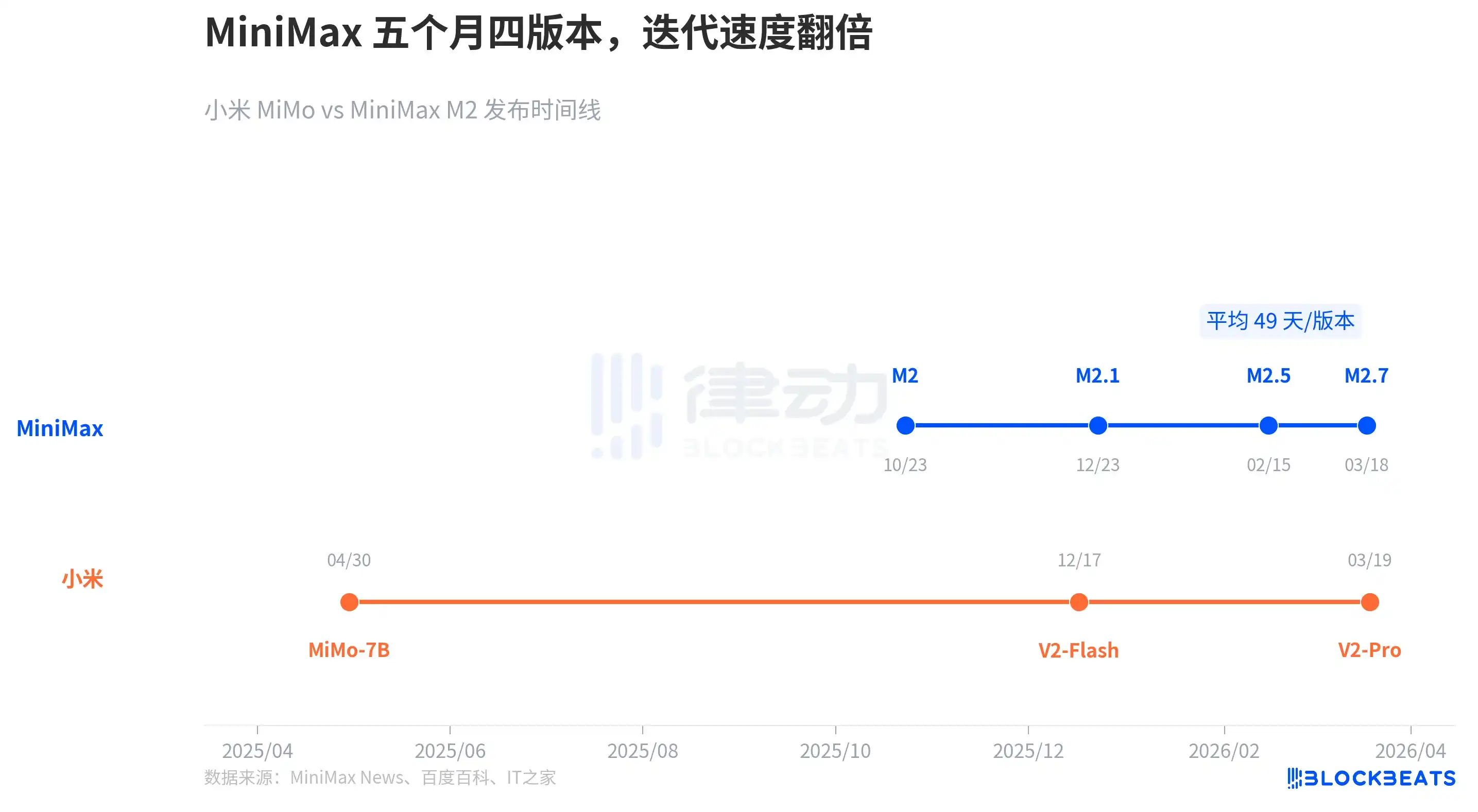
According to public release records, MiniMax iterated four major versions from the release of M2 in October 2025 to the release of M2.7 in March 2026—a new version every 49 days on average. The interval between M2.5 and M2.7 was only about 30 days.

Xiaomi MiMo's rhythm is different: MiMo-7B (a 7B parameter open-source inference model) was released in April 2025, V2-Flash (309B total parameters) in December 2025, and V2-Pro (1T total parameters) in March 2026. The parameter scale leap between each generation is larger, but the version intervals are also longer.

MiniMax chose small steps and quick runs, with small iteration amplitudes but extremely high frequency; M2.7's self-iterative mechanism is itself designed for "continuous evolution." Xiaomi chose蓄力一击, with each version representing a major leap in parameter scale and architecture.
Anonymous for 8 Days, Topping OpenRouter

Beyond the technical route, Xiaomi's release strategy also broke industry conventions.

According to a Reuters report, on March 11, an anonymous model named Hunter Alpha appeared on OpenRouter, the world's largest API aggregation platform. No brand endorsement, no launch event, no technical blog. Its API pricing was extremely low, yet its performance was surprisingly strong.

The community began speculating about its origin. According to Republic World and multiple tech media reports, the most mainstream guess was DeepSeek V4, as MiMo team leader Luo Fuli had previously conducted research at DeepSeek. Call volume surged rapidly, exceeding 1 trillion tokens during the anonymous period, topping the OpenRouter weekly chart.
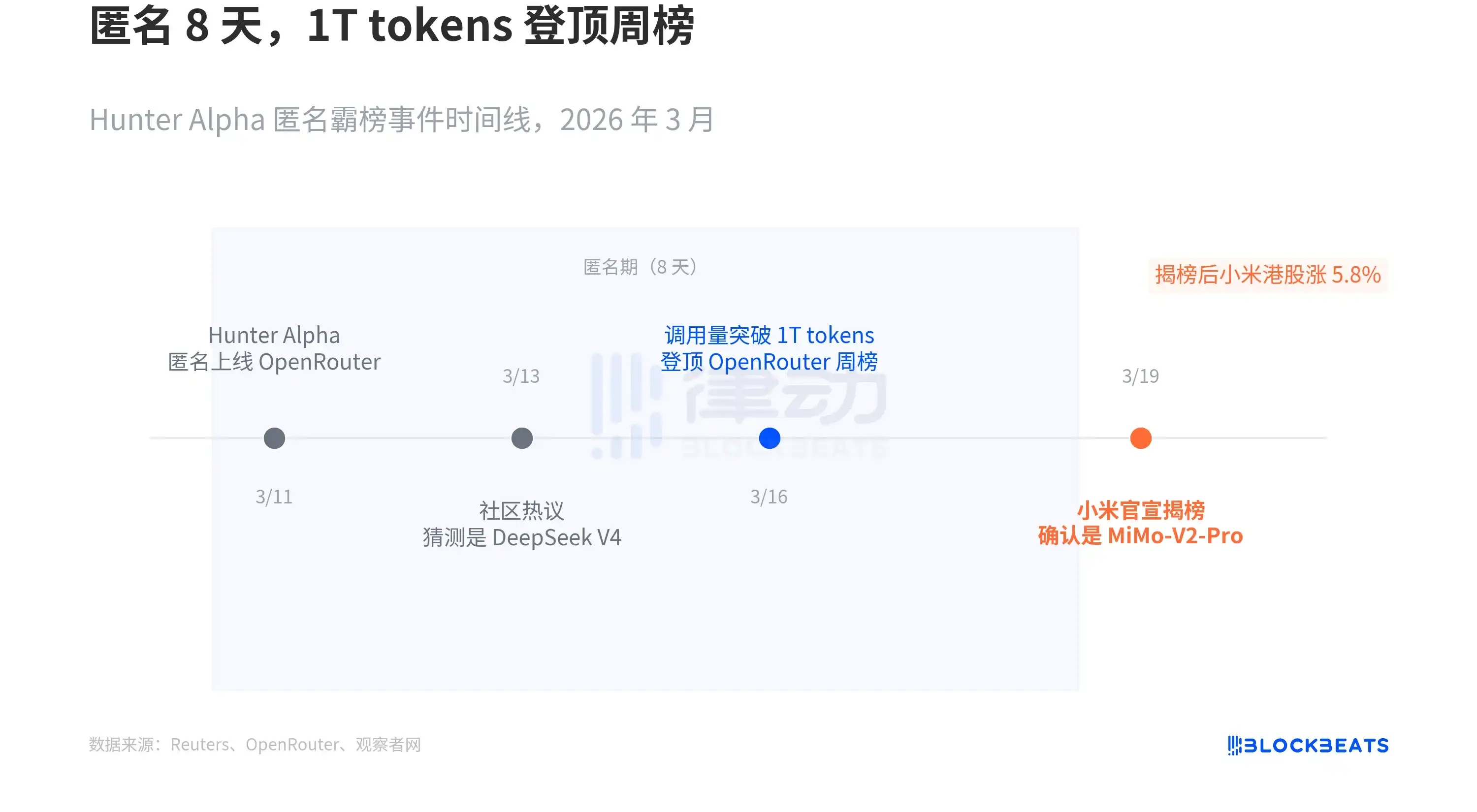
In the early hours of March 19, Xiaomi revealed the answer: Hunter Alpha was MiMo-V2-Pro. According to the same Reuters report, Xiaomi's Hong Kong stock saw a gain of up to 5.8% after the reveal.

This was the first time a domestic large model proved itself on a global platform through pure blind testing. Relying not on brand or宣传, but letting developers vote with their feet over 8 days.

Perguntas relacionadas

QWhat are the two Chinese companies that recently released their Agent-oriented large models, and what are the model names?

AMiniMax released the M2.7 model, and Xiaomi's MiMo team released the V2-Pro model.

QHow does the API output pricing of MiniMax M2.7 and MiMo-V2-Pro compare to Claude Opus 4.6?

AThe API output price for MiniMax M2.7 is $1.2 per million tokens, which is 1/21 of Claude Opus 4.6's $25. MiMo-V2-Pro is $3 per million tokens, which is 1/8 of Claude Opus 4.6's price.

QWhat are the core technical approaches of MiMo-V2-Pro and MiniMax M2.7?

AMiMo-V2-Pro follows a 'scale-up' approach with over 1 trillion total parameters and a Hybrid Attention mechanism. MiniMax M2.7 uses a 'self-iterative evolution' mechanism where the model autonomously runs optimization cycles to improve its own performance.

QWhat was unique about Xiaomi's release strategy for the MiMo-V2-Pro model?

AXiaomi first released the model anonymously on OpenRouter under the name 'Hunter Alpha' for 8 days. It gained significant developer traction and topped the OpenRouter weekly chart before Xiaomi revealed it was their model.

QHow did the iteration rhythms of MiniMax and Xiaomi's MiMo team differ?

AMiniMax iterated rapidly, releasing four versions in five months (approx. every 49 days). Xiaomi's MiMo team had longer release intervals with larger parameter scale jumps between versions, such as from 7B parameters to 309B, and then to 1T.

Leituras Relacionadas

An Open-Source AI Tool That No One Saw Predicted Kelp DAO's $292 Million Vulnerability 12 Days Ago

An open-source AI security tool flagged critical risks in Kelp DAO’s cross-chain architecture 12 days before a $292 million exploit on April 18, 2026—the largest DeFi incident of the year. The vulnerability was not in the smart contracts but in the configuration of LayerZero’s cross-chain bridge: a 1-of-1 Decentralized Verifier Network (DVN) setup allowed an attacker to forge cross-chain messages with a single compromised node. The tool, which performs AI-assisted architectural risk assessments using public data, identified several unremediated risks, including opaque DVN configuration, single-point-of-failure across 16 chains, unverified cross-chain governance controls, and similarities to historical bridge attacks like Ronin and Harmony. It also noted the absence of an insurance pool, which amplified losses as Aave and other protocols absorbed nearly $300M in bad debt. The attack unfolded over 46 minutes: the attacker minted 116,500 rsETH on Ethereum via a fraudulent message, used it as collateral to borrow WETH on lending platforms, and laundered funds through Tornado Cash. While an emergency pause prevented two subsequent attacks worth ~$200M, the damage was severe. The tool’s report, committed to GitHub on April 6, scored Kelp DAO a medium-risk 72/100—later acknowledged as too lenient. It failed to query on-chain DVN configurations or initiate private disclosure, highlighting gaps in current DeFi security approaches that focus on code audits but miss config-level and governance risks. The incident underscores the need for independent, AI-powered risk assessment tools that evaluate protocol architecture, not just code.

marsbitHá 1h

An Open-Source AI Tool That No One Saw Predicted Kelp DAO's $292 Million Vulnerability 12 Days Ago

marsbitHá 1h

Trading

Spot
Futuros

Artigos em Destaque

Como comprar WAR

Bem-vindo à HTX.com!Tornámos a compra de WeStarter (WAR) simples e conveniente.Segue o nosso guia passo a passo para iniciar a tua jornada no mundo das criptos.Passo 1: cria a tua conta HTXUtiliza o teu e-mail ou número de telefone para te inscreveres numa conta gratuita na HTX.Desfruta de um processo de inscrição sem complicações e desbloqueia todas as funcionalidades.Obter a minha contaPasso 2: vai para Comprar Cripto e escolhe o teu método de pagamentoCartão de crédito/débito: usa o teu visa ou mastercard para comprar WeStarter (WAR) instantaneamente.Saldo: usa os fundos da tua conta HTX para transacionar sem problemas.Terceiros: adicionamos métodos de pagamento populares, como Google Pay e Apple Pay, para aumentar a conveniência.P2P: transaciona diretamente com outros utilizadores na HTX.Mercado de balcão (OTC): oferecemos serviços personalizados e taxas de câmbio competitivas para os traders.Passo 3: armazena teu WeStarter (WAR)Depois de comprar o teu WeStarter (WAR), armazena-o na tua conta HTX.Alternativamente, podes enviá-lo para outro lugar através de transferência blockchain ou usá-lo para transacionar outras criptomoedas.Passo 4: transaciona WeStarter (WAR)Transaciona facilmente WeStarter (WAR) no mercado à vista da HTX.Acede simplesmente à tua conta, seleciona o teu par de trading, executa as tuas transações e monitoriza em tempo real.Oferecemos uma experiência de fácil utilização tanto para principiantes como para traders experientes.

118 Visualizações TotaisPublicado em {updateTime}Atualizado em 2025.02.23

Como comprar WAR

Discussões

Bem-vindo à Comunidade HTX. Aqui, pode manter-se informado sobre os mais recentes desenvolvimentos da plataforma e obter acesso a análises profissionais de mercado. As opiniões dos utilizadores sobre o preço de WAR (WAR) são apresentadas abaixo.

活动图片