L1 is Dead, Long Live Appchain

marsbitPublicado em 2026-04-20Última atualização em 2026-04-20

Resumo

"L1 is Dead, Appchain Rises" critiques the failure of current Layer-1 (L1) blockchain models, arguing their tokens are trending toward zero. The author identifies key flaws: linear token emissions that incentivize selling rather than value creation, weak value propositions like "gas token" and "governance" narratives, mismanagement by bloated "foundations" or "labs" that drain value through excessive spending and token sales, and poor industry leadership focused on short-term narratives and overhyped trends like RaaS and high TPS. The solution proposed is a fundamental shift. New L1 token models are needed, moving away from the "low float, high FDV" paradigm that disadvantages retail investors. Fundraising should be sufficient only for launch, not excessive. Token unlocks should be tied to real milestones like CEX listings or DeFi integration. The ultimate goal should be for L1 tokens to become widely used mediums of exchange, not just fuel for networks. Value is increasingly moving to the application layer, with successful apps building their own chains (appchains). The author concludes that L1s must build sustainable value by creating useful applications and services, fostering strong holder communities, and achieving self-sustainability without relying on continuous token emissions.

Author:iwillpat

Compiled by: Jiahuan, ChainCatcher

Since the era of "Rollup as a Service" (RaaS) began, the outcome was already predetermined. This is the precursor to the execution layer entering a death spiral and commoditization.

What I mean is, general-purpose L1 tokens will continue to trend towards zero, and likely no exceptions. I will try to explain why, and what I would do differently if I were an L1 operator.

The main drivers of L1 failure are as follows: linear token releases, failed value propositions, poor governance, and industry "leadership".

I will briefly elaborate on these points—these are just personal views, not definitive conclusions.

Linear staking releases in their current form have some benefits, namely distribution through liquid staking ("My 7% APY!"), but they fail in several key aspects.

Delegated Proof of Stake (DPoS) makes it easy for armchair "decentralization fundamentalists" to participate in network security, but it does not properly incentivize insiders, users, and developers. At best, it incentivizes people to hold tokens, doing nothing to create any real value.

The most classic argument I've heard about PoS is: large validators have an economic incentive not to dump on you. But that hasn't stopped them from selling every possible allocation and block reward.

This leads to my next point: they sell because L1 tokens have no long-term value proposition.

Tissue Paper Thin

The "gas token" and "governance" narratives are tired and unconvincing—like two-ply Bounty paper towels that disintegrate when wet. The value of a network token depends on what you can buy with it.

So the goal of all blockchain teams should be to push their token as a currency as widely as possible. In the pursuit of higher TPS and lower block times, the industry's vision of "peer-to-peer electronic cash" seems to have been lost.

Let's be brutally honest: throughput, TVL, and low latency give the token no value. Liquidity and usage rate do.

This next point is the most substantial and painful: blockchain "Labs". (And various foundations.)

Selling at unlock, large-discount OTC deals, eye-watering operational expenses, incentive programs to attract hot money, hiring "KOLs"... we can all name a few.

Ultimately, every dollar spent by Labs is a tax on token holders. Unless that Labs generates revenue through some service, first-party wallet, or application, it is surviving by selling tokens.

This in itself is not bad—they provide valuable services through engineering resources, explorers, and APIs. But if Labs does not bring net new buy pressure to the token, and expenses are climbing unsustainably, it is slowly bleeding to death.

One of the primary goals of Labs should be to build the network into a permissionless, self-sustaining system that passes the "hands-off test". Eventually, business development should be community-driven, and the network should have its own spiritual "CTO".

This doesn't require 400 employees; 30-40 excellent people are enough, plus those developing first-party apps and services.

Finally—after this I'll share my "solution"—cryptocurrency has been led astray by many large capital allocators and advisors.

Putting aside FTX, Celsius, and Luna, we have been force-fed by the industry's biggest players: short-term narratives, excessive leverage, "maximal extractable value", like stuffing a pathetic, bloated retail turkey.
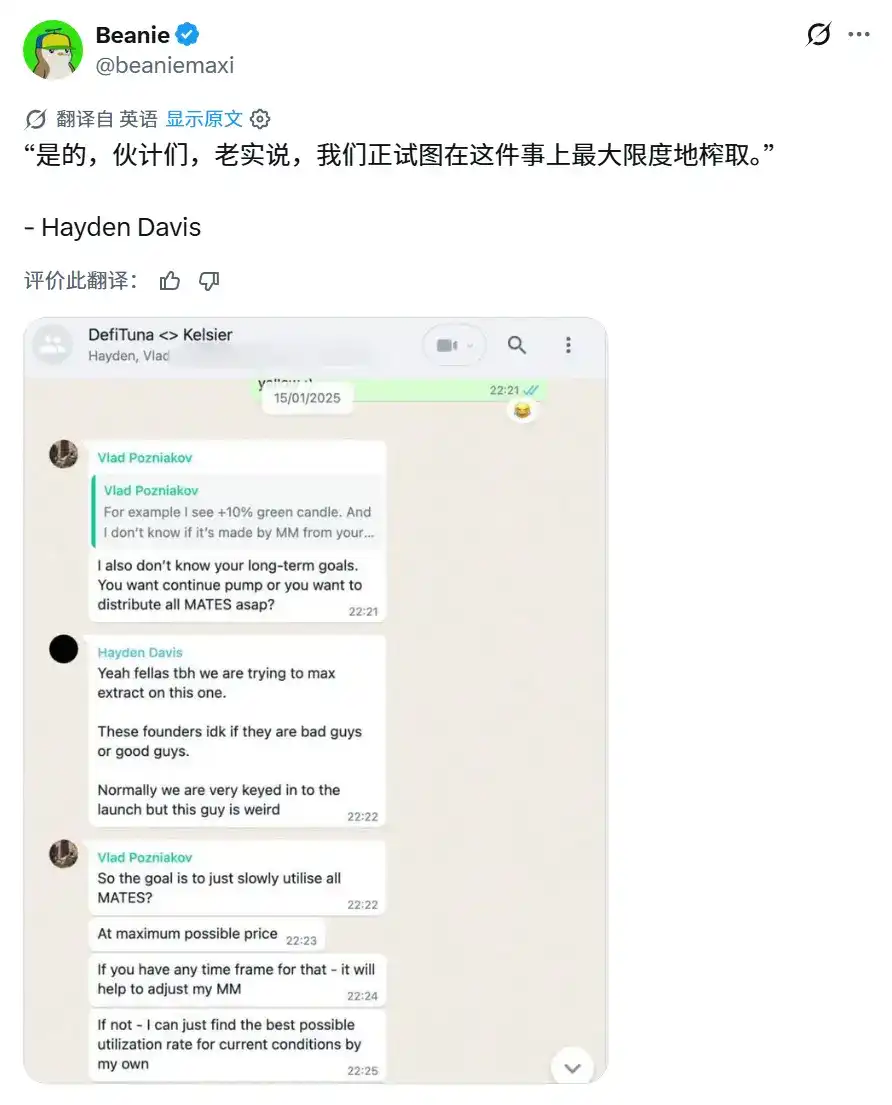
Promoting TPS over smart contract security, investing in the 10th general-purpose blockchain, raising funds at outrageous valuations, raising far more capital than needed, claiming security advantages that simply don't exist... these are all classic symptoms of severe crypto brain rot.

Placing bold bets on the direction of the industry is one thing—privacy coins, MoveVM, tokenized IP, decentralized social.

But burning money into another idiotic hype cycle or short-term cash grab is another matter entirely: RaaS, data availability, any L1 that tokens at a product with a multi-unicorn valuation before having a product, infrastructure solutions for crypto problems that don't exist or generate revenue...

(Full disclosure: I don't claim to be an investment genius, but I can do basic math. Buy pressure must exceed sell pressure.)

Where to Next?

Next, I will briefly talk about where the industry should go.

We need new L1 token models and a completely different way for crypto VCs to play. The current "low float, high FDV" paradigm works when valuations are lower and there is incremental capital flowing in.

But retail is no longer willing to pay for seed-round valuations that are 1000x at TGE, nor withstand the selling pressure from massive unlocks and insider staking rewards 12 months later.

L1s simply don't need hundreds of millions to launch a mainnet—unless I'm missing something. Raise enough to build the platform and go to market, then raise more later; everyone will be better off.

Token unlocks should be tied to milestones like CEX liquidity, payments, and DeFi lending, and on-chain governance should be given higher priority. Foundations should maintain at least some transparency regarding their balance sheets, expenses, and investments.

Retail doesn't want to pay for network security (i.e., validator rewards). Eventually, the network should be able to sustain itself without any staking rewards.

Maybe staking rewards shouldn't have existed from the start, and network or Labs revenue should go directly to validators. Then, see how hard validators would work.

Less and less value is flowing to the base layer, and we shouldn't be investing so much in their development. Gas fees on all chains are trending towards zero, successful applications are migrating to their own chains, and cross-chain bridging has never been easier.

So you can draw this conclusion: it's better to build an application (or appchain) first and then vertically integrate—Hyperliquid, Pump, etc. have done this.

I'm not saying to stop investing in general-purpose blockchains, but I do believe the core function of a network token should ultimately be a truly useful medium of exchange—permissionless L1s should be liquidity hubs for DeFi and testing grounds for new applications.

These are not new ideas. I think many L1 teams have realized: to survive, they need to build their own applications and services. The treadmill of foundations surviving by selling tokens is slowing down.

If you work in these teams on something that doesn't generate revenue, you might want to start thinking about what value you can create.

Interestingly, mass adoption by retail or institutions seems far less important than building a strong holder community and keeping them happy. When in doubt, ask the community.

Even if their advice is terrible, at least ask them who their favorite and least favorite person on your team is.

I hesitated for weeks about posting this. This is not a well-structured thought piece; it's more like a bunch of shower thoughts.

My point is: all L1s are making the same serious mistakes, differing only in luck and timing. The best-performing projects survive, usually due to stronger leadership and faster delivery, but the question of a sustainable value proposition remains unanswered.

We can continue down this long and painful path of value extraction, watching BTC maxis and sats stackers continue to outperform; or, we admit the problems with the current L1 model and start building for a slightly fairer outcome.

Perguntas relacionadas

QWhat are the main reasons the author believes that general L1 tokens will trend towards zero?

AThe author cites four main reasons: linear token releases, failed value propositions, poor governance, and flawed industry leadership that prioritizes short-term gains over sustainable development.

QAccording to the author, why do large validators in Proof-of-Stake systems continue to sell their tokens despite economic incentives not to?

AThey sell because L1 tokens lack a long-term value proposition; the 'gas token' and 'governance' narratives are weak, and token value ultimately depends on what it can be used to purchase.

QWhat criticism does the author level against blockchain 'Labs' and Foundations?

AThe author criticizes them for acting as a tax on token holders by selling tokens to fund high operational expenses, over-hiring, and unsustainable spending without generating net new buy pressure for the token.

QWhat does the author propose as a better model for launching and funding L1s?

AThe author suggests that L1s do not need hundreds of millions to launch, token unlocks should be tied to milestones like CEX listings and DeFi adoption, and governance should be more community-driven with greater transparency from foundations.

QWhat is the author's view on the future direction of the industry, and what does 'Appchain' represent in the title?

AThe author believes value is moving away from base layers (L1s) and that the future lies in application-specific blockchains (Appchains), where successful applications migrate to their own chains, enabling vertical integration and a more sustainable model.

Leituras Relacionadas

Anthropic Cries Wolf: Is the AGI Threat Real, or Just an IPO Story?

Anthropic has published an article titled "When AI builds itself," discussing the emerging concept of "recursive self-improvement," where AI begins to actively participate in designing, training, testing, and optimizing its own subsequent versions. The company presents internal data showing that by May 2026, over 80% of code merged into its codebase was written by Claude, its AI model. Claude's capabilities have expanded to handling complex, open-ended engineering tasks, achieving a 76% success rate in such areas, and even contributing to research processes, such as optimizing code performance and conducting AI safety experiments. Anthropic outlines an evolution from human-driven development to AI-assisted workflows, culminating in the current stage where AI agents can autonomously write, run, and delegate code. The company cautions that the path toward a "closed loop," where AI continuously improves itself, is becoming visible. It calls for coordinated global mechanisms to potentially slow or pause frontier AI development to allow safety research and societal structures to catch up. However, the timing of this warning coincides with Anthropic's preparations for an IPO, framing the narrative not just as a safety concern but also as a demonstration of Claude's advanced capabilities and its integral role in accelerating Anthropic's own R&D—creating a potential "flywheel" effect for competitive advantage. This contrasts with OpenAI's recent, more policy-oriented discussion of the same risks, highlighting the competitive dynamics in the AI industry as companies position themselves in both the technological and regulatory landscape.

marsbitHá 34m

Anthropic Cries Wolf: Is the AGI Threat Real, or Just an IPO Story?

marsbitHá 34m

BIT Research: ETF Purchases Have Slowed, Strategy (MicroStrategy) Has Slowed, What Else Can Drive Bitcoin's Rise?

Market Refocus on Inflation and Rate Expectations Weighs on Bitcoin Currently, the market is in a phase of macro-repricing dominated by inflation and interest rate expectations. Bitcoin, which previously benefited from easy liquidity and low inflation, is seeing its core bullish drivers weaken. These drivers were market expectations for interest rate cuts and strong inflows from Bitcoin ETFs and institutions like MicroStrategy (referred to as "Strategy" in the text). The logic has shifted. Recent high inflation data (e.g., CPI hitting 3.8% in a May 2026 report) has caused the market to sharply reduce its rate cut expectations for 2025 and even price in potential hikes. This is a key constraint for Bitcoin, as it lacks cash flows and is highly sensitive to rate expectations. Concurrently, institutional capital flows have slowed significantly. Following the hot CPI data, Bitcoin ETFs saw accelerated outflows, with around $4.3 billion leaving over a period. MicroStrategy's ability to keep adding substantial Bitcoin to its balance sheet is also diminishing. Together, ETF and MicroStrategy holdings total roughly $110 billion, but their momentum as growth engines is cooling. In summary, Bitcoin's current pressure stems not from its own fundamentals but from a changing macro environment. As long as inflation stays elevated, Bitcoin is likely to remain in a consolidating phase. However, historically, inflation eventually peaks. Once it recedes and rate cut expectations rebuild, institutional capital could return, potentially fueling a new and more robust recovery phase for Bitcoin.

marsbitHá 42m

BIT Research: ETF Purchases Have Slowed, Strategy (MicroStrategy) Has Slowed, What Else Can Drive Bitcoin's Rise?

marsbitHá 42m

Earning 1000 Trillion in Half a Year, 'Pocketing' 20 Million per Capita: This Round of Wealth Creation in the Korean Stock Market is Unprecedented in Scale

The South Korean stock market is experiencing an unprecedented wealth surge in 2026, with household equity and fund asset values soaring by over 1,000 trillion KRW (~$730bn) year-to-date. This translates to an average per capita wealth increase of roughly 20 million KRW, fueled by a historic 109% rally in the KOSPI index. The boom is driven by three converging forces: an AI-driven semiconductor supercycle boosting giants like Samsung and SK Hynix; the government's "Value-Up" market reforms addressing long-standing corporate governance issues; and aggressive real estate regulations that have locked capital within financial markets, preventing profits from flowing back into property. This has triggered a wealth effect, boosting high-end consumption significantly. However, the gains are highly concentrated. The two semiconductor behemoths account for over half the index's value, but retail investors own relatively low stakes in them, systematically missing the biggest rallies. Wealth and consumption benefits are skewed towards luxury goods and imported cars, bypassing mainstream retail. Further risks stem from excessive leverage, with high trading volume in leveraged ETFs, and a market sentiment heavily reliant on the AI sector's fortunes and speculative rumors. While this cycle marks a potential shift from real estate to equities as a primary wealth generator for Koreans, its sustainability, amid structural imbalances and leverage, remains a critical test.

marsbitHá 47m

Earning 1000 Trillion in Half a Year, 'Pocketing' 20 Million per Capita: This Round of Wealth Creation in the Korean Stock Market is Unprecedented in Scale

marsbitHá 47m

Trading

Spot
Futuros

Artigos em Destaque

Como comprar ERA

Bem-vindo à HTX.com!Tornámos a compra de Caldera (ERA) simples e conveniente.Segue o nosso guia passo a passo para iniciar a tua jornada no mundo das criptos.Passo 1: cria a tua conta HTXUtiliza o teu e-mail ou número de telefone para te inscreveres numa conta gratuita na HTX.Desfruta de um processo de inscrição sem complicações e desbloqueia todas as funcionalidades.Obter a minha contaPasso 2: vai para Comprar Cripto e escolhe o teu método de pagamentoCartão de crédito/débito: usa o teu visa ou mastercard para comprar Caldera (ERA) instantaneamente.Saldo: usa os fundos da tua conta HTX para transacionar sem problemas.Terceiros: adicionamos métodos de pagamento populares, como Google Pay e Apple Pay, para aumentar a conveniência.P2P: transaciona diretamente com outros utilizadores na HTX.Mercado de balcão (OTC): oferecemos serviços personalizados e taxas de câmbio competitivas para os traders.Passo 3: armazena teu Caldera (ERA)Depois de comprar o teu Caldera (ERA), armazena-o na tua conta HTX.Alternativamente, podes enviá-lo para outro lugar através de transferência blockchain ou usá-lo para transacionar outras criptomoedas.Passo 4: transaciona Caldera (ERA)Transaciona facilmente Caldera (ERA) no mercado à vista da HTX.Acede simplesmente à tua conta, seleciona o teu par de trading, executa as tuas transações e monitoriza em tempo real.Oferecemos uma experiência de fácil utilização tanto para principiantes como para traders experientes.

472 Visualizações TotaisPublicado em {updateTime}Atualizado em 2026.06.02

Como comprar ERA

Discussões

Bem-vindo à Comunidade HTX. Aqui, pode manter-se informado sobre os mais recentes desenvolvimentos da plataforma e obter acesso a análises profissionais de mercado. As opiniões dos utilizadores sobre o preço de ERA (ERA) são apresentadas abaixo.

活动图片