xAI's Trump Card: Why Grok 5 Could Become the Strongest Model in 2026?

marsbitPublicado em 2026-01-19Última atualização em 2026-01-19

Resumo

xAI's Grok 5, a 7-trillion-parameter model set for release in 2026, is positioned to become the most powerful AI model due to four key advantages. First, xAI has a massive compute advantage, with plans to deploy 1 million GPUs across multiple data centers, including custom power solutions like airlifted gas turbines and Tesla Megapacks to bypass grid limitations. Second, it leverages real-time data from X (Twitter), processing over 100 million posts daily for training, enabling superior cultural and trend awareness. Third, X’s distribution network—700 million DAU and 6 billion MAU—provides a built-in user base and integration potential for an "everything app." Finally, xAI benefits from physical AI integration through Tesla’s autonomous vehicles and Optimus robots, which supply real-world data and act as deployment platforms. Despite risks like Musk’s controversies, execution challenges, and potential shifts in scaling laws, xAI’s ecosystem strategy may secure its lead.

Author: Ejaaz

Compiled by: Deep Tide TechFlow

Deep Tide Guide: This article is a direct counterattack against recent pessimistic voices about xAI. The author systematically argues, from four dimensions—computing power, data, distribution channels, and physical AI—why xAI might surpass all competitors by 2026.

The core point is straightforward: While others are still discussing model architecture, Musk is already building his own power grid, airlifting gas turbines, and feeding data with Tesla robots. This is an analysis with a clear stance, worth reading.

Main text follows:

Lately, I've seen too much criticism of xAI. This article aims to set the record straight.

I will systematically break down a judgment: the upcoming Grok 5 from xAI isn't just about catching up with competitors; it's about directly surpassing them.

Don't forget, we're talking about a company that's only two years old. Yet, they built the world's largest supercomputer in 122 days (normally taking four years), achieved 600 million monthly active users, and possess something no other AI lab has—a physical carrier (yes, autonomous robots).

Enough talk, let's get straight to the point.

Musk is Building His Own Power Grid

Entering 2026, xAI's advantage in computing power is overwhelmingly dominant. Their current real-time computing power (approximately 500,000 GPUs) is greater than that of Anthropic and Meta combined.

And it doesn't stop there. Including Colossus I and II, they plan to deploy 900,000 GPUs by the second quarter of 2026. With the recently announced Colossus III (yes, another new data center already under construction) operational, it is expected to reach 1 million GPUs, with a total investment of $35 billion.

How can others catch up with this scale?

But the issue isn't just how much money was spent or how much hardware was stacked; it's how they did it. Look at this tweet:
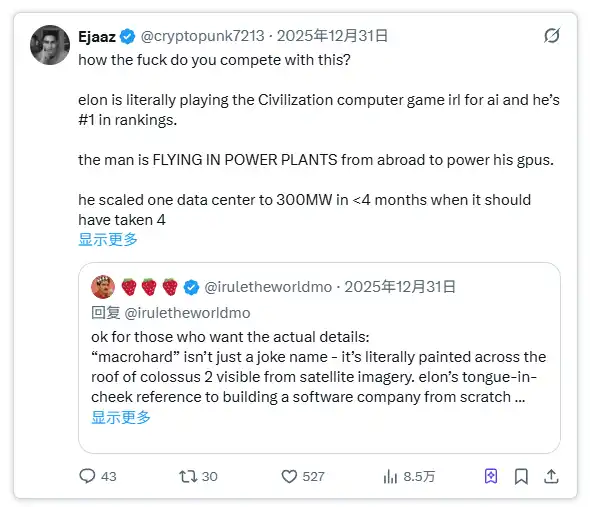
Elon directly airlifted gas turbines to power the data centers because the grids in Tennessee and Memphis simply couldn't handle it. These turbines alone can support an additional 600,000 GPUs.

He chose to completely bypass the entire state's power grid (conventional expansion would take years) just to speed up model training. In addition, he deployed about 250MW of Tesla Megapack energy storage batteries to handle situations where the grid can't supply enough during peak usage.

This forward-thinking combined with extremely fast execution is giving xAI a huge computing power advantage over competitors.

You have to understand, the regulatory approvals, talent recruitment, and operational logistics involved in this have never been done on this scale before. xAI not only did it but made it look easy.

If the hypothesis that "more computing power = stronger model" holds true (and it currently seems to), then the rumored 7 trillion parameter Grok 5 will be a monster upon release. For comparison: Grok 4 has 3 trillion parameters—this is more than double.
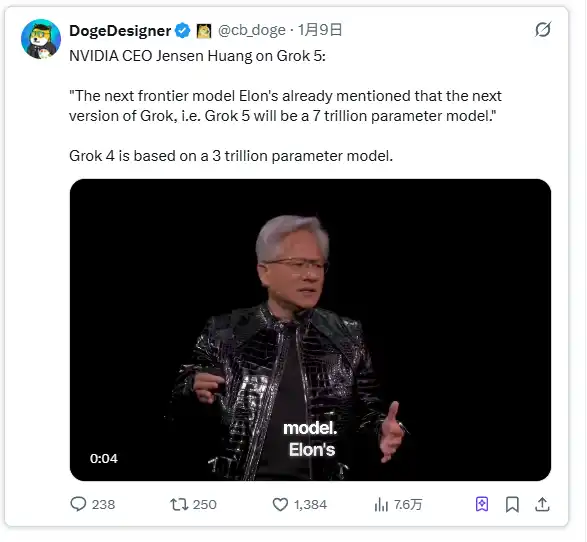
NVIDIA CEO Jensen Huang on Grok 5:

"Elon has mentioned that the next frontier model, the next version of Grok, namely Grok 5, will be a 7 trillion parameter model."

The infrastructure race is no longer in doubt.

There is no infrastructure expansion war right now because xAI has already won. Their strategy is "build first, talk later." Unless other labs catch up, xAI's models will remain ahead.

X's "X-Factor": Unlocking Personal AI

xAI has stronger computing power than anyone, but top-tier models also require massive amounts of data.

And not just any data. AI labs are increasingly realizing that real-time data is the key to unlocking personalized AI—an AI that deeply understands your desires and goals and helps you execute them before you even think of it.

Google's latest "Personal Intelligence" product is the clearest signal that models are ultimately heading in this direction. But xAI has a unique advantage here that Google doesn't:

A social media platform that feeds them over 100 million posts daily.

This means over 100 million pieces of text, images, and videos can be used to train Grok, enabling:

  • Real-time trends and breaking news
  • Large-scale understanding of virality, trends, and human behavior
  • Real-time sensing of the global cultural zeitgeist

Other models can only tell you what's happening; Grok can simultaneously tell you what's happening and how people feel about it—and faster than anyone else.

This capability is valuable.

If we assume the value users get from a tailored AI model is 10 times that of a general-purpose large model, then X's moat is very difficult to breach.

It's not just the data; X's distribution capability is also insane:

  • 70 million daily active users
  • 600 million monthly active users
  • An "Ask Grok" button next to every post

It's not hard to imagine xAI integrating real-time prediction markets, shopping, banking, dating, and more into the same App in the future, all powered by Grok.

Currently, most model lab valuations are based on GPU count, intelligence benchmarks, and reputation. xAI has all of these, plus the opportunity to penetrate multiple internet monopoly areas—don't forget their goal is to become an "Everything App."

Today, X's recommendation algorithm is powered by Grok, which analyzes every post to make recommendations. Tomorrow, it will provide personal intelligence services for each user.

Grok is clearly not just a standard large language model; its valuation should reflect that.

Physical AI Advantage: xAI is the Most Forward-Looking Lab

It's no secret that robots will have a huge impact on the world in the next five years. The technology has finally matured.

From factory manual labor to "last-mile" delivery, from fast-food chains to top surgeons, all will be assisted or entirely replaced by robots.

The viral videos from Boston Dynamics over a decade ago have now snowballed into autonomous vehicle fleets and (surprisingly impressively) humanoid robots. Honestly, when it comes to these two things, only one company comes to mind: Tesla.

A car that drives better than a human is no longer a fantasy. The latest v14.2.2.3 update is technically already a better driver than you. Once regulations pass, you'll see autonomous Teslas transporting people everywhere.

Similarly, a humanoid robot that can carry your shopping bags and carefully wipe your mother's fine china is becoming a reality. Optimus will begin mass shipments into homes and factories by the end of this year.

What does this have to do with xAI?

Two things:

  1. Machines need a brain to drive them, and Tesla uses Grok.
  2. Grok needs diverse data sources to understand the world around it, and this data comes from Tesla's robots.

This symbiotic relationship gives xAI an almost unfair advantage over competitors. I think Google is the only company that can compete at this level, but they are still behind.

Today, Grok is already powering Tesla vehicles—the latest update lets you to simply tell Grok to drive you somewhere while playing music and telling you about Roman history.

Similarly, Grok is now receiving video data from Tesla cameras, distance data from Tesla sensors, etc., helping it understand real-world physics, visual perception, and navigation.

All this data now helps it become stronger in other capabilities, such as generating more physically accurate video content.

You have to admit Musk is playing 5D chess. He's not just building a large language model; he's building the entire ecosystem for AI to live and operate in.

Writing this, I admit it all sounds fantastic, but also incredibly ambitious......which leads to the final part of the article:

Yes, There Are Risks Here

There are risks in everything. Maybe managing 5 companies is Elon's limit, and 6 is too many......but I doubt it. If there's anyone in this world who has repeatedly proven able to prove doubters wrong time and again, it's him.

Call me crazy, I don't care—what he has already achieved is itself extremely improbable.

I think there are three key risks:

The King of Controversy — Elon and headlines are old friends. He is currently involved in a $130 billion lawsuit with OpenAI and is under investigation by EU and Indian regulators. Who knows, this guy might do something outrageous that messes up the entire vision.

Execution Risk — xAI burns about $1 billion per month; that's a huge bill. And Elon alone manages 5 companies (not including Starlink).

Scaling Laws — xAI is betting everything on "more computing power = stronger model," but if a new, better training architecture is discovered, this hypothesis could be overturned. Andrej Karpathy has stated multiple times that he doesn't believe large language models are the final form.

That's it! I think people have been unfairly critical of xAI's efforts to push the frontiers of intelligence lately and seem to forget they are still a force to be reckoned with.

I hope this article changes your perspective. Thanks for reading.

Perguntas relacionadas

QWhat are the key advantages that xAI has over its competitors according to the article?

AThe article highlights four key advantages: massive computing power (with plans for 1 million GPUs by 2026), access to a vast, real-time data stream from the X platform, a powerful distribution channel with 600M monthly active users, and a unique 'physical AI' advantage through integration with Tesla's autonomous driving and Optimus robotics.

QHow is Elon Musk ensuring sufficient power for xAI's massive data centers?

AHe is bypassing the local power grid by airlifting gas turbine generators to power the data centers directly. He is also deploying Tesla Megapack battery storage systems to handle peak demand, allowing for a rapid expansion that the conventional grid could not support.

QWhat is the significance of the X platform's data for training Grok?

AThe X platform provides Grok with over 100 million posts daily, offering a massive, real-time dataset. This allows Grok to understand current trends, breaking news, viral content, and human behavior on a global scale, giving it a significant edge in personalization and cultural awareness over models trained on static datasets.

QWhat is the 'physical AI' advantage that xAI possesses?

AxAI's 'physical AI' advantage comes from its symbiotic relationship with Tesla. Grok is the AI brain for Tesla's autonomous vehicles and Optimus robots. In return, these physical systems provide Grok with vast amounts of real-world data on visual perception, navigation, and physics, which helps improve its overall capabilities.

QWhat are the main risks to xAI's ambitious plans as mentioned in the article?

AThe article identifies three main risks: 1) Reputational and regulatory risk due to Elon Musk's controversies and ongoing legal battles. 2) Execution risk from managing multiple companies and a high monthly burn rate of ~$1 billion. 3) The risk that the 'scaling laws' (more compute = better model) assumption could be invalidated by a breakthrough in a new, more efficient AI architecture.

Leituras Relacionadas

Annual Salary of Millions Competing for Electricians, Meta Rushes to Open Its Own Technical School

The AI boom is facing an unexpected bottleneck: a severe shortage of skilled construction workers and electricians. As tech giants like Meta, OpenAI, and Alphabet race to build massive data centers—such as OpenAI's $16 billion "Stargate" project—they are hitting a critical labor wall. The U.S. needs an estimated 130,000 more electricians, 240,000 construction workers, and 150,000 supervisors by 2030 for AI infrastructure alone, but tens of thousands of electrician jobs go unfilled each year. While AI companies offer high premiums, with electricians earning up to $280,000 annually, worker scarcity still causes massive losses—delays on a single project can cost $14.2 million per month. The complexity of building AI data centers, which require immense power (equivalent to powering hundreds of thousands of homes), sophisticated electrical systems, and advanced liquid cooling solutions, demands highly skilled technicians who are in short supply. To combat this, companies are investing heavily in training. Meta has committed $115 million to a free training school offering tuition, housing, and stipends, targeting 5,000 new workers. OpenAI is partnering with unions to secure skilled labor. These efforts are paying off, with a significant rise in Gen Z interest in trade schools over college. However, the power demands are staggering. AI data centers are driving a rapid surge in electricity consumption, projected to account for up to 12% of U.S. power use by 2028 and raising costs for consumers. Furthermore, the construction boom is project-based, leading to a potential future glut of trained workers once building peaks, which could depress wages industry-wide. The race for AI supremacy now depends as much on skilled hands as on advanced chips.

marsbitHá 8m

Annual Salary of Millions Competing for Electricians, Meta Rushes to Open Its Own Technical School

marsbitHá 8m

OpenAI No Longer Sells Its Most Expensive Model for Profit

OpenAI is shifting its business strategy away from promoting its most expensive, flagship models for every task. Recent price cuts—80% for GPT-5.6 Luna and 20% for Terra—signal a deeper change: the company now actively advises users that many tasks don't require the most powerful model. Instead, OpenAI recommends a tiered approach: use the high-end GPT-5.6 Sol for complex planning and analysis, then delegate execution to cheaper models like Luna. This mirrors moves by Anthropic, which recently launched Claude Opus 5 at half the price of its top model, Fable 5. Both companies are de-emphasizing flagship models as primary revenue drivers, using them instead for brand prestige and technological showcases. The industry is entering a "mass-market" phase, similar to automotive, where high-volume, cost-effective models handle daily operations and drive scale. OpenAI's price reductions are partly enabled by AI models themselves optimizing underlying code and infrastructure, creating a self-reinforcing cycle of efficiency gains and cost reduction. Competition is shifting from "who is smartest" to "who offers the best value." The goal is no longer selling individual models but fostering widespread API adoption and ecosystem lock-in. By making AI calls cheap and ubiquitous, companies like OpenAI aim to become the indispensable, utility-like infrastructure powering automated workflows—the "water and electricity" of software, quietly embedded everywhere.

marsbitHá 8m

OpenAI No Longer Sells Its Most Expensive Model for Profit

marsbitHá 8m

Will the Fed Definitely Raise Interest Rates in September? How Will Crypto and U.S. Stocks Withstand the Pressure?

The market's expectation for a September Fed rate hike surged dramatically in early August, jumping from under 50% to over 80% within a week. This shift followed a contentious July FOMC meeting, where a 9-3 vote to hold rates revealed growing dissent from hawkish members advocating for an immediate hike to combat persistent inflation. The primary catalyst for this repricing is rising oil prices, driven by renewed geopolitical tensions around the Strait of Hormuz, which threaten global supply. Energy costs directly influence inflation metrics, making the upcoming July CPI report (due August 12th) a critical data point. If it shows inflation reaccelerating, the probability of a September hike will solidify. For Bitcoin and crypto assets, this is typically bearish news. Bitcoin continues to behave as a high-beta, liquidity-sensitive risk asset. A rate hike raises the opportunity cost of holding non-yielding assets and could drive capital toward money markets, pressuring crypto prices in the short term. However, historical patterns suggest that if a hike is perceived as the end of a tightening cycle rather than the start, any negative price impact may be brief. U.S. stocks, particularly crypto-linked equities like Coinbase and growth-oriented tech stocks, are also vulnerable. Higher rates increase discount rates in valuation models, putting pressure on high-multiple companies. This coincides with a pivotal tech earnings season where investor focus has shifted from massive AI capital expenditure to tangible revenue and cash flow generation. Companies with negative cash flow and weak growth narratives could face heightened volatility if borrowing costs rise in September. In summary, a September Fed hike has evolved into a mainstream market scenario. Key factors to watch are oil prices, the July CPI report, and Fed communications, which will determine the final decision and its impact on volatile crypto and equity markets.

marsbitHá 19m

Will the Fed Definitely Raise Interest Rates in September? How Will Crypto and U.S. Stocks Withstand the Pressure?

marsbitHá 19m

Trading

Spot
活动图片





