Wisdom Tree + Glassnode: Reframing Blockchains as Economic Systems

insights.glassnodePublicado em 2026-03-17Última atualização em 2026-03-17

Resumo

The digital asset ecosystem is increasingly viewed as an emerging financial system with its own infrastructure and economic structure. This report, a collaboration between Wisdom Tree and Glassnode, reframes blockchain networks as multi-layered economic systems that mirror traditional markets in function and incentives. Key insights include the use of transaction fees as a direct measure of blockchain health, the economic models of security (energy-backed for Bitcoin, capital-backed for Ethereum), and the industrialization of mining. Systemically important crypto exchanges and custodians now link on-chain activity to traditional capital markets, facilitating institutional adoption. Stablecoins serve as the core settlement and liquidity layer, while DeFi and tokenization extend financial functions on-chain with growing integration into traditional finance. The full analysis provides a data-driven framework for evaluating digital assets beyond price, using observable on-chain metrics and macroeconomic benchmarks.

The digital asset ecosystem is increasingly being evaluated not as a collection of speculative assets, but as an emerging financial system with its own infrastructure, economic inputs, and market structure.

In our joint analysis with Wisdom Tree, we reframe blockchain networks and digital assets as a multi-layered economic system that increasingly mirrors traditional markets in structure, incentives, and economic function.

For financial professionals, this framing demonstrates how digital assets can be analyzed through observable data and compared against traditional macroeconomic benchmarks, offering a more robust foundation for valuation and risk assessment than a price-centric analysis alone.

Key Takeaways

  • Transaction fees provide a direct, price-independent measure of a blockchain's growth, health and maturity. The transparency of blockchain data allows analysts to quantify economic activity with a level of fidelity that is difficult to achieve in other financial systems.
  • In blockchain systems, transaction security and settlement finality are enforced through economic incentives built into the protocol. Bitcoin represents an energy-backed security model, while Ethereum is an example of a capital-backed security model.
  • Mining has evolved into an industrialized commodity business: Cost structures, margin dispersion, and consolidation dynamics increasingly resemble traditional energy and extractive industries.
  • Crypto exchanges and custodians have become systemically relevant: they function as the primary financial gateways, linking on-chain activity to traditional capital markets, and driving the transition from retail-dominated ownership to institutional participation through regulated channels.
  • Stablecoins underpin settlement and liquidity across the ecosystem. Acting as the primary unit of account, stablecoins enable real-time clearing and continuous capital mobility across global markets.
  • DeFi and tokenization extend financial functionality on-chain. Trading, lending, and capital deployment are increasingly executed via rules-based systems, with growing integration into traditional finance.

The full report is freely available for download in PDF format.

Download report PDF

Quantifying Network Demand

At the foundation of the blockchain economy is blockspace, a scarce digital resource consumed by every transaction, smart contract execution, and settlement event, and priced dynamically through transaction fees.

Transaction fees, in this context, are not incidental costs but market-based pricing for network usage, offering a direct lens into network demand. Unlike traditional economic data, this activity is observable in near real time, enabling a high-fidelity view of system utilization.

While fee levels remain cyclical and sensitive to market conditions, the longer-term trend in the data points toward sustained growth in infrastructure-level demand. This dynamic positions blockspace as a core economic primitive for evaluating the ecosystem.

Security as an Economic Input

Blockchain networks replace institutional trust with explicitly funded security models, where participants are economically incentivized to validate transactions and maintain system integrity.

In Bitcoin’s Proof-of-Work model, this relationship is observable through hashrate, or the total computational power securing the network, which reflects the aggregate energy and capital deployed to maintain transaction finality. As the economic value of the network grows, so too does the incentive to invest in this security layer.

In practice, this has given rise to increasingly industrialised operations (most notably in Bitcoin mining), where cost efficiency, scale, and capital access shape competitive positioning.
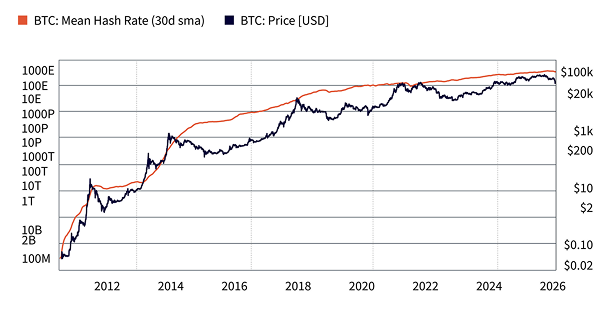
Bitcoin Hashrate vs. BTC Price

Financial Gateways and Institutional Integration

If blockchain networks form the economic substrate, then exchanges and custodians operate as the primary and systemically important financial gateways to traditional capital markets.

As infrastructure has matured, so too has the investor base. Ownership is increasingly shifting toward institutional and regulated capital, marking a transition from early adopters toward participants operating within formal mandates, governance frameworks, and risk constraints.
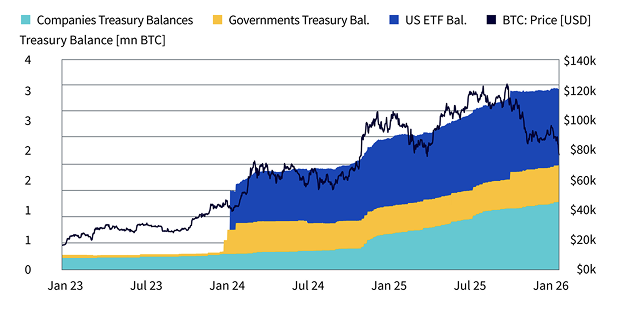
Institutional & Corporate Ownership of Bitcoin (Time Series)

The System’s Monetary Layer

Stablecoins have emerged as the core liquidity and settlement instrument within the blockchain economy. Functionally, they operate as the primary unit of account, medium of exchange, and collateral asset across both centralized and decentralized venues. Their ability to enable instant, final settlement makes them a growing rail for cross-border value transfer.

Growth in stablecoin supply reflects a broader structural shift: capital migrating from traditional banking infrastructure onto blockchain rails to support trading, settlement, and financial activity.
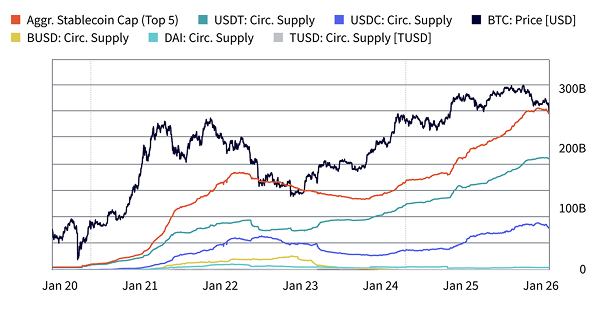
Stablecoin Supply Over Time

Extending Markets Beyond Traditional Rails

DeFi today represents an alternative financial system, where trading, lending, and capital deployment are executed through rules-based protocols rather than intermediaries.

This architecture enables continuous, transparent market activity, with mechanisms such as automated market making and on-chain credit replacing traditional structures.

At the same time, tokenization is extending this system outward: bringing traditional financial assets on-chain and deepening the integration between blockchain infrastructure and global capital markets.
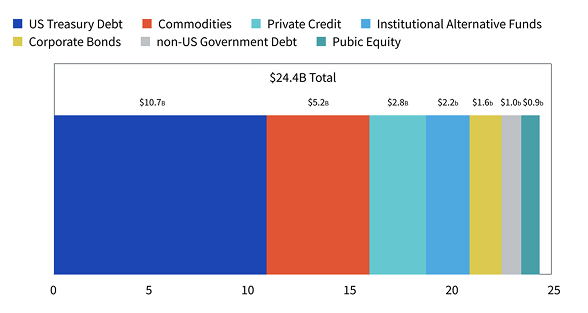
Tokenized Assets by Category

To read the full analysis, download the report in PDF format.

Download report PDF

Disclaimer: This report does not provide any investment advice. All data is provided for information and educational purposes only. No investment decision shall be based on the information provided here and you are solely responsible for your own investment decisions. We urge users to exercise caution and discretion when utilizing these metrics. Glassnode shall not be held responsible for any discrepancies or potential inaccuracies.


  • Follow us on X for timely market updates and analysis
  • Join our Telegram channel
  • For on-chain metrics, dashboards, and alerts, visit Glassnode Studio

Perguntas relacionadas

QWhat is the primary measure of a blockchain's growth, health, and maturity that is independent of price?

ATransaction fees provide a direct, price-independent measure of a blockchain's growth, health, and maturity.

QHow do the security models of Bitcoin and Ethereum differ according to the report?

ABitcoin represents an energy-backed security model, while Ethereum is an example of a capital-backed security model.

QWhat role do stablecoins play in the blockchain ecosystem?

AStablecoins underpin settlement and liquidity across the ecosystem, acting as the primary unit of account and enabling real-time clearing and continuous capital mobility across global markets.

QWhat is the function of crypto exchanges and custodians in the blockchain economy?

ACrypto exchanges and custodians function as the primary financial gateways, linking on-chain activity to traditional capital markets and driving the transition from retail-dominated ownership to institutional participation.

QWhat is the core economic primitive for evaluating the blockchain ecosystem, as described in the 'Quantifying Network Demand' section?

ABlockspace is the core economic primitive for evaluating the ecosystem, as it is a scarce digital resource consumed by every transaction and priced dynamically through transaction fees.

Leituras Relacionadas

Day 6 of the rsETH Incident: DeFi United Secures Approximately $100 Million in Intentional Commitments, but a $50 Million Gap Remains

On April 18, Kelp DAO’s rsETH LayerZero bridge was exploited, resulting in the unauthorized minting of 116.5k rsETH (approx. $292M). The attacker borrowed around $190M on Aave V3. The Arbitrum Security Council froze 30,766 ETH linked to the incident. DeFi United, a cross-protocol rescue initiative led by Awe, was formed to cover a total shortfall of 112.2k rsETH ($258M). As of April 24, several protocols have pledged around $100M in support, though most commitments are still under DAO voting or discussion. Key pledges include: - Golem: 1,000 ETH ($2.3M) - Aave founder Stani Kulechov: 5,000 ETH ($11.5M) - EtherFi: up to 5,000 ETH ($11.5M) - Lido: up to 2,500 stETH ($5.75M), contingent on full coverage - Mantle: proposed a $69M loan to Aave DAO under specific terms The remaining shortfall is estimated at $50M. Aave’s treasury and safety module (~$236M combined) can cover the worst-case bad debt scenario ($230M). Three potential loss distribution paths were outlined by DefiLlama’s 0xngmi: 1. Uniform 18.5% haircut for all rsETH holders: Aave bad debt ~$216M 2. Only protect Mainnet, abandon L2: bad debt up to $341M 3. Repay only pre-attack holders: technically difficult, ~$91M net loss KelpDAO has not yet announced a specific plan. The success of DeFi United depends heavily on KelpDAO’s final decision on loss allocation.

marsbitHá 23m

Day 6 of the rsETH Incident: DeFi United Secures Approximately $100 Million in Intentional Commitments, but a $50 Million Gap Remains

marsbitHá 23m

Kicked Out of PayPal, Musk Aims for a Comeback in the Crypto Market

Elon Musk's X (formerly Twitter) has launched its "Smart Cashtags" feature, generating approximately $1 billion in trading volume within days of its April 2026 pilot launch. The feature allows users to click on stock or crypto tickers (or even full Solana token contract addresses) in posts to view real-time price charts and discussions without leaving the app. Initially available to iPhone users in the US and Canada, with a partnership in Canada enabling direct trading via the Wealthsimple app. This move is part of Musk's broader "Everything App" vision, spearheaded by the upcoming X Money platform. Analysts, such as Mizuho's Dan Dolev, see this as a potential disruptor to the US payments market, even prompting a downgrade of PayPal's stock. X Money's beta offers services like 6% APY on deposits, cashback, and P2P transfers, with speculation it may later incorporate crypto trading and stablecoin settlements for faster transactions. However, the ambitious plan faces significant regulatory scrutiny. Senator Elizabeth Warren has questioned the sustainability of the high 6% yield and raised concerns over X's banking partner, Cross River Bank, which has a history of regulatory violations. Additional risks involve the "GENIUS Act," which may create loopholes for stablecoin issuance without full FDIC insurance coverage, potentially leaving users unprotected. The integration of social trading on a platform with over 500 million users could inject new liquidity and retail interest into the crypto market. Yet, it also amplifies risks like herd mentality and the blurring of lines between entertainment and financial speculation. Musk's return to finance, after his ouster from PayPal, hinges on balancing innovation with regulatory compliance.

marsbitHá 2h

Kicked Out of PayPal, Musk Aims for a Comeback in the Crypto Market

marsbitHá 2h

Trading

Spot
Futuros
活动图片





