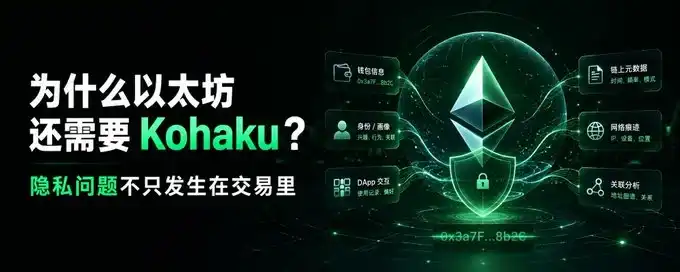
Why Does Ethereum Still Need Kohaku? Privacy Concerns Aren't Just in Transactions

marsbitPublicado em 2026-06-09Última atualização em 2026-06-09

Resumo

The article "Why Ethereum Still Needs Kohaku: Privacy Issues Extend Beyond Transactions" explains the Kohaku initiative as a suite of privacy-first tools designed to improve user privacy on the Ethereum network. It addresses the problem that while Ethereum's transparency enables innovation, it also exposes users' financial activities, asset holdings, and social connections when they reuse a single address. Kohaku aims to bridge the gap between existing privacy protocols (like Railgun, Privacy Pools) and practical user experience by integrating privacy features into wallets, developer tools, and daily interactions. Key focuses include: enabling wallets to manage multiple accounts for different purposes ("many accounts, many you"), facilitating controlled visibility for transactions instead of full transparency, protecting user data during RPC queries and network activity, and providing developers with easier ways to integrate privacy. The article clarifies that Kohaku is not a single product but an ongoing effort to make privacy a default, usable component of the ecosystem, moving beyond complex protocols to practical application. It counters common misconceptions, arguing that privacy is a fundamental user right for normal activities, not just for anonymity, and that it can coexist with compliance through selective disclosure. Ultimately, Kohaku represents an essential step for Ethereum's maturation, ensuring users can participate in the open network while maintaining contro...

Author: Luna

This article is an original contribution from the author. The views expressed are solely those of the author's personal understanding. ETHPanda has edited and organized the content.

Recently, the relevant team within the Ethereum Foundation has become more active in explaining the direction of this privacy-related work around Kohaku to the outside world. The community has shown considerable interest in this name, but some confusion also exists: Is it a wallet, a protocol, or a set of more underlying developer tools? This article will clarify the problems Kohaku aims to solve in a more understandable way.

Kohaku points not to a single feature, but to a theme that is increasingly difficult to avoid in Ethereum's long-term user experience: privacy. It connects privacy protocols, wallet experiences, developer tools, and daily user activities, attempting to bring these capabilities beyond just research papers or tools for a few advanced users.

If summarized in one sentence: What Kohaku wants to achieve is to allow Ethereum users to maintain basic information boundaries while using the open network.

I. First, Understand the Problem: Why Does Ethereum Have Privacy Anxiety?

The power of Ethereum largely comes from its "openness." Transactions, contracts, asset flows, and address interactions can all be verified and audited by anyone. This transparency enables open finance, on-chain governance, and composable applications.

However, the same mechanism also brings side effects: the on-chain behavior of ordinary users is almost by default exposed. An address can reveal which assets a user holds, which protocols they have participated in, when payments or receipts occurred, which addresses they have interacted with, and can even be used to infer certain social relationships or economic status.

In real life, we do not post our bank statements, shopping records, social relationships, and salary income on public bulletin boards. But in the on-chain world, if users consistently reuse the same address, similar information exposure is very likely to occur.

Therefore, Ethereum's privacy issue is not as simple as "whether someone wants to hide bad deeds." It is more like a fundamental user rights issue: As on-chain applications increasingly resemble real-life activities, can users still decide which information should be public and which should only be disclosed in necessary scenarios?

II. What is the Kohaku Initiative?

Kohaku is a set of privacy-first tooling in the Ethereum ecosystem. It revolves around wallets, privacy protocols, developer integrations, and user experience. It is not a standalone consumer App, nor is it just a single protocol.

The Kohaku documentation lists tooling directions for privacy pool protocols such as Railgun, Privacy Pools, Tornado, some of which are still WIP or in alpha stages; the GitHub repository also continued merging related implementations and version updates at the end of May. Therefore, Kohaku is more like a set of evolving privacy infrastructure tools rather than a fully finalized product.

The question it aims to answer is also very concrete: Ethereum already has some privacy protocols and cryptographic capabilities; how can wallets and applications more easily, securely, and naturally integrate them into real-world usage scenarios?

💡 The key word for Kohaku is not "mystery," but "usability": turning privacy capabilities into basic components that wallets and applications can call, users can understand, and the ecosystem can iterate upon.

III. Why is Kohaku Considered "Infrastructure Catch-up"?

Over the past few years, the Ethereum ecosystem has spent a great deal of effort solving issues like scaling, L2, account abstraction, modularity, and data availability. This work has made transactions cheaper, throughput higher, and application deployment more flexible. But for ordinary users, another issue is equally important: Will what I do on-chain be permanently, completely, and without context exposed to everyone?

Privacy technology is not new today. The problem lies in the fact that many privacy solutions have long remained at the protocol layer, research layer, or advanced user layer. Users need to understand complex concepts, wallets require additional adaptation, and developers also lack sufficiently convenient integration methods. As a result, while privacy capabilities exist, they have not become part of the default experience.

Kohaku is precisely about bridging that "from protocol to experience" middle layer. Privacy should not just be a selling point for an independent tool; it can gradually enter more routine areas such as wallet design, account management, RPC access, fund flows, and developer interfaces.

IV. What Specific Problems Might Kohaku Be Addressing?

1. Wallet Layer Privacy: Privacy Must Enter the Entry Point

The wallet is the first entry point for the vast majority of users into Ethereum. If privacy capabilities cannot enter wallets, they will be difficult for ordinary users to truly adopt.

When users connect to a dApp today, they often directly expose a long-term address. This address might be used simultaneously for DeFi, NFTs, social interactions, receiving payments, and voting. Once these activities are linked together, the address is no longer just a technical identifier but becomes a publicly analyzable dossier.

The concept of "many accounts, many you" mentioned in the Kohaku documentation provides an intuitive idea: in reality, a person uses different identities in different scenarios. Correspondingly, in the on-chain experience, wallets could also make it easier for users to create and manage different accounts for different dApps and purposes, and complete funding and usage in more privacy-friendly ways.

2. Transaction Privacy: From "Fully Public" to "Controllable Visibility"

Ethereum transactions are transparent by default; the sender, receiver, amount, and transaction data may all be visible. But not all transactions need to disclose their complete context permanently to the entire network.

This does not mean turning Ethereum into a completely black-box system. A more reasonable direction is "controllable visibility": users can prove, disclose, and audit when necessary, but do not need to expose all information indiscriminately to all observers.

Privacy pool protocols like Railgun and Privacy Pools attempt to provide such capabilities. Kohaku's role, then, is more akin to helping wallets and applications integrate these protocol capabilities into usable experiences.

3. RPC & Network Privacy: Queries Themselves Can Leak Information

When many people discuss on-chain privacy, they only focus on whether transactions are public, overlooking another issue: when wallets query on-chain data, they might also leak what the user is looking at, checking, or which addresses they are concerned about.

Wallets typically need to obtain on-chain information via RPC. If all requests pass through centralized RPC services, users' querying behavior itself could form a profile. Therefore, the Kohaku documentation mentions directions like private RPC, user-defined RPC, light clients, and verifying untrusted RPC results through light clients like Helios.

This type of work may sound less eye-catching than "private transactions," but it is crucial for the real user experience. Because privacy doesn't only happen at the moment a transaction is sent; it also occurs in every step where a wallet loads balances, browses history, connects to applications, and requests data.

4. Developer Usability: Privacy Cannot Stay Only in Papers

For privacy technology to enter mainstream applications, developers must be able to understand and integrate it at low cost. Otherwise, even the strongest cryptographic capabilities can only serve a few teams familiar with the underlying mechanisms.

Through toolkits, documentation, and wallet implementations, Kohaku breaks down these problems into modules more accessible to developers: Which privacy protocols can be integrated? How do wallets handle accounts? How do users complete shield/unshield? How to retain necessary proving capabilities while protecting privacy?

This work requires not just code, but also ecosystem understanding. Wallet teams, protocol teams, application developers, and ordinary users all need to understand more clearly: What problems is Kohaku actually solving, and how will these capabilities enter daily use?

V. Common Misconceptions: Privacy Is Not a Thin Slogan

Misconception 1: Privacy Equals Anonymous Crime Tools

This is the most common and easily misleading misconception. In reality, privacy is a basic need for ordinary people: you would not want all your payment records, asset status, and social relationships to be queried by strangers at any time. On-chain privacy follows the same logic.

Of course, privacy tools need to address risks of abuse and explore mechanisms for proof, disclosure, and risk control. However, the existence of risks should not lead to negating all reasonable privacy needs of users.

Misconception 2: Ethereum Already Has Privacy Protocols, So the Problem Is Solved

There is a big gap between "having tools" and "users being able to use them naturally." Ordinary users will not research complex protocols for every daily interaction, nor will they voluntarily take on the security risks that come with high-threshold operations.

Therefore, the real key is to build privacy capabilities into wallets, default processes, and developer interfaces. Only when users can make safer choices without becoming cryptography experts can privacy be considered to have entered the product layer.

Misconception 3: Kohaku Is a Standalone Product

Kohaku is not a single product but a set of work revolving around privacy protocol toolkits, wallet implementations, best practices, RPC privacy, and developer integrations.

Thus, evaluating Kohaku is not just about whether it has launched a standalone App, but also about whether these tools can be absorbed by more wallets and applications to become part of the default experience.

Misconception 4: Privacy and Compliance Are Inevitably in Conflict

There is indeed tension between privacy and compliance, but it is not necessarily a binary choice. More important future directions may include minimizing information exposure, selective disclosure, verifiable claims, risk isolation, and user authorization.

In other words, good privacy design is not about making all information disappear, but about allowing information to be disclosed only in appropriate scenarios, with appropriate granularity, and to appropriate parties.

VI. What Would Users Experience After These Capabilities Enter Wallets?

If work like Kohaku is adopted by more wallets, ordinary users might first notice not complex cryptographic concepts, but several changes closer to daily use.

  • Wallets might encourage users to manage accounts by scenario more, rather than tying all activities to one long-term address.
  • The barrier to using privacy protocols might decrease, but this depends on wallet integration, protocol maturity, and security audit progress.
  • Wallets might pay more attention to RPC, query, and network layer leakage issues; users would be protected not just in transactions themselves, but also in their querying behavior.
  • Users might have more choices: when to be public, to whom, and to what extent.

These changes will not happen overnight, nor do they mean all wallets will immediately incorporate complex privacy features. But they point in the same direction: the maturation of Ethereum's user experience should not only be reflected in being cheaper and faster, but also in being safer and having more defined boundaries.

VII. What Should Developers Focus On?

For developers, the focus of Kohaku is not to require all applications to immediately shift to being privacy-first, but to make privacy capabilities easier to understand, test, and integrate.

In the past, many applications by default required users to connect with the same address and built all interactions on the premise of address traceability. As privacy tools gradually mature, product teams can rethink: Should they support more granular identities? Should they reduce unnecessary data exposure? Should they make privacy protection a more natural default process, rather than hiding it in advanced settings?

This is especially true for wallet teams. Wallets are not just signing tools; they are also the management layer for user identity, assets, permissions, and information boundaries. The value of Kohaku ultimately depends on whether these complex technologies can be translated into simple, trustworthy, low-friction interactions.

Conclusion: Privacy Is a Piece of the Puzzle for Ethereum's Journey Towards Everyday Use

If Ethereum were merely an open ledger used by a few developers and traders, the privacy pressure brought by transparency might not be so apparent. But if Ethereum is to carry broader activities like payments, identity, social interactions, organizational collaboration, and finance, then privacy is no longer a peripheral issue.

The importance of the Kohaku Initiative lies precisely here: it not only states "Ethereum needs privacy," but also places privacy back into the positions that truly affect user experience—wallets, protocols, and developer tools.

Kohaku is still under construction and iteration, but it addresses a very real problem: In a default-public on-chain world, how can users regain the right to choose?

This might also be a question that Ethereum's next phase of user experience must answer. Truly mature public infrastructure should not only allow everyone to participate but also enable everyone to maintain reasonable boundaries while participating.


Perguntas relacionadas

QWhat is the primary purpose of the Kohaku Initiative within the Ethereum ecosystem, as described in the article?

AThe primary purpose of the Kohaku Initiative is to bridge the gap between existing privacy protocols/capabilities and real-world user experience. It is a set of privacy-first tooling focused on making privacy features easier to integrate into wallets, more understandable for users, and more accessible for developers, moving them from research papers into default user experiences.

QAccording to the article, what is one of the key misconceptions about privacy on Ethereum that the author addresses?

AA key misconception addressed is that 'privacy equals anonymous crime tools.' The author argues that privacy is a fundamental need for ordinary users, akin to not wanting all payment records, asset status, and social relationships to be publicly queryable. While acknowledging risks of abuse, the article asserts that reasonable user privacy demands should not be dismissed.

QBesides transaction privacy, what other aspect of user activity does Kohaku aim to protect, as mentioned in the section about RPC and network privacy?

AKohaku aims to protect the privacy of user queries and data-fetching behavior. When wallets query blockchain data via RPC services, these requests can reveal what information a user is looking at, which addresses they are checking, or what they are interested in, potentially creating a user profile. Kohaku explores solutions like private RPC and light clients to address this.

QWhat specific user experience change might wallets adopting Kohaku's principles encourage, according to the article?

AWallets might encourage users to manage different accounts for different scenarios or purposes, rather than binding all activities to a single, long-term address. This aligns with the concept of 'many accounts, many you,' helping users maintain better information boundaries across various dApps and use cases.

QHow does the article define the relationship between privacy and compliance, arguing against a common misunderstanding?

AThe article argues that privacy and compliance are not necessarily in conflict. The future direction should focus on minimizing information exposure, enabling selective disclosure, using verifiable claims, isolating risks, and implementing user authorization. Good privacy design allows information to be disclosed only in appropriate scenarios, to appropriate parties, and with appropriate granularity, rather than hiding everything.

Leituras Relacionadas

Wang Chuan: After Investing in Storage Stocks and Seeing a Thirty-Fold Return, How to Remain Unanxious (Part 7) - A Quarter-Century Cycle

Wang Chuan: Reflections on Investment Anxiety and Market Cycles After Observing a 30x Gain in a Storage Stock (Part 7) – A Quarter-Century Cycle This article examines the cyclical nature and inherent risks in technology hardware investments, using the storage and semiconductor sectors as examples. It criticizes the misleading practice of "annualized" Net Dollar Retention (NDR) rates, where short-term growth is extrapolated unrealistically. A key concept explored is "reflexivity" – demand driven by panic, exploration, and liquidity during market booms, which can vanish just as quickly when conditions reverse. This reflexivity exists both in product demand and among speculative stock buyers, creating powerful feedback loops that inflate prices during upturns and exacerbate crashes during downturns. The author highlights a major risk for hardware sectors: unlike assets with defined cycles (e.g., Bitcoin's halving), there's no guarantee of a swift recovery post-crash. Companies like Micron, Intel, and Cisco took roughly a quarter-century to surpass their 2000 highs, enduring drawdowns exceeding 80%. This is attributed to the "bullwhip effect" in supply chains, where demand collapses instantly but过剩产能 persists, and a migration of narrative-driven capital. High-valuation stories吸引 speculative funds during growth phases, but these funds quickly depart for the next hot narrative once growth slows, leaving behind stronger companies with much lower valuations. The piece warns of dangerous mental models formed during bull markets: 1) equating current strong demand with perpetual high growth, and 2) believing that making fast, large profits is easy. Citing巴菲特, the author notes that easy money undermines rationality, likening speculators to Cinderella at a ball with a clock that has no hands. The current phase presents an asymmetric risk-reward scenario: potential for further gains exists, but the downside risk is an 80%+ drawdown and a multi-decade wait for breakeven, which reflexive speculators cannot tolerate. The hypothetical investor "老王" (Lao Wang), who achieved a 30x return, is used to illustrate potential pitfalls. Leverage could lead to a wipeout during a sharp correction. Even without leverage, ingrained beliefs in easy money would likely lead him to double down after losses, expecting a quick rebound. Instead, he might face a protracted decline, depleting his resources through frantic trading as the high-growth narrative fades. The conclusion references Schopenhauer, comparing those who have seen multiple market cycles to an audience seeing the same magic trick repeatedly—once the illusion is understood, its power is gone.

marsbitHá 6m

Wang Chuan: After Investing in Storage Stocks and Seeing a Thirty-Fold Return, How to Remain Unanxious (Part 7) - A Quarter-Century Cycle

marsbitHá 6m

US Stocks Too Expensive? This Top CIO Scoured the Globe and Found 5 Stocks More Attractive Than NVIDIA

Summary: Main Street Research CIO James Demmert maintains his bullish 8,100 target for the S&P 500 but argues that greater opportunities now lie overseas. He identifies five international stocks with superior valuations poised to benefit from the AI revolution, suggesting international markets will outperform the US for years. Key Recommendations: 1. **ASML (Netherlands):** A foundational chip manufacturing technology provider, offering crucial AI exposure and geographic diversification. Demmert's top long-term pick. 2. **HSBC (UK/Asia):** A global bank with a 9x P/E ratio, better growth prospects than US peers like JPMorgan, and strong Asian presence. 3. **Siemens Energy (Germany):** A direct play on global power grid expansion driven by AI, crypto, and EV electricity demand. 4. **BHP Group (Australia):** A "hidden AI play" and "second derivative" of the trend due to massive copper demand for data centers. Trades at a 16x P/E. 5. **AstraZeneca (UK):** An undervalued healthcare stock with a strong pipeline (18x P/E, >20% growth), expected to benefit from AI's impact on medicine. Core Thesis: International outperformance is driven by both attractive valuations and a major policy shift. While the US tightens fiscal policy, Europe and Japan are launching unprecedented stimulus, reigniting growth. Demmert recommends allocating 45% of a portfolio internationally, citing excessive US investor conservatism as a key mistake.

marsbitHá 11m

US Stocks Too Expensive? This Top CIO Scoured the Globe and Found 5 Stocks More Attractive Than NVIDIA

marsbitHá 11m

a16z Partner: Three Paths for Crypto Projects to Find PMF

Author: Jason Rosenthal. Compiler: Shenchao TechFlow. Finding Product-Market Fit (PMF) is the most critical variable for a company's survival. In the crypto space, misaligned growth hacking and airdrops often mask the absence of true PMF. However, leading teams are now finding PMF faster. Here are three proven paths for crypto projects to achieve PMF: 1. **Co-build with Anchor Clients:** Partner with the most sophisticated potential clients in your field and develop the product based on their specific needs. Their adoption serves as the strongest validation, more valuable than media coverage or TVL metrics. This approach is shaping current product roadmaps, as seen in collaborations between crypto startups and traditional finance. 2. **Position Ahead of an Exponential Curve:** Identify and position yourself ahead of a major emerging trend before the market fully realizes it. The most evident current curve is the rise of AI Agents as autonomous economic actors. Projects like AgentCash by Merit Systems, which enables AI Agents to pay for API access with crypto, are building foundational payment rails for the impending Agent economy. 3. **Be Your Own First and Best Customer:** The most enduring infrastructure companies don't wait for external validation. They first build and prove their technology by using it to power their own applications at scale before offering it to others. Matter Labs exemplifies this by anchoring its ZKsync technology in a concrete application, Cari Network, which enables U.S. regional banks to conduct real-time, on-chain interbank transfers of tokenized deposits. The underlying logic is consistent: the fastest path to PMF involves choosing the right battlefield and executing with conviction—by co-building with clients whose validation compounds, positioning ahead of the curve before consensus forms, or becoming your own best case study.

marsbitHá 12m

a16z Partner: Three Paths for Crypto Projects to Find PMF

marsbitHá 12m

Wang Chuan: How to Avoid Anxiety When the Neighbor, Lao Wang, Made Thirty Times His Investment in Storage Stocks (7) - A Quarter-Century Cycle

Wang Chuan: Reflections on a Quarter-Century Cycle – How to Stay Calm After a 30x Gain on Storage Stocks (Part 7) This article continues the discussion on investment pitfalls. It highlights the deceptive use of metrics like the "Annualized Net Dollar Retention Rate" by some companies to inflate growth projections. The core analysis focuses on the "reflexivity" present in both product demand and financial markets during boom periods. In a bubble, speculative and fear-driven demand in the real economy interacts with speculative, leveraged buying in financial markets, creating a powerful upward feedback loop. This dynamic reverses sharply when faced with physical or liquidity constraints, leading to a cascading downturn. The hardware and semiconductor sectors face unique risks. Unlike assets with defined cycles, there's no guarantee of a swift recovery post-crash. Historical examples like Micron, Intel, and Cisco show it can take decades to surpass previous peaks after severe drawdowns (80-95%). This is due to the "bullwhip effect" in supply chains—demand vanishes quickly while过剩产能 persists—and the migration of speculative capital and growth narratives to new sectors once momentum slows. Companies may have stronger fundamentals years later, but the speculative "soul" of extreme valuations is long gone. The author warns of psychological traps for new investors: mistaking temporary, intense demand for permanent growth, and believing that making quick, large profits is easy. Citing Buffett, the piece cautions that easy money erodes rationality. The current phase presents an asymmetric risk-reward scenario: potential for further gains versus the risk of an 80%+ drawdown and a multi-decade recovery wait—an outcome reflexive speculators cannot endure. The hypothetical "Lao Wang" who made 30x may be wiped out by leverage or, driven by the "get-rich-quick" mindset, may repeatedly try to recover losses until exhausted, failing to recognize that the high-growth narrative has ended. The piece concludes with Schopenhauer's analogy: those who've seen multiple cycles are like an audience watching the same magic trick repeatedly—the illusion no longer works.

链捕手Há 20m

Wang Chuan: How to Avoid Anxiety When the Neighbor, Lao Wang, Made Thirty Times His Investment in Storage Stocks (7) - A Quarter-Century Cycle

链捕手Há 20m

Trading

Spot
Futuros

Artigos em Destaque

O que é ETH 2.0

ETH 2.0: Uma Nova Era para o Ethereum Introdução ETH 2.0, amplamente conhecido como Ethereum 2.0, marca uma atualização monumental à blockchain do Ethereum. Esta transição não é meramente uma mudança estética; visa melhorar fundamentalmente a escalabilidade, segurança e sustentabilidade da rede. Com uma mudança do mecanismo de consenso em Proof of Work (PoW), intensivo em energia, para um Proof of Stake (PoS) mais eficiente, o ETH 2.0 promete uma abordagem transformadora ao ecossistema blockchain. O que é ETH 2.0? ETH 2.0 é um conjunto de atualizações distintas e interconectadas focadas na otimização das capacidades e desempenho do Ethereum. Esta reformulação foi projetada para abordar desafios críticos que o mecanismo atual do Ethereum enfrentou, particularmente em relação à velocidade das transações e à congestão da rede. Objetivos do ETH 2.0 Os principais objetivos do ETH 2.0 giram em torno da melhoria de três aspectos centrais: Escalabilidade: Com o objetivo de melhorar significativamente o número de transações que a rede pode manejar por segundo, o ETH 2.0 procura ultrapassar a limitação atual de aproximadamente 15 transações por segundo, alcançando potencialmente milhares. Segurança: Medidas de segurança melhoradas são integrais ao ETH 2.0, especialmente através da resistência aprimorada contra ciberataques e da preservação do ethos descentralizado do Ethereum. Sustentabilidade: O novo mecanismo PoS foi projetado não apenas para melhorar a eficiência, mas também para reduzir drasticamente o consumo de energia, alinhando a estrutura operacional do Ethereum com considerações ambientais. Quem é o Criador do ETH 2.0? A criação do ETH 2.0 pode ser atribuída à Ethereum Foundation. Esta organização sem fins lucrativos, que desempenha um papel crucial no apoio ao desenvolvimento do Ethereum, é liderada pelo co-fundador notável Vitalik Buterin. A sua visão de um Ethereum mais escalável e sustentável tem sido a força motriz por trás desta atualização, envolvendo contribuições de uma comunidade global de desenvolvedores e entusiastas dedicados a melhorar o protocolo. Quem são os Investidores do ETH 2.0? Embora os detalhes sobre os investidores do ETH 2.0 não tenham sido tornados públicos, é sabido que a Ethereum Foundation recebe apoio de várias organizações e indivíduos no espaço da blockchain e tecnologia. Esses parceiros incluem firmas de capital de risco, empresas de tecnologia e organizações filantrópicas que compartilham um interesse mútuo em apoiar o desenvolvimento de tecnologias descentralizadas e infraestrutura de blockchain. Como Funciona o ETH 2.0? ETH 2.0 é notável por introduzir uma série de características chave que o diferenciam do seu predecessor. Proof of Stake (PoS) A transição para um mecanismo de consenso PoS é uma das mudanças de destaque do ETH 2.0. Ao contrário do PoW, que depende da mineração intensiva em energia para a verificação de transações, o PoS permite que os utilizadores validem transações e criem novos blocos de acordo com a quantidade de ETH que apostam na rede. Isso leva a uma maior eficiência energética, reduzindo o consumo em aproximadamente 99,95%, tornando o Ethereum 2.0 uma alternativa consideravelmente mais ecológica. Shard Chains As shard chains são outra inovação crítica do ETH 2.0. Estas cadeias menores operam em paralelo com a cadeia principal do Ethereum, permitindo que várias transações sejam processadas simultaneamente. Esta abordagem melhora a capacidade geral da rede, abordando preocupações de escalabilidade que têm atormentado o Ethereum. Beacon Chain No coração do ETH 2.0 está a Beacon Chain, que coordena a rede e gere o protocolo PoS. Ela atua como uma espécie de organizador: supervisiona os validadores, garante que as shards permaneçam conectadas à rede e monitora a saúde geral do ecossistema blockchain. Linha do Tempo do ETH 2.0 A jornada do ETH 2.0 tem sido marcada por vários marcos chave que traçam a evolução desta atualização significativa: Dezembro de 2020: O lançamento da Beacon Chain marcou a introdução do PoS, preparando o caminho para a migração para o ETH 2.0. Setembro de 2022: A conclusão de “The Merge” representa um momento crucial em que a rede Ethereum fez a transição com sucesso de um quadro PoW para um PoS, anunciando uma nova era para o Ethereum. 2023: O lançamento esperado das shard chains visa melhorar ainda mais a escalabilidade da rede Ethereum, solidificando o ETH 2.0 como uma plataforma robusta para aplicações e serviços descentralizados. Características Chave e Benefícios Escalabilidade Melhorada Uma das vantagens mais significativas do ETH 2.0 é a sua escalabilidade melhorada. A combinação de PoS e shard chains permite que a rede expanda a sua capacidade, permitindo que acomode um volume de transações muito maior em comparação com o sistema legado. Eficiência Energética A implementação do PoS representa um enorme passo em direção à eficiência energética na tecnologia blockchain. Ao reduzir drasticamente o consumo de energia, o ETH 2.0 não só reduz os custos operacionais, mas também se alinha mais estreitamente com os objetivos globais de sustentabilidade. Segurança Aprimorada Os mecanismos atualizados do ETH 2.0 contribuem para uma segurança melhorada em toda a rede. O uso do PoS, juntamente com medidas de controle inovadoras estabelecidas através das shard chains e da Beacon Chain, assegura um maior grau de proteção contra potenciais ameaças. Custos Mais Baixos para os Utilizadores À medida que a escalabilidade melhora, os efeitos sobre os custos de transação também serão evidentes. Aumentada a capacidade e reduzida a congestão, espera-se que isso se traduza em taxas mais baixas para os utilizadores, tornando o Ethereum mais acessível para transações do dia a dia. Conclusão ETH 2.0 marca uma evolução significativa no ecossistema da blockchain do Ethereum. Ao abordar questões fundamentais como a escalabilidade, o consumo de energia, a eficiência das transações e a segurança geral, a importância desta atualização não pode ser subestimada. A transição para o Proof of Stake, a introdução das shard chains e o trabalho fundamental da Beacon Chain são indicativos de um futuro em que o Ethereum pode atender à crescente demanda do mercado descentralizado. Em uma indústria movida pela inovação e progresso, o ETH 2.0 representa um testemunho das capacidades da tecnologia blockchain em pavimentar o caminho para uma economia digital mais sustentável e eficiente.

100 Visualizações TotaisPublicado em {updateTime}Atualizado em 2024.12.03

O que é ETH 2.0

O que é ETH 3.0

ETH3.0 e $eth 3.0: Uma Análise Profunda do Futuro do Ethereum Introdução No ambiente em rápida evolução da criptomoeda e da tecnologia blockchain, o ETH3.0, frequentemente denotado como $eth 3.0, emergiu como um tema de considerável interesse e especulação. O termo abrange dois conceitos principais que merecem esclarecimento: Ethereum 3.0: Esta representa uma potencial atualização futura destinada a aumentar as capacidades da atual blockchain do Ethereum, focando especialmente na melhoria da escalabilidade e desempenho. ETH3.0 Meme Token: Este distinto projeto de criptomoeda procura aproveitar a blockchain do Ethereum na criação de um ecossistema centrado em memes, promovendo o envolvimento na comunidade de criptomoedas. Compreender esses aspectos do ETH3.0 é essencial não apenas para entusiastas de criptomoedas, mas também para aqueles que observam as tendências tecnológicas mais amplas no espaço digital. O que é ETH3.0? Ethereum 3.0 Ethereum 3.0 é promovido como uma atualização proposta para a rede Ethereum já estabelecida, que tem sido a espinha dorsal de muitas aplicações descentralizadas (dApps) e contratos inteligentes desde a sua criação. As melhorias vislumbradas concentram-se principalmente na escalabilidade—integrando tecnologias avançadas como sharding e provas de conhecimento zero (zk-proofs). Essas inovações tecnológicas visam facilitar um número sem precedentes de transações por segundo (TPS), potencialmente alcançando milhões, abordando assim uma das limitações mais significativas enfrentadas pela tecnologia blockchain atual. A melhoria não é meramente técnica, mas também estratégica; visa preparar a rede Ethereum para uma adoção generalizada e utilidade em um futuro marcado por uma maior demanda por soluções descentralizadas. ETH3.0 Meme Token Em contraste com o Ethereum 3.0, o ETH3.0 Meme Token aventura-se por um domínio mais leve e divertido, combinando a cultura dos memes da internet com a dinâmica das criptomoedas. Este projeto permite que os usuários comprem, vendam e negociem memes na blockchain do Ethereum, proporcionando uma plataforma que fomenta o envolvimento da comunidade através da criatividade e interesses compartilhados. O ETH3.0 Meme Token visa demonstrar como a tecnologia blockchain pode interseccionar com a cultura digital, criando casos de uso que são tanto divertidos quanto financeiramente viáveis. Quem é o Criador do ETH3.0? Ethereum 3.0 A iniciativa em direção ao Ethereum 3.0 é impulsionada principalmente por um consórcio de desenvolvedores e pesquisadores dentro da comunidade Ethereum, notavelmente incluindo Justin Drake. Conhecido por suas percepções e contribuições para a evolução do Ethereum, Drake tem sido uma figura proeminente nas discussões sobre a transição do Ethereum para uma nova camada de consenso, referida como “Beam Chain”. Esta abordagem colaborativa ao desenvolvimento significa que o Ethereum 3.0 não é fruto de um único criador, mas sim uma manifestação da engenhosidade coletiva focada no avanço da tecnologia blockchain. ETH3.0 Meme Token Os detalhes sobre o criador do ETH3.0 Meme Token são atualmente indetectáveis. A natureza dos tokens de meme frequentemente leva a uma estrutura mais descentralizada e impulsionada pela comunidade, o que poderia explicar a falta de atribuição específica. Isso alinha-se com a ethos da comunidade de criptomoedas mais ampla, onde a inovação geralmente surge de esforços colaborativos em vez de esforços individuais. Quem são os Investidores do ETH3.0? Ethereum 3.0 O apoio ao Ethereum 3.0 provém principalmente da Fundação Ethereum, juntamente com uma comunidade entusiástica de desenvolvedores e investidores. Esta associação fundacional proporciona um grau significativo de legitimidade e melhora as perspectivas de uma implementação bem-sucedida, uma vez que aproveita a confiança e credibilidade construída ao longo de anos de operações de rede. Em um clima em rápida mudança no mundo das criptomoedas, o apoio da comunidade desempenha um papel crucial no impulso ao desenvolvimento e adoção, posicionando o Ethereum 3.0 como um sério candidato a futuros avanços na blockchain. ETH3.0 Meme Token Embora as fontes atualmente disponíveis não forneçam informações explícitas sobre as fundações ou organizações de investimento que apoiam o ETH3.0 Meme Token, é indicativo do modelo típico de financiamento para tokens de meme, que frequentemente depende de apoio base e engajamento da comunidade. Os investidores em tais projetos costumam consistir em indivíduos motivados pelo potencial de inovação impulsionada pela comunidade e pelo espírito de cooperação encontrado dentro da comunidade cripto. Como Funciona o ETH3.0? Ethereum 3.0 As características distintivas do Ethereum 3.0 residem em sua proposta de implementação de sharding e tecnologia zk-proof. Sharding é um método de partição da blockchain em partes menores e gerenciáveis ou “shards”, que podem processar transações simultaneamente em vez de sequencialmente. Esta descentralização do processamento ajuda a prevenir congestionamentos e garante que a rede permaneça responsiva mesmo sob carga pesada. A tecnologia de prova de conhecimento zero (zk-proof) contribui com outra camada de sofisticação ao permitir a validação de transações sem revelar os dados subjacentes envolvidos. Este aspecto não apenas melhora a privacidade, mas também aumenta a eficiência geral da rede. Há também conversas sobre a incorporação de uma Máquina Virtual Ethereum de conhecimento zero (zkEVM) nesta atualização, amplificando ainda mais as capacidades e utilidade da rede. ETH3.0 Meme Token O ETH3.0 Meme Token distingue-se ao capitalizar sobre a popularidade da cultura dos memes. Estabelece um mercado para que os usuários participem da negociação de memes, não apenas para entretenimento, mas também para potencial ganho econômico. Ao integrar recursos como staking, provisão de liquidez e mecanismos de governança, o projeto fomenta um ambiente que incentiva a interação e participação da comunidade. Ao oferecer uma mistura única de entretenimento e oportunidade econômica, o ETH3.0 Meme Token visa atrair um público diversificado, variando de entusiastas de criptomoedas a conhecedores casuais de memes. Cronologia do ETH3.0 Ethereum 3.0 11 de novembro de 2024: Justin Drake sugere a próxima atualização do ETH 3.0, centrada nas melhorias de escalabilidade. Este anúncio sinaliza o início de discussões formais sobre a futura arquitetura do Ethereum. 12 de novembro de 2024: A proposta antecipada para Ethereum 3.0 deve ser revelada no Devcon em Bangkok, preparando o cenário para um feedback mais amplo da comunidade e potenciais próximos passos no desenvolvimento. ETH3.0 Meme Token 21 de março de 2024: O ETH3.0 Meme Token é oficialmente listado no CoinMarketCap, marcando sua entrada no domínio público das criptomoedas e aumentando a visibilidade de seu ecossistema baseado em memes. Pontos Chave Em conclusão, Ethereum 3.0 representa uma evolução significativa dentro da rede Ethereum, focando em superar limitações quanto à escalabilidade e desempenho através de tecnologias avançadas. As atualizações propostas refletem uma abordagem proativa às futuras demandas e usabilidade. Por outro lado, o ETH3.0 Meme Token encapsula a essência da cultura impulsionada pela comunidade no espaço das criptomoedas, aproveitando a cultura dos memes para criar plataformas envolventes que incentivam a criatividade e participação dos usuários. Compreender os distintos propósitos e funcionalidades do ETH3.0 e $eth 3.0 é fundamental para qualquer pessoa interessada nos desenvolvimentos contínuos dentro do espaço cripto. Com ambas as iniciativas a pavimentar caminhos únicos, elas sublinham coletivamente a natureza dinâmica e multifacetada da inovação em blockchain.

104 Visualizações TotaisPublicado em {updateTime}Atualizado em 2024.12.03

O que é ETH 3.0

Como comprar ETH

Bem-vindo à HTX.com!Tornámos a compra de Ethereum (ETH) simples e conveniente.Segue o nosso guia passo a passo para iniciar a tua jornada no mundo das criptos.Passo 1: cria a tua conta HTXUtiliza o teu e-mail ou número de telefone para te inscreveres numa conta gratuita na HTX.Desfruta de um processo de inscrição sem complicações e desbloqueia todas as funcionalidades.Obter a minha contaPasso 2: vai para Comprar Cripto e escolhe o teu método de pagamentoCartão de crédito/débito: usa o teu visa ou mastercard para comprar Ethereum (ETH) instantaneamente.Saldo: usa os fundos da tua conta HTX para transacionar sem problemas.Terceiros: adicionamos métodos de pagamento populares, como Google Pay e Apple Pay, para aumentar a conveniência.P2P: transaciona diretamente com outros utilizadores na HTX.Mercado de balcão (OTC): oferecemos serviços personalizados e taxas de câmbio competitivas para os traders.Passo 3: armazena teu Ethereum (ETH)Depois de comprar o teu Ethereum (ETH), armazena-o na tua conta HTX.Alternativamente, podes enviá-lo para outro lugar através de transferência blockchain ou usá-lo para transacionar outras criptomoedas.Passo 4: transaciona Ethereum (ETH)Transaciona facilmente Ethereum (ETH) no mercado à vista da HTX.Acede simplesmente à tua conta, seleciona o teu par de trading, executa as tuas transações e monitoriza em tempo real.Oferecemos uma experiência de fácil utilização tanto para principiantes como para traders experientes.

3.2k Visualizações TotaisPublicado em {updateTime}Atualizado em 2026.06.02

Como comprar ETH

Discussões

Bem-vindo à Comunidade HTX. Aqui, pode manter-se informado sobre os mais recentes desenvolvimentos da plataforma e obter acesso a análises profissionais de mercado. As opiniões dos utilizadores sobre o preço de ETH (ETH) são apresentadas abaixo.

活动图片














