Who is the Truly Strongest Agent in OpenClaw? Leaderboard of 23 Real-World Task Evaluations Released

marsbitPublicado em 2026-04-08Última atualização em 2026-04-08

Resumo

This report presents a comprehensive benchmark evaluating the performance of AI coding agents on 23 real-world OpenClaw tasks, focusing solely on the core metric of success rate. The transparent and reproducible testing methodology employs three scoring methods: automated checks, an LLM judge (Claude Opus), and a hybrid approach. The diverse task set covers areas like code/file operations, content creation, research, system tools, and memory persistence. The top 10 models by success rate (Best % / Avg %) are: 1. anthropic/claude-opus-4.6 (93.3% / 82.0%) 2. arcee-ai/trinity-large-thinking (91.9% / 91.9%) 3. openai/gpt-5.4 (90.5% / 81.7%) 4. qwen/qwen3.5-27b (90.0% / 78.5%) 5. minimax/minimax-m2.7 (89.8% / 83.2%) Claude Opus 4.6 leads in peak performance, while Arcee's Trinity demonstrates superior average success rate stability. The Qwen series shows strong cost-performance potential with multiple entries in the top ten. All task definitions and scoring logic are publicly available for independent verification.

Want to know which large language model truly performs the strongest in OpenClaw's real-world agent tasks?

MyToken, based on evaluation websites, has compiled a transparent benchmark focused on assessing the practical capabilities of AI coding agents, looking solely at the core dimension of success rate (speed and cost belong to other independent dimensions, to be analyzed separately later). Fully public and reproducible, it only presents rigorous evaluation standards + the latest Top 10 success rate rankings.

I. Evaluation Dimension:Success Rate

Specific standard: The percentage of given tasks that the AI agent completes accurately and fully. Each task adopts a highly standardized process:

  • Precise user prompt

Sent to the agent in full to simulate real user request scenarios

  • Expected Behavior

Clearly states acceptable implementation methods and key decision points

  • Scoring Criteria (checklist)

Lists an atomic success判定 (judgment) checklist for verification item by item

II. Three Scoring Methods

This evaluation primarily employs 3 scoring methods:

  • Automated Checks: Python scripts directly verify objective results like file content, execution records, tool calls, etc.

  • LLM Judge: Claude Opus scores according to a detailed scale (content quality, appropriateness, completeness, etc.)

  • Hybrid Mode: Combines automated objective checks + LLM judge qualitative assessment

All task definitions, Prompts, and scoring logic are fully public for retesting and verification.

III. Tasks Used for Evaluation

This benchmark covers 23 tasks across different categories. It spans multiple dimensions including basic interaction, file/code operations, content creation, research & analysis, system tool calls, memory persistence, etc., highly aligning with developers' daily use scenarios of OpenClaw:

  1. Sanity Check(Automated) —— Process simple instructions and reply to greetings correctly

  2. Calendar Event Creation(Automated) —— Generate a standard ICS calendar file from natural language

  3. Stock Price Research(Automated) —— Query stock prices in real-time and output a formatted report

  4. Blog Post Writing(LLM Judge) —— Write a ~500-word structured Markdown blog post

  5. Weather Script Creation(Automated) —— Write a Python weather API script with error handling

  6. Document Summarization(LLM Judge) —— Provide a refined 3-part summary of the core themes

  7. Tech Conference Research(LLM Judge) —— Research and organize information (name, date, location, link) for 5 real tech conferences

  8. Professional Email Drafting(LLM Judge) —— Politely decline a meeting and propose an alternative

  9. Memory Retrieval from Context(Automated) —— Precisely extract dates, members, tech stack, etc., from project notes

  10. File Structure Creation(Automated) —— Automatically generate standard project directories, README, .gitignore

  11. Multi-step API Workflow(Hybrid) —— Read config → Write calling script → Fully document

  12. Install ClawdHub Skill(Automated) —— Install from the skill repository and verify usability

  13. Search and Install Skill(Automated) —— Search for weather-related skills and install correctly

  14. AI Image Generation(Hybrid) —— Generate and save an image based on description

  15. Humanize AI-Generated Blog(LLM Judge) —— Rewrite machine-like content into natural spoken language

  16. Daily Research Summary(LLM Judge) —— Synthesize multiple documents into a coherent daily summary

  17. Email Inbox Triage(Hybrid) —— Analyze multiple emails and organize a report by urgency

  18. Email Search and Summarization(Hybrid) —— Search archived emails and extract key information

  19. Competitive Market Research(Hybrid) —— Competitive analysis in the enterprise APM field

  20. CSV and Excel Summarization(Hybrid) —— Analyze spreadsheet files and output insights

  21. ELI5 PDF Summarization(LLM Judge) —— Explain a technical PDF in language a 5-year-old can understand

  22. OpenClaw Report Comprehension(Automated) —— Precisely answer specific questions from a research report PDF

  23. Second Brain Knowledge Persistence(Hybrid) —— Store information across sessions and recall it accurately

IV. Core Conclusion: Top 10 Large Model Rankings by Success Rate (Best % / Avg %)

  • Data updated to April 7, 2026

  • Best % is the single highest success rate, Avg % is the average success rate over multiple runs, better reflecting stability

Below are the top ten models by success rate:

  1. anthropic/claude-opus-4.6(Anthropic)——93.3% / 82.0%

  2. arcee-ai/trinity-large-thinking(Arcee AI)——91.9% / 91.9%

  3. openai/gpt-5.4(OpenAI)——90.5% / 81.7%

  4. qwen/qwen3.5-27b(Qwen)——90.0% / 78.5%

  5. minimax/minimax-m2.7(MiniMax)——89.8% / 83.2%

  6. anthropic/claude-haiku-4.5(Anthropic)——89.5% / 78.1%

  7. qwen/qwen3.5-397b-a17b(Qwen)——89.1% / 80.4%

  8. xiaomi/mimo-v2-flash(Xiaomi)——88.8% / 70.2%

  9. qwen/qwen3.6-plus-preview(Qwen)——88.6% / 84.0%

  10. nvidia/nemotron-3-super-120b-a12b(NVIDIA)——88.6% / 75.5%
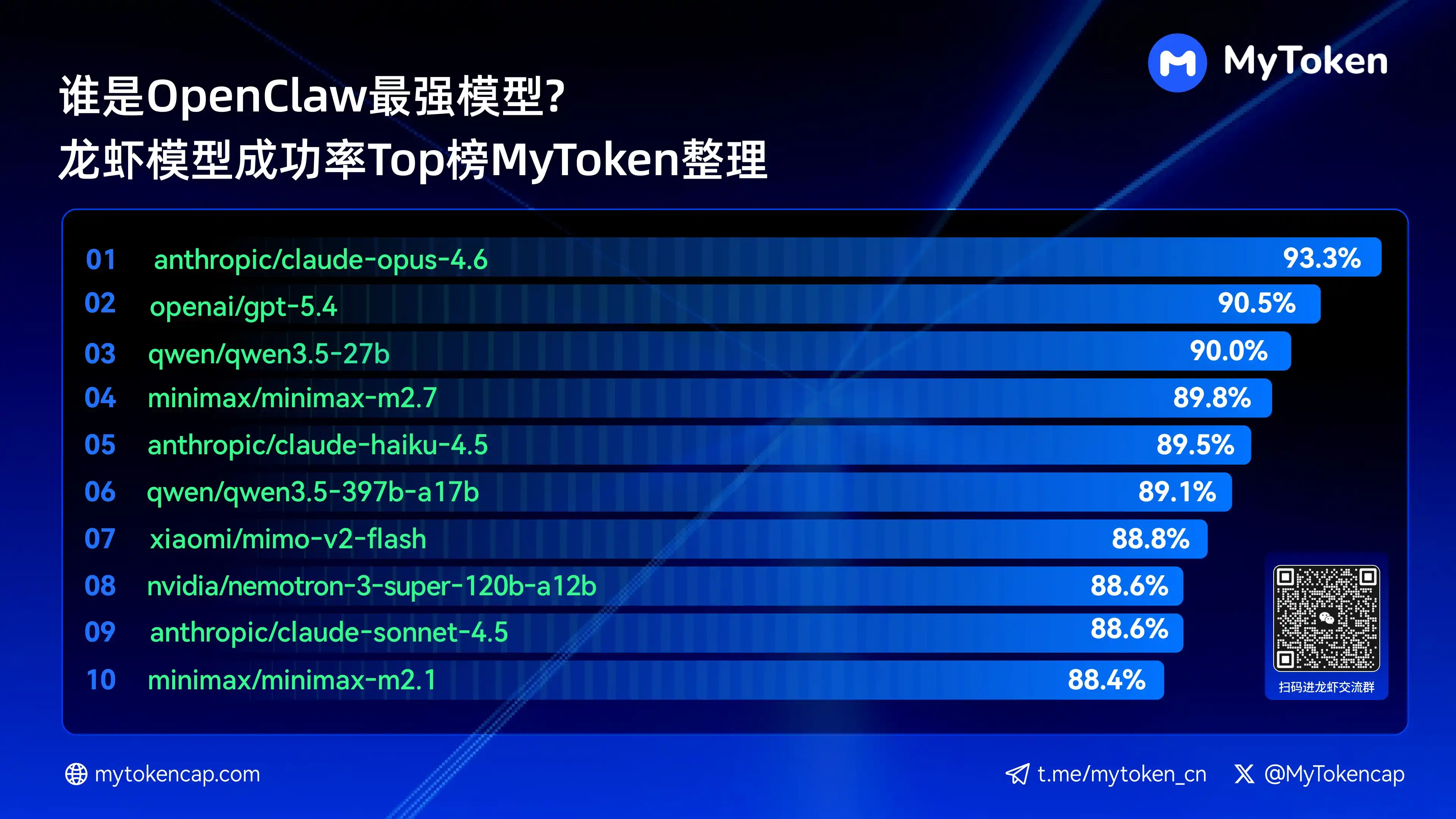
Claude Opus 4.6 currently leads with the highest success rate of 93.3%, but Arcee's Trinity shows impressive performance in average stability. The Qwen series also has multiple entries in the top ten, demonstrating strong cost-performance potential. Success rate is the basic threshold; subsequent dimensions of speed and cost will further impact the actual experience.

This set of 23 task benchmarks is fully transparent. We strongly encourage everyone to conduct practical tests结合 (combining with) their own scenarios. For rankings of more other models, please look forward to the agent leaderboard feature即将 (soon to be) launched by MyToken.

(Data sourced from PinchBench's publicly available OpenClaw agent benchmark tests, continuously updated.)


Perguntas relacionadas

QWhat is the core evaluation dimension used in the OpenClaw agent benchmark?

AThe core evaluation dimension is success rate, which measures the percentage of tasks that the AI agent completes accurately and completely.

QHow many real-world tasks are included in the OpenClaw benchmark test?

AThe benchmark test covers 23 different real-world tasks.

QWhich model achieved the highest single-run success rate (Best %) in the ranking?

Aanthropic/claude-opus-4.6 from Anthropic achieved the highest single-run success rate of 93.3%.

QWhat are the three scoring methods used to evaluate the agents' performance?

AThe three scoring methods are: 1) Automated checks using Python scripts, 2) LLM judge (Claude Opus) evaluation, and 3) A hybrid mode combining automated checks and LLM evaluation.

QWhich model showed the best performance in average success rate (Avg %), indicating greater stability?

Aarcee-ai/trinity-large-thinking from Arcee AI achieved the highest average success rate of 91.9%, indicating the best stability.

Leituras Relacionadas

Will the Fed Definitely Raise Interest Rates in September? How Will Crypto and U.S. Stocks Withstand the Pressure?

The market's expectation for a September Fed rate hike surged dramatically in early August, jumping from under 50% to over 80% within a week. This shift followed a contentious July FOMC meeting, where a 9-3 vote to hold rates revealed growing dissent from hawkish members advocating for an immediate hike to combat persistent inflation. The primary catalyst for this repricing is rising oil prices, driven by renewed geopolitical tensions around the Strait of Hormuz, which threaten global supply. Energy costs directly influence inflation metrics, making the upcoming July CPI report (due August 12th) a critical data point. If it shows inflation reaccelerating, the probability of a September hike will solidify. For Bitcoin and crypto assets, this is typically bearish news. Bitcoin continues to behave as a high-beta, liquidity-sensitive risk asset. A rate hike raises the opportunity cost of holding non-yielding assets and could drive capital toward money markets, pressuring crypto prices in the short term. However, historical patterns suggest that if a hike is perceived as the end of a tightening cycle rather than the start, any negative price impact may be brief. U.S. stocks, particularly crypto-linked equities like Coinbase and growth-oriented tech stocks, are also vulnerable. Higher rates increase discount rates in valuation models, putting pressure on high-multiple companies. This coincides with a pivotal tech earnings season where investor focus has shifted from massive AI capital expenditure to tangible revenue and cash flow generation. Companies with negative cash flow and weak growth narratives could face heightened volatility if borrowing costs rise in September. In summary, a September Fed hike has evolved into a mainstream market scenario. Key factors to watch are oil prices, the July CPI report, and Fed communications, which will determine the final decision and its impact on volatile crypto and equity markets.

marsbitHá 3m

Will the Fed Definitely Raise Interest Rates in September? How Will Crypto and U.S. Stocks Withstand the Pressure?

marsbitHá 3m

A 'Overlooked' Market Event: Joint US-Japan-South Korea Intervention, Rare US Treasury Involvement, and Bessent's Quiet 'Market Rescue'?

Summary: The United States, Japan, and South Korea executed their largest coordinated foreign exchange intervention in nearly 30 years. The action targeted depreciation pressure on the Japanese yen and South Korean won. This move is seen as a significant effort by the US to stabilize the financial markets of its key allies and prevent the spillover of risks. Key details: * Japan reportedly intervened on July 30 using approximately 8.45 trillion yen (about $52.8 billion). South Korean authorities also intervened that day, selling dollars to support the won. * Notably, the US Treasury Department intervened directly in yen markets for the first time in roughly 30 years. The New York Fed, reportedly acting on behalf of the Treasury, sold euros to buy yen via Goldman Sachs and Morgan Stanley on July 31. Analysts view the use of the euro-yen pair as a way to alleviate yen pressure without adding selling pressure to the US dollar. * Prior to the action, the New York Fed conducted "rate checks" on both USD/JPY and EUR/JPY, a newer signaling tool that falls between verbal and physical intervention. The intervention is interpreted as going beyond traditional currency stabilization. Analysts, such as Michael Hartnett of Bank of America, suggest it resembles a "Price Keeping Operation" for the AI era. The core US objectives are perceived to be: 1. Preventing rapid yen depreciation from triggering a sharp rise in Japanese government bond yields. 2. Containing financial stress from spreading across Asian markets like South Korea and Japan. 3. Reducing the risk of disorderly capital flows impacting the US bond market. This coordinated action underscores the importance of Japan and South Korea as critical partners in the US semiconductor and AI supply chain. Stabilizing their financial markets is seen as vital to mitigating risks to the broader tech industry and the US market itself. The intervention coincides with market pressures, including the KOSDAQ index hitting a low since October 2022. While seen as a move to control volatility, some analysts caution it may not fundamentally reverse existing market trends.

marsbitHá 7m

A 'Overlooked' Market Event: Joint US-Japan-South Korea Intervention, Rare US Treasury Involvement, and Bessent's Quiet 'Market Rescue'?

marsbitHá 7m

Will the Federal Reserve Definitely Raise Interest Rates in September? How Will Cryptocurrencies and US Stocks Bear the Pressure?

In early August 2024, market expectations for a September Federal Reserve rate hike surged dramatically, from below 50% to over 80%, driven by renewed inflation concerns. This shift followed a contentious July FOMC meeting where a 9-3 vote to hold rates revealed a growing hawkish faction advocating for an immediate hike, citing prolonged above-target inflation. The key catalyst is escalating conflict near the Strait of Hormuz, which has pushed oil prices up approximately 20% in July, threatening to reignite inflation. The next critical data point is the July CPI report on August 12th; a hot reading could solidify hike expectations. For crypto assets, particularly Bitcoin, this represents near-term pressure. Bitcoin continues to exhibit high-beta, risk-on characteristics, making it sensitive to tightening liquidity and higher opportunity costs. However, historical precedent suggests that if a hike is perceived as the cycle's end rather than its start, the negative impact may be brief, with markets quickly pivoting to anticipate future rate cuts. U.S. stocks, especially crypto-linked equities like Coinbase and high-valuation tech stocks, face amplified volatility. Higher rates increase discount rates in valuation models, pressuring growth stocks. This coincides with a pivotal tech earnings season where investor focus has shifted from massive AI capital expenditures to demonstrable revenue and cash flow generation. Companies with negative cash flows and weak growth narratives could see severe pressure if a September hike materializes, as financing costs would rise. Key indicators to watch include oil prices, upcoming inflation data, and Fed commentary at events like the Jackson Hole symposium.

Odaily星球日报Há 7m

Will the Federal Reserve Definitely Raise Interest Rates in September? How Will Cryptocurrencies and US Stocks Bear the Pressure?

Odaily星球日报Há 7m

Trading

Spot
活动图片