White House Ignites, BSC Spreads Like Wildfire: A Meme Carnival Bidding Farewell to the 'Imperial Decree Model'

Odaily星球日报Publicado em 2026-01-21Última atualização em 2026-01-21

Resumo

White House Ignites, BSC Rallies: A Meme Carnival Moving Beyond the "Imperial Decree" Model The meme market witnessed another sensational surge when the White House official account on X posted about "victory, eviction operations, and memes" on January 21. Within minutes, meme tokens named "memes" were launched on both Solana and BSC chains, sparking a race between the two ecosystems. Contrary to expectations that Solana’s earlier launch and active ecosystem would dominate, the BSC version outperformed in market cap and holder engagement. At its peak, the BSC meme reached a market cap of $28 million with 7,300 holders, while Solana’s version capped at $3.6 million with 3,900 holders. Real-time user data from GMGN also showed significantly higher engagement on BSC. This outcome challenges the long-standing perception that BSC memes rely heavily on endorsements from figures like CZ and He Yi—a pattern often mocked as "crypto Shandong style." In fact, both CZ and He Yi have recently expressed caution against "wordplay memes" created by parsing their social posts. CZ explicitly warned users against buying tokens based on his tweets, while He Yi discouraged the community from treating such meme creation as meaningful contribution. The success of the BSC-based "memes" token—inspired by the White House rather than internal figures—suggests a possible shift in BSC’s meme culture. He Yi’s now-deleted retweet of the White House post may have contributed to its visibility, though th...

Original | Odaily Planet Daily (@OdailyChina)

Author | Golem (@web 3_golem)
The meme market today once again witnessed a "golden dog" legend.

On January 21 at 11:10, the official White House account posted on X platform mentioning "victory, eviction operations, and memes". One minute later, a Meme coin named memes quickly appeared on the Solana chain; 20 minutes later, the BSC chain version was also born. A Meme race between the two chains officially began.

According to empiricism, the Solana version should have the advantage—not only is the ecosystem active, but it also conforms to the consensus of "First is first". However, the result was unexpected: the BSC chain's memes surpassed in market capitalization. According to GMGN data, the BSC version's market cap reached a high of $28 million, with 7,300 holding addresses; while the Solana version's peak was only $3.6 million, with 3,900 holding addresses.

The new feature of GMGN also reveals where players' attention lies: 3 hours after the token's birth, the number of simultaneous online users for the Solana version remained below 1,000, while the BSC version once approached 3,000.

Although some questioned whether the BSC version's market cap was due to "whales pumping, aiming to harvest", the real market attention does not lie—this time, BSC indeed won.

The community often joked that BSC's Meme model was "Shandong Study in the crypto circle", where only projects related to CZ and He Yi had a way out, which once raised concerns about the ecosystem's sustainability. However, BSC's victory in this Meme race not only caused a wave of "slapping thighs" regret for missing out but also prompted the community to rethink the evolution of its Meme model. As GMGN founder Haze said: "The BSC 3.0 era has arrived." (Odaily Note: Haze holds 1.93% of BSC chain memes, ranking second on the holdings list.)

CZ and He Yi Publicly State They Do Not Support "Word-Picking Memes"

I once expressed my thoughts on the BSC Meme model at an Odaily editorial tea party, believing that CZ and He Yi were actually already "kidnapped" by the community. The current BSC Meme model, which relies on "imperial decrees" for cold start, deceives continuous interaction, gets listed on Binance Alpha, and finally gets "poured out", is actually a consensus of the BSC community. Although this model started with CZ's unintentional actions in early 2025, they actually don't like it. However,发展到如今, CZ and He Yi are also powerless to reverse the situation.

When I published this view, it was merely a conjecture, but recent public statements from CZ and He Yi have proven this to be a fact. On January 13, CZ posted saying that although he likes Meme coins, if players blindly follow the trend and buy Meme coins "picked" from his tweets, they are almost destined to lose money.

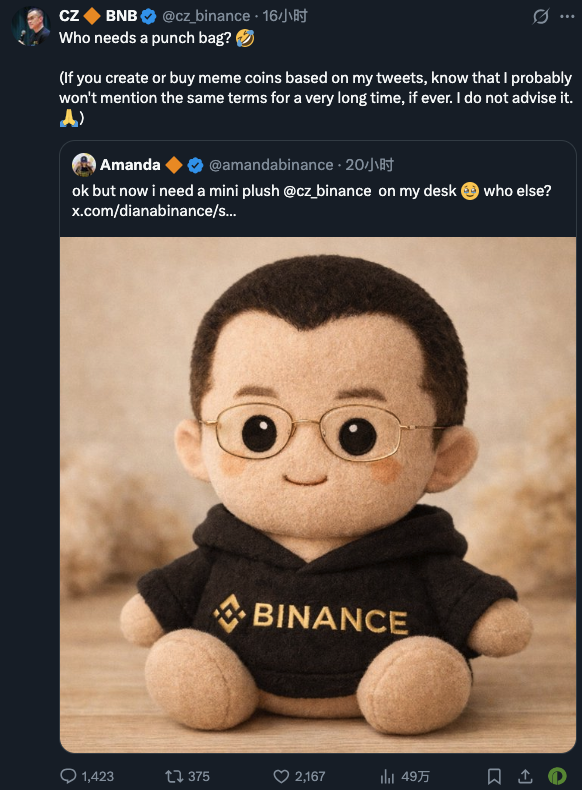
To prevent everyone from blindly chasing these "word-picking Memes", CZ's tweets have started to become cautious. Yesterday, CZ reposted a plush toy created by a user based on his image, which was an ordinary matter, but CZ still specifically noted: If you create or buy Meme coins based on my tweets, please note that I may not mention the same words again for a long time, maybe never. I do not recommend you do this. He even added a 🙏 icon at the end, showing CZ's concern for the community.
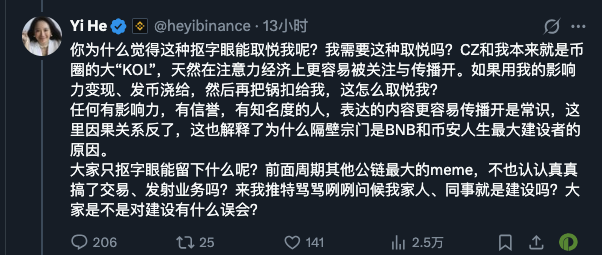
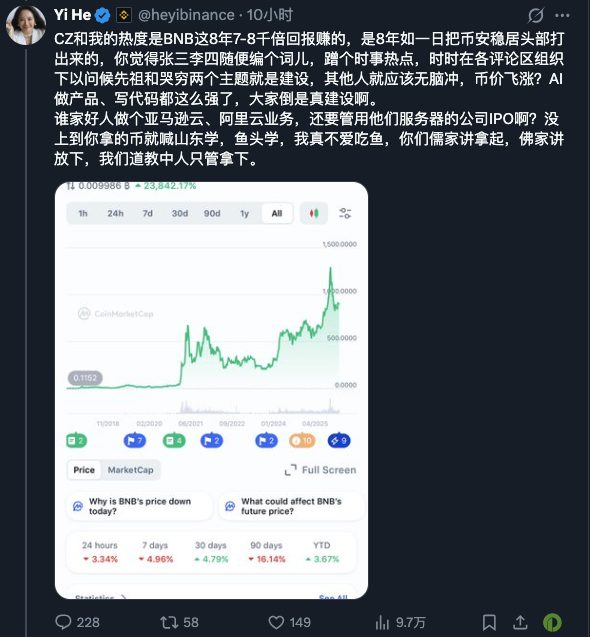
Compared to CZ's euphemism, He Yi's attitude towards the community's "word-picking Memes" is more straightforward. In the early morning of January 21, under a user's post, He Yi not only said that she would severely punish all internal Binance insider trading and bribery, but also "domineeringly" stated that she does not need to rely on Binance Alpha listing Memes that pick words from her tweets to gain pleasure, and also advised the community to focus on real building, not to regard "word-picking and flattery" as real building and be moved by themselves. He Yi also stated that she does not like eating fish, and players should not call it Shandong Study just because Binance Alpha did not list the tokens she supported.
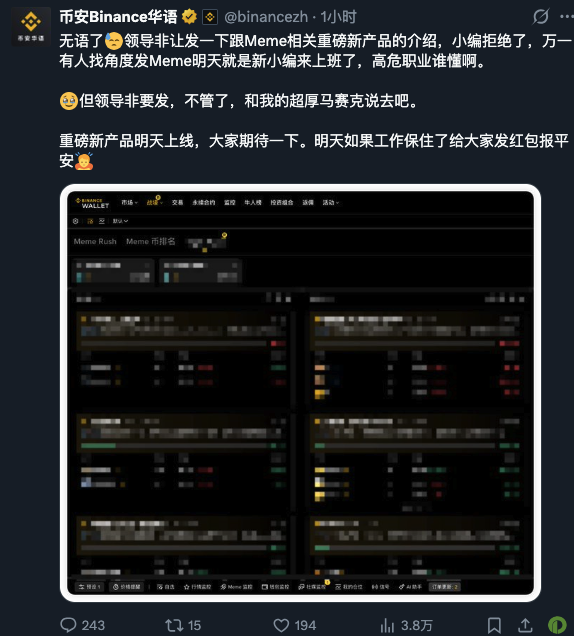
Under the influence of CZ and He Yi's public statements not supporting "word-picking Memes", Binance's official announcements about Memes have also started to become cautious. On January 21, Binance's Chinese account posted that it will launch a new Meme product feature, but to prevent the community from finding angles to issue Meme coins, the editor特意打了超厚马赛克 (specifically applied a very thick mosaic). Although somewhat戏谑 (mockingly), it is enough to see the cautious attitude of the entire Binance team, whether towards Meme coins that pick words from CZ and He Yi's tweets, or those that pick words from Binance's official announcements.
Is BSC Meme Finally Going to Be Different?

Outsiders watch the热闹 (excitement), insiders watch the门道 (tricks). He Yi's remarks not only feel very "alive", but experienced Meme players have realized that the previous BSC Meme model is collapsing from the top down. The successfully outperforming BSC chain memes on the morning of January 21 might be an appetizer. Ironically, memes was also born from the art of "word-picking", but this time it was the White House.

Additionally, after the White House posted, He Yi reposted it (now deleted). This repost, which was unrelated to Binance and He Yi, seemed slightly突兀 (abrupt) in her homepage timeline, and the community was also confused about the reason for He Yi's repost. How much credit He Yi's repost deserves for the BSC's memes, launched 20 minutes later, outperforming Solana's memes is also worth a question mark.

Finally, we might still have to ask that unchanging question, will BSC really be different this time?

Perguntas relacionadas

QWhat was the unexpected outcome in the meme coin race between Solana and BSC following the White House's post?

AContrary to the expectation that the Solana version would dominate due to its active ecosystem and the 'first is first' consensus, the BSC version of the 'memes' token surpassed it in market capitalization, reaching a high of $28 million compared to Solana's $3.6 million.

QHow did the founders of Binance, CZ and He Yi, publicly express their stance on 'wordplay Meme' coins?

ACZ stated that while he likes meme coins, he warned that blindly buying coins created from words in his tweets would almost certainly lead to losses and explicitly advised against it. He Yi was more direct, stating she does not need to rely on such coins for pleasure and advised the community to focus on real development instead of 'wordplay and flattery'.

QWhat new cautious behavior did the official Binance account demonstrate regarding meme-related announcements?

AThe official Binance Chinese account posted about launching a new meme product feature but added very thick mosaics to the announcement to prevent the community from finding angles to create new meme coins, showing a cautious attitude towards both coins based on CZ/He Yi's words and those based on official Binance announcements.

QWhat does the article suggest the success of the BSC 'memes' token might indicate about the future of BSC's meme model?

AThe article suggests that the success of the BSC 'memes' token, which was sparked by an external source (the White House) rather than internal figures like CZ or He Yi, might signal a shift away from the top-down 'edict model' and the beginning of a new, more sustainable 'BSC 3.0' for meme coins on the chain.

QWhat metric from GMGN highlighted the difference in user attention between the Solana and BSC versions of the 'memes' token?

AGMGN data showed that the number of simultaneous online users for the Solana version remained below 1,000 three hours after launch, while the BSC version一度接近 (once approached) nearly 3,000, indicating significantly higher market attention on the BSC chain.

Leituras Relacionadas

a16z: AI's 'Amnesia', Can Continuous Learning Cure It?

The article "a16z: AI's 'Amnesia' – Can Continual Learning Cure It?" explores the limitations of current large language models (LLMs), which, like the protagonist in the film *Memento*, are trapped in a perpetual present—unable to form new memories after training. While methods like in-context learning (ICL), retrieval-augmented generation (RAG), and external scaffolding (e.g., chat history, prompts) provide temporary solutions, they fail to enable true internalization of new knowledge. The authors argue that compression—the core of learning during training—is halted at deployment, preventing models from generalizing, discovering novel solutions (e.g., mathematical proofs), or handling adversarial scenarios. The piece introduces *continual learning* as a critical research direction to address this, categorizing approaches into three paths: 1. **Context**: Scaling external memory via longer context windows, multi-agent systems, and smarter retrieval. 2. **Modules**: Using pluggable adapters or external memory layers for specialization without full retraining. 3. **Weights**: Enabling parameter updates through sparse training, test-time training, meta-learning, distillation, and reinforcement learning from feedback. Challenges include catastrophic forgetting, safety risks, and auditability, but overcoming these could unlock models that learn iteratively from experience. The conclusion emphasizes that while context-based methods are effective, true breakthroughs require models to compress new information into weights post-deployment, moving from mere retrieval to genuine learning.

marsbitHá 2h

a16z: AI's 'Amnesia', Can Continuous Learning Cure It?

marsbitHá 2h

Can a Hair Dryer Earn $34,000? Deciphering the Reflexivity Paradox in Prediction Markets

An individual manipulated a weather sensor at Paris Charles de Gaulle Airport with a portable heat source, causing a Polymarket weather market to settle at 22°C and earning $34,000. This incident highlights a fundamental issue in prediction markets: when a market aims to reflect reality, it also incentivizes participants to influence that reality. Prediction markets operate on two layers: platform rules (what outcome counts as a win) and data sources (what actually happened). While most focus on rules, the real vulnerability lies in the data source. If reality is recorded through a specific source, influencing that source directly affects market settlement. The article categorizes markets by their vulnerability: 1. **Single-point physical data sources** (e.g., weather stations): Easily manipulated through physical interference. 2. **Insider information markets** (e.g., MrBeast video details): Insiders like team members use non-public information to trade. Kalshi fined a剪辑师 $20,000 for insider trading. 3. **Actor-manipulated markets** (e.g., Andrew Tate’s tweet counts): The subject of the market can control the outcome. Evidence suggests Tate’sociated accounts coordinated to profit. 4. **Individual-action markets** (e.g., WNBA disruptions): A single person can execute an event to profit from their pre-placed bets. Kalshi and Polymarket handle these issues differently. Kalshi enforces strict KYC, publicly penalizes insider trading, and reports to regulators. Polymarket, with its anonymous wallet-based system, has historically been more permissive, arguing that insider information improves market accuracy. However, it cooperated with authorities in the "Van Dyke case," where a user traded on classified government information. The core paradox is reflexivity: prediction markets are designed to discover truth, but their financial incentives can distort reality. The more valuable a prediction becomes, the more likely participants are to influence the event itself. The market ceases to be a mirror of reality and instead shapes it.

marsbitHá 3h

Can a Hair Dryer Earn $34,000? Deciphering the Reflexivity Paradox in Prediction Markets

marsbitHá 3h

Trading

Spot
Futuros

Artigos em Destaque

O que é MEME 2.0

Memecoin 2.0: A Ascensão do $MEME 2.0 no Mundo das Criptomoedas Introdução No panorama em constante evolução das criptomoedas, um novo concorrente surgiu. Memecoin 2.0, simbolizado como $MEME 2.0, eleva o conceito de moedas meme a um novo nível emocionante. Como um subproduto do Memecoin original, este projeto capturou a atenção da comunidade crypto ao mudar o foco de incentivos financeiros típicos para uma experiência envolvente e divertida. Operando na blockchain Ethereum, Memecoin 2.0 redefine audaciosamente o envolvimento da comunidade na esfera crypto. O que é Memecoin 2.0, $MEME 2.0? No seu cerne, Memecoin 2.0 é um projeto de criptomoeda que prioriza o espírito comunitário e a diversão associada à cultura meme. Ao contrário das criptomoedas convencionais, que se concentram em casos de uso práticos e benefícios tangíveis, Memecoin 2.0 distingue-se ao abraçar o lado mais leve da moeda digital. O projeto existe sem promessas de utilidade, um roteiro estruturado ou retornos financeiros, focando em vez disso em fomentar uma comunidade vibrante centrada em memes e no prazer partilhado. Ao fazer isso, aproveita a crescente tendência da cultura meme no espaço online, tornando-se num jogador único no mundo dos ativos digitais. Criador do Memecoin 2.0, $MEME 2.0 Apesar de extensa pesquisa sobre as origens do Memecoin 2.0, a identidade explícita do seu criador continua desconhecida. Esta anonimidade não é incomum na comunidade crypto, onde muitos projetos são liderados por indivíduos ou grupos que preferem ficar nos bastidores. A falta de informações publicamente disponíveis sobre o criador pode ser vista como um movimento estratégico, colocando os holofotes no envolvimento da comunidade em vez de na notoriedade individual dentro do espaço. Investidores do Memecoin 2.0, $MEME 2.0 As informações sobre os investidores ou o financiamento do Memecoin 2.0 são escassas. Esta ausência de detalhes pode sugerir que o projeto é autofinanciado ou que o seu foco na comunidade, em vez de estruturas de investimento tradicionais, atraiu um tipo diferente de apoiador. Como o mundo das moedas memes geralmente envolve mais envolvimento de base do que investimento institucional, esta abordagem alinha-se ao ethos de projetos orientados pela comunidade. Como Funciona o Memecoin 2.0, $MEME 2.0? O Memecoin 2.0 opera inteiramente na blockchain Ethereum, aproveitando as suas robustas características de segurança e escalabilidade. Ao aproveitar os pontos fortes da Ethereum, o Memecoin 2.0 pode oferecer um ambiente seguro para interações dos utilizadores enquanto assegura que as transações são eficientes e custo-efetivas. Uma das características únicas do Memecoin 2.0 reside na sua estrutura orientada pela comunidade. O valor e a popularidade do token $MEME 2.0 derivam da participação ativa dos seus utilizadores, em vez de uma utilidade inerente. Este design reforça o foco do projeto no aspecto de entretenimento das criptomoedas, implicando que o riso e o envolvimento da comunidade são as verdadeiras moedas que impulsionam o seu sucesso. Além disso, o projeto insere-se no ecossistema mais amplo das moedas meme, onde o valor de cada moeda meme oscila com base na cultura, nas tendências e no envolvimento da comunidade, em vez de nos princípios económicos tradicionais. Linhas do Tempo do Memecoin 2.0, $MEME 2.0 Para melhor entender a evolução e os marcos do Memecoin 2.0, aqui está uma linha do tempo que destaca eventos significativos na sua história: 2024: O início do Memecoin 2.0 é reconhecido como um desdobramento do Memecoin original, estabelecendo-se dentro do contexto próspero das moedas meme enquanto opera na blockchain Ethereum. 13 de Julho de 2024: O Memecoin 2.0 posiciona-se oficialmente como uma moeda meme centrada na comunidade na rede Ethereum, enfatizando a sua abordagem centrada no entretenimento que convida os utilizadores a participar e envolver-se no seu crescimento. Pontos Chave Sobre o Memecoin 2.0, $MEME 2.0 Várias características críticas definem o Memecoin 2.0: Abordagem Centrada na Comunidade: A missão primária do Memecoin 2.0 é criar uma experiência comunitária divertida e envolvente, capitalizando o prazer coletivo derivado da cultura meme. Construído na Ethereum: Operar na blockchain Ethereum fornece ao projeto uma infraestrutura essencial que garante segurança e escalabilidade. Falta de Utilidade ou Roteiro: Numa notável divergência das criptomoedas tradicionais, o Memecoin 2.0 não promete quaisquer características utilitárias ou retornos financeiros, reafirmando o seu compromisso com o envolvimento da comunidade e a participação social. Foco na Cultura Meme: Ao abraçar os aspectos humorísticos e culturais do fenómeno meme, o Memecoin 2.0 fornece uma plataforma para que os utilizadores se envolvam com a crypto offline e online. Contexto Adicional: A Importância das Moedas Meme As moedas meme emergiram como uma classe distinta de criptomoeda, frequentemente impulsionadas pelo humor e por uma abordagem leve ao comércio. Estas moedas geralmente carecem de utilidade significativa ou roteiros de desenvolvimento, atraindo os utilizadores com a promessa de diversão, interação comunitária e relevância cultural. No panorama do ecossistema crypto mais amplo, as moedas meme revive a importância do envolvimento da comunidade, resistindo contra abordagens exclusivamente orientadas para o lucro. Projetos como o Memecoin 2.0 inauguram uma era em que o entretenimento pode harmonizar-se com aspirações financeiras, transformando a blockchain numa plataforma para criatividade e interação social. Conclusão O Memecoin 2.0, ou $MEME 2.0, representa uma nova onda de criptomoeda que prioriza o envolvimento da comunidade em detrimento de estruturas financeiras rígidas. Com um foco no humor e na interação social, capitaliza a fascinação em torno da cultura meme. Ao operar na blockchain Ethereum, o Memecoin 2.0 aproveita as capacidades da tecnologia, enquanto mantém um compromisso firme com o valor de entretenimento da moeda digital. À medida que o espaço em torno das criptomoedas continua a evoluir, o Memecoin 2.0 serve como um testemunho da ideia de que o futuro dos ativos digitais pode muito bem depender de experiências partilhadas, risadas e conexões comunitárias sólidas. No mundo imprevisível da crypto, talvez a alegria possa ser tão valiosa quanto o ganho financeiro tradicional.

32 Visualizações TotaisPublicado em {updateTime}Atualizado em 2024.12.03

O que é MEME 2.0

Como comprar MEME

Bem-vindo à HTX.com!Tornámos a compra de Memeland (MEME) simples e conveniente.Segue o nosso guia passo a passo para iniciar a tua jornada no mundo das criptos.Passo 1: cria a tua conta HTXUtiliza o teu e-mail ou número de telefone para te inscreveres numa conta gratuita na HTX.Desfruta de um processo de inscrição sem complicações e desbloqueia todas as funcionalidades.Obter a minha contaPasso 2: vai para Comprar Cripto e escolhe o teu método de pagamentoCartão de crédito/débito: usa o teu visa ou mastercard para comprar Memeland (MEME) instantaneamente.Saldo: usa os fundos da tua conta HTX para transacionar sem problemas.Terceiros: adicionamos métodos de pagamento populares, como Google Pay e Apple Pay, para aumentar a conveniência.P2P: transaciona diretamente com outros utilizadores na HTX.Mercado de balcão (OTC): oferecemos serviços personalizados e taxas de câmbio competitivas para os traders.Passo 3: armazena teu Memeland (MEME)Depois de comprar o teu Memeland (MEME), armazena-o na tua conta HTX.Alternativamente, podes enviá-lo para outro lugar através de transferência blockchain ou usá-lo para transacionar outras criptomoedas.Passo 4: transaciona Memeland (MEME)Transaciona facilmente Memeland (MEME) no mercado à vista da HTX.Acede simplesmente à tua conta, seleciona o teu par de trading, executa as tuas transações e monitoriza em tempo real.Oferecemos uma experiência de fácil utilização tanto para principiantes como para traders experientes.

214 Visualizações TotaisPublicado em {updateTime}Atualizado em 2025.03.21

Como comprar MEME

Discussões

Bem-vindo à Comunidade HTX. Aqui, pode manter-se informado sobre os mais recentes desenvolvimentos da plataforma e obter acesso a análises profissionais de mercado. As opiniões dos utilizadores sobre o preço de MEME (MEME) são apresentadas abaixo.

活动图片