Crypto Crime Hit Hard: $700 Million Frozen By DOJ Strike Force

bitcoinistPublicado em 2026-04-25Última atualização em 2026-04-25

Resumo

A US law enforcement task force has frozen over $700 million in cryptocurrency linked to investment scams targeting Americans. The operation, which involved cooperation from crypto exchanges and legal processes, also took down more than 500 fraudulent websites and a Telegram channel used to recruit victims. Two Chinese nationals were named in arrest warrants for operating a scam compound in Burma. In a related move, the US State Department announced a $10 million reward for information disrupting scam centers in Burma. Singaporean authorities, alongside major crypto exchanges and analytics firms, also prevented nearly $3 million in losses through a parallel operation. The scale of cybercrime remains vast, with the FBI reporting over $20 billion in losses in 2025.

A US law enforcement task force seized hundreds of fake investment websites and unsealed warrants against two suspects tied to a Burmese crypto scam compound.

US Reward For Scam Center Tips

The US State Department is offering $10 million to anyone who helps disrupt the Tai Chang scam centers in Burma — a bounty that signals just how seriously Washington is taking the problem of industrialized fraud in Southeast Asia.

That announcement came alongside a sweeping action Thursday by the US Scam Center Strike Force, which said it had frozen more than $700 million in crypto connected to investment scams targeting American victims.

The funds were restrained through a combination of voluntary cooperation from crypto exchanges and formal legal processes.

Fake Sites, A Seized Telegram Channel, And Two Arrest Warrants

The operation’s reach went beyond asset freezes. Authorities pulled down over 500 fraudulent investment websites that had been used to lure victims into depositing cryptocurrency. Visitors who try to access those domains now see a government seizure notice.

A Telegram channel was also seized. Reports say it had been used to recruit unsuspecting job seekers into a crypto scam center operating in Cambodia — a common tactic in Southeast Asia, where traffickers pose as employers to lure workers into forced labor at fraud compounds.
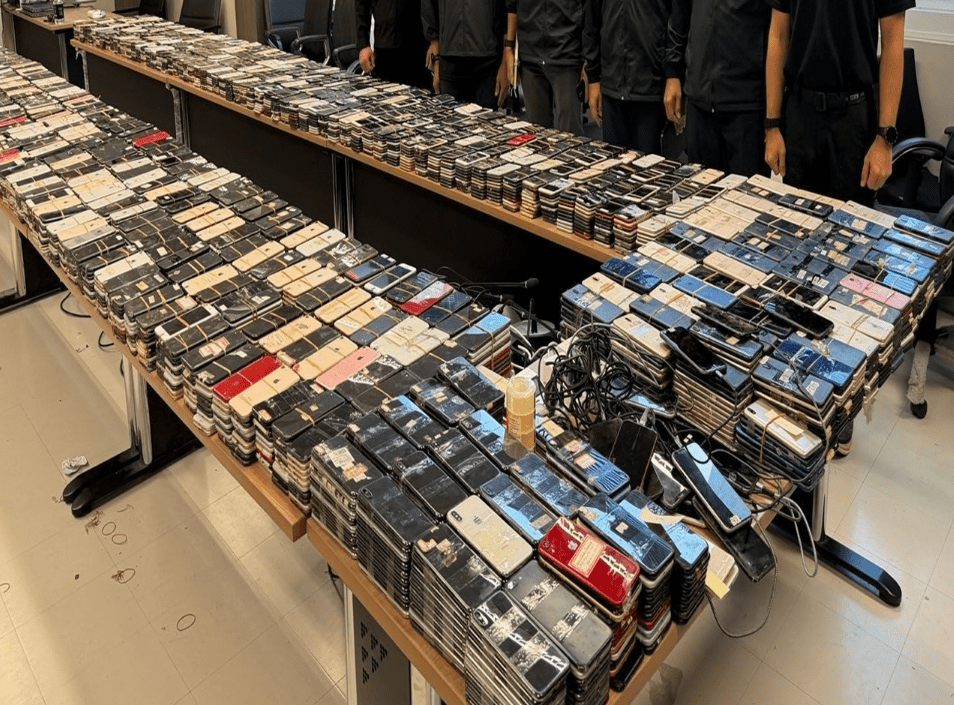
Source: US DOJ

Two Chinese nationals, Huang Xingshan and Jiang Wen Jie, were named in criminal complaints and arrest warrants unsealed as part of the operation. The pair is accused of running a crypto investment fraud scheme at the Shunda compound in Burma. That facility was seized by the Karen National Liberation Army in November 2025.

Exchanges And Blockchain Firms Join The Fight

The US was not alone in acting Thursday. Singapore’s police force ran a parallel month-long operation from mid-March through mid-April, working alongside Coinbase, Gemini, Coinhako, Independent Reserve, and blockchain analytics companies TRM Labs and Chainalysis.

BTCUSD currently trading at $78,076. Chart: TradingView

That effort stopped more than $2.86 million in potential losses and included over 90 direct interventions with scam victims — some by phone, others in person.

The willingness of major crypto platforms to cooperate with law enforcement marks a shift in how these cases are being handled. Blockchain transactions are traceable, and that transparency is increasingly being used against the very criminals who rely on crypto for speed and anonymity.

Losses Running Into The Billions

The scale of the problem is hard to overstate. The FBI received more than a million cybercrime complaints in 2025 alone, with total reported losses hitting more than $20 billion.

The $701 million frozen Thursday, while a significant number, represents a fraction of what has already been lost.

Featured image from Meta, chart from TradingView

Perguntas relacionadas

QWhat was the total amount of cryptocurrency frozen by the US Scam Center Strike Force?

AThe US Scam Center Strike Force froze more than $700 million in cryptocurrency connected to investment scams.

QWhat reward is the US State Department offering for information on the Tai Chang scam centers in Burma?

AThe US State Department is offering a $10 million reward for information that helps disrupt the Tai Chang scam centers in Burma.

QHow many fraudulent investment websites were taken down as part of the operation?

AAuthorities pulled down over 500 fraudulent investment websites used to lure victims.

QWho were the two individuals named in the criminal complaints and arrest warrants?

AThe two individuals named were Chinese nationals Huang Xingshan and Jiang Wen Jie, accused of running a crypto investment fraud scheme.

QWhich organizations did Singapore's police force collaborate with in their parallel operation?

ASingapore's police force worked with Coinbase, Gemini, Coinhako, Independent Reserve, and blockchain analytics companies TRM Labs and Chainalysis.

Leituras Relacionadas

Apple's Desired On-Device AI Sees a Dark Horse Emerge: The First Cognitive Model is Born, 4B Matches GPT-5.4

A Chinese company, Tomorrow's Journey (Nextie), has introduced what it is calling the industry's first "cognitive model" for edge devices. Named New Journey Alpha, this 4-billion-parameter model reportedly matches the performance of trillion-parameter giants like GPT-5.4 in group intelligence tasks such as debate and collective decision-making. The development follows Andrej Karpathy's vision of stripping vast factual knowledge from large language models to retain only a smaller "cognitive core" capable of reasoning, planning, and knowing its own limits. This approach directly addresses the soaring computational costs and token expenses hindering AI's widespread deployment, as highlighted by incidents like Amazon shutting down an internal AI tool due to prohibitive costs. Trained via reinforcement learning on a corpus of academic papers from 1800-2020 to enhance generalization, the model enables three key advancements: 1) Improved decision quality in multi-agent systems, 2) Drastically reduced compute costs, allowing for cost-effective cloud or on-device (e.g., MacBook) deployment, and 3) The feasibility of "proactive" AI agents that act autonomously without user prompts, unlocking new commercial possibilities beyond today's reactive models. Built by the former Microsoft Xiaoice team—known for creating a 3.6B model that outperformed a 65B Llama model—the company is now focusing on the multi-agent systems sector, a field gaining significant investor interest. The model's economic impact is profound; by achieving high-level performance with minimal parameters, it fundamentally alters the cost structure of AI services, challenging the prevailing model of ever-larger parameter counts.

marsbitHá 2h

Apple's Desired On-Device AI Sees a Dark Horse Emerge: The First Cognitive Model is Born, 4B Matches GPT-5.4

marsbitHá 2h

OpenAI's 'Blueprint for the Future': Making AI Beneficial for Every Person on the Planet

A new transformative technology emerges every few generations. OpenAI draws a parallel with the advent of electricity in the 1920s, which initially brought convenience but ultimately enabled unprecedented progress in medicine, engineering, and living standards by empowering people to create new possibilities. AI is poised to recreate this phenomenon. Its true significance lies not in the technology itself, but in what people can achieve with it—from understanding a medical bill or starting a business to aiding scientific discovery. OpenAI believes AI should be universally accessible, allowing everyone to use it according to their own needs. This future, however, is not guaranteed. While transformative tech can centralize power, OpenAI's philosophy is that AI must serve humanity, augmenting human capabilities and broadly distributing its benefits. The company's first commitment is to build AI for human service, aiming to empower the many rather than concentrate power in a few. Safety, alignment with human intent, and oversight are paramount. OpenAI is optimistic about AI's potential to expand human welfare but remains clear-eyed about risks. The goal is to help people achieve more, not to replace them. Full automation is not the desired future; human judgment, values, and direction will become even more critical. OpenAI outlines three core goals: 1. Build automated AI researchers to accelerate and increasingly automate the research process itself, maintaining close human collaboration. The internal projection is that by March 2028, a significant portion of their research will be conducted by AI systems working alongside human researchers. 2. Accelerate economic development by advancing science, boosting productivity, and fostering growth, while ensuring the fruits are widely shared. 3. Provide a personal AGI for everyone on Earth, allowing individuals to benefit from this transformative technology in their own way. The company is entering its third phase, moving from foundational AGI research (Phase 1) to product deployment and learning from real-world use (Phase 2). The current challenge is making advanced AI abundant, affordable, safe, practical, and usable for all individuals and organizations. OpenAI concludes that a widely distributed power structure leads to a more resilient, adaptable, and free society. A positive AI future should not be controlled by a handful of entities but built, benefited from, and owned by many. If realized correctly, AI can become a cornerstone for enhancing global productivity, creativity, scientific advancement, and economic opportunity, fulfilling the mission to ensure AGI benefits all of humanity.

marsbitHá 3h

OpenAI's 'Blueprint for the Future': Making AI Beneficial for Every Person on the Planet

marsbitHá 3h

Trading

Spot
Futuros
活动图片





