When War Is Settled Before the News: How Prediction Markets 'Priced' Maduro's Capture Six Days in Advance

Odaily星球日报Publicado em 2026-01-04Última atualização em 2026-01-04

Resumo

"Prediction markets, particularly Polymarket, demonstrated their ability to forecast major geopolitical events ahead of official announcements, as illustrated by the fictional yet plausible account of insider trading prior to the U.S. military operation that captured Venezuelan President Maduro in early January 2026. According to the article, several anonymous accounts on Polymarket placed large bets days before the actual event, with one address initiating trades as early as December 27, 2025—six days before the operation occurred. These insiders, likely individuals with access to classified U.S. government or military intelligence, collectively profited over $630,000. The piece highlights how Polymarket’s structure—anonymous, non-KYC, and crypto-settled—enables such trades with minimal risk of exposure. While prediction markets can serve as decentralized early-warning systems for the public, they also raise serious concerns about national security and insider trading. The incident may prompt stricter U.S. regulatory measures, such as the proposed 'Predictive Markets Integrity Act,' aimed at preventing officials from trading on non-public information. The tension between market transparency and state secrecy underscores a growing challenge: when prediction markets outpace official narratives, they risk disrupting traditional information control and operational security."

Original | Odaily Planet Daily (@OdailyChina)

Author | Golem (@web3_golem)
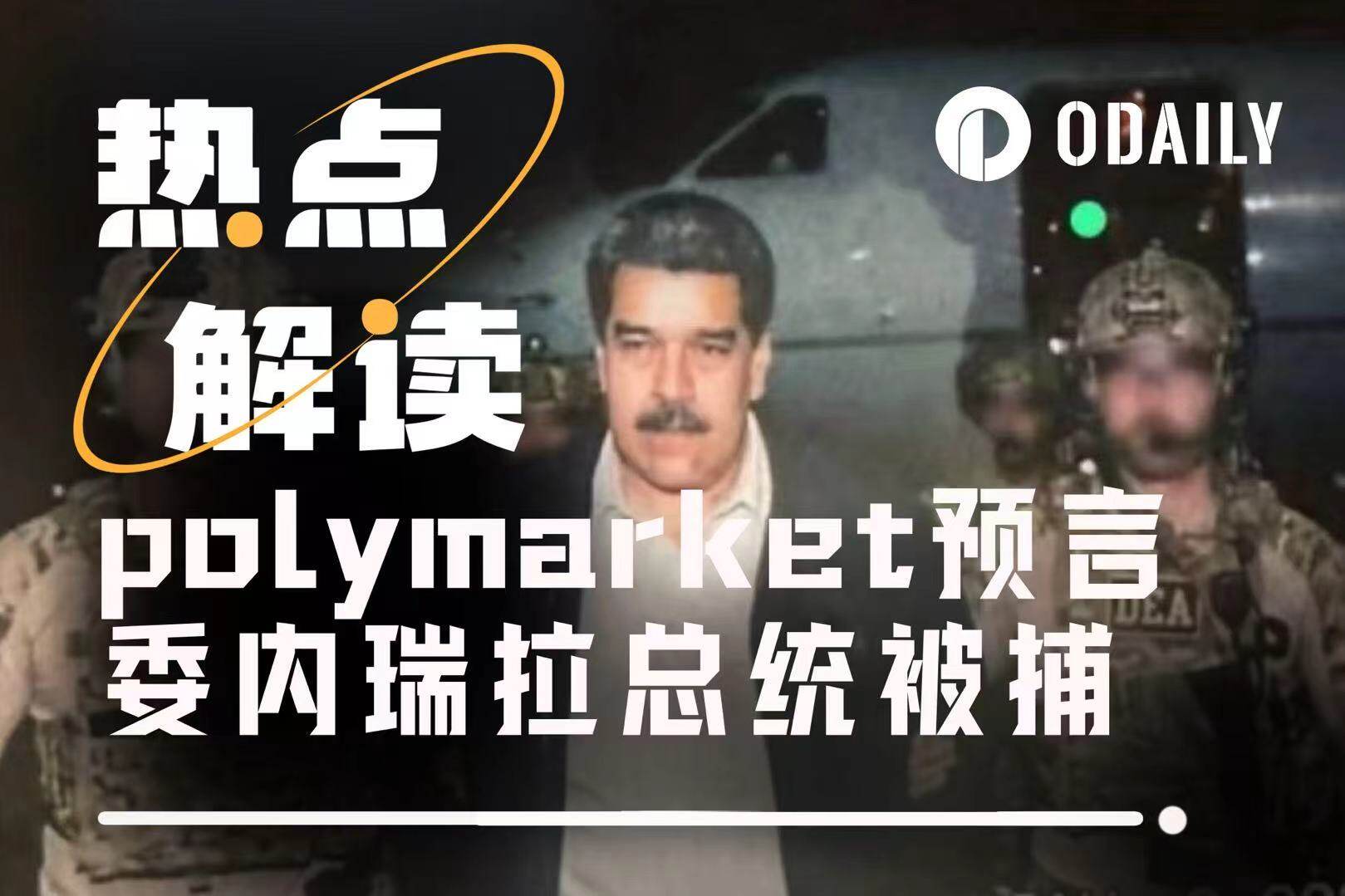
A Short Story Before the Arrest of Venezuela's President...

Eastern Time, January 1, 2026. After experiencing assassination attempts, cryptocurrency launches, tariff trade wars, and other troubles, Trump had relatively smoothly survived the first year of his presidency. But he had no time to celebrate. At that moment, he was conspiring with several key White House officials and military generals at Mar-a-Lago in Florida, planning a military operation that would shock the world.

They were refining the action details in a secret, highly soundproofed room. The atmosphere was tense. Feeling thirsty, Trump pressed the Coke button on the table, wanting an iced Coke. A waiter, passing through layers of Secret Service guards, brought the still-fizzing Coke to Trump's side. "There must be no mistakes in tomorrow's operation against Maduro," Trump muttered.

Those who long serve political elites know when to play deaf and dumb to avoid trouble they can't handle. But clearly, this "Coke Kid" was willing to take the risk.

That night, the waiter, "Coke Kid," opened Polymarket, the world's largest prediction market, and registered an account. He didn't understand the crypto industry, but he knew this platform had accurately predicted Trump would become the 47th U.S. president last year. He then bought "yes" on multiple related predictions, including "The U.S. will invade Venezuela before January 31, 2026." The probability was only 6% at the time. He invested his entire month's salary.

Eastern Time, January 2, 2026, 22:46. Trump gave the order for the raid. Over 150 fighter jets took off from 20 bases, conducting a low-altitude surprise attack on the Venezuelan coast.

Eastern Time, January 3, 1:01 AM. U.S. forces breached Venezuela's air defense system. U.S. Delta Force ground troops reached Maduro's residence, broke through the steel doors, exchanged fire, subdued Maduro and his wife, and immediately evacuated. There were no U.S. casualties. Two hours later, the Maduros were taken to the USS Iwo Jima and subsequently transferred to New York.

The capture operation of a sovereign nation's president ended within 5 hours. Trump watched the entire operation unfold from Mar-a-Lago.

Eastern Time, January 3, 4:30 AM. Trump announced on Truth Social that the President of Venezuela and his wife had been captured and removed from the country.

Simultaneously, predictions on Polymarket regarding "Maduro's ouster timing" and "Trump's military action against Venezuela timing" were swiftly settled. The "Coke Kid" had already resigned on January 2. With his early bet, he had secured his first pot of gold...

(P.S.: This story is purely fictional. If any director wants to make a movie based on this, I am willing to provide this script free of charge.)

Insiders Knew About the U.S. Military Operation 6 Days Earlier

Although the above plot smells strongly of fast-food fiction like "Rebirth: I Was a Waiter at Mar-a-Lago," it might not be entirely false. The "Coke Kid" is pure fiction, but the capture of Venezuelan President Maduro by U.S. forces is real, and it's highly likely that "insiders" placed early bets on Polymarket.

According to Lookonchain monitoring, before Trump announced Maduro's capture, three insider addresses on Polymarket suddenly bet on his ouster, collectively profiting $630,400. Without exception, these were created and funded just days before the event. Among them, address 0x31a5 (0x31a5...8eD9) invested $34,000, profiting $409,900; address 0xa72D (0xa72D...eBd4) invested $5,800, profiting $75,000; address SBet365 invested $25,000, profiting $145,600.

The most impressive among these three addresses was 0x31a5 (0x31a5...8eD9). The U.S. military operation to capture Maduro occurred at 1:00 AM ET on January 3. The media and other countries first learned this news at 4:30 AM ET on January 3, when Trump announced the operation's completion on Truth Social.

But this insider at address 0x31a5 (0x31a5...8eD9) first bet "Maduro will step down before January 31, 2026" at 7:20 PM ET on December 30, 2025. He even bet "U.S. troops will enter Venezuela before January 31, 2026" as early as December 27.
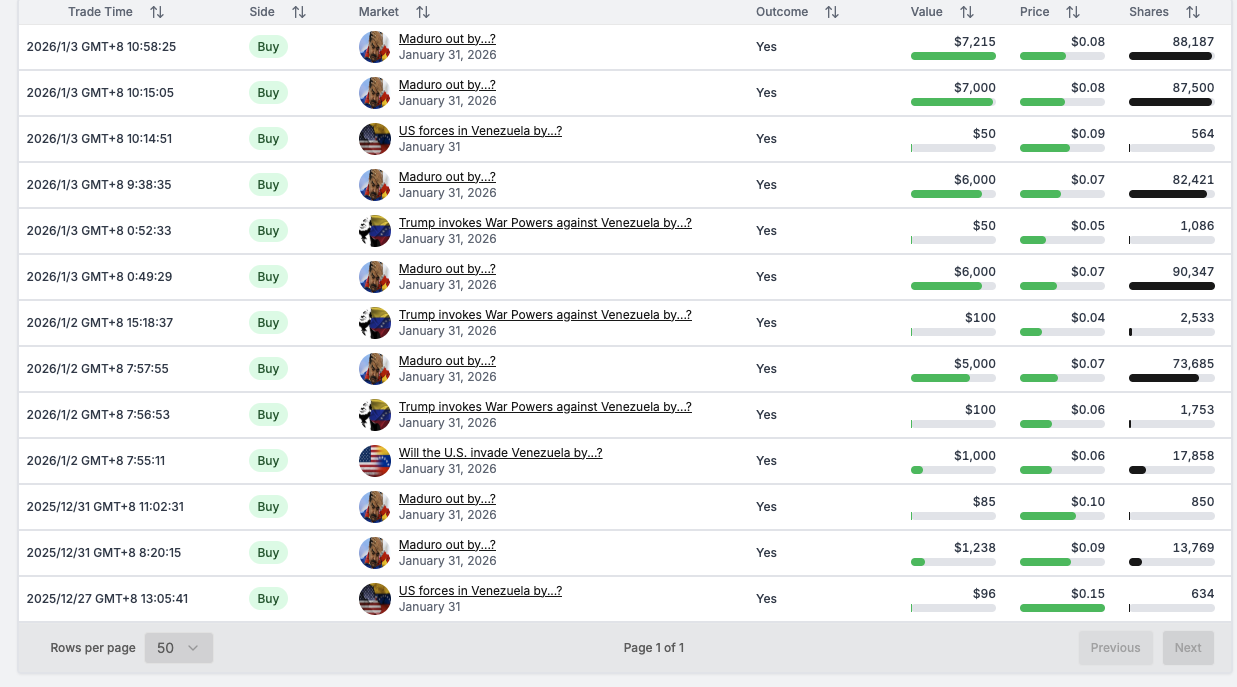
0x31a5 (0x31a5...8eD9) betting before the actual U.S. military action

This means insiders knew about the U.S. military operation 6 days in advance and began building positions on Polymarket. Obtaining the行动计划 (action plan) of the world's most powerful armed forces—the U.S. military—so far in advance is something likely no hacker or national intelligence agency could achieve, but Polymarket did.

It didn't use any surveillance手段 (means); it merely opened an express lane for human greed. Undoubtedly, this insider must be close to U.S. political leaders or senior military officers, or perhaps holds a high position themselves (Surely it couldn't be a U.S. soldier involved in the action, placing orders while fighting?).

More importantly, the actors hardly need worry about exposure. Polymarket is structurally endowed with anonymity advantages: no KYC, near-zero account creation cost, sufficient liquidity, and crypto settlement ensuring privacy. Under these conditions, piercing the address and confirming the true identity afterwards is highly difficult.

So when the participation cost is driven extremely low, and the potential回报 (return) is extremely high, it's no longer a moral issue but an incentive design problem. Faced with such a mechanism, even outwardly respectable,正义立场 (righteous-standing) politicians can hardly guarantee they will never cross that line.

Predicting Truth or Rejecting Insider Trading

But let's consider another possibility: if the Venezuelan government had monitored the abnormal buying activity on Polymarket in advance, would things have turned out differently? (This isn't hard, as the insider betting was quite obvious—large buys in a low-probability market. Targeted monitoring would likely have detected anomalies.)

Then, perhaps the Venezuelan government would have become alert before the U.S. action. To be safe, Maduro might have moved to a more impregnable underground bunker earlier; or提前整顿军队 (prepared the troops in advance) to ready for battle (Odaily Note: During the action, half of Venezuela's army was松懈 (relaxed) due to Christmas holidays), then the U.S. might not have had zero casualties but instead suffered heavy流血事件 (bloodshed); at the very least, Venezuela could have sought support from other countries earlier or publicly stated the possible U.S. action at the UN to politically constrain them.

Of course, these assumptions are very rough, and this event might truly be a coincidence. But the fact remains: "Probability changes on Polymarket for major political events consistently precede mainstream information release."

Once this pattern is repeatedly verified, the price signals of prediction markets cease to be just trading outcomes and begin to be seen by the outside world as a reference indicator. Their role may gradually resemble the Pentagon's "Pizza Index"—an informal yet highly sensitive risk thermometer.

This is certainly not what U.S. authorities want to see.

Previously, U.S. Representative Ritchie Torres planned to propose the "Predictive Markets Public Integrity Act of 2026," aimed at establishing restrictive rules for potential "insider trading" in prediction markets. The bill intends to prohibit federally elected officials, political appointees, and executive branch employees from trading prediction market contracts related to government policy or political outcomes if they possess or can reasonably access material non-public information in the course of their duties.

Following the exposure of the Polymarket insider event regarding Maduro, this bill might receive high-level attention from the U.S. government. Kalshi's PR account promptly responded, stating its platform rules explicitly prohibit any activity based on material non-public information.

Kalshi can guarantee this because it was built from the start on compliance principles, with very high KYC requirements for users. If insider trading occurred, Kalshi could immediately identify the user and even freeze funds.

Polymarket naturally became a haven for these insiders. To some extent, insider trading and Polymarket mutually benefit each other. Polymarket provides a safe house for insiders to make money, and insider trading brings Polymarket more trading volume and notoriety.

Many of Polymarket's breakout moments occurred because it revealed the truth earlier than traditional media. This isn't because Polymarket players are brilliantly clever, but because a minority guides the probability. Ideally, prediction markets reflect the wisdom of the crowd, but in reality, they are just a playground for insiders.

For most ordinary people, this might not be a bad thing. Using prediction markets like Polymarket, people can sense the direction of certain events earlier, reducing被动承受 (passive承受承受承受承受承受承受承受承受承受承受承受承受承受承受承受承受承受承受承受承受承受承受承受承受承受承受承受承受承受承受承受承受承受承受承受承受承受承受承受承受承受承受承受承受承受承受承受承受承受承受承受承受承受承受承受承受承受承受承受承受承受承受承受承受承受承受承受承受承受承受承受承受承受承受承受承受承受承受承受承受承受承受承受承受承受承受承受承受承受承受承受承受承受承受承受承受承受承受承受承受承受承受承受承受承受承受承受承受承受承受承受承受承受承受承受承受承受承受承受承受承受承受承受承受承受承受承受承受承受承受承受承受承受承受承受承受承受承受承受承受承受承受承受承受承受承受承受承受承受承受承受承受承受承受承受承受承受承受承受承受承受承受承受承受承受承受承受承受承受承受承受承受承受承受承受承受承受承受承受承受承受承受承受承受承受承受承受承受承受承受承受承受承受承受承受承受承受承受承受承受承受承受承受承受承受承受承受承受承受承受承受承受承受承受承受承受承受承受承受承受承受承受承受承受承受承受承受承受承受承受承受承受承受承受承受承受承受承受承受承受承受承受承受承受承受承受承受承受承受承受承受承受承受承受承受承受承受承受承受承受承受承受承受承受承受承受承受承受承受承受承受承受承受承受承受承受承受承受承受承受承受承受承受承受承受承受承受承受承受承受承受承受承受承受承受承受承受承受承受承受承受承受承受承受承受承受承受承受承受承受承受承受承受承受承受承受承受承受承受承受承受承受承受承受承受承受承受承受承受承受承受承受承受承受承受承受承受承受承受承受承受承受承受承受承受承受承受承受承受承受承受承受承受承受承受承受承受承受承受承受承受承受承受承受承受承受承受承受承受承受承受承受承受承受承受承受承受承受承受承受承受承受承受承受承受承受承受承受承受承受承受承受承受承受承受承受承受承受承受承受承受承受承受承受承受承受承受承受承受承受承受承受承受承受承受承受承受承受承受承受承受承受承受承受承受承受承受承受承受承受承受承受承受承受承受承受承受承受承受承受承受承受承受承受承受承受承受承受承受承受承受承受承受承受承受承受承受承受承受承受承受承受承受承受承受承受承受承受承受承受承受承受承受承受承受承受承受承受承受承受承受承受承受承受承受承受承受承受承受承受承受承受承受承受承受承受承受承受承受承受承受承受承受承受承受承受承受承受承受承受承受承受承受承受承受承受承受承受承受承受承受承受承受承受承受承受承受承受承受承受承受承受承受承受承受承受承受承受承受承受承受承受承受承受承受承受承受承受承受承受承受承受承受承受承受承受承受承受承受承受承受承受承受承受承受承受承受承受承受承受承受承受承受承受承受承受承受承受承受承受承受承受承受承受承受承受承受承受承受承受承受承受承受承受承受承受承受承受承受承受承受承受承受承受承受承受承受承受承受承受承受承受承受承受承受承受承受承受承受承受承受承受承受承受承受承受承受承受承受承受承受承受承受承受承受承受承受承受承受承受承受承受承受承受承受承受承受承受承受承受承受承受承受承受承受承受承受承受承受承受承受承受承受承受承受承受承受承受承受承受承受承受承受承受承受承受承受承受承受承受承受承受承受承受承受承受承受承受承受承受承受承受承受承受承受承受承受承受承受承受承受承受承受承受承受承受承受承受承受承受承受承受承受承受承受承受承受承受承受承受承受承受承受承受承受承受承受承受承受承受承受承受承受承受承受承受承受承受承受承受承受承受承受承受承受承受承受承受承受承受承受承受承受承受承受承受承受承受承受承受承受承受承受承受承受承受承受承受承受承受承受承受承受承受承受承受承受承受承受承受承受承受承受承受承受承受承受承受承受承受承受承受承受承受承受承受承受承受承受承受承受承受承受承受承受承受承受承受承受承受承受承受承受承受承受承受承受承受承受承受承受承受承受承受承受承受承受承受承受承受承受承受承受承受承受承受承受承受承受承受承受承受承受承受承受承受承受承受承受承受承受承受承受承受承受承受承受承受承受承受承受承受承受承受承受承受承受承受承受承受承受承受承受承受承受承受承受承受承受承受承受承受承受承受承受承受承受承受承受承受承受承受承受承受承受承受承受承受承受承受承受承受承受承受承受承受承受承受承受承受承受承受承受承受承受承受承受承受承受承受承受承受承受承受承受承受承受承受承受承受承受承受承受承受承受承受承受承受承受承受承受承受承受承受承受承受承受承受承受承受承受承受承受承受承受承受承受承受承受承受承受承受承受承受承受承受承受承受承受承受承受承受承受承受承受承受承受承受承受承受承受承受承受承受承受承受承受承受承受承受承受承受承受承受承受承受承受承受承受承受承受承受承受承受承受承受承受承受承受承受承受承受承受承受承受承受承受承受承受承受承受承受承受承受承受承受承受承受承受承受承受承受承受承受承受承受承受承受承受承受承受承受承受承受承受承受承受承受承受承受承受承受承受承受承受承受承受承受承受承受承受承受承受承受承受承受承受承受承受承受承受承受承受承受承受承受承受承受承受承受承受承受承受承受承受承受承受承受承受承受承受承受承受承受承受承受承受承受承受承受承受承受承受承受承受承受承受承受承受承受承受承受承受承受承受承受承受承受承受承受承受承受承受承受承受承受承受承受承受承受承受承受承受承受承受承受承受承受承受承受承受承受承受承受承受承受承受承受承受承受承受承受承受承受承受承受承受承受承受承受承受承受承受承受承受承受承受承受承受承受承受承受承受承受承受承受承受承受承受承受承受承受承受承受承受承受承受承受承受承受承受承受承受承受承受承受承受承受承受承受承受承受承受承受承受承受承受承受承受承受承受承受承受承受承受承受承受承受承受承受承受承受承受承受承受承受承受承受承受承受承受承受承受承受承受承受承受承受承受承受承受承受承受承受承受承受承受承受承受承受承受承受承受承受承受承受承受承受承受承受承受承受承受承受承受承受承受承受承受承受承受承受承受承受承受承受承受承受承受承受承受承受承受承受承受承受承受承受承受承受承受承受承受承受承受承受承受承受承受承受承受承受承受承受承受承受承受承受承受承受承受承受承受承受承受承受承受承受承受承受承受承受承受承受承受承受承受承受承受承受承受承受承受承受承受承受承受承受承受承受承受承受承受承受承受承受承受承受承受承受承受承受承受承受承受承受承受承受承受承受承受承受承受承受承受承受承受承受承受承受承受承受承受承受承受承受承受承受承受承受承受承受承受承受承受承受承受承受承受承受承受承受承受承受承受承受承受承受承受承受承受承受承受承受承受承受承受承受承受承受承受承受承受承受承受承受承受承受承受承受承受承受承受承受承受承受承受承受承受承受承受承受承受承受承受承受承受承受承受承受承受承受承受承受承受承受承受承受承受承受承受承受承受承受承受承受承受承受承受承受承受承受承受承受承受承受承受承受承受承受承受承受承受承受承受承受承受承受承受承受承受承受承受承受承受承受承受承受承受承受承受承受承受承受承受承受承受承受承受承受承受承受承受承受承受承受承受承受承受承受承受承受承受承受承受承受承受承受承受承受承受承受承受承受承受承受承受承受承受承受承受承受承受承受承受承受承受承受承受承受承受承受承受承受承受承受承受承受承受承受承受承受承受承受承受承受承受承受承受承受承受承受承受承受承受承受承受承受承受承受承受承受承受承受承受承受承受承受承受承受承受承受承受承受承受承受承受承受承受承受承受承受承受承受承受承受承受承受承受承受承受承受承受承受承受承受承受承受承受承受承受承受承受承受承受承受承受承受承受承受承受承受承受承受承受承受承受承受承受承受承受承受承受承受承受承受承受承受承受承受承受承受承受承受承受承受承受承受承受承受承受承受承受承受承受承受承受承受承受承受承受承受承受承受承受承受承受承受承受承受承受承受承受承受承受承受承受承受承受承受承受承受承受承受承受承受承受承受承受承受承受承受承受承受承受承受承受承受承受承受承受承受承受承受承受承受承受承受承受承受承受承受承受承受承受承受承受承受承受承受承受承受承受承受承受承受承受承受承受承受承受承受承受承受承受承受承受承受承受承受承受承受承受承受承受承受承受承受承受承受承受承受承受承受承受承受承受承受承受承受承受承受承受承受承受承受承受承受承受承受承受承受承受承受承受承受承受承受承受承受承受承受承受承受承受承受承受承受承受承受承受承受承受承受承受承受承受承受承受承受承受承受承受承受承受承受承受承受承受承受承受承受承受承受承受承受承受承受承受承受承受承受承受承受承受承受承受承受承受承受承受承受承受承受承受承受承受承受承受承受承受承受承受承受承受承受承受承受承受承受承受承受承受承受承受承受承受承受承受承受承受承受承受承受承受承受承受承受承受承受承受承受承受承受承受承受承受承受承受承受承受承受承受承受承受承受承受承受承受承受承受承受承受承受承受承受承受承受承受承受承受承受承受承受承受承受承受承受承受承受承受承受承受承受承受承受承受承受承受承受承受承受承受承受承受承受承受承受承受承受承受承受承受承受承受承受承受承受承受承受承受承受承受承受承受承受承受承受承受承受承受承受承受承受承受承受承受承受承受承受承受承受承受承受承受承受承受承受承受承受承受承受承受承受承受承受承受承受承受承受承受承受承受承受承受承受承受承受承受承受承受承受承受承受承受承受承受承受承受承受承受承受承受承受承受承受承受承受承受承受承受承受承受承受承受承受承受承受承受承受承受承受承受承受承受承受承受承受承受承受承受承受承受承受承受承受承受承受承受承受承受承受承受承受承受承受承受承受承受承受承受承受承受承受承受承受承受承受承受承受承受承受承受承受极) of sudden news, no longer完全受制于 (completely subject to) emotional public opinion and滞后 (lagging) media narratives. In outcome, this反而像 (instead resembles) a form of informational "decentralization."

But for those at the pyramid's顶端 (apex), the situation is恰恰相反 (precisely the opposite). For a long time, "who knows what and when" has itself been an order. The truth isn't不可公开 (not for public release); it needs to be released at the right time and in the right concentration. Anyone trying to打破这一节奏 (break this rhythm) is seen as challenging the established rules.

Therefore, Polymarket might kick the iron plate of U.S. regulation again. In 2024, Polymarket's founder had his New York home raided by the FBI—the tensest confrontation between Polymarket and the U.S. government. Now, Polymarket has returned to the U.S. market and obtained CFTC approval, suggesting relations have thawed.

But涉及 (involving) high-level classified military or security matters like the Maduro capture operation, any form of提前外泄 (pre-leakage) of information is unacceptable to the U.S. government. And currently,正值 (it is precisely when) prediction markets are trying to achieve regulatory positioning and争取 (strive for) institutional space. The emergence of such events, even if ultimately deemed coincidental, will be interpreted as a potential threat at the regulatory level.

Prediction markets face not just technical compliance issues, but whether they are unintentionally侵入 (intruding into) the sensitive boundaries of traditional information security and national governance.

If prediction no longer leads the truth, what does it have left? This question cannot be avoided in the future.


Perguntas relacionadas

QWhat is the main subject of the fictional story at the beginning of the article?

AThe main subject is a fictional story about a waiter ('Coke Boy') at Mar-a-Lago who overhears President Trump planning a military operation to capture Venezuelan President Maduro. The waiter uses this insider information to place successful bets on the prediction market Polymarket before the news becomes public.

QAccording to the article, what evidence suggests that the prediction market Polymarket had insider trading related to the Maduro operation?

AThe article cites on-chain analysis from Lookonchain, which identified three insider addresses on Polymarket that placed bets on Maduro's ouster just days before the actual event. One address (0x31a5...8eD9) placed its first bet on 'Maduro will step down by January 31, 2026' on December 30, 2025, and even earlier on December 27 for 'US troops will enter Venezuela by January 31, 2026', six days before the military action occurred.

QWhat potential consequence does the article suggest if the government of Venezuela had monitored the Polymarket activity?

AThe article suggests that if the government of Venezuela had monitored the unusual buying activity on Polymarket, it might have been alerted to the potential threat. This could have led President Maduro to move to a more secure location, put the military on higher alert (preventing them from being caught off-guard during the Christmas holiday), or seek international support to politically constrain the U.S., potentially leading to a bloodier conflict.

QHow does the article describe the fundamental conflict that prediction markets like Polymarket create for governments?

AThe article states that for governments and elite groups, the control over 'who knows what and when' is a fundamental part of the established order. Truth is meant to be released at an appropriate time and in a controlled manner. Prediction markets, by allowing insider information to be monetized and revealed early through price movements, challenge this control and invade the 'sensitive boundaries of traditional information security and national governance.'

QWhat regulatory response to prediction market insider trading is mentioned in the article?

AThe article mentions that U.S. Representative Ritchie Torres plans to introduce the 'Predictive Markets Integrity Act of 2026.' This bill aims to prohibit federal officials, political appointees, and executive branch employees from trading on prediction market contracts related to government policy or political outcomes if they possess or have access to material non-public information through their official duties.

Leituras Relacionadas

North Korean Hackers Loot $500 Million in a Single Month, Becoming the Top Threat to Crypto Security

North Korean hackers, particularly the notorious Lazarus Group and its subgroup TraderTraitor, have stolen over $500 million from cryptocurrency DeFi platforms in less than three weeks, bringing their total theft for the year to over $700 million. Recent major attacks on Drift Protocol and KelpDAO, resulting in losses of approximately $286 million and $290 million respectively, highlight a strategic shift: instead of targeting core smart contracts, attackers are now exploiting vulnerabilities in peripheral infrastructure. For instance, the KelpDAO attack involved compromising downstream RPC infrastructure used by LayerZero's decentralized validation network (DVN), allowing manipulation without breaching core cryptography. This sophisticated approach mirrors advanced corporate cyber-espionage. Additionally, North Korea has systematically infiltrated the global crypto workforce, with an estimated 100 operatives using fake identities to gain employment at blockchain companies, enabling long-term access to sensitive systems and facilitating large-scale thefts. According to Chainalysis, North Korean-linked hackers stole a record $2 billion in 2025, accounting for 60% of all global crypto theft that year. Their total historical crypto theft has reached $6.75 billion. Post-theft, they employ specialized money laundering methods, heavily relying on Chinese OTC brokers and cross-chain mixing services rather than standard decentralized exchanges. Security experts, while acknowledging the increased sophistication, emphasize that many attacks still exploit fundamental weaknesses like poor access controls and centralized operational risks. Strengthening private key management, limiting privileged access, and enhancing coordination among exchanges, analysts, and law enforcement immediately after an attack are critical to improving defense and fund recovery chances. The industry's challenge now extends beyond secure smart contracts to safeguarding operational security at the infrastructure level.

marsbitHá 31m

North Korean Hackers Loot $500 Million in a Single Month, Becoming the Top Threat to Crypto Security

marsbitHá 31m

Circle CEO's Seoul Visit: No Korean Won Stablecoin Issuance, But Met All Major Korean Banks

Circle CEO Jeremy Allaire's recent activities in Seoul indicate a strategic shift for the company, moving away from issuing a Korean won-backed stablecoin and instead focusing on embedding itself as a key infrastructure provider within Korea’s financial and crypto ecosystem. Despite Korea accounting for nearly 30% of global crypto trading volume—with a market characterized by high retail participation and altcoin dominance—Circle has chosen not to compete for the role of stablecoin issuer. Instead, Allaire met with major Korean banks (including Shinhan, KB, and Woori), financial groups, leading exchanges (Upbit, Bithumb, Coinone), and tech firms like Kakao. This approach reflects a broader industry transition: the core of stablecoin competition is shifting from issuance rights to systemic positioning. With Korean regulators still debating whether banks or tech companies should issue stablecoins, Circle is avoiding regulatory uncertainty by strengthening its role as a service and technology partner. The company is deepening integration with trading platforms, building connections, and promoting stablecoin infrastructure. This positions Circle to benefit regardless of which entity eventually issues a won stablecoin. Allaire also noted the potential for a Chinese yuan stablecoin in the next 3–5 years, underscoring a regional trend of stablecoins becoming more regulated and integrated with traditional finance. Ultimately, Circle’s strategy highlights that future influence in the stablecoin market will belong not necessarily to the issuers, but to the foundational infrastructure layers that enable cross-system transactions.

marsbitHá 58m

Circle CEO's Seoul Visit: No Korean Won Stablecoin Issuance, But Met All Major Korean Banks

marsbitHá 58m

SpaceX Ties Up with Cursor: A High-Stakes AI Gambit of 'Lock First, Acquire Later'

SpaceX has secured an option to acquire AI programming company Cursor for $60 billion, with an alternative clause requiring a $10 billion collaboration fee if the acquisition does not proceed. This structure is not merely a potential acquisition but a strategic move to control core access points in the AI era. The deal is designed as a flexible, dual-path arrangement, allowing SpaceX to either fully acquire Cursor or maintain a binding partnership through high-cost collaboration. This "option-style" approach minimizes immediate regulatory and integration risks while ensuring long-term alignment between the two companies. At its core, the transaction exchanges critical AI-era resources: SpaceX provides its Colossus supercomputing cluster—one of the world’s most powerful AI training infrastructures—while Cursor contributes its AI-native developer environment and strong product adoption. This synergy connects compute power, models, and application layers, forming a closed-loop AI capability stack. Cursor, founded in 2022, has achieved rapid growth with over $1 billion in annual revenue and widespread enterprise adoption. Its value lies in transforming software development through AI agents capable of coding, debugging, and system design—positioning it as a gateway to future software production. For SpaceX, this move is part of a broader strategy to evolve from a aerospace company into an AI infrastructure empire, integrating xAI, supercomputing, and chip manufacturing. Controlling Cursor fills a gap in its developer tooling layer, strengthening its AI narrative ahead of a potential IPO. The deal reflects a shift in AI competition from model superiority to ecosystem and entry-point control. With programming tools as a key battleground, securing developer loyalty becomes crucial for dominating the software production landscape. Risks include questions around Cursor’s valuation, technical integration challenges, and potential regulatory scrutiny. Nevertheless, the deal underscores a strategic bet: controlling both compute and software development access may redefine power dynamics in the AI-driven future.

marsbitHá 1h

SpaceX Ties Up with Cursor: A High-Stakes AI Gambit of 'Lock First, Acquire Later'

marsbitHá 1h

Trading

Spot
Futuros

Artigos em Destaque

O que é $S$

Compreender o SPERO: Uma Visão Abrangente Introdução ao SPERO À medida que o panorama da inovação continua a evoluir, o surgimento de tecnologias web3 e projetos de criptomoeda desempenha um papel fundamental na formação do futuro digital. Um projeto que tem atraído atenção neste campo dinâmico é o SPERO, denotado como SPERO,$$s$. Este artigo tem como objetivo reunir e apresentar informações detalhadas sobre o SPERO, para ajudar entusiastas e investidores a compreender as suas bases, objetivos e inovações nos domínios web3 e cripto. O que é o SPERO,$$s$? O SPERO,$$s$ é um projeto único dentro do espaço cripto que procura aproveitar os princípios da descentralização e da tecnologia blockchain para criar um ecossistema que promove o envolvimento, a utilidade e a inclusão financeira. O projeto é concebido para facilitar interações peer-to-peer de novas maneiras, proporcionando aos utilizadores soluções e serviços financeiros inovadores. No seu núcleo, o SPERO,$$s$ visa capacitar indivíduos ao fornecer ferramentas e plataformas que melhoram a experiência do utilizador no espaço das criptomoedas. Isso inclui a possibilidade de métodos de transação mais flexíveis, a promoção de iniciativas impulsionadas pela comunidade e a criação de caminhos para oportunidades financeiras através de aplicações descentralizadas (dApps). A visão subjacente do SPERO,$$s$ gira em torno da inclusão, visando fechar lacunas dentro das finanças tradicionais enquanto aproveita os benefícios da tecnologia blockchain. Quem é o Criador do SPERO,$$s$? A identidade do criador do SPERO,$$s$ permanece algo obscura, uma vez que existem recursos publicamente disponíveis limitados que fornecem informações detalhadas sobre o(s) seu(s) fundador(es). Esta falta de transparência pode resultar do compromisso do projeto com a descentralização—uma ética que muitos projetos web3 partilham, priorizando contribuições coletivas em vez de reconhecimento individual. Ao centrar as discussões em torno da comunidade e dos seus objetivos coletivos, o SPERO,$$s$ incorpora a essência do empoderamento sem destacar indivíduos específicos. Assim, compreender a ética e a missão do SPERO é mais importante do que identificar um criador singular. Quem são os Investidores do SPERO,$$s$? O SPERO,$$s$ é apoiado por uma diversidade de investidores que vão desde capitalistas de risco a investidores-anjo dedicados a promover a inovação no setor cripto. O foco desses investidores geralmente alinha-se com a missão do SPERO—priorizando projetos que prometem avanço tecnológico social, inclusão financeira e governança descentralizada. Essas fundações de investidores estão tipicamente interessadas em projetos que não apenas oferecem produtos inovadores, mas que também contribuem positivamente para a comunidade blockchain e os seus ecossistemas. O apoio desses investidores reforça o SPERO,$$s$ como um concorrente notável no domínio em rápida evolução dos projetos cripto. Como Funciona o SPERO,$$s$? O SPERO,$$s$ emprega uma estrutura multifacetada que o distingue de projetos de criptomoeda convencionais. Aqui estão algumas das características-chave que sublinham a sua singularidade e inovação: Governança Descentralizada: O SPERO,$$s$ integra modelos de governança descentralizada, capacitando os utilizadores a participar ativamente nos processos de tomada de decisão sobre o futuro do projeto. Esta abordagem promove um sentido de propriedade e responsabilidade entre os membros da comunidade. Utilidade do Token: O SPERO,$$s$ utiliza o seu próprio token de criptomoeda, concebido para servir várias funções dentro do ecossistema. Esses tokens permitem transações, recompensas e a facilitação de serviços oferecidos na plataforma, melhorando o envolvimento e a utilidade gerais. Arquitetura em Camadas: A arquitetura técnica do SPERO,$$s$ suporta modularidade e escalabilidade, permitindo a integração contínua de funcionalidades e aplicações adicionais à medida que o projeto evolui. Esta adaptabilidade é fundamental para manter a relevância no panorama cripto em constante mudança. Envolvimento da Comunidade: O projeto enfatiza iniciativas impulsionadas pela comunidade, empregando mecanismos que incentivam a colaboração e o feedback. Ao nutrir uma comunidade forte, o SPERO,$$s$ pode melhor atender às necessidades dos utilizadores e adaptar-se às tendências do mercado. Foco na Inclusão: Ao oferecer taxas de transação baixas e interfaces amigáveis, o SPERO,$$s$ visa atrair uma base de utilizadores diversificada, incluindo indivíduos que anteriormente podem não ter participado no espaço cripto. Este compromisso com a inclusão alinha-se com a sua missão abrangente de empoderamento através da acessibilidade. Cronologia do SPERO,$$s$ Compreender a história de um projeto fornece insights cruciais sobre a sua trajetória de desenvolvimento e marcos. Abaixo está uma cronologia sugerida que mapeia eventos significativos na evolução do SPERO,$$s$: Fase de Conceituação e Ideação: As ideias iniciais que formam a base do SPERO,$$s$ foram concebidas, alinhando-se de perto com os princípios de descentralização e foco na comunidade dentro da indústria blockchain. Lançamento do Whitepaper do Projeto: Após a fase conceitual, um whitepaper abrangente detalhando a visão, os objetivos e a infraestrutura tecnológica do SPERO,$$s$ foi lançado para atrair o interesse e o feedback da comunidade. Construção da Comunidade e Primeiros Envolvimentos: Esforços ativos de divulgação foram feitos para construir uma comunidade de primeiros adotantes e investidores potenciais, facilitando discussões em torno dos objetivos do projeto e angariando apoio. Evento de Geração de Tokens: O SPERO,$$s$ realizou um evento de geração de tokens (TGE) para distribuir os seus tokens nativos a apoiantes iniciais e estabelecer liquidez inicial dentro do ecossistema. Lançamento da dApp Inicial: A primeira aplicação descentralizada (dApp) associada ao SPERO,$$s$ foi lançada, permitindo que os utilizadores interagissem com as funcionalidades principais da plataforma. Desenvolvimento Contínuo e Parcerias: Atualizações e melhorias contínuas nas ofertas do projeto, incluindo parcerias estratégicas com outros players no espaço blockchain, moldaram o SPERO,$$s$ em um jogador competitivo e em evolução no mercado cripto. Conclusão O SPERO,$$s$ é um testemunho do potencial do web3 e das criptomoedas para revolucionar os sistemas financeiros e capacitar indivíduos. Com um compromisso com a governança descentralizada, o envolvimento da comunidade e funcionalidades inovadoras, abre caminho para um panorama financeiro mais inclusivo. Como em qualquer investimento no espaço cripto em rápida evolução, potenciais investidores e utilizadores são incentivados a pesquisar minuciosamente e a envolver-se de forma ponderada com os desenvolvimentos em curso dentro do SPERO,$$s$. O projeto demonstra o espírito inovador da indústria cripto, convidando a uma exploração mais aprofundada das suas inúmeras possibilidades. Embora a jornada do SPERO,$$s$ ainda esteja a desenrolar-se, os seus princípios fundamentais podem, de facto, influenciar o futuro de como interagimos com a tecnologia, as finanças e uns com os outros em ecossistemas digitais interconectados.

69 Visualizações TotaisPublicado em {updateTime}Atualizado em 2024.12.17

O que é $S$

O que é AGENT S

Agent S: O Futuro da Interação Autónoma no Web3 Introdução No panorama em constante evolução do Web3 e das criptomoedas, as inovações estão constantemente a redefinir a forma como os indivíduos interagem com plataformas digitais. Um projeto pioneiro, o Agent S, promete revolucionar a interação humano-computador através do seu framework aberto e agente. Ao abrir caminho para interações autónomas, o Agent S visa simplificar tarefas complexas, oferecendo aplicações transformadoras em inteligência artificial (IA). Esta exploração detalhada irá aprofundar-se nas complexidades do projeto, nas suas características únicas e nas implicações para o domínio das criptomoedas. O que é o Agent S? O Agent S é um framework aberto e agente, especificamente concebido para abordar três desafios fundamentais na automação de tarefas computacionais: Aquisição de Conhecimento Específico de Domínio: O framework aprende inteligentemente a partir de várias fontes de conhecimento externas e experiências internas. Esta abordagem dupla capacita-o a construir um rico repositório de conhecimento específico de domínio, melhorando o seu desempenho na execução de tarefas. Planeamento ao Longo de Longos Horizontes de Tarefas: O Agent S emprega planeamento hierárquico aumentado por experiência, uma abordagem estratégica que facilita a decomposição e execução eficientes de tarefas intrincadas. Esta característica melhora significativamente a sua capacidade de gerir múltiplas subtarefas de forma eficiente e eficaz. Gestão de Interfaces Dinâmicas e Não Uniformes: O projeto introduz a Interface Agente-Computador (ACI), uma solução inovadora que melhora a interação entre agentes e utilizadores. Utilizando Modelos de Linguagem Multimodais de Grande Escala (MLLMs), o Agent S pode navegar e manipular diversas interfaces gráficas de utilizador de forma fluida. Através destas características pioneiras, o Agent S fornece um framework robusto que aborda as complexidades envolvidas na automação da interação humana com máquinas, preparando o terreno para uma infinidade de aplicações em IA e além. Quem é o Criador do Agent S? Embora o conceito de Agent S seja fundamentalmente inovador, informações específicas sobre o seu criador permanecem elusivas. O criador é atualmente desconhecido, o que destaca ou o estágio nascente do projeto ou a escolha estratégica de manter os membros fundadores em anonimato. Independentemente da anonimidade, o foco permanece nas capacidades e no potencial do framework. Quem são os Investidores do Agent S? Como o Agent S é relativamente novo no ecossistema criptográfico, informações detalhadas sobre os seus investidores e financiadores não estão explicitamente documentadas. A falta de informações disponíveis publicamente sobre as fundações de investimento ou organizações que apoiam o projeto levanta questões sobre a sua estrutura de financiamento e roteiro de desenvolvimento. Compreender o apoio é crucial para avaliar a sustentabilidade do projeto e o seu impacto potencial no mercado. Como Funciona o Agent S? No núcleo do Agent S reside uma tecnologia de ponta que lhe permite funcionar eficazmente em diversos ambientes. O seu modelo operacional é construído em torno de várias características-chave: Interação Humano-Computador Semelhante: O framework oferece planeamento avançado em IA, esforçando-se para tornar as interações com computadores mais intuitivas. Ao imitar o comportamento humano na execução de tarefas, promete elevar as experiências dos utilizadores. Memória Narrativa: Utilizada para aproveitar experiências de alto nível, o Agent S utiliza memória narrativa para acompanhar os históricos de tarefas, melhorando assim os seus processos de tomada de decisão. Memória Episódica: Esta característica fornece aos utilizadores orientações passo a passo, permitindo que o framework ofereça suporte contextual à medida que as tarefas se desenrolam. Suporte para OpenACI: Com a capacidade de funcionar localmente, o Agent S permite que os utilizadores mantenham o controlo sobre as suas interações e fluxos de trabalho, alinhando-se com a ética descentralizada do Web3. Fácil Integração com APIs Externas: A sua versatilidade e compatibilidade com várias plataformas de IA garantem que o Agent S possa integrar-se perfeitamente em ecossistemas tecnológicos existentes, tornando-o uma escolha apelativa para desenvolvedores e organizações. Estas funcionalidades contribuem coletivamente para a posição única do Agent S no espaço cripto, à medida que automatiza tarefas complexas e em múltiplos passos com mínima intervenção humana. À medida que o projeto evolui, as suas potenciais aplicações no Web3 podem redefinir a forma como as interações digitais se desenrolam. Cronologia do Agent S O desenvolvimento e os marcos do Agent S podem ser encapsulados numa cronologia que destaca os seus eventos significativos: 27 de Setembro de 2024: O conceito de Agent S foi lançado num artigo de pesquisa abrangente intitulado “Um Framework Agente Aberto que Usa Computadores como um Humano”, mostrando a base para o projeto. 10 de Outubro de 2024: O artigo de pesquisa foi disponibilizado publicamente no arXiv, oferecendo uma exploração aprofundada do framework e da sua avaliação de desempenho com base no benchmark OSWorld. 12 de Outubro de 2024: Uma apresentação em vídeo foi lançada, proporcionando uma visão visual das capacidades e características do Agent S, envolvendo ainda mais potenciais utilizadores e investidores. Estes marcos na cronologia não apenas ilustram o progresso do Agent S, mas também indicam o seu compromisso com a transparência e o envolvimento da comunidade. Pontos-Chave Sobre o Agent S À medida que o framework Agent S continua a evoluir, várias características-chave destacam-se, sublinhando a sua natureza inovadora e potencial: Framework Inovador: Concebido para proporcionar um uso intuitivo de computadores semelhante à interação humana, o Agent S traz uma abordagem nova à automação de tarefas. Interação Autónoma: A capacidade de interagir autonomamente com computadores através de GUI significa um avanço em direção a soluções computacionais mais inteligentes e eficientes. Automação de Tarefas Complexas: Com a sua metodologia robusta, pode automatizar tarefas complexas e em múltiplos passos, tornando os processos mais rápidos e menos propensos a erros. Melhoria Contínua: Os mecanismos de aprendizagem permitem que o Agent S melhore a partir de experiências passadas, aprimorando continuamente o seu desempenho e eficácia. Versatilidade: A sua adaptabilidade em diferentes ambientes operacionais, como OSWorld e WindowsAgentArena, garante que pode servir uma ampla gama de aplicações. À medida que o Agent S se posiciona no panorama do Web3 e das criptomoedas, o seu potencial para melhorar as capacidades de interação e automatizar processos significa um avanço significativo nas tecnologias de IA. Através do seu framework inovador, o Agent S exemplifica o futuro das interações digitais, prometendo uma experiência mais fluida e eficiente para os utilizadores em diversas indústrias. Conclusão O Agent S representa um ousado avanço na união da IA e do Web3, com a capacidade de redefinir a forma como interagimos com a tecnologia. Embora ainda esteja nas suas fases iniciais, as possibilidades para a sua aplicação são vastas e cativantes. Através do seu framework abrangente que aborda desafios críticos, o Agent S visa trazer interações autónomas para o primeiro plano da experiência digital. À medida que avançamos mais profundamente nos domínios das criptomoedas e da descentralização, projetos como o Agent S desempenharão, sem dúvida, um papel crucial na formação do futuro da tecnologia e da colaboração humano-computador.

529 Visualizações TotaisPublicado em {updateTime}Atualizado em 2025.01.14

O que é AGENT S

Como comprar S

Bem-vindo à HTX.com!Tornámos a compra de Sonic (S) simples e conveniente.Segue o nosso guia passo a passo para iniciar a tua jornada no mundo das criptos.Passo 1: cria a tua conta HTXUtiliza o teu e-mail ou número de telefone para te inscreveres numa conta gratuita na HTX.Desfruta de um processo de inscrição sem complicações e desbloqueia todas as funcionalidades.Obter a minha contaPasso 2: vai para Comprar Cripto e escolhe o teu método de pagamentoCartão de crédito/débito: usa o teu visa ou mastercard para comprar Sonic (S) instantaneamente.Saldo: usa os fundos da tua conta HTX para transacionar sem problemas.Terceiros: adicionamos métodos de pagamento populares, como Google Pay e Apple Pay, para aumentar a conveniência.P2P: transaciona diretamente com outros utilizadores na HTX.Mercado de balcão (OTC): oferecemos serviços personalizados e taxas de câmbio competitivas para os traders.Passo 3: armazena teu Sonic (S)Depois de comprar o teu Sonic (S), armazena-o na tua conta HTX.Alternativamente, podes enviá-lo para outro lugar através de transferência blockchain ou usá-lo para transacionar outras criptomoedas.Passo 4: transaciona Sonic (S)Transaciona facilmente Sonic (S) no mercado à vista da HTX.Acede simplesmente à tua conta, seleciona o teu par de trading, executa as tuas transações e monitoriza em tempo real.Oferecemos uma experiência de fácil utilização tanto para principiantes como para traders experientes.

968 Visualizações TotaisPublicado em {updateTime}Atualizado em 2025.03.21

Como comprar S

Discussões

Bem-vindo à Comunidade HTX. Aqui, pode manter-se informado sobre os mais recentes desenvolvimentos da plataforma e obter acesso a análises profissionais de mercado. As opiniões dos utilizadores sobre o preço de S (S) são apresentadas abaixo.

活动图片