When Breakpoint Becomes a 'Festival': Why Solana Still Puts Builders Center Stage

marsbitPublicado em 2025-12-16Última atualização em 2025-12-16

Resumo

Breakpoint 2025 in Abu Dhabi marked a significant evolution for the Solana ecosystem—from a developer-focused gathering into a global “festival” of builders, capital, and cultural energy. Authored by Abhitej, a long-time Solana builder, the piece reflects on whether the event has retained its builder-first ethos amid rapid scaling and institutional interest. Unlike traditional conferences, Breakpoint felt open, decentralized, and intentionally designed to reduce hierarchy. It balanced the presence of developers, founders, creators, and investors without letting any group dominate. The agenda emphasized short, high-signal talks and demos, giving more people visibility. Solana’s culture stands out for rejecting elitism—anyone building something meaningful, no matter how small, gets a platform. The ecosystem embraces what works, from DeFi and infrastructure innovation to memecoins, learning from both successes and failures. Despite market turbulence, Breakpoint 2025 felt grounded in product-building, with mature discussions on scalability, cost, and real-world use cases. The energy was optimistic yet pragmatic—a celebration of creation, not extraction. While some insular “Solana-only” attitudes persist, the overall vibe was collaborative and forward-moving. Abu Dhabi’s setting contributed to the event’s inclusive, international atmosphere. Breakpoint has outgrown the conference model—it’s now a cultural festival embodying the open, builder-centric spirit of the next internet...

In December 2025, after Solana Breakpoint 2025 concluded in Abu Dhabi, Abhitej, an entrepreneur long entrenched in the Solana ecosystem, wrote this article. As a co-founder of Filament Finance and now a core builder at Bento.fun, he reflects, based on firsthand experience from multiple Breakpoints, on whether builders are still truly placed at the center as the conference has scaled.

The title may seem sharp, but it is not a negation of the grand event; rather, it's a reminder from within the ecosystem: as Breakpoint evolved from an early developer-led gathering into a global spectacle sharing the city with the F1 Grand Prix and Bitcoin MENA, with institutions, capital, and grand narratives flooding in, are the true "heads-down coders" getting diluted in the mix.

Unlike macro judgments from an external perspective, Abhitej focuses on those hard-to-quantify factors that determine the ecosystem's direction—whether the culture remains open, whether the stage still belongs to the builders, whether participation remains low-barrier. The article does not attempt to provide a standard answer, but it reminds us: Solana's vitality has never been on the stage or in the narratives, but in the developers around the globe who are persistently, quietly, yet truly building products.

Below is the original text:

I attended the first Breakpoint in Lisbon, and four years later, came to Abu Dhabi for the latest edition. In between, industry giants have fallen, the price of SOL has completed roller-coaster rides more than once, and Memecoin mania has repeatedly tested the resilience of the entire ecosystem.

But as the Solana ecosystem began preparing for Breakpoint 2025, it had already established its position:

Leading in multiple core metrics such as transaction count, application revenue, and DEX trading volume

Possessing the most culturally perceptive, user-close ecosystem atmosphere

Being the strongest, or at least one of the strongest, builder ecosystems

@joeljohn's article "Most used chain based on what?" also well pointed out Solana's dominance in multiple recent dimensions.
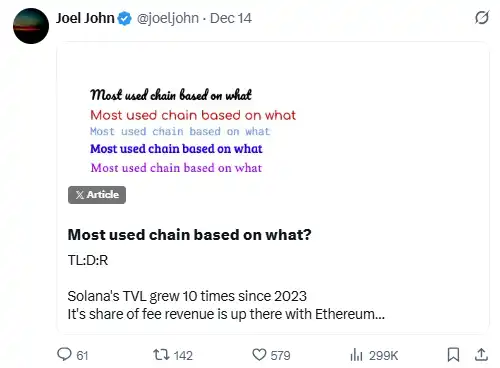
All of this has happened against the backdrop of an extremely brutal cycle for retail. Arbitrageurs have squeezed value to near its limits, altcoins have underperformed the market overall, and net developer inflow has dropped to a low. What this industry truly lacks is a spark of optimism, something that reminds people: the crypto world itself is still beautiful.

I believe Breakpoint lit that match.

When I walked into the Solana Breakpoint venue in Abu Dhabi, the first thing I felt wasn't excitement, but a movement in progress.

Not the kind of noisy, chaotic bustle. More like an undercurrent. A force in flow.

It didn't feel like entering a conference. There was no tension, no forced social pressure, no anxiety of "I must be in the right room at the right time." It felt more like a festival, a place where people weren't there to "extract value" from each other, but to genuinely celebrate "creation."

People were smiling, talking, moving around freely. Developers, creators, founders, institutions—everyone had their place, and overall, it wasn't unbalanced.

This sense of harmony was obvious from the start. No single group was overly amplified: institutions didn't dominate the narrative; creators weren't treated as mascots; founders weren't elevated to unreachable statuses. Everyone seemed approachable.

And that, in itself, is very rare.

The longer I stayed at Breakpoint, the more I felt that all this was not accidental, but deliberately designed.

The agenda wasn't like top-down information infusion: five-minute lightning talks, debates, product demos, conversations. Short, sharp, high information density. Letting more people be seen, rather than having a few repeatedly occupy the stage. You could clearly feel that this wasn't a one-time inspiration, but the result of long-term iteration.

Breakpoint wasn't achieved overnight, but gradually figured out "what really works" through years of practice.

A brief exchange I had with @paarugsethi from Superteam India was enough to make one realize how deeply the Solana ecosystem thinks about culture and the founder community.

Dissolving Elitism

But if there's one thing Solana does better than most ecosystems, it's this: it successfully dissolves elitism.

There's no invisible hierarchy here where "only a few voices matter." As long as you've genuinely built something valuable, even if it's small, you can get a platform to showcase it.

This openness changes everything: it reduces fear, invites more participation, and ultimately creates momentum. And momentum compounds.

After talking to more and more people, another characteristic became clear: within the Solana ecosystem, there is a shared sense of direction. Not a dogmatic consensus, but a state of "moving forward together." There are navigators, signal sources, and people who are seen as directional coordinates by others. Because of this, the ecosystem doesn't easily fragment.

In many ecosystems, people fight their own battles, narratives conflict, gaps keep widening, and everyone endlessly argues about "what should be," unwilling to accept "what is working."

Solana does it differently. If speculation works, it's accepted. If it fits the behavior of the new generation, it's studied, not shamed. There's no moral superiority, no whitewashing. Even memecoins, despite that phase being chaotic and predatory, were seen as an acceleration experiment, a stress test of internet capital markets.

The system crashed, some profited from it, and lessons were truly absorbed. Solana didn't pretend it never happened, but distilled the cognition as an "entire ecosystem." This acceptance, instead, made space for innovation, rather than accumulating resentment.

The most prominent feeling this year was Breakpoint's extreme builder-first nature. The market has cooled, prices are no longer狂热, the "100x overnight" crowd has noticeably decreased. But it's precisely at times like these that the real builders begin to shine.

DeFi appears more mature; infrastructure discussions return to reality: predictability of block space, latency optimization, how to make app execution cheaper and more reliable.

You can see this change in specific products: Kalshi choosing Solana as tokenization infrastructure; Phantom supporting consumer-facing interface experiences; Phoenix perps, Prop AMM, new market designs; experiments in AI, bots, privacy; hackathons, Superteam projects, those still rough but real early ideas. People come to listen to shares to learn, not to ask "how to pump this token."

This energy shift is extremely important. It makes the entire conference feel solid, honest, and product-centric.

If there's one discomfort, it's that some narrow-minded attitudes still exist in the ecosystem—"if it's not Solana-only, it's not worth attention."

This mindset isn't unique to Solana, but it shrinks the pie. The real opportunity isn't winning a public chain war, but reshaping the entire tech stack. And that can only be achieved through collaboration, not posturing.

The irony is: Solana doesn't need to proclaim loudly. Anyone walking into Breakpoint can feel it directly. This ecosystem doesn't need to mock each other online. The products, the culture, the builders, the momentum—they are loud enough.

A "Festival"

This brings me back to the initial conclusion: Solana has outgrown "holding conferences." Conferences are one-way, static, bounded. What Solana is doing now aligns more with the native form of the new generation: a festival, a celebration that exists for builders. A space where culture, capital, experimental spirit, and belief collide.

And these "festivals" will only continue to grow: more vibrant, more immersive, more diverse. Every corner adds new flavor to this internet that is taking shape.

Breakpoint 2025 is one of the best conferences I've ever attended, and it clearly shows where Solana is heading.

P.S.: In my view, choosing Abu Dhabi as the host city was an important reason why Breakpoint 2025 could be so special.


Criptomoedas em alta

Perguntas relacionadas

QWhat is the main concern raised by Abhitej about the evolution of Solana Breakpoint?

AAbhitej is concerned about whether builders, the core developers who code and create, remain at the center of the event as Breakpoint has scaled up from an early developer-led gathering into a large global conference with significant institutional and capital presence.

QAccording to the article, what makes Solana's ecosystem culture different from others?

ASolana's ecosystem culture is described as open, non-elitist, and builder-first. It successfully消解 (dissolves) elitism, where anyone who builds something valuable, even on a small scale, can get a platform. It lacks a hidden hierarchy and moral superiority, accepting what works—like投机 (speculation) or memecoins—as part of its experimental nature.

QWhat key change in energy or focus was observed at Breakpoint 2025 compared to more狂热 (frenzied) market times?

AThe energy at Breakpoint 2025 was more builder-first and product-centered. With the cooling market and fewer people seeking 'overnight 100x' gains, discussions shifted to mature DeFi, realistic infrastructure improvements (like predictable block space and lower costs), and genuine learning, rather than questions about token pumps.

QHow does the author describe the overall atmosphere and structure of Breakpoint?

AThe author describes Breakpoint not as a traditional conference but more like a '节日' (festival or celebration)—a dynamic, immersive space that feels like a movement. It lacks the pressure of traditional networking, is intentionally designed to be inclusive with short, high-density talks, and allows different groups (developers, creators, founders, institutions) to coexist harmoniously without any one dominating.

QWhat is one potential weakness or狭隘 (narrow-minded) attitude the author points out within the Solana ecosystem?

AThe author points out a narrow-minded attitude where some in the ecosystem believe that 'if it's not Solana-only, it's not worth paying attention to.' This mentality can limit collaboration and the larger opportunity to reshape the entire tech stack, which requires working together rather than engaging in tribal '公链战争' (public chain wars).

Leituras Relacionadas

Must-Watch Events Next Week|CLARITY Act Could Face Senate Vote; SpaceX, Circle to Report Earnings (8.3-8.9)

**Summary: Key Events and Developments to Watch (August 3-9)** The upcoming week is marked by significant financial disclosures, key legislative deadlines, and notable product updates. **Major Financial Events:** Several companies are scheduled to release their Q2 2026 earnings. American Bitcoin (ABTC) will report on August 3, followed by SpaceX and Hut 8 Mining Corp. on August 4, and Circle on August 5. Notably, a significant portion of SpaceX shares (up to 12% of total shares) will be unlocked on August 6 following their earnings release. **Key Legislative Deadline:** The U.S. Senate faces an August 7 deadline to secure 60 votes for the CLARITY Act, a bipartisan bill aiming to establish a federal regulatory framework for cryptocurrencies. The Senate may hold a full vote on the bill during the week. **Economic Data:** The U.S. July Non-Farm Payrolls report will be released on August 7, providing crucial labor market data. **Technology & Product Updates:** * **Shutdowns:** DeFi portfolio tracker Zapper and wallet app Ctrl Wallet will cease operations on August 3. * **Upgrades:** LayerZero will deprecate its v1 relayers on August 3. XRP Ledger's new version 3.3.0, featuring five new functions, is expected next week. * **AI:** Elon Musk announced that the advanced Grok 4.6 AI model is set for release around August 7. * **Bitcoin:** The BIP-110 forced signaling for a potential Bitcoin network change is scheduled to begin around August 8. **Other Notable Events:** Chinese robotics firm Unitree Tech has set its preliminary price inquiry for its IPO for August 5. South Korean exchange Upbit will delist AQT and AERGO tokens on August 3.

marsbitHá 1h

Must-Watch Events Next Week|CLARITY Act Could Face Senate Vote; SpaceX, Circle to Report Earnings (8.3-8.9)

marsbitHá 1h

Stocks Are Plummeting More Sharply Than Cryptocurrencies. Where Has the Money Gone?

Stock Markets Plunge Deeper Than Cryptocurrencies: Where Did the Money Go? In late July, Seoul's Kospi index triggered circuit breakers for two consecutive days, plummeting over 40% from its June high. The collapse was led by heavyweight stocks like SK Hynix, whose record profits still disappointed investors, and devastating leveraged ETFs, with one major product losing over 83% of its value. This signaled a global, forced deleveraging targeting the most crowded trades. Interestingly, while stocks exhibited extreme volatility akin to crypto markets, Bitcoin rose nearly 15% in July after a prior steep drop. Analysis shows the money fleeing equities did not flow into Bitcoin. Instead, Bitcoin had already absorbed its sell-off in May-June, when U.S. spot Bitcoin ETFs saw historic outflows. The true safe-haven beneficiary was gold, whose price rose over 20% year-on-year, highlighting a decoupling between Bitcoin and gold as "digital gold." The sell-off was a targeted unwinding of leveraged positions in tech and semiconductors, accelerated by broker-dealer risk management and shifts in the AI narrative, including new competition from Chinese memory chipmakers. The retreat path was clear: from high-valuation tech stocks to cash and U.S. Treasuries, then to gold. For Bitcoin to attract sustained institutional inflows, conditions like eased global liquidity pressure, a "soft-landing" Fed rate cut, and U.S. regulatory clarity via legislation like the stalled CLARITY Act are needed. Currently, Bitcoin is not a safe haven but an already-cleared asset. Its low correlation with tech stocks, however, makes it a potential diversification play for institutional portfolios once the storm passes. The money isn't here yet, but the positioning is underway.

marsbitHá 1h

Stocks Are Plummeting More Sharply Than Cryptocurrencies. Where Has the Money Gone?

marsbitHá 1h

In Conversation with Ray Dalio: We Are Currently in an AI Bubble, with 1% of My Portfolio in Bitcoin

Ray Dalio, founder of Bridgewater Associates, warns in an interview that the current AI boom shows classic bubble characteristics, which could lead to significant economic downturns as seen in past cycles like 1929 or 2000. He explains that speculative enthusiasm, fueled by debt and overvaluation, often precedes a crash when rising rates or taxation force asset sales, causing widespread losses and recession. Dalio also outlines his "Big Cycle" theory, describing an approximate 80-year pattern where widening wealth gaps, massive government deficits, and shifting geopolitical power (like China's rise) create internal conflict and global instability. He emphasizes that we are in a late-cycle, transitional phase where traditional powers like the US and UK face decline. For personal wealth protection, Dalio advises diversification beyond cash into assets like stocks, bonds, real estate, and particularly gold, which he prefers over Bitcoin. While he holds about 1% of his portfolio in Bitcoin as a non-printable hard asset, he views gold as more secure from technological or governmental threats. Regarding AI's impact, Dalio believes it will disproportionately benefit capital owners, worsening inequality by replacing both physical and cognitive labor. He suggests that human intuition and emotional intelligence, combined with AI, will be key for future workers. On taxation, Dalio argues that wealth taxes are impractical and risk triggering asset sell-offs, reducing productive investment. He points to the UK as a cautionary example of debt, low productivity, and political strife. Geopolitically, Dalio foresees a more regionalized world, with the US showing weakness in prolonged conflicts like with Iran, akin to past imperial declines. The ideal outcome, he suggests, is coexisting powerful blocs (e.g., Americas, China-Asia Pacific) without major war.

marsbitHá 5h

In Conversation with Ray Dalio: We Are Currently in an AI Bubble, with 1% of My Portfolio in Bitcoin

marsbitHá 5h

Trading

Spot

Artigos em Destaque

Como comprar O

Bem-vindo à HTX.com!Tornámos a compra de O1 exchange (O) simples e conveniente.Segue o nosso guia passo a passo para iniciar a tua jornada no mundo das criptos.Passo 1: cria a tua conta HTXUtiliza o teu e-mail ou número de telefone para te inscreveres numa conta gratuita na HTX.Desfruta de um processo de inscrição sem complicações e desbloqueia todas as funcionalidades.Obter a minha contaPasso 2: vai para Comprar Cripto e escolhe o teu método de pagamentoCartão de crédito/débito: usa o teu visa ou mastercard para comprar O1 exchange (O) instantaneamente.Saldo: usa os fundos da tua conta HTX para transacionar sem problemas.Terceiros: adicionamos métodos de pagamento populares, como Google Pay e Apple Pay, para aumentar a conveniência.P2P: transaciona diretamente com outros utilizadores na HTX.Mercado de balcão (OTC): oferecemos serviços personalizados e taxas de câmbio competitivas para os traders.Passo 3: armazena teu O1 exchange (O)Depois de comprar o teu O1 exchange (O), armazena-o na tua conta HTX.Alternativamente, podes enviá-lo para outro lugar através de transferência blockchain ou usá-lo para transacionar outras criptomoedas.Passo 4: transaciona O1 exchange (O)Transaciona facilmente O1 exchange (O) no mercado à vista da HTX.Acede simplesmente à tua conta, seleciona o teu par de trading, executa as tuas transações e monitoriza em tempo real.Oferecemos uma experiência de fácil utilização tanto para principiantes como para traders experientes.

446 Visualizações TotaisPublicado em {updateTime}Atualizado em 2026.06.29

Como comprar O

Como comprar PROS

Bem-vindo à HTX.com!Tornámos a compra de Pharos (PROS) simples e conveniente.Segue o nosso guia passo a passo para iniciar a tua jornada no mundo das criptos.Passo 1: cria a tua conta HTXUtiliza o teu e-mail ou número de telefone para te inscreveres numa conta gratuita na HTX.Desfruta de um processo de inscrição sem complicações e desbloqueia todas as funcionalidades.Obter a minha contaPasso 2: vai para Comprar Cripto e escolhe o teu método de pagamentoCartão de crédito/débito: usa o teu visa ou mastercard para comprar Pharos (PROS) instantaneamente.Saldo: usa os fundos da tua conta HTX para transacionar sem problemas.Terceiros: adicionamos métodos de pagamento populares, como Google Pay e Apple Pay, para aumentar a conveniência.P2P: transaciona diretamente com outros utilizadores na HTX.Mercado de balcão (OTC): oferecemos serviços personalizados e taxas de câmbio competitivas para os traders.Passo 3: armazena teu Pharos (PROS)Depois de comprar o teu Pharos (PROS), armazena-o na tua conta HTX.Alternativamente, podes enviá-lo para outro lugar através de transferência blockchain ou usá-lo para transacionar outras criptomoedas.Passo 4: transaciona Pharos (PROS)Transaciona facilmente Pharos (PROS) no mercado à vista da HTX.Acede simplesmente à tua conta, seleciona o teu par de trading, executa as tuas transações e monitoriza em tempo real.Oferecemos uma experiência de fácil utilização tanto para principiantes como para traders experientes.

469 Visualizações TotaisPublicado em {updateTime}Atualizado em 2026.06.29

Como comprar PROS

O que é VERONA

I. Introdução ao Projeto VERONA é uma blockchain construída para todos, em todo o lado, através da abstração da cadeia. Utilizando a sua camada de Abstração Generalizada, a VERONA distingue-se por integrar funcionalidades complexas de blockchain, como contas, assinaturas e interoperabilidade, diretamente ao nível do protocolo. Esta abordagem permite a interação com aplicações de blockchain sem a necessidade de compreender as tecnologias subjacentes.1) Informação Básica Nome: VERONA (VERONA)III. Links Relacionados Link do site oficial: https://xion.burnt.com/ Whitepaper: https://xion.burnt.com/whitepaper.pdf Exploradores: https://explorer.burnt.com/ Mídias Sociais: https://x.com/burnt_xion Nota: A introdução ao projeto provém dos materiais publicados ou fornecidos pela equipa oficial do projeto, que é apenas para referência e não constitui aconselhamento de investimento. A HTX não se responsabiliza por quaisquer perdas diretas ou indiretas resultantes.

1.2k Visualizações TotaisPublicado em {updateTime}Atualizado em 2026.06.22

O que é VERONA

Discussões

Bem-vindo à Comunidade HTX. Aqui, pode manter-se informado sobre os mais recentes desenvolvimentos da plataforma e obter acesso a análises profissionais de mercado. As opiniões dos utilizadores sobre o preço de A (A) são apresentadas abaixo.

活动图片













