What Are the Key Challenges in Robinhood's Advancement of Tokenized Stocks?

marsbitPublicado em 2026-01-30Última atualização em 2026-01-30

Resumo

Robinhood's push into tokenized stocks faces a key challenge: accurately reflecting corporate actions like stock splits and dividends on-chain. While blockchain-based tokenization promises real-time synchronization and transparency, Robinhood’s custom contracts on Arbitrum deviate from standard ERC-20 logic, causing significant data misinterpretations by third-party platforms. High-yield ETFs with frequent return-of-capital distributions and reverse stock splits require dynamic rebasing mechanisms that adjust token supply to reflect underlying NAV erosion or share consolidation. However, external data aggregators using conventional ERC-20 models overestimate circulating supply and market cap—sometimes by 10x to 100x—because they fail to capture these off-ledger adjustments. Of the 21 mismatched tokens identified, reported supply was inflated by 56%, with ~90% of errors stemming from dividend-driven NAV adjustments and the rest from reverse splits. Unlike Solana’s Token-2022 standard—which natively supports UI-scaling extensions—EVM chains lack a rebasing standard, forcing issuers like Robinhood and xStocks to use custom implementations. A proposed ERC-8056 standard aims to create a unified interface for corporate actions on Ethereum, which would improve interoperability and data accuracy across platforms.

Compiled by: Ken, Chaincatcher

Legendary investor Warren Buffett holds an almost religious, steadfast opposition to the concept of "stock splits."

The reason Berkshire Hathaway Class A shares trade at over $700,000 per share is that Buffett believes stock splits are merely a formalistic move that does not change the fundamental value of the enterprise. In Buffett's world, if you cut a pizza into eight slices instead of four, you don't get more pizza. You just have more dishes to wash.

While stock splits may not be a "big deal" from a valuation perspective, they are highly regulated activities overseen by the U.S. Securities and Exchange Commission and enforced by exchanges.

When a company announces a stock split, it must file a Form 8-K and notify shareholders in advance before the change takes effect. This critical time window allows transfer agents to adjust the share register, brokers to update internal systems, and data providers like Bloomberg to update their data feeds—so that a $500 stock doesn't appear to have crashed to $50 overnight after a 10-for-1 split.

Stock splits are not the only corporate actions that require this high level of coordination. Dividend distributions present similar complexities.

On the ex-dividend date, the stock price is adjusted downward by the amount of the dividend. Some funds, particularly high-yield income funds, take this practice to the extreme. They frequently distribute income, but these distributions are largely return of capital, essentially returning the investor's principal to them rather than paying investment profits. While the number of shares remains the same, the net asset value (NAV) is steadily eroded over time.

Tracking the performance of these funds requires a clear distinction between price return and total return.

Assume you hold 100 shares of a high-yield ETF, priced at $100 per share (an investment of $10,000). The fund distributes $5 per share monthly, with 90% classified as return of capital. After 12 months, you received $60 per share in cash (total $6,000), but the fund's NAV has dropped from $100 to $46. At this point, the total price return is negative $5,400, but the total return is $10,600 (remaining NAV $4,600 plus distributions of $6,000), a positive return of 6%.

These are precisely the problems blockchain is supposed to solve.

A single, shared ledger, updated atomically and visible to everyone simultaneously. If everyone reads from the same on-chain record, corporate actions like stock splits and dividends would propagate instantly throughout the system, eliminating the cumbersome and frantic reconciliation work currently done between isolated intermediaries.

It was this promise that led to a warm market reception when Robinhood (@RobinhoodApp) CEO Vlad Tenev announced the tokenized stock strategy in June 2025.

Six months on, Robinhood's tokens are officially live, and data is flowing. Unfortunately, some issues are beginning to surface.

The Good

Robinhood's announcement acted as a catalyst for the market.

Other issuers quickly moved to launch competing products. Backed Finance (acquired by Kraken) launched xStocks (@xStocksFi) on Solana, followed by Ondo Global Markets (@OndoFinance) launching its tokenized stock product.
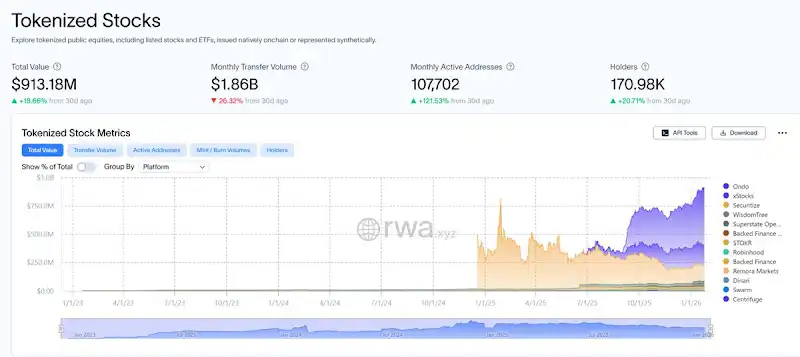
RWA.xyz data as of January 23, 2026

Tokenized stocks had a truly breakout year. In the second half of 2025 alone, the asset class grew by 128%, pushing the total asset value to nearly $1 billion.
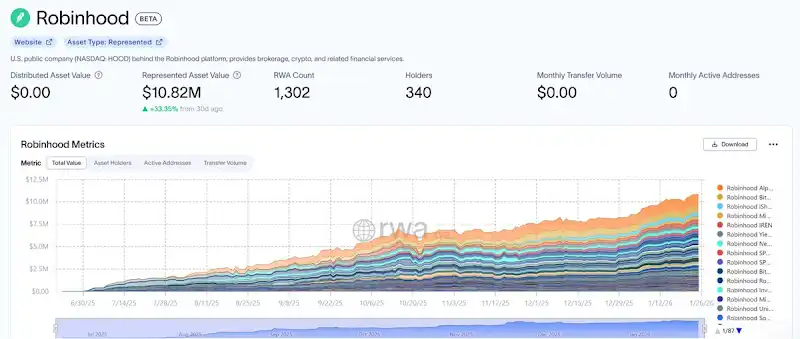
RWA.xyz data as of January 23, 2026

Robinhood's tokenized U.S. stocks and ETFs are now available to European customers. Each token is issued on the Arbitrum network, fully backed by stocks held by Robinhood, and enables 24/5 trading with zero commission. Relevant data is available on RWA.xyz.

However, accurately capturing the metrics for Robinhood's tokenized stocks has proven more complex than anticipated.

The Bad

Most blockchain data platforms index tokens assuming they follow standard conventions. For ERC-20 tokens, this means tracking mints and burns, accumulating the total supply from zero, and calculating market cap as supply multiplied by price.

This works for thousands of tokens on Ethereum and other EVM networks. But ERC-20 was not designed for securities that undergo corporate actions. The standard does not natively support stock splits, reverse splits, or benchmark adjustments driven by dividends.

Consequently, Robinhood had to use custom contracts to properly handle these events and ensure the rights of its end-users. These tokens work fine within the Robinhood App, but their mechanics are opaque to external data platforms and incompatible with DeFi protocols—both of which assume standard ERC-20 tokens.

When we compare the token supply calculated using standard ERC-20 logic with the actual on-chain data, the discrepancies are too large to ignore. Some tokens are off by a factor of 10, others by as much as 100.

Almost all errors can be attributed to two causes: (1) NAV erosion from dividends and (2) reverse stock splits.

NAV Erosion from High-Yield ETF Dividends

Data as of January 23, 2026

These are high-yield option income ETFs that pay frequent distributions, with 90% or more of the payout classified as "return of capital." Each distribution returns cash to investors, but this is primarily a return of principal rather than investment profits. The number of shares remains constant, while the NAV steadily declines over time.

Robinhood's contracts address this by decoupling "shares" from "tokens." The holder's share count remains the same, but an internal multiplier adjusts the reported token supply downward as return of capital accumulates, reflecting the erosion of the underlying NAV.

However, data platforms following the standard ERC-20 model simply add up mints and burns. This approach fails to capture this re-basing adjustment, overestimating the circulating token supply and thus the reported market cap.

Reverse Stock Splits
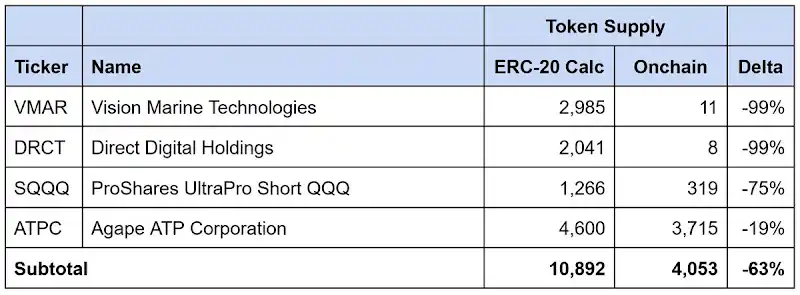
Data as of January 23, 2026

<极好的span style="font-size: inherit; font-family: PingFang SC,Helvetica Neue,Helvetica,Arial,Hiragino Sans GB,Heiti SC,Microsoft YaHei,WenQuanYi Micro Hei,sans-serif;">The same issue arises with reverse stock splits. Reverse splits increase the per-share price by consolidating shares, often to meet exchange listing requirements. The number of shares is reduced proportionally, but the price per share increases proportionally, leaving the total value unchanged.

Again, Robinhood's contracts adjust the token supply to reflect the reverse split, while third-party platforms following the standard ERC-20 model overestimate the circulating supply and reported market cap.

Total Robinhood Data Discrepancy
Data as of January 23, 2026

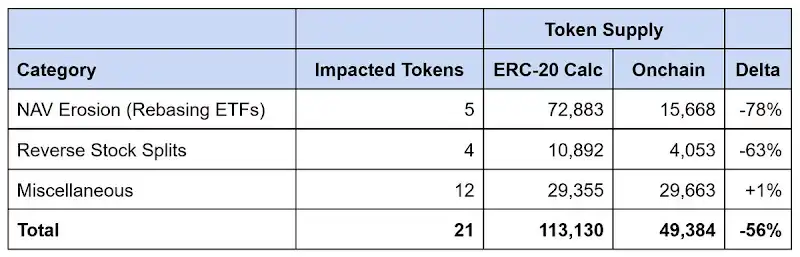
Among the 21 tokens we identified with data mismatches, the reported supply was overestimated by approximately 64,000 tokens, a discrepancy of up to 56%. NAV erosion from high-yield ETFs accounted for about 90% of this gap, with reverse stock splits explaining the remainder.

Any data platform relying on standard ERC-20 logic to calculate supply will severely overestimate the market cap of Robinhood's tokenized stocks, often by multiples.

The Solution

Tokenized Stock Taxonomy: Models & Infrastructure
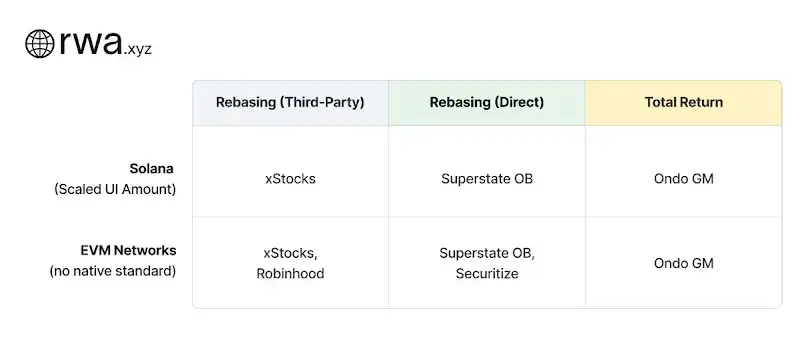
Tokenized stock issuers have taken different approaches to handling corporate actions. They can be broadly categorized into two types.

Rebasing Models

Rebasing models maintain现货价格平价 (spot price parity): meaning 1 token should always trade close to the price of 1 underlying share. When a corporate action occurs, token balances are automatically adjusted to maintain this relationship. Issuers using this method fall into two camps based on their relationship with the underlying asset issuer:

  • Rebasing (Third-Party): The issuer operates independently of the company whose stock is tokenized. Both xStocks (@xStocksFi, under Backed Finance / Kraken) and Robinhood (@RobinhoodApp) take this approach. Tokens are backed by custodied shares, but due to no direct relationship with the underlying issuer, they replicate economic exposure without conferring legal ownership.
  • Rebasing (Direct): The issuer partners with the public company to tokenize its shares. Superstate's Opening Bell (@SuperstateInc) and Securitize (@Securitize) operate as SEC-registered transfer agents and serve as the official shareholder registry. Because tokens are issued in coordination with the company, the tokens themselves are the legal securities, affording holders actual shareholder rights not available in the third-party model.

Both structures require multiplier infrastructure to reflect corporate actions on-chain.

Solana's Token-2022 standard natively provides a scaling UI amount extension. The issuer simply updates a multiplier, which then adjusts the balance displayed in the user interface without changing the raw token amount. For example, a 2-for-1 stock split changes the multiplier from 1.0 to 2.0; wallets显示 double the balance, while the underlying raw token count remains unchanged. As the standard is native to Solana, data platforms can directly query for multiplier changes.

EVM networks currently lack an equivalent standard. Issuers like xStocks and Robinhood have had to build their own multiplier mechanisms. While balances adjust correctly and wallets display prices consistent with the spot price, these implementations are bespoke. Third parties relying on standard ERC-20 calls cannot detect when the multiplier changes or query its current value. Therefore, each issuer's specific implementation must be understood separately.

This is why Chris Ridmann of Superstate and Gilbert Shih of Robinhood co-drafted ERC-8056, a proposed draft standard aiming to introduce a standardized "Scaling UI Amount Extension" for ERC-20 tokens. This would provide data platforms with a unified interface for tracking corporate actions across issuers.


Perguntas relacionadas

QWhat are the key challenges Robinhood faces in advancing tokenized stocks according to the article?

AThe key challenges are accurately handling corporate actions like stock splits, reverse splits, and dividend-driven principal return distributions within the ERC-20 standard framework. Their custom contracts for these events are opaque to external data platforms and DeFi protocols, leading to significant miscalculations in reported token supply and market capitalization by third parties using standard ERC-20 logic.

QHow do high-yield ETFs cause net asset value erosion, and how does it affect token supply calculations?

AHigh-yield ETFs frequently distribute dividends, with over 90% often classified as a return of principal. This returns the investor's own capital rather than profit, so the share count remains the same but the net asset value (NAV) steadily declines over time. Robinhood's contracts use an internal multiplier to adjust the reported token supply downward to reflect this NAV shrinkage. Standard ERC-20 data platforms, which simply sum mints and burns, cannot capture this re-basing, causing them to overestimate the circulating token supply and market cap.

QWhat problem does a reverse stock split create for tokenized stocks on-chain?

AA reverse stock split reduces the number of shares to increase the price per share, keeping the total value constant. Robinhood's contracts adjust the token supply to reflect this change. However, third-party data platforms using the standard ERC-20 model fail to account for this adjustment, leading them to overestimate the circulating supply and the reported market capitalization of the token.

QWhat are the two main categories of models for handling corporate actions in tokenized stocks?

AThe two main categories are Rebasing Models. These maintain spot price parity (1 token ≈ 1 share) and automatically adjust token balances during corporate actions. They are further divided into Rebasing (Third-Party), where the issuer is independent of the company (e.g., xStocks, Robinhood), and Rebasing (Direct), where the issuer partners with the public company and the token is the legal security itself, providing actual shareholder rights (e.g., Superstate, Securitize).

QWhat proposed solution aims to standardize the handling of corporate actions for ERC-20 tokenized stocks?

AERC-8056 is a draft proposal co-authored by Chris Ridmann of Superstate and Gilbert Shih of Robinhood. It aims to introduce a standardized 'Scaling UI Amount Extension' for ERC-20 tokens. This would provide a unified interface for data platforms to track corporate actions across different issuers on EVM networks, which currently lack a native standard like Solana's Token-2022.

Leituras Relacionadas

KOL's Perspective: Why Is SOL Set to Rise from This Point?

**Summary: Why SOL is Positioned for Growth at This Level** The article argues that SOL is poised for an upward move from its current price point, citing several key factors. Primarily, SOL has just broken out of a 4-month consolidation phase. This breakout signals a return of risk appetite to the broader crypto market, as SOL is seen as a key indicator of overall crypto health. The token's ownership has reportedly shifted from short-term traders and tourists to long-term accumulators, leading to low volume. Any meaningful increase in trading activity could thus trigger significant upward momentum. Fundamental strengths include strong institutional adoption, integration with DeFi and RWAs (Real-World Assets), and the potential benefits from the Clarity Act. Despite its high volatility—having dropped 70% from its all-time high but still up 12x from its bear market low—SOL is highlighted as one of the few tokens from the last cycle to reach new highs. It boasts a robust ecosystem of applications, users, and protocols. Future catalysts include the expected influx of AI developers following the Miami Accelerate conference, which focused on AI on Solana. Furthermore, Solana is positioned as the premier chain for memecoin activity, a trend expected to continue and drive network usage and fees. The article concludes that recent price action reflects a healthy transfer to long-term holders, setting the stage for growth.

marsbitHá 10m

KOL's Perspective: Why Is SOL Set to Rise from This Point?

marsbitHá 10m

Those Pre-Bitcoin PoW Protocols Have Recently Been Reimplemented

This article details a recent surge in replicating pre-Bitcoin Proof-of-Work (PoW) protocols, specifically focusing on Hal Finney's 2004 RPOW (Reusable Proofs of Work). Within five days in May 2026, multiple independent builders in the Bitcoin/cypherpunk community launched projects inspired by this early electronic cash proposal. The initiative began with Fred Krueger's `rpow2.com`, a centralized but auditable system that replaced RPOW's original IBM 4758 hardware with Ed25519 signatures. Initially a faithful replica, it later adopted Bitcoin-like features (21M supply cap, difficulty adjustment) and a controversial 5.24% founder allocation. This sparked rapid forks, including `rpow4.com` which incorporated full Bitcoin parameters, a prediction market (`rpowmarket.com`), and a DEX (`rpow2swap.com`). Concurrently, Mike In Space created a prototype of Wei Dai's 1998 b-money proposal (`b-money.replit.app`), pushing the historical exploration even further back. The article contrasts these centralized, server-dependent experiments with Bitcoin's core innovation of decentralized, trustless consensus. It also highlights a parallel development: the `HASH` project on Ethereum, which uses smart contract hooks to enable a purely fair-launch, browser-mineable PoW token with 0% allocations to team or VCs. The collective activity is framed as a meme-driven, educational exploration of cypherpunk history rather than a serious financial movement, with all projects heavily disclaiming any investment value.

marsbitHá 15m

Those Pre-Bitcoin PoW Protocols Have Recently Been Reimplemented

marsbitHá 15m

South Korean Exchanges 'Battle' Regulators, Challenging the Boundaries of Enforcement and Legislation

South Korea's cryptocurrency industry is engaged in a rare, direct confrontation with regulators. The Financial Intelligence Unit (FIU), the primary anti-money laundering (AML) watchdog, has recently imposed heavy penalties on major exchanges like Upbit and Bithumb for alleged violations involving unregistered overseas VASPs and AML procedures. However, exchanges are now actively challenging these actions in court and through industry associations. In a significant shift, the Seoul Administrative Court ruled in favor of Upbit's operator, Dunamu, overturning part of an FIU-ordered business suspension. The court found the FIU's penalty criteria and justification insufficiently clear. Similarly, the court suspended the enforcement of a six-month business suspension against Bithumb pending a final ruling, citing potential irreversible harm to the exchange. Beyond legal battles, the industry is contesting proposed legislative amendments. The Digital Asset eXchange Alliance (DAXA) strongly opposes a draft rule that would mandate Suspicious Transaction Reports (STRs) for all crypto transfers over 10 million KRW (~$6,800). DAXA argues this "poison pill" clause violates legal principles and would overwhelm the STR system, increasing reports from 63,000 to an estimated 5.45 million annually for major exchanges, thereby crippling effective AML monitoring. This conflict highlights a structural tension in South Korea's crypto governance: comprehensive digital asset laws are still developing, while regulators rely heavily on AML enforcement. The industry's move from passive compliance to active legal and legislative challenges signifies a new phase, pressing for clearer rules and more proportionate enforcement. While short-term disputes may intensify, this clash could ultimately lead to a more mature and sustainable regulatory framework for South Korea's vibrant crypto market.

marsbitHá 1h

South Korean Exchanges 'Battle' Regulators, Challenging the Boundaries of Enforcement and Legislation

marsbitHá 1h

After 50x Storage Surge, Justin Sun Always Looks to the Next Decade

Sun Yuchen, known for his controversial stunts like a $30 million lunch with Warren Buffett (canceled due to a kidney stone) and eating a $6.2 million duct-taped banana, is often overshadowed by a significant fact: his decade-long track record of spotting major investment trends. In 2016, he famously advised young people to invest in Bitcoin, Nvidia, Tesla, and Tencent instead of buying property. A hypothetical $20,000 investment in Nvidia and Tesla from that list would now be worth over 50 million RMB. His latest major call was on November 6, 2025, predicting a "50x storage opportunity" tied to the AI boom, which materialized with Sandisk's stock surging nearly 50-fold by 2026. Looking ahead, Sun now focuses on the next frontier: Physical AI. He identifies four key areas: 1. **Embodied AI/Robotics**: He sees this reaching its "iPhone moment," with companies like UBTech and Galaxy General leading in commercialization. 2. **Drones**: Viewed as the first commercially viable form of Physical AI, revolutionizing sectors from warfare (e.g., AeroVironment's Switchblade) to logistics. 3. **Spatial Computing**: Beyond VR, it's about AI understanding physical space, a foundational technology for robotics and autonomous systems, exemplified by Apple's Vision Pro. 4. **Space Exploration**: After a 2025 suborbital flight with Blue Origin, Sun advocates for space as the ultimate frontier, discussing blockchain's potential role in space asset management and data transactions. His investment philosophy involves betting on entire, inevitable trends rather than single companies. For robotics, he sees Tesla (the body/manufacturer) and Nvidia (the brain/AI platform) as complementary plays. In defense drones, he highlights companies making tanks obsolete (AeroVironment) and those augmenting fighter jets (Kratos). For space, he participated in Blue Origin's flight and anticipates SpaceX's potential IPO to redefine the sector's valuation. Sun Yuchen's vision frames the next two decades not as a revolution in information flow (like the internet), but in the fundamental operation of the physical world through AI-powered robots, autonomous systems, and spatial intelligence, ultimately extending human and AI activity into space. While many still focus on conventional assets, he continues to look toward the next technological horizon.

marsbitHá 2h

After 50x Storage Surge, Justin Sun Always Looks to the Next Decade

marsbitHá 2h

Trading

Spot
Futuros
活动图片