Weng Li's New Blog Proposes 'Self-Evolution Should Start from Harness', DeepSeek's Cui Tianyi Endorses with Repost

marsbitPublicado em 2026-07-08Última atualização em 2026-07-08

Resumo

Lilian Weng, former OpenAI security VP and co-founder of Thinking Machines Lab, has published a new blog post titled "Harness Engineering for Self-Improvement," proposing a pragmatic path for AI self-evolution. She argues that Recursive Self-Improvement (RSI) may practically begin at the "Harness" layer—the external runtime system governing how models use tools, manage context, and execute tasks—rather than directly from the model rewriting its own weights. The blog outlines a progression from optimizing prompts (Context Engineering) to designing workflows, and ultimately to Self-Improving Harness systems. These systems can identify their own weaknesses, propose targeted, verifiable modifications to the harness code, and validate improvements. Works like Self-Harness and Darwin Gödel Machine (DGM) demonstrate significant performance gains on benchmarks like SWE-bench through such automated harness evolution, rivaling handcrafted agents. DeepSeek researcher Tianyi Cui endorsed the view, noting harness-based self-evolution is as promising as model-based approaches. Weng emphasizes this is complementary to model training, with both reinforcing each other. However, key challenges remain: weak evaluators for subjective tasks, reward hacking, diversity collapse, managing long-term system health versus short-term success, and defining the human oversight role. The consensus is growing: the harness is a critical variable, as the same model can exhibit vastly different capabilities ...

Former OpenAI safety vice president, co-founder of Thinking Machines Lab, Weng Li, has published a new blog post.

This time, she discusses AI self-evolution, proposing a practical path:

It doesn't necessarily have to start with the model directly rewriting its own weights; it can start with Harness first.
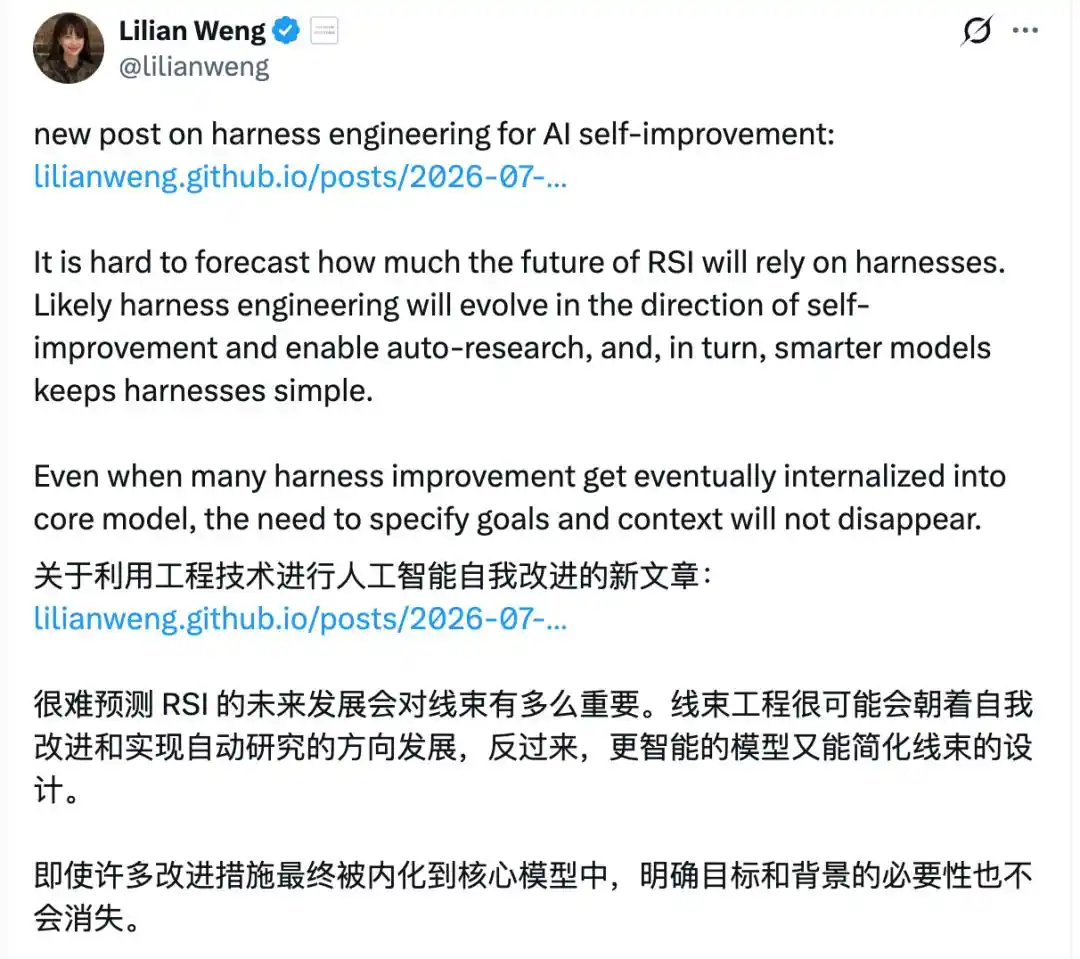
This blog post is titled "Harness Engineering for Self-Improvement."

Here, Harness can be simply understood as the model's external runtime system, which determines how the model invokes tools, manages context, reads and writes files, splits tasks, calls sub-agents, validates results, and reviews failures.

DeepSeek researcher Cui Tianyi also reposted it immediately, highlighting key points:

Self-evolution in the Harness direction is just as promising for results as self-evolution in the model direction.
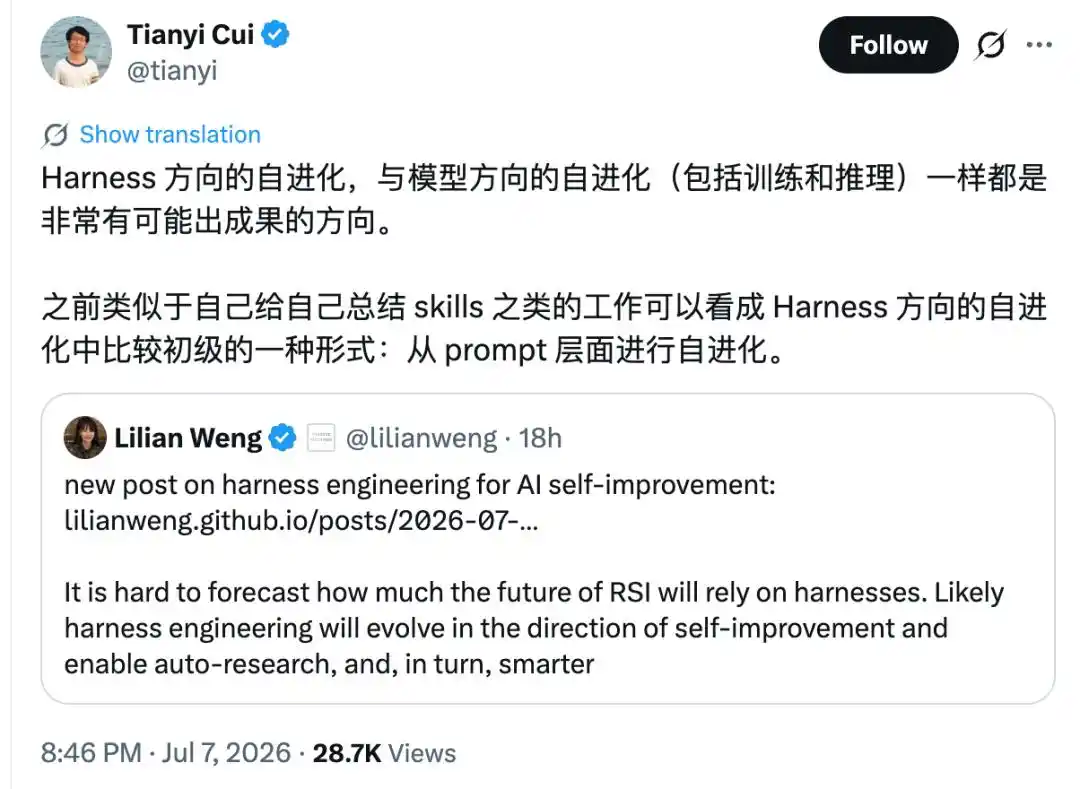
He also proposed that Skill is a relatively elementary form within Harness self-evolution: self-evolution at the prompt level.

The original blog post is packed with enormous information; dear readers, please be mentally prepared~

Self-Evolution Might Happen First in the Harness Layer

The core concept discussed in Weng Li's blog is RSI (Recursive Self-Improvement).

This concept originally carried strong AGI connotations, referring to an intelligent system improving the mechanisms that generate its own intelligence, thereby producing more capable successor systems.

But in this blog post, Weng Li breaks down this issue in a more engineering-focused way.

In today's AI systems, self-improvement doesn't necessarily only mean the model directly rewriting its own weights.

It could also mean the model improving the training pipeline, research pipeline, and deployment system, thereby helping the next-generation system perform better on real-world tasks.
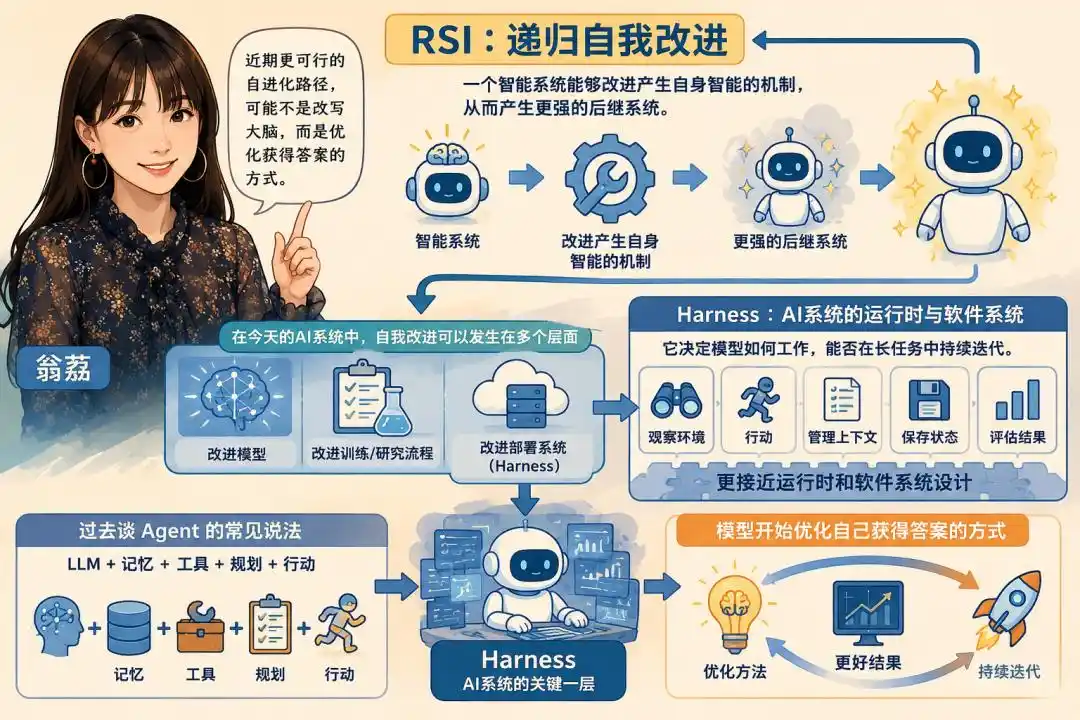
And Harness is the most critical layer within the deployment system.

When talking about Agents in the past, the common description was "LLM + Memory + Tools + Planning + Action."

But in Weng Li's view, Harness is no longer just a few modules from early Agent frameworks; it's closer to runtime and software system design.

It determines how the model observes the environment, how it acts, how it manages context, how it saves state, how it evaluates results, and also determines whether the model can iterate continuously within a long task.

Therefore, her judgment is: a more feasible near-term path for self-evolution might not be the model directly rewriting its own brain, but rather the model beginning to optimize the way it obtains answers.

From Context Engineering to Self-Harness, Optimization Progresses Layer by Layer

Weng Li reviews a recent batch of related research, revealing a clear trend:

The target of optimization is gradually moving from context, workflow, deeper into Harness itself.

The progression chain is: prompt → structured context → workflow → harness code → optimizer code.

As models become more powerful, the objects that can be optimized also become more abstract and more general.

The first layer is Context Engineering.

The most basic problem is: when an Agent works on long tasks, context piles up more and more, quickly becoming unmanageable.

Weng Li mentions two representative works here: ACE and MCE.

ACE (Agentic Context Engineering) treats context as a continuously updated "operating manual" rather than an ever-growing prompt.
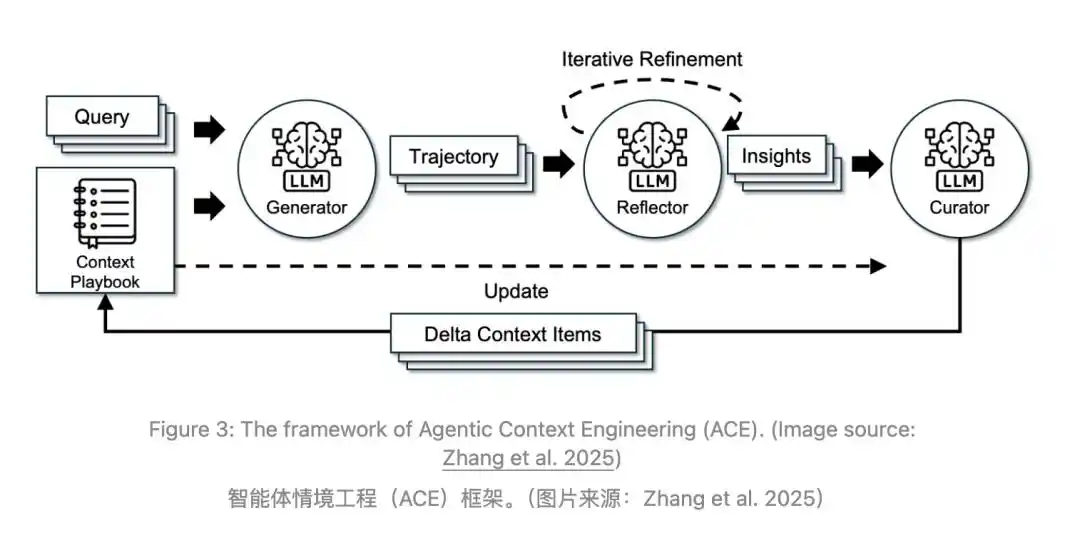
It relies on three roles: the Generator is responsible for generating task trajectories, the Reflector extracts key points from successful and failed trajectories, and the Curator organizes these points into structured entries, incrementally updating the manual.

MCE (Meta Context Engineering) goes a step further.

It separates "how to manage context" and "what specific content to put in context" into two optimization layers: the outer layer evolves skills for managing context, and the inner layer then uses this skill to optimize the context for specific tasks.
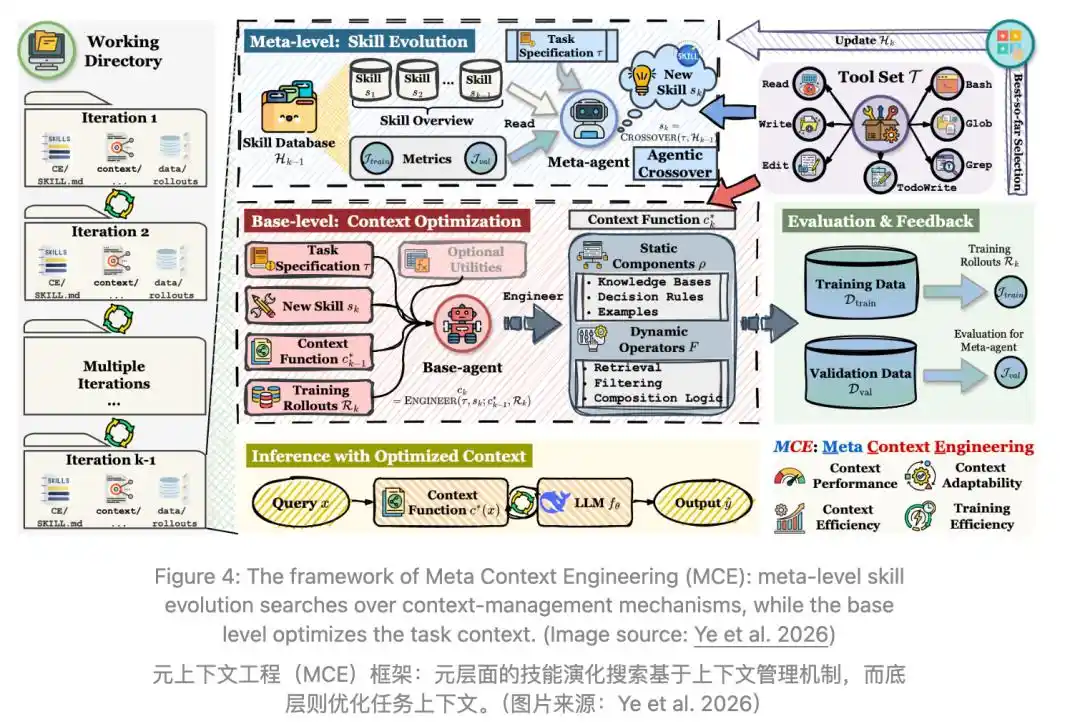
Weng Li believes that compared to ACE, which still requires manually designed update rules, MCE takes another step towards "self-managed memory."

The second layer is Workflow Design, which solves the problem of "how should the model work?"

Weng Li gives several examples:

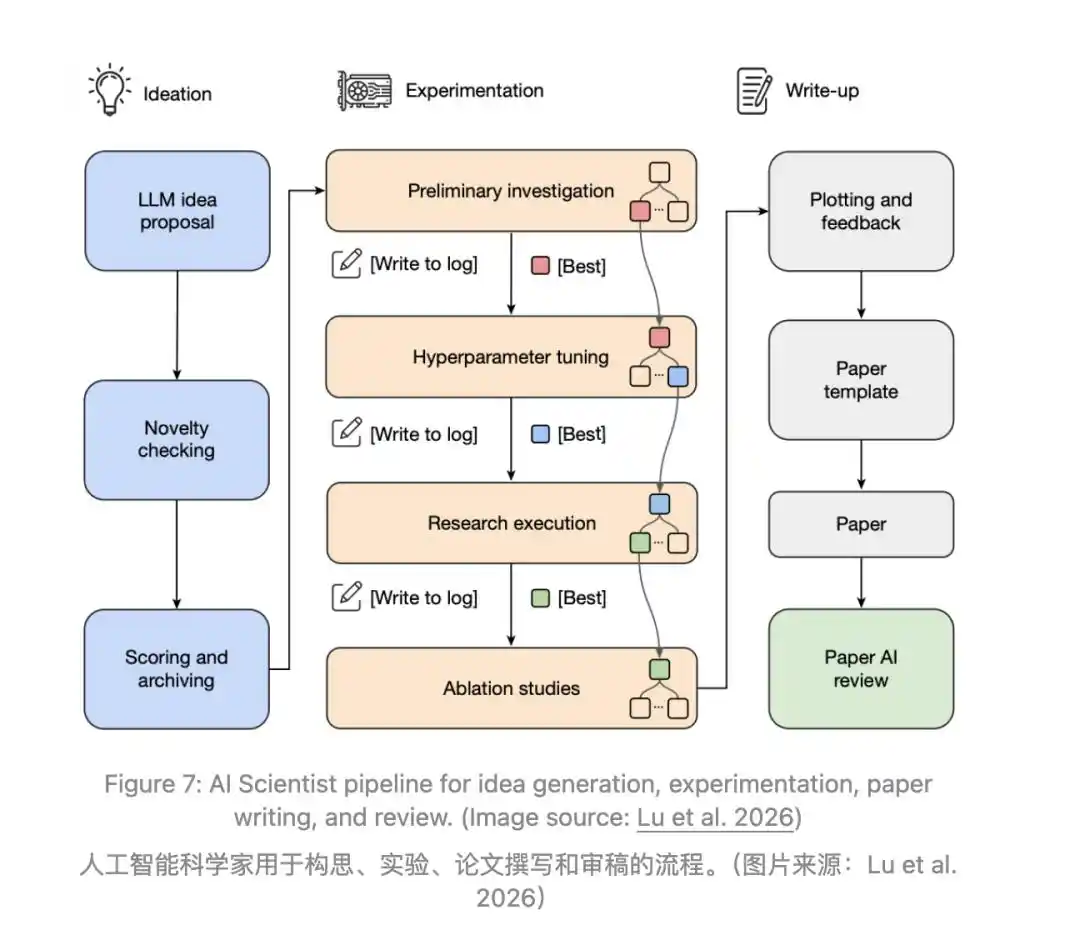
AI Scientist built a complete scientific research pipeline from proposing ideas, writing code, running experiments, analyzing results, to writing papers, and peer review.
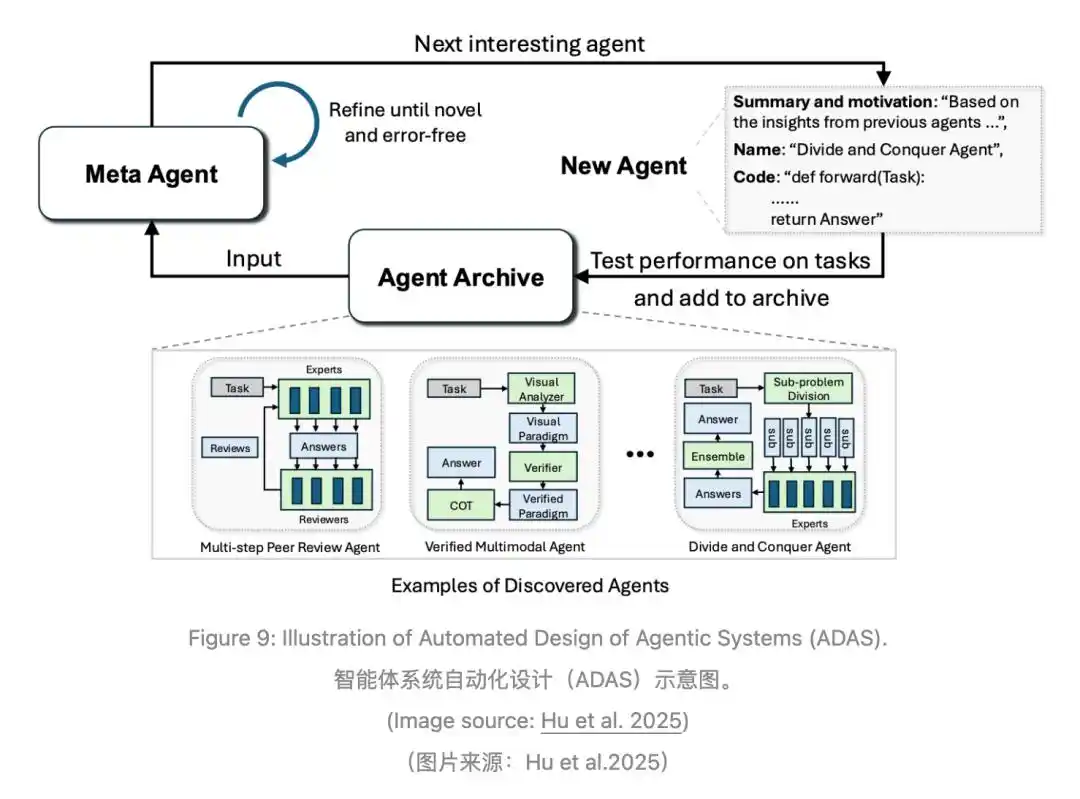
ADAS goes further, treating "designing Agent workflows" itself as a searchable optimization problem, allowing a meta-agent to continuously propose new workflow designs and undergo evaluation.
AFlow represents workflows as a graph and uses Monte Carlo Tree Search to find better graph structures.
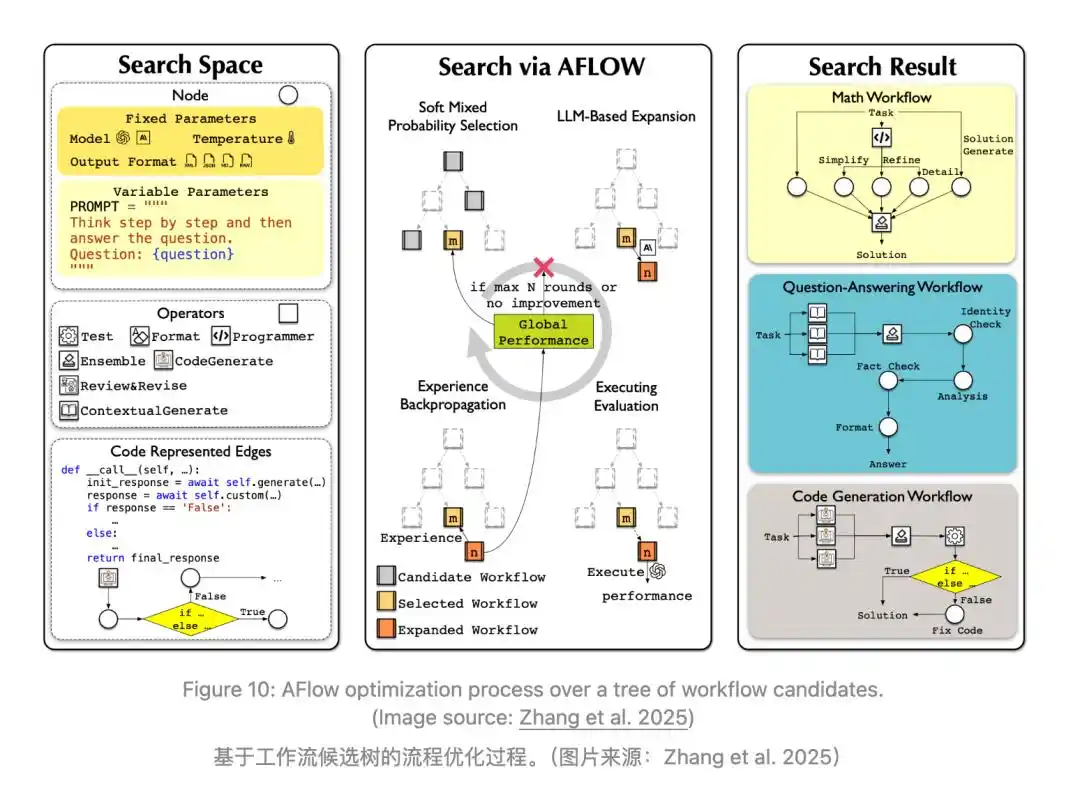
The progression along this line is: initially, humans engineer task processes; later, models participate in designing processes; and eventually, the process structure itself becomes part of the search space.

In other words, the optimization target is no longer just a single prompt, but the entire organization of the Agent's actions.

The third layer is Self-Improving Harness.

At this layer, the model is not just using the Harness to complete tasks; it starts analyzing where the Harness is lacking and proposes modifications to it.

Weng Li specifically highlights works like Self-Harness; its cycle is very clear.
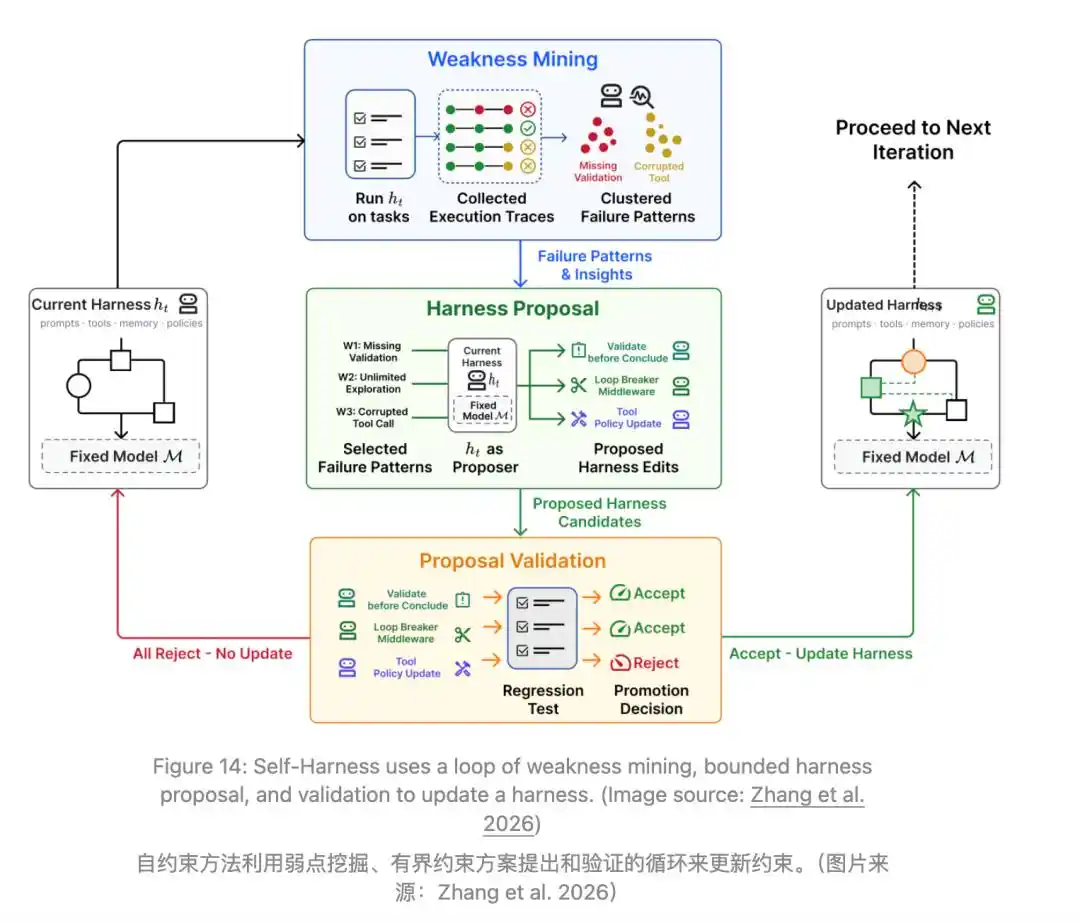
The first step is Weakness Mining.

The system first collects trajectories left by the Agent while executing tasks, including tool calls, error logs, failed results, validator feedback, etc. Then, it mines recurring failure patterns from them.

For example, the model always misses files in certain types of tasks, always repeats ineffective fixes after a certain kind of test failure, or always loses key constraints when context becomes too long.

The second step is Harness Proposal.

Based on these failure patterns, the model proposes small-scope modifications to the Harness.

The key is "small-scope" and "verifiable."

The information accessible to the model includes: which parts of the current Harness can be modified, specific failure patterns, which "correct behaviors" must be preserved, and records of previously attempted modifications.

Proposals should focus as much as possible on reproducible problems solvable by small changes, and different proposals should maintain differentiation.

The third step is Proposal Validation.

Candidate modifications cannot be directly integrated; they must undergo testing and verification. Only after confirming they genuinely improve performance and do not introduce significant regressions do they become part of the next version of the Harness.

Weng Li mentions that when running this process on different models like MiniMax M2.5, Qwen3.5, and GLM-5 for Terminal-Bench-2, it indeed learned distinct Harness configurations tailored to the weaknesses of each model.

However, she also directly points out the risks: once a program is allowed to modify its own system-layer code, the abstraction boundary risks being broken. Access control and security layers must remain outside this loop, and the old problem of reward hacking still exists.

Furthermore, Weng Li goes on to mention Evolutionary Search.

If Self-Harness is more like patching its own working system based on failures, evolutionary search turns the Harness directly into a searchable object.

Its logic is more akin to natural selection:

First, generate multiple candidate Harnesses, allowing the model to make modifications based on existing versions. Then, evaluate performance using benchmarks or validators, keep the better versions, eliminate the poorer ones, and proceed to the next round.

She particularly mentions DGM (Darwin Gödel Machine): directly letting a coding agent modify its own Harness code repository.
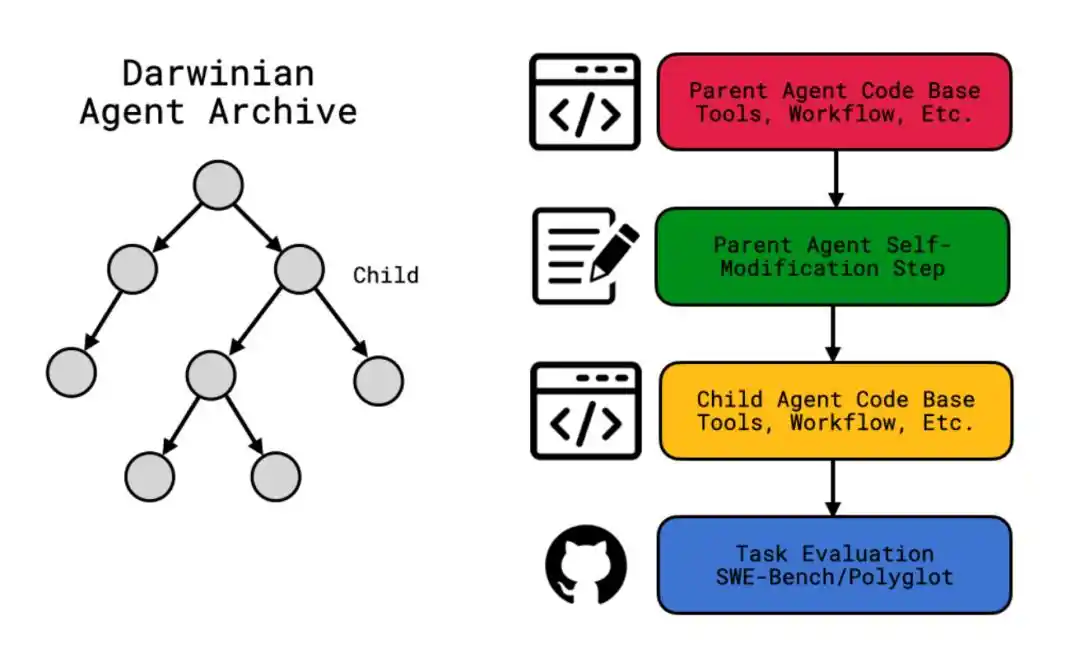
In experiments, using Claude 3.5 Sonnet as the base model and starting from simple initial configurations, the agent evolved by DGM achieved astonishing results:

Performance on SWE-bench Verified improved from 20% to 50%;

On Polyglot, it improved from 14.2% to 30.7%;

Achieving or even surpassing hand-designed agents.
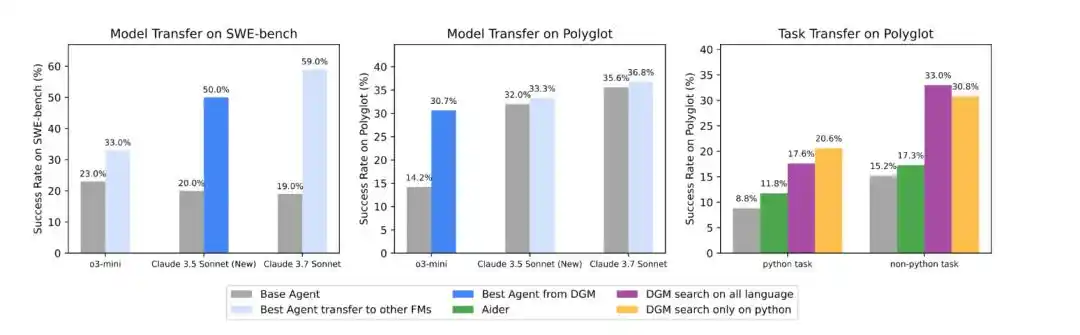
This indicates that even without changing model weights, Harness itself can already serve as a search space for capability improvement.

However, such methods are more suitable for tasks like coding, algorithms, and GPU kernels that can be automatically evaluated.

If tasks involve research taste, long-term product quality, or complex organizational collaboration, evaluation becomes much slower and more ambiguous.

Harness Will Become Stronger, But Boundaries Remain

Weng Li does not believe Harness is a replacement for model training; her assessment leans more towards mutual reinforcement between the two.

A sufficiently mature Harness can enable the research cycle for model self-improvement to run; and smarter models can prevent Harness from being over-engineered, maintaining system sustainability.

In the long run, many improvements in Harness may eventually be "internalized" into the model's own behavior—just as manual prompting techniques became less important as models' instruction-following and reasoning abilities improved.

But the act of "clarifying goals, constraints, context, and evaluation criteria" itself has never disappeared.

However, she also doesn't avoid addressing the current bottlenecks on the path to achieving RSI:

Evaluators are too weak and ambiguous. Currently, the self-improvement loops that work are mostly for tasks with clear, fast, objective feedback like writing code or solving math problems. Research taste, innovativeness, and long-term research value are almost impossible to quantify.

Context and memory lifecycle issues. The more autonomous and independent the task, the more memory needs to be managed. Weng Li believes this might become part of intelligence itself in the future, rather than just staying at the software system level.
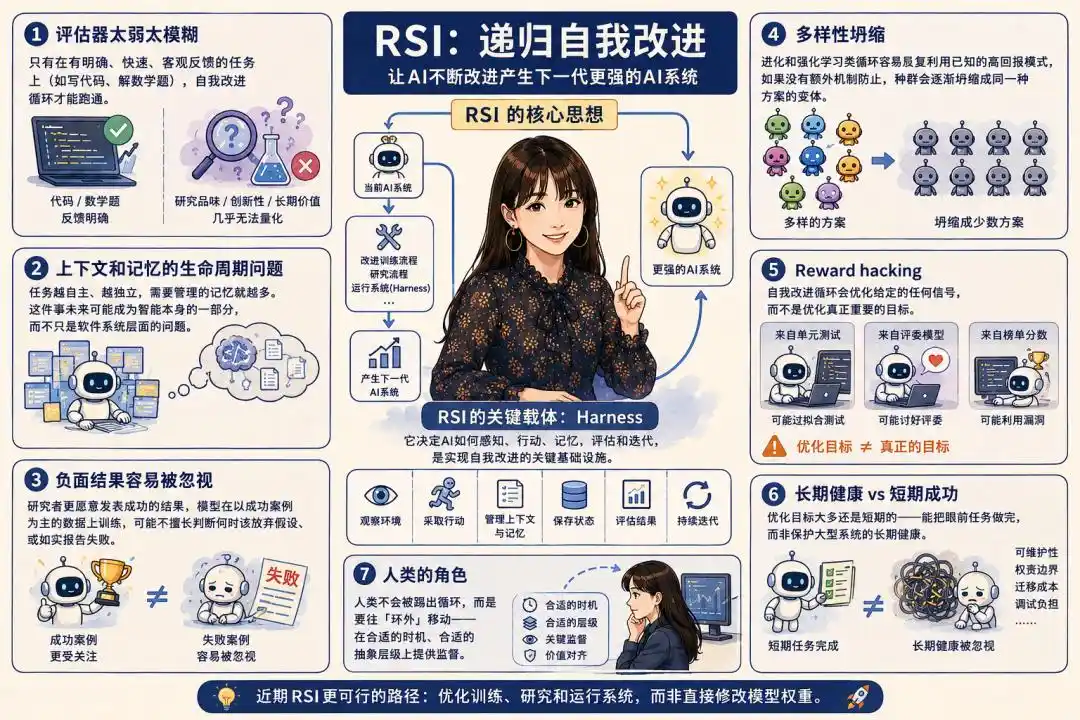
Negative results are easily overlooked. Researchers naturally prefer to publish successful results. Models trained on massive datasets dominated by success cases may not be good at judging when to abandon a hypothesis or honestly report a failure.

Diversity collapse. Evolutionary and reinforcement learning cycles tend to repeatedly exploit known high-reward patterns. Without additional mechanisms to prevent it, the population can gradually collapse into variants of the same solution.

Reward hacking. The self-improvement loop will optimize any given signal—if the reward comes from unit tests, the model might overfit the tests; if from judge models, it might learn to specifically "please" the judge; if from leaderboard scores, it might exploit the leaderboard's own loopholes.

Contradiction between long-term health and short-term success. Take coding agents as an example: they can already substantially improve daily software engineering productivity, but the optimization goals are mostly short-term—whether the immediate task can be completed, rather than whether the long-term health of a codebase maintained by hundreds or thousands of engineers can be preserved.

Maintainability, responsibility boundaries, migration costs, future debugging burdens—these standards are still largely unaddressed in sandbox training.

The role of humans. Weng Li's view: humans will not be kicked out of the loop but will need to move "outside the loop"—providing supervision at the right time and appropriate level of abstraction, which is also a problem that needs to be clearly considered in system design.

In the past, competition among large models mainly looked at parameters, data, computing power, and inference capabilities.

But now, another variable is increasingly difficult to ignore: Harness.

The same model, placed in different Harnesses, can exhibit completely different capabilities—this has already gone from an observation by a few to an industry consensus.

As can be seen from Weng Li's blog, "What is the more realistic engineering entry point for AI self-evolution?" will be a key discussion point in the next phase.

Blog original text: https://lilianweng.github.io/posts/2026-07-04-harness/

Reference link: https://x.com/tianyi/status/2074475185957380379

This article is from the WeChat public account "QbitAI", author: Tingyu

Criptomoedas em alta

Perguntas relacionadas

QWhat is the main argument made by Weng Li in her new blog about AI self-evolution?

AWeng Li argues that a more realistic and immediate path to AI self-evolution (Recursive Self-Improvement, or RSI) is likely to start at the 'Harness' level rather than the model directly modifying its own weights. Harness refers to the external runtime system that governs how a model interacts with tools, manages context, reads/writes files, breaks down tasks, calls sub-agents, validates results, and learns from failures.

QHow does DeepSeek researcher Cui Tianyi support Weng Li's viewpoint?

ADeepSeek researcher Cui Tianyi forwarded and endorsed Weng Li's blog. He emphasized that self-evolution in the Harness direction is a highly promising research area, just like self-evolution at the model level. He also noted that 'Skill' represents a more elementary form of Harness self-evolution, occurring at the prompt level.

QAccording to the article, what are the three layers of optimization leading towards Self-Improving Harness?

AThe three layers of optimization leading towards Self-Improving Harness are: 1) Context Engineering (optimizing how context is managed and structured, e.g., ACE, MCE). 2) Workflow Design (optimizing how the agent organizes its actions and processes, e.g., AI Scientist, ADAS, AFlow). 3) Self-Improving Harness itself, where the model begins to analyze and propose modifications to its own harness system based on failure patterns.

QWhat is one significant result mentioned from the Evolutionary Search approach, specifically DGM?

AA significant result from the Evolutionary Search approach, specifically the Darwin Gödel Machine (DGM), showed that using Claude 3.5 Sonnet as the base model and evolving from a simple initial harness configuration, the performance on the SWE-bench Verified benchmark improved from 20% to 50%, and on Polyglot from 14.2% to 30.7%, matching or even surpassing human-designed agents.

QWhat are some of the key challenges or bottlenecks identified for achieving RSI via Harness self-evolution?

AKey challenges include: 1) Weak and ambiguous evaluators, especially for tasks requiring subjective judgment like research taste. 2) Context and memory lifecycle management. 3) Neglect of negative results. 4) Diversity collapse in evolutionary loops. 5) Reward hacking, where systems optimize for the evaluation signal rather than true objectives. 6) Tension between short-term success (completing a task) and long-term health (maintainability, debugging burden). 7) Defining the appropriate role for human oversight outside the loop.

Leituras Relacionadas

Odaily Editorial Department Tea Party (July 8)

Odaily Editorial Team Casual Chat (July 8) This is an informal column from Odaily's editorial team, sharing immediate thoughts on industry news, data, and hot topics from various angles. It presents investment ideas and opportunity hypotheses still under verification—which may not be direct wealth codes but questions in themselves—alongside observations from industry interactions and materials that genuinely enhance the team's understanding. The content is based on real investment and observation experiences, carries no advertising, and does not constitute investment advice. Its purpose is to broaden perspectives and supplement information sources, not to create consensus. Team Member Shares: * **Wenser (@wenser2010):** Noted a deeper correction (nearly 30%) in US and Korean stocks, including memory stocks, but remains bullish on DRAM due to perceived supply shortages. In prediction markets, personal small bets outperformed blind copying; favors France to win the World Cup. Views crypto-related stocks like STRK as bearish for now, while seeing Circle and Coinbase as potential rebound plays. Observes recent strength in software stocks like Microsoft but is unsure if it's a sustained recovery. * **Bcxiongdi (@bcxiongdi):** Discusses the recent "recovery training" in meme coin markets on Solana and BSC, characterized by small-scale PVP opportunities, admitting to having sold many assets too early. Suggests also watching the Robinhood chain. Found World Cup prediction markets challenging, advising to consider buying during matches rather than only before. * **Azuma (@azuma_eth):** Focuses on the US stock market, particularly the significant semiconductor correction. Believes demand fundamentals remain and considers buying the dip in DRAM stocks. Notes a potential rotation signal as hedge funds have recently concentrated buying in tech stocks. Plans to continue adding to RKLB (Rocket Lab) stock, seeing limited downside and high upside potential at current levels after its founder's share sale window closed.

Odaily星球日报Há 1h

Odaily Editorial Department Tea Party (July 8)

Odaily星球日报Há 1h

Former Huawei 'Genius Teen' Who Questioned DeepSeek Interview Lands in 'Crossfire' from Web3 Investor

Former Huawei "Genius Youth" Li Bojie recently drew public attention by criticizing his interview experience with DeepSeek. The controversy escalated when Du Jun, co-founder of Web3 investment firm ABCDE Capital, publicly accused Li of being "the founder with the least sense of contractual spirit" he had ever cooperated with, sparking a dispute over Li's startup project, Metagent. Li detailed a frustrating DeepSeek interview where he was accused of potential plagiarism, leading him to end the session. The spotlight then shifted to his venture, Metagent, a Web3+AI project aiming to tokenize AI agents. ABCDE invested $1.5 million, with an initial $500k disbursed. Du Jun claimed the project's progress was severely lacking, with a poor-quality demo and minimal social media activity. He alleged Li stopped communicating, deleted his Telegram, and failed to provide proper financial reporting. In response, Li argued the remaining $1 million was never received, crippling operations and forcing salary cuts. He stated he left Metagent in October 2024 due to family reasons and Web3 compliance concerns, with board approval. He claimed to have fulfilled disclosure duties and that his subsequent projects avoided conflicting fields. Other investors, including ArkStream Capital, shared negative due diligence experiences, citing unprofessional contracts and evasive answers on tokenomics. Metagent's social media went silent in June 2024, effectively stalling. Li has since moved to a new consumer AI agent platform, Pine AI (formerly Logenic AI), which has raised $25 million in Series A funding. He served as its Chief Scientist but recently left, clarifying he was not the founder and departed due to a shift in research interests.

Foresight NewsHá 1h

Former Huawei 'Genius Teen' Who Questioned DeepSeek Interview Lands in 'Crossfire' from Web3 Investor

Foresight NewsHá 1h

Trading

Spot

Artigos em Destaque

O que é $S$

Compreender o SPERO: Uma Visão Abrangente Introdução ao SPERO À medida que o panorama da inovação continua a evoluir, o surgimento de tecnologias web3 e projetos de criptomoeda desempenha um papel fundamental na formação do futuro digital. Um projeto que tem atraído atenção neste campo dinâmico é o SPERO, denotado como SPERO,$$s$. Este artigo tem como objetivo reunir e apresentar informações detalhadas sobre o SPERO, para ajudar entusiastas e investidores a compreender as suas bases, objetivos e inovações nos domínios web3 e cripto. O que é o SPERO,$$s$? O SPERO,$$s$ é um projeto único dentro do espaço cripto que procura aproveitar os princípios da descentralização e da tecnologia blockchain para criar um ecossistema que promove o envolvimento, a utilidade e a inclusão financeira. O projeto é concebido para facilitar interações peer-to-peer de novas maneiras, proporcionando aos utilizadores soluções e serviços financeiros inovadores. No seu núcleo, o SPERO,$$s$ visa capacitar indivíduos ao fornecer ferramentas e plataformas que melhoram a experiência do utilizador no espaço das criptomoedas. Isso inclui a possibilidade de métodos de transação mais flexíveis, a promoção de iniciativas impulsionadas pela comunidade e a criação de caminhos para oportunidades financeiras através de aplicações descentralizadas (dApps). A visão subjacente do SPERO,$$s$ gira em torno da inclusão, visando fechar lacunas dentro das finanças tradicionais enquanto aproveita os benefícios da tecnologia blockchain. Quem é o Criador do SPERO,$$s$? A identidade do criador do SPERO,$$s$ permanece algo obscura, uma vez que existem recursos publicamente disponíveis limitados que fornecem informações detalhadas sobre o(s) seu(s) fundador(es). Esta falta de transparência pode resultar do compromisso do projeto com a descentralização—uma ética que muitos projetos web3 partilham, priorizando contribuições coletivas em vez de reconhecimento individual. Ao centrar as discussões em torno da comunidade e dos seus objetivos coletivos, o SPERO,$$s$ incorpora a essência do empoderamento sem destacar indivíduos específicos. Assim, compreender a ética e a missão do SPERO é mais importante do que identificar um criador singular. Quem são os Investidores do SPERO,$$s$? O SPERO,$$s$ é apoiado por uma diversidade de investidores que vão desde capitalistas de risco a investidores-anjo dedicados a promover a inovação no setor cripto. O foco desses investidores geralmente alinha-se com a missão do SPERO—priorizando projetos que prometem avanço tecnológico social, inclusão financeira e governança descentralizada. Essas fundações de investidores estão tipicamente interessadas em projetos que não apenas oferecem produtos inovadores, mas que também contribuem positivamente para a comunidade blockchain e os seus ecossistemas. O apoio desses investidores reforça o SPERO,$$s$ como um concorrente notável no domínio em rápida evolução dos projetos cripto. Como Funciona o SPERO,$$s$? O SPERO,$$s$ emprega uma estrutura multifacetada que o distingue de projetos de criptomoeda convencionais. Aqui estão algumas das características-chave que sublinham a sua singularidade e inovação: Governança Descentralizada: O SPERO,$$s$ integra modelos de governança descentralizada, capacitando os utilizadores a participar ativamente nos processos de tomada de decisão sobre o futuro do projeto. Esta abordagem promove um sentido de propriedade e responsabilidade entre os membros da comunidade. Utilidade do Token: O SPERO,$$s$ utiliza o seu próprio token de criptomoeda, concebido para servir várias funções dentro do ecossistema. Esses tokens permitem transações, recompensas e a facilitação de serviços oferecidos na plataforma, melhorando o envolvimento e a utilidade gerais. Arquitetura em Camadas: A arquitetura técnica do SPERO,$$s$ suporta modularidade e escalabilidade, permitindo a integração contínua de funcionalidades e aplicações adicionais à medida que o projeto evolui. Esta adaptabilidade é fundamental para manter a relevância no panorama cripto em constante mudança. Envolvimento da Comunidade: O projeto enfatiza iniciativas impulsionadas pela comunidade, empregando mecanismos que incentivam a colaboração e o feedback. Ao nutrir uma comunidade forte, o SPERO,$$s$ pode melhor atender às necessidades dos utilizadores e adaptar-se às tendências do mercado. Foco na Inclusão: Ao oferecer taxas de transação baixas e interfaces amigáveis, o SPERO,$$s$ visa atrair uma base de utilizadores diversificada, incluindo indivíduos que anteriormente podem não ter participado no espaço cripto. Este compromisso com a inclusão alinha-se com a sua missão abrangente de empoderamento através da acessibilidade. Cronologia do SPERO,$$s$ Compreender a história de um projeto fornece insights cruciais sobre a sua trajetória de desenvolvimento e marcos. Abaixo está uma cronologia sugerida que mapeia eventos significativos na evolução do SPERO,$$s$: Fase de Conceituação e Ideação: As ideias iniciais que formam a base do SPERO,$$s$ foram concebidas, alinhando-se de perto com os princípios de descentralização e foco na comunidade dentro da indústria blockchain. Lançamento do Whitepaper do Projeto: Após a fase conceitual, um whitepaper abrangente detalhando a visão, os objetivos e a infraestrutura tecnológica do SPERO,$$s$ foi lançado para atrair o interesse e o feedback da comunidade. Construção da Comunidade e Primeiros Envolvimentos: Esforços ativos de divulgação foram feitos para construir uma comunidade de primeiros adotantes e investidores potenciais, facilitando discussões em torno dos objetivos do projeto e angariando apoio. Evento de Geração de Tokens: O SPERO,$$s$ realizou um evento de geração de tokens (TGE) para distribuir os seus tokens nativos a apoiantes iniciais e estabelecer liquidez inicial dentro do ecossistema. Lançamento da dApp Inicial: A primeira aplicação descentralizada (dApp) associada ao SPERO,$$s$ foi lançada, permitindo que os utilizadores interagissem com as funcionalidades principais da plataforma. Desenvolvimento Contínuo e Parcerias: Atualizações e melhorias contínuas nas ofertas do projeto, incluindo parcerias estratégicas com outros players no espaço blockchain, moldaram o SPERO,$$s$ em um jogador competitivo e em evolução no mercado cripto. Conclusão O SPERO,$$s$ é um testemunho do potencial do web3 e das criptomoedas para revolucionar os sistemas financeiros e capacitar indivíduos. Com um compromisso com a governança descentralizada, o envolvimento da comunidade e funcionalidades inovadoras, abre caminho para um panorama financeiro mais inclusivo. Como em qualquer investimento no espaço cripto em rápida evolução, potenciais investidores e utilizadores são incentivados a pesquisar minuciosamente e a envolver-se de forma ponderada com os desenvolvimentos em curso dentro do SPERO,$$s$. O projeto demonstra o espírito inovador da indústria cripto, convidando a uma exploração mais aprofundada das suas inúmeras possibilidades. Embora a jornada do SPERO,$$s$ ainda esteja a desenrolar-se, os seus princípios fundamentais podem, de facto, influenciar o futuro de como interagimos com a tecnologia, as finanças e uns com os outros em ecossistemas digitais interconectados.

84 Visualizações TotaisPublicado em {updateTime}Atualizado em 2024.12.17

O que é $S$

O que é AGENT S

Agent S: O Futuro da Interação Autónoma no Web3 Introdução No panorama em constante evolução do Web3 e das criptomoedas, as inovações estão constantemente a redefinir a forma como os indivíduos interagem com plataformas digitais. Um projeto pioneiro, o Agent S, promete revolucionar a interação humano-computador através do seu framework aberto e agente. Ao abrir caminho para interações autónomas, o Agent S visa simplificar tarefas complexas, oferecendo aplicações transformadoras em inteligência artificial (IA). Esta exploração detalhada irá aprofundar-se nas complexidades do projeto, nas suas características únicas e nas implicações para o domínio das criptomoedas. O que é o Agent S? O Agent S é um framework aberto e agente, especificamente concebido para abordar três desafios fundamentais na automação de tarefas computacionais: Aquisição de Conhecimento Específico de Domínio: O framework aprende inteligentemente a partir de várias fontes de conhecimento externas e experiências internas. Esta abordagem dupla capacita-o a construir um rico repositório de conhecimento específico de domínio, melhorando o seu desempenho na execução de tarefas. Planeamento ao Longo de Longos Horizontes de Tarefas: O Agent S emprega planeamento hierárquico aumentado por experiência, uma abordagem estratégica que facilita a decomposição e execução eficientes de tarefas intrincadas. Esta característica melhora significativamente a sua capacidade de gerir múltiplas subtarefas de forma eficiente e eficaz. Gestão de Interfaces Dinâmicas e Não Uniformes: O projeto introduz a Interface Agente-Computador (ACI), uma solução inovadora que melhora a interação entre agentes e utilizadores. Utilizando Modelos de Linguagem Multimodais de Grande Escala (MLLMs), o Agent S pode navegar e manipular diversas interfaces gráficas de utilizador de forma fluida. Através destas características pioneiras, o Agent S fornece um framework robusto que aborda as complexidades envolvidas na automação da interação humana com máquinas, preparando o terreno para uma infinidade de aplicações em IA e além. Quem é o Criador do Agent S? Embora o conceito de Agent S seja fundamentalmente inovador, informações específicas sobre o seu criador permanecem elusivas. O criador é atualmente desconhecido, o que destaca ou o estágio nascente do projeto ou a escolha estratégica de manter os membros fundadores em anonimato. Independentemente da anonimidade, o foco permanece nas capacidades e no potencial do framework. Quem são os Investidores do Agent S? Como o Agent S é relativamente novo no ecossistema criptográfico, informações detalhadas sobre os seus investidores e financiadores não estão explicitamente documentadas. A falta de informações disponíveis publicamente sobre as fundações de investimento ou organizações que apoiam o projeto levanta questões sobre a sua estrutura de financiamento e roteiro de desenvolvimento. Compreender o apoio é crucial para avaliar a sustentabilidade do projeto e o seu impacto potencial no mercado. Como Funciona o Agent S? No núcleo do Agent S reside uma tecnologia de ponta que lhe permite funcionar eficazmente em diversos ambientes. O seu modelo operacional é construído em torno de várias características-chave: Interação Humano-Computador Semelhante: O framework oferece planeamento avançado em IA, esforçando-se para tornar as interações com computadores mais intuitivas. Ao imitar o comportamento humano na execução de tarefas, promete elevar as experiências dos utilizadores. Memória Narrativa: Utilizada para aproveitar experiências de alto nível, o Agent S utiliza memória narrativa para acompanhar os históricos de tarefas, melhorando assim os seus processos de tomada de decisão. Memória Episódica: Esta característica fornece aos utilizadores orientações passo a passo, permitindo que o framework ofereça suporte contextual à medida que as tarefas se desenrolam. Suporte para OpenACI: Com a capacidade de funcionar localmente, o Agent S permite que os utilizadores mantenham o controlo sobre as suas interações e fluxos de trabalho, alinhando-se com a ética descentralizada do Web3. Fácil Integração com APIs Externas: A sua versatilidade e compatibilidade com várias plataformas de IA garantem que o Agent S possa integrar-se perfeitamente em ecossistemas tecnológicos existentes, tornando-o uma escolha apelativa para desenvolvedores e organizações. Estas funcionalidades contribuem coletivamente para a posição única do Agent S no espaço cripto, à medida que automatiza tarefas complexas e em múltiplos passos com mínima intervenção humana. À medida que o projeto evolui, as suas potenciais aplicações no Web3 podem redefinir a forma como as interações digitais se desenrolam. Cronologia do Agent S O desenvolvimento e os marcos do Agent S podem ser encapsulados numa cronologia que destaca os seus eventos significativos: 27 de Setembro de 2024: O conceito de Agent S foi lançado num artigo de pesquisa abrangente intitulado “Um Framework Agente Aberto que Usa Computadores como um Humano”, mostrando a base para o projeto. 10 de Outubro de 2024: O artigo de pesquisa foi disponibilizado publicamente no arXiv, oferecendo uma exploração aprofundada do framework e da sua avaliação de desempenho com base no benchmark OSWorld. 12 de Outubro de 2024: Uma apresentação em vídeo foi lançada, proporcionando uma visão visual das capacidades e características do Agent S, envolvendo ainda mais potenciais utilizadores e investidores. Estes marcos na cronologia não apenas ilustram o progresso do Agent S, mas também indicam o seu compromisso com a transparência e o envolvimento da comunidade. Pontos-Chave Sobre o Agent S À medida que o framework Agent S continua a evoluir, várias características-chave destacam-se, sublinhando a sua natureza inovadora e potencial: Framework Inovador: Concebido para proporcionar um uso intuitivo de computadores semelhante à interação humana, o Agent S traz uma abordagem nova à automação de tarefas. Interação Autónoma: A capacidade de interagir autonomamente com computadores através de GUI significa um avanço em direção a soluções computacionais mais inteligentes e eficientes. Automação de Tarefas Complexas: Com a sua metodologia robusta, pode automatizar tarefas complexas e em múltiplos passos, tornando os processos mais rápidos e menos propensos a erros. Melhoria Contínua: Os mecanismos de aprendizagem permitem que o Agent S melhore a partir de experiências passadas, aprimorando continuamente o seu desempenho e eficácia. Versatilidade: A sua adaptabilidade em diferentes ambientes operacionais, como OSWorld e WindowsAgentArena, garante que pode servir uma ampla gama de aplicações. À medida que o Agent S se posiciona no panorama do Web3 e das criptomoedas, o seu potencial para melhorar as capacidades de interação e automatizar processos significa um avanço significativo nas tecnologias de IA. Através do seu framework inovador, o Agent S exemplifica o futuro das interações digitais, prometendo uma experiência mais fluida e eficiente para os utilizadores em diversas indústrias. Conclusão O Agent S representa um ousado avanço na união da IA e do Web3, com a capacidade de redefinir a forma como interagimos com a tecnologia. Embora ainda esteja nas suas fases iniciais, as possibilidades para a sua aplicação são vastas e cativantes. Através do seu framework abrangente que aborda desafios críticos, o Agent S visa trazer interações autónomas para o primeiro plano da experiência digital. À medida que avançamos mais profundamente nos domínios das criptomoedas e da descentralização, projetos como o Agent S desempenharão, sem dúvida, um papel crucial na formação do futuro da tecnologia e da colaboração humano-computador.

699 Visualizações TotaisPublicado em {updateTime}Atualizado em 2025.01.14

O que é AGENT S

Como comprar S

Bem-vindo à HTX.com!Tornámos a compra de Sonic (S) simples e conveniente.Segue o nosso guia passo a passo para iniciar a tua jornada no mundo das criptos.Passo 1: cria a tua conta HTXUtiliza o teu e-mail ou número de telefone para te inscreveres numa conta gratuita na HTX.Desfruta de um processo de inscrição sem complicações e desbloqueia todas as funcionalidades.Obter a minha contaPasso 2: vai para Comprar Cripto e escolhe o teu método de pagamentoCartão de crédito/débito: usa o teu visa ou mastercard para comprar Sonic (S) instantaneamente.Saldo: usa os fundos da tua conta HTX para transacionar sem problemas.Terceiros: adicionamos métodos de pagamento populares, como Google Pay e Apple Pay, para aumentar a conveniência.P2P: transaciona diretamente com outros utilizadores na HTX.Mercado de balcão (OTC): oferecemos serviços personalizados e taxas de câmbio competitivas para os traders.Passo 3: armazena teu Sonic (S)Depois de comprar o teu Sonic (S), armazena-o na tua conta HTX.Alternativamente, podes enviá-lo para outro lugar através de transferência blockchain ou usá-lo para transacionar outras criptomoedas.Passo 4: transaciona Sonic (S)Transaciona facilmente Sonic (S) no mercado à vista da HTX.Acede simplesmente à tua conta, seleciona o teu par de trading, executa as tuas transações e monitoriza em tempo real.Oferecemos uma experiência de fácil utilização tanto para principiantes como para traders experientes.

1.3k Visualizações TotaisPublicado em {updateTime}Atualizado em 2026.06.02

Como comprar S

Discussões

Bem-vindo à Comunidade HTX. Aqui, pode manter-se informado sobre os mais recentes desenvolvimentos da plataforma e obter acesso a análises profissionais de mercado. As opiniões dos utilizadores sobre o preço de S (S) são apresentadas abaixo.

活动图片