Welcoming the God of Wealth on the Fifth Day of Lunar New Year, Trump Overturns the Altar: Imposes 10% Global Tariffs in Defiance of Supreme Court

比推Publicado em 2026-02-21Última atualização em 2026-02-21

Resumo

On the fifth day of the Chinese New Year, a day traditionally associated with welcoming the god of wealth, former U.S. President Donald Trump made headlines by defying a Supreme Court ruling that invalidated his global tariff policies enacted under national emergency laws. In response, Trump immediately invoked alternative trade authority to impose an additional 10% global tariff, declaring existing national security tariffs effective immediately without seeking further congressional approval. He publicly criticized the justices who ruled against him. Meanwhile, a viral story about Punch, a baby monkey in a Japanese zoo abandoned at birth and raised by handlers, sparked widespread sympathy online. Footage of the monkey being dragged by an adult during social integration efforts led to a surge in the related meme cryptocurrency PUNCH, which saw an 80-fold increase in value. In cryptocurrency circles, predictions circulated that Bitcoin could reach $1 million by 2026, though opinions were divided on the feasibility. Some commentators expressed concerns about the crypto market’s health, suggesting it had “halved” in vitality, while others remained optimistic about future growth. Additionally, Ethereum co-founder Vitalik Buterin criticized the concept of “Web4.0,” arguing that it promotes the creation of valueless digital clutter rather than meaningful innovation. The response from the community was mixed, with some supporting his skepticism and others defending technological ...

On the fifth day of the Lunar New Year, welcome blessings and prosperity as you greet the God of Wealth~

What have the KOLs in the crypto space been talking about over the past 24 hours?

Note: The following content is compiled from the X platform and represents personal opinions. It does not represent the stance of this platform and should not be considered investment advice.

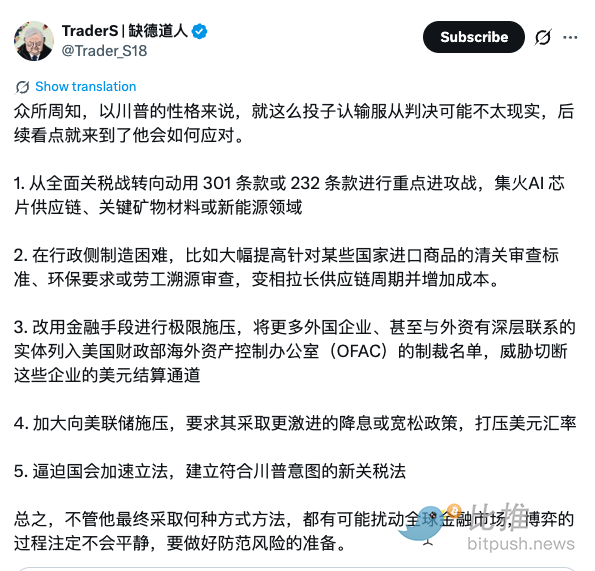
Welcoming the God of Wealth on the Fifth Day, Trump Overturns the Altar: 10% Global Tariffs in Defiance of Supreme Court

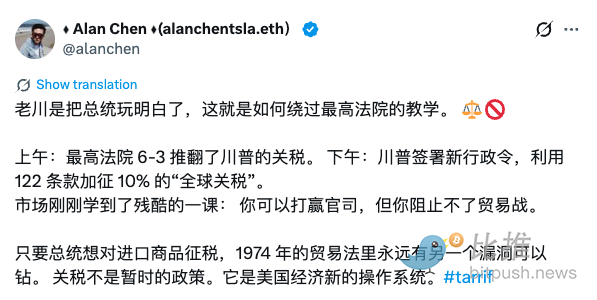
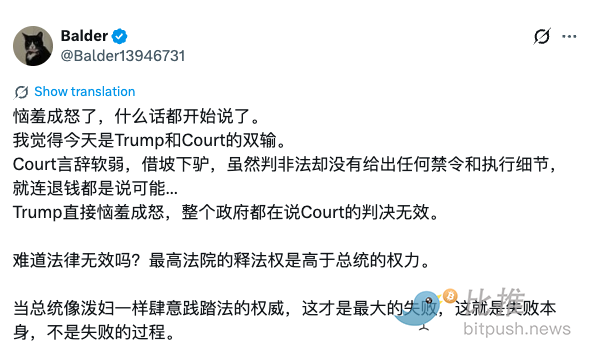
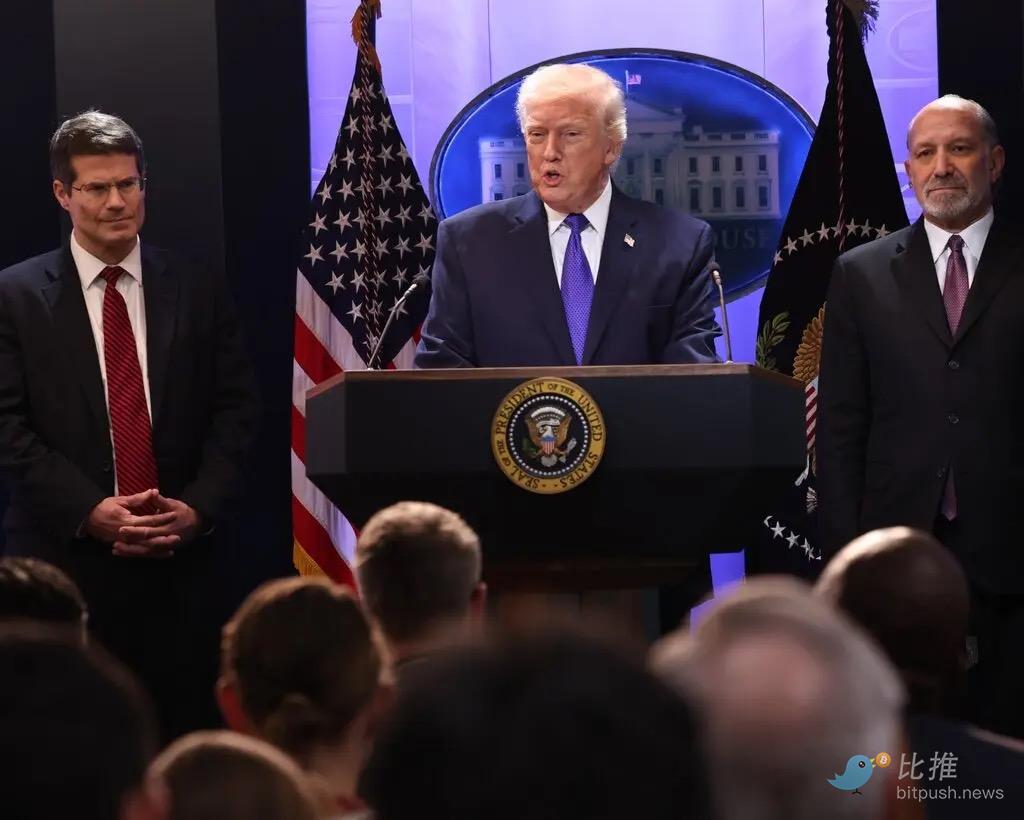
Last night, Beijing time, the U.S. Supreme Court ruled that Trump's global tariff policy, implemented under federal laws related to national emergencies, was invalid. Shortly after the ruling, Trump quickly invoked another trade authority to issue a new order, announcing an additional 10% global tariff on top of existing tariffs, with all current national security tariffs taking effect immediately.

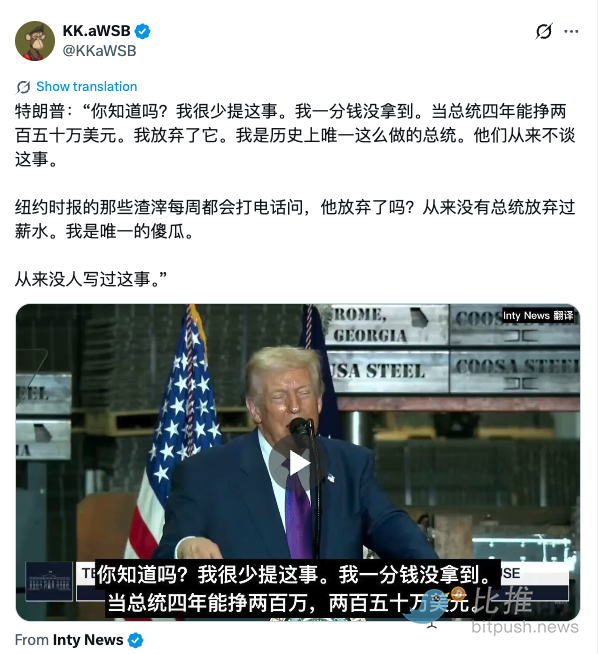
Trump explicitly stated that he would not seek further authorization from Congress, adding, "I don't need to." Regarding the justices who issued the unfavorable ruling, Trump angrily criticized them during a press conference, calling them "fools and lackeys."
Popular replies:

Section 122 is indeed the president's backdoor, but the market overreacted. After three years of tariff wars, U.S. stocks still hit new highs, indicating that investors had already priced in this risk.

Here's some political insight: Emperor Chuan is invincible in the human world for the next three years.

All laws are meant to bind ordinary people. Trump is the true embodiment of 'I want it, I get it.'

Why do people still see him as normal? He is clearly a narcissistic personality disorder patient—isn't it obvious?

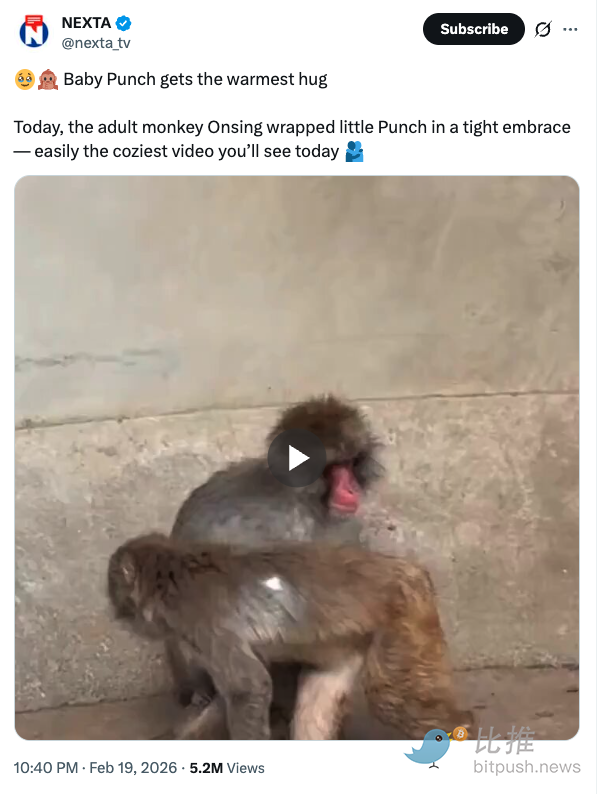
Internet Hearts Ache for Little Monkey Punch, Homonymous Meme Coin Soars 80x

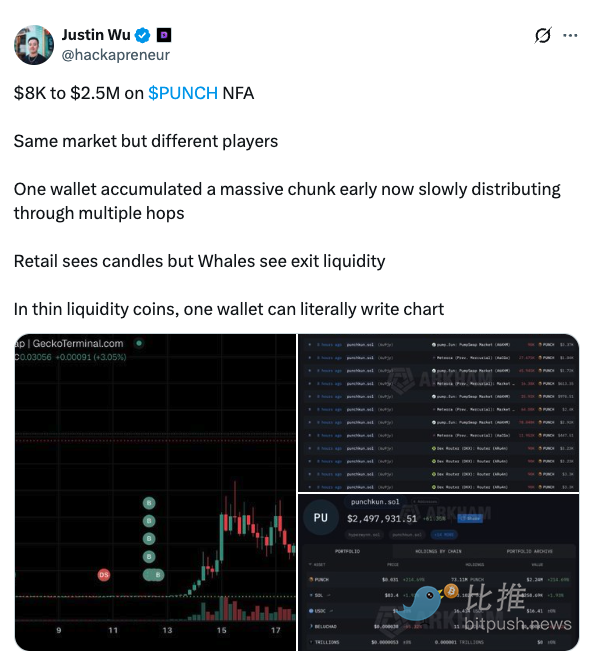
A little monkey named Punch from Ichikawa Zoo in Japan has recently become the focus of the entire internet. Abandoned by its mother at birth, Punch was raised by zookeepers and went viral after a video showed it clinging tightly to a stuffed gorilla for comfort. However, yesterday, Punch was dragged by an adult monkey within the group, a scene that left countless netizens heartbroken. The zoo responded that this was part of Punch's process of learning to integrate into the group, and its adaptability is moving. This story of growth and resilience quickly exploded on social media, with several crypto projects also expressing support. As a result, the homonymous meme coin PUNCH surged, with a seven-day increase of nearly 80 times.
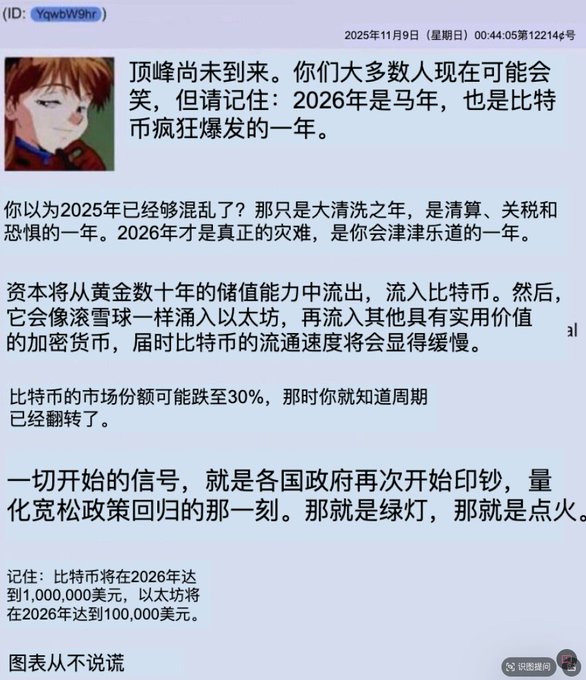
Some Guru Predicts Bitcoin Will Reach $1 Million in 2026
<极img style="max-width:100%;overflow:hidden;" src="https://d1x7dwosqaosdj.cloudfront.net/images/2026-02/54bab4455fef4b5c8304d4912452ab68.png" alt="">

Popular replies:

It's been almost two months now; reaching $1 million is too far-fetched. $360,000 is more like it.

The most painful thing in life is missing out on all the correct predictions others made in the past, only to catch the one failure.

Institutions are worried about quantitative tightening, while gurus expect money printing. The gurus might be right—some countries have already started dumping U.S. bonds. If there aren't enough buyers, the Fed might have to print money to absorb them.

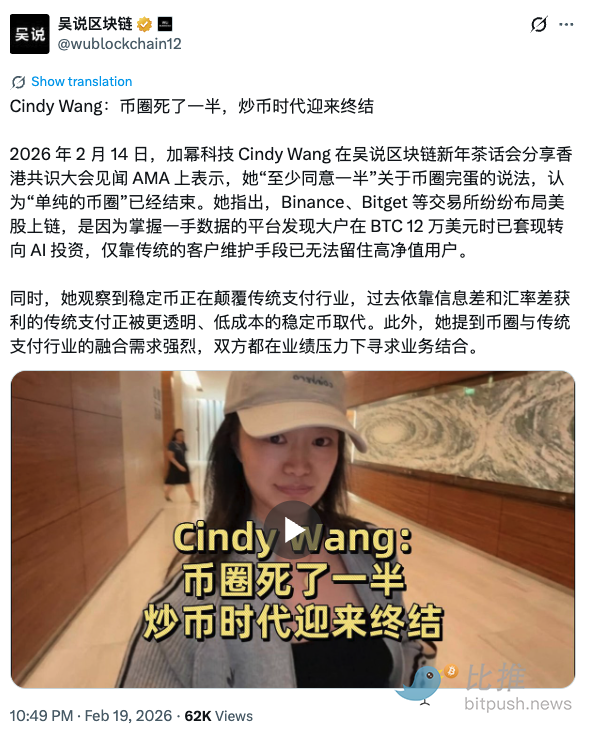
Has the Crypto Circle "Died" by Half?
Popular replies:

No insights, just hindsight, along with boasting about their own companies.

They've made enough money and now start smashing the pot.

Creating panic without foresight is the epitome of being led by emotions. If you're not optimistic, you can leave the circle. Without predictive ability, don't make blind predictions. I can say right now that the next cycle will be much stronger than this one—believe it or not.

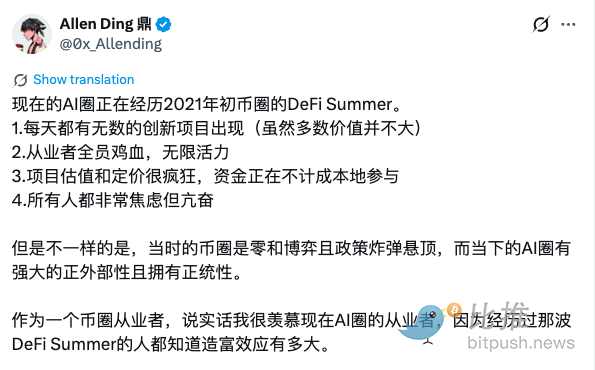
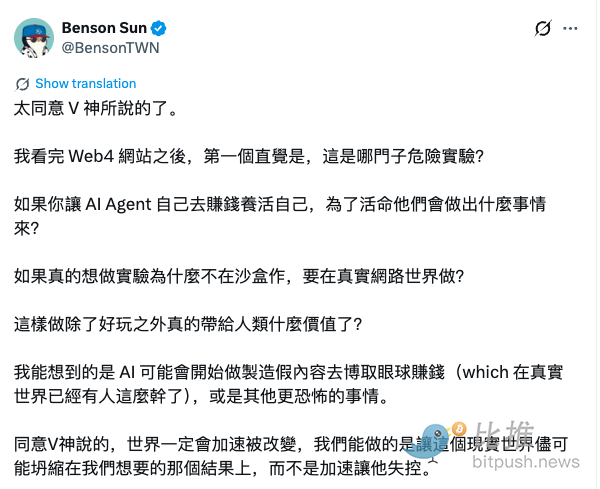
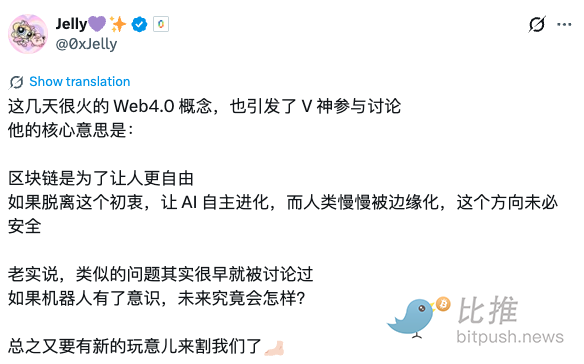
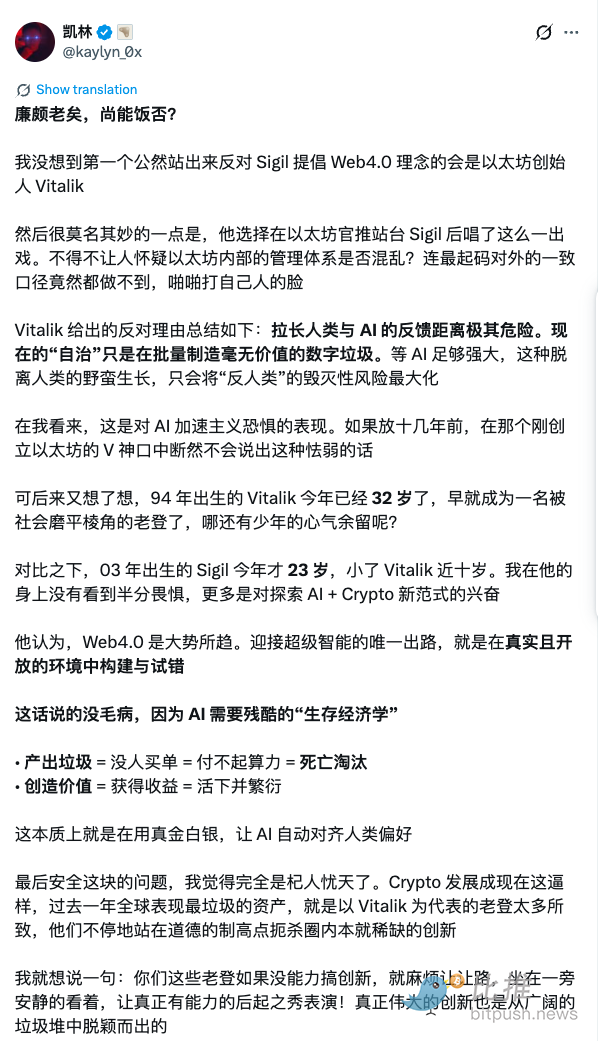
V神 Opposes Web4.0 Concept: Mass Production of Worthless Digital Junk
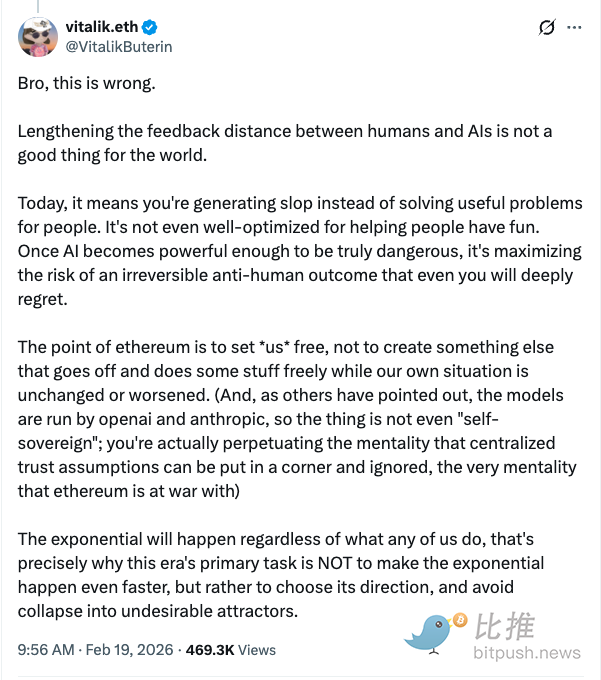
Popular replies:

Indeed, aside from being fun, it has no practical value. An internet without people isn't the internet. If it's all robots, what kind of Web is that?

Those left behind by the times lack imagination and are still stuck in the web2 framework.

Every time new technology emerges, there is always chaos and even danger. Regulation either overreacts or does nothing. Humanity stumbles through every technological revolution like this.

Your circle really knows how to coin terms. Web3 is fading, and now they're shouting about web4...


Twitter:https://twitter.com/BitpushNewsCN

Bitpush TG Discussion Group:https://t.me/BitPushCommunity

Bitpush TG Subscription: https://t.me/bitpush

Original link:https://www.bitpush.news/articles/7613417

Perguntas relacionadas

QWhat was the US Supreme Court's ruling regarding Trump's global tariff policy, and how did Trump respond?

AThe US Supreme Court ruled that Trump's global tariff policy implemented under national emergency federal laws was invalid. In response, Trump invoked another trade authority to issue a new order, announcing an additional 10% global tariff on top of existing tariffs, with all current national security tariffs taking effect immediately.

QWhat is the story behind the meme coin PUNCH and why did its value surge?

APUNCH is a meme coin named after a baby monkey named Punch from Ichikawa Zoo in Japan. Punch was abandoned by its mother and raised by zookeepers, gaining viral attention online for a video of it hugging a stuffed animal for comfort. Its value surged nearly 80 times in seven days after the story of its struggle to integrate into the monkey group went viral on social media, with several crypto projects showing support.

QWhat prediction was made about Bitcoin's price in 2026, and what were some community reactions?

AA prediction was made that Bitcoin would reach $1 million by 2026. Community reactions were mixed, with some calling it unrealistic and suggesting $360,000 as a plausible target, while others speculated that massive money printing by the Federal Reserve could potentially drive such a surge.

QWhat is V神's (Vitalik Buterin) criticism of Web4.0, and how did people respond?

AVitalik Buterin criticized Web4.0, arguing that it promotes the mass production of worthless digital garbage. Responses varied, with some agreeing that it lacks practical value without human involvement, while others accused him of lacking imagination and being stuck in a Web2 framework.

QAccording to the article, what is the general sentiment about the current state of the crypto circle?

AThe sentiment is divided. Some suggest that half of the crypto circle is 'dead,' criticizing the lack of foresight and fear-mongering. Others are more bullish, arguing that the next market cycle will be much stronger than the current one and dismissing the pessimistic predictions.

Leituras Relacionadas

Gensyn AI: Don't Let AI Repeat the Mistakes of the Internet

In recent months, the rapid growth of the AI industry has attracted significant talent from the crypto sector. A persistent question among researchers intersecting both fields is whether blockchain can become a foundational part of AI infrastructure. While many previous AI and Crypto projects focused on application layers (like AI Agents, on-chain reasoning, data markets, and compute rentals), few achieved viable commercial models. Gensyn differentiates itself by targeting the most critical and expensive layer of AI: model training. Gensyn aims to organize globally distributed GPU resources into an open AI training network. Developers can submit training tasks, nodes provide computational power, and the network verifies results while distributing incentives. The core issue addressed is not decentralization for its own sake, but the increasing centralization of compute power among tech giants. In the era of large models, access to GPUs (like the H100) has become a decisive bottleneck, dictating the pace of AI development. Major AI companies are heavily dependent on large cloud providers for compute resources. Gensyn's approach is significant for several reasons: 1) It operates at the core infrastructure layer (model training), the most resource-intensive and technically demanding part of the AI value chain. 2) It proposes a more open, collaborative model for compute, potentially increasing resource utilization by dynamically pooling idle GPUs, similar to early cloud computing logic. 3) Its technical moat lies in solving complex challenges like verifying training results, ensuring node honesty, and maintaining reliability in a distributed environment—making it more of a deep-tech infrastructure company. 4) It targets a validated, high-growth market with genuine demand, rather than pursuing blockchain integration without purpose. Ultimately, the boundaries between Crypto and AI are blurring. AI requires global resource coordination, incentive mechanisms, and collaborative systems—areas where crypto-native solutions excel. Gensyn represents a step toward making advanced training capabilities more accessible and collaborative, moving beyond a niche controlled by a few giants. If successful, it could evolve into a fundamental piece of AI infrastructure, where the most enduring value in the AI era is often created.

marsbitHá 9h

Gensyn AI: Don't Let AI Repeat the Mistakes of the Internet

marsbitHá 9h

Why is China's AI Developing So Fast? The Answer Lies Inside the Labs

A US researcher's visit to China's top AI labs reveals distinct cultural and organizational factors driving China's rapid AI development. While talent, data, and compute are similar to the West, Chinese labs excel through a pragmatic, execution-focused culture: less emphasis on individual stardom and conceptual debate, and more on teamwork, engineering optimization, and mastering the full tech stack. A key advantage is the integration of young students and researchers who approach model-building with fresh perspectives and low ego, prioritizing collective progress over personal credit. This contrasts with the US culture of self-promotion and "star scientist" narratives. Chinese labs also exhibit a strong "build, don't buy" mentality, preferring to develop core capabilities—like data pipelines and environments—in-house rather than relying on external services. The ecosystem feels more collaborative than tribal, with mutual respect among labs. While government support exists, its scale is unclear, and technical decisions appear driven by labs, not state mandates. Chinese companies across sectors, from platforms to consumer tech, are building their own foundational models to control their tech destiny, reflecting a broader cultural drive for technological sovereignty. Demand for AI is emerging, with spending patterns potentially mirroring cloud infrastructure more than traditional SaaS. Despite challenges like a less mature data industry and GPU shortages, Chinese labs are propelled by vast talent, rapid iteration, and deep integration with the open-source community. The competition is evolving beyond a pure model race into a contest of organizational execution, developer ecosystems, and industrial pragmatism.

marsbitHá 10h

Why is China's AI Developing So Fast? The Answer Lies Inside the Labs

marsbitHá 10h

3 Years, 5 Times: The Rebirth of a Century-Old Glass Factory

Corning, a 175-year-old glass company, is experiencing a dramatic revival as a key player in AI infrastructure, driven by surging demand for high-performance optical fiber in data centers. AI data centers require vastly more fiber than traditional ones—5 to 10 times as much per rack—to handle high-speed data transmission between GPUs. This structural demand shift, coupled with supply constraints from the lengthy expansion cycle for fiber preforms, has created a significant supply-demand gap. Nvidia has invested in Corning, along with Lumentum and Coherent, in a $4.5 billion total commitment to secure the optical supply chain for AI. Corning's competitive edge lies in its expertise in producing ultra-low-loss, high-density, and bend-resistant specialty fiber, which is critical for 800G+ and future 1.6T data rates. Its deep involvement in co-packaged optics (CPO) with partners like Nvidia further solidifies its position. While not the largest fiber manufacturer globally, Corning's revenue from enterprise/data center clients now exceeds 40% of its optical communications sales, and it has secured multi-year supply agreements with major hyperscalers including Meta and Nvidia. Financially, Corning's optical communications revenue has surged, doubling from $1.3 billion in 2023 to over $3 billion in 2025. Its stock price has risen nearly 6-fold since late 2023. Key future catalysts include the rollout of Nvidia's CPO products and the scale of undisclosed customer agreements. However, risks include high current valuations and potential disruption from next-generation technologies like hollow-core fiber. The company's long-term bet on light over electricity, maintained even through the telecom bubble crash, is now being validated by the AI boom.

marsbitHá 11h

3 Years, 5 Times: The Rebirth of a Century-Old Glass Factory

marsbitHá 11h

Trading

Spot
Futuros
活动图片