The cryptocurrency market experienced a new round of sell-offs over the weekend, with Bitcoin falling below the $80,000 mark to its lowest level since April of last year, extending a month-long downward trend. This selling wave, which began after Trump nominated Warsh as Fed Chair, has not only hit cryptocurrencies hard but also reversed the gains in gold and silver, as market bets on dollar devaluation are unraveling.
Amid thin liquidity and limited buying interest, Bitcoin's decline reached 10% at one point on Saturday, touching a low of $75,709.88. Other major tokens like Ethereum and Solana saw even steeper drops, falling by 17% and over 17% respectively. According to CoinGecko data, the total market value of cryptocurrencies evaporated by approximately $111 billion in the past 24 hours.
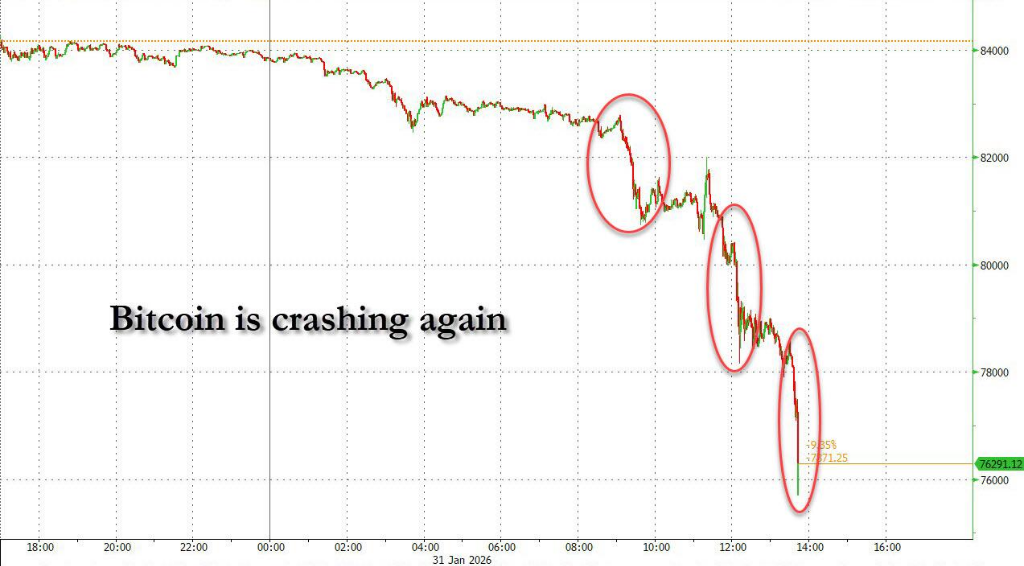
This decline occurred against a backdrop of thin liquidity and limited buying interest, amplifying the drop of the world's largest cryptocurrency to over 30%. Data from market tracker Coinglass showed that about $1.6 billion in long and short positions were liquidated during the same period, with most occurring in the last four hours, primarily concentrated in Bitcoin and Ethereum.
The news of President Trump nominating Warsh to serve as the next Chair of the Federal Reserve seemed to exacerbate the cryptocurrency decline. As previously reported by Wall Street Insights, former Goldman Sachs executive Gavyn Davies stated that choosing Warsh reduces the risk of a crisis triggered by the "Sell America" trade, as he is expected to be resolute in guarding against inflation.
Liquidation Scale Expands, Retail Interest Remains Low
According to data from market tracker Coinglass, approximately $1.6 billion in long and short positions were liquidated in the past 24 hours, with most occurring in the last four hours, primarily concentrated in Bitcoin and Ethereum.
After closing at $83,817 on Friday, Bitcoin fell to $78,092 by Saturday evening, a drop of 7%. This decline brings it back to levels seen after April '25, continuing weeks of macro-level disappointment.
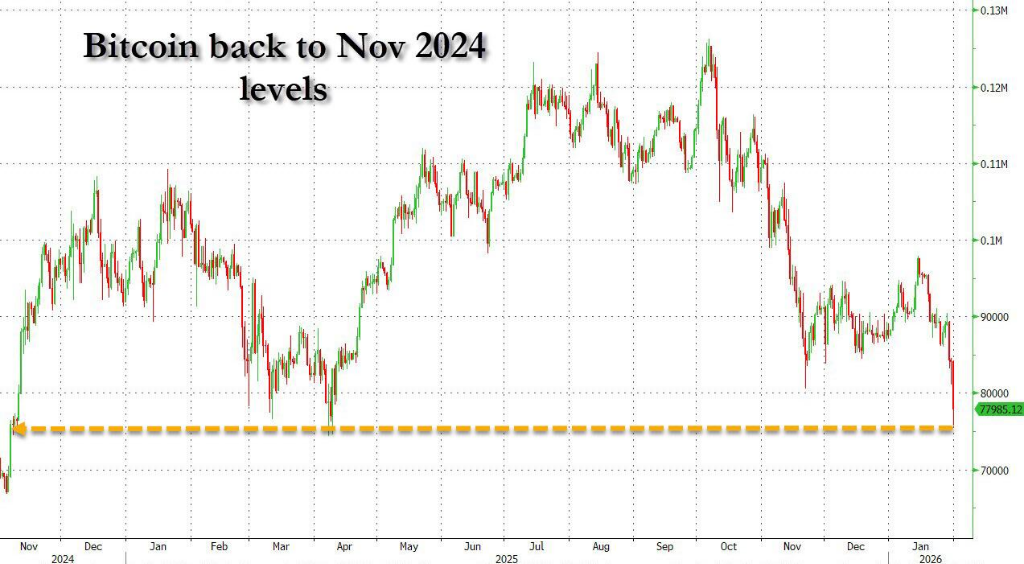
Needham analyst John Todaro said, "The current levels indicate extremely low interest from retail investors," adding that trading volume could remain low for "the next one or two quarters." Continued outflows from spot ETFs further confirm the waning investor interest.
Safe-Haven Attribute Fails, Gold and Silver Become Preferred
Davies, the former chief economist and partner at Goldman Sachs Group, stated that Warsh's policy mix might be welcomed by market participants, though he wishes to reduce the Fed's role in the markets, meaning he may be less willing to intervene during stock market turbulence. "Many market observers would like this combination—a smaller balance sheet alongside more deregulation of the banking system."
Gavyn Davies, Co-founder and Chairman of Fulcrum Asset Management and head of the London office, said in a video posted on the company's website:
"The market, including the dollar, will breathe a significant sigh of relief. Choosing Warsh reduces the risk of that truly crisis-inducing 'Sell America' trade."
Despite the dollar weakening for most of January and growing investor wariness towards the policy risks of the Trump administration, this change failed to boost cryptocurrency market sentiment. Similarly, when gold prices surged to record highs, Bitcoin failed to respond meaningfully.
Louis Navellier of Navellier & Associates said, "Silver and gold have become the tools for investors worried about fiat currency." After gold and silver experienced significant pullbacks on Friday, Bitcoin still failed to attract inflows. Traditional safe-haven funds remain concentrated in metals and cash.
This absence of buying highlights the dilemma of Bitcoin's role in a broader investment portfolio. Geopolitical risks have failed to spark demand, and Bitcoin's dual positioning as both a momentum trade and a hedge against currency devaluation is now in trouble.
Geopolitical Tensions and Regulatory Uncertainty
Bitcoin prices could also be affected by escalating tensions between Israel and Iran. According to Xinhua News Agency, Trump stated that the US and Iran are negotiating, and an advisor to Iran's Supreme Leader said a "negotiation framework" is taking shape. Earlier on January 31st, social media was flooded with rumors about the assassination of the commander of Iran's Islamic Revolutionary Guard Corps Navy, drone attacks on naval bases, and explosions in multiple locations. Iranian media debunked these rumors one by one, stating that the claims were untrue.
Furthermore, delays in new market structure regulations for the US cryptocurrency industry have dampened interest in digital assets. The market had anticipated that regulatory clarity would boost confidence, but the Senate committee's shift in focus to housing issues has led to a postponement of cryptocurrency legislation.
It is worth noting that although Warsh has called Bitcoin a "good asset" and a "good cop on the beat for policy," his nomination news seems to have reversed the strong rally in gold, silver, and cryptocurrencies. The market expects that Warsh may wish to reduce the Fed's role in the markets, meaning he might be less willing to intervene during periods of stock market turbulence.