Crypto Extortion Hits Strait Of Hormuz As Scammers Exploit Shipping Crisis

bitcoinistPublicado em 2026-04-21Última atualização em 2026-04-21

Resumo

An emerging crypto extortion scam is targeting shipping companies with vessels stranded near the Strait of Hormuz, according to maritime risk firm Marisks. Criminals posing as Iranian security officials are sending fraudulent messages offering safe passage in exchange for transit fees paid in Bitcoin or Tether. The scam exploits desperation amid the ongoing regional conflict, which has severely restricted movement through the critical waterway. Victims are instructed to submit documents and pay a cryptocurrency fee to secure transit. However, the messages are not from Iranian authorities. Paying could not only result in financial loss but also potentially violate international sanctions, as any crypto transfer linked to Iranian entities may be considered material support. Legal risks remain even if companies are defrauded. The scheme appears to capitalize on earlier reports that Iran was considering a real crypto-based toll system.

At least one vessel that came under fire while trying to leave the Strait of Hormuz may have been acting on fraudulent instructions — directions that came not from Iranian officials, but from criminals posing as them.

Maritime risk firm Marisks flagged the possibility in a warning issued Monday, though it stopped short of confirming the link.

The warning describes a scam targeting ship owners whose vessels are stuck west of the strait. Unknown groups have been sending messages to these companies, claiming to represent Iranian security services and offering safe passage in exchange for transit fees paid in Bitcoin or Tether (USDT).

Image: Pension Awareness

Fake Officials, Real Consequences

Marisks was direct: the messages are fraudulent. They do not come from Iranian authorities, the firm said.

Tehran has not publicly addressed the situation.

The scam follows a pattern designed to look credible. Recipients are told to submit documents for review. Once verified, they are assigned a fee in cryptocurrency. Pay it, the messages say, and safe transit will be arranged at an agreed time.

It is a structured process — one built to look official enough that desperate ship owners might believe it.

Bitcoin is currently trading at $76,278. Chart: TradingView

The timing is no accident. The Strait of Hormuz has been largely closed since conflict escalated in the Middle East. Before hostilities, the waterway carried roughly 20% of the world’s oil and liquefied natural gas.

Ships have been stranded for days, some under threat of armed intervention. That pressure creates exactly the kind of desperation scammers rely on.

Reports earlier this month indicated that Iran itself had been weighing a real Bitcoin-denominated toll on vessels passing through the strait — charging around $1 per barrel for loaded tankers while letting empty ships through free.

The scam appears to have grown directly out of that reporting, borrowing its credibility from a policy that was already in the news.

Satellite image of Strait of Hormuz. Source: WSJ

Sanctions Risk Adds To The Danger

For shipping companies tempted to pay, the financial and legal exposure goes beyond losing money to criminals.

According to Chainalysis senior intelligence analyst Kaitlin Martin, any cryptocurrency transfer tied to Iranian-controlled waterways could be classified as material support — a designation that puts companies in potential violation of US and international sanctions.

Entities linked to the Islamic Revolutionary Guard Corps fall under some of the strictest sanctions in force.

That means victims of the scam could face legal scrutiny even after being defrauded. Paying what appears to be a ransom to free a stranded vessel could trigger the same sanctions mechanisms designed to punish deliberate violators.

Featured image from Unsplash, chart from TradingView

Criptomoedas em alta

Perguntas relacionadas

QWhat is the main subject of the scam described in the article targeting ships in the Strait of Hormuz?

AThe scam involves criminals posing as Iranian security officials, sending fraudulent messages to ship owners offering safe passage in exchange for transit fees paid in Bitcoin or Tether (USDT).

QWhich maritime risk firm issued a warning about the possibility of fraudulent instructions to vessels?

AMarisks, a maritime risk firm, issued the warning about the fraudulent messages.

QWhat significant risk do shipping companies face beyond financial loss if they pay the cryptocurrency ransom?

AThey risk violating US and international sanctions, as any cryptocurrency transfer tied to Iranian-controlled waterways could be classified as material support, potentially leading to legal scrutiny.

QWhy is the timing of this scam particularly effective, according to the article?

AThe timing is effective because the Strait of Hormuz has been largely closed due to escalated conflict, leaving ships stranded and under threat, which creates the desperation that scammers rely on.

QWhat real policy proposal by Iran may have lent credibility to this cryptocurrency extortion scam?

AReports indicated that Iran itself had been considering a real Bitcoin-denominated toll on vessels passing through the strait, charging around $1 per barrel for loaded tankers, which the scam appears to have exploited for credibility.

Leituras Relacionadas

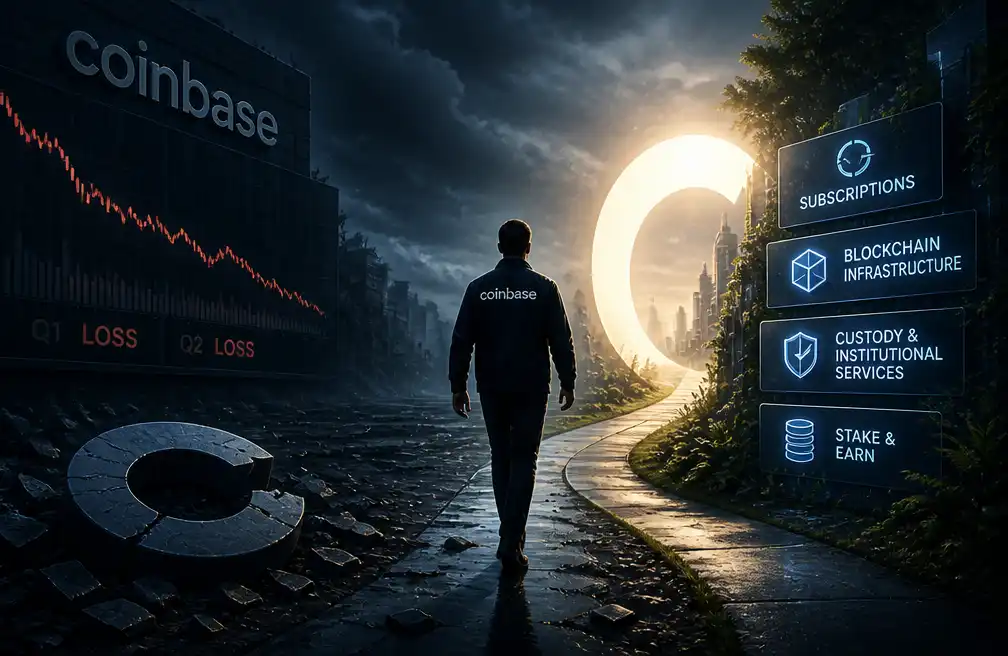
With Two Consecutive Quarters of Losses, Coinbase Must Rely on Paths Beyond Trading

Coinbase posted its second consecutive quarterly net loss of $359 million on $1.22 billion in revenue for Q2, highlighting its vulnerability to crypto market cycles where weaker prices and lower volatility reduce user trading. However, the report also reveals a strategic shift in its business model. Despite a 25% quarter-over-quarter decline in global spot trading volume, Coinbase increased its market share to a company-record 10.3%. This suggests its position as a compliant U.S. on-ramp is strengthening even in a cooler market. A key development is the diversification of revenue streams. Transaction revenue fell to $599 million, nearly equaling subscription and services revenue of $555 million. Stablecoin services, generating $292 million, are becoming a crucial revenue "floor." This income, derived from interest on the $20 billion average USDC balance held on its platform, is less tied to daily trading activity. Furthermore, while spot trading volume dropped significantly, derivatives volume held steady at $1.03 trillion. Coinbase is pushing to integrate spot, stablecoin, and derivatives liquidity to create a more interconnected and sticky ecosystem for users. The GAAP net loss includes non-cash expenses like stock-based compensation and crypto asset valuation changes. Its adjusted EBITDA remained positive at $208 million for the 14th straight quarter, indicating core operations can cover ongoing costs. The company is also reducing expenses to manage the downturn. The central question moving forward is whether Coinbase's growing market share, stablecoin revenues, and expanding product integration can sufficiently offset the inherent cyclicality of its core trading business during future market contractions.

marsbitHá 7m

With Two Consecutive Quarters of Losses, Coinbase Must Rely on Paths Beyond Trading

marsbitHá 7m

In the Age of Artificial Intelligence, We Need 'Magicians,' Not 'Managers'

In the AI era, leadership must shift from management to magic. As knowledge rapidly expires, value shifts from what leaders know to what they can facilitate. Traditional "inside-out" management, driven by internal experience, is giving way to "outside-in" thinking focused on external opportunities, customer needs, and disruptive change. The core challenge is fostering new ideas that may invalidate existing knowledge. While technologies like steam, electricity, and AI provide the "skeleton" for innovation, it is human vision—connecting technology to customer dreams—that creates magic. Historical figures like Richard Arkwright and Eldridge R. Johnson succeeded not by inventing core technologies, but by reimagining work and business models from the outside in. Leaders must transition from controllers to "architects of flourishing." Their role is to design environments where empowerment, creativity, and adaptive learning thrive. This involves granting autonomy, fostering partnerships, and building resilient systems that scale innovation. Critical leadership qualities now include judgment, creativity, and the ability to learn continuously rather than relying on static expertise. Therefore, cultivating future leaders requires a focus on timeless fundamentals, humanities for broader perspective, and social acuity, rather than over-specialization in quickly outdated technical skills. The future rewards those who respond to the unseen and create conditions for better answers to emerge. Leadership in the AI age is less about having all the answers and more about enabling others to discover them—creating organizations where people explore, imagine, and thrive.

marsbitHá 42m

In the Age of Artificial Intelligence, We Need 'Magicians,' Not 'Managers'

marsbitHá 42m

Trading

Spot

Artigos em Destaque

Como comprar ONE

Bem-vindo à HTX.com!Tornámos a compra de Harmony (ONE) simples e conveniente.Segue o nosso guia passo a passo para iniciar a tua jornada no mundo das criptos.Passo 1: cria a tua conta HTXUtiliza o teu e-mail ou número de telefone para te inscreveres numa conta gratuita na HTX.Desfruta de um processo de inscrição sem complicações e desbloqueia todas as funcionalidades.Obter a minha contaPasso 2: vai para Comprar Cripto e escolhe o teu método de pagamentoCartão de crédito/débito: usa o teu visa ou mastercard para comprar Harmony (ONE) instantaneamente.Saldo: usa os fundos da tua conta HTX para transacionar sem problemas.Terceiros: adicionamos métodos de pagamento populares, como Google Pay e Apple Pay, para aumentar a conveniência.P2P: transaciona diretamente com outros utilizadores na HTX.Mercado de balcão (OTC): oferecemos serviços personalizados e taxas de câmbio competitivas para os traders.Passo 3: armazena teu Harmony (ONE)Depois de comprar o teu Harmony (ONE), armazena-o na tua conta HTX.Alternativamente, podes enviá-lo para outro lugar através de transferência blockchain ou usá-lo para transacionar outras criptomoedas.Passo 4: transaciona Harmony (ONE)Transaciona facilmente Harmony (ONE) no mercado à vista da HTX.Acede simplesmente à tua conta, seleciona o teu par de trading, executa as tuas transações e monitoriza em tempo real.Oferecemos uma experiência de fácil utilização tanto para principiantes como para traders experientes.

358 Visualizações TotaisPublicado em {updateTime}Atualizado em 2026.06.02

Como comprar ONE

Discussões

Bem-vindo à Comunidade HTX. Aqui, pode manter-se informado sobre os mais recentes desenvolvimentos da plataforma e obter acesso a análises profissionais de mercado. As opiniões dos utilizadores sobre o preço de ONE (ONE) são apresentadas abaixo.

活动图片