Wall Street 'Withdraws' from Bitcoin Basis Arbitrage: CME Falls Out of Favor, the Golden Age of Arbitrage Comes to an End

marsbitPublicado em 2026-01-22Última atualização em 2026-01-22

Resumo

Wall Street is retreating from the once-lucrative Bitcoin basis trade, as narrowing spreads between spot and futures prices have made the strategy barely profitable. The cash-and-carry trade, which involved buying Bitcoin spot (often via ETFs) and selling futures to capture the premium, has seen annualized returns drop to around 5%, down from nearly 17% a year ago, barely covering funding and execution costs. This compression has led to a significant shift in market structure: CME's Bitcoin futures open interest has fallen below Binance's for the first time since 2023, indicating a withdrawal of hedge funds and large US accounts from this specific arbitrage strategy. While CME was the preferred venue for this institutional trade, Binance's dominance in perpetual futures has remained steady. The approval of spot Bitcoin ETFs initially fueled the trade's popularity but also accelerated its decline by attracting capital that quickly eroded the arbitrage opportunity. The market is now maturing, with participants shifting from simple leveraged directional bets to using options, hedges, and expressing views through diverse instruments like ETFs. This increased efficiency has naturally narrowed price disparities between venues. As the era of easy, high returns from basis trading ends, participants are expected to seek more complex strategies in decentralized markets and other crypto assets.

Original Title: Wall Street Pulls Back From Bitcoin』s Money-Spinning Basis Trade

Original Author: Sidhartha Shukla, Bloomberg

Original Compilation: Peggy, BlockBeats

Editor's Note: The once considered 'surefire' Bitcoin basis arbitrage is quietly losing its appeal: the open interest between CME and Binance is shifting, and the spread has narrowed to the point where it barely covers funding and execution costs.

On the surface, this is a squeeze in arbitrage opportunities; at a deeper level, the crypto derivatives market is maturing. Institutions no longer need to rely on 'arbitrage' for returns, and traders are shifting from leverage to options and hedging. The era of high returns through simple strategies is fading, and new competition will emerge in more complex and refined strategies.

Below is the original text:

The crypto derivatives market is undergoing a quiet yet significant change: one of the most stable and profitable trading strategies is showing signs of faltering.

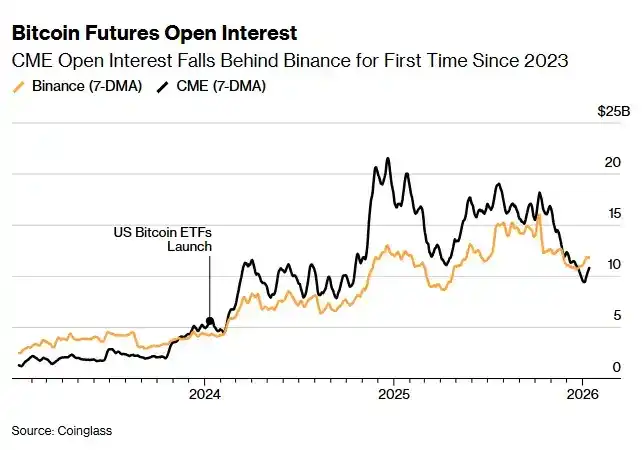
The 'cash-and-carry' trade, commonly used by institutions—buying Bitcoin spot while selling futures to profit from the spread—is collapsing. This not only signals a rapid compression of arbitrage opportunities but also releases a deeper message: the structure of the crypto market is changing. The open interest of Bitcoin futures on the Chicago Mercantile Exchange (CME) has fallen below that of Binance for the first time since 2023, further indicating that the highly profitable arbitrage opportunities of the past are being rapidly eroded as spreads narrow and market access becomes more efficient.

After the launch of spot Bitcoin ETFs in early 2024, CME once became the preferred venue for Wall Street trading desks to execute such strategies. This operation is highly similar to the 'basis trade' in traditional markets: buying Bitcoin spot through ETFs while selling futures contracts to profit from the spread between the two.

In the months following the ETF approval, the annualized return of this so-called 'delta-neutral strategy' often reached double digits, attracting billions of dollars in capital—capital that was indifferent to the direction of Bitcoin's price movement, focusing solely on capturing the returns. However, it was precisely the ETF that drove the rapid expansion of this trade that also sowed the seeds of its demise: as more trading desks rushed in, the arbitrage spread was quickly erased. Today, the returns from this trade are barely enough to cover funding costs.
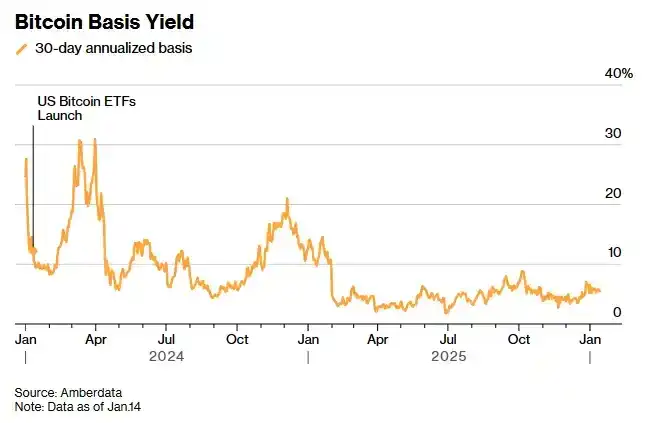
According to data compiled by Amberdata, the current annualized return for a one-month period is hovering around 5%, near its lowest level in recent years. Greg Magadini, Director of Derivatives at Amberdata, noted that around this time last year, the basis was close to 17%, but has now fallen to about 4.7%, barely enough to cover the threshold of funding and execution costs. Meanwhile, the one-year U.S. Treasury yield is around 3.5%, making the trade increasingly less attractive.

Against the backdrop of narrowing spreads, the open interest of CME Bitcoin futures has fallen from a peak of over $21 billion to below $10 billion, according to data compiled by Coinglass. In contrast, Binance's open interest has remained relatively stable, at around $11 billion. James Harris, CEO of digital asset management firm Tesseract, stated that this change reflects more of a pullback by hedge funds and large U.S. accounts, rather than a broad retreat from crypto assets after Bitcoin prices peaked in October.

Exchanges like Binance are the primary venues for perpetual contracts. These contracts are settled, priced, and margin-calculated continuously, often updated multiple times a day. Perpetual contracts, commonly referred to as 'perps,' account for the largest share of crypto trading volume. Last year, CME also launched smaller-sized, longer-term futures contracts covering crypto assets and equity indices, offering futures positions close to the spot market, allowing investors to hold contracts for up to five years without frequent rollovers.

Harris of Tesseract noted that historically, CME has been the preferred venue for institutional capital and 'cash-and-carry' trades. He added that CME's open interest being overtaken by Binance is 'a significant signal that the market participation structure is shifting.' He described the current situation as a 'tactical reset,' driven by lower returns and thinning liquidity, rather than a loss of market confidence.

According to a statement from CME Group, 2025 is a key inflection point for the market: as regulatory frameworks become clearer and investor expectations for the sector improve, institutional capital is expanding from single bets on Bitcoin to tokens like Ethereum, Ripple's XRP, and Solana.

CME Group stated: 'Our average daily nominal open interest for Ethereum futures in 2024 was about $1 billion, and by 2025, this number has grown to nearly $5 billion.'
Although the Federal Reserve's interest rate cuts have reduced funding costs, this has not driven a sustained rebound in the crypto market since the collective crash of various tokens on October 10. Current borrowing demand is weak, decentralized finance (DeFi) yields are low, and traders are more inclined to use options and hedging tools rather than directly leveraging directional bets.

Le Shi, Managing Director of market maker Auros in Hong Kong, stated that as the market matures, traditional participants now have more channels to express directional views, from ETFs to direct access to exchanges. This increase in choice has narrowed the price differences between trading venues, naturally compressing the arbitrage opportunities that once drove the growth of CME's open interest.

Le said: 'There is a self-balancing effect here.' He believes that as market participants continue to flock to the lowest-cost trading venues, the basis narrows, and the motivation to engage in cash-and-carry trades diminishes accordingly.

On Wednesday, Bitcoin fell by 2.4% at one point to $87,188 before paring losses. This decline briefly erased all gains for the year.

Bohumil Vosalik, Chief Investment Officer of 319 Capital, stated that the era of nearly risk-free high returns may be over, forcing traders to turn to more complex strategies in decentralized markets. For high-frequency and arbitrage-focused institutions, this means they need to look elsewhere for opportunities.

Original Link

Perguntas relacionadas

QWhat is the main reason for the decline in the profitability of Bitcoin basis trades according to the article?

AThe main reason is the rapid compression of arbitrage spreads due to increased market efficiency and massive inflows from Wall Street trading desks after the launch of spot Bitcoin ETFs, which has pushed returns down to levels that barely cover funding and execution costs.

QHow has the open interest in Bitcoin futures on CME changed compared to Binance, and what does this shift indicate?

AThe open interest in Bitcoin futures on CME has fallen below that of Binance for the first time since 2023, dropping from a peak of over $21 billion to under $10 billion. This shift indicates a tactical reset where hedge funds and large US accounts are pulling back from basis trades due to lower yields, rather than a broad retreat from crypto assets.

QWhat specific trading strategy used by institutions is discussed in the article, and how does it work?

AThe strategy discussed is the 'cash-and-carry' trade, also known as basis trade. It involves buying Bitcoin spot (often through ETFs) and simultaneously selling Bitcoin futures contracts to profit from the price difference (basis) between the spot and futures markets.

QWhat does the article suggest about the future of trading opportunities in the crypto derivatives market?

AThe article suggests that the era of easy, high returns from simple arbitrage strategies is ending. Future opportunities will require more complex and sophisticated strategies, as traders move towards options, hedging, and seeking alpha in decentralized markets.

QAccording to the article, what broader market development is contributing to the maturation of the crypto derivatives landscape?

AThe broader market development is the increasing clarity and improved regulatory framework, which has encouraged institutional capital to expand beyond Bitcoin into other tokens like Ethereum, XRP, and Solana, as evidenced by the growth in CME's Ethereum futures open interest.

Leituras Relacionadas

How Many Tokens Away Is Yang Zhilin from the 'Moon Chasing the Light'?

The article explores the intense competition between two leading Chinese AI companies, DeepSeek and Kimi (Moon Dark Side), and the mounting pressure on Yang Zhilin, the founder of Kimi. While DeepSeek re-emerged after 15 months of silence with its powerful V4 model—boasting 1.6 trillion parameters and low-cost, long-context capabilities—Kimi has been focusing on long-context processing and multi-agent systems with its K2.6 model. Yang faces a threefold challenge: technological rivalry, commercialization pressure, and investor expectations. Despite Kimi’s high valuation (reaching $18 billion), its revenue heavily relies on a single product with low paid conversion rates, while DeepSeek’s strategic silence and open-source influence have strengthened its market position and valuation prospects, now targeting over $20 billion. Both companies reflect broader trends in China’s AI ecosystem: Kimi aims for global influence through open-source contributions and agent-based advancements, while DeepSeek prioritizes foundational innovation and hardware independence, notably shifting to Huawei’s chips. Their competition is seen as vital for China’s AI progress, with the gap between top Chinese and U.S. models narrowing to just 2.7% on the Elo rating scale. Ultimately, the article argues that this rivalry, though anxiety-inducing for leaders like Zhilin, is essential for driving innovation and solidifying China’s role in the global AI landscape.

marsbitHá 6h

How Many Tokens Away Is Yang Zhilin from the 'Moon Chasing the Light'?

marsbitHá 6h

TechFlow Intelligence Bureau: ChatGPT Helps Amateur Mathematician Crack 60-Year-Old Problem, CFTC Sues New York Regulator Over Coinbase and Gemini

An amateur mathematician, with the assistance of ChatGPT, has solved a combinatorial mathematics puzzle originally proposed by Hungarian mathematician Paul Erdős in the 1960s. This marks another milestone in AI-aided mathematical research, demonstrating the evolving capabilities of large language models in formal reasoning. In other AI developments, OpenAI introduced a new privacy filter tool for enterprise API usage, automatically screening sensitive data. Meanwhile, the Qwen3.6-27B model achieved 100 tokens per second on a single RTX 5090 GPU using quantization, significantly lowering the cost barrier for local AI deployment. In crypto and Web3, the U.S. CFTC sued New York’s financial regulator, challenging its oversight of Coinbase and Gemini—a first-of-its-kind federal-state regulatory clash. Following a vulnerability, KelpDAO and major DeFi protocols established a recovery fund. Tether froze $344 million in assets linked to Iran’s central bank upon U.S. Treasury request, highlighting the centralized control risks in stablecoins. Separately, Litecoin underwent a 3-hour chain reorganization to undo a privacy-layer exploit. In the U.S., former President Trump invoked the Defense Production Act to address power grid bottlenecks affecting AI data centers and dismissed the entire National Science Board, raising concerns over research independence. A retail trader gained 250% on a $600k Intel options bet amid AI-related speculation. Xiaomi announced its first performance electric vehicle, targeting rivals like Tesla. Meanwhile, iPhone users reported devices automatically reinstalling a hidden app daily, suspected to be MDM-related. A Chinese securities report noted that A-share institutional crowding has reached its second-longest streak since 2007, signaling high valuations and potential style rotation. The day’s developments reflect a dual narrative: AI is enabling unprecedented individual breakthroughs, while centralized power structures—whether governmental or corporate—are becoming more assertive, underscoring that decentralization is as much a political-economic challenge as a technical one.

marsbitHá 6h

TechFlow Intelligence Bureau: ChatGPT Helps Amateur Mathematician Crack 60-Year-Old Problem, CFTC Sues New York Regulator Over Coinbase and Gemini

marsbitHá 6h

Trading

Spot
Futuros
活动图片