Wall Street Keeps Buying XRP: US Spot ETFs Post 19-Day Inflow Streak

bitcoinistPublicado em 2025-12-16Última atualização em 2025-12-16

Resumo

US-listed spot XRP ETFs have recorded 19 consecutive trading days of net inflows with zero outflows, accumulating nearly $1 billion in new investments by December 12, according to Sosovalue data. Total net assets reached approximately $1.18 billion. Industry experts, including Bitmern Mining CEO Giannis Andreou, attribute this sustained inflow to institutional demand rather than retail speculation. In a significant shift, XRP ETFs have now surpassed Solana ETFs in total assets under management, with $1.638 billion compared to SOL's $1.566 billion. Analysts suggest XRP's appeal lies in its institutional suitability and lack of staking, contrasting with Solana's on-chain efficiency for retail users. Despite strong ETF performance, XRP's price fell to $1.98 at press time, testing a key support level.

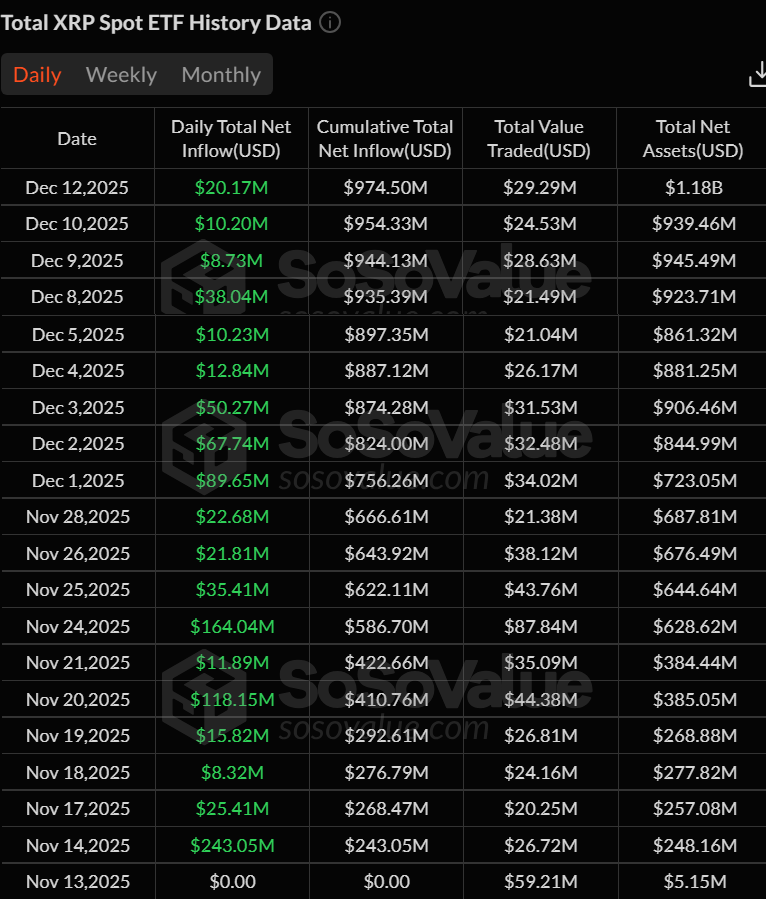
US-listed spot XRP ETFs just put together a streak that’s hard to ignore: 19 straight trading days of net inflows, with zero outflow sessions over the run, according to daily flow data compiled by Sosovalue.

The numbers add up quickly. By Dec. 12, cumulative net inflows sat at $974.50 million, while total net assets across the products were shown at roughly $1.18 billion.

XRP ETFs Log 19 Straight Trading Days Of Inflows

The early days did most of the heavy lifting. Sosovalue’s table shows $243.05 million of net inflow on Nov. 14, then another surge on Nov. 24 ($164.04 million). There were also chunky adds on Nov. 20 ($118.15 million) and Dec. 1 ($89.65 million). Even as the pace cooled, inflows didn’t flip—Dec. 8 posted $38.04 million, and Dec. 12 added another $20.17 million.
US spot ETF inflows | Source: X @gandreou007

On X, Bitmern Mining founder and CEO Giannis Andreou framed it bluntly today: “19 consecutive trading days of inflows. Zero outflow days. Nearly $1B in net capital added.” He called it “sustained institutional positioning,” not retail froth.

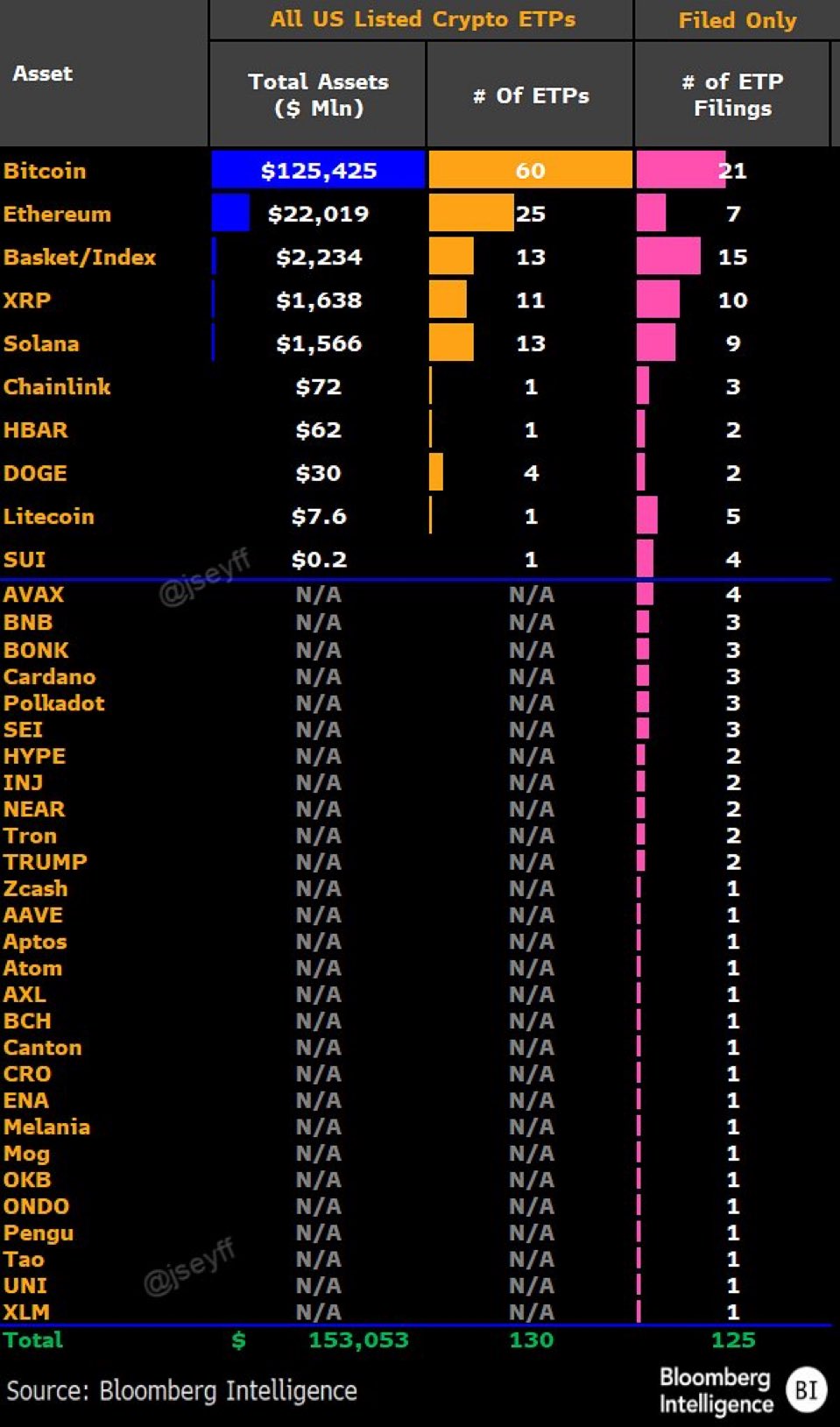
That “institutional bid” angle is also showing up in the asset rankings. In a Dec. 13 post, Canary Capital CEO Steven McClurg pointed to a separate snapshot of the US crypto ETP landscape showing XRP products now edging out Solana by total assets under management.

Bloomberg Intelligence data in the chart puts XRP ETP assets at about $1.638 billion, just ahead of Solana at $1.566 billion, in a market where Bitcoin still towers over everything at $125.425 billion and Ethereum sits at $22.019 billion.
Crypto ETF inflow data | Source: X @stevenmcclurg

McClurg’s explanation for the flip was less about Solana underperforming and more about where each asset “fits” in the wrapper trade.

“SOL ETFs launched before XRP, but XRP ETFs have now passed SOL in total AUM. I expected this,” McClurg wrote, adding “SOL is much more efficient to hold on-chain and to stake directly for retail audiences, whereas XRP has more institutional demand and no staking. As with everything, there will be an audience that prefers direct ownership, and an audience that prefers the ease of financial instruments. Some will do both.”

Notably, from Dec. 8 to Dec. 12, Bitcoin spot ETFs recorded net inflows of $287 million for the week, while Ethereum spot ETFs saw weekly net inflows of $209 million. SOL spot ETFs recorded net inflows of $33.6 million.

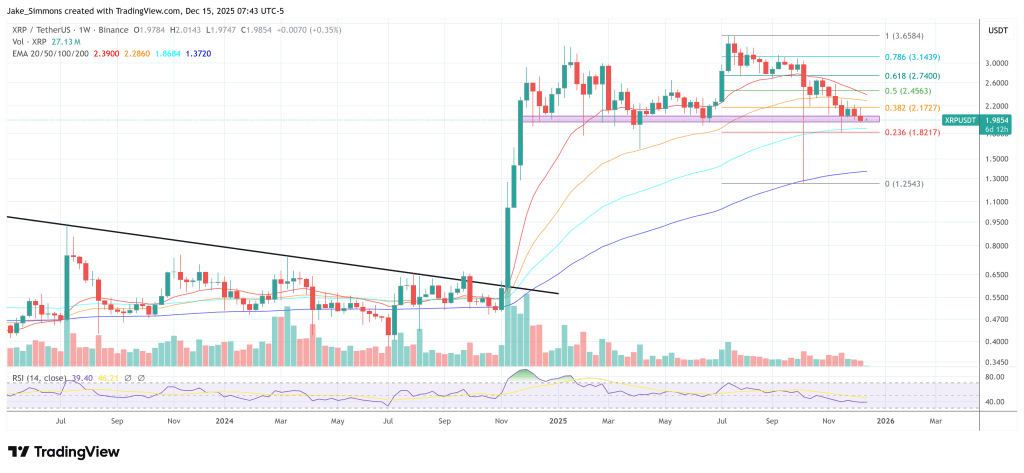
At press time, XRP once again fell below the $2 mark. The token traded at $1.98 and thus at the key support zone. A drop below the red support band could strengthen the bear case for a deeper crash to the 100-week or even 200-week Exponential Moving Average (EMA). XRP visited the latter during the October 10 crash.
Price hovers in crucial support zone, 1-week chart | Source: XRPUSDT on TradingView.com

Leituras Relacionadas

Gensyn AI: Don't Let AI Repeat the Mistakes of the Internet

In recent months, the rapid growth of the AI industry has attracted significant talent from the crypto sector. A persistent question among researchers intersecting both fields is whether blockchain can become a foundational part of AI infrastructure. While many previous AI and Crypto projects focused on application layers (like AI Agents, on-chain reasoning, data markets, and compute rentals), few achieved viable commercial models. Gensyn differentiates itself by targeting the most critical and expensive layer of AI: model training. Gensyn aims to organize globally distributed GPU resources into an open AI training network. Developers can submit training tasks, nodes provide computational power, and the network verifies results while distributing incentives. The core issue addressed is not decentralization for its own sake, but the increasing centralization of compute power among tech giants. In the era of large models, access to GPUs (like the H100) has become a decisive bottleneck, dictating the pace of AI development. Major AI companies are heavily dependent on large cloud providers for compute resources. Gensyn's approach is significant for several reasons: 1) It operates at the core infrastructure layer (model training), the most resource-intensive and technically demanding part of the AI value chain. 2) It proposes a more open, collaborative model for compute, potentially increasing resource utilization by dynamically pooling idle GPUs, similar to early cloud computing logic. 3) Its technical moat lies in solving complex challenges like verifying training results, ensuring node honesty, and maintaining reliability in a distributed environment—making it more of a deep-tech infrastructure company. 4) It targets a validated, high-growth market with genuine demand, rather than pursuing blockchain integration without purpose. Ultimately, the boundaries between Crypto and AI are blurring. AI requires global resource coordination, incentive mechanisms, and collaborative systems—areas where crypto-native solutions excel. Gensyn represents a step toward making advanced training capabilities more accessible and collaborative, moving beyond a niche controlled by a few giants. If successful, it could evolve into a fundamental piece of AI infrastructure, where the most enduring value in the AI era is often created.

marsbitHá 7h

Gensyn AI: Don't Let AI Repeat the Mistakes of the Internet

marsbitHá 7h

Why is China's AI Developing So Fast? The Answer Lies Inside the Labs

A US researcher's visit to China's top AI labs reveals distinct cultural and organizational factors driving China's rapid AI development. While talent, data, and compute are similar to the West, Chinese labs excel through a pragmatic, execution-focused culture: less emphasis on individual stardom and conceptual debate, and more on teamwork, engineering optimization, and mastering the full tech stack. A key advantage is the integration of young students and researchers who approach model-building with fresh perspectives and low ego, prioritizing collective progress over personal credit. This contrasts with the US culture of self-promotion and "star scientist" narratives. Chinese labs also exhibit a strong "build, don't buy" mentality, preferring to develop core capabilities—like data pipelines and environments—in-house rather than relying on external services. The ecosystem feels more collaborative than tribal, with mutual respect among labs. While government support exists, its scale is unclear, and technical decisions appear driven by labs, not state mandates. Chinese companies across sectors, from platforms to consumer tech, are building their own foundational models to control their tech destiny, reflecting a broader cultural drive for technological sovereignty. Demand for AI is emerging, with spending patterns potentially mirroring cloud infrastructure more than traditional SaaS. Despite challenges like a less mature data industry and GPU shortages, Chinese labs are propelled by vast talent, rapid iteration, and deep integration with the open-source community. The competition is evolving beyond a pure model race into a contest of organizational execution, developer ecosystems, and industrial pragmatism.

marsbitHá 9h

Why is China's AI Developing So Fast? The Answer Lies Inside the Labs

marsbitHá 9h

3 Years, 5 Times: The Rebirth of a Century-Old Glass Factory

Corning, a 175-year-old glass company, is experiencing a dramatic revival as a key player in AI infrastructure, driven by surging demand for high-performance optical fiber in data centers. AI data centers require vastly more fiber than traditional ones—5 to 10 times as much per rack—to handle high-speed data transmission between GPUs. This structural demand shift, coupled with supply constraints from the lengthy expansion cycle for fiber preforms, has created a significant supply-demand gap. Nvidia has invested in Corning, along with Lumentum and Coherent, in a $4.5 billion total commitment to secure the optical supply chain for AI. Corning's competitive edge lies in its expertise in producing ultra-low-loss, high-density, and bend-resistant specialty fiber, which is critical for 800G+ and future 1.6T data rates. Its deep involvement in co-packaged optics (CPO) with partners like Nvidia further solidifies its position. While not the largest fiber manufacturer globally, Corning's revenue from enterprise/data center clients now exceeds 40% of its optical communications sales, and it has secured multi-year supply agreements with major hyperscalers including Meta and Nvidia. Financially, Corning's optical communications revenue has surged, doubling from $1.3 billion in 2023 to over $3 billion in 2025. Its stock price has risen nearly 6-fold since late 2023. Key future catalysts include the rollout of Nvidia's CPO products and the scale of undisclosed customer agreements. However, risks include high current valuations and potential disruption from next-generation technologies like hollow-core fiber. The company's long-term bet on light over electricity, maintained even through the telecom bubble crash, is now being validated by the AI boom.

marsbitHá 9h

3 Years, 5 Times: The Rebirth of a Century-Old Glass Factory

marsbitHá 9h

Trading

Spot
Futuros

Artigos em Destaque

Como comprar US

Bem-vindo à HTX.com!Tornámos a compra de Talus Network (US) simples e conveniente.Segue o nosso guia passo a passo para iniciar a tua jornada no mundo das criptos.Passo 1: cria a tua conta HTXUtiliza o teu e-mail ou número de telefone para te inscreveres numa conta gratuita na HTX.Desfruta de um processo de inscrição sem complicações e desbloqueia todas as funcionalidades.Obter a minha contaPasso 2: vai para Comprar Cripto e escolhe o teu método de pagamentoCartão de crédito/débito: usa o teu visa ou mastercard para comprar Talus Network (US) instantaneamente.Saldo: usa os fundos da tua conta HTX para transacionar sem problemas.Terceiros: adicionamos métodos de pagamento populares, como Google Pay e Apple Pay, para aumentar a conveniência.P2P: transaciona diretamente com outros utilizadores na HTX.Mercado de balcão (OTC): oferecemos serviços personalizados e taxas de câmbio competitivas para os traders.Passo 3: armazena teu Talus Network (US)Depois de comprar o teu Talus Network (US), armazena-o na tua conta HTX.Alternativamente, podes enviá-lo para outro lugar através de transferência blockchain ou usá-lo para transacionar outras criptomoedas.Passo 4: transaciona Talus Network (US)Transaciona facilmente Talus Network (US) no mercado à vista da HTX.Acede simplesmente à tua conta, seleciona o teu par de trading, executa as tuas transações e monitoriza em tempo real.Oferecemos uma experiência de fácil utilização tanto para principiantes como para traders experientes.

375 Visualizações TotaisPublicado em {updateTime}Atualizado em 2025.12.11

Como comprar US

Discussões

Bem-vindo à Comunidade HTX. Aqui, pode manter-se informado sobre os mais recentes desenvolvimentos da plataforma e obter acesso a análises profissionais de mercado. As opiniões dos utilizadores sobre o preço de US (US) são apresentadas abaixo.

活动图片













