Venezuela Attack: US Lawmaker To Introduce Prediction Market Bill Targeting Insider Trading

bitcoinistPublicado em 2026-01-04Última atualização em 2026-01-04

Resumo

US Representative Ritchie Torres plans to introduce a bill banning government officials from insider trading on prediction markets. This follows reports that three recently created wallets netted over $630,000 in profits on Polymarket by betting on the capture of Venezuelan President Nicolás Maduro just hours before a US military operation. The proposed "Public Integrity In Financial Prediction Markets Act of 2026" would prohibit federal officials from trading prediction contracts when possessing nonpublic government information. Meanwhile, the crypto market remained resilient, with Bitcoin rising 2.13% to $91,414 and the total market cap reaching $3.08 trillion.

The US strike on Venezuela represents the largest headline event of the new year so far. In several developments spinning off this incident, Representative Ritchie Torres is reportedly moving to introduce a bill targeting insider trading on prediction markets amid traders’ netting heavy profits on forecasted capture of President Nicolás Maduro.

The Push For Integrity In Prediction Markets

On January 3, US President Donald announced a successful military mission in Venezuela resulting in the capture of President Maduro and his wife, Cilia Flores. The Republican-led administration in Washington accuses Maduro and his spouse of running a “narco-terrorist organization,” and both parties have been arraigned to face charges of drug trafficking in New York.

Amid the numerous condemnations and reactions to this move by the US government, there have been revelations of insider trading around the event in the predictions market. Blockchain analysis page Lookonchain reports that three insider wallets placed Polymarket bets on the capture of Maduro just hours before the attack.
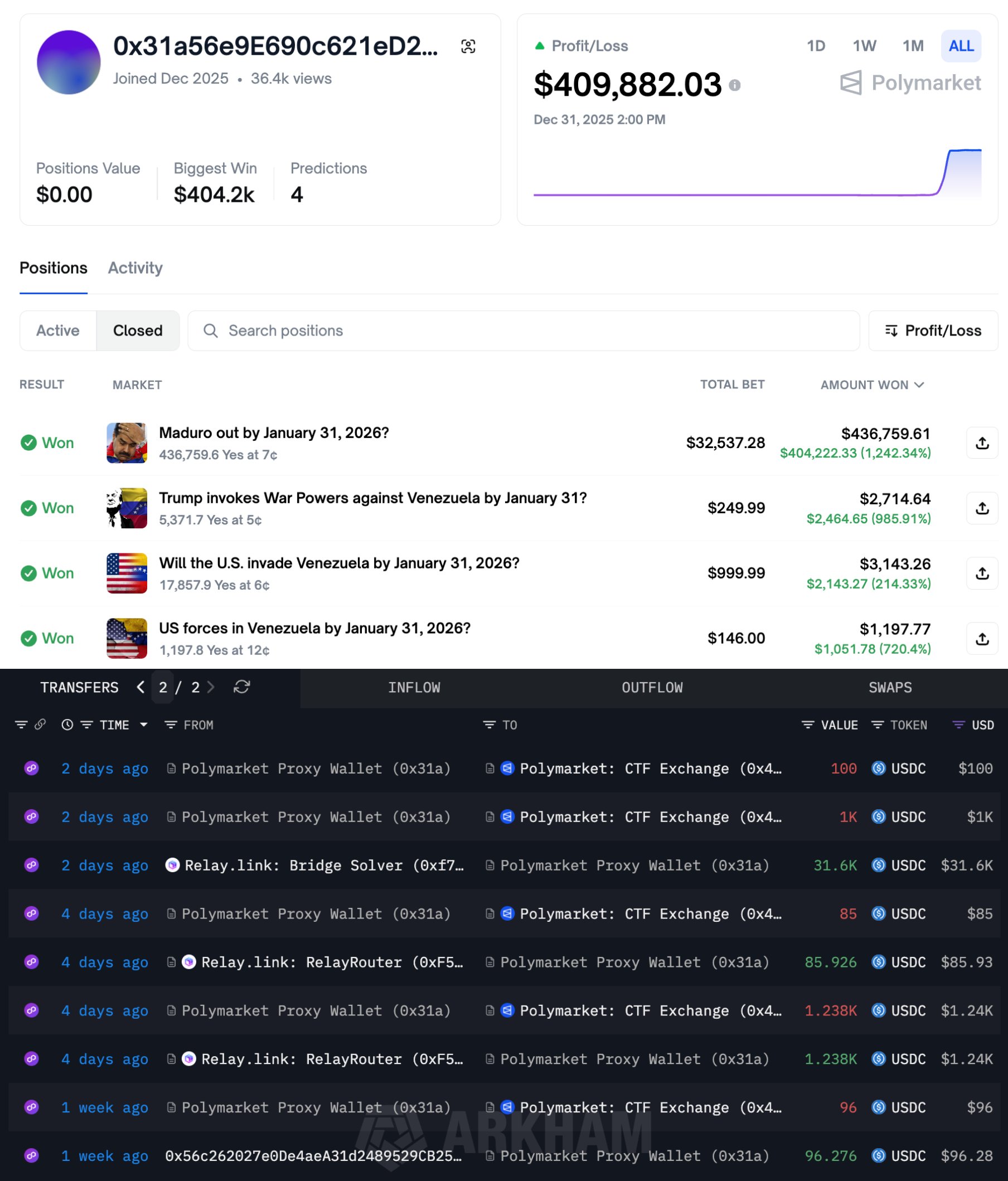
Source: @lookonchain on X

Data shows that these three wallets were recently created, funded, and only placed bets relating to Venezuela and Maduro’s capture to net total profits valued at $630,848. The largest of these transactions came from a trader who invested $34,000 to record gains of $409,900.

According to the founder of PunchBowl News, Jake Sherman, Rep Ritchie Torres (D-N.Y.) aims to introduce a bill that illegalizes this act among government officials and protects important state-related information. The bill, which would be titled the Public Integrity In Financial Prediction Markets Act of 2026, aims to ban all affiliated government persons from participating in the prediction market bets when exposed to certain information.

Sherman states that the description of the proposed law read:

This bill prohibits federal elected officials, political appointees, and Executive Branch employees from engaging in certain transactions involving prediction market contracts when they either possess material nonpublic information relevant to the transaction or could reasonably obtain such information through their official duties.

The restriction applies to buying, selling, or exchanging prediction market contracts tied to government policy, government action, or political outcomes on platforms engaged in interstate commerce

Notably, prediction markets surged in late 2025 following growing Wall Street interest in the blockchain market infrastructure. Kalshi, which presently ranks as the largest prediction platform, is presently valued at $11 billion after a $1 billion fundraising in December.

Crypto Market Resilient Amid Venezuela Attack

In other news, the crypto market has shown no significant negative reaction to the US attack on Venezuelan soil. Over the last day, Bitcoin has moved by 2.13% to trade at $91,414 as the total crypto market cap climbed to $3.08 trillion.

Total crypto market valued at $3.08 trillion on the daily chart | Source: TOTAL chart on Tradingview.com

Criptomoedas em alta

Perguntas relacionadas

QWhat is the main purpose of the bill that Representative Ritchie Torres plans to introduce?

AThe bill, titled the Public Integrity In Financial Prediction Markets Act of 2026, aims to prohibit federal elected officials, political appointees, and Executive Branch employees from engaging in transactions involving prediction market contracts when they possess material nonpublic information or could reasonably obtain it through their official duties.

QWhat specific event triggered the revelation of insider trading on prediction markets?

AThe revelation of insider trading was triggered by the US military mission in Venezuela on January 3 that resulted in the capture of President Nicolás Maduro and his wife, with traders netting heavy profits by betting on this outcome just hours before the attack.

QHow much profit did the three insider wallets reportedly make from their Polymarket bets?

AThe three insider wallets netted total profits valued at $630,848, with the largest transaction from a single trader who invested $34,000 to record gains of $409,900.

QWhich prediction market platform is currently the largest and what is its valuation?

AKalshi is currently the largest prediction market platform, valued at $11 billion after a $1 billion fundraising round in December 2025.

QHow did the cryptocurrency market react to the US military action in Venezuela?

AThe cryptocurrency market showed no significant negative reaction, with Bitcoin's price increasing by 2.13% to $91,414 and the total crypto market cap climbing to $3.08 trillion.

Leituras Relacionadas

Annual Salary of Millions Competing for Electricians, Meta Rushes to Open Its Own Technical School

The AI boom is facing an unexpected bottleneck: a severe shortage of skilled construction workers and electricians. As tech giants like Meta, OpenAI, and Alphabet race to build massive data centers—such as OpenAI's $16 billion "Stargate" project—they are hitting a critical labor wall. The U.S. needs an estimated 130,000 more electricians, 240,000 construction workers, and 150,000 supervisors by 2030 for AI infrastructure alone, but tens of thousands of electrician jobs go unfilled each year. While AI companies offer high premiums, with electricians earning up to $280,000 annually, worker scarcity still causes massive losses—delays on a single project can cost $14.2 million per month. The complexity of building AI data centers, which require immense power (equivalent to powering hundreds of thousands of homes), sophisticated electrical systems, and advanced liquid cooling solutions, demands highly skilled technicians who are in short supply. To combat this, companies are investing heavily in training. Meta has committed $115 million to a free training school offering tuition, housing, and stipends, targeting 5,000 new workers. OpenAI is partnering with unions to secure skilled labor. These efforts are paying off, with a significant rise in Gen Z interest in trade schools over college. However, the power demands are staggering. AI data centers are driving a rapid surge in electricity consumption, projected to account for up to 12% of U.S. power use by 2028 and raising costs for consumers. Furthermore, the construction boom is project-based, leading to a potential future glut of trained workers once building peaks, which could depress wages industry-wide. The race for AI supremacy now depends as much on skilled hands as on advanced chips.

marsbitHá 19m

Annual Salary of Millions Competing for Electricians, Meta Rushes to Open Its Own Technical School

marsbitHá 19m

OpenAI No Longer Sells Its Most Expensive Model for Profit

OpenAI is shifting its business strategy away from promoting its most expensive, flagship models for every task. Recent price cuts—80% for GPT-5.6 Luna and 20% for Terra—signal a deeper change: the company now actively advises users that many tasks don't require the most powerful model. Instead, OpenAI recommends a tiered approach: use the high-end GPT-5.6 Sol for complex planning and analysis, then delegate execution to cheaper models like Luna. This mirrors moves by Anthropic, which recently launched Claude Opus 5 at half the price of its top model, Fable 5. Both companies are de-emphasizing flagship models as primary revenue drivers, using them instead for brand prestige and technological showcases. The industry is entering a "mass-market" phase, similar to automotive, where high-volume, cost-effective models handle daily operations and drive scale. OpenAI's price reductions are partly enabled by AI models themselves optimizing underlying code and infrastructure, creating a self-reinforcing cycle of efficiency gains and cost reduction. Competition is shifting from "who is smartest" to "who offers the best value." The goal is no longer selling individual models but fostering widespread API adoption and ecosystem lock-in. By making AI calls cheap and ubiquitous, companies like OpenAI aim to become the indispensable, utility-like infrastructure powering automated workflows—the "water and electricity" of software, quietly embedded everywhere.

marsbitHá 19m

OpenAI No Longer Sells Its Most Expensive Model for Profit

marsbitHá 19m

Will the Fed Definitely Raise Interest Rates in September? How Will Crypto and U.S. Stocks Withstand the Pressure?

The market's expectation for a September Fed rate hike surged dramatically in early August, jumping from under 50% to over 80% within a week. This shift followed a contentious July FOMC meeting, where a 9-3 vote to hold rates revealed growing dissent from hawkish members advocating for an immediate hike to combat persistent inflation. The primary catalyst for this repricing is rising oil prices, driven by renewed geopolitical tensions around the Strait of Hormuz, which threaten global supply. Energy costs directly influence inflation metrics, making the upcoming July CPI report (due August 12th) a critical data point. If it shows inflation reaccelerating, the probability of a September hike will solidify. For Bitcoin and crypto assets, this is typically bearish news. Bitcoin continues to behave as a high-beta, liquidity-sensitive risk asset. A rate hike raises the opportunity cost of holding non-yielding assets and could drive capital toward money markets, pressuring crypto prices in the short term. However, historical patterns suggest that if a hike is perceived as the end of a tightening cycle rather than the start, any negative price impact may be brief. U.S. stocks, particularly crypto-linked equities like Coinbase and growth-oriented tech stocks, are also vulnerable. Higher rates increase discount rates in valuation models, putting pressure on high-multiple companies. This coincides with a pivotal tech earnings season where investor focus has shifted from massive AI capital expenditure to tangible revenue and cash flow generation. Companies with negative cash flow and weak growth narratives could face heightened volatility if borrowing costs rise in September. In summary, a September Fed hike has evolved into a mainstream market scenario. Key factors to watch are oil prices, the July CPI report, and Fed communications, which will determine the final decision and its impact on volatile crypto and equity markets.

marsbitHá 29m

Will the Fed Definitely Raise Interest Rates in September? How Will Crypto and U.S. Stocks Withstand the Pressure?

marsbitHá 29m

Trading

Spot

Artigos em Destaque

Como comprar US

Bem-vindo à HTX.com!Tornámos a compra de Talus Network (US) simples e conveniente.Segue o nosso guia passo a passo para iniciar a tua jornada no mundo das criptos.Passo 1: cria a tua conta HTXUtiliza o teu e-mail ou número de telefone para te inscreveres numa conta gratuita na HTX.Desfruta de um processo de inscrição sem complicações e desbloqueia todas as funcionalidades.Obter a minha contaPasso 2: vai para Comprar Cripto e escolhe o teu método de pagamentoCartão de crédito/débito: usa o teu visa ou mastercard para comprar Talus Network (US) instantaneamente.Saldo: usa os fundos da tua conta HTX para transacionar sem problemas.Terceiros: adicionamos métodos de pagamento populares, como Google Pay e Apple Pay, para aumentar a conveniência.P2P: transaciona diretamente com outros utilizadores na HTX.Mercado de balcão (OTC): oferecemos serviços personalizados e taxas de câmbio competitivas para os traders.Passo 3: armazena teu Talus Network (US)Depois de comprar o teu Talus Network (US), armazena-o na tua conta HTX.Alternativamente, podes enviá-lo para outro lugar através de transferência blockchain ou usá-lo para transacionar outras criptomoedas.Passo 4: transaciona Talus Network (US)Transaciona facilmente Talus Network (US) no mercado à vista da HTX.Acede simplesmente à tua conta, seleciona o teu par de trading, executa as tuas transações e monitoriza em tempo real.Oferecemos uma experiência de fácil utilização tanto para principiantes como para traders experientes.

455 Visualizações TotaisPublicado em {updateTime}Atualizado em 2026.06.02

Como comprar US

Discussões

Bem-vindo à Comunidade HTX. Aqui, pode manter-se informado sobre os mais recentes desenvolvimentos da plataforma e obter acesso a análises profissionais de mercado. As opiniões dos utilizadores sobre o preço de US (US) são apresentadas abaixo.

活动图片












