USDT Volume Hit A Record $4.4 Trillion In Q4 2025, Tether Report Shows

bitcoinistPublicado em 2026-02-06Última atualização em 2026-02-06

Resumo

Tether's Q4 2025 report reveals record-breaking growth for USDT, with on-chain transfer volume surging to $4.4 trillion. The number of users grew by 35.2 million, reaching a total of 534.5 million, marking the eighth consecutive quarter of adding over 30 million users. Active users hit an all-time high of 24.8 million. Retail transaction volume also reached a new peak of 2.2 billion, with 88.2% being under $1,000. Despite a bearish crypto market in October, USDT's market cap grew to $187.3 billion, and it outperformed the broader market, gaining 3.5% while major cryptocurrencies declined. Bitcoin was trading around $65,800, down over 9% in 24 hours.

A new report from Tether shows USDT saw growth in several metrics during the last quarter of 2025, including a new record in transfer volume.

Tether’s USDT Set A New Transfer Volume Record In Q4 2025

USDT issuer Tether has released its market report for Q4 2025 and it shows several new records for the largest stablecoin by market cap. First, the number of USDT users increased by 35.2 million during the period, taking the total to 534.5 million.
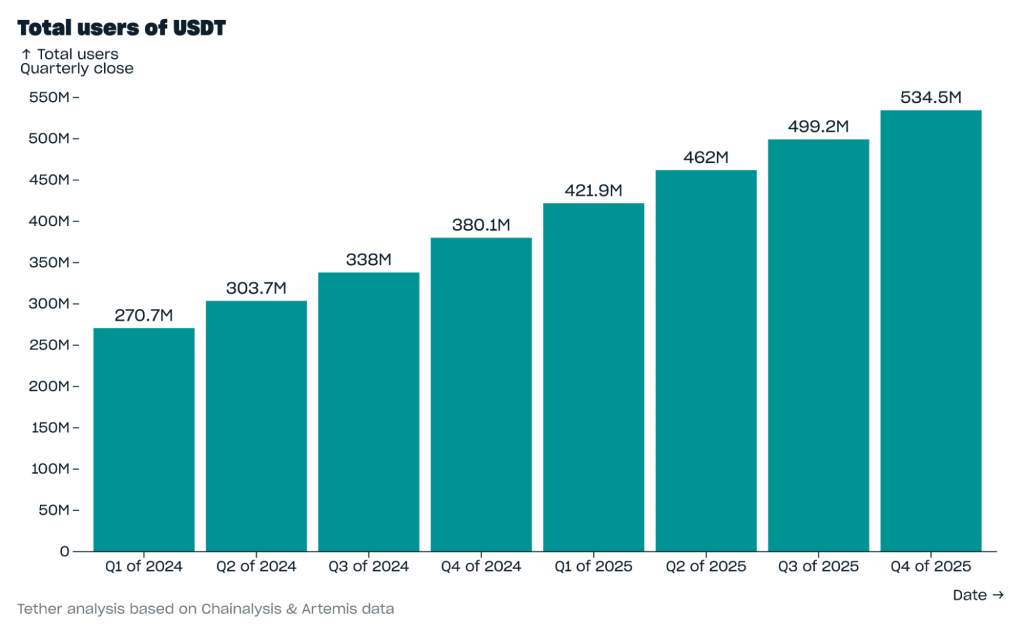
The quarterly growth in USDT users over the last couple of years | Source: Tether

In this count, Tether has included both the users who have received and used USDT for at least 24 hours on-chain, as well as the estimates of users that have received the stablecoin on centralized platforms like exchanges.

From the above chart, it’s visible that Q4 2025 was the eighth consecutive quarter in which Tether’s stablecoin saw growth of more than 30 million users. In terms of active users, the quarter set a new all-time high (ATH) with an average of 24.8 million users receiving USDT at least once inside a 30-day rolling window. “This accounts for 68.4% of all stablecoin monthly active users,” noted the report.

On-chain transfer volume also set a new ATH in this quarter, hitting a value of $4.4 trillion following a jump of $248.6 billion.
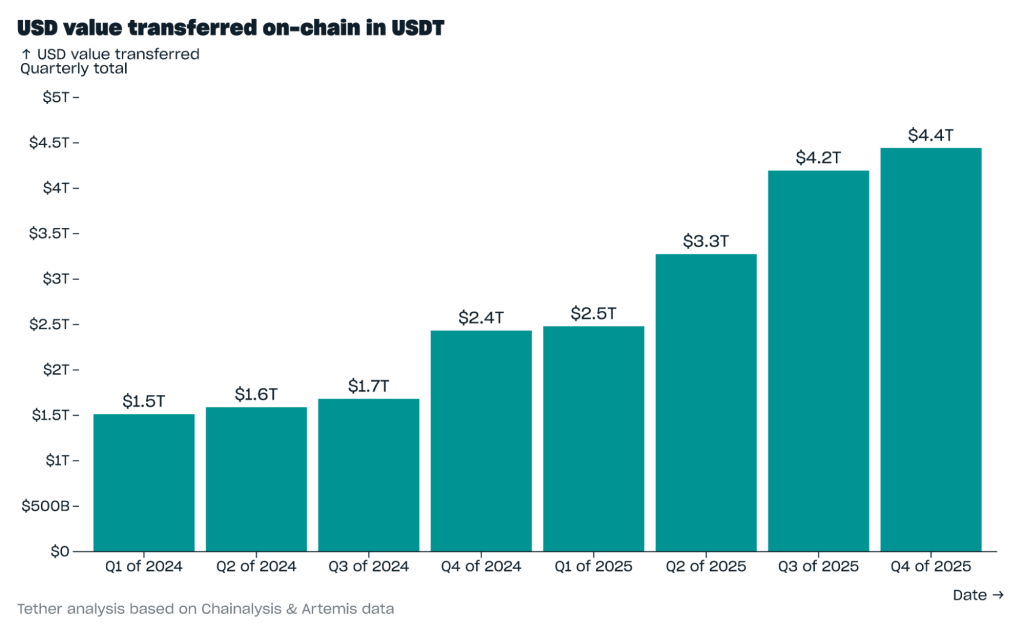
The stablecoin's transaction volume saw a notable rise over the past year | Source: Tether

As displayed in the chart, the USDT transfer volume stood at just $1.7 trillion in Q3 2024, so the sharp jump to $4.4 trillion since then indicates demand for using the stablecoin has seen a notable boost. “Of this $4.4T quarterly total, $2.8T (63.6%) was in transactions where USD₮ was the only asset transferred, and $1.6T (36.4%) was in transactions where multiple assets were transferred (typically in DeFi swaps),” said the report.

There has also been growth in transaction demand among the retail investors, as the number of transfers involving the stablecoin jumped by $313.1 million in Q4 to a new ATH of 2.2 billion. 88.2% of these transactions involved a sum less than $1,000.

The capital invested in the stablecoin itself also saw an increase during the quarter, with the market cap hitting $187.3 billion after inflows of $12.4 billion.
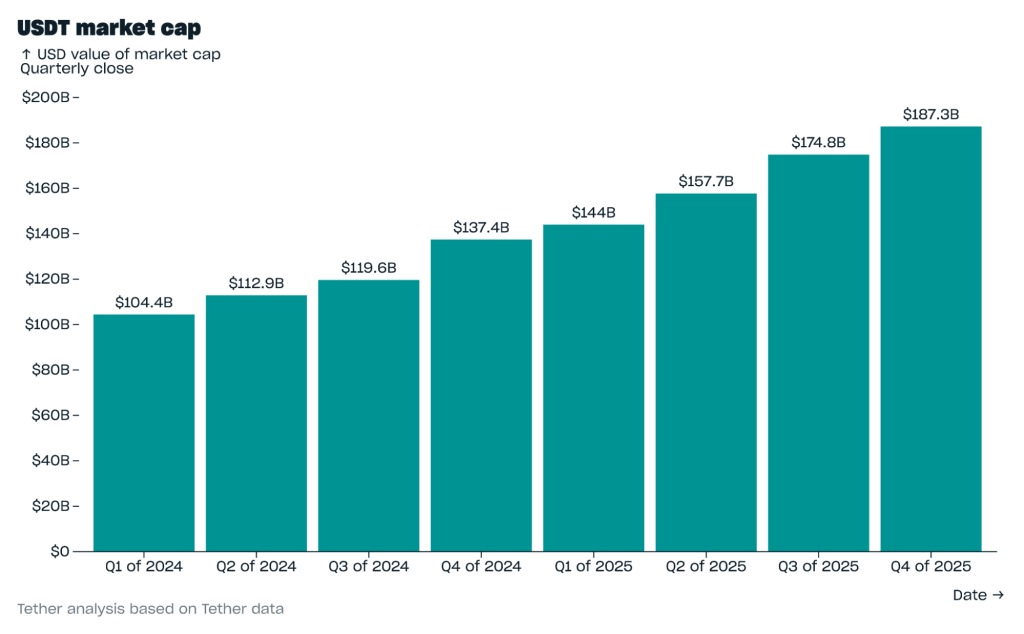
Looks like the token's market cap has seen steady growth | Source: Tether

The growth in the USDT market cap occurred despite the fact that the wider cryptocurrency market saw a bearish transition in October. That said, the downturn still affected the token to some degree as before the market slowdown, its monthly market cap growth rate was sitting at 4.9%, which declined in the aftermath of the liquidation squeeze of October 10th.

Overall, between October 10th and today, USDT has been among the more resilient cryptocurrencies, being up 3.5% while the combined sector has lost more than a third of its market cap. In the same period, USDC, the second largest stablecoin, has seen a drop of 2.6%.

Bitcoin Price

At the time of writing, Bitcoin is trading around $65,800, down more than 9% over the last 24 hours.

The price of the coin seems to have been crashing | Source: BTCUSDT on TradingView


Perguntas relacionadas

QWhat was the total USDT transfer volume in Q4 2025 according to Tether's report?

AThe total USDT transfer volume in Q4 2025 was $4.4 trillion.

QHow many USDT users were there in total by the end of Q4 2025?

AThere were 534.5 million USDT users by the end of Q4 2025.

QWhat percentage of the $4.4 trillion transfer volume involved transactions where USDT was the only asset transferred?

A63.6% of the $4.4 trillion transfer volume involved transactions where USDT was the only asset transferred.

QHow did the market cap of USDT change during Q4 2025, and what was its final value?

AThe market cap of USDT increased by $12.4 billion during Q4 2025, reaching a final value of $187.3 billion.

QWhat was the Bitcoin price mentioned in the article, and how much did it change in the last 24 hours?

ABitcoin was trading around $65,800 at the time of writing, down more than 9% over the last 24 hours.

Leituras Relacionadas

What Happens to Ethereum Developer Tools After the Grants Run Out?

On February 27th, the Ethereum Foundation (EF) announced Project Odin, a structured sustainability support program designed for a select group of strategic, previously grant-funded teams. Unlike a standard grant, Odin offers a long-term advisory mechanism focused on helping these teams establish credible, sustainable paths within a two-year framework, thereby reducing long-term dependence on single funding sources. The program addresses a critical post-grant challenge: how essential public goods, especially major developer tools, can achieve financial sustainability beyond initial funding. While grants from EF and programs like Gitcoin or RetroPGF remain vital for startups and research, they often fall short for mature, widely-used infrastructure. Tools like compilers, languages, and network stacks are deeply embedded but struggle with monetization, trapped between being too foundational to lose and too public to generate natural revenue. Project Odin provides teams with a dedicated Strategic Advisor to guide them through a three-phase process: 1) analyzing current funding and realistic options, 2) validating potential paths with stakeholders, and 3) executing plans, which may include crafting support contracts, service agreements, or other recurring revenue models. The first pilot participant is Vyper, a critical smart contract language for the EVM, highlighting the need for sustainable models for core infrastructure. The initiative reframes the public goods conversation from "who should be funded" to "how do already-proven teams avoid perpetual funding crises?" It encourages ecosystem participants—protocols and projects that depend on these tools—to view sustainable support not just as charity, but as essential risk management for their own operational supply chains.

marsbitHá 15m

What Happens to Ethereum Developer Tools After the Grants Run Out?

marsbitHá 15m

MARA Reports Q1 Revenue Below Expectations, Net Loss of $1.3 Billion, Stock Plunges After Hours

Bitcoin mining firm MARA Holdings reported disappointing Q1 2024 results, causing its stock to erase all daily gains and fall 3.44% in after-hours trading. Revenue dropped 18% year-over-year to $174.6 million, missing Wall Street estimates of $192.7 million. The company posted a net loss of $1.3 billion, a significant increase from a $533.4 million loss a year ago, primarily driven by unrealized losses on its holdings of 38,689 Bitcoin, which depreciated in value during the quarter. MARA also sold over 15,100 BTC in late March to repurchase debt at a discount. The broader mining environment remains challenging due to a 35% decline in Bitcoin's price from its all-time high and a nearly 30% increase in mining difficulty over the past year. MARA's market cap ranking among U.S. miners has slipped to seventh. Critically, the company announced a strategic pivot away from Bitcoin mining expansion. It stated it has no plans to purchase new mining equipment and is fully transitioning toward AI data centers. Its strategy involves retrofitting existing mining sites for AI and high-performance computing (HPC) and leveraging its recent $1.5 billion acquisition of Long Ridge Energy & Power, a gas-fired power plant and data center. This infrastructure could eventually support 600 MW of AI compute capacity, allowing MARA to redeploy up to 90% of its non-custodial mining power for AI and IT workloads.

marsbitHá 16m

MARA Reports Q1 Revenue Below Expectations, Net Loss of $1.3 Billion, Stock Plunges After Hours

marsbitHá 16m

The AI Investment Landscape Is Being Reshaped: Beyond the 'Magnificent Seven', What Opportunities Lie in the Semiconductor Supply Chain?

AI Investment Map is Reshaping: Opportunities Beyond the 'Magnificent Seven' Since ChatGPT ignited the AI wave, investment initially focused on the "Magnificent Seven" tech giants dominating cloud infrastructure. However, the rise of DeepSeek and debates on AI capital expenditure effectiveness are shifting this dynamic. Investors now recognize opportunities deeper in the supply chain—the companies providing the essential "picks and shovels." Early concerns about an AI investment "arms race" and potential low returns were partly alleviated by strong Q1 earnings from cloud providers, validating robust compute demand. This has highlighted a more certain investment thesis: regardless of which AI applications ultimately win, massive capital expenditure will first fuel demand for semiconductors and related components. This "pick-and-shovel" logic has driven semiconductor ETFs to record highs. Key beneficiaries include: * **Memory Chipmakers (e.g., SK Hynix, Samsung, Micron)**: High Bandwidth Memory (HBM) is a critical bottleneck for AI training. * **Photonics Companies**: Crucial for high-speed data transfer within AI data centers. * **The Broader "AI-11" Semiconductor Ecosystem**: This encompasses foundries & lithography (TSMC, ASML), logic & custom chips (AMD, Broadcom, Intel, Marvell), and enterprise storage (SanDisk, Western Digital). Every dollar of AI infrastructure spending flows through this chain. While the "Magnificent Seven" remain dominant in market size, their earnings growth premium over the rest of the S&P 500 ("S&P 493") is narrowing. Market attention and marginal investment are shifting towards the expanding semiconductor supply chain. The investment narrative is evolving from "betting on the ultimate AI winner" to "investing in the certainty of the infrastructure build-out." Understanding this shift from the demand side to the supply side is key to identifying future AI investment opportunities.

marsbitHá 45m

The AI Investment Landscape Is Being Reshaped: Beyond the 'Magnificent Seven', What Opportunities Lie in the Semiconductor Supply Chain?

marsbitHá 45m

Trading

Spot
Futuros
活动图片




