US lawmakers propose tax break for small stablecoin payments, staking rewards

cointelegraphPublicado em 2025-12-21Última atualização em 2025-12-21

Resumo

US lawmakers have introduced a discussion draft proposing tax exemptions for small stablecoin payments and deferral options for staking and mining rewards. The bill, introduced by Representatives Max Miller and Steven Horsford, aims to amend the Internal Revenue Code to accommodate the growing use of digital assets in everyday transactions. It would exempt gains or losses on stablecoin transactions under $200, provided the stablecoin is dollar-pegged and issued under the GENIUS Act. Additionally, taxpayers could defer income recognition from staking and mining rewards for up to five years, addressing concerns around "phantom income." The draft also includes anti-abuse measures and extends certain securities rules to digital assets. Meanwhile, crypto industry groups are urging the Senate to reconsider proposed restrictions on stablecoin rewards.

US lawmakers have introduced a discussion draft that would ease the tax burden on everyday crypto users by exempting small stablecoin transactions from capital gains taxes and offering a new deferral option for staking and mining rewards.

The proposal, introduced by Representatives Max Miller of Ohio and Steven Horsford of Nevada, seeks to amend the Internal Revenue Code to reflect the growing use of digital assets in payments. The draft is set “to eliminate low-value gain recognition arising from routine consumer payment use of regulated payment stablecoins,” per the draft.

Under the draft, users would not be required to recognize gains or losses on stablecoin transactions of up to $200, provided the asset is issued by a permitted issuer under the GENIUS Act, pegged to the US dollar and maintains a tight trading range around $1.

The bill includes safeguards to prevent abuse. The exemption would not apply if a stablecoin trades outside a narrow price band, and brokers or dealers would be excluded from the benefit. Treasury would also retain authority to issue anti-abuse rules and reporting requirements.
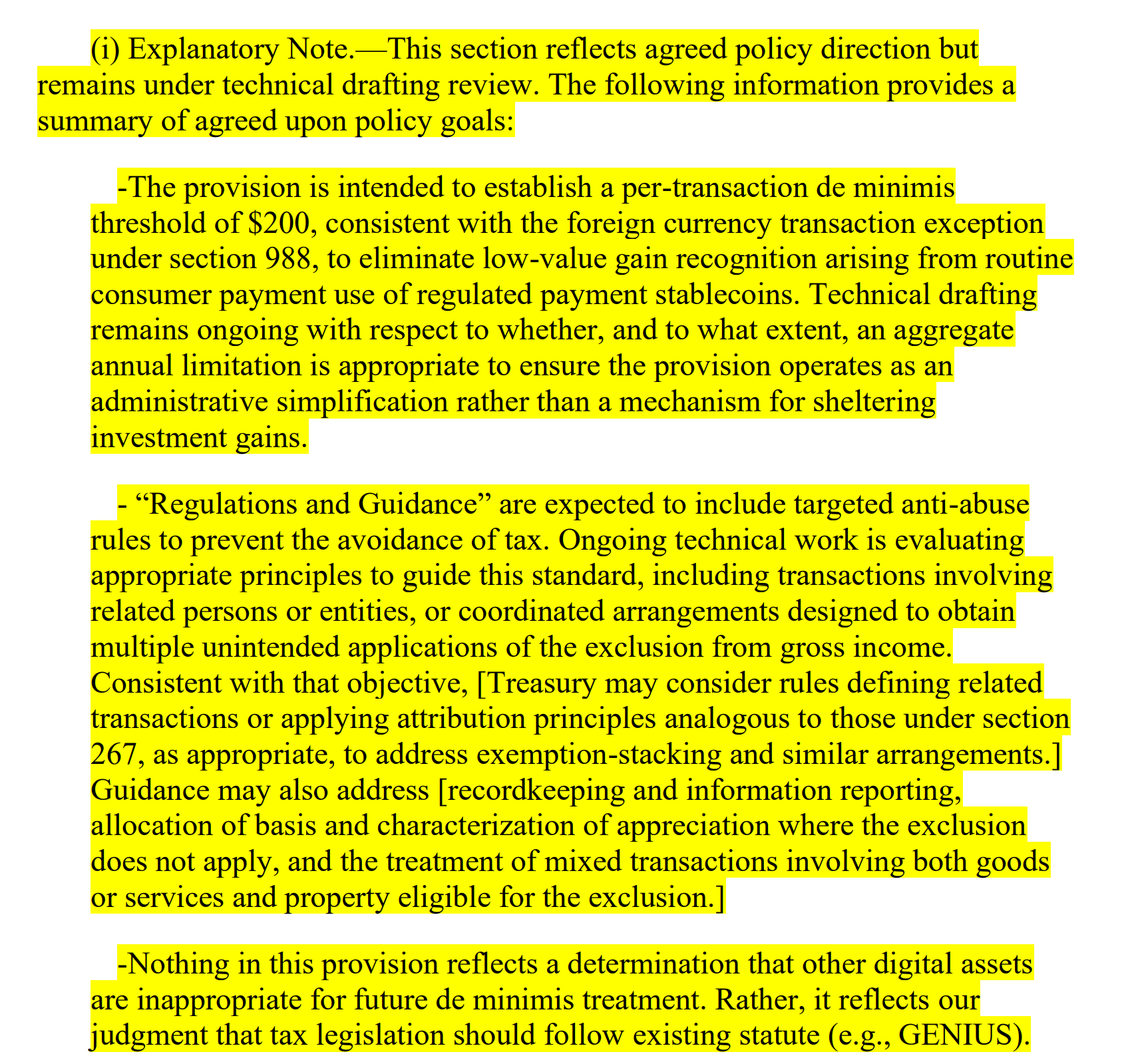
Draft bill explains the reasoning behind tax breaks. Source: House

Related: Crypto Biz: Bank stablecoins get a rulebook; Bitcoin gets a land grab

US bill defers taxes on crypto staking rewards

Beyond payments, the proposal addresses long-standing concerns around “phantom income” from staking and mining. Taxpayers would be allowed to elect to defer income recognition on staking or mining rewards for up to five years, rather than being taxed immediately upon receipt.

“This provision is intended to reflect a necessary compromise between immediate taxation upon dominion & control and full deferral until disposition,” the draft said.

The draft also extends existing securities lending tax treatment to certain digital asset lending arrangements, applies wash sale rules to actively traded crypto assets, and allows traders and dealers to elect mark-to-market accounting for digital assets.

Related: Galaxy predicts stablecoins will overtake ACH transaction volume in 2026

Crypto groups urge Senate to rethink stablecoin rewards ban

Last week, the Blockchain Association sent a letter to the US Senate Banking Committee, signed by more than 125 crypto companies and industry groups, opposing efforts to extend restrictions on stablecoin rewards to third-party platforms.

The group argued that expanding the GENIUS Act’s limits beyond stablecoin issuers would curb innovation and increase market concentration in favor of large incumbents. The letter compared crypto rewards to incentives commonly offered by banks and credit card companies, warning that banning similar features for stablecoins would undermine fair competition.

Magazine: 2026 is the year of pragmatic privacy in crypto — Canton, Zcash and more

Perguntas relacionadas

QWhat is the main purpose of the tax proposal introduced by US lawmakers regarding stablecoins?

AThe proposal aims to ease the tax burden on everyday crypto users by exempting small stablecoin transactions (up to $200) from capital gains taxes and offering a deferral option for staking and mining rewards.

QWhich US representatives introduced the discussion draft to amend the Internal Revenue Code for digital assets?

ARepresentatives Max Miller of Ohio and Steven Horsford of Nevada introduced the discussion draft.

QWhat are the conditions under which a stablecoin transaction would be exempt from capital gains taxes under the draft bill?

AThe exemption applies to stablecoin transactions of up to $200, provided the asset is issued by a permitted issuer under the GENIUS Act, pegged to the US dollar, and maintains a tight trading range around $1.

QHow does the proposal address the issue of 'phantom income' from staking and mining rewards?

ATaxpayers would be allowed to elect to defer income recognition on staking or mining rewards for up to five years, instead of being taxed immediately upon receipt.

QWhy did the Blockchain Association and over 125 crypto companies oppose extending restrictions on stablecoin rewards to third-party platforms?

AThey argued that expanding the GENIUS Act’s limits beyond stablecoin issuers would curb innovation, increase market concentration in favor of large incumbents, and undermine fair competition by banning features similar to incentives offered by banks and credit card companies.

Leituras Relacionadas

Warsh Hearing Concludes: What Are the Notable Signals for the Crypto Industry?

The Senate Banking Committee held a confirmation hearing for Judy Shelton, a Federal Reserve nominee, who faced intense questioning regarding her ability to maintain the central bank's independence amid pressure from President Trump to lower interest rates. Shelton denied any pre-arranged commitments on rate cuts and emphasized her independence, though Democrats remained skeptical, citing contradictions with Trump's public statements. Shelton characterized post-pandemic inflation as a major policy failure and called for a "regime change" in the Fed’s approach, including reforms to inflation measurement and communication strategies. She criticized the current practice of Fed officials frequently signaling future rate moves and did not commit to maintaining post-meeting press conferences, suggesting potential reductions in transparency. Regarding crypto markets, Shelton’s extensive investments in digital asset companies—including Solana, DeFi, and blockchain infrastructure—were noted, though she has pledged to divest these holdings due to ethics rules. Her familiarity with the crypto industry and deregulatory leanings may signal a more open, though cautious, stance toward digital assets. However, concerns were raised about potential conflicts of interest, especially given Trump family involvement in crypto-financial ventures. The timing of her confirmation remains uncertain, pending a Justice Department investigation into current Chair Powell. Shelton’s potential leadership could lead to a more hawkish, productivity-focused Fed with tighter policy communication—factors that may significantly influence liquidity conditions and macro narratives for crypto markets.

marsbitHá 4h

Warsh Hearing Concludes: What Are the Notable Signals for the Crypto Industry?

marsbitHá 4h

Trading

Spot
Futuros

Artigos em Destaque

Como comprar US

Bem-vindo à HTX.com!Tornámos a compra de Talus Network (US) simples e conveniente.Segue o nosso guia passo a passo para iniciar a tua jornada no mundo das criptos.Passo 1: cria a tua conta HTXUtiliza o teu e-mail ou número de telefone para te inscreveres numa conta gratuita na HTX.Desfruta de um processo de inscrição sem complicações e desbloqueia todas as funcionalidades.Obter a minha contaPasso 2: vai para Comprar Cripto e escolhe o teu método de pagamentoCartão de crédito/débito: usa o teu visa ou mastercard para comprar Talus Network (US) instantaneamente.Saldo: usa os fundos da tua conta HTX para transacionar sem problemas.Terceiros: adicionamos métodos de pagamento populares, como Google Pay e Apple Pay, para aumentar a conveniência.P2P: transaciona diretamente com outros utilizadores na HTX.Mercado de balcão (OTC): oferecemos serviços personalizados e taxas de câmbio competitivas para os traders.Passo 3: armazena teu Talus Network (US)Depois de comprar o teu Talus Network (US), armazena-o na tua conta HTX.Alternativamente, podes enviá-lo para outro lugar através de transferência blockchain ou usá-lo para transacionar outras criptomoedas.Passo 4: transaciona Talus Network (US)Transaciona facilmente Talus Network (US) no mercado à vista da HTX.Acede simplesmente à tua conta, seleciona o teu par de trading, executa as tuas transações e monitoriza em tempo real.Oferecemos uma experiência de fácil utilização tanto para principiantes como para traders experientes.

366 Visualizações TotaisPublicado em {updateTime}Atualizado em 2025.12.11

Como comprar US

Discussões

Bem-vindo à Comunidade HTX. Aqui, pode manter-se informado sobre os mais recentes desenvolvimentos da plataforma e obter acesso a análises profissionais de mercado. As opiniões dos utilizadores sobre o preço de US (US) são apresentadas abaixo.

活动图片