U.S. July PCE Price Index Rises 3.7% YoY, Giving Fed Room to Stand Pat

marsbitPublicado em 2026-08-27Última atualização em 2026-08-27

Resumo

U.S. consumer spending unexpectedly stalled in July, while key inflation measures showed mild trends, providing more data support for the Federal Reserve's stance to keep interest rates unchanged. The Commerce Department reported that the July Personal Consumption Expenditures (PCE) price index rose 0.2% month-over-month, with the year-over-year increase holding at 3.7%. The core PCE index, excluding food and energy, also rose 0.2% monthly, with the annual rate steady at 3.3%, meeting expectations. However, inflation-adjusted real personal consumption expenditure was flat for the month. The data indicates signs of cooling in the U.S. economy after strong expansion earlier in the summer. For Fed officials, this supports the argument for pausing rate hikes, although core PCE remains well above the central bank's 2% target, suggesting inflationary pressures have not fully subsided. Market focus now shifts to the annual Jackson Hole symposium, where investors await Fed Chair Wash's speech for clues on the policy path amid persistent inflation. Concurrently, a separate report showed the U.S. second-quarter GDP growth was unchanged from the initial estimate, but with details pointing to stronger consumer spending, adding some support to the economic outlook.

Written by: Zhang Yaqi, Wall Street News

U.S. consumer spending unexpectedly stalled in July, and key inflation gauges showed moderate trends, providing more data support for the Federal Reserve's stance of keeping interest rates unchanged.

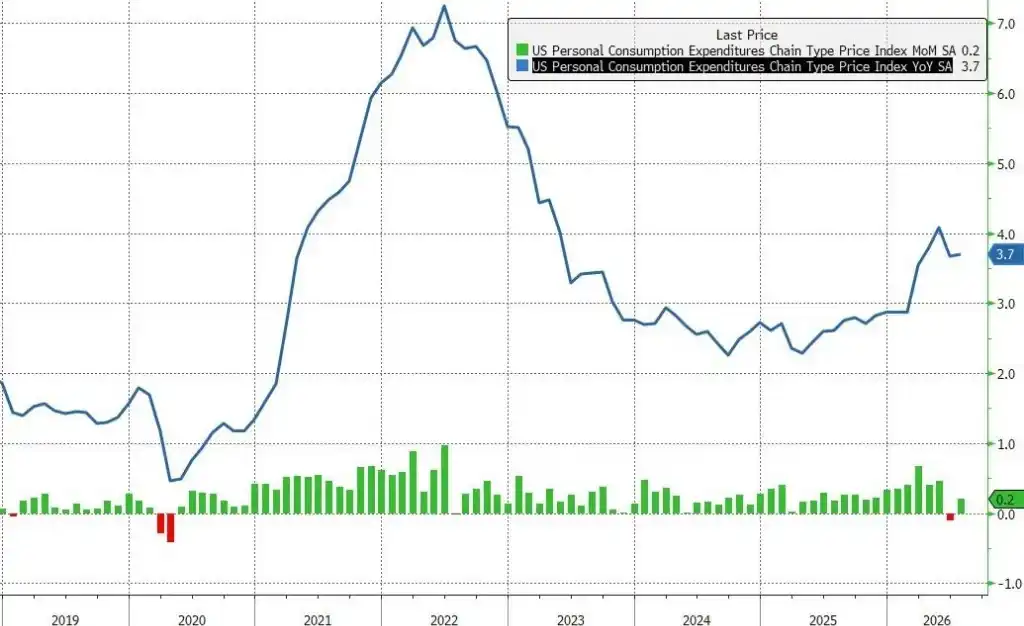
Data released by the U.S. Commerce Department's Bureau of Economic Analysis on Wednesday showed that the Personal Consumption Expenditures (PCE) price index rose 0.2% month-over-month in July, above market expectations of 0.1%, with the year-over-year increase holding steady at 3.7%. The core PCE index, which excludes food and energy, also rose 0.2% month-over-month, with the year-over-year growth rate unchanged at 3.3%, meeting market expectations. Meanwhile, inflation-adjusted real personal consumption expenditures were flat compared to the previous month, following strong growth recorded in both May and June.
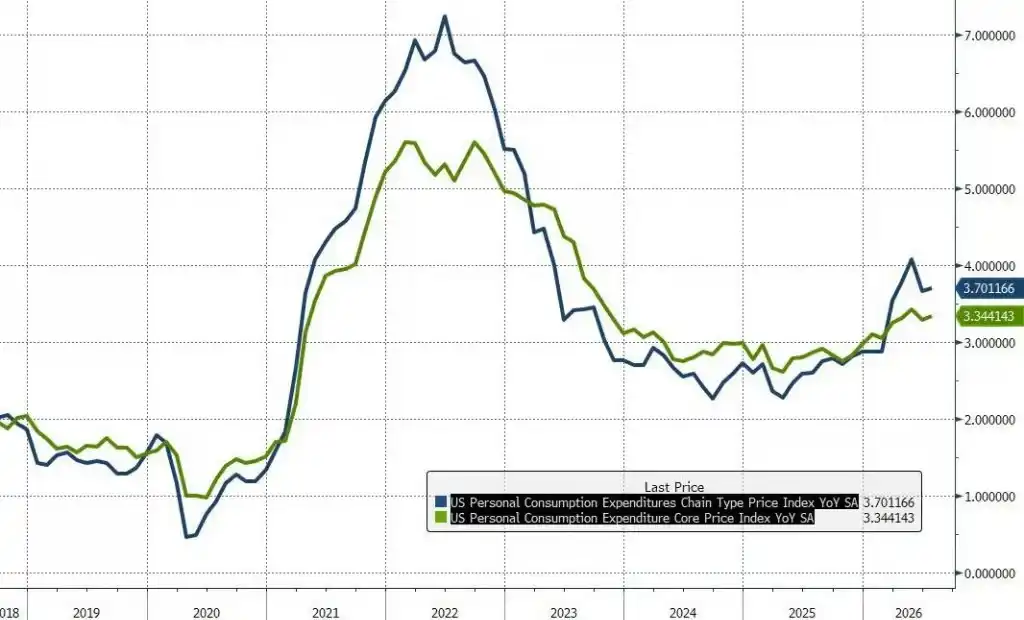
This data corroborates a series of recent economic reports, suggesting signs of cooling in the U.S. economy in July following robust expansion in early summer. For Federal Reserve officials, this batch of data will further support arguments for pausing interest rate hikes, but core PCE remains well above the Fed's 2% policy target, indicating inflation pressures have not fully subsided.

The market's focus now shifts to the annual central bankers' conference in Jackson Hole, Wyoming, on Friday. Investors will closely watch remarks from Fed Chairman Wash for the latest indications on how to address persistent inflation.

Core Inflation Meets Expectations but Remains Significantly Above Fed Target

The year-over-year growth rate of the core PCE index held steady at 3.3% in July, unchanged from June and in line with market expectations, indicating underlying inflation pressure is stabilizing. However, the overall PCE price index, the Fed's preferred inflation gauge, remained at a high 3.7% year-over-year, still a considerable distance from the central bank's 2% policy target.
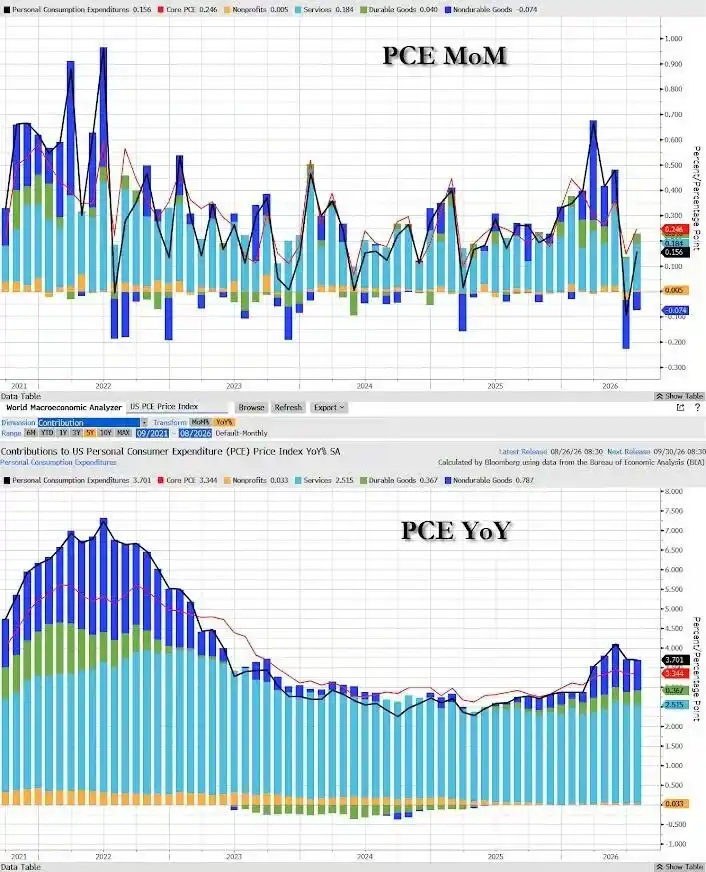
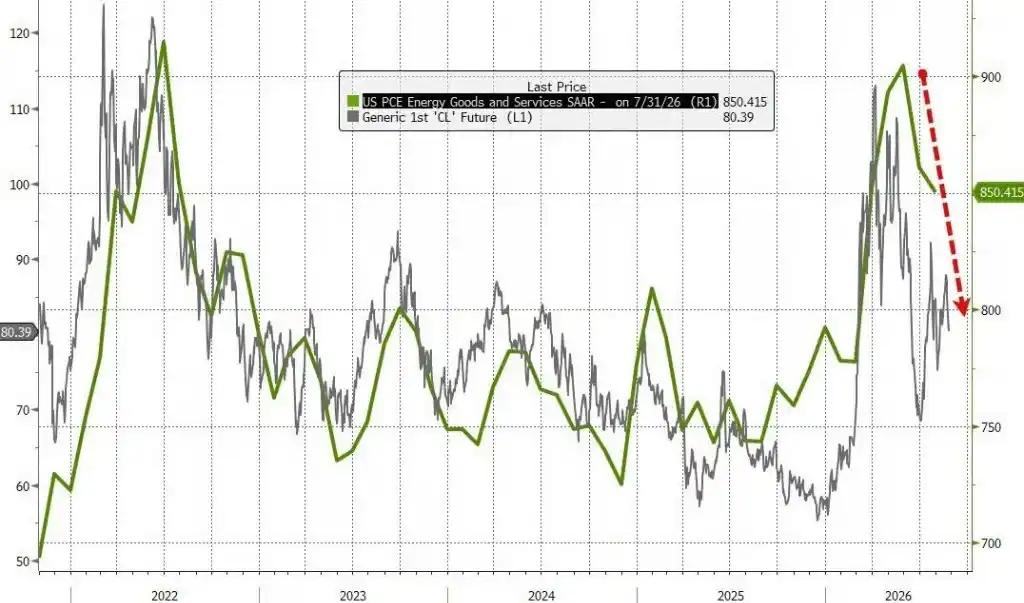
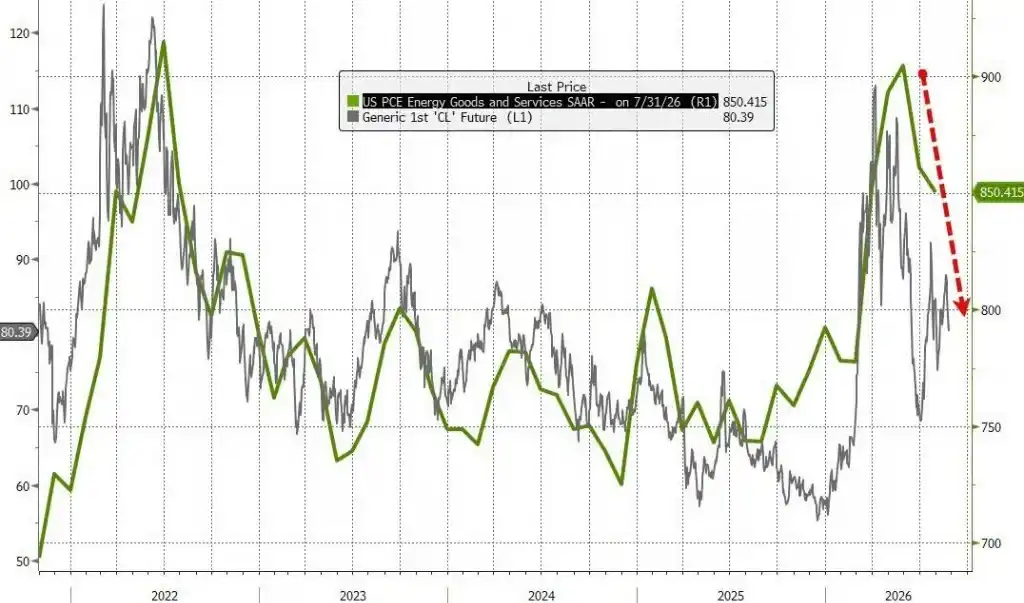
Breaking down the components, prices for nondurable goods continued their downward trend in July, while falling crude oil prices also weighed on the energy component of PCE.
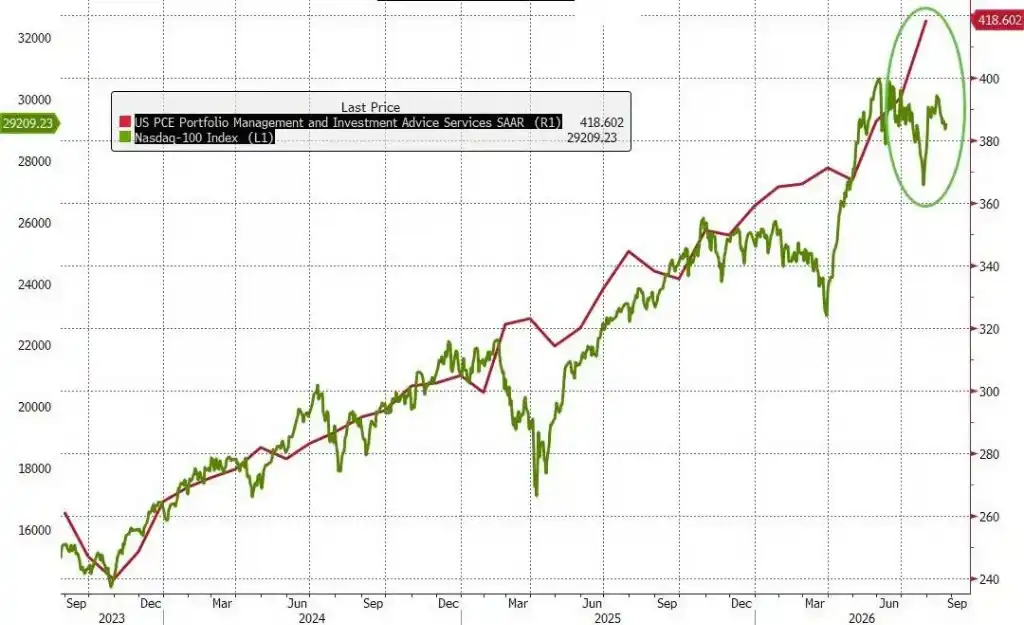
Notably, a significant rise in the cost of securities investment portfolio management services became a structural factor pushing overall prices higher, correlating with stock market performance.
Nominal Consumption Grows, Real Purchasing Power Under Pressure

Nominal personal consumption expenditures rose 0.2% month-over-month in July, while personal income grew 0.4% month-over-month, both slightly exceeding expectations.
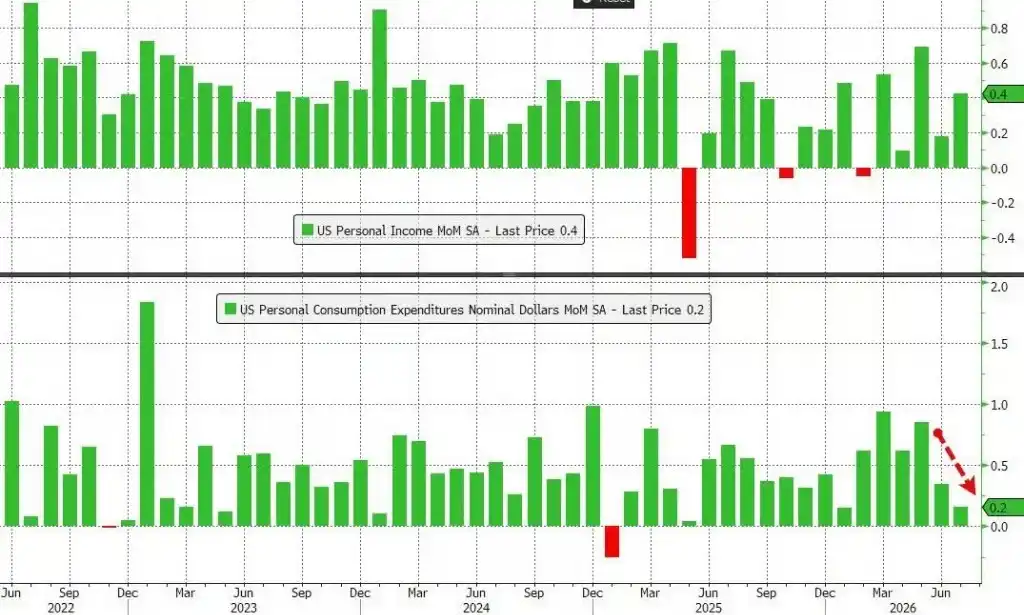
However, inflation-adjusted real consumption expenditures were flat month-over-month, reflecting how price pressures are eroding real purchasing power.
The annual growth rate of income showed a general slowdown. Among the components, wage growth for government employees decelerated to 1.4% year-over-year, the lowest since March 2021; wage growth in the private sector fell from 4.6% to 3.8% year-over-year, the lowest since March 2026.
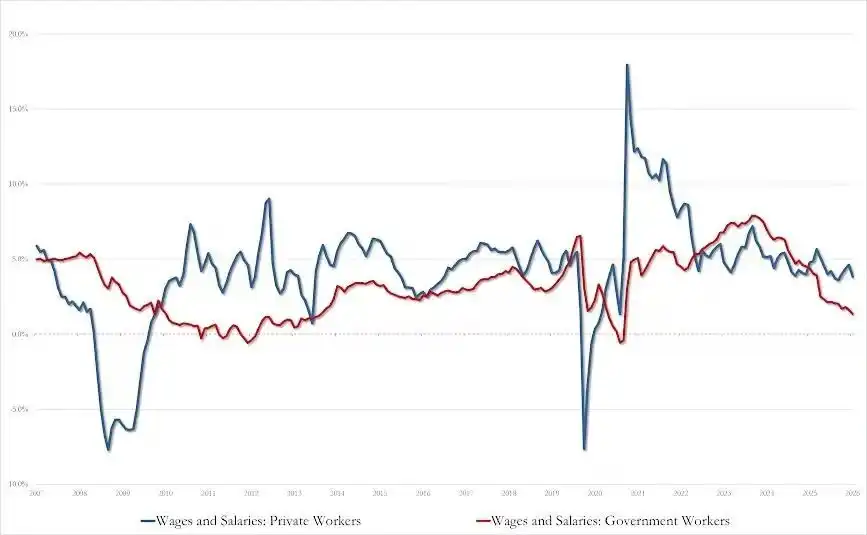
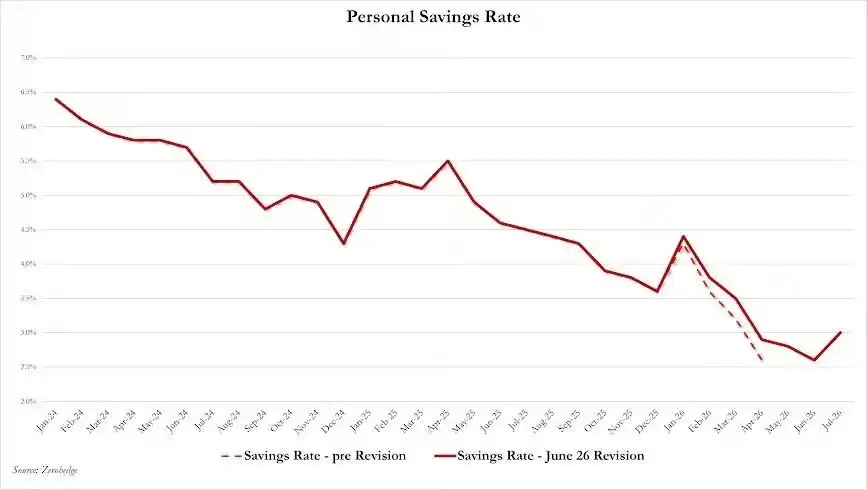
The slowdown in income growth may be prompting consumers to become more cautious—the savings rate saw a noticeable rebound in July, rising from its previous four-year low.
Jackson Hole Speech in Market Spotlight

Against this data backdrop, market attention turns to Wash's remarks at the Jackson Hole symposium this Friday. Investors hope to gain clarity on how the Fed will weigh its monetary policy path as inflation persists above target.

The current PCE data, along with previously released CPI and PPI figures, paint a picture of cooling but not yet fully vanquished inflation, providing Wash with some narrative space. Meanwhile, another report released the same day showed the U.S. second-quarter GDP growth rate was unchanged from the preliminary estimate, but detailed data pointed to stronger consumer spending, adding some support to the economic outlook.


Perguntas relacionadas

QWhat was the headline year-on-year rate of the US PCE Price Index in July according to the article, and what does this figure represent?

AAccording to the article, the US PCE Price Index in July rose 3.7% year-on-year. This figure represents the headline inflation rate based on the Personal Consumption Expenditures price index, which is the Federal Reserve's preferred gauge for inflation.

QHow did the core PCE index perform in July compared to expectations and the previous month?

AIn July, the core PCE index, which excludes food and energy, rose 0.2% month-on-month and maintained a year-on-year rate of 3.3%. This performance was in line with market expectations and unchanged from the rate recorded in June.

QWhat does the article state about the trend in real (inflation-adjusted) personal consumption expenditure for July?

AThe article states that real personal consumption expenditure was flat (unchanged) in July on a month-on-month basis. This follows strong growth in the previous two months (May and June) and indicates that price pressures are eroding actual purchasing power, despite nominal spending rising.

QAccording to the article, what upcoming event is the market focusing on for clues about the Federal Reserve's monetary policy path?

AThe market is focusing on the annual central bankers' conference in Jackson Hole, Wyoming, specifically the upcoming speech by Federal Reserve Chair Wash. Investors are looking for the Fed's latest stance on how to tackle persistent inflation that remains above the 2% target.

QWhat trend in income growth does the article highlight for July, particularly for government and private sector wages?

AThe article highlights that overall income growth is slowing. In July, government employee wage growth slowed to 1.4% year-on-year, its lowest since March 2021. Private sector wage growth also cooled, falling to 3.8% from 4.6%, marking its lowest point since March 2026.

Leituras Relacionadas

When Real Estate Ownership Goes Digital: What Happens to Your Rights, Risks, and Liquidity?

"Tokenizing Real Estate: Rights, Risks, and the Path to Liquidity" While tokenizing real-world assets (RWA) gains traction, real estate presents unique complexities. Beyond technical token issuance, critical challenges remain: enforcing legal rights, managing the underlying physical asset, and creating genuine secondary market liquidity. This article explores these issues through OneAsset, a Dubai-based commercial real estate (CRE) tokenization platform. OneAsset moves away from simply offering asset fragmentation. Instead, it focuses on institutional-grade infrastructure, prioritizing asset quality, legal enforceability, and operational fundamentals. Each property is held in an independent, single-asset vault, backed by a legally separate Special Purpose Vehicle (SPV) for bankruptcy remoteness. Investors acquire tokens representing the economic rights to a specific property, with precise legal claims defined by the underlying SPV structure. OneAsset emphasizes that tokenization cannot transform a poor-quality asset. Its initial focus is on institutional investors and quality Dubai-based CRE, selected for stable tenant cash flows and a clear regulatory environment. The platform integrates compliance by design, aiming to embed investor qualification and transfer rules directly into the token architecture. A core insight is that asset fragmentation does not automatically create liquidity. True liquidity depends on the asset's inherent quality—its location, cash flow, and valuation—as well as sufficient buyer demand. The goal is not just tradability, but making real estate rights more easily priced, verified, and reallocated. Looking ahead, the article discusses the potential for "AiFi" (AI-powered finance). For AI agents to autonomously allocate capital, investment assets like real estate tokens must become truly "machine-readable." This requires a high degree of standardization in legal rights, valuations, cash flows, and compliance data—a direction OneAsset is pursuing through its structured data reporting. In conclusion, real estate tokenization is shifting from a technology narrative to a focus on asset fundamentals. Blockchain can enhance efficiency and programmability, but it cannot replace sound underwriting, property management, or legal execution. The real work begins after the asset is on-chain.

marsbitHá 8m

When Real Estate Ownership Goes Digital: What Happens to Your Rights, Risks, and Liquidity?

marsbitHá 8m

After Affecting Two Generations, Meta Ordered to Pay $18 Billion in Damages

After more than two decades, a legal parallel has emerged. In 1998, major U.S. tobacco companies settled for $206 billion, leading to strict advertising bans and warning labels that significantly reduced smoking rates. On August 26, 2026, Meta reached a landmark settlement with U.S. attorneys general, agreeing to pay up to approximately $18 billion and implement mandatory changes to Facebook and Instagram. This historic settlement, one of the largest against a tech company, stems from allegations that Meta deliberately designed addictive features like infinite scroll and push notifications, harming youth mental health and violating child privacy laws. Facing a potential $1.4 trillion lawsuit and a series of unfavorable jury verdicts, Meta chose to settle on the eighth day of trial to avoid a catastrophic ruling. The core of the agreement is not just the financial penalty, which Meta will pay over 10 years, but a series of strict, 10-year product mandates for young users. These include a hard two-hour daily time limit (combined across apps), a default "nighttime block" from midnight to 6 AM, restricted notifications during school hours, hidden "like" counts, an optional non-algorithmic feed, and stronger age verification. An independent auditor will monitor compliance. Crucially, roughly 30% ($5.3 billion) of Meta's payment is contingent on YouTube and TikTok adopting similar measures and paying around $5 billion each. This move aims to create an industry-wide standard and prevent Meta from being competitively disadvantaged. The settlement is being likened to Big Tobacco's "tobacco moment." By legally framing addictive algorithm design as a "public nuisance," it sets a powerful precedent. Nearly 3,000 similar cases are pending against other social media giants, signaling a fundamental shift in regulatory pressure. The era where platforms could deny the addictive impact of their designs on children is effectively over.

marsbitHá 14m

After Affecting Two Generations, Meta Ordered to Pay $18 Billion in Damages

marsbitHá 14m

Trading

Spot
活动图片