LIT Reaches New Highs Constantly, What Has Lighter Done Right?

marsbitPublicado em 2026-08-27Última atualização em 2026-08-27

Resumo

Lighter (LIT) token prices have surged nearly 5x since March, driven by multiple factors. Key contributors include its low circulating supply (approx. 25% of total), significant token buyback/burns (1.73% of supply), and strong staking incentives. Technically, Lighter is a specialized ZK-Rollup for perpetual DEX, solving the traditional "impossible triangle" for on-chain derivatives. Unlike general-purpose L2s or independent L1s (like dYdX v4, Hyperliquid), Lighter encodes exchange rules—including price-time priority order matching, funding rate caps, and liquidation formulas—directly into its zk-SNARK circuits. This provides cryptographic proof of correct execution. It achieves high performance (<5ms matching latency) while inheriting Ethereum's security, including a robust escape hatch for user withdrawals. Its architecture separates the core trading engine (custom ZK circuits) from a parallel zkEVM for general contracts. Recent optimizations have reduced average block verification time to ~1 minute. As an Ethereum L2, it benefits from the ecosystem's liquidity and composability without relying heavily on bridges. This combination of verifiable on-chain mechanics and Ethereum-grade security is a core value proposition, differentiating Lighter in the competitive perp DEX market and underpinning strategic partnerships like the one with Robinhood.

Original Author: Eric, Foresight News

Starting from August 20th, LIT, the token of perp DEX Lighter which boasts a former Citadel quant team background, has been continuously reaching new all-time highs. By August 26th, LIT had touched a high of $3.8, a nearly 5x increase from its low of around $0.78 recorded on March 30th of this year.
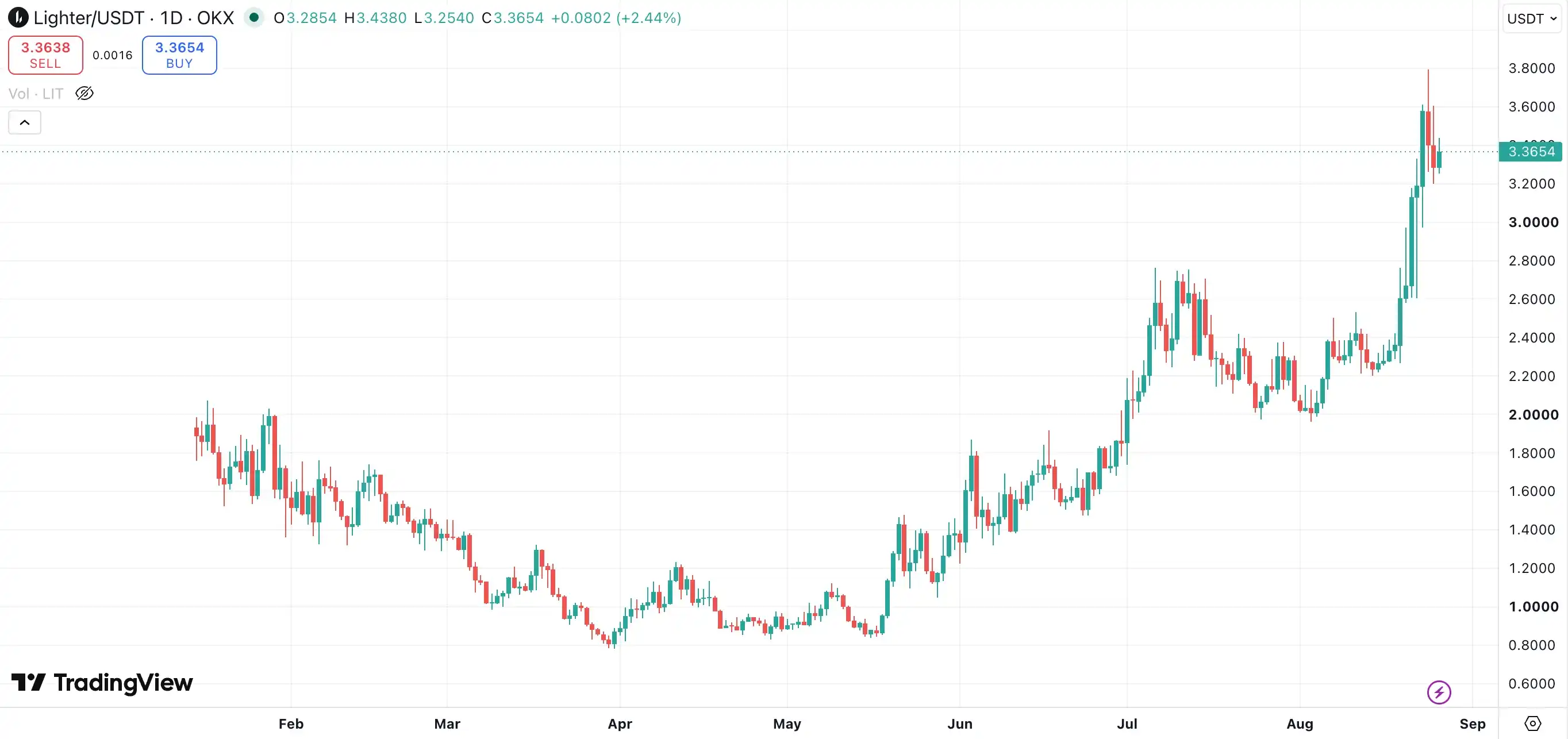
First, it's important to note that the current circulating supply of LIT is only about 25% of the total. Portions allocated to the team and investors are locked until December 30, 2026. The current selling pressure on LIT comes only from staking rewards, which are not substantial. During price increase phases, users have a stronger incentive to stake and are more inclined to hold.
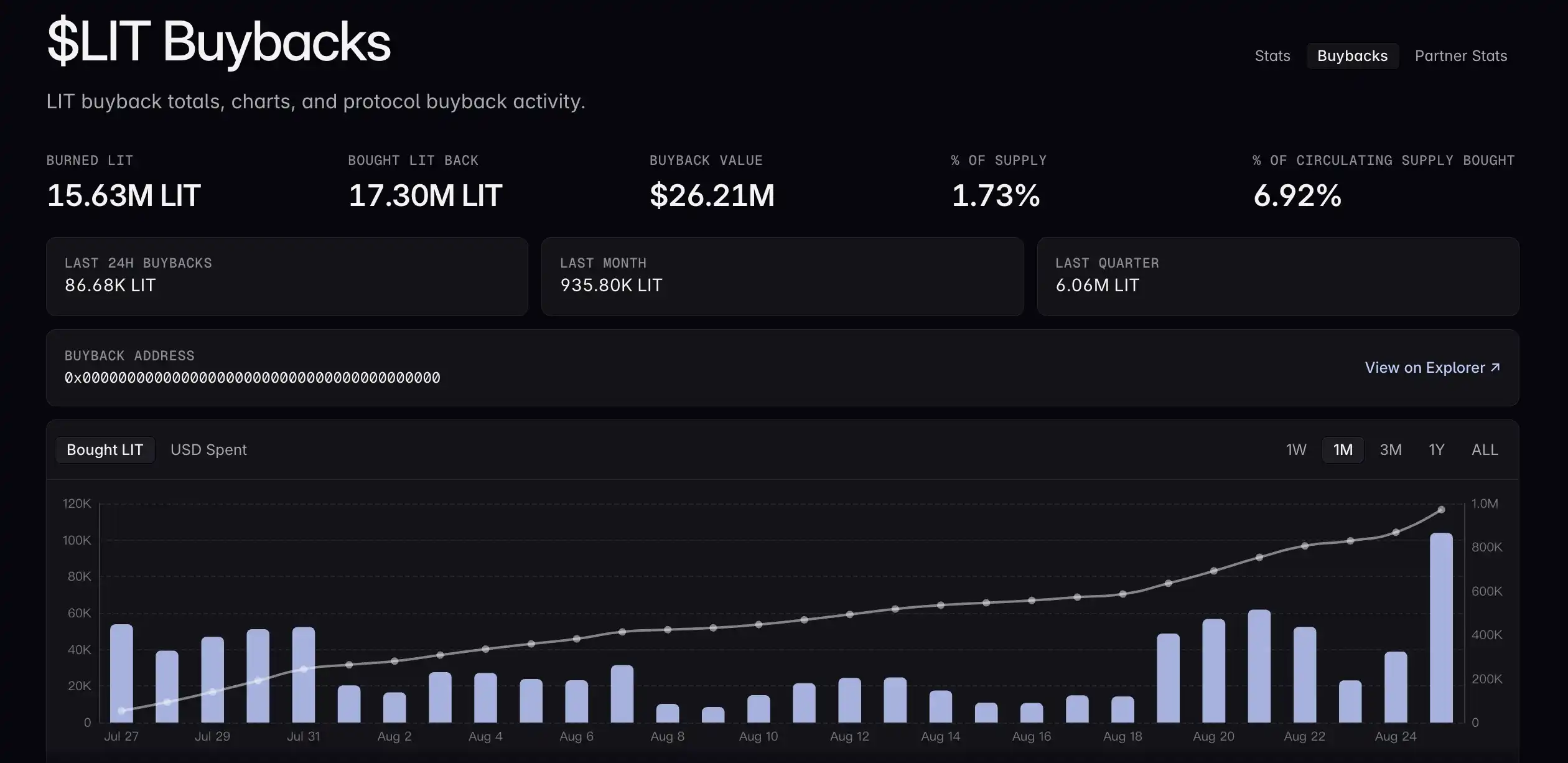
Given the limited circulating supply, the buyback and burn intensity of LIT is also significant. According to the official dashboard, the current amount of LIT bought back has reached 17.3 million, accounting for 1.73% of the total supply and 6.92% of the circulating supply.

In July, in our article "Joining Robinhood in the Race for Market Share, Is Lighter Playing a Big Chess Game?" (https://foresightnews.pro/article/detail/98462), we analyzed the reasons behind LIT's sustained rise, combining factors including the buyback-and-burn mechanism and the collaboration with Robinhood. In addition to these operational stimuli, Lighter has also introduced unique innovations at the chain level.

Before Lighter, on-chain derivatives essentially faced an impossible triangle. General-purpose L2s like Arbitrum have transaction fees and latency unsuitable for high-frequency order placement. Independent chains like dYdX v4 and Hyperliquid somewhat sacrifice security. Hybrid order books in the style of StarkEx rely on centralized matching engines, carrying risks of censorship and MEV.

Hyperliquid's self-built L1 uses HyperBFT consensus to run the matching engine directly within the validator set, achieving sub-second finality and over 200k TPS. The trade-off is a security model that relies entirely on itself, with a few dozen validator nodes supporting the entire chain, and cross-chain asset transfers dependent on bridges.

Lighter chose a different direction. It is a ZK Rollup dedicated solely to trading. Matching, liquidation, and risk control are all encapsulated within its proprietary Lighter Core, using a customized proof engine to generate zk-SNARK proofs, then submitting compressed state to the Ethereum mainnet. Compared to general-purpose zkVMs, this approach sacrifices generality in exchange for proof speed, latency stability, and execution efficiency for high-frequency order books. Official metrics show matching latency below 5 milliseconds, with a single block capable of packing 20,000 orders and cancellations.

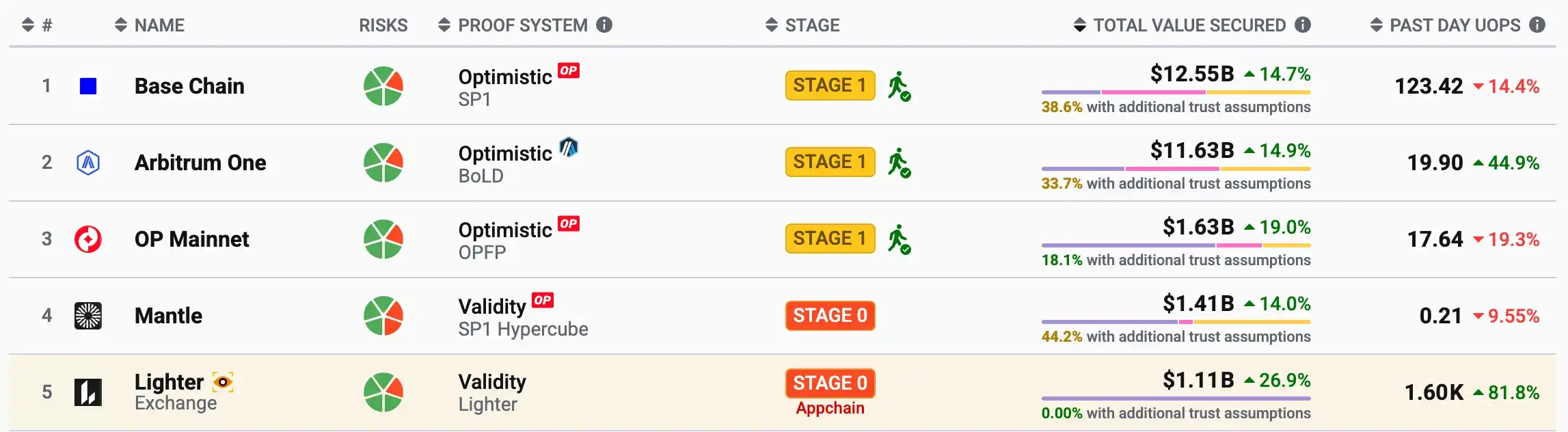
According to L2BEAT data, as an independently developed L2 that doesn't use existing ZK Rollup stacks, Lighter's TVL exceeds $1.1 billion, ranking fifth, just behind Base, Arbitrum, OP Mainnet, and Mantle.
Lighter's system consists of three roles. The sequencer orders transactions first-in-first-out and provides soft finality. The prover generates a proof for each block. Smart contracts on Ethereum host user funds, store state roots, and verify each proof.

The real differentiation lies in what the circuit proves. Most Rollups only prove that state transitions are valid. Lighter's circuits encode the exchange rules themselves as zk constraints. Using a structure called Order Book Tree, a binary prefix tree, it encodes the price-time priority rule into leaf indices, resulting in a proof complexity of only logarithmic order. This means the protocol can cryptographically prove that the highest priority order was filled first, that funding rate caps were correctly enforced, and that liquidations used the correct formulas.

This is particularly crucial for perpetual contracts. Leveraged positions are margin-based, and liquidations are automatic and mechanical. If you cannot verify whether a liquidation was executed correctly, you are choosing to trust the platform at the moment it has the least incentive to be honest with you. Verifiable liquidation is not marketing jargon; it is the core significance of this architecture.

As an Ethereum L2, Lighter inherits two things that independent L1s cannot offer.

The first is exit guarantees. If the sequencer persistently censors transactions, users can directly force-submit transactions on L1. If not processed for over 14 days, the system freezes and enters Desert Mode, allowing users to reconstruct state using on-chain data and submit balance proofs to withdraw funds. This entire process requires no cooperation from the operator. L2BEAT has even practically reproduced this process, reconstructing the state root from L1 blob data and verifying the chain head. All state data required to build proofs is published on-chain, which is the prerequisite for this escape hatch to function.

The second is liquidity network effects. Lighter's funds are custodied in Ethereum contracts. Users can deposit directly from multiple chains like Ethereum, Arbitrum, Base, Solana, etc., and can also reuse assets from ecosystems like Aave, Uniswap, and Ethereum stablecoins, without needing complex cross-chain bridges. In contrast, Hyperliquid's composability is confined within HyperEVM and cannot directly access the hundreds of billions of dollars in TVL on Ethereum.

Another notable feature is LighterEVM's horizontal architecture. The core trading engine runs on custom ZK circuits, while general-purpose smart contracts run in a parallel zkVM environment. The two are logically separated but can atomically share state. Even if on-chain lending protocols become congested, the core order book's matching speed is unaffected. Developers can also build structured products on the EVM side that directly read the order book.

Just yesterday, Lighter published an article introducing its latest progress in the verification system. Over the past month, Lighter's average block verification time has decreased from about 5.3 minutes to about 1 minute, primarily achieved through two independent improvements: first, "heavy/light decomposition," which splits the verification circuit based on transaction complexity, allowing over 98% of simple transactions to pay lower verification costs, cutting verification time in half; second, the results of a prover optimization competition co-hosted with Eigen Labs, focusing on pure infrastructure-level optimizations for the Plonky2 prover, with the first batch of results deployed on August 23rd, halving verification time once again.

Here's a lesser-known fact: when tokenized RWA was just beginning to gain traction, the chain with the most on-chain RWA assets was ZKsync.

There was only one reason: security.

Even today, ZKsync can still rank in the top ten, higher than chains like Arbitrum, Polygon, Base, which may seem stronger on paper. The advantage of ZK proofs lies in the fact that while finality strictly speaking still requires confirmation on the Ethereum mainnet, the validation of transaction credibility is already completed on the L2. For institutions, even if it's a bit slower than other L2s or self-built L1s, or slightly more expensive, it's entirely acceptable.

Compared to general-purpose ZK Rollups like ZKsync and Starknet, or even dedicated L2s developed based on these general-purpose ZK Rollup stacks, Lighter's biggest advantage is that it encodes trading, liquidation, and other logic directly into its circuits, coupled with Ethereum mainnet-level security. This mechanism, potentially even more secure than traditional clearing institutions, gives it the full capability to stand firm in the fiercely competitive perp DEX market.

The collaboration with Robinhood is a case in point. Beyond shared traits like Payment for Order Flow usage and a strong team background, the mechanisms Lighter provides give it unique advantages in security and compliance. The market's willingness to give this architecture a premium is logically clear. For projects aiming to sell perpetual contracts to Robinhood users or traditional financial institutions, "matching rules written in circuits, fund security backed by Ethereum" is a story that can be told to compliance departments and auditing institutions.

Hyperliquid proved that performance can come from consensus. Lighter is proving that trust can come from proofs. While other perp DEXs rack their brains over operations and business, Lighter is carving out a new "path."


Criptomoedas em alta

Perguntas relacionadas

QWhat is the main reason behind LIT's continuous price surge according to the article?

AThe main reasons include limited circulating supply, strong buyback and burn mechanism, and unique technological innovations in its L2 architecture, which enhance trust and security.

QHow does Lighter's ZK Rollup architecture differ from other perp DEX solutions like Hyperliquid?

ALighter is a purpose-built ZK Rollup for trading, encoding exchange rules directly into zk-SNARK circuits for verifiable execution, while inheriting Ethereum's security. Hyperliquid uses a self-built L1 with its own consensus, prioritizing performance but relying on its own security model and bridges.

QWhat two key benefits does Lighter gain by being an Ethereum L2?

ALighter gains exit guarantee (users can force transactions or withdraw via L1 if the sequencer misbehaves) and liquidity network effects (direct access to Ethereum's multi-chain asset ecosystem without complex bridges).

QWhat recent improvement has Lighter made to its block verification time, and how was it achieved?

ALighter reduced its average block verification time from about 5.3 minutes to about 1 minute. This was achieved through two improvements: 'Heavy/Light Decomposition' (splitting verification circuits by transaction complexity) and optimizations from a proof system competition with Eigen Labs targeting the Plonky2 prover.

QWhy does the article suggest Lighter's architecture is particularly compelling for partnerships with traditional finance institutions like Robinhood?

ABecause Lighter's architecture offers verifiable trading and liquidation rules encoded in zk-circuits combined with Ethereum's security, providing a strong, auditable narrative for compliance departments and auditors in traditional finance.

Leituras Relacionadas

StarkWare tests quantum-resistant Bitcoin transaction on mainnet

StarkWare researcher Avihu Levy has conducted the first test of an experimental quantum-resistant transaction on the Bitcoin mainnet. The transaction was confirmed in block 964,199, spending an output protected by Levy's Quantum Safe Bitcoin (QSB) scheme, which was mined by MARA Pool. QSB combines hash-based one-time signatures with computational searches to bind authorization to a specific transaction, aiming to prevent forgery even if a quantum computer breaks Bitcoin's current elliptic-curve cryptography. This test demonstrates that Bitcoin's existing rules can support this form of quantum-resistant spending without a protocol change. However, the method remains costly and impractical for regular use. Generating the test transaction required hours of GPU computation, costing an estimated $150 to $200. Levy and StarkWare position QSB as a last-resort safety net, not a replacement for future protocol-level upgrades. Currently, QSB transactions are nonstandard under Bitcoin Core's policies, requiring direct submission to mining services like MARA's Slipstream for confirmation. The development comes amid concerns that future quantum computers could theoretically derive Bitcoin private keys minutes after a public key is exposed. While QSB offers a transaction-level solution, StarkWare's CEO emphasized the need for a broader soft fork for network-wide protection. Bitcoin developers are separately evaluating proposals, such as BIP-360, to introduce quantum-resistant features at the protocol level.

cointelegraphHá 2m

StarkWare tests quantum-resistant Bitcoin transaction on mainnet

cointelegraphHá 2m

Accumulation Across the Entire Market, BTC May Challenge the $86,000 Resistance Zone?

Record-breaking short liquidations ignited a roughly 26% rebound in Bitcoin from the August lows. Unlike previous leverage-driven squeezes, this rally is supported by substantial buy-side demand. U.S. spot ETFs recorded their strongest weekly inflows of the year, with $2.23 billion, while bitcoin continued to flow out of exchanges. On-chain data shows all wallet cohorts are simultaneously accumulating coins, confirming broad-based buying. Leverage has been effectively cleared post-squeeze, with bitcoin-denominated futures open interest contracting. The funding rate has hovered around neutral, indicating the move was driven more by short covering than new speculative longs. A key challenge lies ahead: a significant supply wall in the $81k to $86k range. This zone is defined by the cost basis of long-term holders, concentrated sell-side order book liquidity, and pending short liquidation clusters. Market structure appears top-heavy, with large-cap assets outperforming smaller ones, a pattern typical of early-cycle rallies. Bitcoin has also decoupled from equities during this move. Cycle indicators have risen from a prolonged "cool" phase, positioning the market in an early stage, far from historical top readings. The path forward hinges on whether this overhead supply can be absorbed. A sustained close above ~$83.3k with continued ETF inflows would signal strength. Conversely, a break below the ~$70k short-term holder cost basis, and ultimately the ~$62k-$65k support floor, would indicate weakening momentum.

marsbitHá 36m

Accumulation Across the Entire Market, BTC May Challenge the $86,000 Resistance Zone?

marsbitHá 36m

When Real Estate Ownership Goes Digital: What Happens to Your Rights, Risks, and Liquidity?

"Tokenizing Real Estate: Rights, Risks, and the Path to Liquidity" While tokenizing real-world assets (RWA) gains traction, real estate presents unique complexities. Beyond technical token issuance, critical challenges remain: enforcing legal rights, managing the underlying physical asset, and creating genuine secondary market liquidity. This article explores these issues through OneAsset, a Dubai-based commercial real estate (CRE) tokenization platform. OneAsset moves away from simply offering asset fragmentation. Instead, it focuses on institutional-grade infrastructure, prioritizing asset quality, legal enforceability, and operational fundamentals. Each property is held in an independent, single-asset vault, backed by a legally separate Special Purpose Vehicle (SPV) for bankruptcy remoteness. Investors acquire tokens representing the economic rights to a specific property, with precise legal claims defined by the underlying SPV structure. OneAsset emphasizes that tokenization cannot transform a poor-quality asset. Its initial focus is on institutional investors and quality Dubai-based CRE, selected for stable tenant cash flows and a clear regulatory environment. The platform integrates compliance by design, aiming to embed investor qualification and transfer rules directly into the token architecture. A core insight is that asset fragmentation does not automatically create liquidity. True liquidity depends on the asset's inherent quality—its location, cash flow, and valuation—as well as sufficient buyer demand. The goal is not just tradability, but making real estate rights more easily priced, verified, and reallocated. Looking ahead, the article discusses the potential for "AiFi" (AI-powered finance). For AI agents to autonomously allocate capital, investment assets like real estate tokens must become truly "machine-readable." This requires a high degree of standardization in legal rights, valuations, cash flows, and compliance data—a direction OneAsset is pursuing through its structured data reporting. In conclusion, real estate tokenization is shifting from a technology narrative to a focus on asset fundamentals. Blockchain can enhance efficiency and programmability, but it cannot replace sound underwriting, property management, or legal execution. The real work begins after the asset is on-chain.

marsbitHá 1h

When Real Estate Ownership Goes Digital: What Happens to Your Rights, Risks, and Liquidity?

marsbitHá 1h

After Affecting Two Generations, Meta Ordered to Pay $18 Billion in Damages

After more than two decades, a legal parallel has emerged. In 1998, major U.S. tobacco companies settled for $206 billion, leading to strict advertising bans and warning labels that significantly reduced smoking rates. On August 26, 2026, Meta reached a landmark settlement with U.S. attorneys general, agreeing to pay up to approximately $18 billion and implement mandatory changes to Facebook and Instagram. This historic settlement, one of the largest against a tech company, stems from allegations that Meta deliberately designed addictive features like infinite scroll and push notifications, harming youth mental health and violating child privacy laws. Facing a potential $1.4 trillion lawsuit and a series of unfavorable jury verdicts, Meta chose to settle on the eighth day of trial to avoid a catastrophic ruling. The core of the agreement is not just the financial penalty, which Meta will pay over 10 years, but a series of strict, 10-year product mandates for young users. These include a hard two-hour daily time limit (combined across apps), a default "nighttime block" from midnight to 6 AM, restricted notifications during school hours, hidden "like" counts, an optional non-algorithmic feed, and stronger age verification. An independent auditor will monitor compliance. Crucially, roughly 30% ($5.3 billion) of Meta's payment is contingent on YouTube and TikTok adopting similar measures and paying around $5 billion each. This move aims to create an industry-wide standard and prevent Meta from being competitively disadvantaged. The settlement is being likened to Big Tobacco's "tobacco moment." By legally framing addictive algorithm design as a "public nuisance," it sets a powerful precedent. Nearly 3,000 similar cases are pending against other social media giants, signaling a fundamental shift in regulatory pressure. The era where platforms could deny the addictive impact of their designs on children is effectively over.

marsbitHá 1h

After Affecting Two Generations, Meta Ordered to Pay $18 Billion in Damages

marsbitHá 1h

Trading

Spot

Artigos em Destaque

Como comprar LIT

Bem-vindo à HTX.com!Tornámos a compra de Lighter (LIT) simples e conveniente.Segue o nosso guia passo a passo para iniciar a tua jornada no mundo das criptos.Passo 1: cria a tua conta HTXUtiliza o teu e-mail ou número de telefone para te inscreveres numa conta gratuita na HTX.Desfruta de um processo de inscrição sem complicações e desbloqueia todas as funcionalidades.Obter a minha contaPasso 2: vai para Comprar Cripto e escolhe o teu método de pagamentoCartão de crédito/débito: usa o teu visa ou mastercard para comprar Lighter (LIT) instantaneamente.Saldo: usa os fundos da tua conta HTX para transacionar sem problemas.Terceiros: adicionamos métodos de pagamento populares, como Google Pay e Apple Pay, para aumentar a conveniência.P2P: transaciona diretamente com outros utilizadores na HTX.Mercado de balcão (OTC): oferecemos serviços personalizados e taxas de câmbio competitivas para os traders.Passo 3: armazena teu Lighter (LIT)Depois de comprar o teu Lighter (LIT), armazena-o na tua conta HTX.Alternativamente, podes enviá-lo para outro lugar através de transferência blockchain ou usá-lo para transacionar outras criptomoedas.Passo 4: transaciona Lighter (LIT)Transaciona facilmente Lighter (LIT) no mercado à vista da HTX.Acede simplesmente à tua conta, seleciona o teu par de trading, executa as tuas transações e monitoriza em tempo real.Oferecemos uma experiência de fácil utilização tanto para principiantes como para traders experientes.

651 Visualizações TotaisPublicado em {updateTime}Atualizado em 2026.06.02

Como comprar LIT

Discussões

Bem-vindo à Comunidade HTX. Aqui, pode manter-se informado sobre os mais recentes desenvolvimentos da plataforma e obter acesso a análises profissionais de mercado. As opiniões dos utilizadores sobre o preço de LIT (LIT) são apresentadas abaixo.

活动图片