Upbit Shifts Nearly All Assets to Cold Storage as Exchange Responds to Security Concerns

bitcoinistPublicado em 2025-12-11Última atualização em 2025-12-11

Resumo

Following a hack that stole $30 million from a Solana hot wallet, Upbit is shifting nearly all customer assets to cold storage, now holding approximately 99% of funds offline. This move places it among the most conservative exchanges globally in terms of online asset exposure, surpassing cold storage ratios of major competitors like Coinbase and Kraken. The decision follows Upbit's second significant security breach and aligns with stricter regulatory expectations in South Korea. While this enhances security, analysts caution that minimal hot wallet reserves could slow withdrawals during high volatility, potentially exacerbating price discrepancies in Korea’s closed crypto market. Upbit has committed to reimbursing affected users and assures that its rebuilt systems will maintain liquidity under normal conditions.

In the aftermath of a hack that saw attackers steal 44.5 billion won (approximately $30 million) from a Solana hot wallet, Upbit has begun shifting nearly all customer assets into cold storage, a move that now places it among the most conservative platforms globally in terms of online asset exposure.

This transition marks one of the strongest security pivots by a major exchange, signaling a broader industry conversation about balancing rapid withdrawals with the need to reduce attack surfaces.

As digital asset markets continue to expand, Upbit’s response provides a real-time glimpse into how platforms balance operational liquidity against systemic cyber risks.
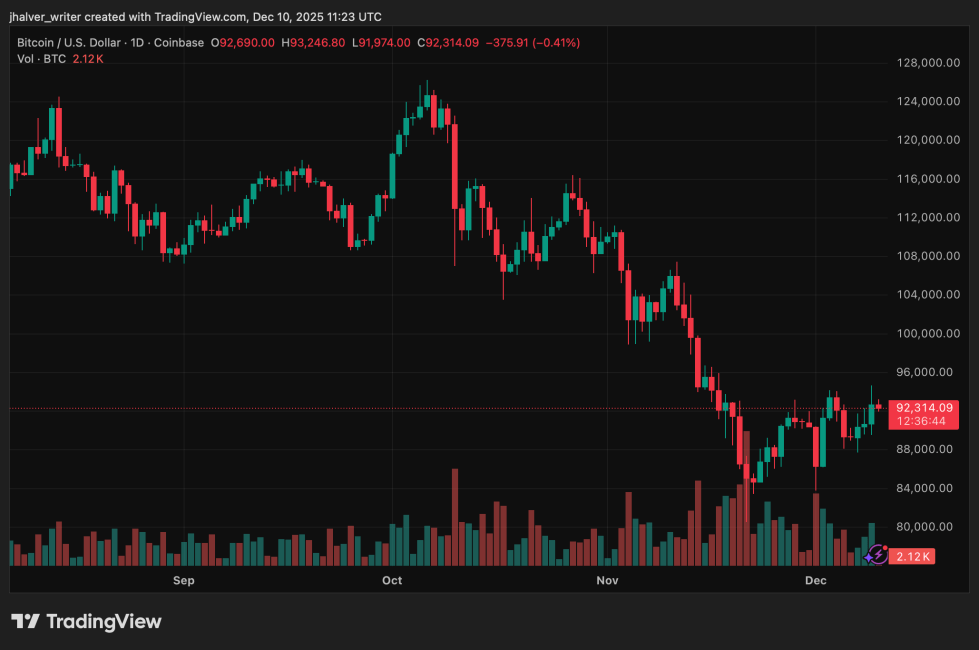
BTC's price records some small gains on the daily chart. Source: BTCUSD on Tradingview

Upbit Pushes Hot Wallet Usage Toward Zero

Following its internal review and system overhaul, Upbit confirmed that it now stores approximately 99% of user assets in cold wallets, with hot wallet exposure reduced to about 1% and expected to decrease further.

As of late October, the exchange held 98.33% of customer funds offline, a rate already well above the 80% minimum required under South Korea’s Virtual Asset User Protection Act.

This shift follows a pattern of rising caution. The recent breach was Upbit’s second significant attack, occurring on November 27, mirroring a 2019 incident that saw more than 342,000 ETH drained from its systems.

This year’s Solana-based attack resulted in withdrawals across 24 tokens within less than an hour, prompting an immediate shutdown of hot wallet operations and emergency transfers to cold storage. Upbit has pledged to fully reimburse affected users from corporate reserves.

Domestic data suggests that the exchange already leads the market in cold storage usage, maintaining the lowest hot wallet ratio among local competitors, whose cold wallet shares range from 82% to 90%.

Security Benchmark Sets Pressure on Global and Local Exchanges

Upbit’s near-99% cold wallet ratio surpasses the standards of major global exchanges. Coinbase stores about 98% of its funds offline, while Kraken’s ratio sits between 95% and 97%.

Several Asian exchanges, including OKX and Gate.io, maintain similar levels. With Upbit’s latest update, the platform now stands at the forefront of global cold storage practices.

Industry observers note that the move aligns with broader regulatory momentum. South Korea’s Financial Services Commission is considering new rules that would require exchanges to compensate users for losses resulting from hacks, regardless of fault, similar to the standards imposed on banks.

Liquidity Questions Linger in a Restricted Market

While security is at the center of Upbit’s restructuring, analysts caution that running with minimal hot wallet reserves may slow withdrawals during periods of heightened market volatility.

South Korea’s crypto market is largely closed to foreign participants, restricting arbitrage and creating conditions where delays can exacerbate price discrepancies, commonly known as the “Kimchi premium.”

During last month’s temporary withdrawal suspension, liquidity was effectively trapped, resulting in sharply widening price gaps between the Korean and global markets. Still, Upbit maintains that its rebuilt systems and predictive models will ensure sufficient liquidity under normal trading conditions.

Cover image from ChatGPT, BTCUSD chart from Tradingview

Leituras Relacionadas

Bank of America Quietly Positions: Could $6 Trillion in Bank Deposits Flow into Stablecoins?

Bank of America has quietly made leadership appointments to accelerate its digital asset strategy, sparking discussion about a potential large-scale migration of bank deposits to stablecoins. Reports highlighted the bank naming Sonali Theisen, Kevin Milsom, and Adam Dixon to lead its global digital asset and AI platform, focusing on stablecoins, tokenized deposits, custody, and crypto settlement. This move revived a claim that $6 trillion in bank deposits could flow into stablecoins, a figure originally cited by Bank of America's CEO Brian Moynihan in January. However, he conditioned this shift on stablecoins being allowed to pay interest—a feature not permitted under the current GENIUS Act. The legislation's final rules are delayed, pushing its effective date to January 2027. Major banks are not waiting. JPMorgan and Citigroup are already piloting tokenized deposit services, and a consortium including Bank of America is building a shared tokenized deposit network targeting a 2027 launch. While some, like Pacemakers.io's Alessandro Hatami, remain skeptical of rapid bank collaboration, data shows significant institutional adoption. Stablecoin settlement volume hit $33 trillion in 2025, and analysts project the market could surpass $1 trillion by 2026. Despite a recent dip in crypto prices and stablecoin supply, the institutional push for real-world use cases continues. The race is on for January 2027, when the GENIUS Act takes effect, potentially reshaping the competition between traditional finance and digital assets.

Foresight NewsHá 20m

Bank of America Quietly Positions: Could $6 Trillion in Bank Deposits Flow into Stablecoins?

Foresight NewsHá 20m

US Treasury Secretary Bement Claims: The US Will Soon Control 80% of Global Computing Power

U.S. Treasury Secretary Ben Sent proclaimed that America is poised to control 80% of the world's computing power, positioning compute dominance as a core pillar of U.S. economic strategy. Speaking on the Mike Rowe show, he stated the U.S. currently holds 50-60% of global compute share, with expectations to reach 80% soon. He framed this as a strategic competition the U.S. "cannot afford to lose," warning that a rival's lead would grant "unacceptable" strategic leverage, while asserting a current one-year AI lead. This high-level policy endorsement is seen as a direct boost for AI infrastructure investment, benefiting chipmakers like NVIDIA and cloud providers' capex cycles. Sent positioned AI compute, semiconductors, and quantum computing as three pillars of national economic strength and security. He defended AI's societal impact, citing historical tech shifts, and argued AI empowers small businesses without causing net job loss so far. He highlighted government efforts to deepen public-private AI cybersecurity cooperation. For investors, the statement signals sustained U.S. policy support for AI infrastructure. However, analysts urge caution, noting "compute share" lacks a standard public metric; the 80% figure is a forecast, not audited data. They recommend focusing on tangible indicators like physical capacity expansion and power infrastructure, with future semiconductor and cloud reports providing key verification data.

marsbitHá 32m

US Treasury Secretary Bement Claims: The US Will Soon Control 80% of Global Computing Power

marsbitHá 32m

Trading

Spot
活动图片