‘Uninformed FUD’ – White House on claims of Coinbase stalling the CLARITY Act again

ambcryptoPublicado em 2026-03-26Última atualização em 2026-03-26

Resumo

The White House has dismissed speculation that Coinbase is opposing the latest stablecoin yield deal and blocking the CLARITY Act, calling the claims "uninformed FUD." Patrick Witt, a digital asset advisor to the President, expressed confidence that the recent agreement between the Senate and the White House would revive momentum for the bill. Rumors of Coinbase CEO Brian Armstrong's opposition originated from a Punchbowl News report, though it was noted his stance was less severe than his previous public objections. The new deal limits stablecoin yields to account activity rather than passive interest earned via intermediaries, a change seen as favorable to banks. As of writing, neither the banking industry nor Armstrong had publicly commented on the compromise. Senator Cynthia Lummis emphasized the urgency of passing the bill under the current pro-crypto administration. Meanwhile, the proposed yield restrictions caused Circle's stock (CRCL) to drop 20% before partially recovering.

The White House has dismissed ongoing speculation that Coinbase has opposed the latest stablecoin yield deal and could block the crypto bill, the CLARITY Act, from moving forward again.

In an X (formerly Twitter) post, Patrick Witt, the executive director of the President’s Council of Advisors for Digital Assets, discredited the claims as ‘uninformed FUD.’
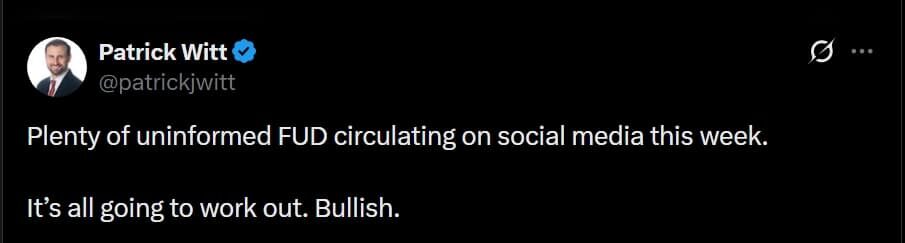
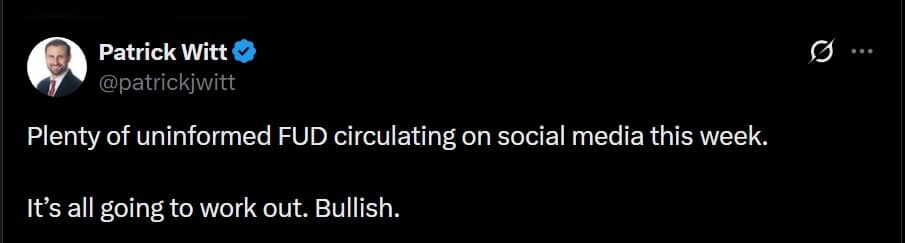
Source: X/Patrick Witt

He seemed confident that the stablecoin yield deal made last week between the Senate and White House would reignite momentum for the CLARITY Act.

Rumors on the Coinbase holdout

The speculation that Coinbase CEO Brian Armstrong opposed the stablecoin yield proposal was sparked by a Punchbowl News (PBN) report.

According to Brendan Pedersen, a reporter at PBN, representatives at the exchange told the Senate on Monday that Coinbase could not support the latest stablecoin yield deal. However, Pedersen clarified that the holdout was not as strong as Armstrong’s public opposition to the bill in January.
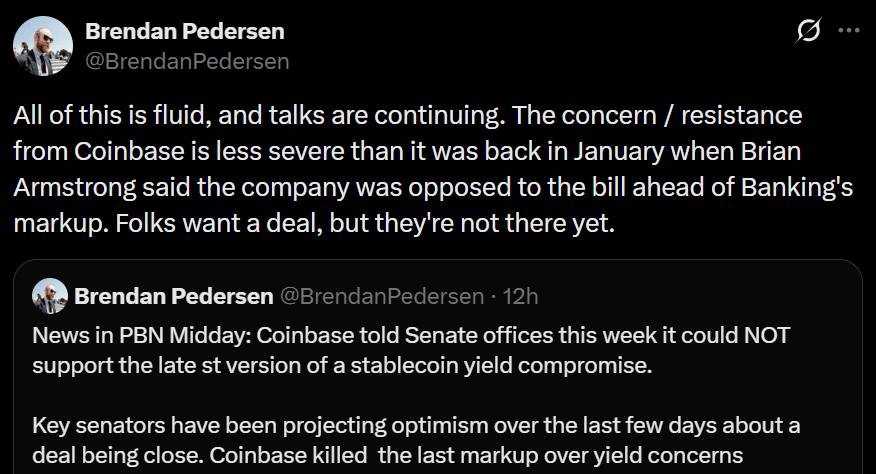
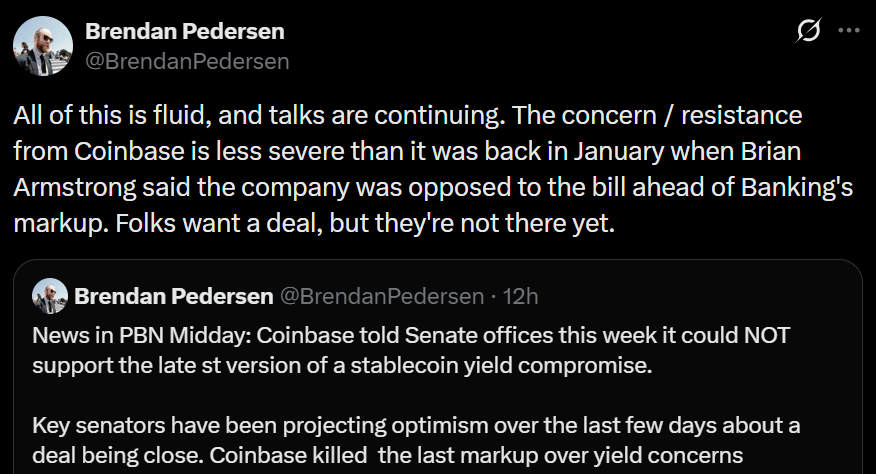
Source: X/Brendan Pedersen

Although some stablecoin yield supporters stood by the alleged Armstrong holdout, others pleaded with him to allow the bill to pass and refine it later.

For his part, Tommy Shaughnessy, founder of crypto VC firm Delphi Ventures, implored Armstrong to reconsider his strong stance against the yield compromise and the crypto bill.
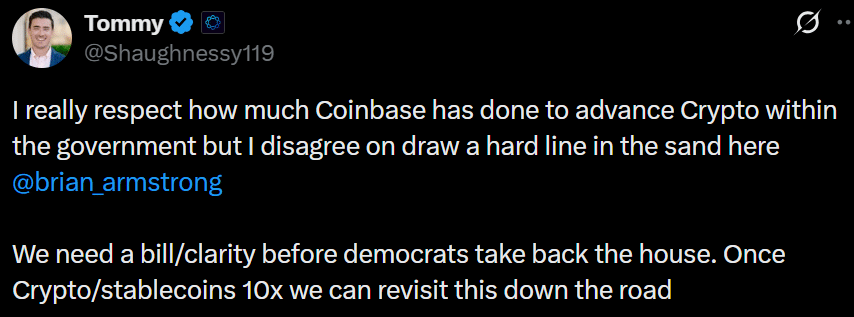
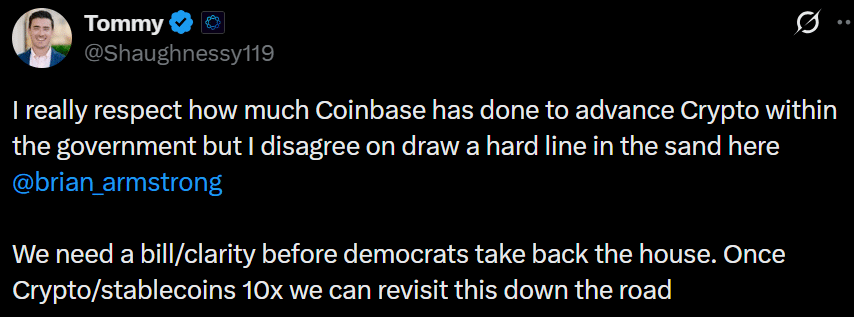
Source: X/Shaughnessy119

The recent deal narrowed stablecoin yield to account activity rather than the current passive interest earned on balances via intermediaries.

Although this was a win for the banks, as of writing, there was no public statement from the industry on whether they were okay with the yield compromise or not.

Likewise, as of writing, Brian Armstrong had not made a public statement on the alleged opposition to the stablecoin yield compromise.
Source: X/Senator Cynthia Lummis

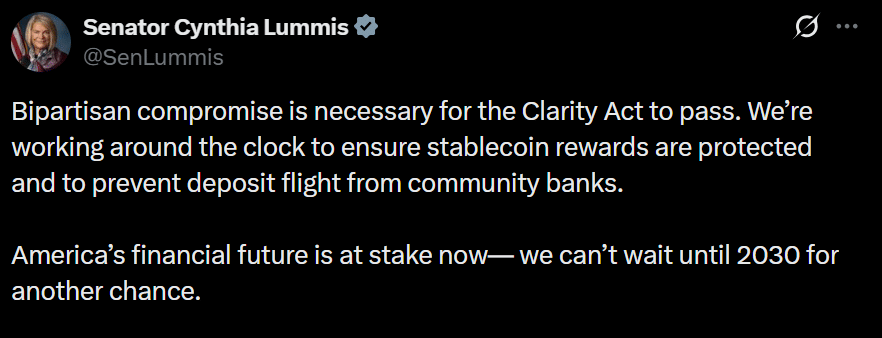
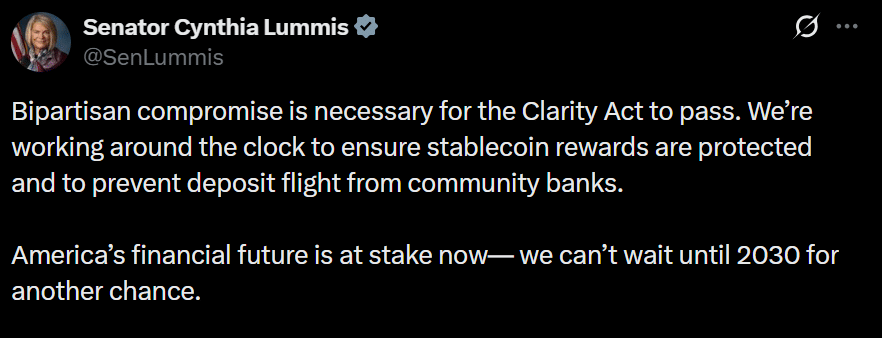
However, Senator Cynthia Lummis stressed that the bill can’t be postponed, underscoring the current pro-crypto regime as the best to advance clear rules for the sector.

Meanwhile, the details on the limited stablecoin yield in the latest CLARITY Act draft made traders turn bearish on Circle stock, CRCL. The stock fell 20% on Tuesday, from $127 to $98, before easing back to over $100 on Wednesday.


Final Summary

  • Trump’s crypto advisor dismissed rumors that Coinbase is opposing the latest stablecoin yield deal, calling the speculation “uninformed FUD.”
  • The proposed stablecoin yield restriction sent Circle stock tumbling 20% this week.

Criptomoedas em alta

Perguntas relacionadas

QWhat did the White House call the claims about Coinbase stalling the CLARITY Act?

AThe White House, through Patrick Witt, dismissed the claims as 'uninformed FUD'.

QWho is Patrick Witt and what is his role?

APatrick Witt is the executive director of the President's Council of Advisors for Digital Assets.

QWhat was the main change in the latest stablecoin yield deal?

AThe recent deal narrowed stablecoin yield to account activity rather than the passive interest earned on balances via intermediaries.

QWhat was the market reaction to the proposed stablecoin yield restrictions?

ACircle's stock (CRCL) fell 20% on Tuesday, from $127 to $98, before recovering to over $100 on Wednesday.

QAccording to the article, had Brian Armstrong made a public statement on the alleged opposition at the time of writing?

ANo, as of the time of writing, Brian Armstrong had not made a public statement on the alleged opposition to the stablecoin yield compromise.

Leituras Relacionadas

Will the Fed Definitely Raise Interest Rates in September? How Will Crypto and U.S. Stocks Withstand the Pressure?

The market's expectation for a September Fed rate hike surged dramatically in early August, jumping from under 50% to over 80% within a week. This shift followed a contentious July FOMC meeting, where a 9-3 vote to hold rates revealed growing dissent from hawkish members advocating for an immediate hike to combat persistent inflation. The primary catalyst for this repricing is rising oil prices, driven by renewed geopolitical tensions around the Strait of Hormuz, which threaten global supply. Energy costs directly influence inflation metrics, making the upcoming July CPI report (due August 12th) a critical data point. If it shows inflation reaccelerating, the probability of a September hike will solidify. For Bitcoin and crypto assets, this is typically bearish news. Bitcoin continues to behave as a high-beta, liquidity-sensitive risk asset. A rate hike raises the opportunity cost of holding non-yielding assets and could drive capital toward money markets, pressuring crypto prices in the short term. However, historical patterns suggest that if a hike is perceived as the end of a tightening cycle rather than the start, any negative price impact may be brief. U.S. stocks, particularly crypto-linked equities like Coinbase and growth-oriented tech stocks, are also vulnerable. Higher rates increase discount rates in valuation models, putting pressure on high-multiple companies. This coincides with a pivotal tech earnings season where investor focus has shifted from massive AI capital expenditure to tangible revenue and cash flow generation. Companies with negative cash flow and weak growth narratives could face heightened volatility if borrowing costs rise in September. In summary, a September Fed hike has evolved into a mainstream market scenario. Key factors to watch are oil prices, the July CPI report, and Fed communications, which will determine the final decision and its impact on volatile crypto and equity markets.

marsbitHá 3m

Will the Fed Definitely Raise Interest Rates in September? How Will Crypto and U.S. Stocks Withstand the Pressure?

marsbitHá 3m

A 'Overlooked' Market Event: Joint US-Japan-South Korea Intervention, Rare US Treasury Involvement, and Bessent's Quiet 'Market Rescue'?

Summary: The United States, Japan, and South Korea executed their largest coordinated foreign exchange intervention in nearly 30 years. The action targeted depreciation pressure on the Japanese yen and South Korean won. This move is seen as a significant effort by the US to stabilize the financial markets of its key allies and prevent the spillover of risks. Key details: * Japan reportedly intervened on July 30 using approximately 8.45 trillion yen (about $52.8 billion). South Korean authorities also intervened that day, selling dollars to support the won. * Notably, the US Treasury Department intervened directly in yen markets for the first time in roughly 30 years. The New York Fed, reportedly acting on behalf of the Treasury, sold euros to buy yen via Goldman Sachs and Morgan Stanley on July 31. Analysts view the use of the euro-yen pair as a way to alleviate yen pressure without adding selling pressure to the US dollar. * Prior to the action, the New York Fed conducted "rate checks" on both USD/JPY and EUR/JPY, a newer signaling tool that falls between verbal and physical intervention. The intervention is interpreted as going beyond traditional currency stabilization. Analysts, such as Michael Hartnett of Bank of America, suggest it resembles a "Price Keeping Operation" for the AI era. The core US objectives are perceived to be: 1. Preventing rapid yen depreciation from triggering a sharp rise in Japanese government bond yields. 2. Containing financial stress from spreading across Asian markets like South Korea and Japan. 3. Reducing the risk of disorderly capital flows impacting the US bond market. This coordinated action underscores the importance of Japan and South Korea as critical partners in the US semiconductor and AI supply chain. Stabilizing their financial markets is seen as vital to mitigating risks to the broader tech industry and the US market itself. The intervention coincides with market pressures, including the KOSDAQ index hitting a low since October 2022. While seen as a move to control volatility, some analysts caution it may not fundamentally reverse existing market trends.

marsbitHá 6m

A 'Overlooked' Market Event: Joint US-Japan-South Korea Intervention, Rare US Treasury Involvement, and Bessent's Quiet 'Market Rescue'?

marsbitHá 6m

Will the Federal Reserve Definitely Raise Interest Rates in September? How Will Cryptocurrencies and US Stocks Bear the Pressure?

In early August 2024, market expectations for a September Federal Reserve rate hike surged dramatically, from below 50% to over 80%, driven by renewed inflation concerns. This shift followed a contentious July FOMC meeting where a 9-3 vote to hold rates revealed a growing hawkish faction advocating for an immediate hike, citing prolonged above-target inflation. The key catalyst is escalating conflict near the Strait of Hormuz, which has pushed oil prices up approximately 20% in July, threatening to reignite inflation. The next critical data point is the July CPI report on August 12th; a hot reading could solidify hike expectations. For crypto assets, particularly Bitcoin, this represents near-term pressure. Bitcoin continues to exhibit high-beta, risk-on characteristics, making it sensitive to tightening liquidity and higher opportunity costs. However, historical precedent suggests that if a hike is perceived as the cycle's end rather than its start, the negative impact may be brief, with markets quickly pivoting to anticipate future rate cuts. U.S. stocks, especially crypto-linked equities like Coinbase and high-valuation tech stocks, face amplified volatility. Higher rates increase discount rates in valuation models, pressuring growth stocks. This coincides with a pivotal tech earnings season where investor focus has shifted from massive AI capital expenditures to demonstrable revenue and cash flow generation. Companies with negative cash flows and weak growth narratives could see severe pressure if a September hike materializes, as financing costs would rise. Key indicators to watch include oil prices, upcoming inflation data, and Fed commentary at events like the Jackson Hole symposium.

Odaily星球日报Há 6m

Will the Federal Reserve Definitely Raise Interest Rates in September? How Will Cryptocurrencies and US Stocks Bear the Pressure?

Odaily星球日报Há 6m

Trading

Spot

Artigos em Destaque

Como comprar HOUSE

Bem-vindo à HTX.com!Tornámos a compra de Housecoin (HOUSE) simples e conveniente.Segue o nosso guia passo a passo para iniciar a tua jornada no mundo das criptos.Passo 1: cria a tua conta HTXUtiliza o teu e-mail ou número de telefone para te inscreveres numa conta gratuita na HTX.Desfruta de um processo de inscrição sem complicações e desbloqueia todas as funcionalidades.Obter a minha contaPasso 2: vai para Comprar Cripto e escolhe o teu método de pagamentoCartão de crédito/débito: usa o teu visa ou mastercard para comprar Housecoin (HOUSE) instantaneamente.Saldo: usa os fundos da tua conta HTX para transacionar sem problemas.Terceiros: adicionamos métodos de pagamento populares, como Google Pay e Apple Pay, para aumentar a conveniência.P2P: transaciona diretamente com outros utilizadores na HTX.Mercado de balcão (OTC): oferecemos serviços personalizados e taxas de câmbio competitivas para os traders.Passo 3: armazena teu Housecoin (HOUSE)Depois de comprar o teu Housecoin (HOUSE), armazena-o na tua conta HTX.Alternativamente, podes enviá-lo para outro lugar através de transferência blockchain ou usá-lo para transacionar outras criptomoedas.Passo 4: transaciona Housecoin (HOUSE)Transaciona facilmente Housecoin (HOUSE) no mercado à vista da HTX.Acede simplesmente à tua conta, seleciona o teu par de trading, executa as tuas transações e monitoriza em tempo real.Oferecemos uma experiência de fácil utilização tanto para principiantes como para traders experientes.

443 Visualizações TotaisPublicado em {updateTime}Atualizado em 2026.06.02

Como comprar HOUSE

Discussões

Bem-vindo à Comunidade HTX. Aqui, pode manter-se informado sobre os mais recentes desenvolvimentos da plataforma e obter acesso a análises profissionais de mercado. As opiniões dos utilizadores sobre o preço de HOUSE (HOUSE) são apresentadas abaixo.

活动图片













