Understanding Vitalik's Reflection on L2: Farewell to Fragmentation, Rectifying the Course Towards Native Rollup in the New Phase

marsbitPublicado em 2026-02-21Última atualização em 2026-02-21

Resumo

Vitalik Buterin's recent reflections on Ethereum's scaling roadmap signal a significant shift: the original plan prioritizing L2s as the primary scaling solution is now considered outdated. Rather than abandoning L2s entirely, the new strategy refocuses on Ethereum L1 as the most secure settlement layer, while L2s are expected to pursue specialization and differentiation—offering unique features like privacy-focused virtual machines or AI-agent environments—instead of mere scalability. A key issue is the fragmentation caused by numerous L2s, many of which remain centralized (e.g., stuck at "Stage 1" with limited decentralization). This undermines Ethereum’s core values and splits liquidity. The community is now moving toward "Native Rollup" concepts, particularly Based Rollup, which integrates rollup logic directly into L1, using Ethereum validators for sequencing instead of independent, often centralized, sequencers. This enhances security, reduces fragmentation, and enables synchronous composability. To improve user experience, preconfirmations and fast L1 confirmation rules are proposed to reduce finality wait times from ~13 minutes to 15-30 seconds. Looking ahead, Ethereum’s evolution will emphasize account abstraction (simplifying user onboarding), privacy with ZK-EVM, and infrastructure for AI agents operating trustlessly on-chain. Ultimately, Vitalik’s critique is not a rejection of L2s but a correction—away from fragmentation and toward deeper integration with L1, ...

Recently, the most discussed topic in the Ethereum community has undoubtedly been Vitalik Buterin's public reflection on the scaling roadmap.

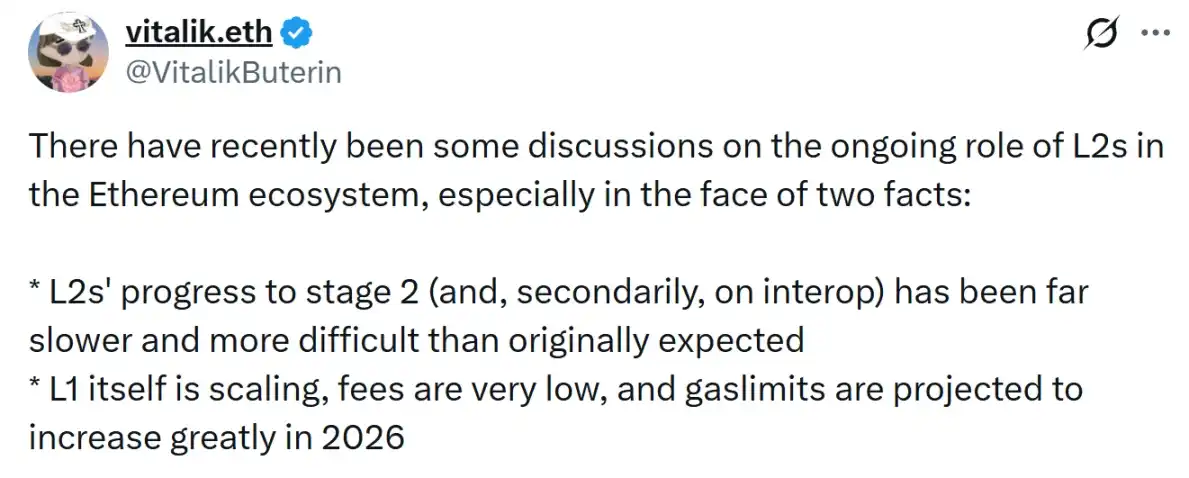
It can be said that Vitalik's attitude was quite "sharp,"直言随着以太坊主网(L1)自身扩容能力的提升,那个在五年前制定的、将 L2 视为主要扩容手段的路线图,已经失效了。

These remarks were once interpreted negatively by the market as "pessimism" or even "denial" towards L2. However, if one carefully examines Vitalik's core points and considers Ethereum's series of mainnet scaling progress, the decentralization progress evaluation framework, and recent technical discussions around Native/Based Rollup, it becomes clear that Vitalik is not completely negating the value of L2, but rather engaging in a kind of "course correction":

Ethereum is not abandoning L2, but is redefining the division of labor—L1 returns to its role as the most secure settlement layer, while L2 pursues differentiation and specialization, thereby refocusing the strategic emphasis on the mainnet itself.
一、Has L2 Fulfilled Its Historical Mission?

Objectively speaking, in the previous cycle, L2 was indeed once seen as Ethereum's lifeline.

In the initial Rollup-Centric roadmap, the division of labor was also very clear: L1 was responsible for security and data availability, L2 was responsible for extreme scaling and low Gas fees. In an era where Gas fees often reached tens of dollars, this was almost the only feasible answer.

But reality developed in a more complex way than expected.

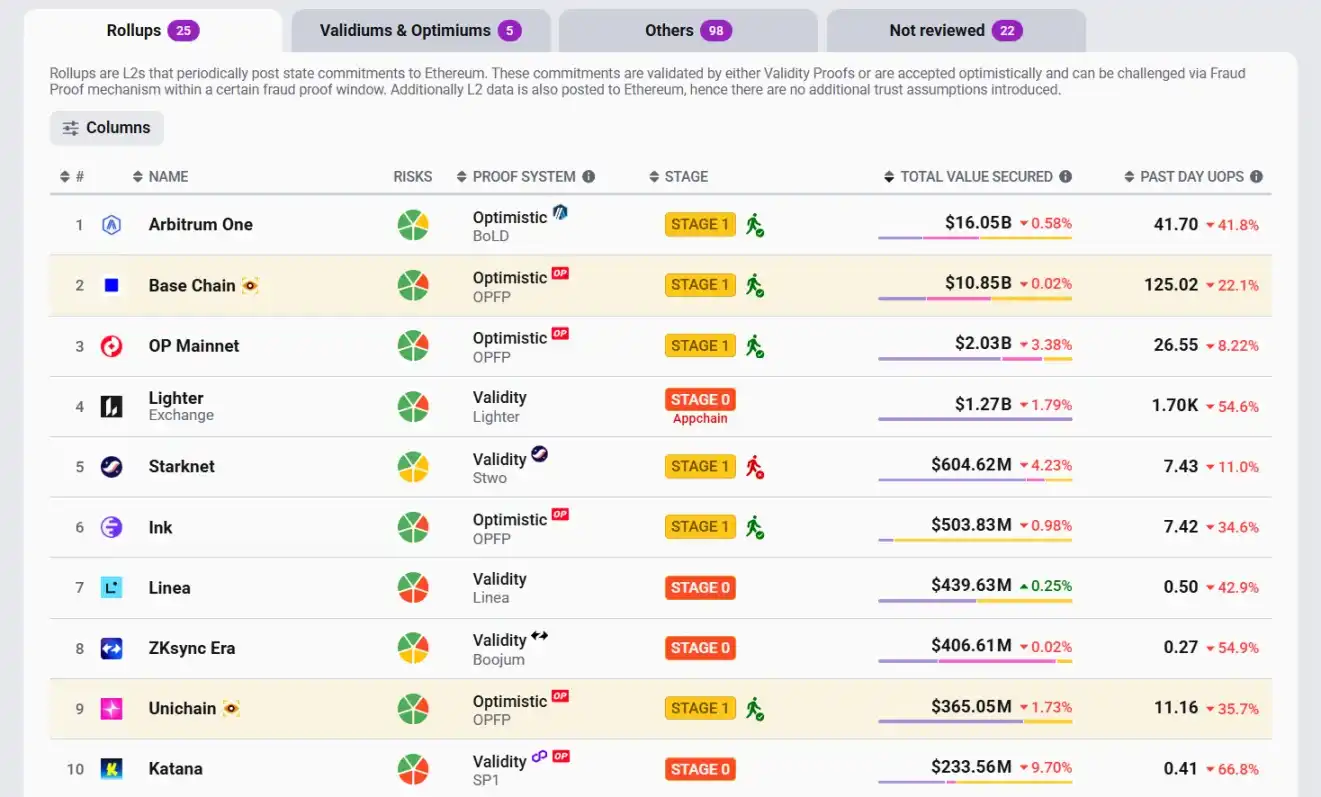
The latest statistics from L2BEAT show that there are now over a hundred L2s in the broad sense, but quantitative膨胀 does not equal structural maturity, with the vast majority making slow progress in decentralization.

Here, some basic knowledge needs to be added. As early as 2022, Vitalik criticized the "Training Wheels" architecture of most Rollups in a blog post,直言其依赖中心化运维、人工干预保障安全. Frequent users of L2Beat should be very familiar with this, as its homepage displays a key related indicator—Stage:

This is an evaluation framework that categorizes Rollups into three stages of decentralization: "Stage 0" which fully depends on centralized control, "Stage 1" with limited dependence, and the fully decentralized "Stage 2". This also reflects the degree of reliance on the artificial intervention of training wheels.

In his recent reflection, Vitalik pointed out that some L2s, possibly due to regulatory or commercial needs, might forever remain at "Stage 1", relying on security councils to control upgradability. This means that such L2s are essentially still a "secondary L1" with cross-chain bridging properties, rather than the "branded shards" initially envisioned.

Or, to put it more bluntly, if the sequencing power, upgrade rights, and final arbitration are concentrated in the hands of a few entities, it not only runs counter to Ethereum's decentralized初衷, but the L2 itself is nothing more than a parasite leaching off the Ethereum mainnet.
At the same time, the proliferation of L2s has brought another structural problem that everyone has felt deeply over the past few years: liquidity fragmentation.

This has caused the流量 originally gathered on Ethereum to be gradually divided, forming一个个被割裂的价值孤岛. As the number of public chains and L2s increases, the degree of liquidity fragmentation will intensify further, which was not the original intention of scaling.

From this perspective, one can understand why Vitalik emphasizes that the next step for L2 is not more chains, but deeper integration. Ultimately, this is actually a timely course correction—through institutionalized scaling and protocol-inherent security mechanisms, strengthening L1's positioning as the world's most trusted settlement layer.

Against this background, scaling is no longer the sole goal; security, neutrality, and predictability have重新成为以太坊的核心资产. The future of L2 lies not in quantity, but in deeper integration with the mainnet and more specialized innovation in细分场景.

For example, providing unique additional functions, such as privacy-specific virtual machines, extreme scaling, or specialized environments designed for non-financial applications like AI agents.

The views of Ethereum Foundation Executive Director Hsiao-Wei Wang at Consensus 2026 coincide with this: L1 should serve as the most secure settlement layer, carrying the most critical activities; while L2 should pursue differentiation and specialization, carrying activities that追求极致用户体验.

二、Native Rollup: Based Rollup + The Future of Preconfirmations?

It is in this wave of reflection on the L2 narrative that the concept of Based Rollup is expected to have its moment of glory in 2026.

Because if the keyword of the past five years was "Rollup-Centric," then the core of the current discussion is shifting to a more specific question: Can Rollups be "grown inside Ethereum" rather than "attached outside Ethereum"?

Therefore, the "Native Rollup" currently hotly debated in the Ethereum community can, to some extent, be understood as an extension of the Based Rollup concept—if Native Rollup is the ultimate ideal, then Based Rollup is currently the most practical path towards that ideal.

As is well known, the biggest difference between Based Rollup and traditional L2s like Arbitrum and Optimism is that it completely抛弃了独立的、甚至是中心化的序列器(Sequencer)层, and instead is directly sequenced by Ethereum L1 nodes. In other words, the Ethereum protocol itself integrates Rollup-like verification logic at the L1 level, thus unifying the extreme performance optimization and protocol-level security that originally belonged to L2 and the Ethereum mainnet separately.

The most intuitive feeling this design gives users is that the Rollup seems to be embedded within Ethereum, inheriting not only L1's censorship resistance and liveness but, more importantly, solving the most headache-inducing problem for L2s—synchronous composability. In a Based Rollup block, you can directly call L1's liquidity, achieving atomic cross-layer transactions.

However, Based Rollup faces a practical challenge: if it completely follows L1's rhythm (one Slot every 12 seconds), the user experience would be cumbersome. After all, under the current Ethereum architecture, even after a transaction is packed into a block, the system still needs to wait about 13 minutes (2 Epochs) to reach finality. This is too slow for financial scenarios.

Interestingly, in the same tweet where Vitalik reflected on L2, he recommended a community proposal from January titled "Combining preconfirmations with based rollups for synchronous composability". The core of this proposal is not simply pushing Based Rollup, but rather proposing a hybrid structure:

Retain low latency sequenced blocks, generate a based block at the end of the slot, submit the based block to L1, and finally combine it with a preconfirmation mechanism to achieve synchronous composability.
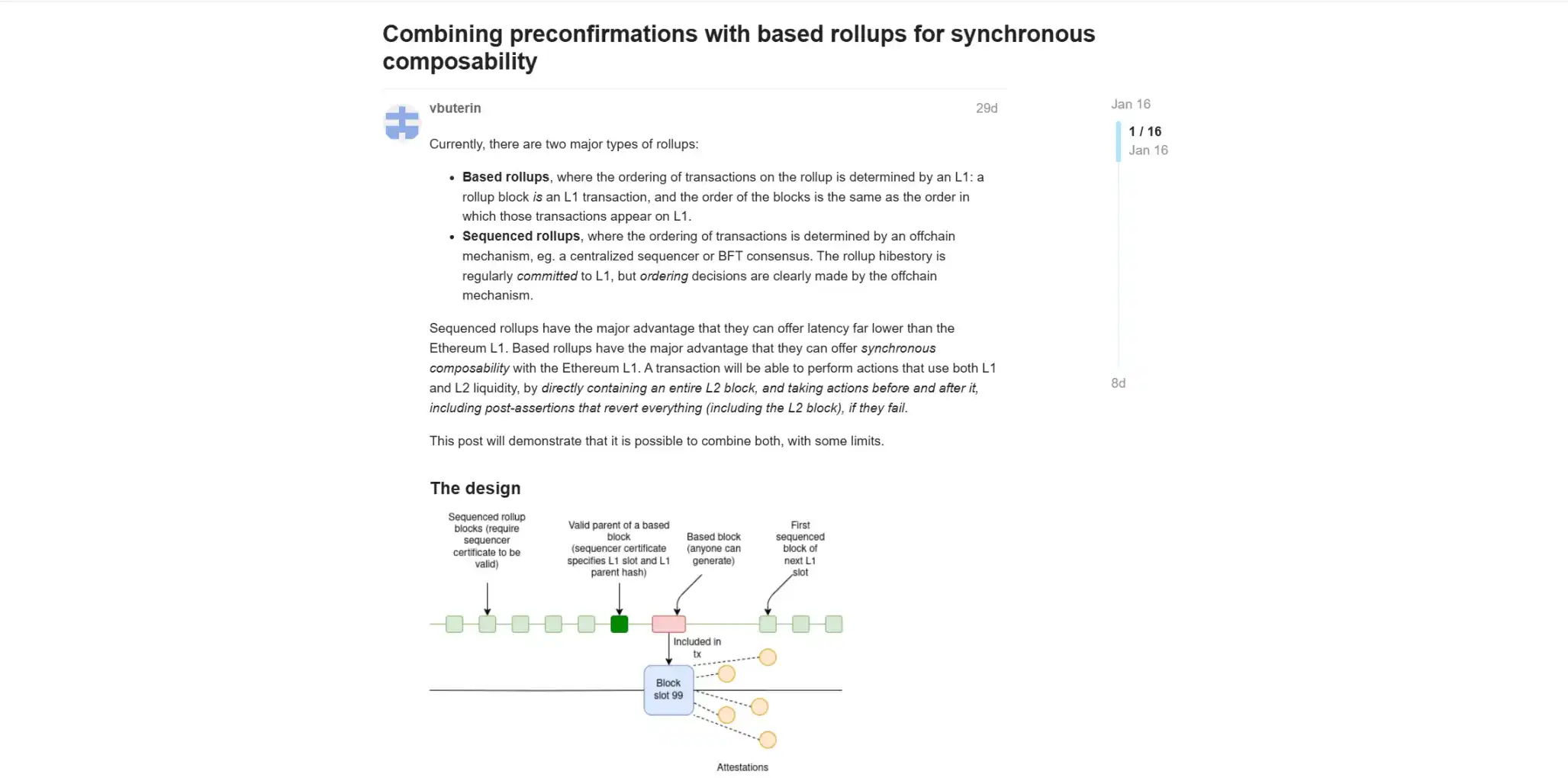
In Based Rollup, a preconfirmation is a commitment made by a specific角色 (like an L1 proposer) that a transaction will be included before it is formally submitted to L1. This is also what Project #4: Fast L1 Confirmation Rule in Ethereum's Interop roadmap explicitly proposes to do.

Its core goal is very direct: to allow applications and cross-chain systems to obtain a "strong and verifiable" L1 confirmation signal within 15–30 seconds, without having to wait the full 13 minutes required for finality.

Mechanically, the fast confirmation rule does not introduce a new consensus process, but rather reutilizes the attester voting that occurs in every slot of Ethereum's PoS system. When a block has accumulated enough, and sufficiently dispersed, validator votes in early slots, even if it has not entered the finalization phase, it can be considered "extremely unlikely to be reverted under a reasonable attack model".

Simply put, this confirmation level does not replace Finality, but provides a strong confirmation explicitly acknowledged by the protocol *before* Finality. For Interop, this is particularly critical: cross-chain systems, Intent Solvers, and wallets no longer need to blindly wait for finality; instead, they can safely advance the next logic within 15–30 seconds based on a protocol-level confirmation signal.

Through this layered confirmation logic, Ethereum finely segments different levels of trust between "security" and "perceived speed,"有望构建出极致丝滑的互操作体验 (extended reading: "Ethereum's 'Second-Level' Evolution: From Fast Confirmations to Settlement Compression, How Interop Eliminates Waiting Time?").

三、What is Ethereum's Future?

Looking back from the vantage point of 2026, Ethereum's main theme is quietly shifting, gradually moving from pursuing extreme "scaling" to pursuing "unification, layering, and inherent security."

Last month, executives from several Ethereum L2 solutions have successively expressed their willingness to explore and embrace the Native Rollup path to enhance the consistency and synergy of the entire network. This attitude itself is an important signal: the Ethereum ecosystem is undergoing a painful but necessary deflation of泡沫, shifting from pursuing "the number of chains" back to pursuing "the unification of the protocol."

However, as Ethereum's underlying roadmap is recalibrated and advanced, especially as L1 continues to strengthen and Based Rollup with preconfirmations are gradually implemented, and底层性能不再是唯一瓶颈时, a more practical problem begins to emerge—the biggest bottleneck is no longer the chain, but the wallet and the entry barrier.

This confirms the insight that imToken repeatedly emphasized in 2025: when infrastructure becomes趋于隐形, what truly determines the limit of scale will be the entry-level interaction experience.

Overall, besides底层扩容, the future breakthrough and规模化发展 of the Ethereum ecosystem will not focus solely on TPS or Blob count, but will revolve around three more structurally significant directions:

  • Account Abstraction and the Erosion of Entry Barriers: Ethereum is promoting native account abstraction (Native AA). Future smart contract wallets will become the default choice, completely replacing obscure seed phrases and EOA addresses. For users of wallets like imToken, this means the barrier to entering the crypto world will become as simple as registering a social media account (extended reading: "From EOA to Account Abstraction: Will Web3's Next Leap Happen in the 'Account System'?");
  • Privacy and ZK-EVM: Privacy features are no longer边缘需求. As ZK-EVM technology matures, Ethereum will provide necessary on-chain privacy protection for commercial applications while maintaining transparency. This will be its core competitive advantage in the public chain competition (extended reading: "The 'Dawn Moment' of the ZK Route: Is Ethereum's Endgame Roadmap Accelerating Comprehensively?");
  • On-Chain Sovereignty of AI Agents: In 2026, the initiator of transactions might not be humans, but AI agents. The future challenge lies in establishing trustless interaction standards: how to ensure that AI agents are executing the user's will, rather than being manipulated by third parties? Ethereum's decentralized settlement layer will become the most reliable rule arbiter for the AI economy (extended reading: "The New Ticket in the Age of AI Agents: What is Ethereum Betting on by Promoting ERC-8004?");

Returning to the initial question, did Vitalik really "deny" L2?

A more accurate understanding is that he denied an overly膨胀、脱离主网、各自为政的碎片化叙事. This is not an endpoint, but a brand new starting point. From the grand illusion of "branded shards" back to the meticulous crafting of Based Rollup and preconfirmations, this本质上反而有助于强化以太坊 L1 作为全球信任底座的绝对地位.

However, this also means that in this return to technological pragmatism, only those innovations that are truly rooted in the underlying principles of Ethereum's new phase and share the same breath and fate as the mainnet will survive and thrive in the next great navigation era.


Perguntas relacionadas

QWhat is the core argument of Vitalik Buterin's recent reflection on Ethereum's scaling roadmap?

AVitalik Buterin argues that the original five-year-old roadmap, which positioned L2 as the primary scaling solution, is now obsolete. The focus is shifting towards a 'dialectical correction': L1 should return to its role as the most secure settlement layer, while L2s should pursue differentiation and specialization, recentering the strategic focus on the mainnet itself.

QAccording to the article, what is a major structural problem caused by the proliferation of L2s?

AA major structural problem caused by the proliferation of L2s is liquidity fragmentation. The expansion has splintered the traffic originally concentrated on Ethereum, creating isolated value islands and exacerbating the fragmentation of liquidity, which was not the original intention of scaling.

QWhat is the key difference between a Based Rollup and a traditional L2 like Arbitrum?

AThe key difference is that Based Rollups completely abandon an independent, often centralized, sequencer layer. Instead, they are ordered directly by Ethereum L1 nodes. This integrates Rollup-like validation logic at the L1 protocol level, unifying extreme performance optimization with protocol-level security.

QHow does the proposed 'Fast L1 Confirmation Rule' aim to improve user experience on Based Rollups?

AThe 'Fast L1 Confirmation Rule' aims to provide applications and cross-chain systems with a 'strong and verifiable' L1 confirmation signal within 15-30 seconds, without waiting for the full 13-minute Finality. It leverages the existing attester votes in Ethereum's PoS system to create a protocol-level, strong confirmation level before finality is reached.

QWhat are the three key directions identified for Ethereum's future scaling and mass adoption, beyond just底层 (underlying) TPS?

AThe three key directions are: 1) Account Abstraction and lowering the entry barrier, making entering crypto as simple as registering a social account. 2) Privacy and ZK-EVM, providing necessary on-chain privacy for commercial applications. 3) AI Agent on-chain sovereignty, establishing the decentralized settlement layer as the most reliable rule adjudicator for the AI economy.

Leituras Relacionadas

Cook's Curtain Call and Ternus Takes the Helm: The Disruption and Reboot of Apple's 4 Trillion Dollar Empire

Tim Cook has officially announced he will step down as CEO of Apple in September, transitioning to executive chairman after a 15-year tenure during which he grew the company’s market value from around $350 billion to nearly $4 trillion. He will be succeeded by John Ternus, a 50-year-old hardware engineering veteran who has been groomed for the role through increasing public visibility and internal responsibility. Ternus’s appointment signals a strategic shift toward hardware and engineering leadership, with Johny Srouji—head of Apple Silicon—taking on an expanded role as Chief Hardware Officer. This consolidation aims to strengthen Apple’s core technological capabilities. However, Cook’s departure highlights a significant unresolved issue: Apple’s delayed and fragmented approach to artificial intelligence. Despite early efforts, such as hiring John Giannandrea from Google in 2018, Apple’s AI initiatives—particularly around Siri—have struggled with internal restructuring and reliance on external partnerships, including with Google. The transition comes at a critical moment as Apple faces paradigm shifts with the rise of artificial general intelligence (ASI). The company’s closed ecosystem of hardware, software, and services—once a major advantage—now presents challenges in adapting to an AI-centric world where intelligence may matter more than the device itself. Ternus must quickly articulate a clear AI strategy, possibly starting at WWDC, to reassure markets and redefine Apple’s role in a new technological era. His task is not only to maintain Apple’s operational excellence but also to reinvigorate its capacity to innovate and lead in the age of AI.

marsbitHá 2h

Cook's Curtain Call and Ternus Takes the Helm: The Disruption and Reboot of Apple's 4 Trillion Dollar Empire

marsbitHá 2h

Trading

Spot
Futuros

Artigos em Destaque

O que é ETH 2.0

ETH 2.0: Uma Nova Era para o Ethereum Introdução ETH 2.0, amplamente conhecido como Ethereum 2.0, marca uma atualização monumental à blockchain do Ethereum. Esta transição não é meramente uma mudança estética; visa melhorar fundamentalmente a escalabilidade, segurança e sustentabilidade da rede. Com uma mudança do mecanismo de consenso em Proof of Work (PoW), intensivo em energia, para um Proof of Stake (PoS) mais eficiente, o ETH 2.0 promete uma abordagem transformadora ao ecossistema blockchain. O que é ETH 2.0? ETH 2.0 é um conjunto de atualizações distintas e interconectadas focadas na otimização das capacidades e desempenho do Ethereum. Esta reformulação foi projetada para abordar desafios críticos que o mecanismo atual do Ethereum enfrentou, particularmente em relação à velocidade das transações e à congestão da rede. Objetivos do ETH 2.0 Os principais objetivos do ETH 2.0 giram em torno da melhoria de três aspectos centrais: Escalabilidade: Com o objetivo de melhorar significativamente o número de transações que a rede pode manejar por segundo, o ETH 2.0 procura ultrapassar a limitação atual de aproximadamente 15 transações por segundo, alcançando potencialmente milhares. Segurança: Medidas de segurança melhoradas são integrais ao ETH 2.0, especialmente através da resistência aprimorada contra ciberataques e da preservação do ethos descentralizado do Ethereum. Sustentabilidade: O novo mecanismo PoS foi projetado não apenas para melhorar a eficiência, mas também para reduzir drasticamente o consumo de energia, alinhando a estrutura operacional do Ethereum com considerações ambientais. Quem é o Criador do ETH 2.0? A criação do ETH 2.0 pode ser atribuída à Ethereum Foundation. Esta organização sem fins lucrativos, que desempenha um papel crucial no apoio ao desenvolvimento do Ethereum, é liderada pelo co-fundador notável Vitalik Buterin. A sua visão de um Ethereum mais escalável e sustentável tem sido a força motriz por trás desta atualização, envolvendo contribuições de uma comunidade global de desenvolvedores e entusiastas dedicados a melhorar o protocolo. Quem são os Investidores do ETH 2.0? Embora os detalhes sobre os investidores do ETH 2.0 não tenham sido tornados públicos, é sabido que a Ethereum Foundation recebe apoio de várias organizações e indivíduos no espaço da blockchain e tecnologia. Esses parceiros incluem firmas de capital de risco, empresas de tecnologia e organizações filantrópicas que compartilham um interesse mútuo em apoiar o desenvolvimento de tecnologias descentralizadas e infraestrutura de blockchain. Como Funciona o ETH 2.0? ETH 2.0 é notável por introduzir uma série de características chave que o diferenciam do seu predecessor. Proof of Stake (PoS) A transição para um mecanismo de consenso PoS é uma das mudanças de destaque do ETH 2.0. Ao contrário do PoW, que depende da mineração intensiva em energia para a verificação de transações, o PoS permite que os utilizadores validem transações e criem novos blocos de acordo com a quantidade de ETH que apostam na rede. Isso leva a uma maior eficiência energética, reduzindo o consumo em aproximadamente 99,95%, tornando o Ethereum 2.0 uma alternativa consideravelmente mais ecológica. Shard Chains As shard chains são outra inovação crítica do ETH 2.0. Estas cadeias menores operam em paralelo com a cadeia principal do Ethereum, permitindo que várias transações sejam processadas simultaneamente. Esta abordagem melhora a capacidade geral da rede, abordando preocupações de escalabilidade que têm atormentado o Ethereum. Beacon Chain No coração do ETH 2.0 está a Beacon Chain, que coordena a rede e gere o protocolo PoS. Ela atua como uma espécie de organizador: supervisiona os validadores, garante que as shards permaneçam conectadas à rede e monitora a saúde geral do ecossistema blockchain. Linha do Tempo do ETH 2.0 A jornada do ETH 2.0 tem sido marcada por vários marcos chave que traçam a evolução desta atualização significativa: Dezembro de 2020: O lançamento da Beacon Chain marcou a introdução do PoS, preparando o caminho para a migração para o ETH 2.0. Setembro de 2022: A conclusão de “The Merge” representa um momento crucial em que a rede Ethereum fez a transição com sucesso de um quadro PoW para um PoS, anunciando uma nova era para o Ethereum. 2023: O lançamento esperado das shard chains visa melhorar ainda mais a escalabilidade da rede Ethereum, solidificando o ETH 2.0 como uma plataforma robusta para aplicações e serviços descentralizados. Características Chave e Benefícios Escalabilidade Melhorada Uma das vantagens mais significativas do ETH 2.0 é a sua escalabilidade melhorada. A combinação de PoS e shard chains permite que a rede expanda a sua capacidade, permitindo que acomode um volume de transações muito maior em comparação com o sistema legado. Eficiência Energética A implementação do PoS representa um enorme passo em direção à eficiência energética na tecnologia blockchain. Ao reduzir drasticamente o consumo de energia, o ETH 2.0 não só reduz os custos operacionais, mas também se alinha mais estreitamente com os objetivos globais de sustentabilidade. Segurança Aprimorada Os mecanismos atualizados do ETH 2.0 contribuem para uma segurança melhorada em toda a rede. O uso do PoS, juntamente com medidas de controle inovadoras estabelecidas através das shard chains e da Beacon Chain, assegura um maior grau de proteção contra potenciais ameaças. Custos Mais Baixos para os Utilizadores À medida que a escalabilidade melhora, os efeitos sobre os custos de transação também serão evidentes. Aumentada a capacidade e reduzida a congestão, espera-se que isso se traduza em taxas mais baixas para os utilizadores, tornando o Ethereum mais acessível para transações do dia a dia. Conclusão ETH 2.0 marca uma evolução significativa no ecossistema da blockchain do Ethereum. Ao abordar questões fundamentais como a escalabilidade, o consumo de energia, a eficiência das transações e a segurança geral, a importância desta atualização não pode ser subestimada. A transição para o Proof of Stake, a introdução das shard chains e o trabalho fundamental da Beacon Chain são indicativos de um futuro em que o Ethereum pode atender à crescente demanda do mercado descentralizado. Em uma indústria movida pela inovação e progresso, o ETH 2.0 representa um testemunho das capacidades da tecnologia blockchain em pavimentar o caminho para uma economia digital mais sustentável e eficiente.

100 Visualizações TotaisPublicado em {updateTime}Atualizado em 2024.12.03

O que é ETH 2.0

O que é ETH 3.0

ETH3.0 e $eth 3.0: Uma Análise Profunda do Futuro do Ethereum Introdução No ambiente em rápida evolução da criptomoeda e da tecnologia blockchain, o ETH3.0, frequentemente denotado como $eth 3.0, emergiu como um tema de considerável interesse e especulação. O termo abrange dois conceitos principais que merecem esclarecimento: Ethereum 3.0: Esta representa uma potencial atualização futura destinada a aumentar as capacidades da atual blockchain do Ethereum, focando especialmente na melhoria da escalabilidade e desempenho. ETH3.0 Meme Token: Este distinto projeto de criptomoeda procura aproveitar a blockchain do Ethereum na criação de um ecossistema centrado em memes, promovendo o envolvimento na comunidade de criptomoedas. Compreender esses aspectos do ETH3.0 é essencial não apenas para entusiastas de criptomoedas, mas também para aqueles que observam as tendências tecnológicas mais amplas no espaço digital. O que é ETH3.0? Ethereum 3.0 Ethereum 3.0 é promovido como uma atualização proposta para a rede Ethereum já estabelecida, que tem sido a espinha dorsal de muitas aplicações descentralizadas (dApps) e contratos inteligentes desde a sua criação. As melhorias vislumbradas concentram-se principalmente na escalabilidade—integrando tecnologias avançadas como sharding e provas de conhecimento zero (zk-proofs). Essas inovações tecnológicas visam facilitar um número sem precedentes de transações por segundo (TPS), potencialmente alcançando milhões, abordando assim uma das limitações mais significativas enfrentadas pela tecnologia blockchain atual. A melhoria não é meramente técnica, mas também estratégica; visa preparar a rede Ethereum para uma adoção generalizada e utilidade em um futuro marcado por uma maior demanda por soluções descentralizadas. ETH3.0 Meme Token Em contraste com o Ethereum 3.0, o ETH3.0 Meme Token aventura-se por um domínio mais leve e divertido, combinando a cultura dos memes da internet com a dinâmica das criptomoedas. Este projeto permite que os usuários comprem, vendam e negociem memes na blockchain do Ethereum, proporcionando uma plataforma que fomenta o envolvimento da comunidade através da criatividade e interesses compartilhados. O ETH3.0 Meme Token visa demonstrar como a tecnologia blockchain pode interseccionar com a cultura digital, criando casos de uso que são tanto divertidos quanto financeiramente viáveis. Quem é o Criador do ETH3.0? Ethereum 3.0 A iniciativa em direção ao Ethereum 3.0 é impulsionada principalmente por um consórcio de desenvolvedores e pesquisadores dentro da comunidade Ethereum, notavelmente incluindo Justin Drake. Conhecido por suas percepções e contribuições para a evolução do Ethereum, Drake tem sido uma figura proeminente nas discussões sobre a transição do Ethereum para uma nova camada de consenso, referida como “Beam Chain”. Esta abordagem colaborativa ao desenvolvimento significa que o Ethereum 3.0 não é fruto de um único criador, mas sim uma manifestação da engenhosidade coletiva focada no avanço da tecnologia blockchain. ETH3.0 Meme Token Os detalhes sobre o criador do ETH3.0 Meme Token são atualmente indetectáveis. A natureza dos tokens de meme frequentemente leva a uma estrutura mais descentralizada e impulsionada pela comunidade, o que poderia explicar a falta de atribuição específica. Isso alinha-se com a ethos da comunidade de criptomoedas mais ampla, onde a inovação geralmente surge de esforços colaborativos em vez de esforços individuais. Quem são os Investidores do ETH3.0? Ethereum 3.0 O apoio ao Ethereum 3.0 provém principalmente da Fundação Ethereum, juntamente com uma comunidade entusiástica de desenvolvedores e investidores. Esta associação fundacional proporciona um grau significativo de legitimidade e melhora as perspectivas de uma implementação bem-sucedida, uma vez que aproveita a confiança e credibilidade construída ao longo de anos de operações de rede. Em um clima em rápida mudança no mundo das criptomoedas, o apoio da comunidade desempenha um papel crucial no impulso ao desenvolvimento e adoção, posicionando o Ethereum 3.0 como um sério candidato a futuros avanços na blockchain. ETH3.0 Meme Token Embora as fontes atualmente disponíveis não forneçam informações explícitas sobre as fundações ou organizações de investimento que apoiam o ETH3.0 Meme Token, é indicativo do modelo típico de financiamento para tokens de meme, que frequentemente depende de apoio base e engajamento da comunidade. Os investidores em tais projetos costumam consistir em indivíduos motivados pelo potencial de inovação impulsionada pela comunidade e pelo espírito de cooperação encontrado dentro da comunidade cripto. Como Funciona o ETH3.0? Ethereum 3.0 As características distintivas do Ethereum 3.0 residem em sua proposta de implementação de sharding e tecnologia zk-proof. Sharding é um método de partição da blockchain em partes menores e gerenciáveis ou “shards”, que podem processar transações simultaneamente em vez de sequencialmente. Esta descentralização do processamento ajuda a prevenir congestionamentos e garante que a rede permaneça responsiva mesmo sob carga pesada. A tecnologia de prova de conhecimento zero (zk-proof) contribui com outra camada de sofisticação ao permitir a validação de transações sem revelar os dados subjacentes envolvidos. Este aspecto não apenas melhora a privacidade, mas também aumenta a eficiência geral da rede. Há também conversas sobre a incorporação de uma Máquina Virtual Ethereum de conhecimento zero (zkEVM) nesta atualização, amplificando ainda mais as capacidades e utilidade da rede. ETH3.0 Meme Token O ETH3.0 Meme Token distingue-se ao capitalizar sobre a popularidade da cultura dos memes. Estabelece um mercado para que os usuários participem da negociação de memes, não apenas para entretenimento, mas também para potencial ganho econômico. Ao integrar recursos como staking, provisão de liquidez e mecanismos de governança, o projeto fomenta um ambiente que incentiva a interação e participação da comunidade. Ao oferecer uma mistura única de entretenimento e oportunidade econômica, o ETH3.0 Meme Token visa atrair um público diversificado, variando de entusiastas de criptomoedas a conhecedores casuais de memes. Cronologia do ETH3.0 Ethereum 3.0 11 de novembro de 2024: Justin Drake sugere a próxima atualização do ETH 3.0, centrada nas melhorias de escalabilidade. Este anúncio sinaliza o início de discussões formais sobre a futura arquitetura do Ethereum. 12 de novembro de 2024: A proposta antecipada para Ethereum 3.0 deve ser revelada no Devcon em Bangkok, preparando o cenário para um feedback mais amplo da comunidade e potenciais próximos passos no desenvolvimento. ETH3.0 Meme Token 21 de março de 2024: O ETH3.0 Meme Token é oficialmente listado no CoinMarketCap, marcando sua entrada no domínio público das criptomoedas e aumentando a visibilidade de seu ecossistema baseado em memes. Pontos Chave Em conclusão, Ethereum 3.0 representa uma evolução significativa dentro da rede Ethereum, focando em superar limitações quanto à escalabilidade e desempenho através de tecnologias avançadas. As atualizações propostas refletem uma abordagem proativa às futuras demandas e usabilidade. Por outro lado, o ETH3.0 Meme Token encapsula a essência da cultura impulsionada pela comunidade no espaço das criptomoedas, aproveitando a cultura dos memes para criar plataformas envolventes que incentivam a criatividade e participação dos usuários. Compreender os distintos propósitos e funcionalidades do ETH3.0 e $eth 3.0 é fundamental para qualquer pessoa interessada nos desenvolvimentos contínuos dentro do espaço cripto. Com ambas as iniciativas a pavimentar caminhos únicos, elas sublinham coletivamente a natureza dinâmica e multifacetada da inovação em blockchain.

98 Visualizações TotaisPublicado em {updateTime}Atualizado em 2024.12.03

O que é ETH 3.0

Como comprar ETH

Bem-vindo à HTX.com!Tornámos a compra de Ethereum (ETH) simples e conveniente.Segue o nosso guia passo a passo para iniciar a tua jornada no mundo das criptos.Passo 1: cria a tua conta HTXUtiliza o teu e-mail ou número de telefone para te inscreveres numa conta gratuita na HTX.Desfruta de um processo de inscrição sem complicações e desbloqueia todas as funcionalidades.Obter a minha contaPasso 2: vai para Comprar Cripto e escolhe o teu método de pagamentoCartão de crédito/débito: usa o teu visa ou mastercard para comprar Ethereum (ETH) instantaneamente.Saldo: usa os fundos da tua conta HTX para transacionar sem problemas.Terceiros: adicionamos métodos de pagamento populares, como Google Pay e Apple Pay, para aumentar a conveniência.P2P: transaciona diretamente com outros utilizadores na HTX.Mercado de balcão (OTC): oferecemos serviços personalizados e taxas de câmbio competitivas para os traders.Passo 3: armazena teu Ethereum (ETH)Depois de comprar o teu Ethereum (ETH), armazena-o na tua conta HTX.Alternativamente, podes enviá-lo para outro lugar através de transferência blockchain ou usá-lo para transacionar outras criptomoedas.Passo 4: transaciona Ethereum (ETH)Transaciona facilmente Ethereum (ETH) no mercado à vista da HTX.Acede simplesmente à tua conta, seleciona o teu par de trading, executa as tuas transações e monitoriza em tempo real.Oferecemos uma experiência de fácil utilização tanto para principiantes como para traders experientes.

2.9k Visualizações TotaisPublicado em {updateTime}Atualizado em 2025.03.21

Como comprar ETH

Discussões

Bem-vindo à Comunidade HTX. Aqui, pode manter-se informado sobre os mais recentes desenvolvimentos da plataforma e obter acesso a análises profissionais de mercado. As opiniões dos utilizadores sobre o preço de ETH (ETH) são apresentadas abaixo.

活动图片