Understanding Premium Rate: Stay 24 Hours Ahead of ETF Data

marsbitPublicado em 2026-01-30Última atualização em 2026-01-30

Resumo

Understanding ETF Premium Rates: A 24-Hour Advantage in Crypto Trading With the approval of BTC and ETH spot ETFs, daily fund flows have become a critical indicator for traders. However, this data is delayed by one day, often causing market prices to reflect the information before it is officially published. A key real-time indicator to anticipate ETF net inflows or outflows is the **ETF premium rate**. The premium rate reflects the difference between an ETF's market price and its net asset value (NAV). A positive premium suggests bullish sentiment and potential inflows, while a negative premium indicates bearish sentiment and likely outflows. Data from January 2026 showed that negative premium rates occurred on 16 out of 18 trading days, with 11 of those days resulting in net outflows. A longer-term analysis (July 2025 to January 2026) revealed an **81% accuracy rate** for negative premiums predicting outflows and **84%** for positive premiums predicting inflows. The mechanism behind this involves Authorized Participants (APs) who perform arbitrage: - A positive premium prompts APs to create ETF shares (buying underlying assets → net inflow). - A negative premium leads to share redemption (selling assets → net outflow). To use premium rates effectively: 1. Focus on **sustained trends** rather than one-day values. 2. Watch for **extreme values** (e.g., beyond ±1%), indicating strong sentiment shifts. 3. Consider **price context**—high prices with n...

Author: San, Deep Tide TechFlow

Since the approval of spot ETFs for BTC and ETH, daily ETF fund inflows and outflows have become a core indicator for many traders to gauge the market.

The logic is simple: net inflows indicate institutional buying and bullish sentiment; net outflows indicate institutional selling and bearish sentiment.

But the problem is, the ETF data we see every day is from the previous day.

By the time the data is released, the price has often already reflected it.

So, is there any way to predict whether today's ETF will have net inflows or outflows in advance?

Yes, the answer is the ETF premium rate.

It's not hard to verify this pattern; looking back at the recently concluded January 2026 is the best sample.

As of January 28, there were 18 trading days in the U.S. stock market.

Statistics show that the premium index on Coinbase remained in positive territory for two days, while the other 16 days were all in negative premium territory.

Corresponding ETF fund flows show that 11 of these 16 days ultimately recorded net outflows.

Especially from January 16 to 23, the negative premium rate continuously fell below -0.15%, corresponding to a weekly net outflow of over $1.3 billion from the ETF market, with BTC's price dropping from a high of $97,000 to around $88,000.
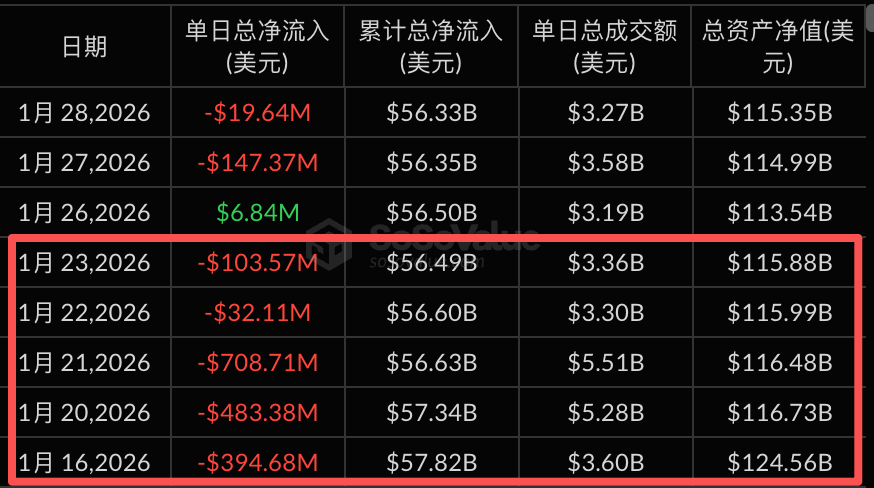
Data source: sosovalue

Let's take a broader view.

From July 1, 2025, to January 28, 2026, there were a total of 146 trading days.

· Negative premium rate occurred for 48 days, corresponding to net outflows for 39 days, with an accuracy rate of 81%.

· Positive premium rate occurred for 98 days, corresponding to net inflows for 82 days, with an accuracy rate of 84%.

This is the value of the premium rate: it allows you to see where the money is flowing earlier than most.

What Is the Premium Rate?

We've been talking about the premium rate, but what exactly is it?

Here's an analogy.

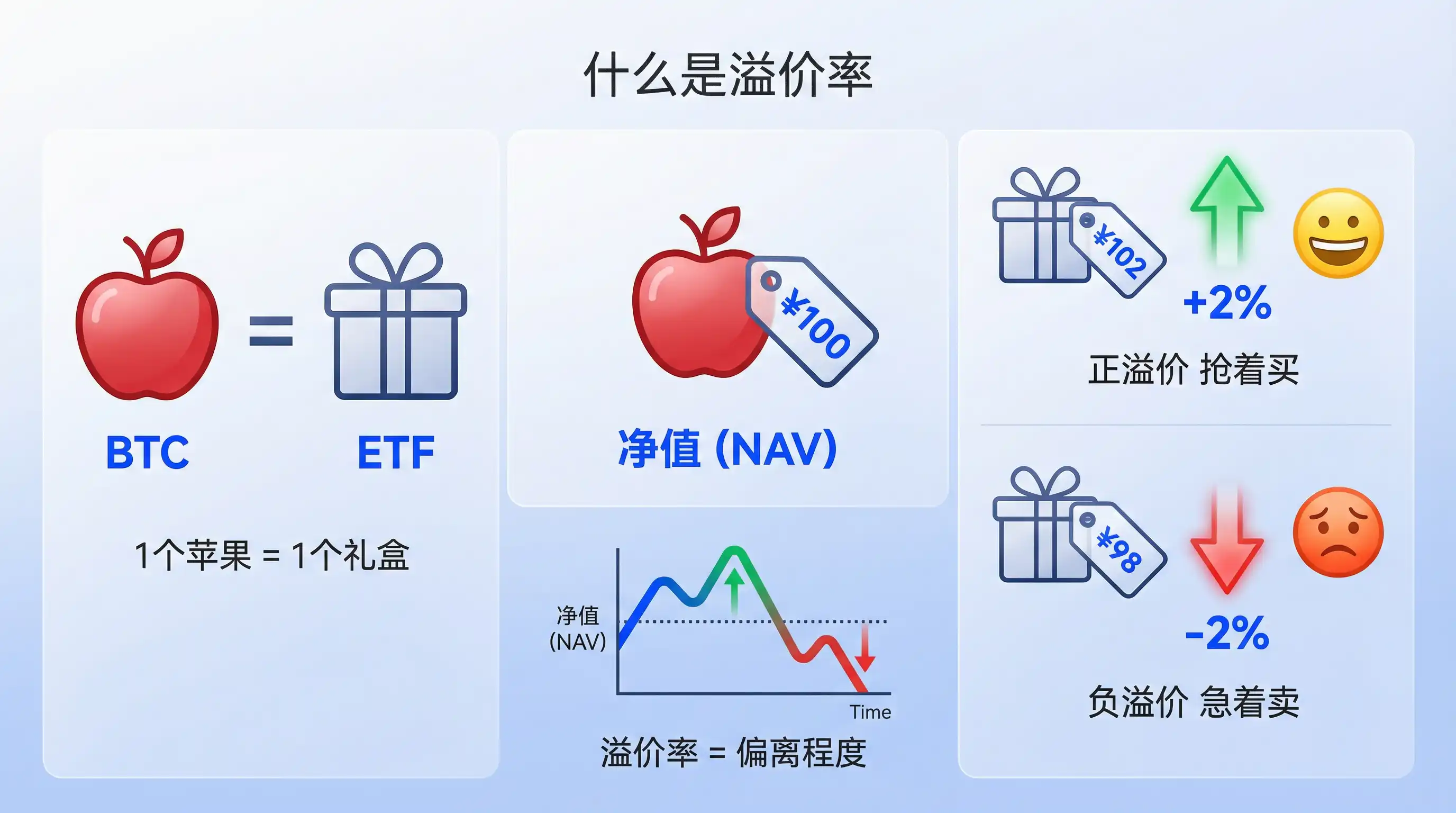
BTC is like loose apples in a grocery market, while BTC spot ETFs are like packaged apple gift boxes in a supermarket, each containing one apple.

An apple sells for $100 in the grocery market—this is the net asset value (NAV).

How much the apple gift box sells for in the supermarket depends on supply and demand.

If many people buy it, the box is driven up to $102—this is a positive premium rate, with a premium of +2%.

If many people sell it, the box drops to $98—this is a negative premium rate, with a premium of -2%.

The premium rate reflects the degree to which the ETF market price deviates from the real price of BTC.

A positive premium indicates optimistic market sentiment, with people rushing to buy.

A negative premium indicates pessimistic market sentiment, with people rushing to sell.
The Relationship Between Premium Rate and ETF Inflows/Outflows

The premium rate is not just a market sentiment indicator; it also becomes a key driver of fund flows.

The key players here are APs, or Authorized Participants, whom you can think of as privileged intermediaries.

The core logic for APs is risk-free arbitrage: they can subscribe to and redeem ETF shares in the primary market, and they can also buy and sell in the secondary market.

As long as there is a price difference, they will engage in arbitrage.

When a positive premium rate appears, the gift box is more expensive than the apple. APs will go to the primary market to buy BTC, package it into ETF shares, and then sell it in the secondary market to profit from the difference. In this process, BTC is bought, resulting in net inflows.

Conversely, when a negative premium rate appears, the gift box is cheaper than the apple. APs will buy ETFs in the secondary market, unpack them to redeem BTC, and then sell the BTC to profit from the difference. In this process, BTC is sold, resulting in net outflows.

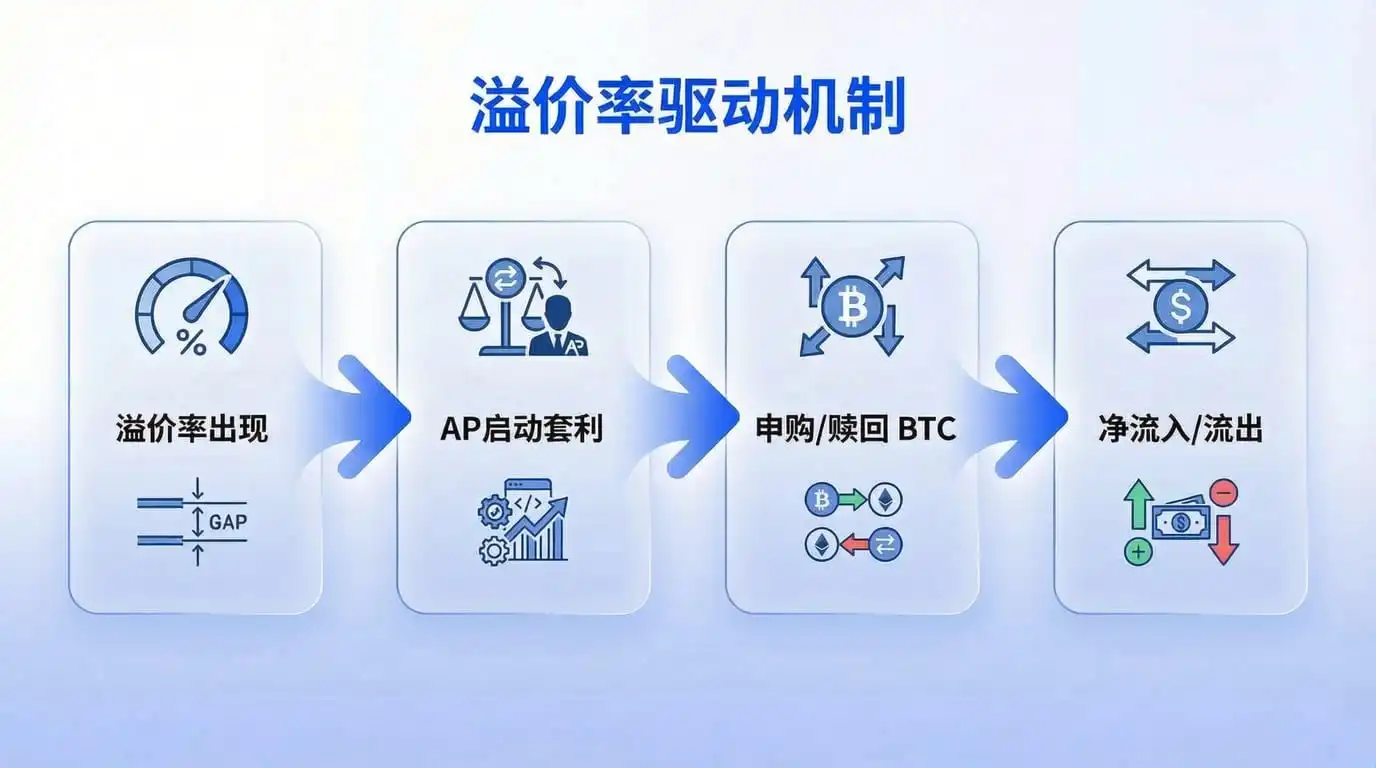
So the logical chain is as follows:

Premium rate appears → APs initiate arbitrage → Subscription or redemption occurs → Net inflows or outflows are formed.
And the ETF fund data we see every day is published the next day after settlement.

The premium rate is real-time; the fund data is lagging.

This is why the premium rate can give you an edge over the market.

How to Apply the Premium Rate

Now that we understand the principle of the premium rate and its relationship with ETF net inflows and outflows, how can we apply it to our individual trading plans?

First, the premium rate is not an indicator to be used alone.

It can tell us the direction of funds but not the magnitude or sustainability.

Here, I suggest combining it with the following dimensions.

1. The Sustainability of the Premium Rate Is More Important Than a Single-Day Value

A single day of negative premium rate may just be short-term volatility.

But if the negative premium rate persists for multiple days, it is likely to correspond to continuous net outflows, which is worth noting.

Looking back at the five consecutive trading days of negative premium rate from January 16 to 23 this year, it corresponded to five days of net outflows, with BTC falling nearly 10%.

2. Pay Attention to Extreme Values of the Premium Rate

Generally, a premium rate fluctuating within ±0.5% is normal.

Once it breaks through ±1%, it indicates a significant deviation in market sentiment, and AP arbitrage activity intensifies, accelerating fund flows.

3. Combine with Price Levels for Judgment

A sustained negative premium rate at high levels may be an early signal of capital flight.

A sustained positive premium rate at low levels may indicate bottom-fishing capital entering the market.

The premium rate itself does not constitute a basis for buying or selling, but it can help you verify the current trend or detect turning points in advance.

Final Thoughts

Finally, there are a few points to note.

No indicator is a holy grail; the effectiveness of the premium rate is based on the normal operation of the AP arbitrage mechanism.

In extreme market conditions, such as the 10.11 crash, where market liquidity dries up, the arbitrage mechanism may fail, and the correlation between the premium rate and fund flows may decrease.

Additionally, the premium rate is just one window into ETF fund movements.

For mature investors, the premium rate is just one piece of the puzzle.

It is recommended to combine it with the following indicators for multi-dimensional cross-verification:

  1. ETF Holdings Changes: An increase in holdings indicates institutions are accumulating; a decrease indicates they are reducing positions. More direct than the premium rate, but data updates are delayed.
  2. Futures Basis and Funding Rate: A positive basis and continuously rising funding rate indicate overheated bullish sentiment, suggesting the market may be overly optimistic. The opposite indicates bearish dominance.
  3. Put/Call Ratio in the Options Market: Puts are put options; calls are call options. A rising ratio indicates increased market避险 sentiment; a falling ratio indicates dominant optimism.
  4. On-Chain Large Transfers and Exchange Net Inflows: Large BTC transfers into exchanges often signal impending selling pressure. Large transfers out of exchanges indicate accumulation.

For example.

When you observe: a continuous negative premium rate, a decrease in ETF holdings, and an increase in exchange net inflows.

Three signals point in the same direction: funds are withdrawing, and selling pressure is accumulating.

At this point, you should at least be alert and control your position, rather than buying the dip.

A single indicator cannot reveal the full picture; multi-dimensional cross-verification is needed to improve the accuracy of judgment.

In this market, the more dimensions you observe, the smaller the information gap, but the time gap will always exist.

Those who see the direction of funds first gain an extra edge.

Perguntas relacionadas

QWhat is the ETF premium rate and how does it help predict fund flows?

AThe ETF premium rate is the percentage difference between the ETF's market price and its net asset value (NAV). A positive premium rate indicates market optimism and potential net inflows, while a negative rate suggests pessimism and potential net outflows. It serves as a real-time indicator that can predict the next day's official ETF flow data, giving traders a 24-hour advantage.

QHow accurate is the premium rate in predicting ETF net inflows and outflows based on the data from July 2025 to January 2026?

AFrom July 1, 2025, to January 28, 2026, covering 146 trading days, the premium rate had an 81% accuracy in predicting net outflows when negative (48 days, 39 net outflows) and an 84% accuracy in predicting net inflows when positive (98 days, 82 net inflows).

QWhat role do Authorized Participants (APs) play in the relationship between premium rate and ETF flows?

AAuthorized Participants (APs) are key players who perform risk-free arbitrage. When there's a positive premium, APs buy BTC, create ETF shares, and sell them on the secondary market for a profit, leading to net inflows. During negative premiums, APs buy ETF shares, redeem them for BTC, and sell the BTC, resulting in net outflows.

QWhat factors should be considered alongside the premium rate for better investment decisions?

AThe premium rate should be used alongside other indicators: 1) Persistence of the premium rate (sustained trends matter more than single-day values), 2) Extreme values (beyond ±0.5% signal stronger movements), 3) Price level (high prices with negative premiums may indicate early sell-offs, low prices with positive premiums may suggest accumulation), and cross-verification with ETF holdings, futures basis, funding rates, options Put/Call ratios, and on-chain large transfers.

QWhy might the premium rate's effectiveness decrease in extreme market conditions?

AIn extreme market conditions, such as severe crashes or liquidity crises (e.g., the 10.11 crash), the arbitrage mechanism may break down. APs might be unable to execute trades efficiently due to market illiquidity, reducing the correlation between the premium rate and actual ETF fund flows.

Leituras Relacionadas

Google and Amazon Simultaneously Invest Heavily in a Competitor: The Most Absurd Business Logic of the AI Era Is Becoming Reality

In a span of four days, Amazon announced an additional $25 billion investment, and Google pledged up to $40 billion—both direct competitors pouring over $65 billion into the same AI startup, Anthropic. Rather than a typical venture capital move, this signals the latest escalation in the cloud wars. The core of the deal is not equity but compute pre-orders: Anthropic must spend the majority of these funds on AWS and Google Cloud services and chips, effectively locking in massive future compute consumption. This reflects a shift in cloud market dynamics—enterprises now choose cloud providers based on which hosts the best AI models, not just price or stability. With OpenAI deeply tied to Microsoft, Anthropic’s Claude has become the only viable strategic asset for Google and Amazon to remain competitive. Anthropic’s annualized revenue has surged to $30 billion, and it is expanding into verticals like biotech, positioning itself as a cross-industry AI infrastructure layer. However, this funding comes with constraints: Anthropic’s independence is challenged as it balances two rival investors, its safety-first narrative faces pressure from regulatory scrutiny, and its path to IPO introduces new financial pressures. Globally, this accelerates a "tri-polar" closed-loop structure in AI infrastructure, with Microsoft-OpenAI, Google-Anthropic, and Amazon-Anthropic forming exclusive model-cloud alliances. In contrast, China’s landscape differs—investments like Alibaba and Tencent backing open-source model firm DeepSeek reflect a more decoupled approach, though closed-source models from major cloud providers still dominate. The $65 billion bet is ultimately about securing a seat at the table in an AI-defined future—where missing the model layer means losing the cloud war.

marsbitHá 1h

Google and Amazon Simultaneously Invest Heavily in a Competitor: The Most Absurd Business Logic of the AI Era Is Becoming Reality

marsbitHá 1h

Computing Power Constrained, Why Did DeepSeek-V4 Open Source?

DeepSeek-V4 has been released as a preview open-source model, featuring 1 million tokens of context length as a baseline capability—previously a premium feature locked behind enterprise paywalls by major overseas AI firms. The official announcement, however, openly acknowledges computational constraints, particularly limited service throughput for the high-end DeepSeek-V4-Pro version due to restricted high-end computing power. Rather than competing on pure scale, DeepSeek adopts a pragmatic approach that balances algorithmic innovation with hardware realities in China’s AI ecosystem. The V4-Pro model uses a highly sparse architecture with 1.6T total parameters but only activates 49B during inference. It performs strongly in agentic coding, knowledge-intensive tasks, and STEM reasoning, competing closely with top-tier closed models like Gemini Pro 3.1 and Claude Opus 4.6 in certain scenarios. A key strategic product is the Flash edition, with 284B total parameters but only 13B activated—making it cost-effective and accessible for mid- and low-tier hardware, including domestic AI chips from Huawei (Ascend), Cambricon, and Hygon. This design supports broader adoption across developers and SMEs while stimulating China's domestic semiconductor ecosystem. Despite facing talent outflow and intense competition in user traffic—with rivals like Doubao and Qianwen leading in monthly active users—DeepSeek has maintained technical momentum. The release also comes amid reports of a new funding round targeting a valuation exceeding $10 billion, potentially setting a new record in China’s LLM sector. Ultimately, DeepSeek-V4 represents a shift toward open yet realistic infrastructure development in the constrained compute landscape of Chinese AI, emphasizing engineering efficiency and domestic hardware compatibility over pure model scale.

marsbitHá 1h

Computing Power Constrained, Why Did DeepSeek-V4 Open Source?

marsbitHá 1h

Trading

Spot
Futuros

Artigos em Destaque

O que é BITCOIN

Compreender o HarryPotterObamaSonic10Inu (ERC-20) e a Sua Posição no Espaço Cripto Nos últimos anos, o mercado de criptomoedas assistiu a um aumento na popularidade das moedas meme, cativando não apenas os traders, mas também aqueles que procuram envolvimento comunitário e valor de entretenimento. Entre estes tokens únicos está o HarryPotterObamaSonic10Inu (ERC-20), um projeto intrigante que mistura referências culturais no tecido das criptomoedas. Este artigo explora os principais aspetos do HarryPotterObamaSonic10Inu, examinando os seus mecanismos, a sua ética orientada pela comunidade e o seu envolvimento com o vasto panorama cripto. O que é o HarryPotterObamaSonic10Inu (ERC-20)? Como o nome sugere, o HarryPotterObamaSonic10Inu é uma moeda meme construída na blockchain Ethereum, classificada sob o padrão ERC-20. Ao contrário das criptomoedas tradicionais, que podem enfatizar a utilidade prática ou o potencial de investimento, este token prospera no valor de entretenimento e na força da sua comunidade. O projeto visa promover um ambiente onde utilizadores envolvidos possam reunir-se, partilhar ideias e participar em atividades inspiradas por diversos fenómenos culturais. Uma característica notável do HarryPotterObamaSonic10Inu é a zero taxa sobre transações. Este elemento atraente visa encorajar a negociação e o envolvimento da comunidade, isento de encargos adicionais que podem desencorajar os traders de pequena escala. A oferta total da moeda está fixada em mil milhões de tokens, uma cifra que marca a sua intenção de manter uma circulação substancial dentro da comunidade. Criador do HarryPotterObamaSonic10Inu (ERC-20) As origens do HarryPotterObamaSonic10Inu estão um pouco envoltas em mistério; os detalhes sobre o criador permanecem desconhecidos. O desenvolvimento deste token carece de uma equipa identificável ou de um plano explícito, o que não é raro no setor das moedas meme. Em vez disso, o projeto surgiu de forma orgânica, com o seu progresso a depender fortemente do entusiasmo e da participação da sua comunidade. Investidores do HarryPotterObamaSonic10Inu (ERC-20) No que diz respeito a investimentos externos e apoios, o HarryPotterObamaSonic10Inu também permanece ambíguo. O token não lista quaisquer fundações de investimento conhecidas ou apoio organizacional significativo. Em vez disso, o “sangue vital” do projeto é a sua comunidade de base, que informa o seu crescimento e sustentabilidade através da ação coletiva e do envolvimento no espaço cripto. Como Funciona o HarryPotterObamaSonic10Inu (ERC-20)? Como uma moeda meme, o HarryPotterObamaSonic10Inu opera principalmente fora dos quadros tradicionais que muitas vezes governam o valor dos ativos. Existem vários aspetos distintivos que definem como o projeto funciona: Transações Sem Taxas: Sem taxas sobre transações, os utilizadores podem comprar e vender o token livremente, sem a preocupação de custos ocultos. Envolvimento da Comunidade: O projeto prospera na interação da comunidade, aproveitando plataformas de redes sociais para criar entusiasmo e facilitar a participação. Discussões, partilha de conteúdo e envolvimento são elementos cruciais que ajudam a expandir o seu alcance e a fomentar a lealdade entre os apoiantes. Sem Utilidade Prática: Deve ser notado que o HarryPotterObamaSonic10Inu não oferece utilidade concreta dentro do ecossistema financeiro. Em vez disso, é classificado como um token principalmente para entretenimento e atividades comunitárias. Referência Cultural: O token incorpora de forma inteligente elementos da cultura popular para atrair interesse, conectando-se tanto com entusiastas de memes como com seguidores de criptomoedas. HarryPotterObamaSonic10Inu exemplifica como as moedas meme operam de forma diferente de projetos de criptomoedas mais tradicionais, entrando no mercado como construções sociais inovadoras em vez de ativos utilitários. Linha do Tempo do HarryPotterObamaSonic10Inu (ERC-20) A história do HarryPotterObamaSonic10Inu é marcada por vários marcos notáveis: Criação: O token surgiu de um meme viral, capturando a imaginação de muitos entusiastas de criptomoedas. Datas específicas de criação não estão disponíveis, sublinhando a sua ascensão orgânica. Listagem em Exchanges: O HarryPotterObamaSonic10Inu conseguiu entrar em várias exchanges, permitindo um acesso e negociação mais fáceis pela comunidade. Iniciativas de Envolvimento da Comunidade: Atividades contínuas direcionadas a melhorar a interação comunitária, incluindo concursos, campanhas em redes sociais e geração de conteúdo por fãs e defensores. Planos de Expansão Futura: O roteiro do projeto inclui o lançamento de uma coleção de NFTs, mercadorias e um site de eCommerce relacionado aos seus temas culturais, envolvendo ainda mais a comunidade e tentando adicionar mais dimensões ao seu ecossistema. Pontos-Chave sobre o HarryPotterObamaSonic10Inu (ERC-20) Natureza Orientada pela Comunidade: O projeto prioriza a contribuição coletiva e a criatividade, assegurando que o envolvimento dos utilizadores está na vanguarda do seu desenvolvimento. Classificação como Moeda Meme: Representa o epítome da criptomoeda baseada em entretenimento, destacando-se dos veículos de investimento tradicionais. Sem Afiliação Direta com o Bitcoin: Apesar da semelhança no nome do ticker, o HarryPotterObamaSonic10Inu é distinto e não tem qualquer relação com o Bitcoin ou outras criptomoedas estabelecidas. Foco na Colaboração: O HarryPotterObamaSonic10Inu é projetado para criar um espaço de colaboração e partilha de histórias entre os seus detentores, proporcionando uma via para a criatividade e o fortalecimento da comunidade. Perspectivas Futuras: A ambição de expandir além da sua premissa inicial para NFTs e mercadorias delineia um caminho para o projeto potencialmente entrar em avenidas mais mainstream dentro da cultura digital. À medida que as moedas meme continuam a capturar a imaginação da comunidade cripto, HarryPotterObamaSonic10Inu (ERC-20) destaca-se devido aos seus laços culturais e abordagem centrada na comunidade. Embora possa não se encaixar no molde típico de um token orientado para utilidade, a sua essência reside na alegria e camaradagem fomentadas entre os seus apoiantes, destacando a natureza em evolução das criptomoedas em uma era cada vez mais digital. À medida que o projeto continua a desenvolver-se, será importante observar como as dinâmicas comunitárias influenciam a sua trajetória no panorama em constante mudança da tecnologia blockchain.

1.2k Visualizações TotaisPublicado em {updateTime}Atualizado em 2024.12.03

O que é BITCOIN

Como comprar BTC

Bem-vindo à HTX.com!Tornámos a compra de Bitcoin (BTC) simples e conveniente.Segue o nosso guia passo a passo para iniciar a tua jornada no mundo das criptos.Passo 1: cria a tua conta HTXUtiliza o teu e-mail ou número de telefone para te inscreveres numa conta gratuita na HTX.Desfruta de um processo de inscrição sem complicações e desbloqueia todas as funcionalidades.Obter a minha contaPasso 2: vai para Comprar Cripto e escolhe o teu método de pagamentoCartão de crédito/débito: usa o teu visa ou mastercard para comprar Bitcoin (BTC) instantaneamente.Saldo: usa os fundos da tua conta HTX para transacionar sem problemas.Terceiros: adicionamos métodos de pagamento populares, como Google Pay e Apple Pay, para aumentar a conveniência.P2P: transaciona diretamente com outros utilizadores na HTX.Mercado de balcão (OTC): oferecemos serviços personalizados e taxas de câmbio competitivas para os traders.Passo 3: armazena teu Bitcoin (BTC)Depois de comprar o teu Bitcoin (BTC), armazena-o na tua conta HTX.Alternativamente, podes enviá-lo para outro lugar através de transferência blockchain ou usá-lo para transacionar outras criptomoedas.Passo 4: transaciona Bitcoin (BTC)Transaciona facilmente Bitcoin (BTC) no mercado à vista da HTX.Acede simplesmente à tua conta, seleciona o teu par de trading, executa as tuas transações e monitoriza em tempo real.Oferecemos uma experiência de fácil utilização tanto para principiantes como para traders experientes.

3.8k Visualizações TotaisPublicado em {updateTime}Atualizado em 2025.03.21

Como comprar BTC

O que é $BITCOIN

OURO DIGITAL ($BITCOIN): Uma Análise Abrangente Introdução ao OURO DIGITAL ($BITCOIN) OURO DIGITAL ($BITCOIN) é um projeto baseado em blockchain que opera na rede Solana, com o objetivo de combinar as características dos metais preciosos tradicionais com a inovação das tecnologias descentralizadas. Embora partilhe um nome com o Bitcoin, frequentemente referido como “ouro digital” devido à sua percepção como uma reserva de valor, o OURO DIGITAL é um token separado projetado para criar um ecossistema único dentro da paisagem Web3. O seu objetivo é posicionar-se como um ativo digital alternativo viável, embora os detalhes sobre as suas aplicações e funcionalidades ainda estejam em desenvolvimento. O que é o OURO DIGITAL ($BITCOIN)? OURO DIGITAL ($BITCOIN) é um token de criptomoeda explicitamente projetado para uso na blockchain Solana. Em contraste com o Bitcoin, que fornece um papel amplamente reconhecido como armazenamento de valor, este token parece focar em aplicações e características mais amplas. Aspectos notáveis incluem: Infraestrutura Blockchain: O token é construído na blockchain Solana, conhecida pela sua capacidade de lidar com transações de alta velocidade e baixo custo. Dinâmicas de Oferta: O OURO DIGITAL tem um fornecimento máximo limitado a 100 quatrilhões de tokens (100P $BITCOIN), embora os detalhes sobre o seu fornecimento circulante ainda não tenham sido divulgados. Utilidade: Embora as funcionalidades precisas não estejam explicitamente delineadas, existem indicações de que o token poderia ser utilizado para várias aplicações, potencialmente envolvendo aplicações descentralizadas (dApps) ou estratégias de tokenização de ativos. Quem é o Criador do OURO DIGITAL ($BITCOIN)? Neste momento, a identidade dos criadores e da equipa de desenvolvimento por trás do OURO DIGITAL ($BITCOIN) permanece desconhecida. Esta situação é típica entre muitos projetos inovadores no espaço da blockchain, particularmente aqueles alinhados com finanças descentralizadas e fenómenos de moedas meme. Embora tal anonimato possa fomentar uma cultura orientada pela comunidade, intensifica as preocupações sobre governança e responsabilidade. Quem são os Investidores do OURO DIGITAL ($BITCOIN)? As informações disponíveis indicam que o OURO DIGITAL ($BITCOIN) não tem apoiantes institucionais conhecidos ou investimentos proeminentes de capital de risco. O projeto parece operar num modelo peer-to-peer focado no apoio e adoção da comunidade, em vez de rotas de financiamento tradicionais. A sua atividade e liquidez estão principalmente situadas em exchanges descentralizadas (DEXs), como a PumpSwap, em vez de plataformas de negociação centralizadas estabelecidas, destacando ainda mais a sua abordagem de base. Como Funciona o OURO DIGITAL ($BITCOIN) A mecânica operacional do OURO DIGITAL ($BITCOIN) pode ser elaborada com base no seu design de blockchain e nas características da rede: Mecanismo de Consenso: Ao aproveitar o exclusivo proof-of-history (PoH) da Solana combinado com um modelo de proof-of-stake (PoS), o projeto assegura uma validação eficiente das transações, contribuindo para o alto desempenho da rede. Tokenomics: Embora mecanismos deflacionários específicos não tenham sido extensivamente detalhados, o vasto fornecimento máximo de tokens implica que pode atender a microtransações ou casos de uso de nicho que ainda estão por definir. Interoperabilidade: Existe o potencial para integração com o ecossistema mais amplo da Solana, incluindo várias plataformas de finanças descentralizadas (DeFi). No entanto, os detalhes sobre integrações específicas permanecem não especificados. Cronologia de Eventos Chave Aqui está uma cronologia que destaca marcos significativos relacionados ao OURO DIGITAL ($BITCOIN): 2023: O lançamento inicial do token ocorre na blockchain Solana, marcado pelo seu endereço de contrato. 2024: O OURO DIGITAL ganha visibilidade ao tornar-se disponível para negociação em exchanges descentralizadas como a PumpSwap, permitindo que os utilizadores o negociem contra SOL. 2025: O projeto testemunha atividade de negociação esporádica e potencial interesse em envolvimentos liderados pela comunidade, embora não tenham sido documentadas parcerias ou avanços técnicos notáveis até ao momento. Análise Crítica Forças Escalabilidade: A infraestrutura subjacente da Solana suporta altos volumes de transações, o que pode aumentar a utilidade do $BITCOIN em vários cenários de transação. Acessibilidade: O potencial preço de negociação baixo por token pode atrair investidores de retalho, facilitando uma participação mais ampla devido a oportunidades de propriedade fracionada. Riscos Falta de Transparência: A ausência de apoiantes, desenvolvedores ou um processo de auditoria publicamente conhecidos pode gerar ceticismo em relação à sustentabilidade e confiabilidade do projeto. Volatilidade do Mercado: A atividade de negociação depende fortemente do comportamento especulativo, o que pode resultar em volatilidade significativa dos preços e incerteza para os investidores. Conclusão O OURO DIGITAL ($BITCOIN) surge como um projeto intrigante, mas ambíguo, dentro do ecossistema em rápida evolução da Solana. Embora tente aproveitar a narrativa do “ouro digital”, a sua divergência do papel estabelecido do Bitcoin como reserva de valor sublinha a necessidade de uma diferenciação mais clara da sua utilidade pretendida e estrutura de governança. A aceitação e adoção futuras dependerão provavelmente da abordagem da atual opacidade e da definição mais explícita das suas estratégias operacionais e económicas. Nota: Este relatório abrange informações sintetizadas disponíveis até outubro de 2023, e desenvolvimentos podem ter ocorrido além do período de pesquisa.

92 Visualizações TotaisPublicado em {updateTime}Atualizado em 2025.05.13

O que é $BITCOIN

Discussões

Bem-vindo à Comunidade HTX. Aqui, pode manter-se informado sobre os mais recentes desenvolvimentos da plataforma e obter acesso a análises profissionais de mercado. As opiniões dos utilizadores sobre o preço de BTC (BTC) são apresentadas abaixo.

活动图片














