Truth, Bubbles, and Illusions: Looking Back at the 2025 Crypto Report Card

比推Publicado em 2026-01-12Última atualização em 2026-01-12

Resumo

Based on the article "Truth, Bubbles, and Illusions: A Look Back at the 2025 Crypto Report Card," here is a summary of its main points: The author reflects on their 2025 predictions for the crypto market. They admit to being wrong about Bitcoin's peak in Q4, as the cycle held, and wrong about a memecoin or AI agent supercycle, as retail investors favored traditional assets like gold and AI stocks instead. The AI x Crypto narrative saw mixed results with project development but poor token performance, and NFTs were declared "dead." Key insights from 2025 include: 1. **Bitcoin ETFs acted as a floor, not a ceiling:** Massive selling by long-term holders created a $95B supply overhang, causing BTC to underperform. However, its correlation with traditional risk assets fell, which is bullish long-term. 2. **Airdrops are not dead:** Nearly $4.5B was airdropped in 2025 (e.g., Story Protocol, Berachain). The game has shifted towards requiring more focused, high-conviction farming due to points fatigue and better Sybil detection. 3. **Fee switches set a price floor, not an engine for growth:** Token buybacks from fees establish a bottom price but don't guarantee appreciation, as seen with UNI's price action. The market treats everything as a trade. 4. **Stablecoins gained traction for payments, but "proxy trading" was difficult:** Stablecoins like USDT saw real-world adoption for payments. However, investing in related equities (e.g., Circle's IPO) proved challenging, as gains we...

Author: Ignas

Compilation: Plain Talk Blockchain

Original Title: Crypto Truth and Lies: A Review of the 2025 Report Card


A year ago, I wrote "Truth and Lies of the 2025 Crypto Market".

At that time, everyone was sharing higher Bitcoin price targets. I wanted to find a different framework to discover where the public might be wrong and to position myself differently. The goal was simple: to seek out ideas that already existed but were overlooked, disliked, or misunderstood.
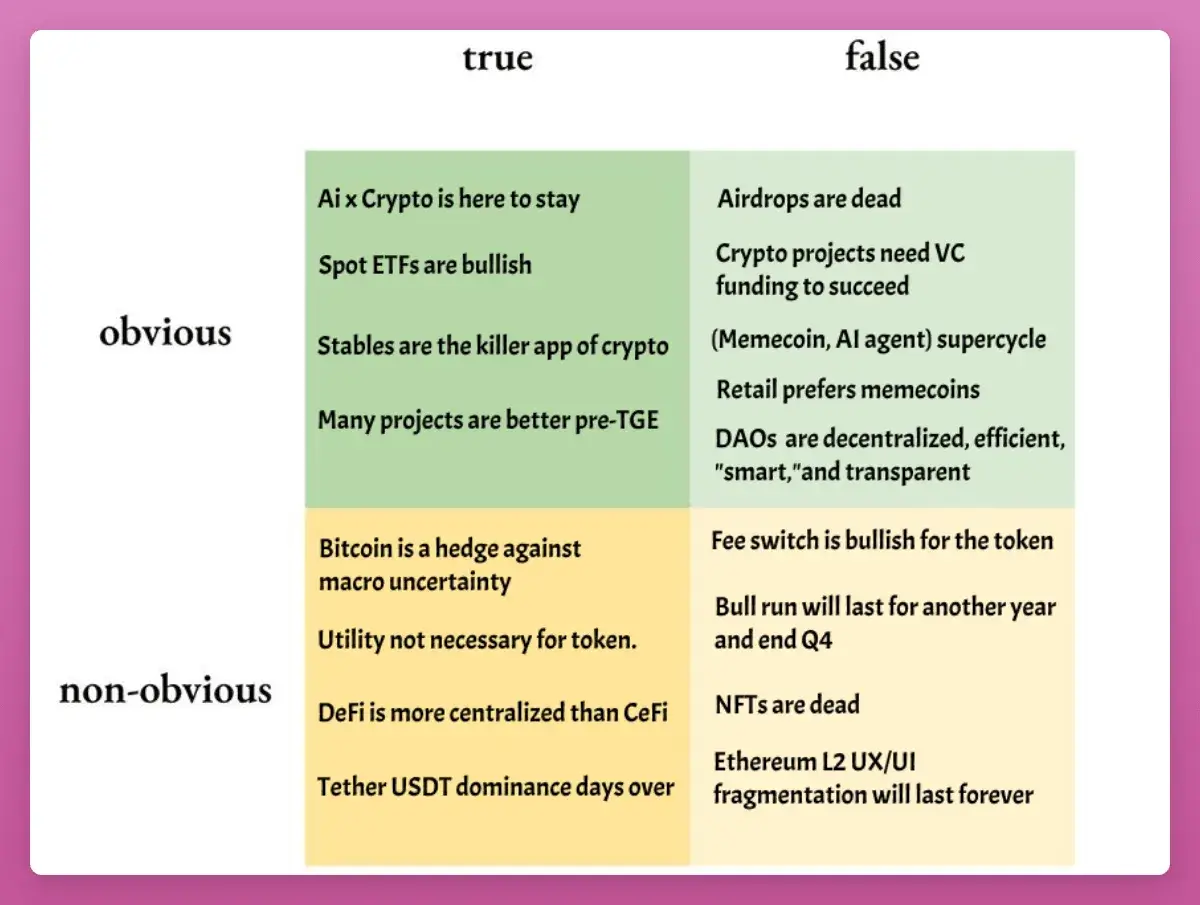
Before sharing the 2026 edition, here is a clear review of what truly mattered in 2025. What we got right, what we got wrong, and what we should learn from it. If you don't examine your own thinking, you're not investing, you're guessing.

Quick Summary

  • "BTC Peaked in Q4": Most people expected this, but it seemed too good to be true. Turns out they were right, and I was wrong (and paid the price). Unless BTC skyrockets from here and breaks the 4-year cycle pattern, I'll concede this one.

  • "Retail Prefers Memecoins": The truth is, retail doesn't prefer crypto at all. They bought gold, silver, AI stocks, and anything that wasn't cryptocurrency. The supercycle for memecoins or AI Agents also did not materialize.

  • "AI x Crypto Remains Strong": Mixed results. Projects continued to deliver, the x402 standard evolved, and funding continued. But tokens failed to sustain any rallies.

  • "NFTs Are Dead": Yes.

These are easy to review in hindsight. The real insights lie in the following five larger themes.

1. Spot ETFs Are the Floor, Not the Ceiling

Since March 2024, long-term Bitcoin holders (OGs) have sold approximately 1.4 million BTC, worth about $121.17 billion.

Imagine the bloodbath in the crypto market without ETFs: Despite the decline in price, BTC ETF inflows remained positive ($26.9 billion).

The gap of about $95 billion is precisely why BTC underperformed almost all macro assets. There's nothing wrong with BTC itself; you don't even need to dig deep into unemployment or manufacturing data to explain it—it's just the "great rotation" by whales and "4-year cycle believers".
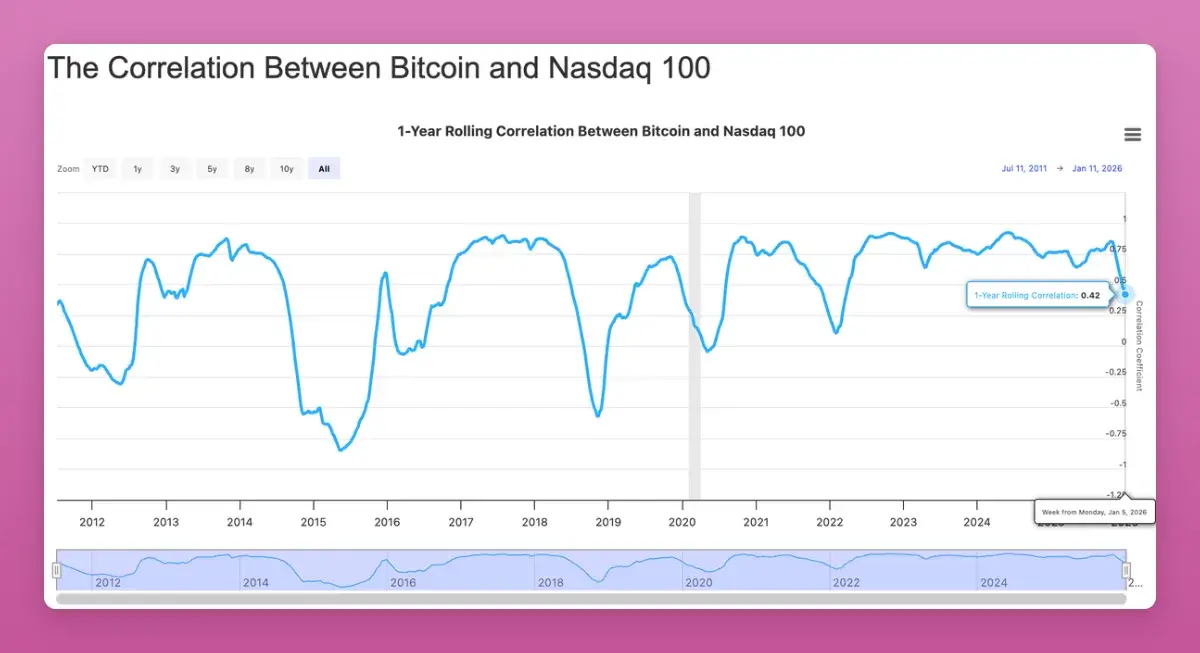
More importantly, Bitcoin's correlation with traditional risk assets like the Nasdaq fell to its lowest since 2022 (-0.42). While everyone hoped for an upward breakout in correlation, in the long run, this is bullish as an uncorrelated portfolio asset sought by institutions.
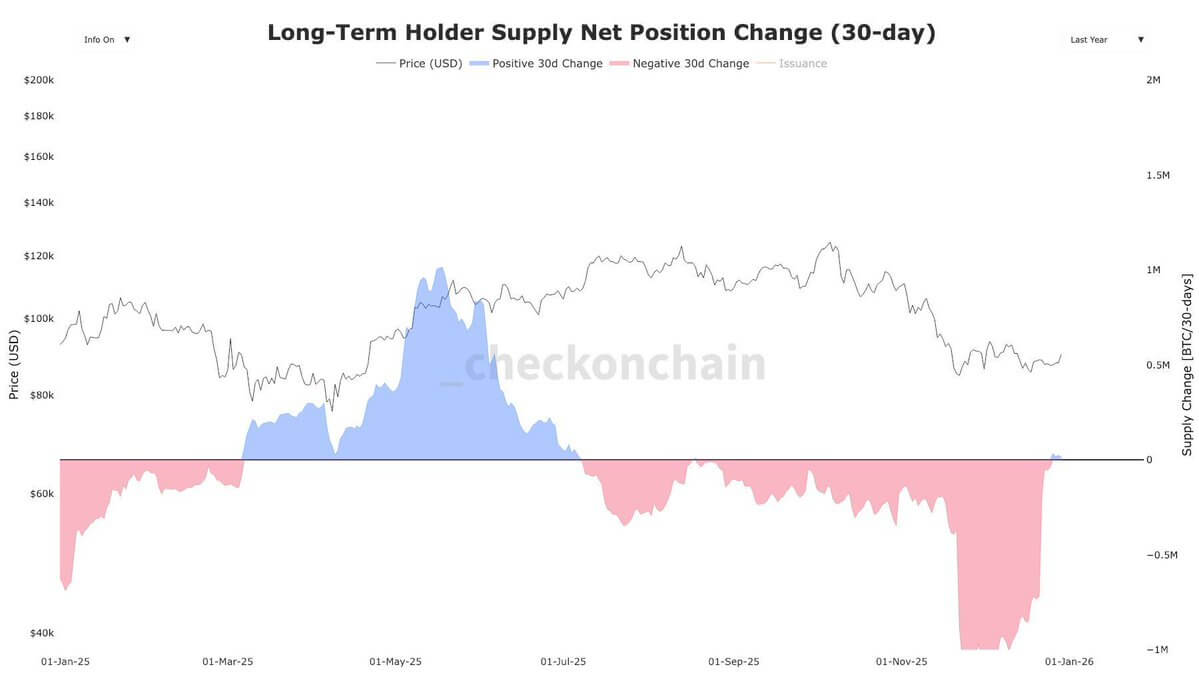
There are signs the supply shock is over. Therefore, I dare to predict a BTC price of $174,000 for 2026 (equivalent to 10% of gold's market cap).

2. Airdrops Clearly "Did Not" Disappear

The crypto community (CT) once again claimed airdrops were dead. But in 2025, we saw nearly $4.5 billion in large airdrop distributions:

  • Story Protocol (IP): ~$1.4B

  • Berachain (BERA): ~$1.17B

  • Jupiter (JUP): ~$7.91M

  • Animecoin (ANIME): ~$7.11M

The changes are: points fatigue, stronger Sybil detection, and lower valuations. You also need to "claim and sell" to maximize returns.

2026 will be a big year for airdrops, with heavyweights like Polymarket, Metamask, Base(?) preparing to launch tokens. This is not the year to stop clicking buttons, but to stop betting blindly. Airdrop "farming" requires concentrated effort on high-conviction bets.

3. Fee Switches Are Not Price Appreciation Engines, They Are the Floor

My prediction was: Fee switches won't automatically drive token prices up. Most protocols don't generate enough revenue to support their massive market caps.

"The fee switch doesn't affect how high the token can go; it sets a 'floor price'."

Look at the projects ranked by "Holder Revenue" on DeFillama: Except for $HYPE, all high revenue-share tokens outperformed ETH (though ETH is now the benchmark everyone challenges).
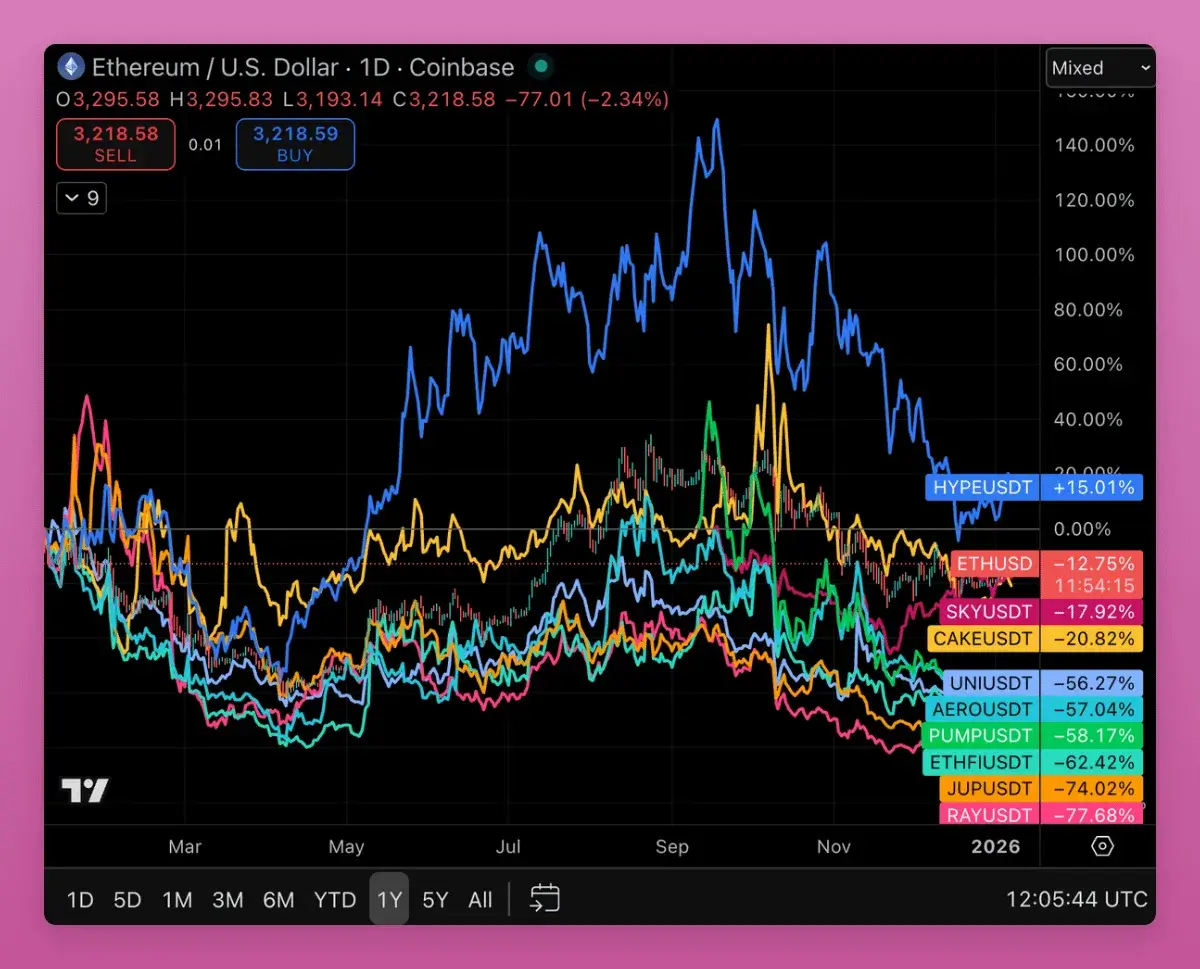
The surprise was $UNI. Uniswap finally flipped the switch and even burned $100 million worth of tokens. UNI initially surged 75% but then gave back all its gains.
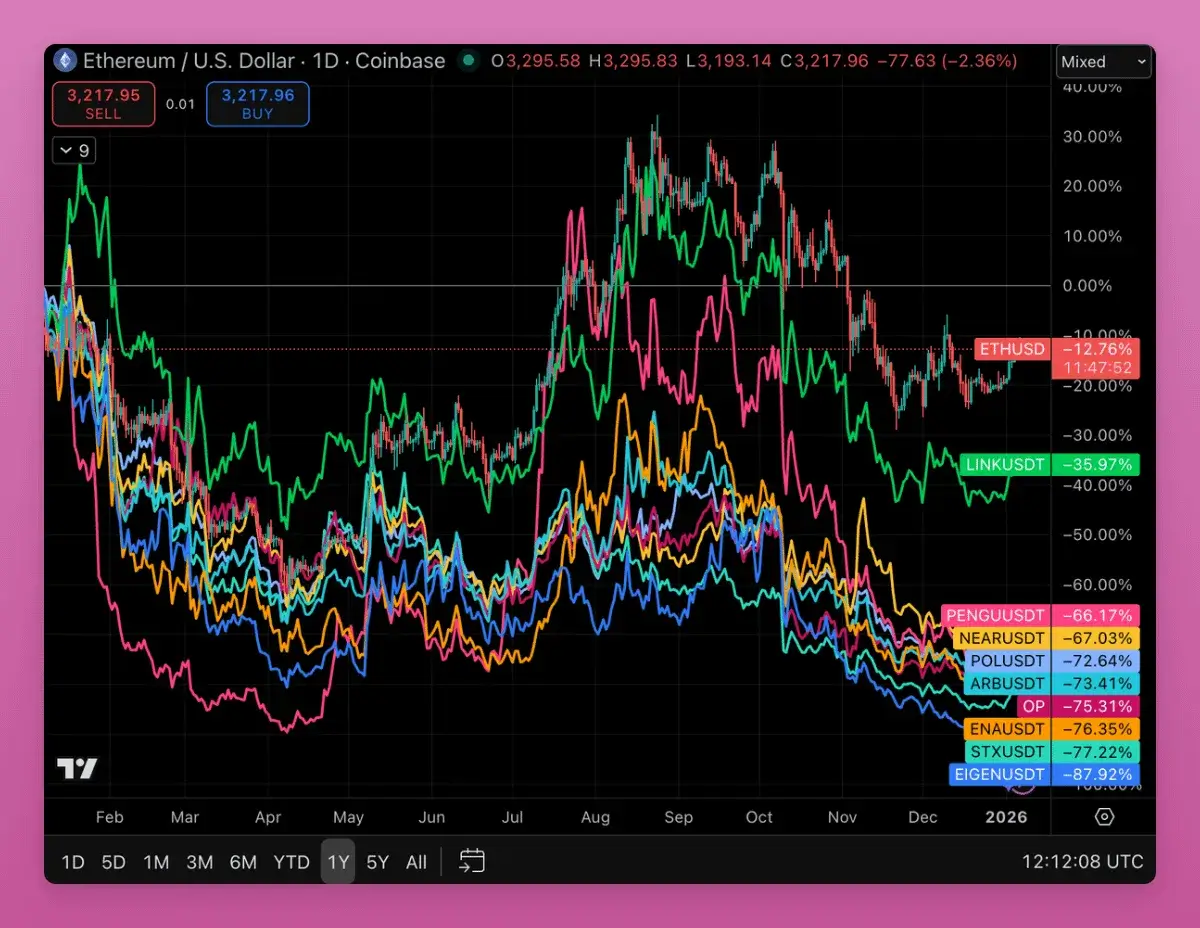
Three revelations:

Token buybacks set a price floor, not a ceiling.

Everything this cycle is a trade (refer to UNI's pump and dump).

Buybacks are only one side of the story; sell pressure (unlocks) must be considered, as most tokens are still low float.

4. Stablecoins Capture Mindshare, But "Proxy Trading" Is Hard to Monetize

Stablecoins are going mainstream. When I rented a motorbike in Bali, the owner even asked for payment in USDT on TRON.

Although USDT's dominance fell from 67% to 60%, its market cap is still growing. Citibank predicts the stablecoin market cap could reach $1.9 to $4 trillion by 2030.

In 2025, the narrative shifted from "trading" to "payment infrastructure". However, trading the stablecoin narrative wasn't easy: Circle's IPO gave back all its gains after an initial surge, and other proxy assets also underperformed.
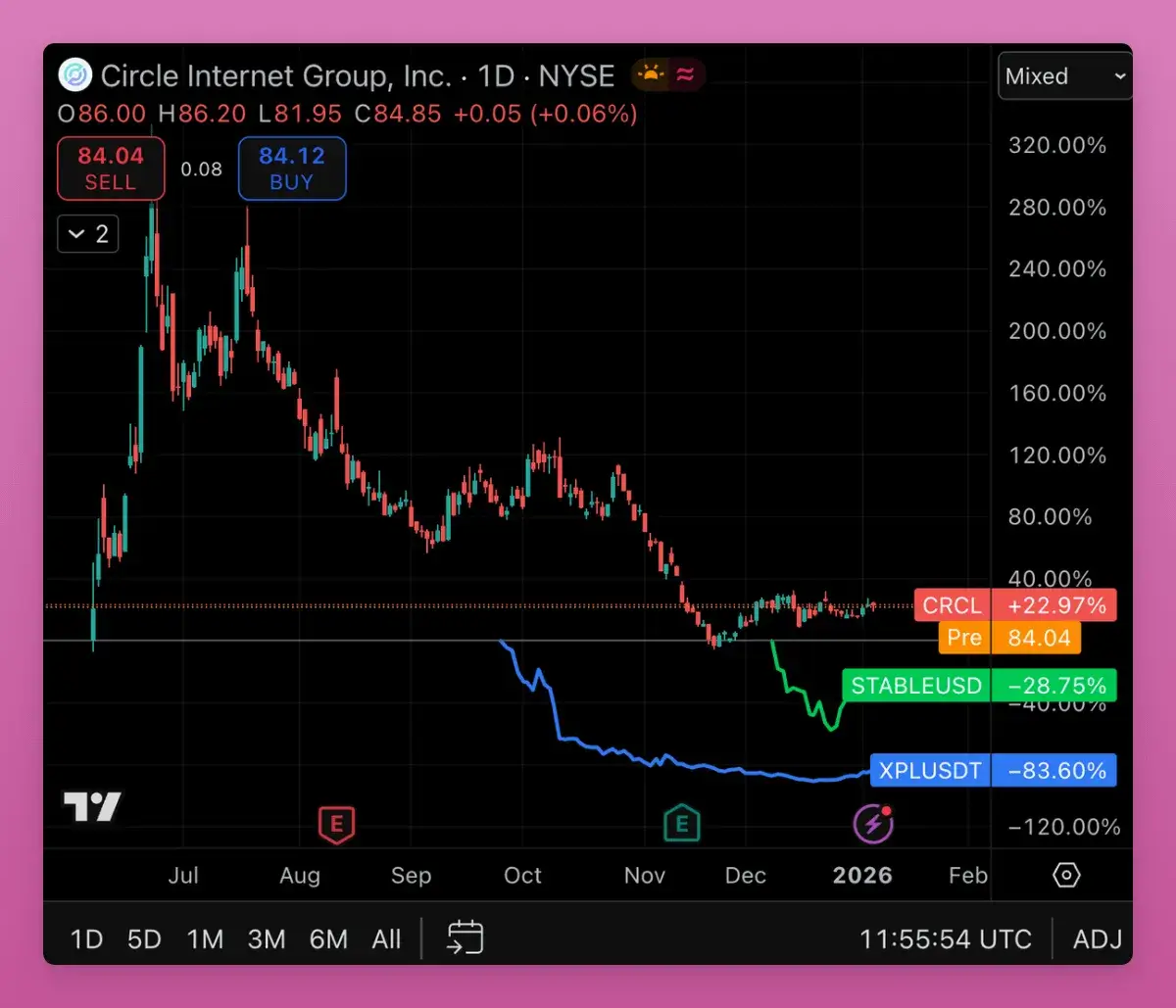
One truth of 2025: Everything is just a trade.
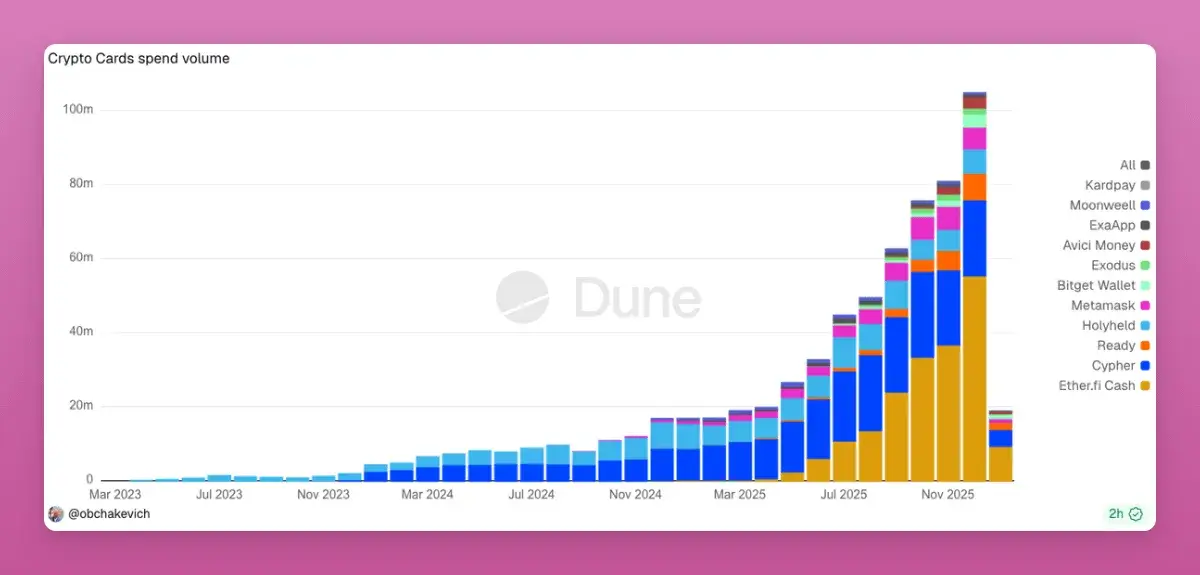
Currently, crypto payment cards are exploding due to their convenience in bypassing strict bank AML requirements. Every card swipe is a transaction on-chain. If direct peer-to-peer payments bypassing Visa/Mastercard emerge in 2026, that would be a 1000x opportunity.

5. DeFi Is More Centralized Than CeFi

This is a bold claim: DeFi's business and TVL concentration is higher than that of traditional finance (CeFi).

Aave commands over 60% of the lending market share (compared to JPMorgan's 12% in the US).

L2 protocols are mostly multi-billion dollar unregulated Multisigs.

Chainlink controls almost all value oracles in DeFi.

In 2025, the conflict between "centralized equity holders" and "token holders/DAO" became apparent. Who truly owns the protocol, IP rights, and revenue streams? The internal dispute at Aave showed that token holders have fewer rights than we thought.

If the "Labs" ultimately win, many DAO tokens will become uninvestable. 2026 will be a crucial year for aligning the interests of equity and token holders.

Summary

2025 proved one thing: Everything is a trade. Exit windows are extremely short. No token has long-term conviction.

As a result, 2025 marked the death of HODL culture, DeFi turned into Onchain Finance, and with improving regulation, DAOs are shedding their "pseudo-decentralized" disguise.


Twitter:https://twitter.com/BitpushNewsCN

Bitpush TG Group:https://t.me/BitPushCommunity

Bitpush TG Subscription: https://t.me/bitpush

Original link:https://www.bitpush.news/articles/7601755

Perguntas relacionadas

QWhat was the author's main prediction about Bitcoin's price cycle in 2025, and were they correct?

AThe author predicted that Bitcoin would peak in Q4 of 2025, but they were wrong. The market followed the expected four-year cycle, and the author admitted to paying the price for this incorrect prediction.

QAccording to the article, what was the state of the NFT market in 2025?

AThe article states that NFTs were dead in 2025, confirming the author's previous prediction.

QHow did the performance of tokens with fee switches (like UNI) compare to the author's expectations?

AThe author predicted that fee switches would not automatically drive token prices up but would instead set a price floor. This was confirmed when UNI initially surged 75% after its fee switch was activated but then gave back all its gains, showing that buybacks set a price bottom, not a ceiling.

QWhat significant shift occurred in the stablecoin narrative in 2025?

AThe narrative for stablecoins shifted from 'trading' to 'payment infrastructure' in 2025, as their use for real-world payments grew, exemplified by instances like a Balinese motorbike rental requesting payment in USDT on the TRON network.

QWhy does the author argue that DeFi is more centralized than CeFi?

AThe author argues that DeFi is more centralized due to extreme market concentration: Aave holds over 60% of the lending market share (compared to JPMorgan's 12% in the U.S.), L2 protocols are run by multi-sigs, and Chainlink dominates the oracle market for DeFi.

Leituras Relacionadas

Gensyn AI: Don't Let AI Repeat the Mistakes of the Internet

In recent months, the rapid growth of the AI industry has attracted significant talent from the crypto sector. A persistent question among researchers intersecting both fields is whether blockchain can become a foundational part of AI infrastructure. While many previous AI and Crypto projects focused on application layers (like AI Agents, on-chain reasoning, data markets, and compute rentals), few achieved viable commercial models. Gensyn differentiates itself by targeting the most critical and expensive layer of AI: model training. Gensyn aims to organize globally distributed GPU resources into an open AI training network. Developers can submit training tasks, nodes provide computational power, and the network verifies results while distributing incentives. The core issue addressed is not decentralization for its own sake, but the increasing centralization of compute power among tech giants. In the era of large models, access to GPUs (like the H100) has become a decisive bottleneck, dictating the pace of AI development. Major AI companies are heavily dependent on large cloud providers for compute resources. Gensyn's approach is significant for several reasons: 1) It operates at the core infrastructure layer (model training), the most resource-intensive and technically demanding part of the AI value chain. 2) It proposes a more open, collaborative model for compute, potentially increasing resource utilization by dynamically pooling idle GPUs, similar to early cloud computing logic. 3) Its technical moat lies in solving complex challenges like verifying training results, ensuring node honesty, and maintaining reliability in a distributed environment—making it more of a deep-tech infrastructure company. 4) It targets a validated, high-growth market with genuine demand, rather than pursuing blockchain integration without purpose. Ultimately, the boundaries between Crypto and AI are blurring. AI requires global resource coordination, incentive mechanisms, and collaborative systems—areas where crypto-native solutions excel. Gensyn represents a step toward making advanced training capabilities more accessible and collaborative, moving beyond a niche controlled by a few giants. If successful, it could evolve into a fundamental piece of AI infrastructure, where the most enduring value in the AI era is often created.

marsbitHá 10h

Gensyn AI: Don't Let AI Repeat the Mistakes of the Internet

marsbitHá 10h

Why is China's AI Developing So Fast? The Answer Lies Inside the Labs

A US researcher's visit to China's top AI labs reveals distinct cultural and organizational factors driving China's rapid AI development. While talent, data, and compute are similar to the West, Chinese labs excel through a pragmatic, execution-focused culture: less emphasis on individual stardom and conceptual debate, and more on teamwork, engineering optimization, and mastering the full tech stack. A key advantage is the integration of young students and researchers who approach model-building with fresh perspectives and low ego, prioritizing collective progress over personal credit. This contrasts with the US culture of self-promotion and "star scientist" narratives. Chinese labs also exhibit a strong "build, don't buy" mentality, preferring to develop core capabilities—like data pipelines and environments—in-house rather than relying on external services. The ecosystem feels more collaborative than tribal, with mutual respect among labs. While government support exists, its scale is unclear, and technical decisions appear driven by labs, not state mandates. Chinese companies across sectors, from platforms to consumer tech, are building their own foundational models to control their tech destiny, reflecting a broader cultural drive for technological sovereignty. Demand for AI is emerging, with spending patterns potentially mirroring cloud infrastructure more than traditional SaaS. Despite challenges like a less mature data industry and GPU shortages, Chinese labs are propelled by vast talent, rapid iteration, and deep integration with the open-source community. The competition is evolving beyond a pure model race into a contest of organizational execution, developer ecosystems, and industrial pragmatism.

marsbitHá 11h

Why is China's AI Developing So Fast? The Answer Lies Inside the Labs

marsbitHá 11h

3 Years, 5 Times: The Rebirth of a Century-Old Glass Factory

Corning, a 175-year-old glass company, is experiencing a dramatic revival as a key player in AI infrastructure, driven by surging demand for high-performance optical fiber in data centers. AI data centers require vastly more fiber than traditional ones—5 to 10 times as much per rack—to handle high-speed data transmission between GPUs. This structural demand shift, coupled with supply constraints from the lengthy expansion cycle for fiber preforms, has created a significant supply-demand gap. Nvidia has invested in Corning, along with Lumentum and Coherent, in a $4.5 billion total commitment to secure the optical supply chain for AI. Corning's competitive edge lies in its expertise in producing ultra-low-loss, high-density, and bend-resistant specialty fiber, which is critical for 800G+ and future 1.6T data rates. Its deep involvement in co-packaged optics (CPO) with partners like Nvidia further solidifies its position. While not the largest fiber manufacturer globally, Corning's revenue from enterprise/data center clients now exceeds 40% of its optical communications sales, and it has secured multi-year supply agreements with major hyperscalers including Meta and Nvidia. Financially, Corning's optical communications revenue has surged, doubling from $1.3 billion in 2023 to over $3 billion in 2025. Its stock price has risen nearly 6-fold since late 2023. Key future catalysts include the rollout of Nvidia's CPO products and the scale of undisclosed customer agreements. However, risks include high current valuations and potential disruption from next-generation technologies like hollow-core fiber. The company's long-term bet on light over electricity, maintained even through the telecom bubble crash, is now being validated by the AI boom.

marsbitHá 12h

3 Years, 5 Times: The Rebirth of a Century-Old Glass Factory

marsbitHá 12h

Trading

Spot
Futuros
活动图片

