Trump's Post Leaked in Advance? Polymarket Abnormal Betting Points to US-Iran Ceasefire Before Next Week

marsbitPublicado em 2026-03-24Última atualização em 2026-03-24

Resumo

Former US President Donald Trump announced on Truth Social that "very good and productive discussions" were taking place to resolve the Middle East conflict. Prior to this public statement, several accounts on the prediction market platform Polymarket placed large bets, totaling approximately $160,000, that a ceasefire between the US would occur by March 31 or April 15. These bets, which would yield over $1 million if successful, were made by 10 newly created accounts and had already generated over $300,000 in floating profits after Trump's post. The timing and success of these wagers, particularly from an account with a history of profitable bets on geopolitical events, have raised suspicions of insider trading. In response, Polymarket announced new rules explicitly prohibiting trading on stolen confidential information, illegal insider knowledge, or by users who can influence event outcomes. Concurrently, unusual trading activity was detected in S&P 500 e-mini futures and WTI crude oil futures just minutes before Trump's post. A significant, isolated spike in volume occurred in these typically illiquid pre-market sessions. Shortly after the post, S&P futures surged over 2.5% while oil prices fell nearly 6%, suggesting that some entities may have traded on advance knowledge of the announcement. The SEC and CME Group declined to comment.

Author: Jinshi Data

On Monday morning local time, US President Trump posted on Truth Social, stating that the US and Iran had "very good and productive discussions" regarding resolving the Middle East war.

However, before Trump publicly disclosed this news, several accounts on the prediction market platform Polymarket had already placed large bets that the war would end within this week.

Ten recently opened accounts invested thousands of dollars in Polymarket's "US-Iran Ceasefire" market, betting on a ceasefire being reached by March 31 or April 15; these accounts collectively wagered approximately $160,000, and if a ceasefire is achieved before the end of the month, they stand to profit over $1 million.

These accounts were identified by X platform user Lirrato on Sunday and were subsequently shared and spread by the PolymarketHistory account. After Trump's post on Monday, the unrealized gains of these 10 accounts have already exceeded $300,000.
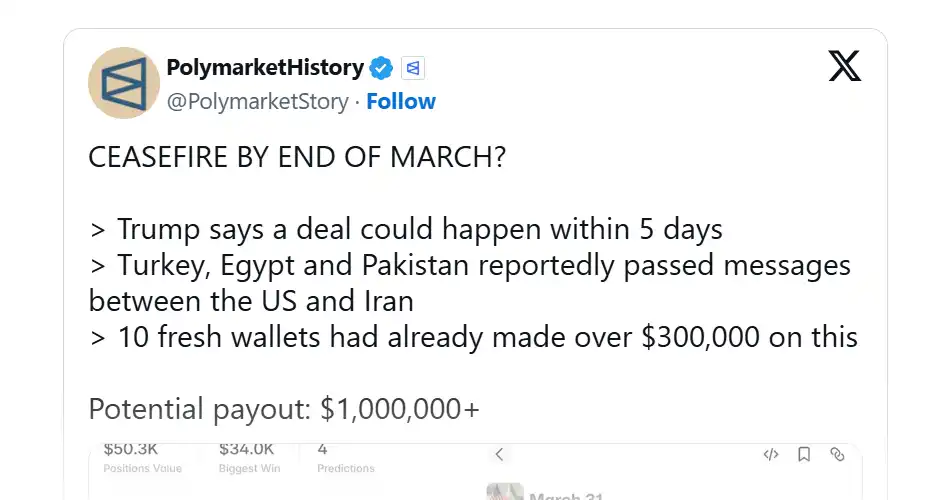
One account named "NOTHINGEVERFRICKINGHAPPENS" was particularly noteworthy. This account was registered in late February. Its first two trades were betting $7,600 on a US strike against Iran before February 28 and betting $11,283 on a strike before March 1; these two bets yielded profits totaling over $85,000. Now, the account has bet $8,005 on a US-Iran ceasefire before March 31 and another $15,614 on a ceasefire before April 15; these two bets have already generated unrealized gains of over $30,000.

The scale, timing, and past performance of these bets have led to external speculation about whether these Polymarket accounts belong to insiders—individuals connected to US or Iranian political circles who possess non-public information about diplomatic progress.

Prediction markets have previously been mired in insider trading scandals. A recent example involves a Polymarket trader who bet on the US taking military action against Venezuela, profiting over $400,000; a few days later, the US announced the capture of Venezuelan strongman Nicolás Maduro. Its competitor, Kalshi, recently also banned two users for insider trading, marking the platform's first public investigation into such activities.

On Monday, Polymarket announced an upgrade to its insider trading rules, explicitly prohibiting three types of behavior: trading using stolen confidential information, trading using illegal insider information, and trading when a user has the ability to influence the outcome of an event.

Polymarket's Chief Legal Officer, Neal Kumar, stated in a declaration: "Market prosperity relies on clear rules. The new regulations provide clarity for all participants and also demonstrate the compliance system we have built."

This rule adjustment may indicate that Polymarket will follow Kalshi's lead and initiate insider trading investigations. Although it is not yet certain whether the accounts betting on a US-Iran ceasefire are insiders, a platform investigation is expected to uncover the truth.

Abnormal Volume Spikes in S&P and Crude Futures Before Trump's Post

Furthermore, several minutes before Trump posted his market-moving social media update, abnormal trading volume spikes were also observed in S&P 500 futures and crude oil futures.

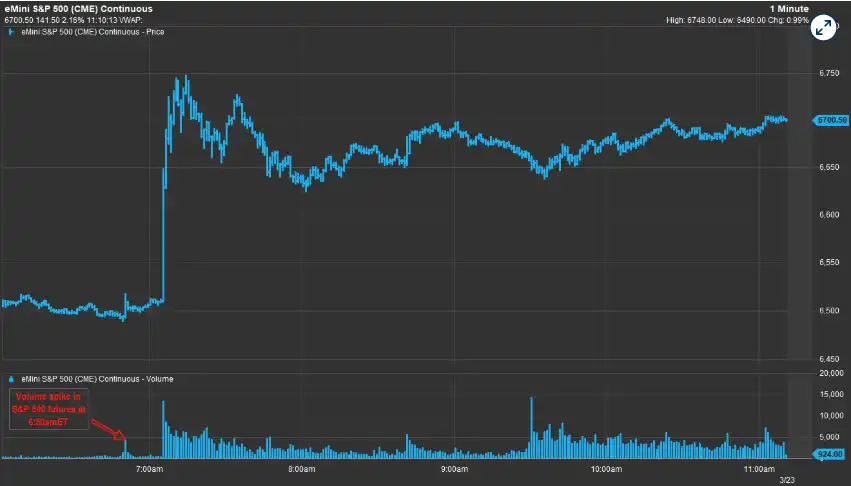
Around 6:50 AM New York time on Monday, the trading volume of S&P 500 e-mini futures traded on the Chicago Mercantile Exchange (CME) experienced a sharp and isolated surge, breaking the typically quiet pre-market backdrop. The early session is usually characterized by thin liquidity, making this sudden volume spike one of the largest moments of on-screen volume for that session up to that point.
A similar pattern emerged in the crude oil market. WTI crude oil futures also showed a noticeable uptick in trading activity around the same time, with a significant volume spike disrupting the previously calm market conditions.
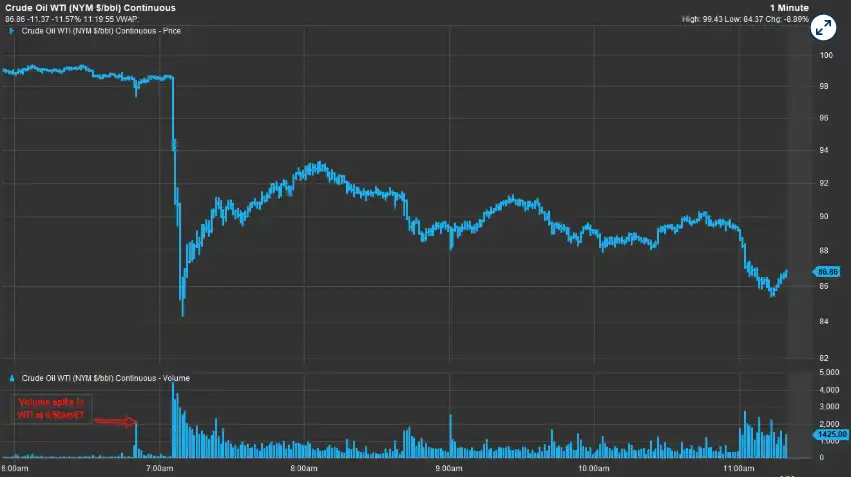
Approximately 15 minutes later, at 7:05 AM, Trump's statement about delaying strikes on Iranian power plants immediately triggered a rally in risk assets. S&P 500 futures surged over 2.5% before the open, while West Texas Intermediate (WTI) crude futures fell nearly 6% following the announcement.

The timing of the synchronized volume spikes in the stock and oil markets during the early session caught traders' attention—especially since there was no apparent catalyst driving the movement at the time of the spikes.

Pre-market futures trading typically has lower liquidity, making brief bursts of buying and selling more conspicuous than during regular trading hours. Nonetheless, these trades were still notable because anyone who bought stock futures in large quantities while simultaneously selling or shorting crude oil futures at that moment would have made huge profits just minutes later.

The US Securities and Exchange Commission (SEC) and the CME Group both declined to comment.

Algorithmic trading strategies and macro-driven strategies could also trigger rapid cross-asset capital flows during pre-market trading, even in the absence of a single identifiable catalyst.


Perguntas relacionadas

QWhat did President Trump post on Truth Social regarding US-Iran relations?

APresident Trump posted on Truth Social that there had been 'very good and productive conversations' regarding resolving the Middle East war.

QWhat suspicious activity was observed on the Polymarket prediction platform before Trump's announcement?

ATen recently created accounts placed large bets, totaling approximately $160,000, predicting a ceasefire between the US and Iran would be reached by March 31st or April 15th.

QWhat is the name of one notable account that made profitable bets on these events, and what were its wagers?

AOne notable account was named 'NOTHINGEVERFRICKINGHAPPENS'. It previously profited over $85,000 from bets on US strikes on Iran and had new bets on a ceasefire that were already up over $30,000 in profit.

QWhat other financial markets showed unusual activity just before Trump's post?

AS&P 500 e-mini futures and WTI crude oil futures showed isolated, sharp spikes in trading volume approximately 15 minutes before Trump's post, in an otherwise quiet pre-market session.

QHow did Polymarket respond to concerns about potential insider trading on its platform?

APolymarket announced upgraded insider trading rules, explicitly prohibiting trading on stolen confidential information, illegal insider information, and trading by users with the ability to influence event outcomes.

Leituras Relacionadas

Jensen Huang's CMU Speech: In the AI Era, Don't Just Watch, Build

Jensen Huang, CEO of NVIDIA and a first-generation immigrant, delivered the commencement address to Carnegie Mellon University's class of 2026. He shared his personal journey from a humble background to founding NVIDIA, emphasizing resilience, learning from failure, and the responsibility that comes with leadership. Huang framed the present moment as the dawn of the AI revolution, a shift he believes is more profound than previous computing waves. He described AI as fundamentally resetting computing—moving from human-written software to machines that understand, reason, and use tools. This will create a new industry for generating intelligence and transform every sector. While acknowledging AI's potential to automate tasks and displace some jobs, Huang distinguished between the *tasks* of a job and its core *purpose*. He argued AI will augment human capability, not replace humans. The real risk, he stated, is not AI itself, but people being left behind by those who effectively use AI. He presented AI as a generational opportunity for massive infrastructure investment—in chip factories, data centers, energy grids, and advanced manufacturing—that could re-industrialize nations like the U.S. and bridge the digital divide by making computing and intelligent tools accessible to all. Huang called for a balanced approach: advancing AI safely and responsibly, establishing prudent policies, ensuring broad access, and encouraging universal participation. He urged the graduates not to fear the future but to engage with optimism and ambition, reminding them of CMU's motto, "My heart is in the work." His core message was clear: this is their moment to actively build and shape the AI-powered future, not merely observe it.

marsbitHá 51m

Jensen Huang's CMU Speech: In the AI Era, Don't Just Watch, Build

marsbitHá 51m

The Era Has Arrived Where Human Writers Must Prove They Are Not Machines

The article describes an era where AI-generated content is flooding the market, forcing human authors to prove they are not machines. It begins with the example of dozens of AI-written, error-ridden biographies of Henry Kissinger appearing on Amazon within hours of his death, a pattern repeated for other deceased celebrities and even living experts who find fraudulent books under their names. This spam content has exploded, with monthly new book releases on platforms like Amazon reaching 300,000 by late 2025. The issue spans genres, from suspiciously high proportions of AI-written teen romance and self-help books to dangerous, AI-generated foraging guides containing lethal advice. The platforms' automated review systems, designed to catch plagiarism and banned words, are ill-equipped to detect AI-generated text that avoids these pitfalls while being nonsensical or fraudulent. The problem has infiltrated traditional publishing. A major publisher, Hachette, had to recall a bestselling horror novel after AI detection tools suggested 78% of its content was machine-generated. An acclaimed European philosophy book was later revealed to be entirely written by AI under a fake author persona. In response, authors are fighting back. At the 2026 London Book Fair, 10,000 writers published a blank book titled "Don't Steal This Book" containing only their signatures—using emptiness as a protest weapon in an age of AI overproduction. Initiatives like the "Human Author Certification" program have emerged, ironically placing the burden on humans to prove their work is not machine-made. The article warns of a vicious cycle: AI-generated low-quality books pollute the data used to train future AI models, leading to "model collapse" and an ever-worsening flood of digital waste, eroding trust in publishing and devaluing human creativity.

marsbitHá 1h

The Era Has Arrived Where Human Writers Must Prove They Are Not Machines

marsbitHá 1h

Trading

Spot
Futuros
活动图片




