Trump's Bank Arrives: 49% Goes to Middle East Royalty, 38% Belongs to President's Family

marsbitPublicado em 2026-08-28Última atualização em 2026-08-28

Resumo

The U.S. Office of the Comptroller of the Currency (OCC) has granted preliminary conditional approval to World Liberty Financial to establish a national trust bank for its USD1 stablecoin. Major ownership of the bank's holding company reveals Sheikh Tahnoon bin Zayed al Nahyan, a senior UAE official and national security advisor, holds 49% through an investment vehicle, while entities linked to the Trump family hold 38%. This mirrors a prior $500 million investment by the sheikh into World Liberty, which reportedly channeled $263 million to Trump-linked entities. The bank would allow World Liberty to directly custody USD1's dollar reserves (currently $4 billion) and keep all interest income, estimated at $150 million annually, rather than sharing it with a third-party custodian. This move was enabled by the 2025 "Genius Act," signed by the president, which permits approved stablecoin issuers to self-custody reserves. The approval process, overseen by a Trump-appointed OCC head, has drawn scrutiny due to the unprecedented foreign and presidential family stakes in a federally chartered bank poised to manage significant U.S. Treasury investments.

Earlier this month, the U.S. Office of the Comptroller of the Currency (OCC) granted World Liberty Financial preliminary conditional approval to establish a federally chartered national trust bank to issue, redeem, and custody USD1, the dollar-backed stablecoin it launched last year.

The Wall Street Journal disclosed the ownership structure behind this bank on Thursday.
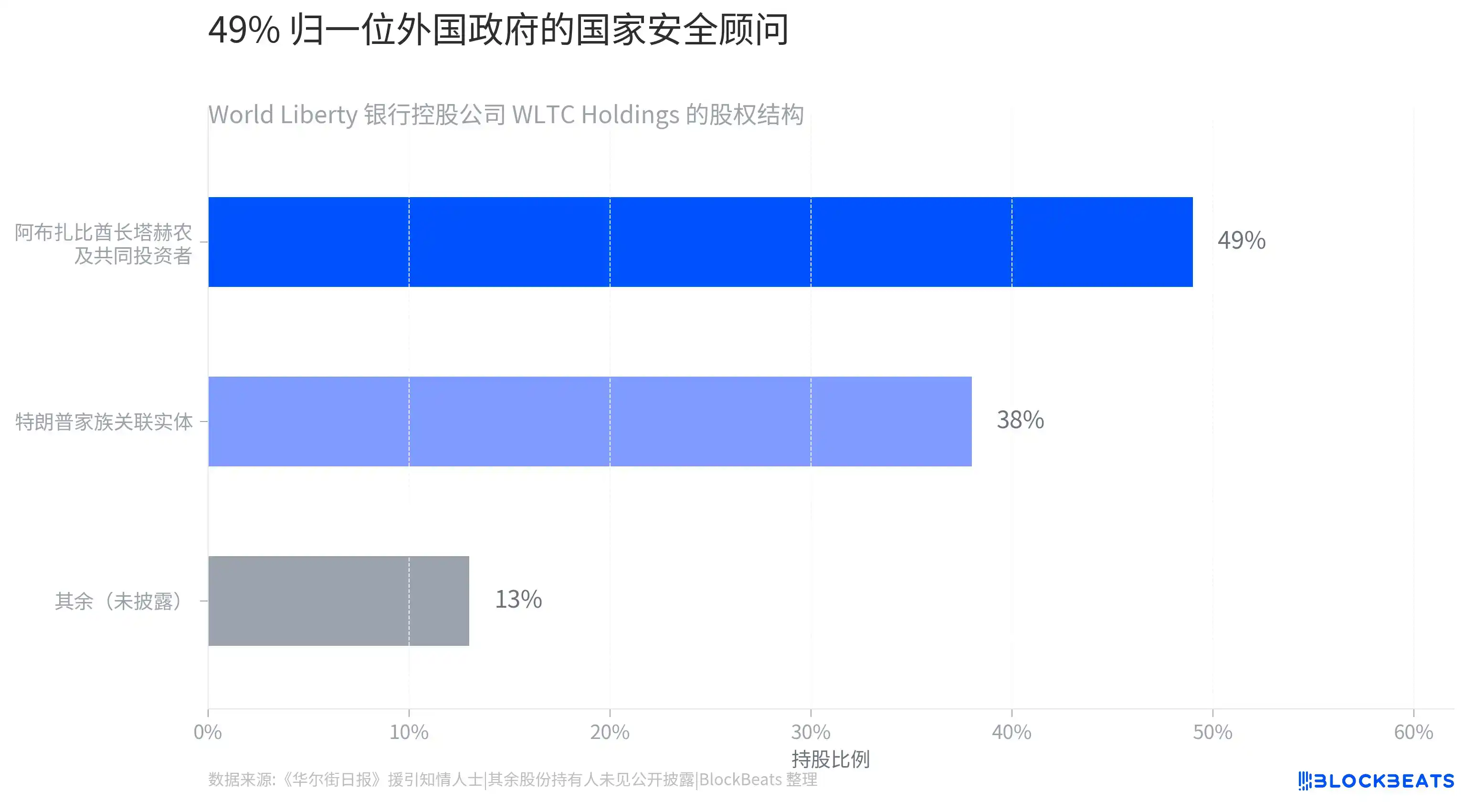
The largest shareholder is Sheikh Tahnoon bin Zayed al Nahyan, a member of the Abu Dhabi royal family, and his co-investors. Through an entity called StringZ Holding RSC, they hold 49% of the bank's holding company, WLTC Holdings.

Entities linked to the Trump family hold 38%.

Who is Tahnoon? He is the National Security Advisor of the United Arab Emirates and a brother of the country's President. He oversees a financial empire exceeding $1.3 trillion, with funds coming from both his personal wealth and state coffers. In Western media reports, he is sometimes referred to as the "Spy Sheikh."

This Isn't His First Appearance on This Chain

In January 2025, four days before Trump's inauguration, Tahnoon and co-investors invested $500 million into World Liberty Financial through an entity called Aryam Investment 1, acquiring a 49% stake in the company. That deal was not disclosed at the time and was only exposed by The Wall Street Journal this January.

According to the President's latest financial disclosure, $263 million of that money flowed to Trump family entities.

Democratic lawmakers and legal experts criticized it directly at the time: a senior foreign government official holding significant ownership in a company belonging to a U.S. President-elect was unprecedented.

Now, the same 49% appears in an institution about to receive a U.S. federal bank charter. The shareholder structure of the bank holding company is the same as that of World Liberty itself, except Tahnoon's side uses a different entity to hold the shares.

What Exactly Will This Bank Do?

It is not a traditional bank; a trust charter generally does not allow taking deposits or making loans. What it can do is: hold assets for clients nationwide and facilitate faster payment settlements.

Specifically for World Liberty, this charter allows it to issue USD1 directly and custody the dollar assets backing the stablecoin itself. These two tasks are currently handled by partner BitGo, an independent trust bank that holds USD1's reserves and keeps a portion of the interest.

This is the core of the business.

USD1 currently has a market capitalization of $4 billion. World Liberty states that the dollars backing it are invested in U.S. Treasury bonds and other cash equivalents, generating an estimated $150 million in interest annually.

Previously, this interest had to be shared with BitGo. With its own bank, it won't.

And the logic is self-reinforcing: the more USD1 in circulation, the larger the reserves, the greater the interest income. Therefore, World Liberty says the mission of this trust bank is to drive the "mainstream adoption" of USD1 while offering new services to customers, such as charging fees to custody their cryptocurrency.

After the OCC approval, World Liberty CEO Zach Witkoff said the company's ambition is "to build the most trusted and widely used digital dollar in the world." He is the son of Steve Witkoff, the U.S. Middle East envoy.

The Legal Gateway for This Charter Was Signed by the President Himself

World Liberty only began the process of setting up the bank after July 2025, the month the President signed the Genius Act.

This law did one key thing: it allowed approved stablecoin companies to directly hold the reserve assets backing their tokens.

Before this, World Liberty had to rely on a third party like BitGo. After this, it can do it itself, as long as it obtains a federal charter. It applied in January of this year and received preliminary conditional approval on August 14.

The Genius Act also stipulates that U.S.-issued dollar-pegged stablecoins must be backed by specific assets, including U.S. Treasury securities maturing in 93 days or less. Treasury Secretary Besant previously cited a prediction that stablecoins could grow into a market approaching $4 trillion and has written that "this could lower the government's borrowing costs."

In other words, the stablecoin track has clear fiscal significance for this administration; it creates new buyers for U.S. Treasury debt. And one of the companies running furthest ahead on this track belongs to the President's family.

The Same Regulator, Several Other Decisions This Summer

The OCC has approved a series of national bank charters for crypto companies in recent months, with Ripple and Circle both receiving preliminary approvals. The current Comptroller, Jonathan Gould, was appointed by Trump last year.

But there were also rejections.

In early August, the OCC rejected Dutch fintech company Bunq's application for a national bank charter, citing significant regulatory and compliance concerns. In mid-August, Zerohash, which provides crypto infrastructure for Morgan Stanley's E*Trade, had its trust bank application returned, citing material deficiencies; it subsequently resubmitted with a narrower business scope, with a public comment period ending September 17.

Regarding World Liberty's application, the OCC's letter stated: "This preliminary conditional approval is based on a comprehensive evaluation of all information available to the OCC, including statements and commitments made in the application and by representatives of the bank." Final approval is contingent on meeting a series of "pre-opening requirements" and passing a final examination.

A World Liberty spokesperson said OCC career staff reviewed the application "for compliance with statutory, regulatory, and policy requirements and factors governing bank approvals." The company did not comment on the shareholder structure behind its bank.

An OCC official said application reviews are handled by career staff and that the agency "consulted with multiple experienced career government ethics officials" to ensure the process "complies with all government ethics standards and policies."

There's Another Sum of Money

Tahnoon's $500 million is not the only controversial funding entering this company.

Earlier this month, The New York Times reported that a businessman named Guren "Bobby" Zhou invested a total of $100 million into World Liberty through a new company called Aqua 1, becoming one of the largest buyers of the company's tokens.

Two years ago, he was a failed hardwood flooring retailer in the UK, under investigation for money laundering there, and presided over the collapse of a small crypto startup.

Under World Liberty's policy, up to $75 million of that money was allocated to a company controlled by the President and his three sons, while also benefiting the Witkoff family.

On July 19, the day of the World Cup final, Zhou and Zach Witkoff sat together in a luxury box at the stadium in New Jersey.

What Remains to Be Seen

The bank has not yet opened. It must first meet the conditions set by the OCC and pass a final examination.

What is already certain is: if it opens, an institution 49% owned by a senior foreign government official and 38% owned by the President's family will hold the full reserves of a dollar stablecoin, invest them into U.S. Treasury bonds, and take all the interest.

Criptomoedas em alta

Perguntas relacionadas

QWhat is the primary function of the federal trust bank charter granted to World Liberty Financial, and what key business advantage does it provide?

AThe primary function is to allow World Liberty Financial to directly issue, redeem, and custody its USD1 stablecoin. The key business advantage is that it allows the company to hold the reserve assets backing the stablecoin itself, eliminating the need to share the interest income from those reserves with a third-party custodian like BitGo.

QWho are the major owners of the bank holding company (WLTC Holdings) behind World Liberty Financial, and what percentage does each control?

ASheikh Tahnoon bin Zayed al Nahyan of Abu Dhabi and his co-investors, through StringZ Holding RSC, own 49% of WLTC Holdings. Entities linked to the Trump family own 38%.

QHow did the 'Genius Act,' signed by President Trump, create a legal pathway for World Liberty Financial to establish its own trust bank?

AThe Genius Act, signed in July 2025, allowed approved stablecoin companies to directly hold the reserve assets backing their tokens. This removed the legal requirement for a third-party custodian, enabling World Liberty to seek its own federal trust bank charter to perform this function in-house.

QWhat controversy surrounded the initial $500 million investment in World Liberty Financial by Sheikh Tahnoon bin Zayed al Nahyan in January 2025?

AThe controversy centered on the unprecedented nature of a senior foreign government official holding significant ownership in a company controlled by an incoming U.S. President (then President-elect Trump). Critics argued it created a major conflict of interest, with $263 million of that investment flowing to Trump-family entities.

QWhat is one additional source of controversial funding mentioned in the article that flowed into World Liberty Financial, and who benefited from it?

ABusinessman Guren 'Bobby' Zhou invested $100 million through Aqua 1. Up to $75 million of that was allocated to a company controlled by the then President and his three sons, and also benefited the Witkoff family (the CEO's family).

Leituras Relacionadas

Podcast Notes | After Watching 141 YouTube Investment Guru Videos, I Found Everyone's Bullish on These 5 Stocks

Podcast Summary: After analyzing 141 YouTube investment videos from 21 creators, five stocks were consistently highlighted: Alphabet (Google), Nvidia, Micron, CoreWeave, and Uber. However, the analysis reveals a key concentration: four of these (Google, Nvidia, Micron, CoreWeave) represent essentially the same AI-focused bet, with only Uber standing as an independent pick. The podcaster, Brian, provides his specific views and entry strategies for each. **Key Stocks & Brian's Stance:** - **Alphabet (Google):** Viewed as cheap based on profits but expensive based on sales. Brian is only buying a half-position via monthly investments at ~$362. - **Nvidia:** Models suggest it is undervalued (~$221 vs. a ~$290-330 fair value range), but significant client debt ($500B) raises risk. Brian holds a 12% position (his cap) and would not buy below $148. - **Micron:** Brian's model fair value is ~$1450, but it's a cyclical stock. He is buying only on schedule after it broke below its 50-day moving average (~$961), with a "story broken" line at $434. - **CoreWeave:** Has large contracts but faces scrutiny over demand sustainability, with Nvidia backing unsold capacity. Brian holds zero position due to limited history and structural concerns. - **Uber:** The only non-AI pick, valued cheaply on strong cash flow (~$100B annually). Brian's fair value is ~$109 (current price ~$67), and he is buying a full position. **Core Insight:** Most discussed topics (76/141 videos) were chips, cloud, and AI models. A portfolio built from such consensus may appear diversified but often constitutes a single, concentrated bet on AI. Brian concludes with a disciplined framework for any investment: compare to its own history, understand what the current price assumes, separate a good company from a good price, and pre-define your exit conditions.

marsbitHá 6m

Podcast Notes | After Watching 141 YouTube Investment Guru Videos, I Found Everyone's Bullish on These 5 Stocks

marsbitHá 6m

From 'Interest Rate Trading' to 'Dollar Debasement Trade', the Logic Behind Gold's Rise Has Changed

From "Rate Trade" to "Debasement Trade": The Logic Behind Gold's Rally Has Shifted Gold surged by 17% in August. According to UBS, the key development was a fundamental shift in the driving narrative mid-rally—from the traditional "rate trade" to a "debasement trade" focused on fiscal and dollar concerns. The bank breaks the summer rebound into two acts. The first was a technically-driven bounce from a solid base, supported by light positioning, resilient physical demand (especially from central banks like China's), and softening US economic data. The second act, triggered by the US Treasury's announcement to double long-term bond buybacks, marked a shift in gold's pricing logic. The market began viewing higher long-term yields as a sign of fiscal sustainability risks rather than economic strength, weakening gold's traditional inverse correlation with real rates. Gold's role evolved from an "opportunity cost" asset to a hedge against "fiscal credibility" and currency debasement, further aided by a weakening US dollar. UBS maintains a bullish outlook, noting rising upside risks to its long-term forecasts. While it lowered its 2026 year-end target to $4,675/oz, its 2027+ forecasts are unchanged, with an upside scenario target as high as $6,500/oz. The primary near-term risk is a hawkish Fed pivot, which could trigger a correction. However, UBS views any such dip as a buying opportunity, not a trend reversal, unless AI-driven growth allows for significantly higher rates. The report concludes that as gold is increasingly seen as a hedge against fiscal and currency risks, its strategic role in portfolios is changing. With overall gold allocations still low, there is significant room for further price appreciation if debt sustainability concerns drive sustained strategic buying.

marsbitHá 6m

From 'Interest Rate Trading' to 'Dollar Debasement Trade', the Logic Behind Gold's Rise Has Changed

marsbitHá 6m

Not Just Trading and Meme: These 5 Projects on Base Are Exploring New On-Chain Use Cases

Beyond Trading and Memes: 5 Projects Exploring New On-Chain Use Cases on Base While much of the crypto space is dominated by speculation, Base—Coinbase's Ethereum Layer 2 with over $5B TVL—is fostering innovative projects beyond the usual categories. Here are five notable examples: 1. **Hydrex**: A MetaDEX/AMM aggregator that pools native and external liquidity (e.g., from Uniswap, Morpho) to offer optimal swap rates. It features a ve(3,3)-style incentive model and single-signature transactions. 2. **SwapRoyale**: A fantasy trading competition app where users pay a fixed entry fee to trade with a virtual $100k portfolio in real-time contests. It gamifies trading with various tournament formats and has already distributed over $100k in prizes. 3. **BlockRun**: A permissionless AI gateway and payment layer for the on-chain agent economy. It allows autonomous systems to discover, pay for, and execute services using USDC on Base via the x402 micropayment standard, enabling pay-per-use AI. 4. **PixieChess**: A play-to-earn digital chess game where each piece is a collectible NFT with unique abilities that alter classic rules. Value is kept within the ecosystem, with a treasury funding real ETH prizes for winners. 5. **Tokensto**: A platform that lets users sell their unused AI API credits (e.g., from OpenRouter) for cash. It automatically prices credits and facilitates direct payouts to crypto wallets. These projects demonstrate that builders on Base are actively experimenting with consumer experiences, the agent economy, and novel gaming mechanics, suggesting the surface area for meaningful on-chain activity is broader than current narratives imply.

marsbitHá 50m

Not Just Trading and Meme: These 5 Projects on Base Are Exploring New On-Chain Use Cases

marsbitHá 50m

Trading

Spot

Artigos em Destaque

O que é $BANK

Bank AI: Um Passo Revolucionário no Futuro da Banca Introdução Em uma era marcada por avanços rápidos na tecnologia, o Bank AI está na interseção da inteligência artificial (IA) e dos serviços bancários. Este projeto inovador visa redefinir o panorama financeiro, melhorando a eficiência operacional, as medidas de segurança e as experiências dos clientes através do poder da IA. Ao embarcarmos nesta exploração do Bank AI, iremos aprofundar no que o projeto implica, suas dinâmicas operacionais, seu contexto histórico e marcos significativos. O que é o Bank AI? No seu cerne, o Bank AI representa uma iniciativa transformadora com o objetivo de integrar a inteligência artificial em várias operações bancárias. Este projeto aproveita as capacidades da IA para automatizar processos, melhorar os protocolos de gestão de risco e melhorar a interação com os clientes através de serviços personalizados. Os principais objetivos do Bank AI incluem: Automatização das Funções Bancárias: Ao aproveitar as tecnologias de IA, o Bank AI visa automatizar tarefas rotineiras, reduzindo o peso sobre os recursos humanos e aumentando a eficiência. Gestão de Risco Melhorada: O projeto utiliza algoritmos de IA para prever e identificar riscos, fortalecendo assim as medidas de segurança contra fraudes e outras ameaças. Personalização dos Serviços Bancários: O Bank AI foca em oferecer produtos e serviços financeiros ajustados, analisando dados e comportamentos dos clientes. Melhoria da Experiência do Cliente: A implementação de soluções impulsionadas por IA, como chatbots e assistentes virtuais, visa proporcionar aos usuários interações mais humanizadas, revolucionando a forma como os clientes se envolvem com os bancos. Com esses objetivos, o Bank AI posiciona-se como um ator crucial para tornar a banca mais eficiente, segura e centrada no usuário. Quem é o Criador do Bank AI? Os detalhes sobre o criador do Bank AI permanecem desconhecidos. Assim, nenhuma pessoa ou organização específica foi identificada nas informações disponíveis. O anonimato que cerca a origem do projeto levanta questões, mas não diminui a sua ambiciosa visão e objetivos. Quem são os Investidores do Bank AI? Semelhante ao criador do projeto, informações específicas sobre os investidores ou organizações que apoiam o Bank AI não foram divulgadas. Sem essas informações, é difícil delinear o apoio financeiro e institucional que pode estar impulsionando o projeto para frente. No entanto, a importância de ter uma sólida base de investimento é fundamental para sustentar o desenvolvimento em um campo tão inovador. Como Funciona o Bank AI? O Bank AI opera em várias frentes inovadoras, focando em fatores únicos que o diferenciam das estruturas bancárias tradicionais. Abaixo estão as principais características operacionais: Automatização: Ao aplicar algoritmos de aprendizado de máquina, o Bank AI automatiza vários processos manuais dentro dos bancos. Isso resulta na redução dos custos operacionais e permite que os trabalhadores humanos redirecionem os seus esforços para atividades mais estratégicas. Gestão de Risco Avançada: A integração da IA nas práticas de gestão de risco equipa os bancos com ferramentas para prever com precisão potenciais ameaças, como fraudes, garantindo que as informações e ativos dos clientes permaneçam seguros. Recomendações Financeiras Personalizadas: Através do aprendizado contínuo a partir das interações com os clientes, os sistemas de IA desenvolvem uma compreensão sutil das necessidades dos usuários, permitindo oferecer conselhos adaptados sobre decisões financeiras. Interações Melhoradas com os Clientes: Utilizando chatbots e assistentes virtuais alimentados por IA, o Bank AI permite uma experiência de cliente mais envolvente, permitindo que os usuários tenham suas dúvidas resolvidas rapidamente, reduzindo assim os tempos de espera e melhorando os níveis de satisfação. Juntas, estas características operacionais posicionam o Bank AI como um pioneiro no setor bancário, estabelecendo novos padrões para a prestação de serviços e a excelência operacional. Cronologia do Bank AI Compreender a trajetória do Bank AI requer uma análise do seu contexto histórico. Abaixo está uma cronologia que destaca marcos e desenvolvimentos importantes: Início de 2010: A conceituação da integração da IA nos serviços bancários começou a ganhar atenção à medida que instituições bancárias reconheciam os potenciais benefícios. 2018: Ocorreu um aumento significativo na implementação de tecnologias de IA, quando os bancos começaram a usar ferramentas de IA como chatbots para atendimento ao cliente básico e sistemas de gestão de risco para melhorar o tratamento de segurança. 2023: A sofisticação da IA continuou a avançar, com a introdução de IA generativa para tarefas mais complexas, como processamento de documentos e análise de investimentos em tempo real. Este ano marcou um salto significativo nas capacidades proporcionadas aos bancos pela tecnologia de IA. 2024-Estado Atual: Neste ano, o Bank AI está em uma trajetória ascendente, com pesquisas e desenvolvimentos em andamento prontos para aprimorar ainda mais as capacidades nas operações bancárias. A exploração contínua das aplicações de IA sugere desenvolvimentos emocionantes por vir. Pontos Chave Sobre o Bank AI Integração da IA na Banca: O Bank AI foca na adoção da inteligência artificial para simplificar os processos bancários e melhorar as experiências dos usuários. Automatização e Foco em Gestão de Risco: O projeto enfatiza fortemente essas áreas, visando transferir o peso das tarefas rotineiras enquanto melhora as estruturas de segurança através de análises preditivas. Soluções Bancárias Personalizadas: Ao aproveitar os dados dos clientes, o Bank AI possibilita serviços bancários ajustados que atendem às necessidades individuais dos usuários. Compromisso com o Desenvolvimento: O Bank AI permanece comprometido com contínuas pesquisas e esforços de desenvolvimento, garantindo a sua adaptabilidade e relevância contínua à medida que a tecnologia continua a evoluir. Conclusão Em resumo, o Bank AI exemplifica um passo crucial em frente na indústria bancária, aproveitando a inteligência artificial para remodelar paradigmas operacionais, melhorar a segurança e promover a satisfação do cliente. Apesar das lacunas de informação em torno do criador e dos investidores, os objetivos claros e os mecanismos funcionais do Bank AI fornecem uma base sólida para sua evolução contínua. À medida que a tecnologia de IA continua a avançar e se fundir com o setor bancário, o Bank AI está bem posicionado para impactar significativamente o futuro dos serviços financeiros, aprimorando a maneira como entendemos e interagimos com a banca.

249 Visualizações TotaisPublicado em {updateTime}Atualizado em 2024.12.03

O que é $BANK

Como comprar BANK

Bem-vindo à HTX.com!Tornámos a compra de Lorenzo Protocol (BANK) simples e conveniente.Segue o nosso guia passo a passo para iniciar a tua jornada no mundo das criptos.Passo 1: cria a tua conta HTXUtiliza o teu e-mail ou número de telefone para te inscreveres numa conta gratuita na HTX.Desfruta de um processo de inscrição sem complicações e desbloqueia todas as funcionalidades.Obter a minha contaPasso 2: vai para Comprar Cripto e escolhe o teu método de pagamentoCartão de crédito/débito: usa o teu visa ou mastercard para comprar Lorenzo Protocol (BANK) instantaneamente.Saldo: usa os fundos da tua conta HTX para transacionar sem problemas.Terceiros: adicionamos métodos de pagamento populares, como Google Pay e Apple Pay, para aumentar a conveniência.P2P: transaciona diretamente com outros utilizadores na HTX.Mercado de balcão (OTC): oferecemos serviços personalizados e taxas de câmbio competitivas para os traders.Passo 3: armazena teu Lorenzo Protocol (BANK)Depois de comprar o teu Lorenzo Protocol (BANK), armazena-o na tua conta HTX.Alternativamente, podes enviá-lo para outro lugar através de transferência blockchain ou usá-lo para transacionar outras criptomoedas.Passo 4: transaciona Lorenzo Protocol (BANK)Transaciona facilmente Lorenzo Protocol (BANK) no mercado à vista da HTX.Acede simplesmente à tua conta, seleciona o teu par de trading, executa as tuas transações e monitoriza em tempo real.Oferecemos uma experiência de fácil utilização tanto para principiantes como para traders experientes.

706 Visualizações TotaisPublicado em {updateTime}Atualizado em 2026.06.02

Como comprar BANK

Discussões

Bem-vindo à Comunidade HTX. Aqui, pode manter-se informado sobre os mais recentes desenvolvimentos da plataforma e obter acesso a análises profissionais de mercado. As opiniões dos utilizadores sobre o preço de BANK (BANK) são apresentadas abaixo.

活动图片