Trump Tweets After Hours, Pushing On-Chain Perpetual Contracts into the Mainstream

marsbitPublicado em 2026-03-24Última atualização em 2026-03-24

Resumo

Trump, who calls himself the "Crypto President," is also driving the adoption of perpetual futures contracts. He frequently makes market-moving statements outside traditional trading hours, coinciding with the rise of 24/7 trading infrastructure. Over a single weekend, Hyperliquid’s S&P 500 proxy product experienced three major price swings triggered by Trump’s tweets—first rising on positive remarks, then falling after a threat against Iran, and surging again following claims of diplomatic progress (later denied by Iran). This highlights a structural shift toward perpetual contracts and round-the-clock markets. Perpetual DEX trading volume reached $739 billion in January 2026, accounting for 10.2% of all crypto perpetual trading—up from just 2.0% two years prior. While it remains uncertain whether perps will dominate traditional finance, growth is undeniable. Recent developments, like Katana’s acquisition of IDEX and the launch of Katana Perps, signal increasing momentum. Regulatory clarity and macro risks are accelerating the move toward 24/7 trading, where price discovery happens continuously.

Author: FintechFrank

Compiled by: Deep Tide TechFlow

Deep Tide Guide: This article captures an ongoing structural shift: Trump's habit of making market-moving statements after the market closes, which coincides with the rise of 24/7 trading infrastructure. The S&P 500 proxy product on Hyperliquid experienced three significant fluctuations triggered by Trump's tweets over the same weekend. This is not a coincidence but a preview of a new normal.

Full Text Below:

Trump calls himself the "Crypto President," but in many ways, he is also the "Perpetual Contracts President."

It is well-known that Trump doesn't sleep, and he doesn't hesitate to make statements that can shake the market outside of traditional trading hours. This is a peculiar yet fitting backdrop: the market is evolving toward 24/7 trading, and we happen to have a president who can best be described as "spontaneous and sometimes chaotic."

This dynamic was fully demonstrated over the weekend.

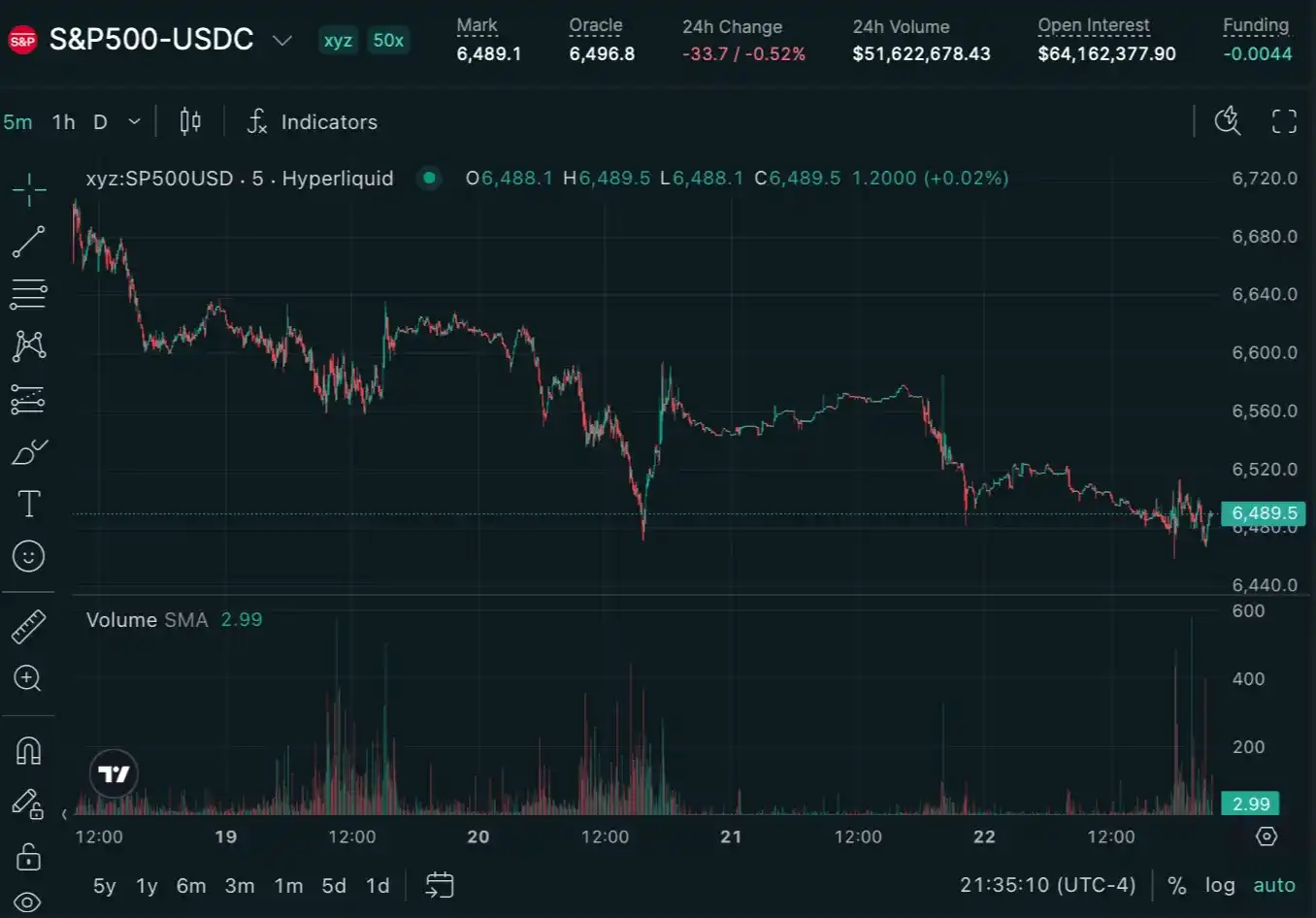
Just days after S&P Global announced it would authorize trading of the S&P 500 on Hyperliquid, Trump stated on Friday afternoon after the market closed that the U.S. is "very close to achieving our goals." The S&P 500 proxy product on Hyperliquid immediately rose.

Then, on Saturday at 7:44 PM Eastern Time, Trump escalated his threats, warning that he would strike Iran's power facilities if the Strait of Hormuz was not reopened. The reaction was instantaneous: the S&P 500 on Hyperliquid immediately fell.

But it didn't end there. On Monday morning, Trump claimed that the U.S. and Iran had held talks on a "comprehensive and thorough resolution of hostilities." S&P 500 futures surged by over 3.5%. Iran later denied Trump's statement.

Trump's presidency may not be driving the arrival of 24/7 markets, but it has made it impossible to ignore the issue.
It remains unclear which perpetual contract product will dominate or whether perpetual contracts will become the primary structure for 24/7 markets. Futures have historically been far less familiar to U.S. retail investors than options, and whether traditional brokerages can successfully promote these products to their customer base remains an open question. I am skeptical. What works in crypto markets may not seamlessly translate to traditional finance users.

Nevertheless, growth is undeniable.

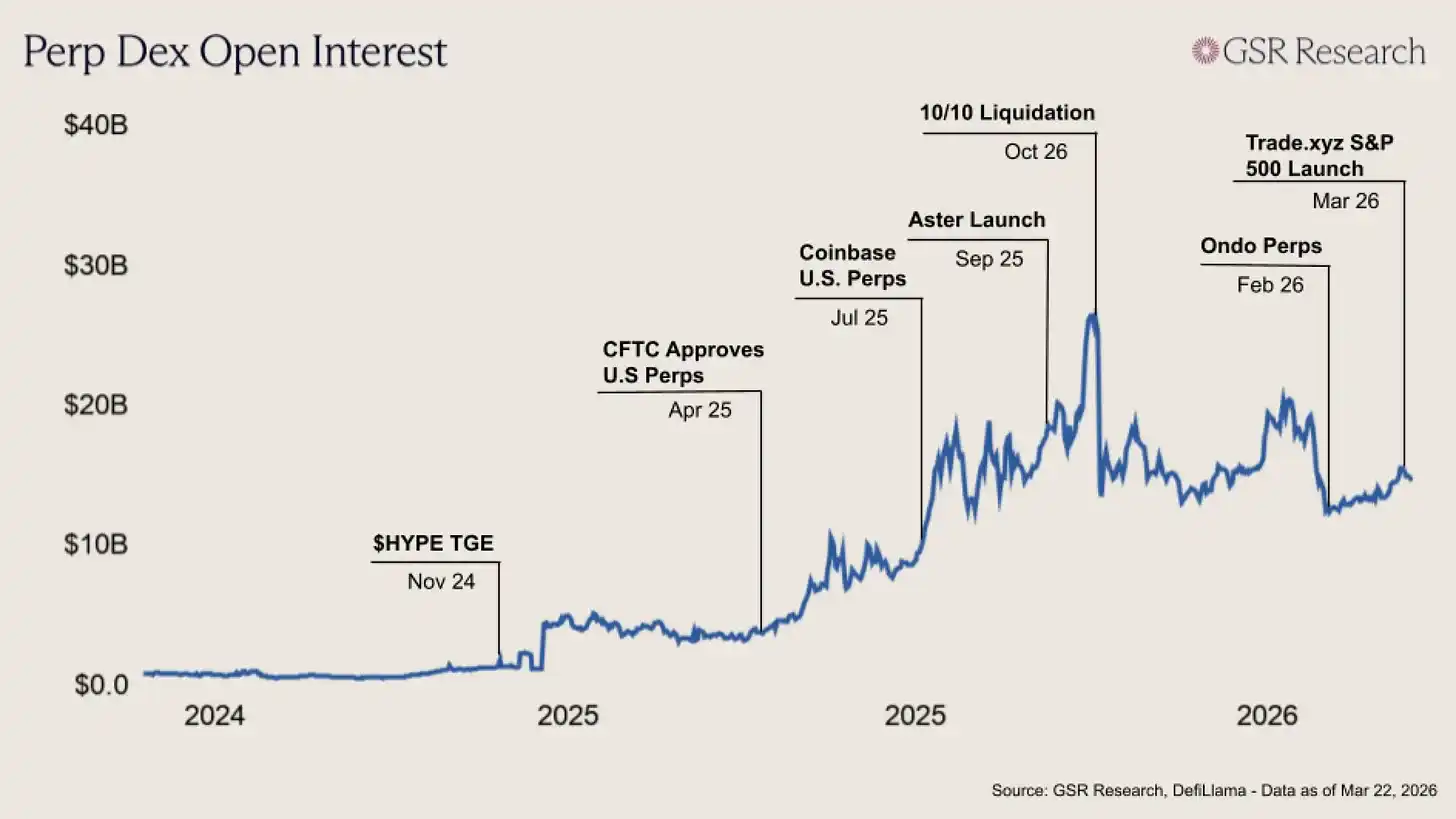
The open interest on perpetual contract DEX platforms has surged significantly. In January 2026, the trading volume of perpetual contract DEXs reached $739 billion, accounting for 10.2% of the total crypto perpetual contract trading volume on decentralized platforms—compared to just 2.0% two years ago.

As Carlos Guzman and Slater Santer of GSR Research show in the chart, news flow in both centralized and decentralized perpetual contract markets has accelerated since the HYPE TGE:
This morning, there was further momentum within the GSR ecosystem:

Katana acquired the early decentralized exchange IDEX and launched Katana Perps, a platform designed to unify spot and derivatives trading on-chain. This is the first major move by CEO Matthew Fisher since taking office, reflecting a pursuit of controlling more of the trading stack and capturing greater economic value.

This move also highlights a broader shift: the environment for perpetual contracts is becoming increasingly favorable. Here’s how Katana put it:

"This move coincides with U.S. regulators sending clear signals allowing crypto perpetual contracts, marking a potential inflection point for on-chain derivatives. At the same time, trading activity continues to migrate toward 24/7 markets, with price discovery increasingly happening in real-time rather than during fixed trading hours. As global markets adapt to new realities, macro risks no longer wait for trading hours, reinforcing the importance of a continuous 24/7 trading environment."


Perguntas relacionadas

QWhat is the main argument of the article regarding Trump and the financial markets?

AThe article argues that former President Trump, through his habit of making market-moving statements after traditional trading hours, is inadvertently accelerating the adoption and mainstream relevance of 24/7 on-chain perpetual contracts, making him a 'Perpetuals President'.

QWhich platform's S&P 500 proxy product is highlighted as reacting to Trump's tweets?

AThe S&P 500 proxy product on the Hyperliquid platform is highlighted, as it experienced significant price movements in response to a series of Trump's tweets over a single weekend.

QWhat significant change in market share for perpetual DEXs does the article mention?

AThe article states that perpetual DEX trading reached $739 billion in January 2026, accounting for 10.2% of all crypto perpetual trading volume, a significant increase from just 2.0% two years prior.

QWhat recent corporate acquisition and product launch is cited as evidence of growing momentum in the on-chain derivatives space?

AKatana acquired the early decentralized exchange IDEX and launched 'Katana Perps', a platform aiming to unify spot and derivatives trading on-chain.

QAccording to the article, what broader shift in trading is being reinforced by global macro events?

AThe article states that trading activity is shifting towards 24/7 markets, with price discovery happening increasingly in real-time, a trend reinforced by the fact that global macro risks no longer wait for traditional market hours.

Leituras Relacionadas

Jensen Huang's CMU Speech: In the AI Era, Don't Just Watch, Build

Jensen Huang, CEO of NVIDIA and a first-generation immigrant, delivered the commencement address to Carnegie Mellon University's class of 2026. He shared his personal journey from a humble background to founding NVIDIA, emphasizing resilience, learning from failure, and the responsibility that comes with leadership. Huang framed the present moment as the dawn of the AI revolution, a shift he believes is more profound than previous computing waves. He described AI as fundamentally resetting computing—moving from human-written software to machines that understand, reason, and use tools. This will create a new industry for generating intelligence and transform every sector. While acknowledging AI's potential to automate tasks and displace some jobs, Huang distinguished between the *tasks* of a job and its core *purpose*. He argued AI will augment human capability, not replace humans. The real risk, he stated, is not AI itself, but people being left behind by those who effectively use AI. He presented AI as a generational opportunity for massive infrastructure investment—in chip factories, data centers, energy grids, and advanced manufacturing—that could re-industrialize nations like the U.S. and bridge the digital divide by making computing and intelligent tools accessible to all. Huang called for a balanced approach: advancing AI safely and responsibly, establishing prudent policies, ensuring broad access, and encouraging universal participation. He urged the graduates not to fear the future but to engage with optimism and ambition, reminding them of CMU's motto, "My heart is in the work." His core message was clear: this is their moment to actively build and shape the AI-powered future, not merely observe it.

marsbitHá 28m

Jensen Huang's CMU Speech: In the AI Era, Don't Just Watch, Build

marsbitHá 28m

The Era Has Arrived Where Human Writers Must Prove They Are Not Machines

The article describes an era where AI-generated content is flooding the market, forcing human authors to prove they are not machines. It begins with the example of dozens of AI-written, error-ridden biographies of Henry Kissinger appearing on Amazon within hours of his death, a pattern repeated for other deceased celebrities and even living experts who find fraudulent books under their names. This spam content has exploded, with monthly new book releases on platforms like Amazon reaching 300,000 by late 2025. The issue spans genres, from suspiciously high proportions of AI-written teen romance and self-help books to dangerous, AI-generated foraging guides containing lethal advice. The platforms' automated review systems, designed to catch plagiarism and banned words, are ill-equipped to detect AI-generated text that avoids these pitfalls while being nonsensical or fraudulent. The problem has infiltrated traditional publishing. A major publisher, Hachette, had to recall a bestselling horror novel after AI detection tools suggested 78% of its content was machine-generated. An acclaimed European philosophy book was later revealed to be entirely written by AI under a fake author persona. In response, authors are fighting back. At the 2026 London Book Fair, 10,000 writers published a blank book titled "Don't Steal This Book" containing only their signatures—using emptiness as a protest weapon in an age of AI overproduction. Initiatives like the "Human Author Certification" program have emerged, ironically placing the burden on humans to prove their work is not machine-made. The article warns of a vicious cycle: AI-generated low-quality books pollute the data used to train future AI models, leading to "model collapse" and an ever-worsening flood of digital waste, eroding trust in publishing and devaluing human creativity.

marsbitHá 53m

The Era Has Arrived Where Human Writers Must Prove They Are Not Machines

marsbitHá 53m

Trading

Spot
Futuros
活动图片




