Trump Family-Linked Crypto Company Faces More Scrutiny Over Auditor Controversy

bitcoinistPublicado em 2025-12-30Última atualização em 2025-12-30

Resumo

Trump-linked crypto treasury company Alt5 Sigma faces intensified scrutiny and potential Nasdaq delisting after appointing an auditor with an expired license and regulatory violations. The firm, which rebranded to hold Donald Trump’s WLFI token, failed to file quarterly reports and has seen high-level departures, including Eric Trump. Its newly hired auditor, Victor Mokuolu CPA, had its license expired in Texas and previously failed a peer review. Alt5 Sigma has since replaced the auditor amid ongoing compliance issues and risks violating audit committee requirements.

Recent reports claim that the internal turmoil of a crypto treasury company backed by the Trump family has deepened as the firm risks being delisted from Nasdaq and has appointed an audit company facing regulatory scrutiny.

Crypto Treasury Company’s Turmoil Intensifies

On Monday, Nasdaq-listed crypto treasury company Alt5 Sigma is facing renewed scrutiny after appointing a new audit company with an expired and inactive license earlier this month, the Financial Times initially reported.

The Las Vegas-based company rebranded from a biotech company to a Digital Asset Treasury Company (DAT) earlier this year, seeking to become the first publicly traded firm to accumulate WLFI, the token of US President Donald Trump’s crypto ventures, World Liberty Financial.

As the report noted, the company’s financial position has turned murky over the past few months due to its failure to file quarterly results on schedule. Now, its recent switch of auditors has deepened its current position as the newly appointed firm, Victor Mokuolu CPA PLLC, was allegedly fined by accounting regulators and failed an inspection under the standard peer review process.

According to the Financial Times, filings in the state of Texas show that the company’s licence expired in August. Meanwhile, the board’s records show that its license has not been renewed by December 26. Therefore, state regulations prohibit the firm from doing any audit work until the licence is renewed.

The audit company has reportedly been working for over two years to address its deficiencies, which previously resulted in a failing grade under the accounting profession’s peer review process in 2023.

This year’s failure to renew its license follows the Texas State Board of Public Accountancy and another US regulator’s actions against the firm for “repeatedly failing to file regulatory paperwork on time.”

In a statement to the news media outlet, Alt5 Sigma affirmed that the auditor is “undergoing a peer review per Texas State Board of Accountancy regulations and will be completed by the end of January 2026, at which point the auditor expects the firm’s licence to be active.”

The Trump-backed crypto treasury firm emphasized that “No reviews or audits of Alt5’s financial statements will be issued by our auditor until the firm’s licence is active.”

In an update, the Financial Times added that Alt5 Sigma fired the audit firm on Christmas Day following its inquiries about the issue. A regulatory filing made on Monday reportedly shows that the company has hired LJ Soldinger Associates as its new accounting firm.

Alt5 Sigma Risks Nasdaq Delisting

The controversial December 8 appointment comes amid a period of turmoil for the company, the report noted, as it already risks being delisted from Nasdaq, where it trades under the ticker “ALTS.”

The company failed to submit its quarterly results for the period ending in late September, blaming the delay on the “timeliness and responsiveness” of its previous auditor, who seemingly quit last month. This has opened the door to a potential delisting from the stock exchange.

In August, World Liberty Financial unveiled its partnership with Alt5 Sigma and became an investor in the technology firm, which sought to raise $1.5 billion for its crypto treasury strategy based on WLFI.

As a result, multiple World Liberty Financial co-founders joined Alt5 Sigma’s board. Notably, Zach Witkoff, son of President Trump’s Special Envoy Steve Witkoff, was appointed as chairman of the crypto treasury firm.

Similarly, Eric Trump joined the company’s board as a director, while Zak Folkman became a board observer. Nonetheless, Trump stepped down from his position in September, just weeks after being appointed, as revealed in a Securities and Exchange Commission (SEC) filing

Jonathan Hugh, Alt5’s Chief Financial Officer (CFO), left the company after just three months, while chief executive Peter Tassiopoulos resigned in October. Meanwhile, board member David Danziger parted ways with the firm in November.

This also puts the company “in violation of a requirement to have an audit committee of a certain size and with accounting experience,” the report concluded.
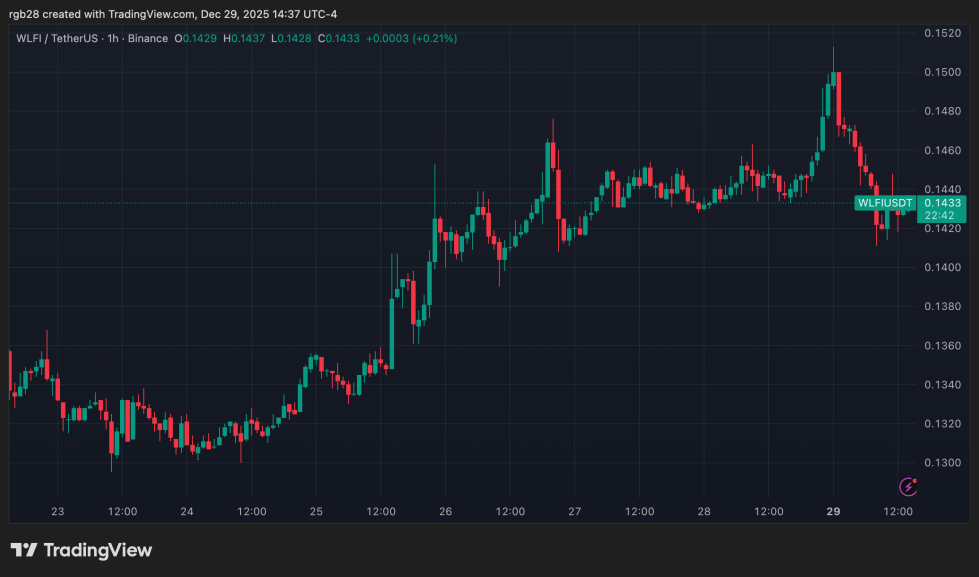
WLFI trades at $0.14 in the one-week chart. Source: WLFIUSDT on TradingView


Perguntas relacionadas

QWhat is the name of the crypto treasury company backed by the Trump family that is facing scrutiny?

AThe company is called Alt5 Sigma.

QWhy is Alt5 Sigma at risk of being delisted from Nasdaq?

AThe company failed to submit its quarterly results for the period ending in late September, which opens the door to a potential delisting.

QWhich audit firm did Alt5 Sigma initially appoint in December, and what was the main issue with it?

AThe company initially appointed Victor Mokuolu CPA PLLC, whose license had expired and was inactive, and the firm had been fined by regulators and failed a peer review.

QWhich member of the Trump family briefly served on Alt5 Sigma's board of directors?

AEric Trump joined the company's board as a director but stepped down from his position in September, just weeks after being appointed.

QWhat is the primary cryptocurrency token that Alt5 Sigma's treasury strategy is based on?

AThe strategy is based on WLFI, the token of former US President Donald Trump's crypto ventures, World Liberty Financial.

Leituras Relacionadas

The Essence of AI Layoffs: Why More AI Adoption Leads to More Corporate Anxiety?

The author, awaiting potential inclusion on an 8000-person layoff list, analyzes the true nature of recent "AI-driven" layoffs. They argue that while AI use, particularly tools like Claude for code generation, has skyrocketed and boosted developer output (e.g., 2-5x more code commits), this has not translated into proportional business growth or revenue. The core issue is a misalignment between increased "Input" (code) and tangible "Outcomes" (user value, revenue). AI acts as a costly B2B SaaS, inflating operational expenses without guaranteed returns. Two key problems emerge: 1) The friction that once filtered out bad ideas is gone, as AI allows cheap pursuit of even weak concepts. 2) Organizational "alignment tax"—the difficulty of coordinating across teams—becomes crippling when development velocity outpaces consensus-building. Thus, layoffs serve two immediate purposes: 1) To offset ballooning AI costs (Token consumption) and maintain cash flow, as rising input costs without outcome growth destroys unit economics. 2) To reduce organizational bloat and alignment friction by simply removing teams, thereby speeding up execution in the short term. Therefore, these layoffs are fundamentally caused by AI, even if AI doesn't directly replace roles. They represent a painful correction until companies learn to convert AI-driven productivity into real business outcomes and streamline organizational coordination to match the new pace of work. The cycle will continue until this learning curve is mastered.

marsbitHá 1h

The Essence of AI Layoffs: Why More AI Adoption Leads to More Corporate Anxiety?

marsbitHá 1h

Can the Solana Foundation and Google's Collaboration on Pay.sh Bridge the Payment Link Between Web2 and Web3 in the Agent Economy?

Solana Foundation, in collaboration with Google Cloud, has launched Pay.sh, a payment gateway designed to bridge the gap between AI agents and enterprise-grade service infrastructure. The initiative aims to solve a key bottleneck in the "agent economy": existing payment systems are ill-suited for autonomous AI agents. Traditional methods like credit cards require human verification, while newer on-chain protocols like x402 and MPP create a separate, Web3-native system that raises barriers for service providers. Pay.sh functions as a universal payment layer. It allows users to fund a Solana wallet via credit card or stablecoin, which then acts as an identity and payment proxy for AI agents. When an agent needs to access a paid API service (e.g., Google Cloud, Alibaba Cloud), Pay.sh handles the transaction seamlessly. It leverages the HTTP 402 status code ("Payment Required") to initiate payments, intelligently choosing between one-time transfers (x402-style) or session-based authorizations (MPC-style) based on the service's billing model. This spares agents from manual account registration and API key management. A key feature for service providers is low integration effort. They can adopt Pay.sh by providing a declarative configuration file, enabling features like tiered pricing, free tiers, and automatic revenue splitting to multiple addresses (e.g., for royalties, cloud costs). Providers can also list their APIs in a central Pay Skill Registry for agent discovery. The collaboration with Google Cloud provides crucial infrastructure for API proxying, traffic routing, and compliance logging, aiming to keep agent activities within regulated boundaries. By connecting Web2 services with Web3 payment rails, Pay.sh positions the Solana wallet as a foundational identity and payment tool for AI agents, potentially driving more transaction volume to the Solana ecosystem. However, the report notes challenges. The service registry currently lacks robust vetting, risking exposure to unauthorized or malicious third-party APIs. Pay.sh also inherits security and compatibility risks from its underlying payment protocols (x402, MPC). Furthermore, adoption may be hindered by varying regional data privacy and payment compliance regulations among API providers. Despite these hurdles, Pay.sh represents a significant step towards integrating Web2 and Web3 for autonomous agent commerce.

marsbitHá 1h

Can the Solana Foundation and Google's Collaboration on Pay.sh Bridge the Payment Link Between Web2 and Web3 in the Agent Economy?

marsbitHá 1h

Bitcoin's Bull-Bear Cycle Indicator Turns Positive for the First Time in 7 Months: End of Bear Market or False Breakout?

Bitcoin's "Bull-Bear Market Cycle Indicator" from CryptoQuant has turned positive for the first time since October 2025. This gauge, based on the P&L Index relative to its 365-day moving average, suggests a potential shift from a bear market phase. Concurrently, the Bull Score Index rose to a neutral reading of 50 in late April. The indicator's move into positive territory follows a roughly 35% price rebound from a low near $60,000 in February to above $81,000. The recovery over approximately three months was faster than the 12-month period observed during the 2022 bear market. However, analysts caution against premature optimism, citing a historical precedent from March 2022. Back then, the Bull Score Index briefly hit 50, but it proved to be a false signal as Bitcoin's price subsequently plunged further. Structural differences exist in the current cycle, including consistent inflows into spot Bitcoin ETFs and an increase in large holder addresses. Yet, some models, referencing the four-year halving cycle, suggest a potential deeper bottom near $50,000 might still be possible around late 2026. In summary, while on-chain data shows marked improvement and the worst panic may be over, market participants remain cautious. A convincing trend reversal confirmation likely requires Bitcoin to sustainably break above key resistance, such as the 200-day moving average near $82,000.

marsbitHá 1h

Bitcoin's Bull-Bear Cycle Indicator Turns Positive for the First Time in 7 Months: End of Bear Market or False Breakout?

marsbitHá 1h

Trading

Spot
Futuros
活动图片