TRON Expands AI Fund to $1B, Targeting Core Infrastructure for Agentic Economy

bitcoinistPublicado em 2026-03-24Última atualização em 2026-03-24

Resumo

TRON has significantly expanded its AI Fund from $100 million to $1 billion, marking a major strategic move toward building core infrastructure for the emerging agentic economy. The fund will focus on investing in early-stage companies developing foundational components such as agent identity systems, stablecoin payment rails, tokenized real-world assets, and developer tools for autonomous financial systems. TRON’s thesis is that AI agents will require programmable, permissionless blockchain infrastructure to transact and manage assets without traditional intermediaries. The expansion reinforces TRON’s commitment to the convergence of AI and blockchain, leveraging its existing scale, including over 370 million user accounts and $21 billion in daily transaction volume. Meanwhile, TRX is trading around $0.30–$0.31, testing key resistance after a period of correction, with a break above $0.32 needed to confirm a bullish trend reversal.

On Monday, TRON announced a significant expansion of its AI Fund, increasing its allocation from $100 million to $1 billion, signaling a major strategic shift toward the emerging agentic economy. This move reflects a growing conviction that the convergence of artificial intelligence and blockchain technology will require a new generation of financial infrastructure built specifically for autonomous systems.

The expanded fund will focus on investments and acquisitions of early-stage companies developing core components of this ecosystem. TRON is prioritizing areas considered foundational to machine-driven economic activity, including agent identity systems, stablecoin-based payment rails, tokenized real-world assets, and developer tooling for autonomous financial systems.

The underlying thesis is clear: as AI agents become increasingly capable of participating in economic processes, they will require programmable, permissionless infrastructure to transact, manage assets, and verify identity without reliance on traditional intermediaries. Blockchain networks, particularly those with established liquidity and scalability, are positioned to support this transition.

By scaling its capital commitment tenfold, TRON is not only reinforcing its early positioning in this narrative but also aiming to play a central role in shaping the infrastructure layer of a rapidly evolving digital economy.

TRON Doubles Down on AI–Blockchain Convergence Thesis

The announcement further emphasizes that this expansion builds on a thesis first outlined in 2023: the convergence of AI and blockchain will create structural demand for programmable, permissionless financial infrastructure. What began as an early conviction has now evolved into a strategic commitment, with TRON positioning itself for a future where AI agents actively participate in the global economy.

This vision is anchored in three core theses. First, stablecoins are the most viable form of money for agent-to-agent commerce. While AI systems cannot access traditional banking rails, they can operate digital wallets, making stablecoins the default settlement layer. Second, stablecoins also serve as the primary payment infrastructure for individuals and small teams, particularly as AI enables lean, high-efficiency operations without reliance on intermediaries.

Third, tokenized equity is positioned as the ownership layer of the agentic economy. As AI agents manage and transact value, they require programmable, divisible, and continuously transferable ownership structures—capabilities inherent to tokenized assets.

TRON’s positioning is reinforced by scale. With over 370 million user accounts, more than $21 billion in daily transaction volume, and over $85 billion in circulating USDT, the network already operates one of the largest stablecoin liquidity layers. This existing infrastructure provides a foundation for agent-driven financial systems to scale efficiently.

TRON Tests Key Resistance as Price Recovers Within Range

TRX is currently trading around the $0.30–$0.31 range, showing signs of recovery after a prolonged corrective phase that followed its late-2025 highs near $0.36. The chart reflects a transition from a clear downtrend into a more range-bound structure, with price gradually stabilizing after forming a base near the $0.27–$0.28 zone.
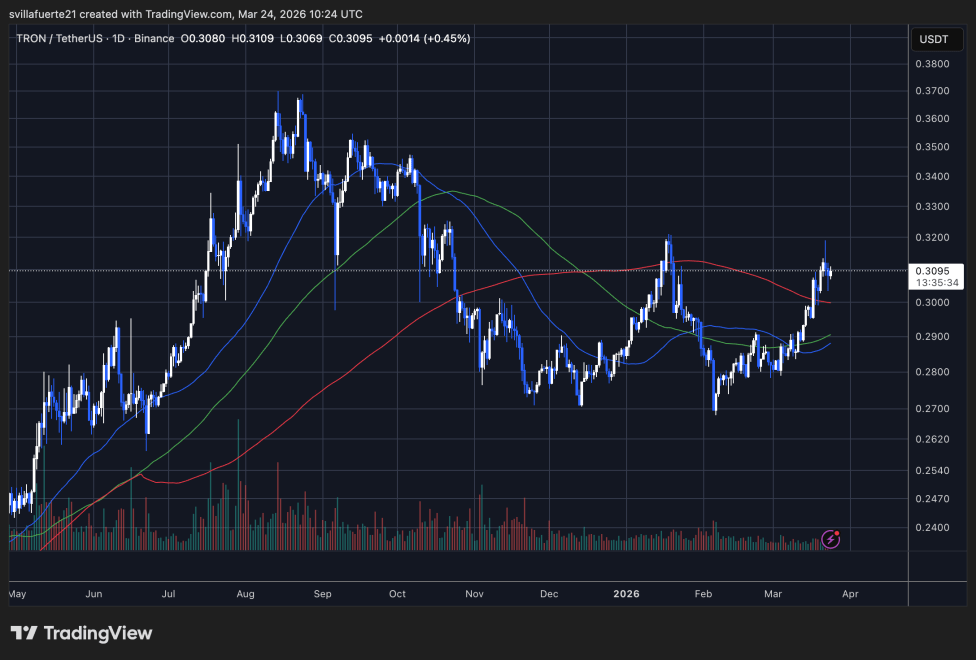
TRON price testing key resistance | Source: TRXUSDT chart on TradingView

From a technical perspective, TRX is now testing a critical area. Price has moved back above the short-term moving averages (50-day and 100-day), which are beginning to flatten, indicating a potential shift in short-term momentum. However, the 200-day moving average remains overhead, acting as dynamic resistance and capping further upside.

The recent upward move appears constructive but not yet decisive. Price has approached the $0.31 region multiple times, suggesting that this level is functioning as immediate resistance, while the $0.28–$0.29 zone now acts as short-term support.

Volume trends show moderate participation during the recovery phase, lacking the strong expansion typically associated with breakout conditions. This suggests that the current move may still be in the early stages of accumulation rather than a confirmed trend reversal.

A sustained break above $0.31–$0.32 would be required to confirm bullish continuation, while failure to hold above $0.29 could reintroduce downside pressure.

Featured image from ChatGPT, chart from TradingView.com

Criptomoedas em alta

Perguntas relacionadas

QWhat is the new allocation size of TRON's AI Fund and what does this expansion target?

ATRON has expanded its AI Fund from $100 million to $1 billion, targeting investments in core infrastructure for the emerging agentic economy.

QAccording to TRON's thesis, what are the three core areas that are foundational to the agentic economy?

AThe three core areas are: 1) Stablecoins as the most viable form for agent-to-agent commerce, 2) Stablecoins as primary payment infrastructure for individuals and small teams, and 3) Tokenized equity as the programmable ownership layer.

QWhat existing infrastructure does TRON cite as a foundation for scaling agent-driven financial systems?

ATRON cites its network with over 370 million user accounts, more than $21 billion in daily transaction volume, and over $85 billion in circulating USDT as its existing infrastructure foundation.

QWhat is the current TRX price range and what key resistance level is it testing?

ATRX is currently trading in the $0.30–$0.31 range and is testing the key resistance level around $0.31–$0.32.

QWhat technical indicators suggest a potential shift in TRX's short-term momentum?

AThe price moving back above the flattening 50-day and 100-day moving averages suggests a potential shift in short-term momentum, though the 200-day moving average remains as overhead resistance.

Leituras Relacionadas

Dialogue with Jia Hang | Looking Back at Two Decades of Chinese Payment Going Global

**Summary: A Conversation with Jia Hang on Two Decades of China's Payment Globalization** Jia Hang, a veteran with over twenty years in payments, reflects on China's attempts to build a global payment network through three key phases: UnionPay (card networks), Alipay+ (digital wallets), and now, stablecoins. His journey began at UnionPay International, aiming to establish China's card network abroad. While successful in following Chinese tourists ("where Chinese go, UnionPay goes"), it struggled to achieve true global scale. The core lesson: card networks like Visa/Mastercard's unassailable advantage isn't just technical standards, but their deeply entrenched **governance and profit-sharing models** that create powerful network effects. Competing as the "same species" is nearly impossible. At Ant Group, he led Alipay+, a strategy to bypass card networks by interconnecting local e-wallets worldwide. While innovative, it faced a similar ceiling. Mobile QR payments and card swipes were essentially **the same species competing for the same pie**, lacking a disruptive value proposition for users or a sustainable new incentive model to replace the card networks' established flywheel. Today, at Singapore's DCS, Jia focuses on stablecoin-based payments. He argues stablecoins represent a fundamental shift. They are not competing with Visa for consumer payments but challenging the **traditional banking and account system for value movement**. Products like "U Cards" (stablecoin-linked payment cards) are transitional, leveraging existing card networks for acceptance while building new rails. The real potential lies in stablecoins enabling seamless, low-cost global value transfer, potentially reorganizing the financial infrastructure around **accounts rather than cards**. Jia believes stablecoin adoption for local retail payments, cross-border transactions, and as high-yield savings vehicles is becoming irreversible. This could gradually reduce reliance on traditional fiat channels, especially in regions with weak currencies or capital controls. The quest for the "next global payment network" continues, now centered on whether stablecoins can successfully bridge Web2 and Web3, establish new governance, and create compelling user value beyond mere cost reduction.

marsbitHá 21m

Dialogue with Jia Hang | Looking Back at Two Decades of Chinese Payment Going Global

marsbitHá 21m

Circle's Stock Price Plunges 76%, Hong Kong Dollar Stablecoin Set to Launch Within Two Weeks

Circle's stock price has plunged approximately 76% from its 2023 peak, reflecting a major market revaluation. Despite this, Circle President Heath Tarbert emphasized the company's focus on long-term execution and its dominant position with USDC's $73 billion circulation across 34 blockchains. The competitive landscape is intensifying. A new consortium-backed stablecoin, Open USD, is attempting to challenge incumbents by sharing reserve yields with partners. More significantly, Visa's new stablecoin platform, initially supporting Open USD while also being compatible with USDC, could erode Circle's network effects. In response, Circle is expanding into real-world payments through partnerships like the one with Japan's JCB. Separately, Tether (USDT) faces a two-year compliance window under new U.S. regulations, requiring it to adjust its reserve composition away from assets like Bitcoin and loans towards cash and U.S. Treasuries. Meanwhile, in Hong Kong, Standard Chartered-backed fintech firm Dian Dian is poised to launch a licensed HKD-pegged stablecoin (HKDAP), moving the industry into a phase where the real test is integrating licensed stablecoins into actual payment flows and corporate treasury systems. The sharp decline in Circle's stock underscores a broader shift: the stablecoin market is moving from a winner-takes-all dynamic to a multi-player competitive arena where execution, compliance, and real-world utility are becoming paramount.

marsbitHá 21m

Circle's Stock Price Plunges 76%, Hong Kong Dollar Stablecoin Set to Launch Within Two Weeks

marsbitHá 21m

Amidst Capital's Encirclement, Decentralization is the Sole Defense for Public Blockchains

In a landscape dominated by power and profit motives, the author argues that decentralization is not merely one desirable feature among many in blockchain design—it is the singular, non-negotiable defense against corporate and capital capture. The article adopts a Machiavellian, realist perspective on human institutions, positing that businesses will inevitably attempt to co-opt any valuable network to protect their profits and dominance. While external attacks like 51% forks are often discussed, the greater existential risk is internal capture—the gradual erosion of a protocol’s neutrality by vested interests, as seen historically with platforms like Visa and Google. The piece critiques permissioned chains, highly centralized “permissionless” layer-1s, and layer-2s without sufficient decentralization (e.g., single sequencers) as inherently vulnerable. These compromised systems, promoted by established financial players, are framed as delaying tactics to stifle truly open networks that threaten existing high-fee, inefficient business models. Real-world examples, such as closed enterprise consortiums that exclude competitors, illustrate how such systems cement oligopolies rather than foster innovation. The author concludes that while decentralized protocols like Ethereum are imperfect and costly to operate, they represent the only viable long-term equilibrium. In a market where value naturally flows to the most secure and neutral settlement layer, only maximally decentralized public blockchains can resist being subsumed by capital and powerful incumbents.

Foresight NewsHá 31m

Amidst Capital's Encirclement, Decentralization is the Sole Defense for Public Blockchains

Foresight NewsHá 31m

Trading

Spot

Artigos em Destaque

Como comprar TRX

Bem-vindo à HTX.com!Tornámos a compra de TRON (TRX) simples e conveniente.Segue o nosso guia passo a passo para iniciar a tua jornada no mundo das criptos.Passo 1: cria a tua conta HTXUtiliza o teu e-mail ou número de telefone para te inscreveres numa conta gratuita na HTX.Desfruta de um processo de inscrição sem complicações e desbloqueia todas as funcionalidades.Obter a minha contaPasso 2: vai para Comprar Cripto e escolhe o teu método de pagamentoCartão de crédito/débito: usa o teu visa ou mastercard para comprar TRON (TRX) instantaneamente.Saldo: usa os fundos da tua conta HTX para transacionar sem problemas.Terceiros: adicionamos métodos de pagamento populares, como Google Pay e Apple Pay, para aumentar a conveniência.P2P: transaciona diretamente com outros utilizadores na HTX.Mercado de balcão (OTC): oferecemos serviços personalizados e taxas de câmbio competitivas para os traders.Passo 3: armazena teu TRON (TRX)Depois de comprar o teu TRON (TRX), armazena-o na tua conta HTX.Alternativamente, podes enviá-lo para outro lugar através de transferência blockchain ou usá-lo para transacionar outras criptomoedas.Passo 4: transaciona TRON (TRX)Transaciona facilmente TRON (TRX) no mercado à vista da HTX.Acede simplesmente à tua conta, seleciona o teu par de trading, executa as tuas transações e monitoriza em tempo real.Oferecemos uma experiência de fácil utilização tanto para principiantes como para traders experientes.

1.9k Visualizações TotaisPublicado em {updateTime}Atualizado em 2026.06.02

Como comprar TRX

Discussões

Bem-vindo à Comunidade HTX. Aqui, pode manter-se informado sobre os mais recentes desenvolvimentos da plataforma e obter acesso a análises profissionais de mercado. As opiniões dos utilizadores sobre o preço de TRX (TRX) são apresentadas abaixo.

活动图片