Tron Accounts for 52% of Global Small-Value USDT Transfer Volume

cryptonews.ruPublicado em 2026-08-17Última atualização em 2026-08-17

Resumo

Tron has solidified its position as a dominant blockchain for stablecoins, largely driven by $USDT activity. According to a Messari report, Tron's stablecoin market cap grew 4.1% in Q2, with $USDT accounting for nearly 99% of all stablecoins on the chain. With $87.9 billion in $USDT, Tron surpassed Ethereum to become the largest host for Tether, a figure that has since grown closer to $91 billion. The network's popularity, especially for small-value payments, is attributed to features like "gasless" transactions and its strong adoption in emerging economies. Tron now captures 52% of global small-amount (under $1,000) USDT transfers. It also saw record activity for a third consecutive quarter, with average daily transactions reaching 11.8 million and active addresses hitting 3.6 million. Analyst Alex Obchakevich highlighted Tron's "real, non-speculative, stable demand" focused on stablecoin transfers and payments, noting its recent infrastructure developments for institutional access and Real-World Assets (RWAs). Additionally, Tron leads in crypto card settlements, holding a 34% market share ($887 million) and maintaining a 21% share of tracked top-up volumes in Q3 with $108.5 million.

Tron, a smart contract-enabled blockchain, has strengthened its position as a stablecoin chain, largely due to sustained $USDT activity on its network.

According to the latest Messari "State of Tron" report, the project's stablecoin market capitalization grew by 4.1% compared to the first quarter, with $USDT accounting for nearly 99% of all stablecoins on the chain.

Furthermore, in the second quarter, Tron became the largest host of Tether's flagship stablecoin, with a $USDT volume of $87.9 billion, compared to Ethereum's $78.7 billion. This share has continued to grow and is now approaching $91 billion.

Tron has become more popular for stablecoin payments following the introduction of a new "gasless" feature, allowing for transactions without fees and without the need to pay TRX. Additionally, it has a first-mover advantage, enjoying significant popularity in emerging economies such as those in Africa and Latin America. This is why it leads in the number of transfers under $1,000 among native issuance chains, capturing 52% of these "small" transfers.

The network also demonstrated record activity for the third consecutive quarter: average daily transactions reached 11.8 million, and average daily active addresses grew to 3.6 million in Q2.

Alex Ouchakevich, a financial analyst and partner at AI-powered analytics company Artemis, emphasized that these exceptionally strong results indicate the blockchain has "real, non-speculative, stable demand that is monetized without subsidies and is independent of market cycles," primarily due to its focused use in stablecoin transfers and payments.

"Over the last three quarters, the network added infrastructure for institutional investor access and launched its first RWA," he noted.

Ouchakevich added that Tron also leads in crypto-card settlements: the share of crypto-card transaction volumes grew to $887 million, accounting for 34% of this market—the highest among all networks. Tron continues to maintain its lead in Q3 with a 21% market share by top-up volume, registering $108.5 million out of the total tracked volume of $509.6 million.

end-content

Criptomoedas em alta

Perguntas relacionadas

QAccording to the Messari report, what percentage of the stablecoin market on the Tron network is dominated by USDT?

AAccording to the Messari "State of Tron" report, USDT accounts for almost 99% of all stablecoins on the Tron blockchain.

QWhich blockchain hosted more USDT in Q2, Tron or Ethereum, and what were the respective amounts?

AIn the second quarter, Tron became the largest host for Tether's flagship stablecoin with $87.9 billion in USDT, compared to $78.7 billion on Ethereum.

QWhat feature helped make Tron more attractive for stablecoin payments, and what is one key reason for its popularity in emerging economies?

ATron became more attractive after implementing a new "gasless" feature, allowing transactions without fees or the need to pay TRX. It also benefits from first-mover advantage and is highly popular in emerging economies like Africa and Latin America.

QWhat share of small-value USDT transfers (under $1,000) does Tron capture according to the article?

ATron captures 52% of the global volume for small-value USDT transfers (under $1,000).

QWhat did Alex Obchakevich highlight as the nature of the demand for the Tron blockchain, and what is one area where Tron leads in crypto card settlements?

AAlex Obchakevich highlighted that Tron has "real, non-speculative, stable demand that is monetized without subsidies and is independent of market cycles." He also noted that Tron leads in crypto card settlements, accounting for 34% of that market volume at $887 million.

Leituras Relacionadas

U.S. National Debt Approaches $40 Trillion in 5 Months, Bitcoin Debate Gains Momentum

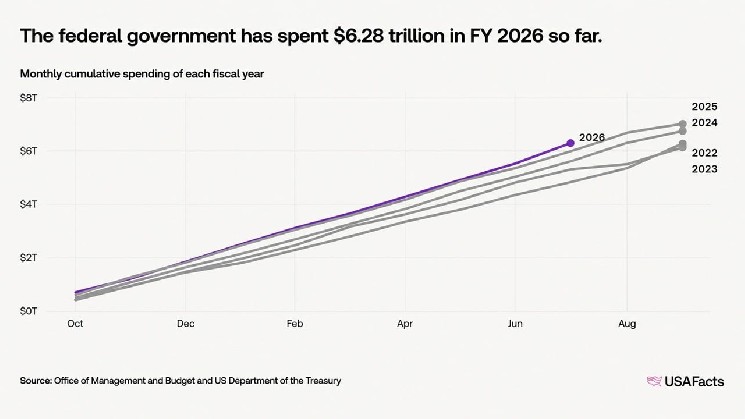
The US national debt has surged to nearly $40 trillion in just five months, the fastest trillion-dollar increase on record. The debt's growth has accelerated dramatically over time, from taking 192 years to reach the first $1 trillion in 1981 to adding the latest $1 trillion in only five months. The federal budget deficit for the fiscal year is already over $1.8 trillion, exceeding last year's total, and net interest payments on the debt have surpassed $1 trillion, now exceeding defense or Medicare spending. This rapid debt accumulation is fueling arguments within the cryptocurrency industry that Bitcoin serves as a hedge against government-backed currencies and fiscal irresponsibility. Proponents, including some lawmakers and industry leaders, argue Bitcoin could act as a "hard currency" fiscal control mechanism. Legislation has even been proposed for the Treasury to acquire Bitcoin to help reduce the national debt. The International Monetary Fund has warned that global public debt could hit 100% of world GDP by 2029 if current trends continue, with the US and China as primary drivers. Some analyses suggest a sovereign debt crisis could drive capital into alternative assets like Bitcoin, similar to past regional banking crises. However, skeptics point out that both Bitcoin and gold have fallen in price at times during 2026 despite record debt, indicating the depreciation hedge theory may operate over a much longer timeframe than short-term price action.

cryptonews.ruHá 9m

U.S. National Debt Approaches $40 Trillion in 5 Months, Bitcoin Debate Gains Momentum

cryptonews.ruHá 9m

Technological Self-Reliance in China: A War from Lithography Machines to ABF Films

"China's Tech Independence: A Battle from Lithography Machines to ABF Film" In August 2026, Japan's Ajinomoto announced a 30% supply cut of ABF film to Chinese mainland clients, causing industry-wide shock and fears of price hikes and shortages in the semiconductor supply chain. That same year, Chinese company Lotus Holdings, known for its MSG business, acquired a small domestic ABF film startup for 103 million yuan, aiming to change this passive situation. ABF film is a core insulating material for advanced CPU, GPU, and AI chip packages. Ajinomoto, originally a food flavoring company, has monopolized over 95% of the global ABF film market for nearly 30 years, deriving its technology from byproducts of monosodium glutamate production. With AI chips consuming 5-10 times more ABF film than traditional chips, the supply-demand gap is widening. Ajinomoto's supply cut to China, where domestic ABF film production accounts for less than 5%, directly threatens the production of domestic high-end AI chips and their substrates. This incident highlights a crucial but often overlooked truth: the vulnerabilities in China's quest for technological self-reliance extend beyond headline areas like lithography machines to critical but seemingly minor components—insulating films, photoresists, electronic specialty gases, etc. The article frames China's tech independence as a multi-front war. While major breakthroughs have been achieved in chip design (e.g., Huawei's HiSilicon), foundry (e.g., SMIC), and memory chips (e.g., YMTC), countless smaller "Ajinomoto-style" chokepoints remain. Lotus Holdings' acquisition represents a significant shift: the battle is no longer fought only by tech giants but has become a collective, industry-wide effort involving companies from diverse backgrounds. Historically, external blockades have often spurred China's technological breakthroughs, as seen with Huawei's Kirin chips and YMTC's 3D NAND flash memory. Ajinomoto's supply cut, while a short-term challenge, may similarly catalyze domestic innovation in ABF film and other critical materials. The path to technological sovereignty is long and arduous, requiring sustained patience and investment to fill every gap in the complex supply chain. Lotus's move is not an immediate solution but a step towards that future, symbolizing a broader, relentless march toward independence.

marsbitHá 29m

Technological Self-Reliance in China: A War from Lithography Machines to ABF Films

marsbitHá 29m

The Great Ethereum "Rate Cut" Debate: Is Now the Golden Window for Staking with the Unconventional EIP-8363?

Ethereon's economic policy is under review as a new proposal, EIP-8363, sparks debate over potential "interest rate cuts" for staking. The unconventional proposal suggests gradually increasing the proportion of newly issued ETH rewards that are burned as the total staked ETH ratio rises, with issuance fully offset by burns once the ratio nears 50%. This would drive the protocol-level staking APR towards 0%, though validators would still earn transaction fees and MEV. This discussion emerges as staked ETH approaches 35% of supply, with the current protocol APR at ~2.6%. The core question is whether Ethereum needs to continue paying high issuance costs for marginal gains in security once sufficient participation is achieved. EIP-8363 aims to optimize security spending, but critics warn it could disproportionately impact solo stakers and potentially increase centralization among large, resilient operators. Paradoxically, this debate coincides with the Pectra upgrade (EIP-7251), which introduces native compounding for staking rewards, significantly improving capital efficiency for long-term holders. This creates a dual narrative: the protocol is making staking more efficient while reconsidering the economic incentive to stake. For long-term ETH holders, this environment may present a "time window" rather than a fixed-rate opportunity. While future APRs are expected to trend downward, starting staking earlier maximizes the compounding effect over time. The decision to stake depends on individual factors like investment horizon, liquidity needs, and risk tolerance regarding options like native validation, staking services, or liquid staking tokens (LSTs). The evolution from encouraging staking to managing its economic cost marks a new, mature phase for Ethereum's tokenomics, where the true value of staking may increasingly lie in the long-term power of compounding time.

marsbitHá 37m

The Great Ethereum "Rate Cut" Debate: Is Now the Golden Window for Staking with the Unconventional EIP-8363?

marsbitHá 37m

Analyst States Bitcoin Remains Within $61-68k Range

An analyst stated that Bitcoin is likely to remain within a trading range of $61,000 to $68,000. According to Kirill Komalenkov, director of strategic communications at Bitbanker, Bitcoin continues to trade sideways amidst declining market volatility. He attributes its current stability to high market liquidity, with volatility near three-year lows. Komalenkov warned that sustained low activity carries risks of a price decline, with potential tests of support at $62,300 and $61,600. He suggested that major market players might use the current situation to accumulate liquidity, meaning any initial breakout from the range could be a false move. The analyst expects this sideways movement to persist until the latter part of August. Key factors for determining future market direction include fund flows into Exchange-Traded Funds (ETFs) and trader activity. However, Komalenkov noted a potential negative scenario for the second half of August, where heightened geopolitical tensions or hawkish rhetoric from US monetary authorities could trigger a new decline. In such a case, Bitcoin could fall to a range of $45,000–$50,000 by early autumn, which might form a new base for a potential market recovery later in the season. Separately, a Russian deputy finance minister recently announced that non-qualified investors in Russia will soon be allowed to legally purchase Bitcoin, Ethereum, and popular stablecoins, with an annual limit of 300,000 rubles per intermediary.

cryptonews.ruHá 39m

Analyst States Bitcoin Remains Within $61-68k Range

cryptonews.ruHá 39m

Trading

Spot

Artigos em Destaque

Como comprar TRX

Bem-vindo à HTX.com!Tornámos a compra de TRON (TRX) simples e conveniente.Segue o nosso guia passo a passo para iniciar a tua jornada no mundo das criptos.Passo 1: cria a tua conta HTXUtiliza o teu e-mail ou número de telefone para te inscreveres numa conta gratuita na HTX.Desfruta de um processo de inscrição sem complicações e desbloqueia todas as funcionalidades.Obter a minha contaPasso 2: vai para Comprar Cripto e escolhe o teu método de pagamentoCartão de crédito/débito: usa o teu visa ou mastercard para comprar TRON (TRX) instantaneamente.Saldo: usa os fundos da tua conta HTX para transacionar sem problemas.Terceiros: adicionamos métodos de pagamento populares, como Google Pay e Apple Pay, para aumentar a conveniência.P2P: transaciona diretamente com outros utilizadores na HTX.Mercado de balcão (OTC): oferecemos serviços personalizados e taxas de câmbio competitivas para os traders.Passo 3: armazena teu TRON (TRX)Depois de comprar o teu TRON (TRX), armazena-o na tua conta HTX.Alternativamente, podes enviá-lo para outro lugar através de transferência blockchain ou usá-lo para transacionar outras criptomoedas.Passo 4: transaciona TRON (TRX)Transaciona facilmente TRON (TRX) no mercado à vista da HTX.Acede simplesmente à tua conta, seleciona o teu par de trading, executa as tuas transações e monitoriza em tempo real.Oferecemos uma experiência de fácil utilização tanto para principiantes como para traders experientes.

2.1k Visualizações TotaisPublicado em {updateTime}Atualizado em 2026.06.02

Como comprar TRX

Discussões

Bem-vindo à Comunidade HTX. Aqui, pode manter-se informado sobre os mais recentes desenvolvimentos da plataforma e obter acesso a análises profissionais de mercado. As opiniões dos utilizadores sobre o preço de TRX (TRX) são apresentadas abaixo.

活动图片