U.S. National Debt Approaches $40 Trillion in 5 Months, Bitcoin Debate Gains Momentum

cryptonews.ruPublicado em 2026-08-17Última atualização em 2026-08-17

Resumo

The US national debt has surged to nearly $40 trillion in just five months, the fastest trillion-dollar increase on record. The debt's growth has accelerated dramatically over time, from taking 192 years to reach the first $1 trillion in 1981 to adding the latest $1 trillion in only five months. The federal budget deficit for the fiscal year is already over $1.8 trillion, exceeding last year's total, and net interest payments on the debt have surpassed $1 trillion, now exceeding defense or Medicare spending. This rapid debt accumulation is fueling arguments within the cryptocurrency industry that Bitcoin serves as a hedge against government-backed currencies and fiscal irresponsibility. Proponents, including some lawmakers and industry leaders, argue Bitcoin could act as a "hard currency" fiscal control mechanism. Legislation has even been proposed for the Treasury to acquire Bitcoin to help reduce the national debt. The International Monetary Fund has warned that global public debt could hit 100% of world GDP by 2029 if current trends continue, with the US and China as primary drivers. Some analyses suggest a sovereign debt crisis could drive capital into alternative assets like Bitcoin, similar to past regional banking crises. However, skeptics point out that both Bitcoin and gold have fallen in price at times during 2026 despite record debt, indicating the depreciation hedge theory may operate over a much longer timeframe than short-term price action.

The rate of U.S. debt accumulation warrants separate consideration. It took 192 years to accumulate the first trillion dollars of debt—this milestone was reached in 1981. Each subsequent trillion accumulated faster: for instance, going from $5 trillion to $10 trillion by 2008 took five years, and then—just five years to climb from $20 trillion in 2017 to $30 trillion in 2022.
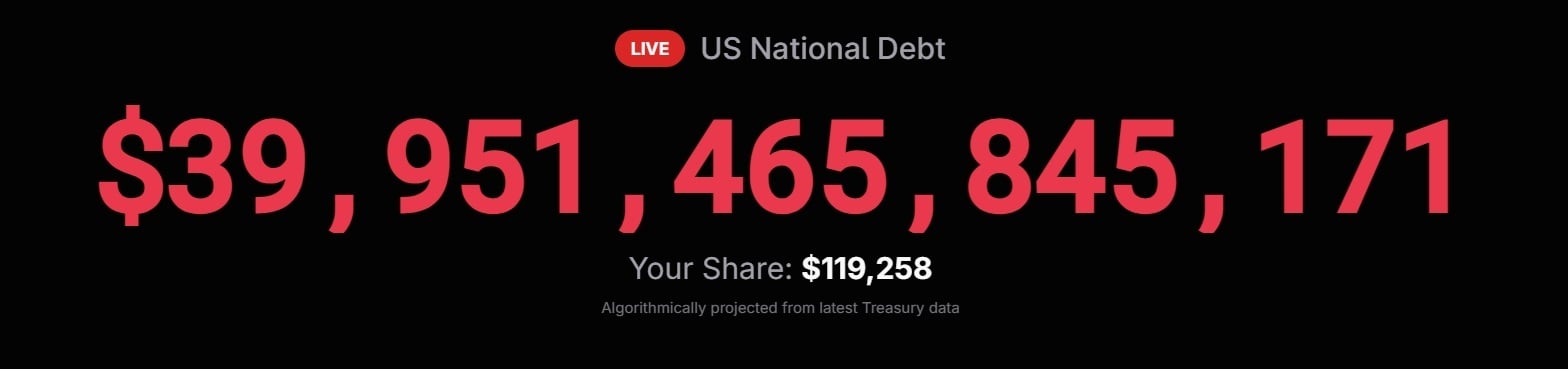
Image Source: US-Debt-Clock.com

The latest surge—from $39 trillion to the recently surpassed mark of $39.95 trillion—took only five months, marking the fastest trillion-dollar increase in history.

What Fuels the Debt Growth and Interest Payment Expenses

In July alone, the federal budget deficit was $432 billion, bringing the deficit for the first ten months of the fiscal year to approximately $1.8 trillion—a figure that already exceeds the entire deficit recorded in the 2025 fiscal year. Maya MacGuineas from the Committee for a Responsible Federal Budget directly pointed to this pace, noting that the government is currently increasing debt by "$14 billion per day," and stating that to stabilize the trend, the deficit must decrease to a level close to 3% of GDP.

An increasing share of this problem is occupied by interest payment expenses. Net interest payments on the debt for the fiscal year have already exceeded $1 trillion—this sum currently exceeds Washington's spending on national defense or the Medicare program. The total federal debt has risen to 124% of GDP, with just the debt held by external investors accounting for approximately 101% of GDP, approaching the record level of 106.1% of GDP recorded in 1946 after World War II.

Bitcoin.com News covered this previous debt-to-GDP ratio milestone in July when this indicator first surpassed the comparable threshold.

Arguments for Bitcoin as a Hedge Against Debt Grow Louder

The movement toward the $40 trillion mark has directly bolstered the crypto industry's favorite argument that Bitcoin serves as a hedge against a currency backed by a government that cannot stop borrowing. This argument was detailed in an analytical piece when the debt first exceeded $39 trillion in July, and has since been supported by an increasing number of institutional sector representatives.

Senator Cynthia Lummis has also been vocal on the matter, and her BITCOIN Act bill (which would require the Treasury Department to acquire up to 1 million BTC within five years and hold the coins for at least two decades) asserts that this could reduce the national debt by a third or even by half. Coinbase CEO Brian Armstrong separately put forward the idea of using Bitcoin as a "hard currency-backed" mechanism to control federal spending, positioning debt as a constitutional issue as much as a fiscal one.

Finally, the International Monetary Fund warned that by 2029, global public debt could reach approximately 100% of world GDP if current trends persist, with the U.S. and China named as two primary contributing factors. The IMF's own analysis shows that such a scenario could play into Bitcoin's favor, i.e., unlike a bond sell-off driven by a quest for yield, a debt solvency crisis could redirect capital into alternative assets rather than simply withdrawing it from markets (this dynamic favored Bitcoin during the Cyprus banking crisis in 2013 and again during the U.S. regional banking crisis in 2023).

Not everyone agrees that this trading strategy works as advertised, given that both Bitcoin and gold have fallen in price for a significant part of 2026, even as the debt set one record after another—a reminder that the debasement theory operates on a longer timeframe than price behavior over a single month.

end-content

Perguntas relacionadas

QAccording to the article, how long did it take for the U.S. national debt to increase from $39 trillion to nearly $40 trillion?

AIt took just five months, marking the fastest trillion-dollar increase in history.

QWhat is the current U.S. federal debt-to-GDP ratio mentioned in the article?

AThe total federal debt has grown to 124% of GDP.

QWho is Maya MacGuineas and what did she state about the U.S. government's debt accumulation?

AMaya MacGuineas is from the Committee for a Responsible Federal Budget. She stated that the government is currently increasing debt at a rate of '$14 billion a day' and that the deficit must shrink to near 3% of GDP to stabilize the trajectory.

QWhat is the main argument presented by the crypto industry regarding Bitcoin's role in relation to the U.S. debt?

AThe crypto industry argues that Bitcoin serves as a hedge against a government-backed currency issued by an entity that cannot stop borrowing.

QWhat warning did the International Monetary Fund (IMF) issue regarding global debt, and what potential consequence for Bitcoin is suggested?

AThe IMF warned that global sovereign debt could reach roughly 100% of world GDP by 2029 if current trends continue. Their analysis suggests such a debt solvency crisis could redirect capital into alternative assets like Bitcoin, rather than simply exiting markets.

Leituras Relacionadas

'The Idea of Catching the Absolute Bottom Is Wrong': Experts on a New Phase of Bitcoin Capitulation

Analysts from CryptoQuant advise investors against trying to pinpoint the exact bottom of Bitcoin's price. Their data shows the percentage of the Bitcoin supply in profit has fallen to 51.4%, a level historically associated with capitulation phases followed by accumulation. This means approximately 48.6% of circulating coins are held at an unrealized loss. The metric, based on UTXO analysis comparing a coin's last moved price to its current market value, last neared this level in early 2023 when Bitcoin traded between $16,000 and $20,000. CryptoQuant states that the idea of catching the "absolute bottom" is flawed. The decline in the average cost basis during a bear market reflects coins transferring from weak hands to stronger, long-term holders. While some investors realize losses, others may use the decline for gradual accumulation. The accumulation window may last longer than many expect, even as fear drives some participants away. Historically, a supply in profit below 55% has been linked to re-accumulation periods. Separately, Swan Bitcoin CEO Cory Klippsten offered a forecast, suggesting Bitcoin could form a bottom in October 2026, followed by a recovery towards approximately $130,000 ahead of the 2028 halving. This aligns with the historical pattern of local lows forming about 12 months after bull market peaks; Bitcoin hit its all-time high above $126,000 in early October 2025. However, Klippsten cautioned against over-relying on past cycles due to limited historical data.

cryptonews.ruHá 45m

'The Idea of Catching the Absolute Bottom Is Wrong': Experts on a New Phase of Bitcoin Capitulation

cryptonews.ruHá 45m

How Does FalconX Bring Institutional Lending On-Chain? Deep Dive into the FALX Operational Mechanism

FALX is a structured credit facility that brings institutional prime brokerage loans on-chain as fixed-income assets. It works by having FalconX originate overcollateralized loans to institutional clients (e.g., quant funds, market makers). These loan exposures enter a bankruptcy-remote SPV. The Pareto protocol provides the on-chain credit vault infrastructure, while M11 Credit acts as the credit curator, administrative agent, and collateral agent. Platforms like Plume, Ethereum, and Solana serve as distribution channels for investors. Investors deposit USDC into the vault, receiving an estimated ~7.4% net yield (after a 10% performance fee). This yield represents a premium over low-risk on-chain alternatives (like tokenized Treasuries at ~4%) to compensate for risks including FalconX operational risk, collateral liquidation risk, SPV legal risk, M11's execution risk, a 31-day redemption notice period, and potential contagion from DeFi re-collateralization. The structure incorporates multiple risk mitigations: overcollateralized underlying loans, a first-loss capital contribution from FalconX, and independent oversight by M11. However, challenges remain, such as scaling investor demand (current AUM is ~$148M against a ~$1B potential capacity), managing redemption liquidity, and addressing new risks from the vault token's use as collateral in DeFi lending protocols like Morpho. FALX demonstrates a pragmatic path for on-chain credit by leveraging existing institutional loan origination and combining it with legal structures, external curation, and blockchain-based distribution.

marsbitHá 46m

How Does FalconX Bring Institutional Lending On-Chain? Deep Dive into the FALX Operational Mechanism

marsbitHá 46m

Trading

Spot
活动图片