
Trading Moment: "Sell America" Trade Ignites Gold to Record High of $4888, Bitcoin Shows Short-Term Divergence, Ethereum Faces Defense Battle at $2800

marsbitPublicado em 2026-01-21Última atualização em 2026-01-21

Resumo

Global markets experienced significant turmoil on January 20, triggered by a sharp sell-off in Japanese long-term government bonds. Fears over expansionary fiscal policies pushed the 40-year JGB yield above 4%, pressuring U.S. Treasuries and driving the 10-year yield to 4.311%. A “Sell America” trade ensued, causing U.S. stocks, bonds, and the dollar to fall sharply. Gold surged to a record $4,888/oz amid safe-haven demand, while silver saw unprecedented retail buying. Bitcoin fell below $90k, erasing year-to-date gains, with analysts divided on further downside. Ethereum struggled near $2,900, with key support at $2,700–$2,800. Solana saw whale accumulation despite the dip, and meme coins gained attention after a White House tweet. ETF outflows continued for Bitcoin and Ethereum. Key economic data and token airdrops are anticipated.

Daily key market data review and trend analysis, produced by PANews.

1. Market Observation
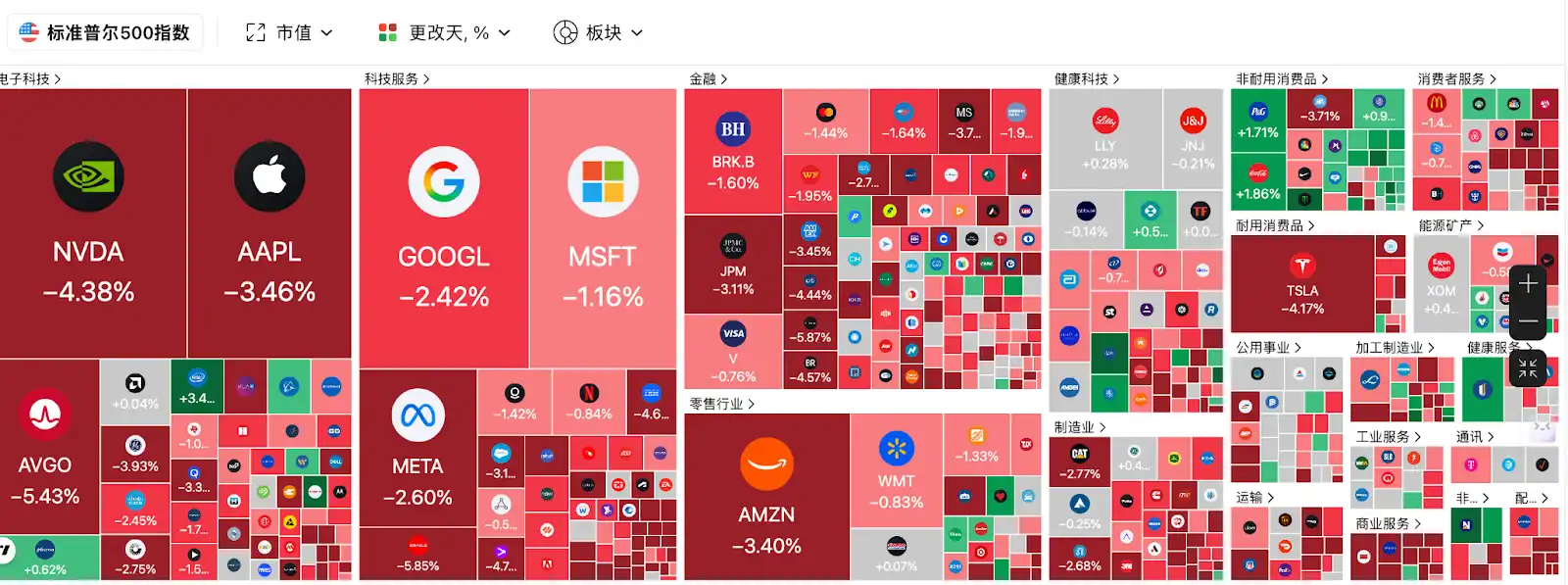
Global financial markets began a turbulent session on January 20th, triggered by intense selling in Japan's long-term government bond market. Fears that Prime Minister Takaichi Sanae's expansionary fiscal plans could spark a "Japanese version of the Truss moment" drove the historic surge of Japan's 40-year government bond yield above 4%. This selling, described by traders as "crazy," quickly transmitted pressure to the United States via Japan, one of the largest holders of US Treasuries, pushing the 10-year US Treasury yield up to 4.311%. Citigroup even warned that volatility in the Japanese bond market could force risk parity funds to sell up to $130 billion in US bonds.

As US markets opened on Tuesday, Trump's reiteration of the need to control Greenland and his threat to impose tariffs on several European countries provided the catalyst for the market to unleash a "Sell America" trading pattern. US stocks, bonds, and the dollar suffered a "triple kill", with the S&P 500 plunging 2.1%, completely erasing its year-to-date gains, and the VIX fear index jumping to its highest level since last November. In a countermove, the Danish pension fund AkademikerPension, managing $25 billion, announced it would liquidate its holdings of US Treasury bonds by the end of the month due to concerns about credit risks stemming from US policy.

Amid this global rush for safe-haven assets, capital flooded into hard assets. Global retail demand for silver reached unprecedented levels, depleting inventories at refineries in multiple countries. The Polish central bank announced its approval of a plan to increase gold holdings by 150 tons, further solidifying the trend of central banks hedging against fiat currency devaluation and geopolitical risks. This drove the spot price of gold to historically break above $4800/oz for the first time, briefly touching a new all-time high of $4888. Meanwhile, US Treasury Secretary Besant attempted to soothe markets, stating she had communicated with Japanese officials who would stabilize markets, and expressed no concern whatsoever about any selling of US Treasuries related to the Greenland issue. However, Bridgewater founder Ray Dalio warned that a "capital war" might be brewing. Looking ahead, with the Fed's independence facing a test from a Supreme Court case, the market's eerie calm has been彻底 shattered. As long as the fundamental issues of geopolitics and fiscal discipline remain unresolved, severe volatility is likely to become the new normal for markets.

Bitcoin, affected by macro headwinds and geopolitics, fell below the $90,000 mark, briefly dipping to $87,790 and wiping out all its gains year-to-date. Over $1.8 billion was liquidated across the network within 48 hours. Analyst Michaël van de Poppe emphasized the need to closely watch Japanese bond yields and the gold price; if both continue to soar, the market will remain under pressure. The BTC/Gold exchange rate has also fallen to a historical low, and technically, it needs to hold the 50-day moving average to avoid a deeper correction. Trader Killa, by comparing the行情 to 2022, pointed out that if the price fails to reclaim the previous high of $94,600, it could continue to decline, viewing MicroStrategy's average holding cost of $75,979 as an important psychological support level. A more pessimistic prediction came from veteran trader Peter Brandt, who warned that the rejection at $98,000 could lead to a drop to $60,000 or lower, while Cheds Trading called for a bottom range of $35,000 to $45,000.

However, there are also strong bullish voices in the market. Trader il Capo of Crypto believes the current area is significant support, and if held, the next target is $100,000. Analyst Sykodelic further believes that even if the price drops below $80,000 for a liquidity cleanse, it would still be a healthy correction in a bull market, preparing for a charge towards $110,000. Analyst Astronomer, although stopped out, maintains a bullish bias, believing a weekly bottom is forming with targets at $95,000 and $112,000, predicting that even in a bear market, the bottom would be above $50,000. On-chain data provides strong support for the bulls. Santiment's monitoring shows that whale addresses holding 10 to 10,000 BTC have accumulated over 36,000 BTC against the trend in the past 9 days, showing a bullish divergence of "smart money" accumulation. Analyst Garrett fundamentally refuted the bearish argument, emphasizing that the current macro environment is completely different from 2022, and institutional entry via ETFs has changed the market structure. Unless there is a new inflation shock and the price effectively breaks below $80,850, any talk of a bear market is premature.

Regarding Ethereum, the price nearly broke below the $2900 mark, with technical patterns and on-chain data presenting a complex state of博弈. Analyst Krugman pointed out that ETH's failure to break through the key $3450 watershed kept the weekly bearish Pinbar pattern valid, with key support below in the $2700 to $2800 range. A break below this area could see the price plummet to $1700. Man of Bitcoin analysis suggests ETH has broken below micro support; as long as the price stays above $2772, the triangle structure remains valid, but the risk of a direct drop needs vigilance. Although the CVD indicator is negative, price finding support above $3000 indicates large players are absorbing selling pressure. Harvey Hunter analyzed from a technical perspective that ETH is building a two-month symmetrical triangle; if it can hold current support and break above $3350, it could embark on a rebound towards a new all-time high of $4800. However, Arthur Hayes warned that if the Japanese bond crisis causes the MOVE index to surge above 130, risk assets including ETH will face a painful deleveraging process.

While mainstream coins fluctuated, Solana fell below $130 with the broader market, but on-chain data shows whales are taking the opportunity to accumulate. Addresses holding 1k to 10k SOL increased significantly, exchange supply hit a two-year low, and network activity and stablecoin supply both reached new highs. Meanwhile, the combination of politics and Memes became a new炒作 hotspot. A tweet from the official White House account saying "The memes will continue" led today's BSC Meme行情, which was also reposted by Binance co-founder He Yi. The related Meme coin "$memes" saw its market cap rise to a high of $20 million. (*Note: Content is for reference only, not investment advice. Please do your own research.)

2. Key Data (As of January 21, 13:00 HKT)

(Data source: CoinAnk, Upbit, SoSoValue, CoinMarketCap)

  • Bitcoin: $89,746 (Year-to-date +2.35%), Daily Spot Volume $59.44B

  • Ethereum: $2,985 (Year-to-date +0.46%), Daily Spot Volume $33.68B

  • Fear & Greed Index: 24 (Fear)

  • Average GAS: BTC: 1.75 sat/vB, ETH: 0.02 Gwei

  • Market Dominance: BTC 59.1%, ETH 12.4%

  • Upbit 24h Trading Volume Ranking: AXS, XRP, BTC, BERA, IP

  • 24h BTC Long/Short Ratio: 48.63% / 51.37%

  • Sector Performance: Crypto market broadly lower, CeFi sector leads decline over 5%

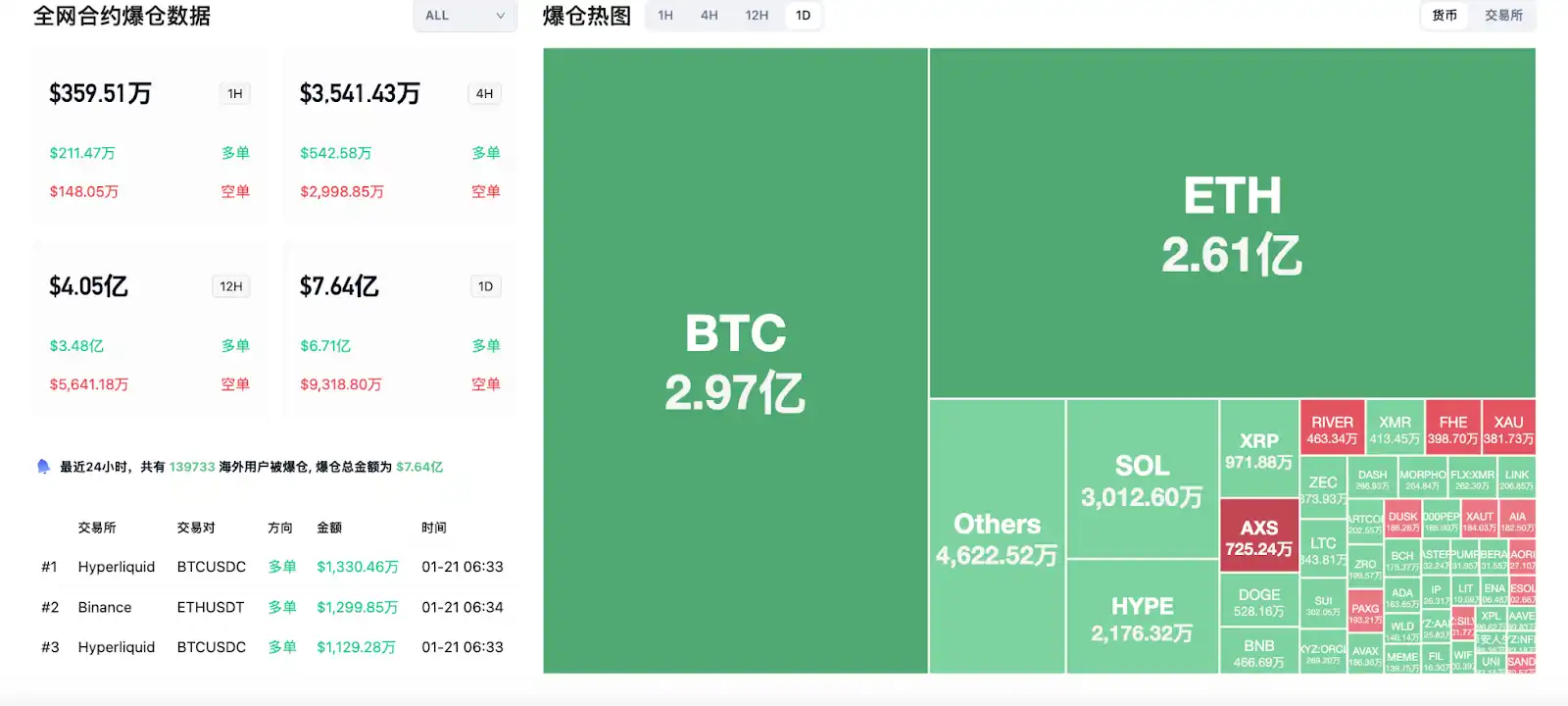
24h Liquidation Data: 139,733 people liquidated globally, Total liquidation amount $764 million, including BTC $297M, ETH $261M, SOL $30.12M
3. ETF Flows (As of January 20)

  • Bitcoin ETF: - $483 million

  • Ethereum ETF: -$230 million

  • XRP ETF: -$53.32 million

  • SOL ETF: +$3.08 million

4. Today's Preview

  • Zama public token auction registration is open, bidding starts January 21, 16:00

  • ETHGas: GWEI airdrop eligibility query opens January 20, community airdrop on January 21

  • Solana Mobile will airdrop 2 billion SKR tokens to Seeker users on January 21

  • MegaETH will launch its mainnet on January 22, initially starting a global stress test

  • Immunefi will launch its platform token IMU on January 22

  • Binance Alpha will list FIGHT on January 22

  • US Q3 Real GDP Annualized QoQ Final (Jan 21, 21:30)

  • US Initial Jobless Claims (week of Jan 17): Expectation 209K, Previous 198K (Jan 21, 21:30)

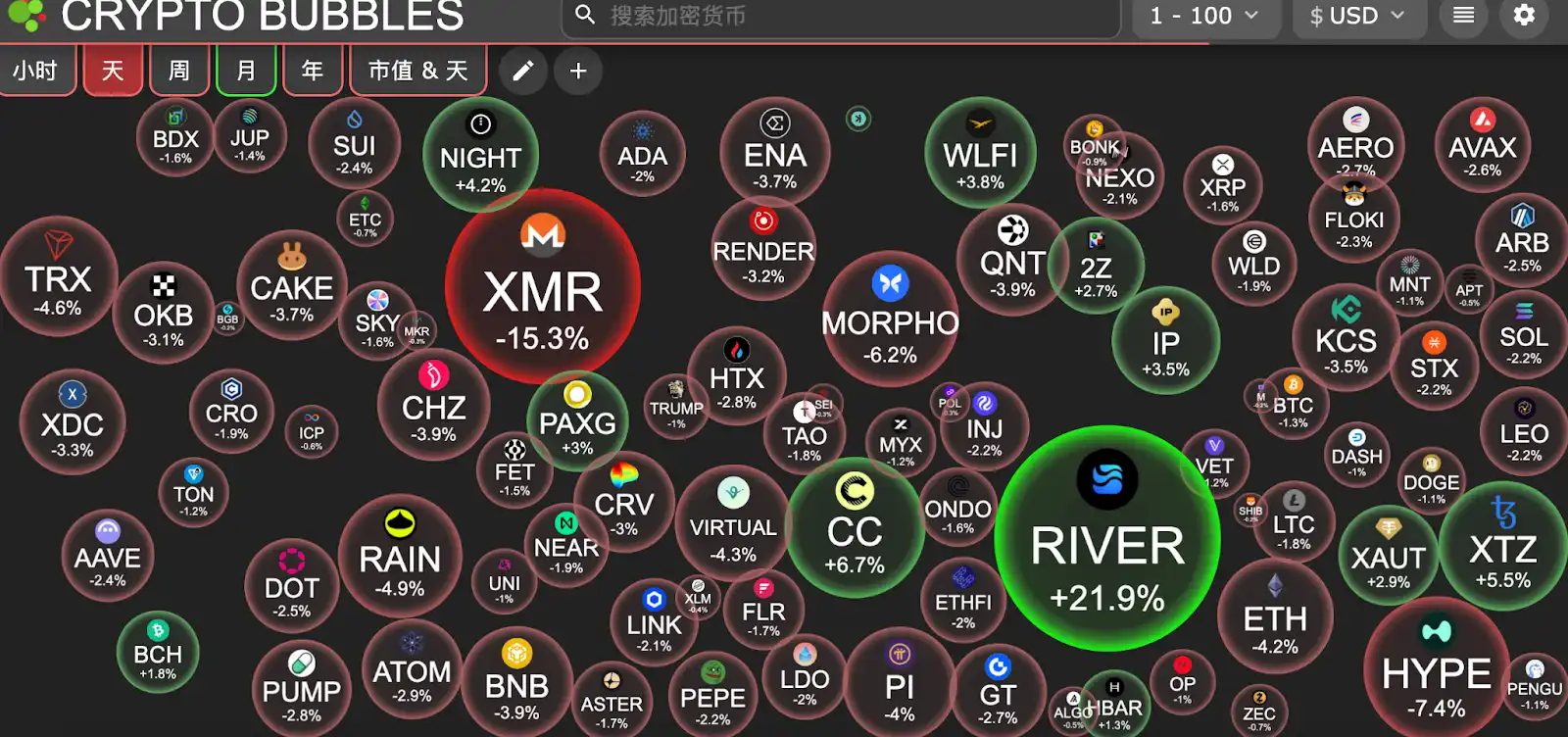
Today's top gainers among top 100 coins by market cap: River +21.9%, Canton Network +6.7%, Tezos +5.5%, Midnight +4.2%, World Liberty Financial +3.8%.
5. Hot News

  • Spot gold breaks above $4850/oz, hitting a new record high

  • Japanese and South Korean stock markets open down over 1%

  • Pendle launches sPENDLE mechanism, replacing vePENDLE and introducing liquid staking

  • Galaxy plans to launch a $100M crypto hedge fund in Q1 2026, with up to 30% assets invested in crypto tokens

  • Solana Mobile launches native token SKR, Seeker users can claim airdrop before April 20

  • US Market Close: Major indices fell sharply, blockchain concept stocks broadly lower

  • Trend Research withdraws another 7,960 ETH from Binance, purchased 17,899 ETH today in total

  • Strategy invests $2.13B to acquire 22,305 additional Bitcoin

  • Trove Markets' token plummets over 95% minutes after listing, negative impact intensifies further

Criptomoedas em alta

Perguntas relacionadas

QWhat triggered the 'Sell America' trading pattern and what were its consequences?

AThe 'Sell America' trading pattern was triggered by former President Trump's reiteration of the need to control Greenland and threats to impose tariffs on several European countries. This led to a 'triple kill' of US stocks, bonds, and the US dollar, with the S&P 500 plunging 2.1% and the VIX fear index surging to its highest level since last November.

QWhat new all-time high did gold reach and what were the key drivers behind this surge?

ASpot gold reached a new all-time high of $4,888 per ounce. The surge was driven by a global wave of risk aversion, with funds pouring into hard assets, unprecedented retail demand for silver, and central bank hedging against fiat currency depreciation and geopolitical risks, exemplified by the Polish central bank's plan to increase its gold reserves by 150 tons.

QWhat is the key technical support level for Ethereum that analysts are watching, and what is the bearish target if it breaks?

AAnalysts are closely watching the key technical support level for Ethereum in the $2,700 to $2,800 range. If this support is broken, the price could potentially plummet to $1,700.

QDespite the market downturn, what on-chain data for Bitcoin provides a bullish signal according to Santiment?

AAccording to Santiment's monitoring, whale addresses holding 10 to 10,000 Bitcoin have bought over 36,000 BTC in the past 9 days, showing a bullish divergence of 'smart money' accumulation.

QWhich asset was an outlier with net inflows in the ETF data as of January 20th, and what was the amount?

AThe Solana (SOL) ETF was an outlier with net inflows of +$3.08 million as of January 20th, while Bitcoin, Ethereum, and XRP ETFs all experienced outflows.

Leituras Relacionadas

After Three Consecutive Quarters of Decline, Can the Crypto Market Find a Window for Stabilization in Q3?

The cryptocurrency market has just concluded its worst-performing quarter since 2022, with total capitalization dropping 12.6% to $2.1 trillion. All core metrics indicate capital is leaving the sector, not just rotating within it. Bitcoin fell 14.2% and Ethereum dropped 25.4% in Q2, breaking their previous correlation with US tech stocks. A key driver is the reversal in US spot Bitcoin ETF flows, which saw a net outflow of approximately $4.67 billion in Q2, including a record monthly outflow near $4.5 billion in June. While recent data suggests long-term holders are accumulating again, sustained ETF outflows mean continued selling pressure. Market focus is now singularly on the Federal Reserve. The upcoming July FOMC meeting is seen as the most critical event for Q3. A dovish signal could support Bitcoin reclaiming a $68,000-$84,000 range, while a hawkish stance might establish a new trading band around $50,000-$56,000. Additionally, regulatory uncertainty persists, with the progress of the crucial *CLARITY Act* stalling in the Senate, reducing its perceived 2026 passage probability to 40-45%. Despite the broad downturn, a few sectors showed growth. Prediction markets saw nominal volume surge 48.7% year-over-year to $113.8 billion, and tokenized collectibles transaction volume rose 143% quarterly to $1.4 billion. The Real-World Asset (RWA) tokenization sector also continued steady growth, now representing ~$28.1 billion in on-chain value. The market's foundation for an extreme crash appears limited, with Bitcoin price hovering near its 200-week moving average. However, the trading paradigm has shifted from narrative-driven speculation to decisions based on price action, policy developments, and interest rate expectations, making a broad sentiment-driven rally unlikely in the near term.

marsbitHá 8h

After Three Consecutive Quarters of Decline, Can the Crypto Market Find a Window for Stabilization in Q3?

marsbitHá 8h

BIT Trading Moment: BTC Still Suppressed by Weekly 200 EMA, Rejection May Restart Decline; Storage and Semiconductors that Surged Last Night Begin Falling in Evening Trading

**Crypto & Stock Market Wrap: Bitcoin Tests Resistance, Stocks Retreat After AI Surge** Bitcoin consolidates around $66,000, facing key resistance near $68,000—an area seen as a major psychological and technical hurdle where previous rallies have failed. Analysts note the cryptocurrency is caught between its 200-week moving average (~$63,333) and 200-week EMA (~$68,328). A clear break above $68k is needed to signal a stronger bullish trend, while a rejection could lead to a retest of $63k support. Market sentiment remains cautious, with low futures open interest pointing to a low-liquidity rebound rather than a full bull market. Bitcoin spot ETFs saw another $203 million inflow. US stock futures pointed lower after a strong Tuesday session led by a massive rebound in semiconductors and memory stocks. The rally was fueled by renewed optimism about AI-driven hardware demand, with Micron, SanDisk, and SK Hynix surging. However, those gains reversed in pre-market trading. Super Micro Computer (SMCI) soared over 20% after hours on strong guidance and a record backlog. Other standouts included Rocket Lab and nuclear energy plays Oklo and X-Energy. Rising oil prices (Brent above $91) and climbing Treasury yields (10-year near 4.64%), however, are reigniting inflation concerns and acting as a headwind for equities. In Asia, markets were mixed. South Korea's KOSPI pared early gains to close slightly higher as semiconductor stocks like SK Hynix gave back initial surges. Japan's Nikkei edged lower as the yen hit a fresh 38-year low against the dollar, raising fears of potential market intervention. Key events to watch include the Samsung Galaxy launch, AMD's AI event, and a slew of major tech earnings from Alphabet, Tesla, and IBM after the close on Wednesday, followed by the ECB meeting and Intel's earnings on Thursday.

marsbitHá 8h

BIT Trading Moment: BTC Still Suppressed by Weekly 200 EMA, Rejection May Restart Decline; Storage and Semiconductors that Surged Last Night Begin Falling in Evening Trading

marsbitHá 8h

Former CFTC Chairman, Circle President Tarbert: Preaching Long-Termism While Cashing Out $30 Million Himself

Former CFTC Chairman and Circle President Heath Tarbert has consistently advocated for a long-term vision in public, urging patience from investors as Circle’s stock price has fallen significantly from its peak. However, it has been revealed that since Circle’s IPO, Tarbert has continuously sold his CRCL shares through pre-arranged trading plans, cashing out approximately $30 million, without making any public market purchases. This contrast between his public messaging and personal actions has drawn criticism. Tarbert joined Circle in July 2023 as Chief Legal Officer, leveraging his regulatory experience to help guide the company through its IPO and expansion. Despite promoting stablecoins as long-term infrastructure, he established a 10b5-1 trading plan just before Circle went public, leading to substantial stock sales over the following year. In March 2026, he initiated another plan to sell more shares. His career trajectory highlights a pattern of moving between high-level regulatory roles and influential positions in the financial sector. After resigning as CFTC Chairman in early 2021, he joined Citadel Securities as Chief Legal Officer just 27 days later, during a period of intense regulatory scrutiny for the firm. He later joined Circle, aiding its efforts to navigate regulatory challenges for its public listing. While Tarbert's expertise in policy and compliance is valuable to companies like Circle, his actions—advocating long-term confidence while personally divesting—raise questions about the alignment between his public statements and his private financial decisions, leaving investors who followed his advice to bear the market risks.

marsbitHá 8h

Former CFTC Chairman, Circle President Tarbert: Preaching Long-Termism While Cashing Out $30 Million Himself

marsbitHá 8h

Gate Research Institute: The 'Wall Street-ization' Wave of Crypto Financial Products – Competition or Integration?

The article titled "Gate Research Institute: Are Crypto Financial Products Sparking a 'Wall Street' Wave—Competition or Convergence?" explores the evolving relationship between the crypto ecosystem and traditional finance (TradFi). The piece begins by reflecting on Bitcoin's original 2009 vision of decentralization, disintermediation, and moving away from banks. It then contrasts this with the 2024 landscape, where key crypto assets like Bitcoin are increasingly held through Wall Street products like ETFs issued by giants like BlackRock. The article questions whether this signifies that TradFi is systematically taking over the rights to issue, price, custody, and distribute crypto financial assets. The core argument is that this is not a zero-sum takeover but rather a bidirectional convergence where each side addresses the other's weaknesses. Crypto offers 24/7 global markets, programmable settlement, and open access but lacks compliant channels, institutional-grade custody, deep fiat liquidity, and mainstream distribution. TradFi possesses these but is constrained by legacy systems, limited operating hours, and slow settlement. Two primary convergence paths are highlighted: * **Path A (CEX to TradFi):** Exemplified by Gate, which has progressed from offering tokenized stocks and CFDs to providing direct, real stock trading (US, Hong Kong, South Korea) within its platform, using USDT. * **Path B (TradFi to Crypto):** Exemplified by Robinhood, which has integrated crypto trading, acquired exchanges like Bitstamp, and is moving traditional assets like stocks onto the blockchain via tokenization and its own Layer 2. Both paths are ultimately competing to become the next-generation, unified financial account—a "super account" where users can seamlessly trade cryptocurrencies, stocks, ETFs, RWA (Real World Assets), and tokenized treasury products in one interface. The growth of RWA and tokenized treasuries (e.g., BlackRock's BUIDL) is presented as the asset-layer fusion, providing stable, yield-bearing assets on-chain and acting as a bridge between the two worlds. In conclusion, the "Wall Street-ization" of crypto is framed as a mutual transformation. Decentralized ideals persist in the protocol layer, while at the application layer, a more efficient, global, and accessible unified capital market is emerging from this convergence. The future competition lies not between crypto exchanges and stockbrokers, but between platforms vying to offer the most comprehensive asset coverage, liquidity, and user experience within a single account.

marsbitHá 8h

Gate Research Institute: The 'Wall Street-ization' Wave of Crypto Financial Products – Competition or Integration?

marsbitHá 8h

Trading

Spot

Artigos em Destaque

O que é BITCOIN

Compreender o HarryPotterObamaSonic10Inu (ERC-20) e a Sua Posição no Espaço Cripto Nos últimos anos, o mercado de criptomoedas assistiu a um aumento na popularidade das moedas meme, cativando não apenas os traders, mas também aqueles que procuram envolvimento comunitário e valor de entretenimento. Entre estes tokens únicos está o HarryPotterObamaSonic10Inu (ERC-20), um projeto intrigante que mistura referências culturais no tecido das criptomoedas. Este artigo explora os principais aspetos do HarryPotterObamaSonic10Inu, examinando os seus mecanismos, a sua ética orientada pela comunidade e o seu envolvimento com o vasto panorama cripto. O que é o HarryPotterObamaSonic10Inu (ERC-20)? Como o nome sugere, o HarryPotterObamaSonic10Inu é uma moeda meme construída na blockchain Ethereum, classificada sob o padrão ERC-20. Ao contrário das criptomoedas tradicionais, que podem enfatizar a utilidade prática ou o potencial de investimento, este token prospera no valor de entretenimento e na força da sua comunidade. O projeto visa promover um ambiente onde utilizadores envolvidos possam reunir-se, partilhar ideias e participar em atividades inspiradas por diversos fenómenos culturais. Uma característica notável do HarryPotterObamaSonic10Inu é a zero taxa sobre transações. Este elemento atraente visa encorajar a negociação e o envolvimento da comunidade, isento de encargos adicionais que podem desencorajar os traders de pequena escala. A oferta total da moeda está fixada em mil milhões de tokens, uma cifra que marca a sua intenção de manter uma circulação substancial dentro da comunidade. Criador do HarryPotterObamaSonic10Inu (ERC-20) As origens do HarryPotterObamaSonic10Inu estão um pouco envoltas em mistério; os detalhes sobre o criador permanecem desconhecidos. O desenvolvimento deste token carece de uma equipa identificável ou de um plano explícito, o que não é raro no setor das moedas meme. Em vez disso, o projeto surgiu de forma orgânica, com o seu progresso a depender fortemente do entusiasmo e da participação da sua comunidade. Investidores do HarryPotterObamaSonic10Inu (ERC-20) No que diz respeito a investimentos externos e apoios, o HarryPotterObamaSonic10Inu também permanece ambíguo. O token não lista quaisquer fundações de investimento conhecidas ou apoio organizacional significativo. Em vez disso, o “sangue vital” do projeto é a sua comunidade de base, que informa o seu crescimento e sustentabilidade através da ação coletiva e do envolvimento no espaço cripto. Como Funciona o HarryPotterObamaSonic10Inu (ERC-20)? Como uma moeda meme, o HarryPotterObamaSonic10Inu opera principalmente fora dos quadros tradicionais que muitas vezes governam o valor dos ativos. Existem vários aspetos distintivos que definem como o projeto funciona: Transações Sem Taxas: Sem taxas sobre transações, os utilizadores podem comprar e vender o token livremente, sem a preocupação de custos ocultos. Envolvimento da Comunidade: O projeto prospera na interação da comunidade, aproveitando plataformas de redes sociais para criar entusiasmo e facilitar a participação. Discussões, partilha de conteúdo e envolvimento são elementos cruciais que ajudam a expandir o seu alcance e a fomentar a lealdade entre os apoiantes. Sem Utilidade Prática: Deve ser notado que o HarryPotterObamaSonic10Inu não oferece utilidade concreta dentro do ecossistema financeiro. Em vez disso, é classificado como um token principalmente para entretenimento e atividades comunitárias. Referência Cultural: O token incorpora de forma inteligente elementos da cultura popular para atrair interesse, conectando-se tanto com entusiastas de memes como com seguidores de criptomoedas. HarryPotterObamaSonic10Inu exemplifica como as moedas meme operam de forma diferente de projetos de criptomoedas mais tradicionais, entrando no mercado como construções sociais inovadoras em vez de ativos utilitários. Linha do Tempo do HarryPotterObamaSonic10Inu (ERC-20) A história do HarryPotterObamaSonic10Inu é marcada por vários marcos notáveis: Criação: O token surgiu de um meme viral, capturando a imaginação de muitos entusiastas de criptomoedas. Datas específicas de criação não estão disponíveis, sublinhando a sua ascensão orgânica. Listagem em Exchanges: O HarryPotterObamaSonic10Inu conseguiu entrar em várias exchanges, permitindo um acesso e negociação mais fáceis pela comunidade. Iniciativas de Envolvimento da Comunidade: Atividades contínuas direcionadas a melhorar a interação comunitária, incluindo concursos, campanhas em redes sociais e geração de conteúdo por fãs e defensores. Planos de Expansão Futura: O roteiro do projeto inclui o lançamento de uma coleção de NFTs, mercadorias e um site de eCommerce relacionado aos seus temas culturais, envolvendo ainda mais a comunidade e tentando adicionar mais dimensões ao seu ecossistema. Pontos-Chave sobre o HarryPotterObamaSonic10Inu (ERC-20) Natureza Orientada pela Comunidade: O projeto prioriza a contribuição coletiva e a criatividade, assegurando que o envolvimento dos utilizadores está na vanguarda do seu desenvolvimento. Classificação como Moeda Meme: Representa o epítome da criptomoeda baseada em entretenimento, destacando-se dos veículos de investimento tradicionais. Sem Afiliação Direta com o Bitcoin: Apesar da semelhança no nome do ticker, o HarryPotterObamaSonic10Inu é distinto e não tem qualquer relação com o Bitcoin ou outras criptomoedas estabelecidas. Foco na Colaboração: O HarryPotterObamaSonic10Inu é projetado para criar um espaço de colaboração e partilha de histórias entre os seus detentores, proporcionando uma via para a criatividade e o fortalecimento da comunidade. Perspectivas Futuras: A ambição de expandir além da sua premissa inicial para NFTs e mercadorias delineia um caminho para o projeto potencialmente entrar em avenidas mais mainstream dentro da cultura digital. À medida que as moedas meme continuam a capturar a imaginação da comunidade cripto, HarryPotterObamaSonic10Inu (ERC-20) destaca-se devido aos seus laços culturais e abordagem centrada na comunidade. Embora possa não se encaixar no molde típico de um token orientado para utilidade, a sua essência reside na alegria e camaradagem fomentadas entre os seus apoiantes, destacando a natureza em evolução das criptomoedas em uma era cada vez mais digital. À medida que o projeto continua a desenvolver-se, será importante observar como as dinâmicas comunitárias influenciam a sua trajetória no panorama em constante mudança da tecnologia blockchain.

1.7k Visualizações TotaisPublicado em {updateTime}Atualizado em 2024.12.03

O que é BITCOIN

Como comprar BTC

Bem-vindo à HTX.com!Tornámos a compra de Bitcoin (BTC) simples e conveniente.Segue o nosso guia passo a passo para iniciar a tua jornada no mundo das criptos.Passo 1: cria a tua conta HTXUtiliza o teu e-mail ou número de telefone para te inscreveres numa conta gratuita na HTX.Desfruta de um processo de inscrição sem complicações e desbloqueia todas as funcionalidades.Obter a minha contaPasso 2: vai para Comprar Cripto e escolhe o teu método de pagamentoCartão de crédito/débito: usa o teu visa ou mastercard para comprar Bitcoin (BTC) instantaneamente.Saldo: usa os fundos da tua conta HTX para transacionar sem problemas.Terceiros: adicionamos métodos de pagamento populares, como Google Pay e Apple Pay, para aumentar a conveniência.P2P: transaciona diretamente com outros utilizadores na HTX.Mercado de balcão (OTC): oferecemos serviços personalizados e taxas de câmbio competitivas para os traders.Passo 3: armazena teu Bitcoin (BTC)Depois de comprar o teu Bitcoin (BTC), armazena-o na tua conta HTX.Alternativamente, podes enviá-lo para outro lugar através de transferência blockchain ou usá-lo para transacionar outras criptomoedas.Passo 4: transaciona Bitcoin (BTC)Transaciona facilmente Bitcoin (BTC) no mercado à vista da HTX.Acede simplesmente à tua conta, seleciona o teu par de trading, executa as tuas transações e monitoriza em tempo real.Oferecemos uma experiência de fácil utilização tanto para principiantes como para traders experientes.

4.3k Visualizações TotaisPublicado em {updateTime}Atualizado em 2026.06.02

Como comprar BTC

O que é $BITCOIN

OURO DIGITAL ($BITCOIN): Uma Análise Abrangente Introdução ao OURO DIGITAL ($BITCOIN) OURO DIGITAL ($BITCOIN) é um projeto baseado em blockchain que opera na rede Solana, com o objetivo de combinar as características dos metais preciosos tradicionais com a inovação das tecnologias descentralizadas. Embora partilhe um nome com o Bitcoin, frequentemente referido como “ouro digital” devido à sua percepção como uma reserva de valor, o OURO DIGITAL é um token separado projetado para criar um ecossistema único dentro da paisagem Web3. O seu objetivo é posicionar-se como um ativo digital alternativo viável, embora os detalhes sobre as suas aplicações e funcionalidades ainda estejam em desenvolvimento. O que é o OURO DIGITAL ($BITCOIN)? OURO DIGITAL ($BITCOIN) é um token de criptomoeda explicitamente projetado para uso na blockchain Solana. Em contraste com o Bitcoin, que fornece um papel amplamente reconhecido como armazenamento de valor, este token parece focar em aplicações e características mais amplas. Aspectos notáveis incluem: Infraestrutura Blockchain: O token é construído na blockchain Solana, conhecida pela sua capacidade de lidar com transações de alta velocidade e baixo custo. Dinâmicas de Oferta: O OURO DIGITAL tem um fornecimento máximo limitado a 100 quatrilhões de tokens (100P $BITCOIN), embora os detalhes sobre o seu fornecimento circulante ainda não tenham sido divulgados. Utilidade: Embora as funcionalidades precisas não estejam explicitamente delineadas, existem indicações de que o token poderia ser utilizado para várias aplicações, potencialmente envolvendo aplicações descentralizadas (dApps) ou estratégias de tokenização de ativos. Quem é o Criador do OURO DIGITAL ($BITCOIN)? Neste momento, a identidade dos criadores e da equipa de desenvolvimento por trás do OURO DIGITAL ($BITCOIN) permanece desconhecida. Esta situação é típica entre muitos projetos inovadores no espaço da blockchain, particularmente aqueles alinhados com finanças descentralizadas e fenómenos de moedas meme. Embora tal anonimato possa fomentar uma cultura orientada pela comunidade, intensifica as preocupações sobre governança e responsabilidade. Quem são os Investidores do OURO DIGITAL ($BITCOIN)? As informações disponíveis indicam que o OURO DIGITAL ($BITCOIN) não tem apoiantes institucionais conhecidos ou investimentos proeminentes de capital de risco. O projeto parece operar num modelo peer-to-peer focado no apoio e adoção da comunidade, em vez de rotas de financiamento tradicionais. A sua atividade e liquidez estão principalmente situadas em exchanges descentralizadas (DEXs), como a PumpSwap, em vez de plataformas de negociação centralizadas estabelecidas, destacando ainda mais a sua abordagem de base. Como Funciona o OURO DIGITAL ($BITCOIN) A mecânica operacional do OURO DIGITAL ($BITCOIN) pode ser elaborada com base no seu design de blockchain e nas características da rede: Mecanismo de Consenso: Ao aproveitar o exclusivo proof-of-history (PoH) da Solana combinado com um modelo de proof-of-stake (PoS), o projeto assegura uma validação eficiente das transações, contribuindo para o alto desempenho da rede. Tokenomics: Embora mecanismos deflacionários específicos não tenham sido extensivamente detalhados, o vasto fornecimento máximo de tokens implica que pode atender a microtransações ou casos de uso de nicho que ainda estão por definir. Interoperabilidade: Existe o potencial para integração com o ecossistema mais amplo da Solana, incluindo várias plataformas de finanças descentralizadas (DeFi). No entanto, os detalhes sobre integrações específicas permanecem não especificados. Cronologia de Eventos Chave Aqui está uma cronologia que destaca marcos significativos relacionados ao OURO DIGITAL ($BITCOIN): 2023: O lançamento inicial do token ocorre na blockchain Solana, marcado pelo seu endereço de contrato. 2024: O OURO DIGITAL ganha visibilidade ao tornar-se disponível para negociação em exchanges descentralizadas como a PumpSwap, permitindo que os utilizadores o negociem contra SOL. 2025: O projeto testemunha atividade de negociação esporádica e potencial interesse em envolvimentos liderados pela comunidade, embora não tenham sido documentadas parcerias ou avanços técnicos notáveis até ao momento. Análise Crítica Forças Escalabilidade: A infraestrutura subjacente da Solana suporta altos volumes de transações, o que pode aumentar a utilidade do $BITCOIN em vários cenários de transação. Acessibilidade: O potencial preço de negociação baixo por token pode atrair investidores de retalho, facilitando uma participação mais ampla devido a oportunidades de propriedade fracionada. Riscos Falta de Transparência: A ausência de apoiantes, desenvolvedores ou um processo de auditoria publicamente conhecidos pode gerar ceticismo em relação à sustentabilidade e confiabilidade do projeto. Volatilidade do Mercado: A atividade de negociação depende fortemente do comportamento especulativo, o que pode resultar em volatilidade significativa dos preços e incerteza para os investidores. Conclusão O OURO DIGITAL ($BITCOIN) surge como um projeto intrigante, mas ambíguo, dentro do ecossistema em rápida evolução da Solana. Embora tente aproveitar a narrativa do “ouro digital”, a sua divergência do papel estabelecido do Bitcoin como reserva de valor sublinha a necessidade de uma diferenciação mais clara da sua utilidade pretendida e estrutura de governança. A aceitação e adoção futuras dependerão provavelmente da abordagem da atual opacidade e da definição mais explícita das suas estratégias operacionais e económicas. Nota: Este relatório abrange informações sintetizadas disponíveis até outubro de 2023, e desenvolvimentos podem ter ocorrido além do período de pesquisa.

142 Visualizações TotaisPublicado em {updateTime}Atualizado em 2025.05.13

O que é $BITCOIN

Discussões

Bem-vindo à Comunidade HTX. Aqui, pode manter-se informado sobre os mais recentes desenvolvimentos da plataforma e obter acesso a análises profissionais de mercado. As opiniões dos utilizadores sobre o preço de BTC (BTC) são apresentadas abaixo.

活动图片














