Top-Tier MEV Bot Loses $7.5 Million: Is 'Approval' the Most Overlooked Fatal Risk On-Chain?

marsbitPublicado em 2026-06-24Última atualização em 2026-06-24

Resumo

The article discusses a sophisticated attack on a prominent Ethereum MEV (Miner Extractable Value) bot, Jaredfromsubway.eth, resulting in a loss exceeding $7.5 million. Unlike typical exploits involving key leaks or smart contract bugs, this attack was a carefully orchestrated "reverse hunt." The attacker spent weeks deploying fake tokens and liquidity pools that mimicked legitimate assets like WETH and USDC. These pools were designed to appear as profitable arbitrage opportunities, tricking the automated bot's trading logic. During its normal operation, the bot was induced to grant ERC-20 token approvals to the malicious contracts. Once sufficient permissions were accumulated, the attacker drained the bot's funds by calling these pre-approved allowances. This incident highlights the often-underestimated risks associated with token approvals in Web3. The article explains that approvals are a fundamental mechanism, allowing smart contracts (like DEXs) to move a user's tokens on their behalf. However, risks arise from practices like granting infinite approvals, the persistence of approvals even after disconnecting from a dApp, and the potential for a once-trusted contract to become compromised later. The piece concludes with advice for managing approval risks: users should adopt the principle of least privilege (approving only the needed amount), use separate wallets for storage versus interactions, and regularly audit and revoke unnecessary approvals using tools like Revoke....

Author: imToken

A long-running MEV bot that hunted ordinary traders on Ethereum finally fell into a 'custom-made' trap worth $7.5 million.

On June 21, the well-known Ethereum sandwich arbitrage bot Jaredfromsubway.eth was attacked, with assets including WETH and USDC transferred from its address. Preliminary statistics show losses exceeding $7.5 million (though public reports on the exact loss figure still vary).

Interestingly, this attack was neither due to private key leakage nor the exploitation of traditional smart contract vulnerabilities. Instead, the attacker deployed a large number of fake tokens, liquidity pools, and auxiliary contracts in advance, packaging them as trading paths with potential arbitrage opportunities. This lured the bot into automatically granting ERC-20 Approvals to malicious contracts during execution, ultimately allowing the assets to be 'legally' transferred away.

As of publication, Jaredfromsubway.eth has publicly messaged the attacker on-chain, stating, 'If 2150 ETH is returned within 48 hours, we are willing to offer a 50% white hat bounty. Otherwise, we will pursue all available legal and law enforcement actions.'
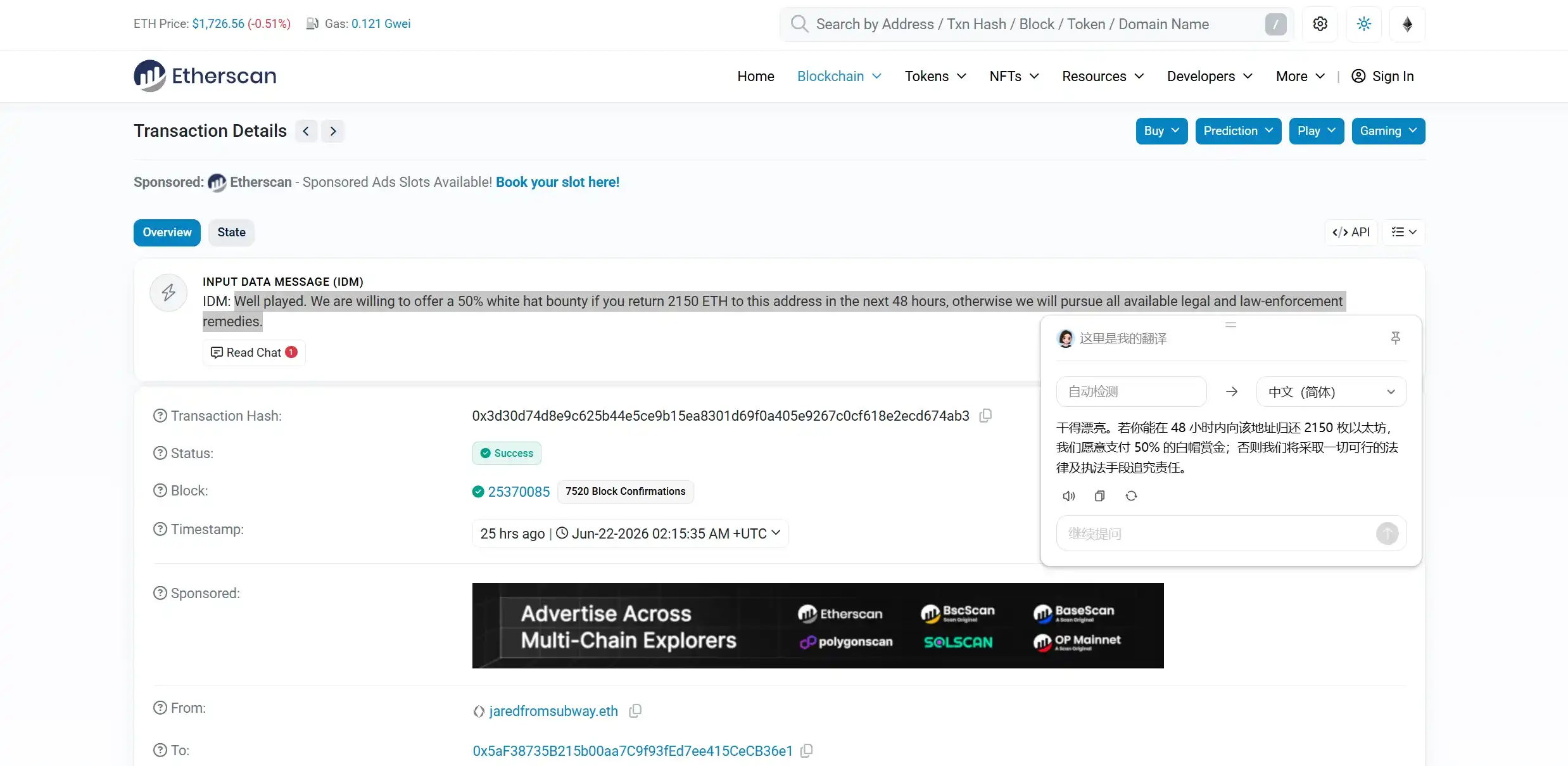
However, if even a highly specialized, code-driven MEV bot can stumble over an Approval, it forces us to re-examine how dangerous the 'Approval' action we use every day truly is.

I. A Reverse Hunt Designed Specifically for an MEV Bot

A careful review of this attack reveals it was not an accidentally triggered flaw but a long-term hunt designed around Jaredfromsubway.eth's trading logic.

Jaredfromsubway.eth has long been one of the most famous sandwich arbitrage bots on Ethereum. Simply put, a sandwich attack involves the bot spotting an impending on-chain transaction, buying ahead of the user to push the price up, waiting for the user to complete their transaction at a worse price, and then immediately selling to pocket the difference.

Consequently, this strategy requires the bot to continuously scan the mempool, identify arbitrage opportunities at extreme speed, and construct transaction paths calling various tokens and contracts. This also means the faster the speed and the broader the asset and protocol coverage, the more opportunities the bot can capture.

Yet, this very aspect became the entry point for this incident.

Based on post-mortem analysis, the attacker did not directly attack the bot's fund contract. Instead, they spent weeks constructing a trading environment that appeared profitable:

  • Step One: Deploy numerous fake tokens and liquidity pools. These tokens mimicked common assets like WETH, USDC, and USDT in name, interface, and trading behavior, tricking the bot's automated identification system into believing it had discovered normal trading paths.
  • Step Two: Gradually gain the bot's trust. In early tests, the approvals granted by the bot were consumed normally during transactions. Once the bot's system began repeatedly executing similar paths, the attacker adjusted the contract logic. This left some of the approvals generated by the bot unconsumed and not reset to zero after transactions, causing them to persist.
  • Finally, the attacker centrally invoked the still-valid approval limits to transfer the real WETH, USDC, and USDT from the bot's contract.
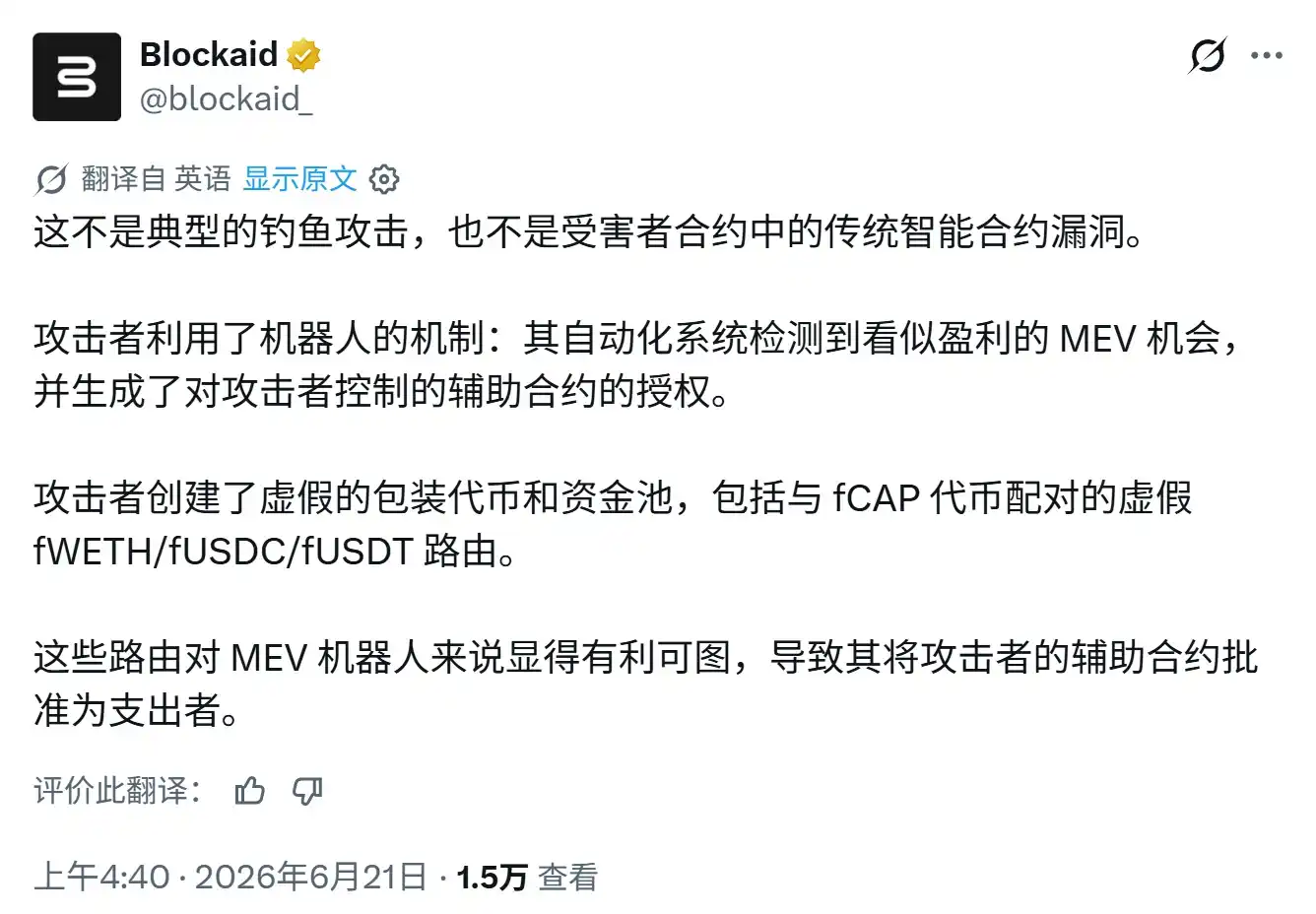
In essence, the entire attack precisely targeted the operational characteristics of MEV bots: first, create an environment that matches their profit-judgment rules; then, exploit their mechanism of pursuing automated execution of trading paths, making the system proactively hand over asset-calling permissions.

This also explains why even a highly specialized MEV bot could be tricked.

It knows how to calculate price differences, Gas costs, and transaction ordering, but may not conduct thorough identity verification for every newly appearing contract. From this perspective, the problem for ordinary users is 'confirming without understanding,' while the problem for automated bots is 'executing automatically without confirmation.'

Superficially, the two are entirely different, but the underlying risk is quite similar: both treat approval as just an ordinary step before completing a transaction, without clearly recognizing how high its hidden risk can be.

II. Why is Approval Always Underestimated?

As is well known, in the ERC-20 standard of Ethereum and EVM-compatible chains, Approve (authorization) is a fairly low-level design.

However, when users directly transfer tokens via their wallet, they typically call `transfer`, which generally doesn't involve Approve. Only in smart contract scenarios like DEXes, lending, staking, or adding liquidity—where users need a smart contract to call tokens on their behalf—does Approval come into play.

For example, when we want to swap USDT for ETH on Uniswap, Uniswap's smart contract cannot directly take USDT from your wallet. It must first execute an Approve to tell the system, 'I allow Uniswap to withdraw X amount of USDT from my wallet.'

Only after the approval is granted can the authorized contract, via `transferFrom`, call the user's USDT within the set limit, allowing the subsequent Swap to proceed smoothly.

In other words, Approval itself is not a vulnerability; it's a fundamental basis for DeFi's normal operation. The problem, however, is that it's somewhat like automatic debit permissions on Alipay/WeChat Pay:

The user hasn't given their account password to the merchant, but they have allowed the merchant to initiate debits within an agreed range. As long as the authorization remains valid, subsequent debits don't require the user to re-enter a password or confirm each transaction individually. This inherently creates issues.
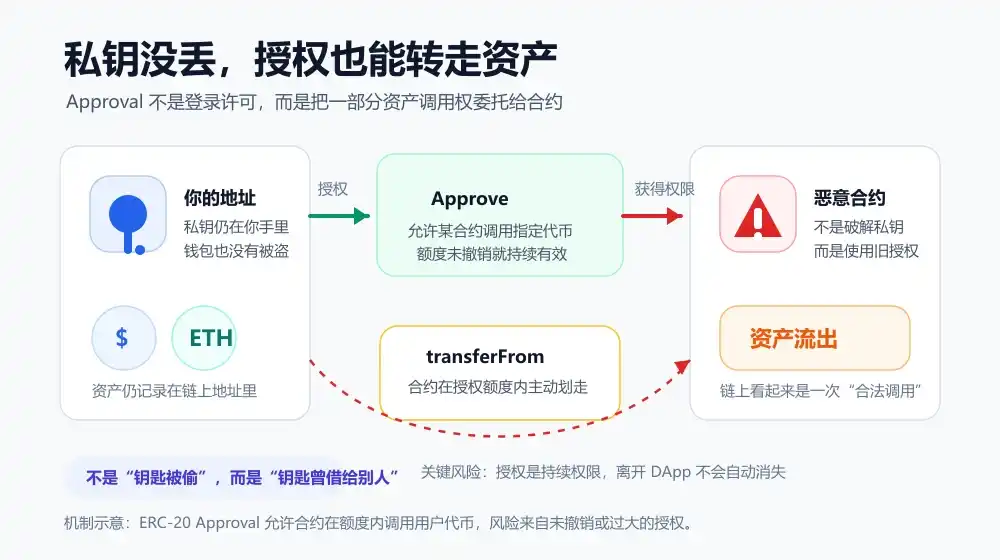
First, there's the issue of infinite approval—turning a one-time transaction into long-term permission. Mainly to reduce operational and Gas costs from repeated approvals, many DApps default to requesting an extremely large approval limit, commonly known as 'infinite approval.'

A user might have only intended to use 100 USDC for a single transaction but ended up allowing the contract to potentially use all USDC in their address in the future. As long as this approval isn't revoked, even if the user's wallet only held a small amount of assets at the time, future deposits of USDC could continue to be affected.

Second, approvals don't disappear by default when you leave a DApp. Many users confuse 'disconnecting a wallet' with 'revoking approval.' In reality, disconnecting only temporarily prevents the webpage from reading or requesting the current wallet; it doesn't change the Approval already written to the blockchain.

Closing the webpage, deleting the DApp, clearing browser cache, or even changing wallet applications won't automatically invalidate it.

Finally, even legitimate contracts can become dangerous in the future. Many approval risks don't only come from phishing sites that were malicious from the start, as seen in this hunt. A user might grant permission to a protocol that was normal at the time, but later, the protocol's contract could be hacked, admin keys leaked, upgradeable logic replaced, or issues could arise with its called router contracts.

For the user, the assets remain in their address, but from a permissions perspective, another contract always retains the ability to call those assets. Therefore, Approval risk isn't just about 'did I authorize a bad actor,' but also includes 'could the entity I authorized have problems later?'

III. So, How Can We Manage Approval Risk?

Faced with Approval risk, the simplest advice is 'don't grant infinite approval.'

However, in real-world DeFi usage, completely refusing approval is impractical. As mentioned, approval itself is not a flaw; it's the basic method for on-chain applications to call assets.

What truly needs to change is transforming Approval from a one-time confirmation action into an ongoing permission management mechanism.
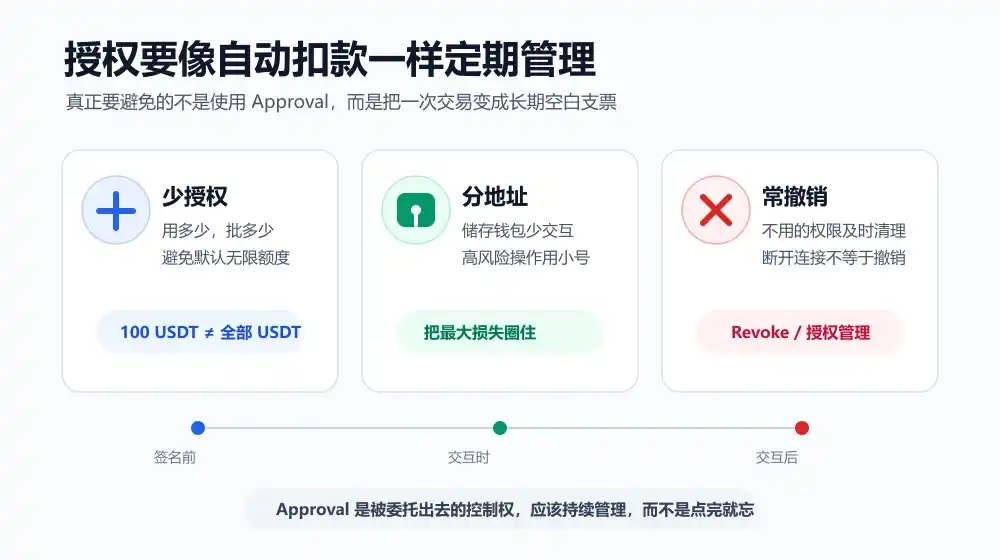
For ordinary users, first, it's essential to establish a few basic habits:

  • First, follow the 'principle of least privilege.' When a wallet pops up an approval prompt, try to set the limit based on the actual needs of the current interaction. For example, if you only plan to use 100 USDT, try to approve only an amount close to 100 USDT, rather than directly granting unlimited permission.
  • Second, separate storage wallets from interaction wallets. Avoid frequently connecting addresses holding large long-term assets to unfamiliar DApps. For activities like airdrops, minting, new projects, and high-risk DeFi interactions, use a separate address to limit potential losses to a smaller scope.
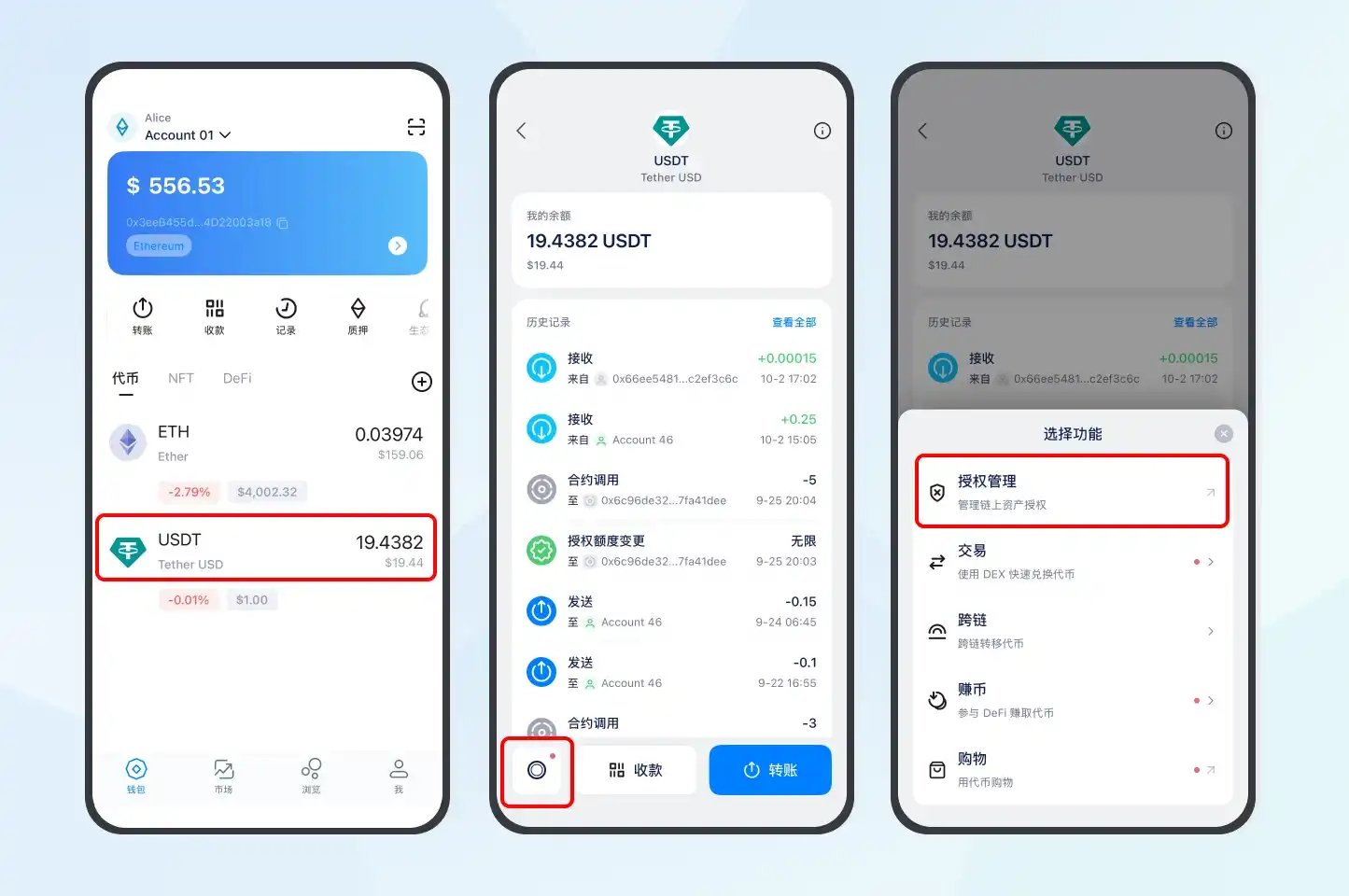
  • Third, regularly check and revoke approvals no longer needed. Users can utilize tools like Revoke.cash or, within imToken, navigate to the corresponding token page, click 'Token Function' in the bottom left, then select 'Authorization Management' to view approval targets, tokens, and amounts for that address. Revoke permissions that are no longer used or of unknown origin (further reading: Step-by-Step Guide to Using Revoke.cash for Authorization Management).
Of course, at the end of the day, facing unpredictable approval attacks, relying solely on user security awareness and regular checks isn't enough. After all, most users find it difficult to distinguish who a string of contract addresses belongs to or judge whether a particular approval amount is reasonable.

Therefore, as the first line of defense for users entering Web3, wallets must provide active defense in their product capabilities.

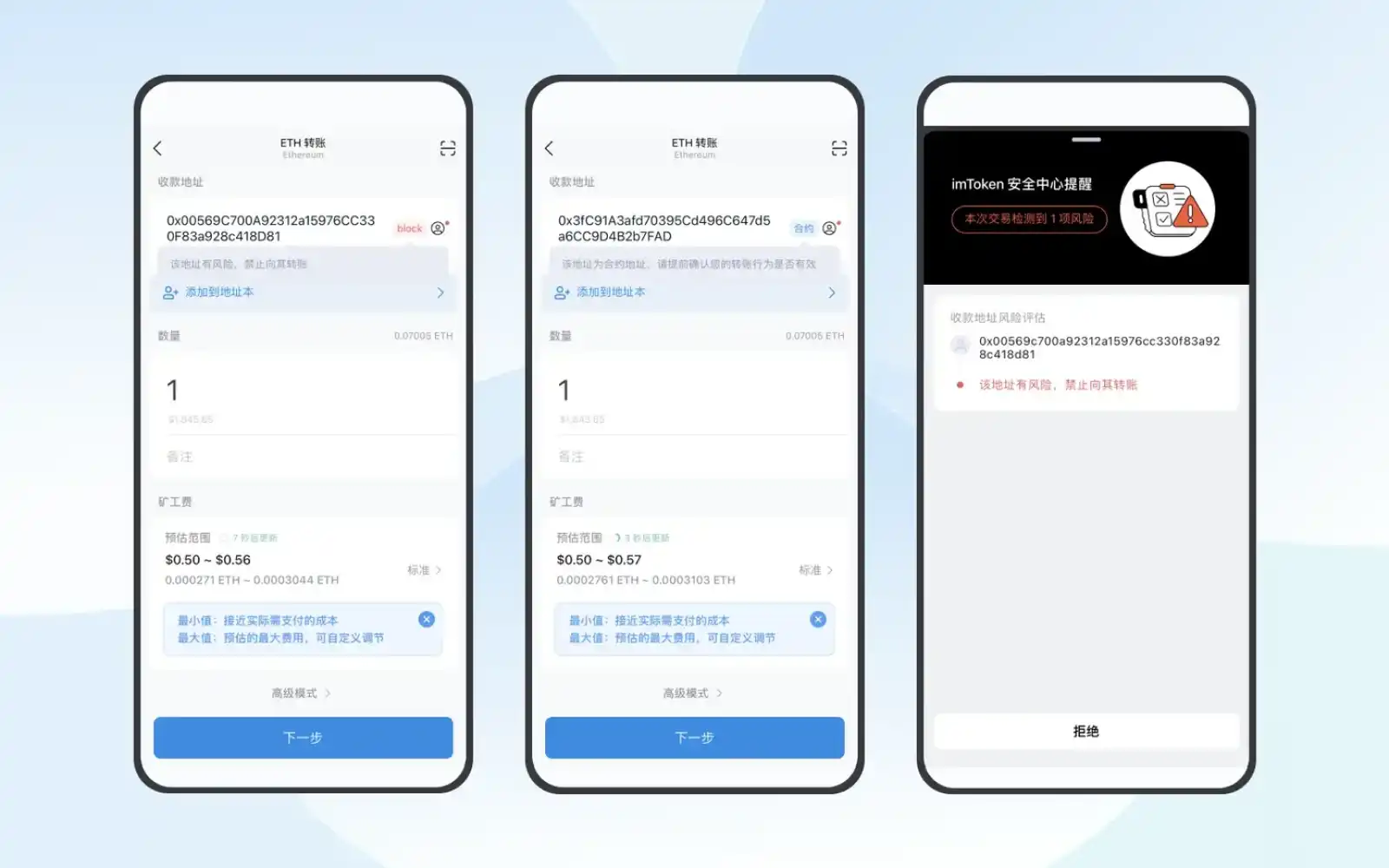
Taking imToken as an example, it marks or blocks identified risky tokens, addresses, and DApps. When users grant token permissions to ordinary external accounts or make direct transfers to contract addresses, targeted risk warnings are also provided. These warnings cannot replace user judgment but at least add a necessary safety buffer before actual signing.

Additionally, imToken performs structured parsing and human-readable presentation of signature content during key processes like DApp login, transfers, token swaps, and approvals. This aims to help users understand what they are agreeing to before confirmation, ensuring that the content users sign must be consistent with the behavior they see, rather than being compressed into an indistinguishable hash string.

With the further advancement of standards like ERC-7730 (Clear Signing), this 'What You See Is What You Sign' readable presentation is expected to gradually evolve from a single wallet's product capability into an industry standard shared among wallets, DApps, and smart contracts.
Overall, private keys determine who owns an account, while Approvals determine who else can call the assets within that account. They are not the same thing but are equally important.

This also means that wallet security cannot stop at 'has the private key been leaked.' This requires joint effort from users to wallets: For users, it's about seeing the object and amount before approving, and promptly cleaning up unnecessary permissions after interactions end. For wallets, it's about making these permissions—originally hidden within contracts—more visible, easier to understand, and more convenient to limit and revoke.

After all, what's truly dangerous might not be the transfer that just happened, but an approval long forgotten yet never invalidated.

Criptomoedas em alta

Perguntas relacionadas

QHow did the attacker manage to steal $7.5 million from the Jaredfromsubway.eth MEV bot, and what was the core vulnerability exploited?

AThe attacker did not exploit a private key leak or a traditional smart contract vulnerability. Instead, they spent weeks creating a 'honeypot' environment by deploying numerous fake tokens and liquidity pools that mimicked legitimate assets like WETH and USDC. This setup tricked the MEV bot's automated system into identifying these as profitable arbitrage paths. During its execution, the bot was induced to grant Approvals to the malicious contracts. Once the approvals were in place and the bot had accumulated a certain level of trust through repeated interactions, the attacker called the still-valid approval limits to legally transfer the bot's real WETH, USDC, and USDT assets. The core vulnerability exploited was the bot's automated and insufficiently verified granting of ERC-20 token approvals.

QWhat are the three main reasons why Approval risks are often underestimated by users in DeFi, according to the article?

AAccording to the article, Approval risks are underestimated due to three main reasons: 1. **Unlimited Approvals**: Users often grant extremely high or infinite approval amounts to DApps to save on gas fees and repeated confirmations for future transactions, exposing all current and future tokens of that type. 2. **Persistence of Approvals**: Users commonly mistake disconnecting a wallet from a DApp interface with revoking an approval. Approvals are recorded on-chain and remain valid until explicitly revoked, regardless of closing the website or switching wallets. 3. **Future Risk of Approved Contracts**: A contract that was safe at the time of approval can later become dangerous due to exploits, admin key leaks, logic upgrades, or issues with downstream contracts it calls, posing an ongoing risk.

QWhat practical steps can ordinary users take to manage and mitigate their Approval-related risks?

AOrdinary users can take several practical steps to manage Approval risks: 1. **Principle of Least Privilege**: Only approve the specific amount needed for the current transaction, avoiding unlimited approvals whenever possible. 2. **Separate Wallets**: Use a dedicated 'hot' wallet for frequent interactions with new or high-risk DApps, and a separate 'cold' wallet for storing significant long-term assets to limit potential exposure. 3. **Regular Review and Revocation**: Periodically use tools like Revoke.cash or wallet-built-in features (e.g., imToken's 'Token Function' -> 'Authorization Management') to review all active approvals and revoke those that are no longer needed or from unknown sources.

QWhat role do wallets like imToken play in helping users defend against Approval risks, beyond user education?

AWallets like imToken provide proactive defense mechanisms at the product level: 1. **Risk Identification and Warnings**: They mark or block known risky tokens, addresses, and DApps, and provide specific risk warnings when users attempt actions like granting token approvals to external accounts or transferring directly to contract addresses. 2. **Clear Signing (Structured Transaction Decoding)**: They parse and present the content of signature requests (for logins, transfers, swaps, approvals) in a human-readable, structured format. This helps users understand what they are agreeing to before signing, ensuring 'What You See Is What You Sign' and preventing confusion with raw hash data. 3. **Support for Industry Standards**: They support the development and adoption of standards like ERC-7730 (Clear Signing) to make this safety feature a shared industry standard across wallets, DApps, and smart contracts.

QAccording to the article's conclusion, how does the importance of managing Approvals compare to protecting private keys, and what is the required approach for overall wallet security?

AThe article concludes that managing Approvals is equally as important as protecting private keys, but they address different aspects of security. The private key determines **who owns the account**, while Approvals determine **who else can move the assets within that account**. Therefore, wallet security cannot be solely focused on 'whether the private key is leaked.' A comprehensive approach requires effort from both users and wallet providers: Users must carefully review approval requests, grant minimal necessary permissions, and regularly clean up unused approvals. Wallet providers must make these on-chain permissions more visible, understandable, and easier to limit and revoke through better user interfaces and proactive safety features.

Leituras Relacionadas

Collector Crypt's DAU Is Only 800, Yet It's Already One of Crypto's Most Profitable Projects?

"Collector Crypt: A Highly Profitable Crypto Project with Only 800 Daily Active Users?" Collector Crypt (CARDS) is a crypto project tokenizing physical graded trading cards (primarily Pokémon) on Solana, achieving significant real-world profitability and growth. According to a Maelstrom Fund analysis, it generated approximately $53M in annualized profit in May, with a June run-rate nearing $109M, against a $550M FDV. Its core revenue driver is a digital pack-opening 'Gacha' system. The platform bulk-buys cards at a 5-15% discount. Users can open digital packs and choose to keep cards or sell them back to the platform at a 7-15% discount to market price. Most users sell back common cards, creating an efficient model: users get packs with a ~2% positive expected value, while Collector Crypt captures ~4.5% profit. The project aims to disrupt the inefficient $22.2B GMV (Q1 2026) eBay trading card market, which charges sellers 16-20% in total fees. Collector Crypt offers 2% fees, instant settlement, insured custody, and one-click trading. Beyond Gacha, future revenue streams include secondary market trading fees, infrastructure partnerships, and an eBay "snipe" tool. It holds ~$23M in card inventory and ~$10M in cash, and has already begun token buybacks. With a total supply of 2B tokens, effective circulation post-2027 unlocks is estimated at ~1.3B. Trading primarily on DEXs has so far limited large institutional entry. The project is expanding into sports cards and attracting Web2 users. Maelstrom Fund's price target is $4 by summer's end, positioning Collector Crypt at the forefront of migrating collectibles on-chain.

Foresight NewsHá 2m

Collector Crypt's DAU Is Only 800, Yet It's Already One of Crypto's Most Profitable Projects?

Foresight NewsHá 2m

New Chair, Old Inflation, Better-Than-Expected Jobs: How Are Global Assets Repriced After Wash's Debut?

New Fed Chairman Kevin Wash's first FOMC meeting delivered a "hold" decision, keeping rates at 3.50%-3.75%. The key signal was a major shift in communication: the policy statement was shortened, and forward guidance was removed. Wash emphasized the Fed will no longer pre-commit to future actions, instead refocusing markets on economic data itself. The updated "dot plot" revealed a hawkish tilt, with the median forecast for the policy rate rising to 3.8% by year-end, suggesting a potential 25-basis-point hike in 2026. PCE inflation forecasts were also significantly raised. This reflects the Fed's current dilemma: a resilient job market (May nonfarm payrolls beat expectations) coupled with persistent inflation (PCE remains well above 2%) makes rate cuts unlikely and hikes a possibility. Wash inherits a deeply divided committee and a challenging macro environment reminiscent of 1994—strong growth with latent stagflation risks. His primary test is balancing inflation control against economic stability. Markets are repricing assets accordingly. The dollar strengthened on higher rate expectations. Treasury ETFs face pressure from potential hikes but may attract haven flows if growth fears emerge. Gold's role is more as a hedge amid conflicting forces. AI infrastructure stocks face valuation compression from higher rates, but the sector's fundamental demand logic remains intact if cloud CapEx holds. Defense stocks offer some resilience due to long-term government contracts. Looking ahead, key data points will drive market moves: the June nonfarm payrolls (July 2) and CPI (mid-July) will be critical for setting the tone of the July FOMC meeting (July 28-29), where Wash may face his first real policy decision. Political pressure from the White House for rate cuts will also be a persistent theme testing Fed independence.

marsbitHá 15m

New Chair, Old Inflation, Better-Than-Expected Jobs: How Are Global Assets Repriced After Wash's Debut?

marsbitHá 15m

Stablecoin Salaries: Why Are They Becoming the First Choice for Cross-Border Workers?

Stablecoin Salaries: Why They're Becoming the Top Choice for Global Remote Workers The traditional global salary system carries hidden exchange rate risks for freelancers in countries like India, Argentina, and Turkey who earn in USD but spend in local currencies. When salaries are instantly converted to local currency, workers lose purchasing power if that currency depreciates against the dollar. For instance, an Indian designer converting a $2000 monthly salary to rupees lost over 10% in purchasing power last year due to the rupee's decline. Holding even a portion of income in USD or USD-pegged stablecoins can preserve value. Stablecoins offer a solution by breaking down barriers to holding dollars. Opening foreign USD bank accounts is difficult, and international wire transfers incur high fees (averaging 6.5%) and delays. In contrast, stablecoin transfers are fast and low-cost. Furthermore, many countries with high inflation and depreciating currencies restrict citizens' access to foreign currency. Self-custody stablecoin wallets enable workers to hold dollar-equivalent assets without needing bank approval, bypassing these limits. These wallets integrate multiple functions: they allow users to convert only what's needed for daily expenses into local currency, keep the remainder in stablecoins, connect to on-chain lending or yield products, and even link to payment cards for direct spending. While challenges remain—such as the lack of deposit insurance and evolving regulatory frameworks—the trend is clear. Reports indicate a growing preference for USD or stablecoin payments among freelancers in high-inflation countries. This shift represents a fundamental restructuring of salary functions: payment currency, asset storage, yield generation, spending, and cross-border flow. It offers the freedom and flexibility that are core to money's purpose, signaling a profound change in the global financial landscape.

Foresight NewsHá 30m

Stablecoin Salaries: Why Are They Becoming the First Choice for Cross-Border Workers?

Foresight NewsHá 30m

Don't Just Focus on Layoffs, The New Structure of the Ethereum Foundation is More Worthy of Appreciation

The Ethereum Foundation (EF) has undergone a significant organizational restructuring, with the most notable change being a strategic refocusing of its priorities rather than just a 20% staff reduction (approximately 54 people). The new structure clearly prioritizes the Protocol and Access layers, which now comprise the largest teams (57 and 34 people, respectively). This signals EF's intent to concentrate its core resources on fundamental, hard-to-outsource aspects of Ethereum: protocol evolution, security, privacy, client development, and the foundational access layer. Key areas within the Protocol layer, led by an architecture group including Vitalik Buterin and Justin Drake, receive heightened emphasis. These include post-quantum security, zkEVM, formal verification, and long-term roadmap development ("Strawmap"). This reflects a shift towards tackling complex, interdependent challenges like scalability, privacy, and future-proofing the protocol, potentially moving from a pure "redundant security" multi-client model towards more specialized clients aided by AI-assisted formal verification. Financially, EF's budget is being reduced by approximately 40%. The goal is to transition from spending about 15% of its remaining funds annually to a more sustainable 5% rate, akin to a long-term endowment, ensuring its longevity. Concurrently, the restructuring involves pushing certain responsibilities—such as application development, adoption, and ecosystem coordination—to external organizations like EthLabs, the Ethereum Apps Guild, and others. This "multi-node" model aims to increase ecosystem resilience by decentralizing functions beyond the EF, though it introduces new coordination challenges. In essence, the reorganization represents EF consciously narrowing its scope to focus on the hardest, most critical protocol-level problems while fostering a more distributed and sustainable ecosystem structure for Ethereum's future growth.

Foresight NewsHá 58m

Don't Just Focus on Layoffs, The New Structure of the Ethereum Foundation is More Worthy of Appreciation

Foresight NewsHá 58m

Trading

Spot
Futuros

Artigos em Destaque

O que é ETH 2.0

ETH 2.0: Uma Nova Era para o Ethereum Introdução ETH 2.0, amplamente conhecido como Ethereum 2.0, marca uma atualização monumental à blockchain do Ethereum. Esta transição não é meramente uma mudança estética; visa melhorar fundamentalmente a escalabilidade, segurança e sustentabilidade da rede. Com uma mudança do mecanismo de consenso em Proof of Work (PoW), intensivo em energia, para um Proof of Stake (PoS) mais eficiente, o ETH 2.0 promete uma abordagem transformadora ao ecossistema blockchain. O que é ETH 2.0? ETH 2.0 é um conjunto de atualizações distintas e interconectadas focadas na otimização das capacidades e desempenho do Ethereum. Esta reformulação foi projetada para abordar desafios críticos que o mecanismo atual do Ethereum enfrentou, particularmente em relação à velocidade das transações e à congestão da rede. Objetivos do ETH 2.0 Os principais objetivos do ETH 2.0 giram em torno da melhoria de três aspectos centrais: Escalabilidade: Com o objetivo de melhorar significativamente o número de transações que a rede pode manejar por segundo, o ETH 2.0 procura ultrapassar a limitação atual de aproximadamente 15 transações por segundo, alcançando potencialmente milhares. Segurança: Medidas de segurança melhoradas são integrais ao ETH 2.0, especialmente através da resistência aprimorada contra ciberataques e da preservação do ethos descentralizado do Ethereum. Sustentabilidade: O novo mecanismo PoS foi projetado não apenas para melhorar a eficiência, mas também para reduzir drasticamente o consumo de energia, alinhando a estrutura operacional do Ethereum com considerações ambientais. Quem é o Criador do ETH 2.0? A criação do ETH 2.0 pode ser atribuída à Ethereum Foundation. Esta organização sem fins lucrativos, que desempenha um papel crucial no apoio ao desenvolvimento do Ethereum, é liderada pelo co-fundador notável Vitalik Buterin. A sua visão de um Ethereum mais escalável e sustentável tem sido a força motriz por trás desta atualização, envolvendo contribuições de uma comunidade global de desenvolvedores e entusiastas dedicados a melhorar o protocolo. Quem são os Investidores do ETH 2.0? Embora os detalhes sobre os investidores do ETH 2.0 não tenham sido tornados públicos, é sabido que a Ethereum Foundation recebe apoio de várias organizações e indivíduos no espaço da blockchain e tecnologia. Esses parceiros incluem firmas de capital de risco, empresas de tecnologia e organizações filantrópicas que compartilham um interesse mútuo em apoiar o desenvolvimento de tecnologias descentralizadas e infraestrutura de blockchain. Como Funciona o ETH 2.0? ETH 2.0 é notável por introduzir uma série de características chave que o diferenciam do seu predecessor. Proof of Stake (PoS) A transição para um mecanismo de consenso PoS é uma das mudanças de destaque do ETH 2.0. Ao contrário do PoW, que depende da mineração intensiva em energia para a verificação de transações, o PoS permite que os utilizadores validem transações e criem novos blocos de acordo com a quantidade de ETH que apostam na rede. Isso leva a uma maior eficiência energética, reduzindo o consumo em aproximadamente 99,95%, tornando o Ethereum 2.0 uma alternativa consideravelmente mais ecológica. Shard Chains As shard chains são outra inovação crítica do ETH 2.0. Estas cadeias menores operam em paralelo com a cadeia principal do Ethereum, permitindo que várias transações sejam processadas simultaneamente. Esta abordagem melhora a capacidade geral da rede, abordando preocupações de escalabilidade que têm atormentado o Ethereum. Beacon Chain No coração do ETH 2.0 está a Beacon Chain, que coordena a rede e gere o protocolo PoS. Ela atua como uma espécie de organizador: supervisiona os validadores, garante que as shards permaneçam conectadas à rede e monitora a saúde geral do ecossistema blockchain. Linha do Tempo do ETH 2.0 A jornada do ETH 2.0 tem sido marcada por vários marcos chave que traçam a evolução desta atualização significativa: Dezembro de 2020: O lançamento da Beacon Chain marcou a introdução do PoS, preparando o caminho para a migração para o ETH 2.0. Setembro de 2022: A conclusão de “The Merge” representa um momento crucial em que a rede Ethereum fez a transição com sucesso de um quadro PoW para um PoS, anunciando uma nova era para o Ethereum. 2023: O lançamento esperado das shard chains visa melhorar ainda mais a escalabilidade da rede Ethereum, solidificando o ETH 2.0 como uma plataforma robusta para aplicações e serviços descentralizados. Características Chave e Benefícios Escalabilidade Melhorada Uma das vantagens mais significativas do ETH 2.0 é a sua escalabilidade melhorada. A combinação de PoS e shard chains permite que a rede expanda a sua capacidade, permitindo que acomode um volume de transações muito maior em comparação com o sistema legado. Eficiência Energética A implementação do PoS representa um enorme passo em direção à eficiência energética na tecnologia blockchain. Ao reduzir drasticamente o consumo de energia, o ETH 2.0 não só reduz os custos operacionais, mas também se alinha mais estreitamente com os objetivos globais de sustentabilidade. Segurança Aprimorada Os mecanismos atualizados do ETH 2.0 contribuem para uma segurança melhorada em toda a rede. O uso do PoS, juntamente com medidas de controle inovadoras estabelecidas através das shard chains e da Beacon Chain, assegura um maior grau de proteção contra potenciais ameaças. Custos Mais Baixos para os Utilizadores À medida que a escalabilidade melhora, os efeitos sobre os custos de transação também serão evidentes. Aumentada a capacidade e reduzida a congestão, espera-se que isso se traduza em taxas mais baixas para os utilizadores, tornando o Ethereum mais acessível para transações do dia a dia. Conclusão ETH 2.0 marca uma evolução significativa no ecossistema da blockchain do Ethereum. Ao abordar questões fundamentais como a escalabilidade, o consumo de energia, a eficiência das transações e a segurança geral, a importância desta atualização não pode ser subestimada. A transição para o Proof of Stake, a introdução das shard chains e o trabalho fundamental da Beacon Chain são indicativos de um futuro em que o Ethereum pode atender à crescente demanda do mercado descentralizado. Em uma indústria movida pela inovação e progresso, o ETH 2.0 representa um testemunho das capacidades da tecnologia blockchain em pavimentar o caminho para uma economia digital mais sustentável e eficiente.

108 Visualizações TotaisPublicado em {updateTime}Atualizado em 2024.12.03

O que é ETH 2.0

O que é ETH 3.0

ETH3.0 e $eth 3.0: Uma Análise Profunda do Futuro do Ethereum Introdução No ambiente em rápida evolução da criptomoeda e da tecnologia blockchain, o ETH3.0, frequentemente denotado como $eth 3.0, emergiu como um tema de considerável interesse e especulação. O termo abrange dois conceitos principais que merecem esclarecimento: Ethereum 3.0: Esta representa uma potencial atualização futura destinada a aumentar as capacidades da atual blockchain do Ethereum, focando especialmente na melhoria da escalabilidade e desempenho. ETH3.0 Meme Token: Este distinto projeto de criptomoeda procura aproveitar a blockchain do Ethereum na criação de um ecossistema centrado em memes, promovendo o envolvimento na comunidade de criptomoedas. Compreender esses aspectos do ETH3.0 é essencial não apenas para entusiastas de criptomoedas, mas também para aqueles que observam as tendências tecnológicas mais amplas no espaço digital. O que é ETH3.0? Ethereum 3.0 Ethereum 3.0 é promovido como uma atualização proposta para a rede Ethereum já estabelecida, que tem sido a espinha dorsal de muitas aplicações descentralizadas (dApps) e contratos inteligentes desde a sua criação. As melhorias vislumbradas concentram-se principalmente na escalabilidade—integrando tecnologias avançadas como sharding e provas de conhecimento zero (zk-proofs). Essas inovações tecnológicas visam facilitar um número sem precedentes de transações por segundo (TPS), potencialmente alcançando milhões, abordando assim uma das limitações mais significativas enfrentadas pela tecnologia blockchain atual. A melhoria não é meramente técnica, mas também estratégica; visa preparar a rede Ethereum para uma adoção generalizada e utilidade em um futuro marcado por uma maior demanda por soluções descentralizadas. ETH3.0 Meme Token Em contraste com o Ethereum 3.0, o ETH3.0 Meme Token aventura-se por um domínio mais leve e divertido, combinando a cultura dos memes da internet com a dinâmica das criptomoedas. Este projeto permite que os usuários comprem, vendam e negociem memes na blockchain do Ethereum, proporcionando uma plataforma que fomenta o envolvimento da comunidade através da criatividade e interesses compartilhados. O ETH3.0 Meme Token visa demonstrar como a tecnologia blockchain pode interseccionar com a cultura digital, criando casos de uso que são tanto divertidos quanto financeiramente viáveis. Quem é o Criador do ETH3.0? Ethereum 3.0 A iniciativa em direção ao Ethereum 3.0 é impulsionada principalmente por um consórcio de desenvolvedores e pesquisadores dentro da comunidade Ethereum, notavelmente incluindo Justin Drake. Conhecido por suas percepções e contribuições para a evolução do Ethereum, Drake tem sido uma figura proeminente nas discussões sobre a transição do Ethereum para uma nova camada de consenso, referida como “Beam Chain”. Esta abordagem colaborativa ao desenvolvimento significa que o Ethereum 3.0 não é fruto de um único criador, mas sim uma manifestação da engenhosidade coletiva focada no avanço da tecnologia blockchain. ETH3.0 Meme Token Os detalhes sobre o criador do ETH3.0 Meme Token são atualmente indetectáveis. A natureza dos tokens de meme frequentemente leva a uma estrutura mais descentralizada e impulsionada pela comunidade, o que poderia explicar a falta de atribuição específica. Isso alinha-se com a ethos da comunidade de criptomoedas mais ampla, onde a inovação geralmente surge de esforços colaborativos em vez de esforços individuais. Quem são os Investidores do ETH3.0? Ethereum 3.0 O apoio ao Ethereum 3.0 provém principalmente da Fundação Ethereum, juntamente com uma comunidade entusiástica de desenvolvedores e investidores. Esta associação fundacional proporciona um grau significativo de legitimidade e melhora as perspectivas de uma implementação bem-sucedida, uma vez que aproveita a confiança e credibilidade construída ao longo de anos de operações de rede. Em um clima em rápida mudança no mundo das criptomoedas, o apoio da comunidade desempenha um papel crucial no impulso ao desenvolvimento e adoção, posicionando o Ethereum 3.0 como um sério candidato a futuros avanços na blockchain. ETH3.0 Meme Token Embora as fontes atualmente disponíveis não forneçam informações explícitas sobre as fundações ou organizações de investimento que apoiam o ETH3.0 Meme Token, é indicativo do modelo típico de financiamento para tokens de meme, que frequentemente depende de apoio base e engajamento da comunidade. Os investidores em tais projetos costumam consistir em indivíduos motivados pelo potencial de inovação impulsionada pela comunidade e pelo espírito de cooperação encontrado dentro da comunidade cripto. Como Funciona o ETH3.0? Ethereum 3.0 As características distintivas do Ethereum 3.0 residem em sua proposta de implementação de sharding e tecnologia zk-proof. Sharding é um método de partição da blockchain em partes menores e gerenciáveis ou “shards”, que podem processar transações simultaneamente em vez de sequencialmente. Esta descentralização do processamento ajuda a prevenir congestionamentos e garante que a rede permaneça responsiva mesmo sob carga pesada. A tecnologia de prova de conhecimento zero (zk-proof) contribui com outra camada de sofisticação ao permitir a validação de transações sem revelar os dados subjacentes envolvidos. Este aspecto não apenas melhora a privacidade, mas também aumenta a eficiência geral da rede. Há também conversas sobre a incorporação de uma Máquina Virtual Ethereum de conhecimento zero (zkEVM) nesta atualização, amplificando ainda mais as capacidades e utilidade da rede. ETH3.0 Meme Token O ETH3.0 Meme Token distingue-se ao capitalizar sobre a popularidade da cultura dos memes. Estabelece um mercado para que os usuários participem da negociação de memes, não apenas para entretenimento, mas também para potencial ganho econômico. Ao integrar recursos como staking, provisão de liquidez e mecanismos de governança, o projeto fomenta um ambiente que incentiva a interação e participação da comunidade. Ao oferecer uma mistura única de entretenimento e oportunidade econômica, o ETH3.0 Meme Token visa atrair um público diversificado, variando de entusiastas de criptomoedas a conhecedores casuais de memes. Cronologia do ETH3.0 Ethereum 3.0 11 de novembro de 2024: Justin Drake sugere a próxima atualização do ETH 3.0, centrada nas melhorias de escalabilidade. Este anúncio sinaliza o início de discussões formais sobre a futura arquitetura do Ethereum. 12 de novembro de 2024: A proposta antecipada para Ethereum 3.0 deve ser revelada no Devcon em Bangkok, preparando o cenário para um feedback mais amplo da comunidade e potenciais próximos passos no desenvolvimento. ETH3.0 Meme Token 21 de março de 2024: O ETH3.0 Meme Token é oficialmente listado no CoinMarketCap, marcando sua entrada no domínio público das criptomoedas e aumentando a visibilidade de seu ecossistema baseado em memes. Pontos Chave Em conclusão, Ethereum 3.0 representa uma evolução significativa dentro da rede Ethereum, focando em superar limitações quanto à escalabilidade e desempenho através de tecnologias avançadas. As atualizações propostas refletem uma abordagem proativa às futuras demandas e usabilidade. Por outro lado, o ETH3.0 Meme Token encapsula a essência da cultura impulsionada pela comunidade no espaço das criptomoedas, aproveitando a cultura dos memes para criar plataformas envolventes que incentivam a criatividade e participação dos usuários. Compreender os distintos propósitos e funcionalidades do ETH3.0 e $eth 3.0 é fundamental para qualquer pessoa interessada nos desenvolvimentos contínuos dentro do espaço cripto. Com ambas as iniciativas a pavimentar caminhos únicos, elas sublinham coletivamente a natureza dinâmica e multifacetada da inovação em blockchain.

109 Visualizações TotaisPublicado em {updateTime}Atualizado em 2024.12.03

O que é ETH 3.0

Como comprar ETH

Bem-vindo à HTX.com!Tornámos a compra de Ethereum (ETH) simples e conveniente.Segue o nosso guia passo a passo para iniciar a tua jornada no mundo das criptos.Passo 1: cria a tua conta HTXUtiliza o teu e-mail ou número de telefone para te inscreveres numa conta gratuita na HTX.Desfruta de um processo de inscrição sem complicações e desbloqueia todas as funcionalidades.Obter a minha contaPasso 2: vai para Comprar Cripto e escolhe o teu método de pagamentoCartão de crédito/débito: usa o teu visa ou mastercard para comprar Ethereum (ETH) instantaneamente.Saldo: usa os fundos da tua conta HTX para transacionar sem problemas.Terceiros: adicionamos métodos de pagamento populares, como Google Pay e Apple Pay, para aumentar a conveniência.P2P: transaciona diretamente com outros utilizadores na HTX.Mercado de balcão (OTC): oferecemos serviços personalizados e taxas de câmbio competitivas para os traders.Passo 3: armazena teu Ethereum (ETH)Depois de comprar o teu Ethereum (ETH), armazena-o na tua conta HTX.Alternativamente, podes enviá-lo para outro lugar através de transferência blockchain ou usá-lo para transacionar outras criptomoedas.Passo 4: transaciona Ethereum (ETH)Transaciona facilmente Ethereum (ETH) no mercado à vista da HTX.Acede simplesmente à tua conta, seleciona o teu par de trading, executa as tuas transações e monitoriza em tempo real.Oferecemos uma experiência de fácil utilização tanto para principiantes como para traders experientes.

3.2k Visualizações TotaisPublicado em {updateTime}Atualizado em 2026.06.02

Como comprar ETH

Discussões

Bem-vindo à Comunidade HTX. Aqui, pode manter-se informado sobre os mais recentes desenvolvimentos da plataforma e obter acesso a análises profissionais de mercado. As opiniões dos utilizadores sobre o preço de ETH (ETH) são apresentadas abaixo.

活动图片