Tokenized US Treasuries Lose Momentum, Equity Tokenization Becomes New Frontier in RWA

marsbitPublicado em 2026-08-11Última atualização em 2026-08-11

Resumo

Tokenized U.S. Treasuries, once a major driver in the RWA market, have plateaued around $15 billion. Meanwhile, the tokenized stock market is rapidly expanding, growing 6.5x to approximately $1.9 billion since early 2025, attracting diverse players. The SEC's recent classification framework identifies four key tokenized security structures, applicable to stocks: 1. **Issuer-Sponsored:** Companies tokenize their own shares directly, preserving full shareholder rights but with stricter compliance (e.g., Securitize). 2. **Custodial:** A third party tokenizes securities held by a custodian like DTCC, also inheriting rights but reliant on traditional infrastructure (e.g., DTCC's pilot, Ondo's recent IVV tokenization). 3. **Linked Security:** A third party issues tokenized debt securities backed by the underlying stock, offering high on-chain flexibility but no voting rights (e.g., Ondo, xStocks, Robinhood's new Stock Tokens). 4. **Security-Based Swap:** Tokenized derivatives contracts providing synthetic exposure (e.g., Robinhood's earlier Classic Stock Tokens). Major players are pursuing different strategies. **Securitize** uses the issuer-sponsored model for full compliance. **Ondo** and **xStocks** leverage the linked security structure for wider accessibility and DeFi integration, though it fragments liquidity and excludes U.S. investors. **Robinhood** has shifted to a linked security model, aiming to leverage its user base and new blockchain. Traditional infrastructure ...

Author: 100y_eth

Compiled: AididiaoJP

Key Takeaways

Unlike the recently stagnant tokenized US Treasury market, the tokenized equity market is experiencing rapid expansion in both quantity and quality.

Players ranging from traditional equity infrastructure providers, fintech companies, crypto exchanges to Web3-native platforms all view tokenized equities as the next major opportunity in the RWA industry. In fact, there are multiple distinct paths to equity tokenization, and understanding their respective strengths, weaknesses, and positioning is crucial.

This article analyzes the strategies of players from diverse backgrounds, including Securitize, Ondo, xStocks, Robinhood, DTCC, NYSE, Nasdaq, and Coinbase.

All Eyes Are on Tokenized Equities
Today, regulators, banks, institutions, fintech companies, and nearly all major market participants show strong interest in tokenization. However, the term 'tokenization' truly becoming a focal point is a relatively recent phenomenon. The main driver behind the early growth of the tokenization market was undeniably US Treasuries. Their rapid adoption relied on three factors: the safety of US government debt, the relatively simple tokenization structure, and the high yields available at the time.

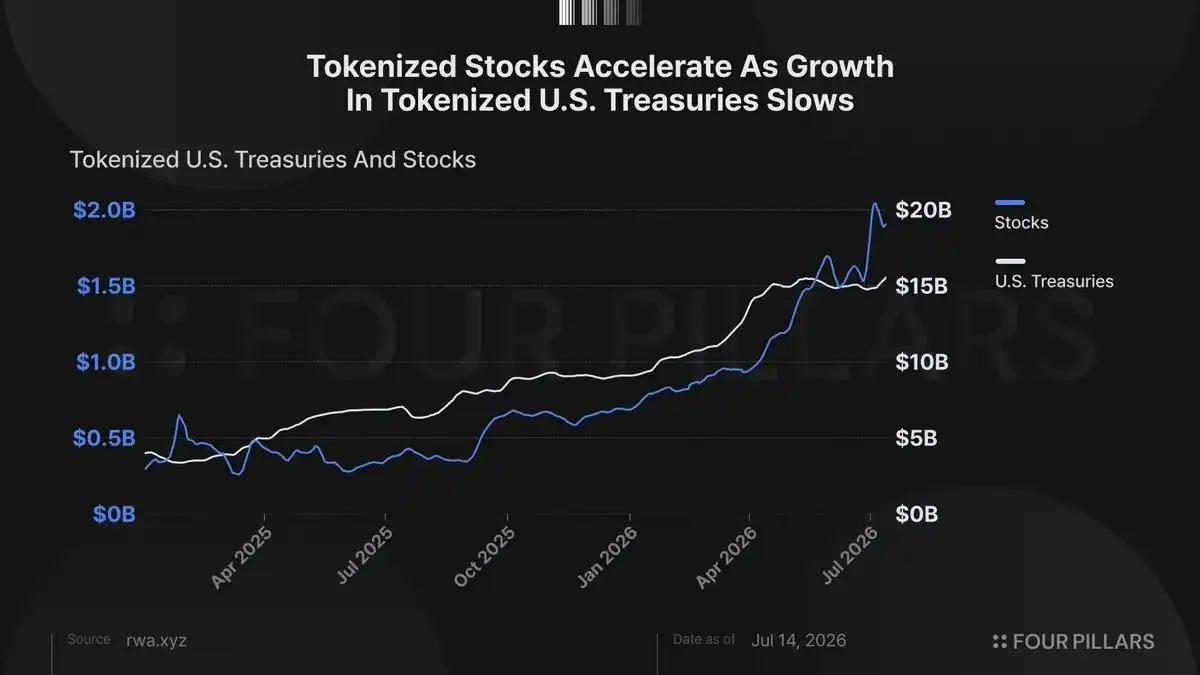
The tokenized US Treasury market grew from $701 million on January 1, 2024, to over $15 billion for the first time on April 17, 2026, representing an astonishing compound annual growth rate (CAGR) of approximately 3.81x. However, after surpassing $15 billion, the market has hovered around that level, showing a clear slowdown in growth. Given that a significant portion of the demand for tokenized Treasuries came from DeFi protocols or exchange margin use cases, the recent unfavorable market environment makes the demand stagnation unsurprising.

As the momentum for tokenized US Treasuries wanes, another tokenization segment is rapidly rising in both scale and quality—tokenized equities. The market has grown 6.5x, from $291 million on January 1, 2025, to approximately $1.9 billion currently, within a year and a half. At the industry level, whether it's Web3-native players like Securitize and Ondo Global Markets, financial companies like Robinhood and Coinbase, or financial infrastructure providers like DTCC, NYSE, and Nasdaq, they have either already launched tokenized equities or are actively preparing to do so.

What advantages do tokenized equities offer over the traditional stock market that make nearly all major US players see them as the next significant opportunity? At first glance, tokenizing stocks seems straightforward, but in practice, depending on the regulatory framework adopted, various tokenization structures emerge, each offering different benefits. To understand these differences, one must first clarify the SEC's classification framework for tokenized securities.

SEC's Classification Framework for Tokenized Securities
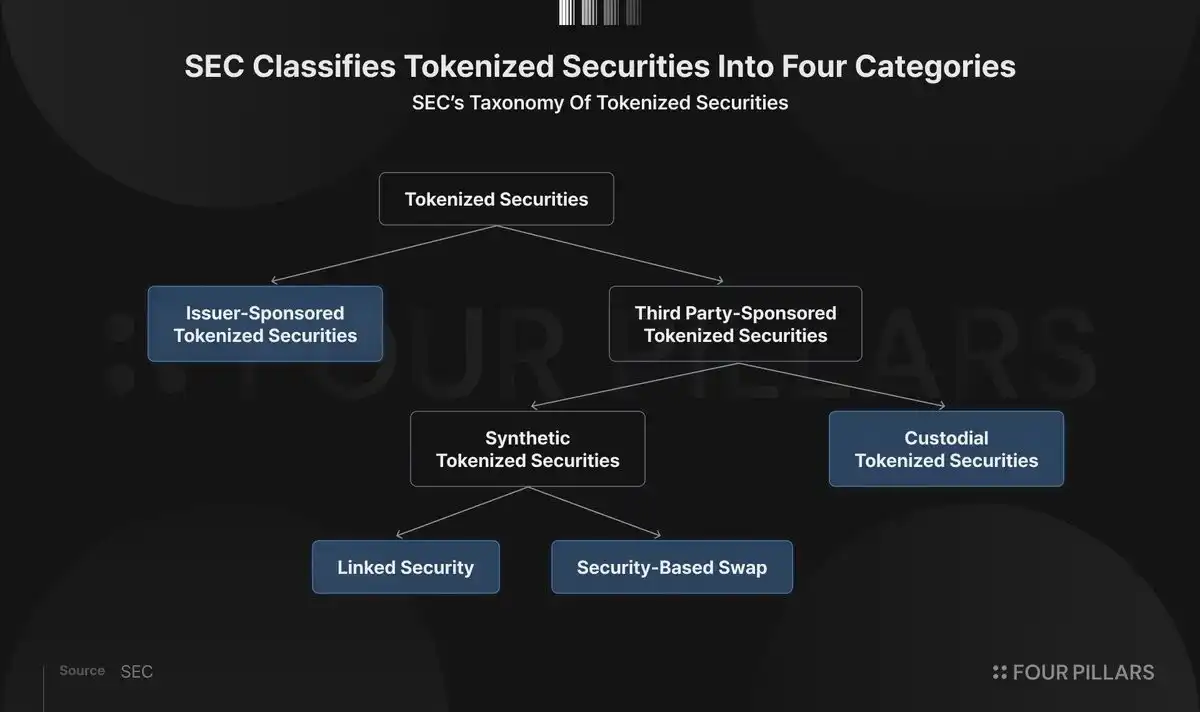
In January of this year, the SEC issued a statement proposing a classification framework for tokenized securities.

First, based on whether the tokenization is conducted by the security issuer itself or a third party, it is categorized into 'Issuer-Sponsored Tokenized Securities' and 'Third Party-Sponsored Tokenized Securities'.

Third Party-Sponsored Tokenized Securities are further subdivided: if the rights related to the underlying security itself are tokenized, it's 'Custodial Tokenized Securities'; if a separate tokenized product is issued that merely references the price, yield, events, or other characteristics of the underlying security, it's 'Synthetic Tokenized Securities'.

Synthetic types are then categorized by product type: if a third party issues an independent security (e.g., a debt security), it's a 'Linked Security'; if it involves entering into a derivative contract, it's a 'Security-Based Swap'.

Ultimately, under this framework, tokenized securities can be classified into the following four categories, which also apply to tokenized equities:

  • Issuer-Sponsored Tokenized Securities: The equity issuer itself, or its designated agent (e.g., a transfer agent), directly tokenizes and operates the security. The issuer (or its agent) connects a blockchain or other DLT system to the official shareholder registry for maintaining shareholder records. This approach does not fundamentally alter the existing legal framework and directly complies with current securities laws. The biggest advantage is that all shareholder rights, including ownership, are inherited by the token. However, strict compliance requirements somewhat limit usability. Primary representatives: Securitize, Superstate, Figure.
  • Custodial Tokenized Securities: A third party tokenizes the interest (indirect rights) in securities held at a depository (like DTCC) or broker-dealer. It similarly inherits all related rights but is highly reliant on existing stock market infrastructure; ownership remains indirect, offering relatively limited improvements over the traditional system. Primary representative: DTCC; Ondo recently used this method to tokenize IVV and MU.
  • Linked Securities: A third party issues and tokenizes an independent security (e.g., a debt security) that provides synthetic exposure to the underlying stock. Token holders only gain exposure to price performance and do not inherit other shareholder rights. The biggest advantage is high flexibility for on-chain use. Primary representatives: Ondo, xStocks, Robinhood Stock Tokens.
  • Security-Based Swaps: A third party issues a derivative contract providing synthetic exposure to the underlying stock and then tokenizes the contract. Like Linked Securities, it only provides exposure related to price, inheriting no other rights. Currently, almost the only major case is Robinhood Classic Stock Tokens.

Analysis of Major Tokenized Equity Platforms

Securitize: Taking the Most Direct Route

Securitize is currently the tokenization platform with the largest market share, with a tokenized RWA scale of $5.1 billion. Its flagship product is BlackRock's money market fund, BUIDL. Securitize holds SEC-registered broker-dealer, transfer agent, and ATS licenses and leverages these regulatory advantages to follow a 'Direct Tokenized Security' model. According to the SEC classification, this falls under 'Issuer-Sponsored Tokenized Securities'.

Recently, Securitize has also extended the same model to tokenized equities. When it listed its own stock SECZ via a SPAC, it used its own service to tokenize and issue $180 million worth of SECZ on-chain.

The advantages of this model are clear: existing stocks can be tokenized as-is while fully complying with current securities laws. Investors first directly register ownership of their shares, previously held through DTCC or brokers, via DRS. Then, Securitize, acting as the transfer agent, tokenizes these shares. The result is that the stock token shares the same CUSIP as the existing stock, inheriting not only economic rights but also all related rights like voting rights and claims on residual assets in bankruptcy.

However, precisely because the tokenized stock is essentially another form of the same security, it comes with corresponding drawbacks. Most importantly, the compliance requirements are stringent, and on-chain usage is relatively restricted. Unlike Ondo's or xStocks' tokenized equities, Securitize's stock tokens can only be transferred between whitelisted wallets that have passed KYC/AML checks, and on-chain interactions are only possible with a limited set of smart contracts pre-approved by the team.
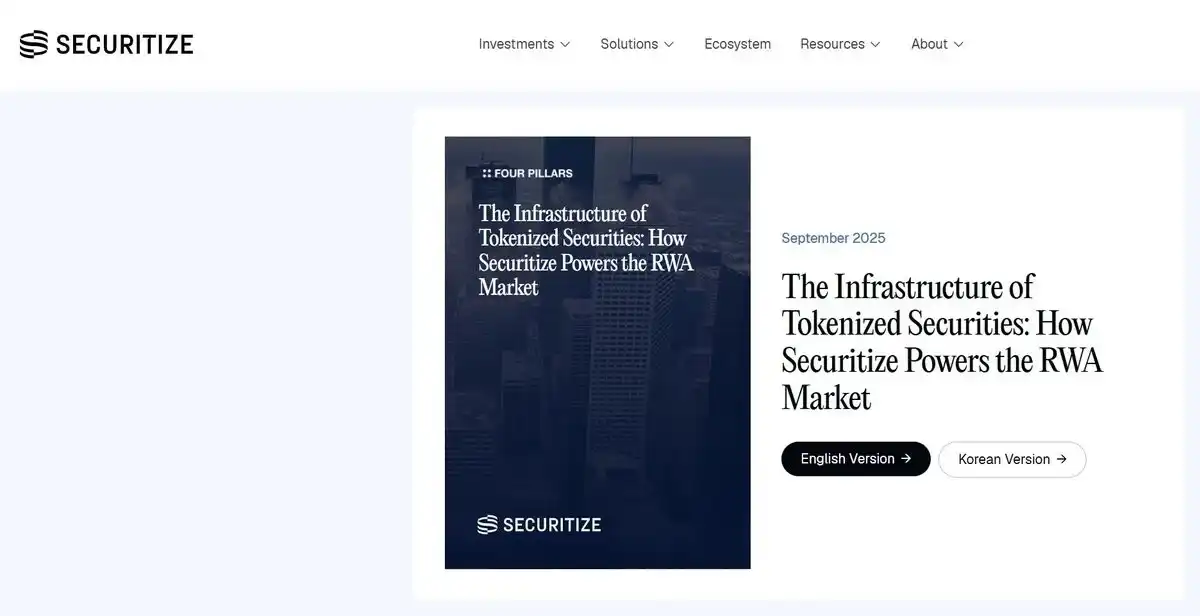
How does Securitize enforce KYC/AML and other compliance requirements on-chain? The answer is the DS Protocol. This is a set of smart contracts developed by Securitize that uses code to enforce compliance throughout the lifecycle of a tokenized security (issuance, transfer, usage, voting, dividends). Four Pillars previously published an in-depth research report on the DS Protocol, which is also featured on Securitize's website. Readers interested in understanding how tokenized securities operate at the smart contract level can refer to that report.

Other platforms tokenizing equities in a similar manner include Superstate and Figure. They all act as transfer agents for tokenization. The key difference lies in the type of stock being tokenized: Securitize and Superstate tokenize shares identical to existing stocks via the DRS system, while Figure issues a separate blockchain-native class of shares and then tokenizes that portion.

Ondo & xStocks: Expanding the Ecosystem with Broad Accessibility

Ondo and xStocks employ a structure where, when a user places an order for a stock token, an offshore SPV acquires the underlying shares and then issues tokenized debt securities backed by those shares.

Taking xStocks as an example. It has a Jersey-regulated SPV—Backed Assets (JE) Limited. When a user requests the issuance of a stock token via the platform, this SPV purchases the underlying shares through US-based Alpaca Securities and holds them in a segregated account at a regulated custodian. Subsequently, the SPV issues independent debt securities backed by these shares, tokenizes them, and delivers them to the user.

This structure falls under the 'Linked Securities' category in the SEC classification.
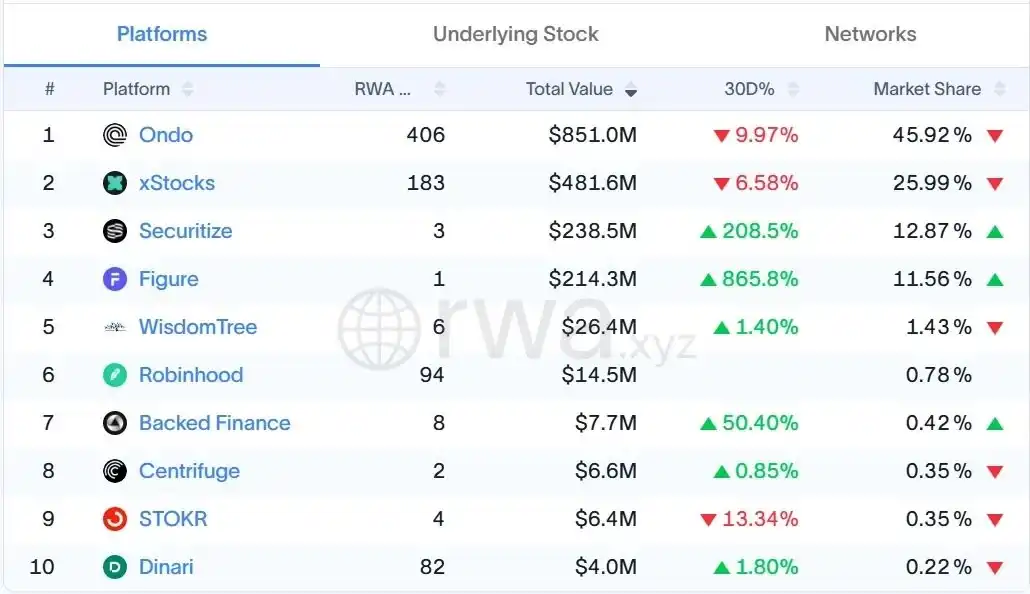
Currently, Ondo has tokenized 406 different stocks with a total value of approximately $851 million; xStocks has tokenized 183 stocks, valued at about $482 million. Their market shares in the tokenized equity segment are 45.9% and 26.0% respectively, firmly holding the top two positions.

The key to their rapid growth lies in the broad accessibility enabled by their tokenization structure. Strictly speaking, they are not tokenizing the stocks themselves but rather tokenizing debt securities issued by a third party and backed by the stocks. Therefore, compared to the issuer-sponsored model that directly tokenizes existing shares, this type of structure faces less stringent compliance requirements for distribution and secondary trading. Users can more freely trade and use the tokenized equities issued by Ondo and xStocks on CEXs and on-chain DeFi protocols. For instance, with xStocks, anyone can trade using a Web3 wallet via the Jupiter DEX or deposit them into lending protocols like Kamino as collateral to borrow stablecoins.

However, this indirect tokenization also creates issues: even if the underlying asset is the same, tokens issued by different platforms are not interoperable, leading to fragmented liquidity. For example, both backed by NVIDIA stock, Ondo issues NVDAon, and xStocks issues NVDAx; the two are not interchangeable. Additionally, due to reliance on Regulation S, US investors and persons are unable to use these services.

To address these limitations, Ondo recently acquired Oasis Pro, gaining broker-dealer, ATS, and transfer agent licenses, moving towards a more compliance-friendly tokenization model. In fact, Ondo has already used these licenses to tokenize shares of the IVV ETF and MU stock held in brokerage accounts via the 'Custodial Tokenized Securities' model, demonstrating the possibility of operating multiple structures in parallel.

Robinhood: Can the Latecomer Gain Traction?

An important new player has entered the tokenized equity ecosystem—Robinhood. It actually already provided tokenized equity services to European investors through Classic Stock Tokens. However, under the SEC classification, that structure is a 'Security-Based Swap': Robinhood enters into a derivative contract with the user referencing a stock and then tokenizes the contract into a receipt token. The entire structure is highly closed, usable only within the Robinhood App.

On July 1, 2026, Robinhood launched a new Stock Tokens service. Its tokenization structure adopts the 'Linked Securities' model, almost identical to Ondo's and xStocks' approaches, with largely similar advantages and disadvantages.

While the structure is the same, the potential Robinhood brings is clear: its product DNA and massive existing user base. Concurrently with launching Stock Tokens, Robinhood also launched the Robinhood Chain mainnet, centered around Stock Tokens. US users can also deposit stablecoins into Morpho on the Robinhood Chain via the Robinhood App to earn 7% interest. Although entering the market later than Ondo and xStocks, with its product iteration capabilities and ecosystem expansion potential, Robinhood still has the opportunity to scale up rapidly.

DTCC, NYSE, Nasdaq: Signals of Financial Infrastructure Transformation

It's not just platforms and companies considering equity tokenization. Key settlement and trading infrastructure providers in the traditional stock market—DTCC, NYSE, Nasdaq—are also moving towards tokenization.

The DTC, a subsidiary of DTCC, has received a no-action letter from the SEC, permitting the tokenization of some securities held at DTC on pre-approved blockchains. DTC expects this to enhance collateral liquidity, extend trading hours, improve operational and settlement efficiency, and enable programmability and real-time auditing. On July 15, DTCC also conducted limited tokenization of securities like QQQ and SPY in a live securities infrastructure environment, successfully completing trades and collateral transfers.

The NYSE submitted a rule change proposal to the SEC in April 2026 to support DTC's tokenization pilot, allowing stocks to settle in tokenized form. Additionally, the NYSE is developing a new regulated exchange—the Digital Trading Platform—aiming to use blockchain infrastructure to enable 7x24 trading of US stocks and ETFs, with support for stablecoin funding. In March 2026, the NYSE also signed a Memorandum of Understanding with Securitize, designating Securitize as the first potential digital transfer agent for this new platform.

Nasdaq received SEC rule change approval in March 2026, allowing stocks in the DTC tokenization pilot to trade and settle in tokenized form on its exchange. Nasdaq is also collaborating with Payward, the parent company of Kraken, to design a gateway service enabling issuers and investors to transfer shares between the regulated Nasdaq market and the permissionless blockchain environment.

Coinbase: Which Path Will It Take?

The final player worth watching is Coinbase. It has not yet launched a tokenized equities service but has stated multiple times since last year its intention to do so. In February of this year, Coinbase launched 5x24 trading for traditional stocks in the US; at an event in June, it announced it would soon offer tokenized equities.
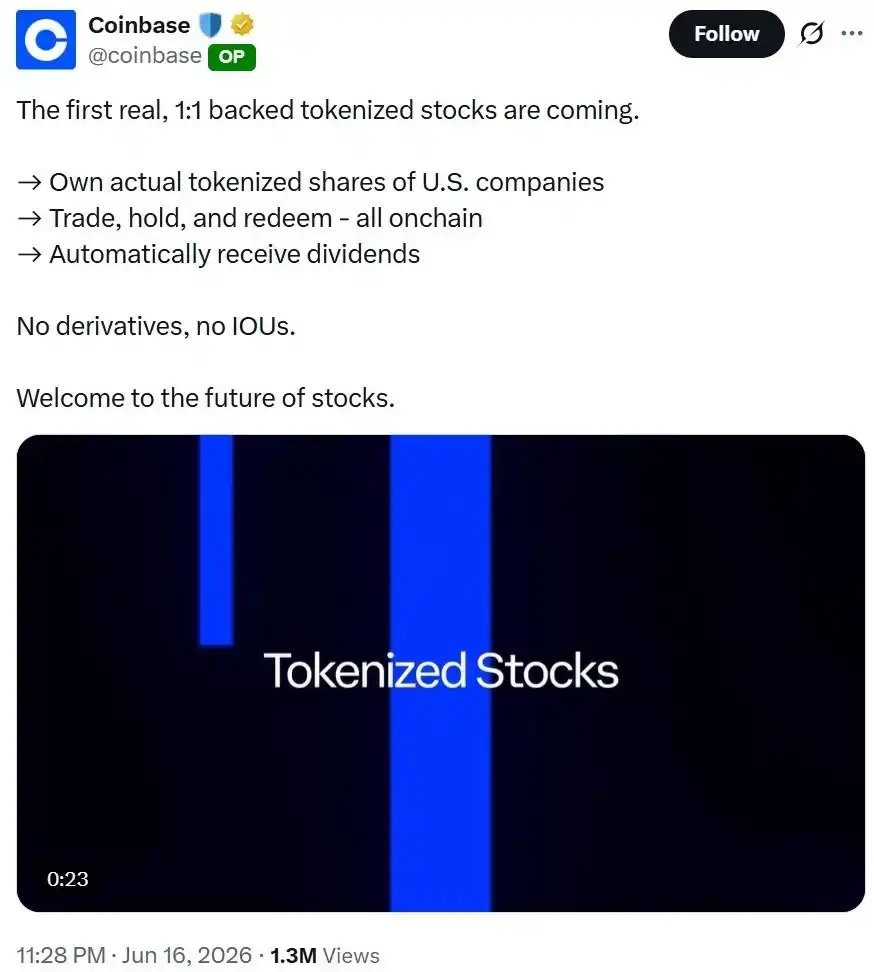
The industry is highly focused on what structure Coinbase will use to tokenize equities. Coinbase has stated that its service will not only ensure the tokens are 1:1 backed by real stocks but will also provide shareholder rights, though the specific structure has not been disclosed in detail. More crucially, it explicitly stated these stock tokens would be usable on-chain while not being available to US customers.

If adopting an issuer-sponsored structure, tokens typically inherit all shareholder rights, are open to US customers, but have relatively restricted on-chain usability. The combination of 'broad on-chain usability + exclusion of US customers' resembles the approach taken by third-party structures (like Linked Securities). It is worth monitoring which structure Coinbase ultimately chooses to tokenize equities and how it will leverage its own exchange infrastructure to expand the tokenized equity ecosystem.

Competing on the Same Battlefield

The goal of financial services is clear: to allow anyone, anywhere, anytime, to trade all types of assets through a single backend and frontend. On the surface, today's financial services seem close to this goal, but in reality, integration mostly happens on the frontend, while the backend remains fragmented.

Stocks, as one of many asset classes, are no exception. Robinhood, which started with stock trading; Coinbase, which started with crypto trading; traditional stock infrastructure providers DTCC/NYSE/Nasdaq; and Web3-native players like Securitize, Ondo, and xStocks—their tokenization structures and strategic directions differ, yet they are all moving towards the same North Star: tokenized equities.

What needs to be closely observed next is how the US and other jurisdictions view tokenized equities, how the regulatory framework evolves, and how these changes will reshape the competitive landscape for all parties. Also, whether tokenized equities can become the next major catalyst driving the expansion of the entire RWA sector after tokenized US Treasuries.

The Korean market is also worth watching: despite high retail trading activity, the development of the RWA industry has been relatively slow. How discussions around tokenized equities will unfold in Korea deserves ongoing tracking.

Criptomoedas em alta

Perguntas relacionadas

QAccording to the article, what is the main reason for the slowdown in the growth of tokenized U.S. Treasury market?

AThe main reason for the slowdown is unfavorable market conditions, as a significant portion of the demand came from DeFi protocols or exchange margin scenarios, and this demand has stagnated.

QHow does the SEC classify tokenized securities based on who sponsors the tokenization?

AThe SEC classifies tokenized securities into two primary categories based on the sponsor: 'Issuer-Sponsored Tokenized Securities' (sponsored by the security issuer itself) and 'Third Party-Sponsored Tokenized Securities' (sponsored by a third party).

QWhat is the key advantage of the 'Issuer-Sponsored Tokenized Securities' model, as exemplified by Securitize, for tokenizing stocks?

AThe key advantage is that the token inherits all shareholder rights, including economic rights, voting rights, and claims to residual assets in bankruptcy, as it represents the same stock under the existing legal framework.

QWhat is a major limitation for U.S.-based investors regarding the tokenized stock products from Ondo and xStocks, and why?

AA major limitation is that U.S. investors and persons cannot use these products because they rely on Regulation S for their issuance, which restricts availability to non-U.S. investors.

QWhat new strategic move did Ondo make to address limitations in its initial tokenized stock model and move towards a more compliance-friendly approach?

AOndo acquired Oasis Pro to obtain broker-dealer, ATS, and transfer agent licenses. This allows Ondo to utilize a 'Custodial Tokenized Securities' model for more compliant tokenization, as demonstrated with the tokenization of IVV ETF and MU stock holdings.

Leituras Relacionadas

China Monopolizes the Humanoid Market: The U.S. is Forced to Defend Itself

China accounted for over 97% of global humanoid robot shipments in the first half of 2026, according to research firm Smart Analytics Global (SAG). Global shipments reached approximately 19,100 units, a 272% increase year-over-year, with China itself representing over 85% of global demand. Shanghai-based AGIBOT led the market with a 44% share, followed by Hangzhou's Unitree Robotics at 31%. Together, these two Chinese firms controlled about 75% of global supply. Demand is shifting from research to practical applications, with industrial and commercial uses now comprising over 70% of shipments. SAG forecasts full-year 2026 shipments near 60,000 units. In response, the U.S. Federal Communications Commission (FCC) banned federal agencies and subsidy recipients from purchasing foreign "advanced robotic devices," including humanoids, citing national security concerns. Analysts attribute China's dominance to strong state support, abundant funding, expanding manufacturing capacity, IPO waves, and a vast domestic ecosystem for testing and deployment. Over 90% of key components for Chinese humanoid robots are now sourced domestically. The AI analysis notes potential risks beyond export controls, such as reputational issues for Chinese firms linked to the defense sector and parallels to past trade conflicts in sectors like solar panels, where rapid Chinese market capture led to protectionist measures. The low average robot price could fuel adoption but also invite dumping accusations.

cryptonews.ruHá 8m

China Monopolizes the Humanoid Market: The U.S. is Forced to Defend Itself

cryptonews.ruHá 8m

Trading

Spot

Artigos em Destaque

O que é ETH 2.0

ETH 2.0: Uma Nova Era para o Ethereum Introdução ETH 2.0, amplamente conhecido como Ethereum 2.0, marca uma atualização monumental à blockchain do Ethereum. Esta transição não é meramente uma mudança estética; visa melhorar fundamentalmente a escalabilidade, segurança e sustentabilidade da rede. Com uma mudança do mecanismo de consenso em Proof of Work (PoW), intensivo em energia, para um Proof of Stake (PoS) mais eficiente, o ETH 2.0 promete uma abordagem transformadora ao ecossistema blockchain. O que é ETH 2.0? ETH 2.0 é um conjunto de atualizações distintas e interconectadas focadas na otimização das capacidades e desempenho do Ethereum. Esta reformulação foi projetada para abordar desafios críticos que o mecanismo atual do Ethereum enfrentou, particularmente em relação à velocidade das transações e à congestão da rede. Objetivos do ETH 2.0 Os principais objetivos do ETH 2.0 giram em torno da melhoria de três aspectos centrais: Escalabilidade: Com o objetivo de melhorar significativamente o número de transações que a rede pode manejar por segundo, o ETH 2.0 procura ultrapassar a limitação atual de aproximadamente 15 transações por segundo, alcançando potencialmente milhares. Segurança: Medidas de segurança melhoradas são integrais ao ETH 2.0, especialmente através da resistência aprimorada contra ciberataques e da preservação do ethos descentralizado do Ethereum. Sustentabilidade: O novo mecanismo PoS foi projetado não apenas para melhorar a eficiência, mas também para reduzir drasticamente o consumo de energia, alinhando a estrutura operacional do Ethereum com considerações ambientais. Quem é o Criador do ETH 2.0? A criação do ETH 2.0 pode ser atribuída à Ethereum Foundation. Esta organização sem fins lucrativos, que desempenha um papel crucial no apoio ao desenvolvimento do Ethereum, é liderada pelo co-fundador notável Vitalik Buterin. A sua visão de um Ethereum mais escalável e sustentável tem sido a força motriz por trás desta atualização, envolvendo contribuições de uma comunidade global de desenvolvedores e entusiastas dedicados a melhorar o protocolo. Quem são os Investidores do ETH 2.0? Embora os detalhes sobre os investidores do ETH 2.0 não tenham sido tornados públicos, é sabido que a Ethereum Foundation recebe apoio de várias organizações e indivíduos no espaço da blockchain e tecnologia. Esses parceiros incluem firmas de capital de risco, empresas de tecnologia e organizações filantrópicas que compartilham um interesse mútuo em apoiar o desenvolvimento de tecnologias descentralizadas e infraestrutura de blockchain. Como Funciona o ETH 2.0? ETH 2.0 é notável por introduzir uma série de características chave que o diferenciam do seu predecessor. Proof of Stake (PoS) A transição para um mecanismo de consenso PoS é uma das mudanças de destaque do ETH 2.0. Ao contrário do PoW, que depende da mineração intensiva em energia para a verificação de transações, o PoS permite que os utilizadores validem transações e criem novos blocos de acordo com a quantidade de ETH que apostam na rede. Isso leva a uma maior eficiência energética, reduzindo o consumo em aproximadamente 99,95%, tornando o Ethereum 2.0 uma alternativa consideravelmente mais ecológica. Shard Chains As shard chains são outra inovação crítica do ETH 2.0. Estas cadeias menores operam em paralelo com a cadeia principal do Ethereum, permitindo que várias transações sejam processadas simultaneamente. Esta abordagem melhora a capacidade geral da rede, abordando preocupações de escalabilidade que têm atormentado o Ethereum. Beacon Chain No coração do ETH 2.0 está a Beacon Chain, que coordena a rede e gere o protocolo PoS. Ela atua como uma espécie de organizador: supervisiona os validadores, garante que as shards permaneçam conectadas à rede e monitora a saúde geral do ecossistema blockchain. Linha do Tempo do ETH 2.0 A jornada do ETH 2.0 tem sido marcada por vários marcos chave que traçam a evolução desta atualização significativa: Dezembro de 2020: O lançamento da Beacon Chain marcou a introdução do PoS, preparando o caminho para a migração para o ETH 2.0. Setembro de 2022: A conclusão de “The Merge” representa um momento crucial em que a rede Ethereum fez a transição com sucesso de um quadro PoW para um PoS, anunciando uma nova era para o Ethereum. 2023: O lançamento esperado das shard chains visa melhorar ainda mais a escalabilidade da rede Ethereum, solidificando o ETH 2.0 como uma plataforma robusta para aplicações e serviços descentralizados. Características Chave e Benefícios Escalabilidade Melhorada Uma das vantagens mais significativas do ETH 2.0 é a sua escalabilidade melhorada. A combinação de PoS e shard chains permite que a rede expanda a sua capacidade, permitindo que acomode um volume de transações muito maior em comparação com o sistema legado. Eficiência Energética A implementação do PoS representa um enorme passo em direção à eficiência energética na tecnologia blockchain. Ao reduzir drasticamente o consumo de energia, o ETH 2.0 não só reduz os custos operacionais, mas também se alinha mais estreitamente com os objetivos globais de sustentabilidade. Segurança Aprimorada Os mecanismos atualizados do ETH 2.0 contribuem para uma segurança melhorada em toda a rede. O uso do PoS, juntamente com medidas de controle inovadoras estabelecidas através das shard chains e da Beacon Chain, assegura um maior grau de proteção contra potenciais ameaças. Custos Mais Baixos para os Utilizadores À medida que a escalabilidade melhora, os efeitos sobre os custos de transação também serão evidentes. Aumentada a capacidade e reduzida a congestão, espera-se que isso se traduza em taxas mais baixas para os utilizadores, tornando o Ethereum mais acessível para transações do dia a dia. Conclusão ETH 2.0 marca uma evolução significativa no ecossistema da blockchain do Ethereum. Ao abordar questões fundamentais como a escalabilidade, o consumo de energia, a eficiência das transações e a segurança geral, a importância desta atualização não pode ser subestimada. A transição para o Proof of Stake, a introdução das shard chains e o trabalho fundamental da Beacon Chain são indicativos de um futuro em que o Ethereum pode atender à crescente demanda do mercado descentralizado. Em uma indústria movida pela inovação e progresso, o ETH 2.0 representa um testemunho das capacidades da tecnologia blockchain em pavimentar o caminho para uma economia digital mais sustentável e eficiente.

250 Visualizações TotaisPublicado em {updateTime}Atualizado em 2024.12.03

O que é ETH 2.0

O que é ETH 3.0

ETH3.0 e $eth 3.0: Uma Análise Profunda do Futuro do Ethereum Introdução No ambiente em rápida evolução da criptomoeda e da tecnologia blockchain, o ETH3.0, frequentemente denotado como $eth 3.0, emergiu como um tema de considerável interesse e especulação. O termo abrange dois conceitos principais que merecem esclarecimento: Ethereum 3.0: Esta representa uma potencial atualização futura destinada a aumentar as capacidades da atual blockchain do Ethereum, focando especialmente na melhoria da escalabilidade e desempenho. ETH3.0 Meme Token: Este distinto projeto de criptomoeda procura aproveitar a blockchain do Ethereum na criação de um ecossistema centrado em memes, promovendo o envolvimento na comunidade de criptomoedas. Compreender esses aspectos do ETH3.0 é essencial não apenas para entusiastas de criptomoedas, mas também para aqueles que observam as tendências tecnológicas mais amplas no espaço digital. O que é ETH3.0? Ethereum 3.0 Ethereum 3.0 é promovido como uma atualização proposta para a rede Ethereum já estabelecida, que tem sido a espinha dorsal de muitas aplicações descentralizadas (dApps) e contratos inteligentes desde a sua criação. As melhorias vislumbradas concentram-se principalmente na escalabilidade—integrando tecnologias avançadas como sharding e provas de conhecimento zero (zk-proofs). Essas inovações tecnológicas visam facilitar um número sem precedentes de transações por segundo (TPS), potencialmente alcançando milhões, abordando assim uma das limitações mais significativas enfrentadas pela tecnologia blockchain atual. A melhoria não é meramente técnica, mas também estratégica; visa preparar a rede Ethereum para uma adoção generalizada e utilidade em um futuro marcado por uma maior demanda por soluções descentralizadas. ETH3.0 Meme Token Em contraste com o Ethereum 3.0, o ETH3.0 Meme Token aventura-se por um domínio mais leve e divertido, combinando a cultura dos memes da internet com a dinâmica das criptomoedas. Este projeto permite que os usuários comprem, vendam e negociem memes na blockchain do Ethereum, proporcionando uma plataforma que fomenta o envolvimento da comunidade através da criatividade e interesses compartilhados. O ETH3.0 Meme Token visa demonstrar como a tecnologia blockchain pode interseccionar com a cultura digital, criando casos de uso que são tanto divertidos quanto financeiramente viáveis. Quem é o Criador do ETH3.0? Ethereum 3.0 A iniciativa em direção ao Ethereum 3.0 é impulsionada principalmente por um consórcio de desenvolvedores e pesquisadores dentro da comunidade Ethereum, notavelmente incluindo Justin Drake. Conhecido por suas percepções e contribuições para a evolução do Ethereum, Drake tem sido uma figura proeminente nas discussões sobre a transição do Ethereum para uma nova camada de consenso, referida como “Beam Chain”. Esta abordagem colaborativa ao desenvolvimento significa que o Ethereum 3.0 não é fruto de um único criador, mas sim uma manifestação da engenhosidade coletiva focada no avanço da tecnologia blockchain. ETH3.0 Meme Token Os detalhes sobre o criador do ETH3.0 Meme Token são atualmente indetectáveis. A natureza dos tokens de meme frequentemente leva a uma estrutura mais descentralizada e impulsionada pela comunidade, o que poderia explicar a falta de atribuição específica. Isso alinha-se com a ethos da comunidade de criptomoedas mais ampla, onde a inovação geralmente surge de esforços colaborativos em vez de esforços individuais. Quem são os Investidores do ETH3.0? Ethereum 3.0 O apoio ao Ethereum 3.0 provém principalmente da Fundação Ethereum, juntamente com uma comunidade entusiástica de desenvolvedores e investidores. Esta associação fundacional proporciona um grau significativo de legitimidade e melhora as perspectivas de uma implementação bem-sucedida, uma vez que aproveita a confiança e credibilidade construída ao longo de anos de operações de rede. Em um clima em rápida mudança no mundo das criptomoedas, o apoio da comunidade desempenha um papel crucial no impulso ao desenvolvimento e adoção, posicionando o Ethereum 3.0 como um sério candidato a futuros avanços na blockchain. ETH3.0 Meme Token Embora as fontes atualmente disponíveis não forneçam informações explícitas sobre as fundações ou organizações de investimento que apoiam o ETH3.0 Meme Token, é indicativo do modelo típico de financiamento para tokens de meme, que frequentemente depende de apoio base e engajamento da comunidade. Os investidores em tais projetos costumam consistir em indivíduos motivados pelo potencial de inovação impulsionada pela comunidade e pelo espírito de cooperação encontrado dentro da comunidade cripto. Como Funciona o ETH3.0? Ethereum 3.0 As características distintivas do Ethereum 3.0 residem em sua proposta de implementação de sharding e tecnologia zk-proof. Sharding é um método de partição da blockchain em partes menores e gerenciáveis ou “shards”, que podem processar transações simultaneamente em vez de sequencialmente. Esta descentralização do processamento ajuda a prevenir congestionamentos e garante que a rede permaneça responsiva mesmo sob carga pesada. A tecnologia de prova de conhecimento zero (zk-proof) contribui com outra camada de sofisticação ao permitir a validação de transações sem revelar os dados subjacentes envolvidos. Este aspecto não apenas melhora a privacidade, mas também aumenta a eficiência geral da rede. Há também conversas sobre a incorporação de uma Máquina Virtual Ethereum de conhecimento zero (zkEVM) nesta atualização, amplificando ainda mais as capacidades e utilidade da rede. ETH3.0 Meme Token O ETH3.0 Meme Token distingue-se ao capitalizar sobre a popularidade da cultura dos memes. Estabelece um mercado para que os usuários participem da negociação de memes, não apenas para entretenimento, mas também para potencial ganho econômico. Ao integrar recursos como staking, provisão de liquidez e mecanismos de governança, o projeto fomenta um ambiente que incentiva a interação e participação da comunidade. Ao oferecer uma mistura única de entretenimento e oportunidade econômica, o ETH3.0 Meme Token visa atrair um público diversificado, variando de entusiastas de criptomoedas a conhecedores casuais de memes. Cronologia do ETH3.0 Ethereum 3.0 11 de novembro de 2024: Justin Drake sugere a próxima atualização do ETH 3.0, centrada nas melhorias de escalabilidade. Este anúncio sinaliza o início de discussões formais sobre a futura arquitetura do Ethereum. 12 de novembro de 2024: A proposta antecipada para Ethereum 3.0 deve ser revelada no Devcon em Bangkok, preparando o cenário para um feedback mais amplo da comunidade e potenciais próximos passos no desenvolvimento. ETH3.0 Meme Token 21 de março de 2024: O ETH3.0 Meme Token é oficialmente listado no CoinMarketCap, marcando sua entrada no domínio público das criptomoedas e aumentando a visibilidade de seu ecossistema baseado em memes. Pontos Chave Em conclusão, Ethereum 3.0 representa uma evolução significativa dentro da rede Ethereum, focando em superar limitações quanto à escalabilidade e desempenho através de tecnologias avançadas. As atualizações propostas refletem uma abordagem proativa às futuras demandas e usabilidade. Por outro lado, o ETH3.0 Meme Token encapsula a essência da cultura impulsionada pela comunidade no espaço das criptomoedas, aproveitando a cultura dos memes para criar plataformas envolventes que incentivam a criatividade e participação dos usuários. Compreender os distintos propósitos e funcionalidades do ETH3.0 e $eth 3.0 é fundamental para qualquer pessoa interessada nos desenvolvimentos contínuos dentro do espaço cripto. Com ambas as iniciativas a pavimentar caminhos únicos, elas sublinham coletivamente a natureza dinâmica e multifacetada da inovação em blockchain.

254 Visualizações TotaisPublicado em {updateTime}Atualizado em 2024.12.03

O que é ETH 3.0

Como comprar ETH

Bem-vindo à HTX.com!Tornámos a compra de Ethereum (ETH) simples e conveniente.Segue o nosso guia passo a passo para iniciar a tua jornada no mundo das criptos.Passo 1: cria a tua conta HTXUtiliza o teu e-mail ou número de telefone para te inscreveres numa conta gratuita na HTX.Desfruta de um processo de inscrição sem complicações e desbloqueia todas as funcionalidades.Obter a minha contaPasso 2: vai para Comprar Cripto e escolhe o teu método de pagamentoCartão de crédito/débito: usa o teu visa ou mastercard para comprar Ethereum (ETH) instantaneamente.Saldo: usa os fundos da tua conta HTX para transacionar sem problemas.Terceiros: adicionamos métodos de pagamento populares, como Google Pay e Apple Pay, para aumentar a conveniência.P2P: transaciona diretamente com outros utilizadores na HTX.Mercado de balcão (OTC): oferecemos serviços personalizados e taxas de câmbio competitivas para os traders.Passo 3: armazena teu Ethereum (ETH)Depois de comprar o teu Ethereum (ETH), armazena-o na tua conta HTX.Alternativamente, podes enviá-lo para outro lugar através de transferência blockchain ou usá-lo para transacionar outras criptomoedas.Passo 4: transaciona Ethereum (ETH)Transaciona facilmente Ethereum (ETH) no mercado à vista da HTX.Acede simplesmente à tua conta, seleciona o teu par de trading, executa as tuas transações e monitoriza em tempo real.Oferecemos uma experiência de fácil utilização tanto para principiantes como para traders experientes.

3.8k Visualizações TotaisPublicado em {updateTime}Atualizado em 2026.06.02

Como comprar ETH

Discussões

Bem-vindo à Comunidade HTX. Aqui, pode manter-se informado sobre os mais recentes desenvolvimentos da plataforma e obter acesso a análises profissionais de mercado. As opiniões dos utilizadores sobre o preço de ETH (ETH) são apresentadas abaixo.

活动图片