Tian Yuandong Announces Startup Venture After Leaving Meta

marsbitPublicado em 2026-05-14Última atualização em 2026-05-14

Resumo

After leaving Meta, Tian Yuan Dong has announced his new venture. The startup Recursive_SI has officially launched with a list of founders including Tian Yuan Dong. The founding team also comprises Richard Socher (CEO), Tim Rocktäschel, Jeff Clune, Tim Shi, Caiming Xiong, and Alexey Dosovitskiy, among others. These members have experience building AI research labs at companies like Salesforce and Uber, and have held leadership roles at OpenAI, DeepMind, Google Brain, and Meta. Recursive_SI aims to develop artificial intelligence capable of conducting experiments autonomously and safely improving itself through an open-ended, automated scientific discovery process. This is seen as a promising path toward superintelligence. The company has raised $650 million at a valuation of $4.65 billion, led by GV (Google Ventures) and Greycroft, with significant investments from AMD Ventures and NVIDIA. The team has grown to over 25 members, including new additions like Zhuge Mingchen. Zhuge, a Founding Member, holds a Ph.D. in Computer Science from KAUST under Professor Jürgen Schmidhuber. His research focuses on Coding Agents, Recursive Self-Improvement (RSI), and next-generation machine paradigms, with contributions including early RSI systems like GPTSwarm and work on agentic AI frameworks. The founders shared their vision on X: building AI that can automatically discover knowledge and recursively self-improve, fundamentally changing the way science and technology advance. The team ...

After leaving Meta, Tian Yuandong has also started his entrepreneurial journey.

Just now, the startup company Recursive_SI officially debuted and disclosed its list of founders, which includes Tian Yuandong.

In addition to Tian Yuandong, the founding team includes Richard Socher (CEO), Tim Rocktäschel, Jeff Clune, Tim Shi, Caiming Xiong, and Alexey Dosovitskiy, among others.
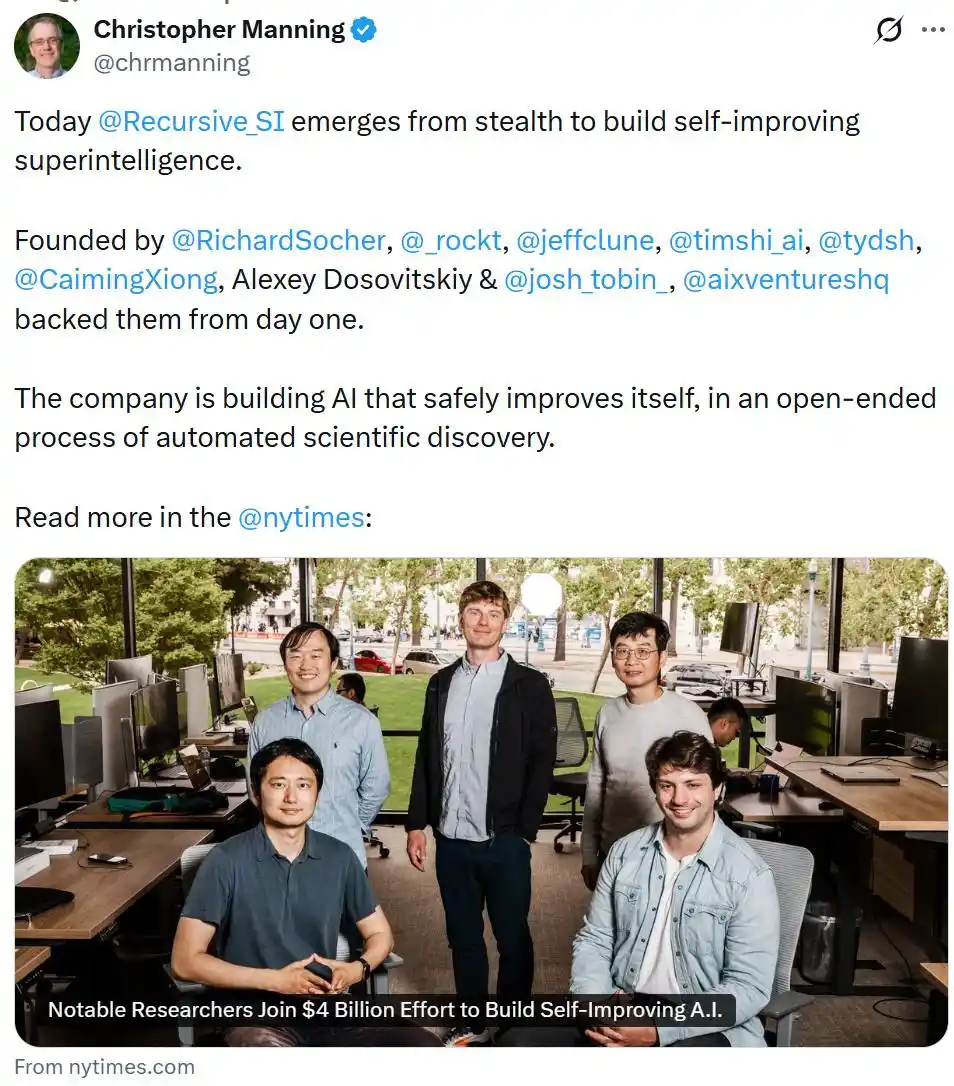
These founding members have previously been involved in establishing AI research labs at Salesforce and Uber, and have held leadership positions at teams such as OpenAI, DeepMind, Google Brain, and Meta, possessing extensive research and entrepreneurial experience.

Recursive_SI is committed to building an artificial intelligence that can autonomously conduct experiments and safely self-improve—continuously evolving within an open-ended, automated scientific discovery process, which is considered the most likely path towards superintelligence.

Currently, Recursive has raised $6.5 billion with a valuation of $46.5 billion, led by GV (Google Ventures) and Greycroft, with significant investments from AMD Ventures and NVIDIA.

The team has grown to over 25 members and continues to expand, having attracted many outstanding talents, including Zhuge Mingchen, who is set to join soon.

Zhuge Mingchen is currently a Founding Member at Recursive. He holds a Ph.D. in Computer Science from King Abdullah University of Science and Technology (KAUST), where he studied under Professor Jürgen Schmidhuber, known as the "Father of LSTM." His research focuses primarily on Coding Agents, Recursive Self-Improvement (RSI), and Next-generation Machine Paradigms.

Since 2023, Zhuge Mingchen has been systematically exploring the direction of Recursive Self-Improvement (RSI).

During the MetaGPT period, he proposed that agents should possess mechanisms for continuous self-optimization and capability evolution, advancing this research direction in subsequent work. Among these, GPTSwarm is considered one of the earliest RSI system paradigms in the LLM era. It was the first to systematically propose and validate a Graph-based Agents framework for self-organizing collaboration, enabling coordination, feedback, and capability evolution among agents through dynamic graph structures. Its core concepts have since been widely adopted by numerous subsequent multi-agent and Agentic AI projects. Agent-as-a-Judge further explored continuous feedback and self-evaluation mechanisms in long-term tasks, attempting to address issues of continuity and stable optimization for agents in complex missions. Research on NeuralComputer further advanced towards next-generation AI system architectures, exploring new machine paradigms that integrate memory, reasoning, and autonomous evolution capabilities.

It can be seen that the research team joining Recursive possesses profound academic experience in the field of recursive self-improvement.

Tian Yuandong and several other founders have promoted the venture on X: "We are building an artificial intelligence that can autonomously discover knowledge and recursively self-improve—this open-ended process will fundamentally change the way science and technology advance."
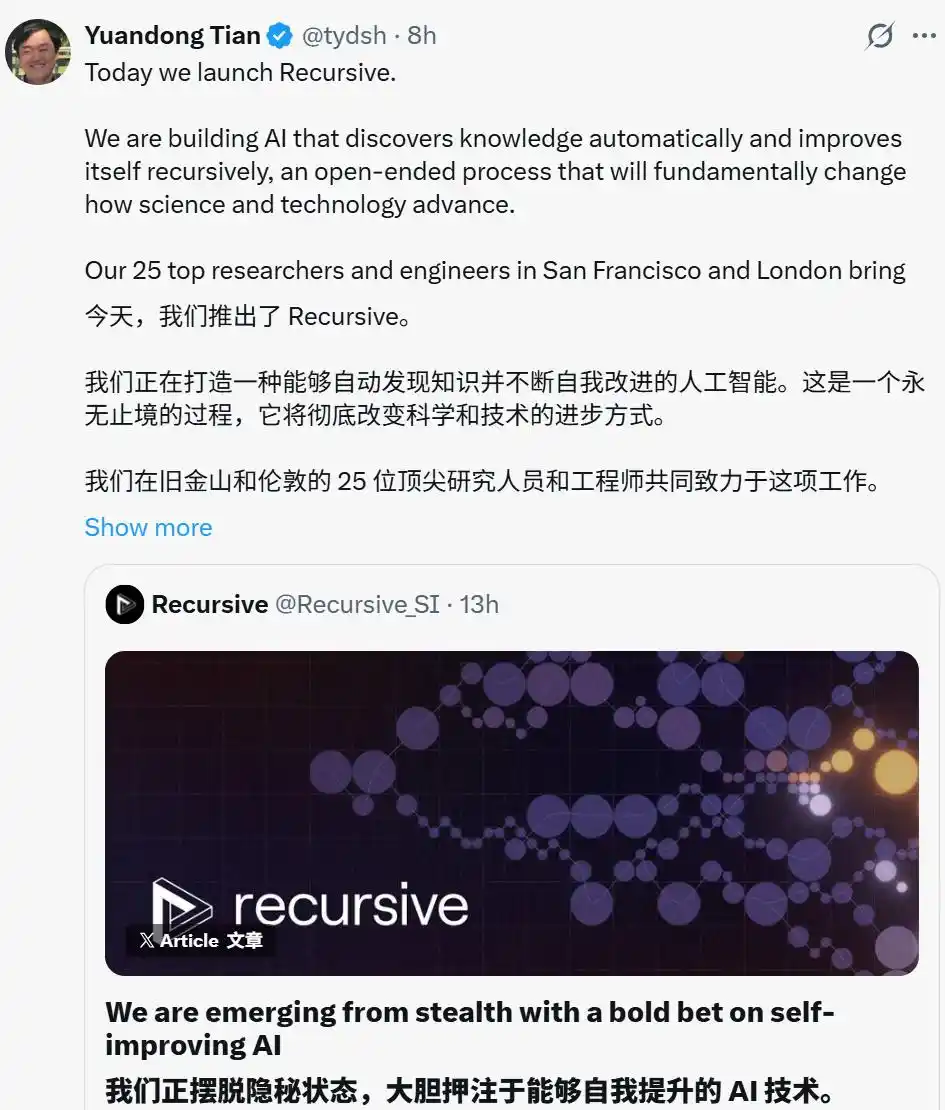
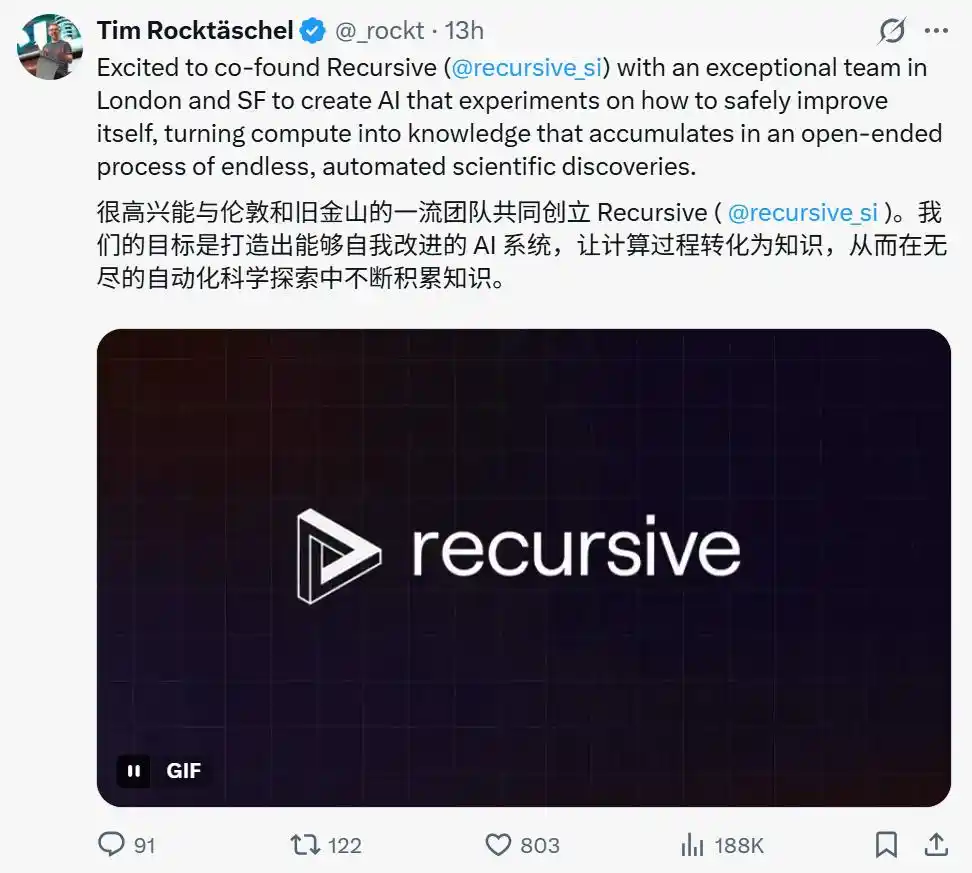
In several core areas of recursively self-improving artificial intelligence, the team is at the industry forefront.

Members have previously achieved major breakthroughs in fields such as open-ended algorithms, quality-diversity algorithms, AI-generated algorithms, self-improving programming agents, automated red teaming and capability discovery, prompt engineering and its automation, learning challenges and environment generation, foundational world models, deep learning for natural language processing, vision transformers, retrieval-augmented generation, and AI scientists.

Therefore, we are truly filled with anticipation for the upcoming research from Recursive_SI.

This article is from the WeChat public account "机器之心" (Machine Heart), author: 机器之心 (Machine Heart), editor: 机器之心编辑部 (Machine Heart Editorial Department)


Perguntas relacionadas

QWhat is the name of the startup co-founded by Tian Yuan Dong after leaving Meta, and what is its primary mission?

AThe startup is called Recursive_SI. Its primary mission is to build an artificial intelligence that can autonomously conduct experiments and safely self-improve through an open-ended process of automated scientific discovery.

QWho are the key investors in Recursive_SI, and what is the current valuation and funding amount mentioned in the article?

AKey investors include GV (Google Ventures) and Greycroft, with AMD Ventures and NVIDIA also participating in significant funding. The company has raised $6.5 billion with a valuation of $46.5 billion.

QWho is Zhuge Mingchen and what is his research focus, particularly in relation to Recursive Self-Improvement (RSI)?

AZhuge Mingchen is a Founding Member of Recursive_SI, holding a Ph.D. in Computer Science from KAUST under Professor Jürgen Schmidhuber. His research focuses on Coding Agents, Recursive Self-Improvement (RSI), and Next-generation Machine Paradigms. Since 2023, he has systematically explored RSI, contributing to early RSI system paradigms like GPTSwarm and Agent-as-a-Judge.

QWhat are some of the core AI research areas where the Recursive_SI founding team is said to be at the industry forefront?

AThe team is at the forefront in areas including open-ended algorithms, quality-diversity algorithms, AI-generated algorithms, self-improving programming agents, automated red teaming and capability discovery, prompt engineering and automation, learning challenge and environment generation, foundational world models, deep learning for natural language processing, vision Transformers, retrieval-augmented generation, and AI scientists.

QWhich major tech companies' AI research labs have the founders of Recursive_SI been involved in establishing or leading, according to the article?

AThe founding members have been involved in establishing or leading AI research labs at Salesforce and Uber, and have held leadership positions at OpenAI, DeepMind, Google Brain, and Meta.

Leituras Relacionadas

GitHub, Transfixed by AI

On the night of February 9th, GitHub suffered a major outage caused by a simple configuration change—reducing a cache refresh interval from 12 to 2 hours—that triggered a cascade of failures. This was not an isolated event, but part of a broader pattern. In early 2026, GitHub experienced at least 8 major incidents, failing to meet its promised 99.9% availability. These outages stemmed from structural issues: explosive growth in load, tight service coupling, and insufficient protection against abnormal traffic. This unprecedented load is driven by AI Agents. In 2025, GitHub handled ~1 billion commits. By 2026, weekly commits reached 275 million, projecting to ~14 billion for the year—a 14x increase. AI tools like Claude Code now contribute 4.5% of all public repository commits, with weekly submissions surging 25x in just three months. AI-generated pull requests jumped from 4 million to 17 million per month in half a year. Unlike human developers, AI Agents work continuously, generating commits at a scale that overwhelms infrastructure designed for human rhythms. The surge also shattered GitHub's business model. Copilot's flat-rate pricing, based on assisting human developers, became unsustainable as Agentic AI sessions consumed resources worth hundreds of dollars for a few dollars in fees. In response, GitHub imposed usage limits and, by June 1st, shifted to a pay-per-use "AI Credits" system. Facing this new reality, GitHub realized a 10x scaling plan was insufficient. It announced a need to *redesign* its architecture for 30x current scale—decoupling services, adding fault isolation, and improving change management to prevent cascading failures. Other platforms like Stripe and AWS are facing similar challenges with AI Agents. Fundamentally, GitHub is transitioning from a human collaboration platform to an "exhaust pipe" for automated AI workflows. Its detailed post-mortem reports aim to maintain trust during this turbulent rebuild. The February outage was not just a technical glitch, but a signal of the software industry's entry into a new, AI-driven era.

marsbitHá 12m

GitHub, Transfixed by AI

marsbitHá 12m

Both Suffer Massive Losses Exceeding $90 Billion, Which Is in Greater Peril: Strategy or Bitmine?

Facing massive paper losses exceeding $90 billion each amidst a sharp market downturn, "Digital Asset Treasury" (DAT) giants Strategy and Bitmine find themselves in a precarious position, but with different underlying risks. Strategy, heavily invested in Bitcoin (BTC), faces significant financial strain. Its strategy relies heavily on debt, including convertible notes and preferred stock (STRC) requiring substantial dividend payments. With its cash reserves dwindling and BTC offering no staking yield for cash flow, Strategy's high leverage makes it vulnerable. A continued price decline could force asset sales to meet obligations, potentially creating a negative feedback loop. Its market value has already fallen sharply. In contrast, Bitmine, an Ethereum (ETH) holder, appears on firmer financial ground. It primarily funds its purchases through equity offerings (like ATM programs), avoiding debt pressure. It also generates income by staking a large portion of its ETH holdings. While not immune to market drops and shareholder dilution concerns, Bitmine maintains more flexibility, recently announcing a new preferred share offering to raise further capital. The core divergence lies in their financing: Bitmine uses equity (investor money), while Strategy uses debt (borrowed money). Consequently, Bitmine currently faces less immediate liquidity pressure than Strategy, which must navigate the dual challenge of servicing debt/dividends and a declining core asset (BTC) price.

marsbitHá 20m

Both Suffer Massive Losses Exceeding $90 Billion, Which Is in Greater Peril: Strategy or Bitmine?

marsbitHá 20m

Where the AI Bubble Really Is: Which Layer of Players Are Naked

AI Bubble: Where It Really Is and Who's Swimming Naked This analysis dissects the AI industry not as a single entity but as a five-layer pyramid, arguing that bubbles are concentrated in specific tiers, not uniformly distributed. **Key Distinction from the 2000 Dot-com Bubble:** Unlike 2000, where companies had stock prices before revenue, today's leading AI players have massive, contract-backed revenue driving their valuations. Core infrastructure demand is real, with every GPU running at full capacity for paying customers. **The Five-Layer Pyramid & Bubble Assessment:** * **L0 (Fab/Manufacturing) & Top L4 (Leading AI Apps): NO BUBBLE.** Companies like TSMC, NVIDIA, major cloud providers (Microsoft, Google, Meta, Amazon), and top AI labs have real revenues and orders. Supply is tightly constrained by TSMC's disciplined capacity control and physical limits like power/land for data centers, preventing a supply glut. * **L1 (Memory): BATTLEGROUND.** Sky-high HBM margins could signal a new structural cycle or a classic "boom before bust." The oligopoly of three major players may enforce supply discipline, making this a high-stakes bet. * **L2 (Interconnect/Optical Modules): BUBBLE TERRITORY.** Companies like Lumentum and AAOI have seen stock surges (4-10x) far outpacing revenue growth. This hardware segment has lower physical barriers to expansion than fabs, allowing speculation. It mirrors the 2000 bubble's epicenter—optics. * **L3 (Infrastructure/"GPU Landlords"): VULNERABLE.** GPU leasing companies profit from the current compute shortage but own no long-term moat. Their business model relies on a temporary bottleneck that will ease as big tech expands and new tech (e.g., potential space-based data centers) emerges. * **L4 Long Tail (VC-backed Startups): STRONG BUBBLE SIGNALS.** VC funding concentration in AI is twice that of the 1999 peak. Many startups with little revenue use the valuation logic of successful giants to justify their own, creating high risk of a "valuation crunch" when funding dries up. **Critical Risks to Monitor:** 1. **GPU Depreciation & Accounting:** Companies extending the assumed useful life of GPUs artificially boost profits. The true economic life depends on future generational leaps from NVIDIA. 2. **"GPU Credit" & Off-Balance-Sheet Leverage:** Emerging structures where shell companies borrow to buy GPUs and lease them out (with chipmakers sometimes investing) move debt off major balance sheets. This echoes the "vendor financing" of 2000 and the securitization risks of 2008, though currently small-scale. 3. **TSMC Abandoning Caution:** If the primary supply bottleneck (TSMC's conservative capacity planning) breaks, runaway supply could trigger a bust. 4. **Algorithmic Efficiency Breakthrough:** A major leap in software efficiency could drastically reduce the need for raw compute hardware, undermining the investment thesis. **Conclusion:** The AI boom is expensive and has frothy areas, but its core is underpinned by real demand and physical supply constraints. The bubble risk is layered: most present in optical components, GPU leasing, and the long-tail startup ecosystem, while the foundational chip manufacturing and leading application layers remain relatively solid—for now.

marsbitHá 32m

Where the AI Bubble Really Is: Which Layer of Players Are Naked

marsbitHá 32m

Trading

Spot
Futuros
活动图片