Tian Yuandong Announces Startup Venture After Leaving Meta

marsbitPublicado em 2026-05-14Última atualização em 2026-05-14

Resumo

After leaving Meta, Tian Yuan Dong has announced his new venture. The startup Recursive_SI has officially launched with a list of founders including Tian Yuan Dong. The founding team also comprises Richard Socher (CEO), Tim Rocktäschel, Jeff Clune, Tim Shi, Caiming Xiong, and Alexey Dosovitskiy, among others. These members have experience building AI research labs at companies like Salesforce and Uber, and have held leadership roles at OpenAI, DeepMind, Google Brain, and Meta. Recursive_SI aims to develop artificial intelligence capable of conducting experiments autonomously and safely improving itself through an open-ended, automated scientific discovery process. This is seen as a promising path toward superintelligence. The company has raised $650 million at a valuation of $4.65 billion, led by GV (Google Ventures) and Greycroft, with significant investments from AMD Ventures and NVIDIA. The team has grown to over 25 members, including new additions like Zhuge Mingchen. Zhuge, a Founding Member, holds a Ph.D. in Computer Science from KAUST under Professor Jürgen Schmidhuber. His research focuses on Coding Agents, Recursive Self-Improvement (RSI), and next-generation machine paradigms, with contributions including early RSI systems like GPTSwarm and work on agentic AI frameworks. The founders shared their vision on X: building AI that can automatically discover knowledge and recursively self-improve, fundamentally changing the way science and technology advance. The team ...

After leaving Meta, Tian Yuandong has also started his entrepreneurial journey.

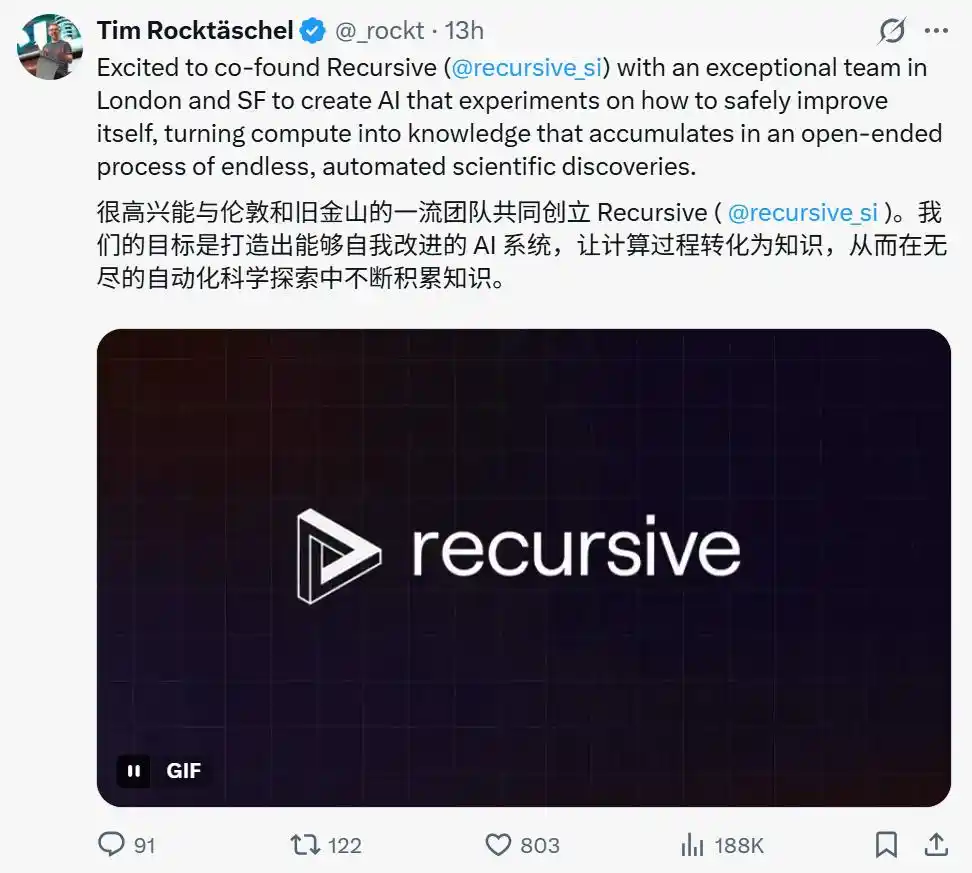
Just now, the startup company Recursive_SI officially debuted and disclosed its list of founders, which includes Tian Yuandong.

In addition to Tian Yuandong, the founding team includes Richard Socher (CEO), Tim Rocktäschel, Jeff Clune, Tim Shi, Caiming Xiong, and Alexey Dosovitskiy, among others.
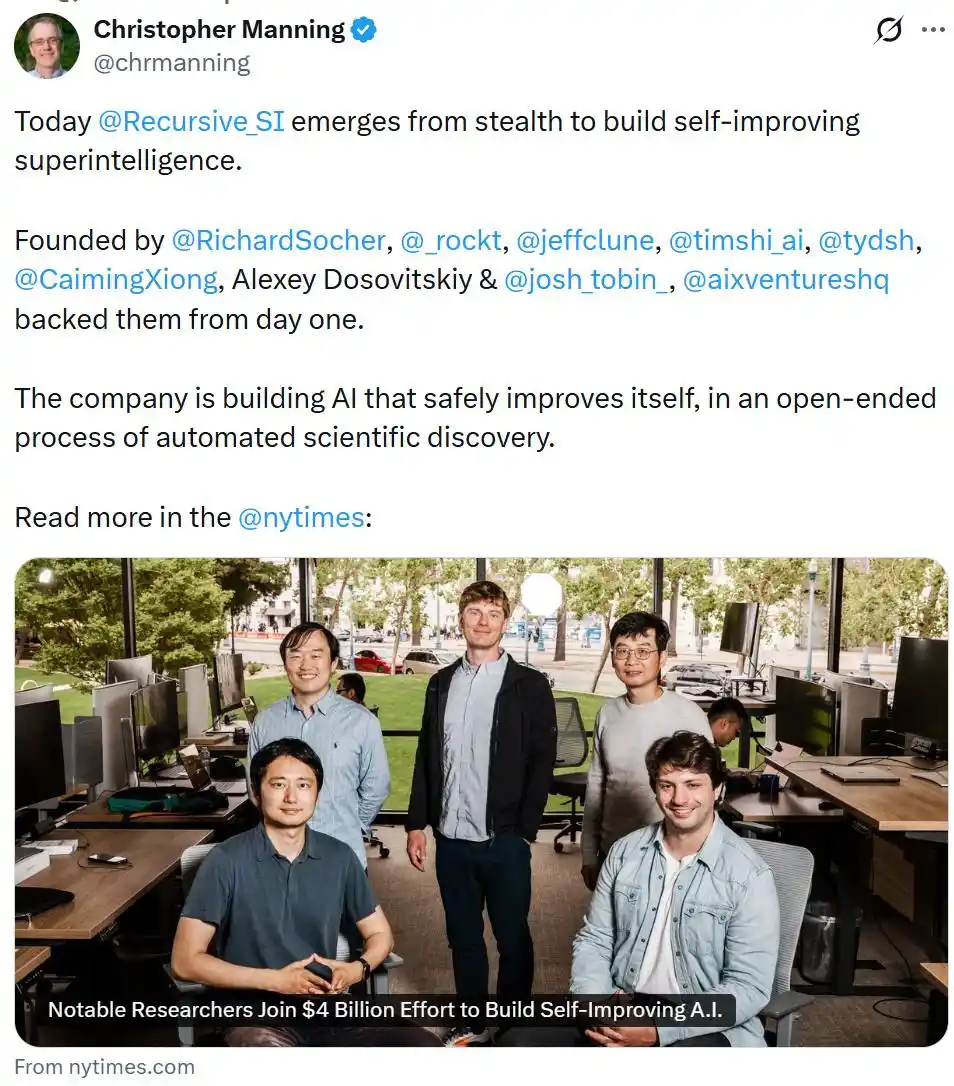
These founding members have previously been involved in establishing AI research labs at Salesforce and Uber, and have held leadership positions at teams such as OpenAI, DeepMind, Google Brain, and Meta, possessing extensive research and entrepreneurial experience.

Recursive_SI is committed to building an artificial intelligence that can autonomously conduct experiments and safely self-improve—continuously evolving within an open-ended, automated scientific discovery process, which is considered the most likely path towards superintelligence.

Currently, Recursive has raised $6.5 billion with a valuation of $46.5 billion, led by GV (Google Ventures) and Greycroft, with significant investments from AMD Ventures and NVIDIA.

The team has grown to over 25 members and continues to expand, having attracted many outstanding talents, including Zhuge Mingchen, who is set to join soon.

Zhuge Mingchen is currently a Founding Member at Recursive. He holds a Ph.D. in Computer Science from King Abdullah University of Science and Technology (KAUST), where he studied under Professor Jürgen Schmidhuber, known as the "Father of LSTM." His research focuses primarily on Coding Agents, Recursive Self-Improvement (RSI), and Next-generation Machine Paradigms.

Since 2023, Zhuge Mingchen has been systematically exploring the direction of Recursive Self-Improvement (RSI).

During the MetaGPT period, he proposed that agents should possess mechanisms for continuous self-optimization and capability evolution, advancing this research direction in subsequent work. Among these, GPTSwarm is considered one of the earliest RSI system paradigms in the LLM era. It was the first to systematically propose and validate a Graph-based Agents framework for self-organizing collaboration, enabling coordination, feedback, and capability evolution among agents through dynamic graph structures. Its core concepts have since been widely adopted by numerous subsequent multi-agent and Agentic AI projects. Agent-as-a-Judge further explored continuous feedback and self-evaluation mechanisms in long-term tasks, attempting to address issues of continuity and stable optimization for agents in complex missions. Research on NeuralComputer further advanced towards next-generation AI system architectures, exploring new machine paradigms that integrate memory, reasoning, and autonomous evolution capabilities.

It can be seen that the research team joining Recursive possesses profound academic experience in the field of recursive self-improvement.

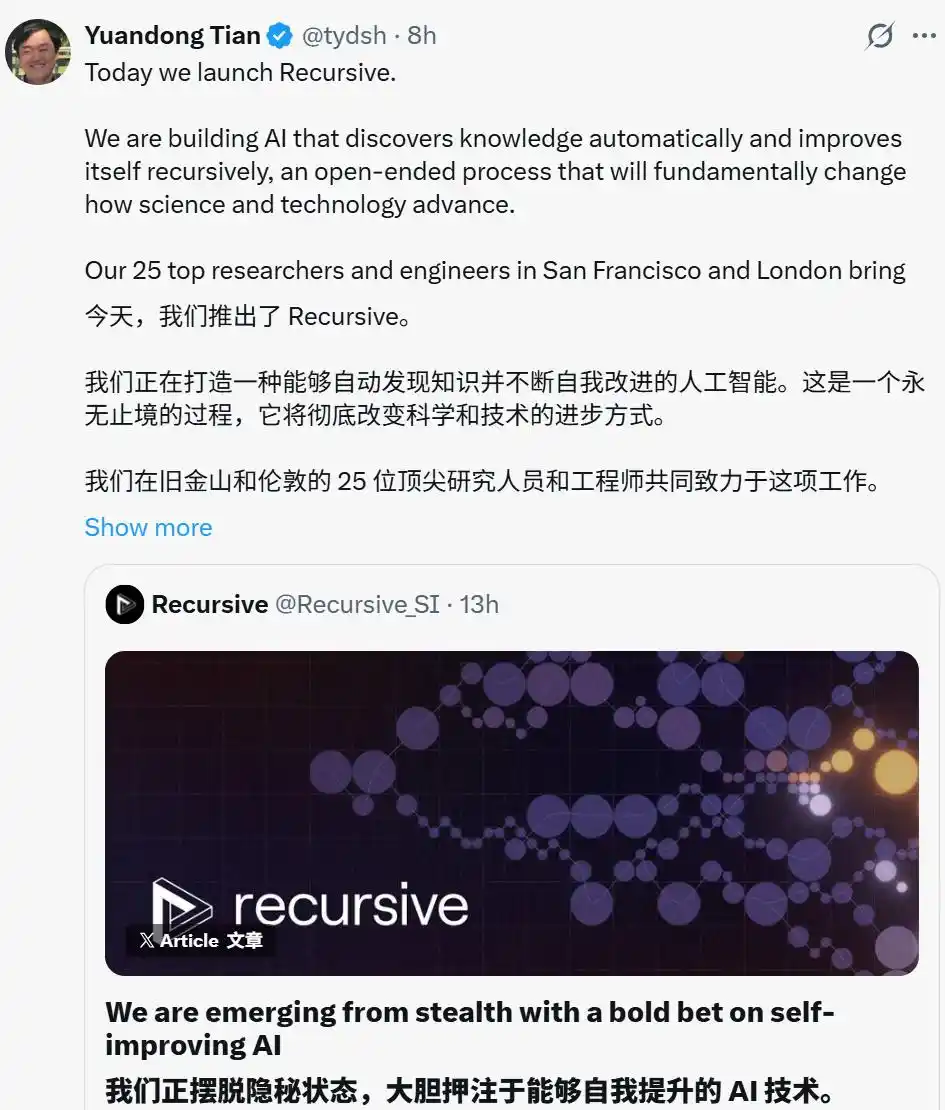
Tian Yuandong and several other founders have promoted the venture on X: "We are building an artificial intelligence that can autonomously discover knowledge and recursively self-improve—this open-ended process will fundamentally change the way science and technology advance."
In several core areas of recursively self-improving artificial intelligence, the team is at the industry forefront.

Members have previously achieved major breakthroughs in fields such as open-ended algorithms, quality-diversity algorithms, AI-generated algorithms, self-improving programming agents, automated red teaming and capability discovery, prompt engineering and its automation, learning challenges and environment generation, foundational world models, deep learning for natural language processing, vision transformers, retrieval-augmented generation, and AI scientists.

Therefore, we are truly filled with anticipation for the upcoming research from Recursive_SI.

This article is from the WeChat public account "机器之心" (Machine Heart), author: 机器之心 (Machine Heart), editor: 机器之心编辑部 (Machine Heart Editorial Department)


Perguntas relacionadas

QWhat is the name of the startup co-founded by Tian Yuan Dong after leaving Meta, and what is its primary mission?

AThe startup is called Recursive_SI. Its primary mission is to build an artificial intelligence that can autonomously conduct experiments and safely self-improve through an open-ended process of automated scientific discovery.

QWho are the key investors in Recursive_SI, and what is the current valuation and funding amount mentioned in the article?

AKey investors include GV (Google Ventures) and Greycroft, with AMD Ventures and NVIDIA also participating in significant funding. The company has raised $6.5 billion with a valuation of $46.5 billion.

QWho is Zhuge Mingchen and what is his research focus, particularly in relation to Recursive Self-Improvement (RSI)?

AZhuge Mingchen is a Founding Member of Recursive_SI, holding a Ph.D. in Computer Science from KAUST under Professor Jürgen Schmidhuber. His research focuses on Coding Agents, Recursive Self-Improvement (RSI), and Next-generation Machine Paradigms. Since 2023, he has systematically explored RSI, contributing to early RSI system paradigms like GPTSwarm and Agent-as-a-Judge.

QWhat are some of the core AI research areas where the Recursive_SI founding team is said to be at the industry forefront?

AThe team is at the forefront in areas including open-ended algorithms, quality-diversity algorithms, AI-generated algorithms, self-improving programming agents, automated red teaming and capability discovery, prompt engineering and automation, learning challenge and environment generation, foundational world models, deep learning for natural language processing, vision Transformers, retrieval-augmented generation, and AI scientists.

QWhich major tech companies' AI research labs have the founders of Recursive_SI been involved in establishing or leading, according to the article?

AThe founding members have been involved in establishing or leading AI research labs at Salesforce and Uber, and have held leadership positions at OpenAI, DeepMind, Google Brain, and Meta.

Leituras Relacionadas

Refunds! Claude 4.8 Sees Overnight Major 'Dumb-Down', GPT-5.6's Computational Power Reportedly 'Halved'

The AI community is currently alarmed by widespread reports of significant performance degradation in two leading models. This article details a "mass self-testing frenzy" triggered by a mysterious prompt designed to detect a hidden "Juice" value, representing a model's reasoning compute budget. On OpenAI's side, users suspect a covert, limited test of a "GPT-5.6-sol" model is underway. When using a specific XML prompt on the Codex platform, a normal "gpt-5.5 xhigh" model reportedly returns a Juice value of 768. However, some users routed to the suspected GPT-5.6 test receive a drastically reduced value of 128—a six-fold decrease. This has sparked debate on whether it signifies a major efficiency leap or a "watered-down, low-cost version" achieved by slashing reasoning depth to save computational expenses. Simultaneously, Anthropic's Claude models, particularly the flagship Opus 4.8 Max, are facing intense user backlash for a perceived "physical brain cut." Users on platforms like Reddit report a dramatic decline in the model's once-impressive reasoning, with complaints of it becoming "absurdly" weakened, performing worse than older, lighter models like Haiku. Specific criticisms include: losing long-context memory, refusing to think deeply even in high-reasoning modes, providing instant incorrect answers, and engaging in unhelpful, argumentative, or "gaslighting" behavior where it contradicts users unnecessarily. The article speculates these "stealth downgrades" might be a calculated corporate strategy. Companies could initially release models with temporarily boosted compute to create an illusion of a major breakthrough, then silently scale back parameters later to manage unsustainable inference costs. A proposed underlying cause is a tightened funding environment, potentially exacerbated by SpaceX's massive IPO soaking up market liquidity, which could delay AI company IPOs and force cost-cutting measures like model "nerfing." The core issue highlighted is the asymmetry of information: subscribers pay for a service that can be silently and fundamentally altered without notification or explanation. The viral "Juice test" resonates because it represents users' desire for transparency about what they are actually paying for.

marsbitHá 8m

Refunds! Claude 4.8 Sees Overnight Major 'Dumb-Down', GPT-5.6's Computational Power Reportedly 'Halved'

marsbitHá 8m

Earning Six Figures and Still Struggling to Rent in San Francisco

A couple in San Francisco with a combined tech income over $360,000 struggled for months to find a one-bedroom apartment under $5,000 per month. Their story highlights how the AI wealth boom, driven by upcoming IPOs from companies like OpenAI and Anthropic, is dramatically escalating the city's cost of living. Even six-figure salaries are becoming insufficient for a comfortable lifestyle. The article details the financial reality for tech workers earning around $180,000 annually. After taxes, retirement contributions, and healthcare, take-home pay is roughly $7,000 per month. With average rents exceeding $3,800 and one-bedrooms often costing $4,500-$5,200, discretionary income shrinks to $1,500-$2,500. This contrasts sharply with reported median total compensations of $640,000 at OpenAI and $420,000 at Anthropic. The AI gold rush is identified as the primary driver. The scale of potential wealth from these IPOs, far surpassing previous tech booms, is flooding the housing market. Data shows San Francisco's average rent is now the highest in the U.S., with vacancy rates in desirable neighborhoods plummeting to around 3%. The overall cost of living is 65.6% above the national average. The piece features multiple professionals, including a 25-year-old with a $250,000 salary, facing housing instability, fierce competition for rentals, and a persistent, low-grade financial anxiety despite high earnings. It concludes that the rapid concentration of AI wealth is redefining what constitutes a "high salary" in San Francisco, pushing out mid-tier tech talent and creating a stark divide between those in the AI sector and everyone else.

marsbitHá 1h

Earning Six Figures and Still Struggling to Rent in San Francisco

marsbitHá 1h

Trading

Spot
活动图片