This Week, Everyone Is Helping AI Open Bank Accounts

marsbitPublicado em 2026-03-19Última atualização em 2026-03-19

Resumo

This week, major players in finance and tech are racing to build payment infrastructure for AI agents. Stripe and Paradigm-backed blockchain Tempo launched its mainnet with a valuation of $5 billion, introducing the Machine Payments Protocol (MPP) to enable autonomous machine-to-machine transactions. Simultaneously, Visa unveiled a command-line tool for AI payments, Mastercard acquired stablecoin firm BVNK for $1.8 billion, Coinbase upgraded its crypto payment protocol x402, and Sam Altman’s World released an AI identity verification toolkit. The core problem: AI agents increasingly need to spend money autonomously—on APIs, compute, data, and services—but traditional payment systems (bank accounts, credit cards) require human authentication, creating a bottleneck. Both traditional finance giants and crypto-native companies are converging on solutions, leveraging existing card networks or blockchain-based systems to reduce friction for AI-driven transactions. Despite the flurry of high-value investments and infrastructure launches, current transaction volumes remain minimal (e.g., x402 processed just $65.4K in 24 hours). The market is nascent, resembling early internet infrastructure build-outs where demand eventually caught up with supply. The race is on to capture what could become a foundational layer for AI commerce—whether through traditional rails or crypto pipelines.

Author: David, Shenchao TechFlow

On March 18th, another blockchain mainnet went live.

It's called Tempo, backed by Stripe and Paradigm. Stripe is one of the world's largest online payment companies, processing $1.9 trillion in transactions last year; Paradigm is one of the largest venture capital firms in the crypto industry. The two jointly invested $500 million in Tempo last year, valuing the project at:

5 billion.

A $5 billion blockchain, not speculating on cryptocurrencies, not doing DeFi, not issuing memes. On the day of the mainnet launch, Tempo's most high-profile product was:

Enabling machines to pay machines.

This might sound abstract, but you can think of it as AI now having to pay for every step. Calling an API costs money, buying computing power costs money, pulling a batch of data from a database costs money...

But the existing payment systems are all designed for humans. Bank accounts require ID cards, credit cards require facial recognition, Alipay requires SMS verification codes.

AI can't pass any of these.

It can help you complete an entire workflow, but when it comes to the payment step, it has to stop and wait for a human to press "confirm."

So, launched alongside the mainnet is an open protocol called MPP (Machine Payments Protocol), co-developed by Stripe.

Simply put, it sets rules for transactions between machines, including how to request payments, how to authorize, how to settle, etc.

The envisioned scenario is that AI can autonomously spend money within preset limits without needing human approval for every transaction. On launch day, over 100 service providers had already integrated, including OpenAI, Anthropic, and Shopify.

But Tempo isn't the only one doing this this week.

Within five days, Visa established a new department and launched an AI payment tool, Coinbase's payment protocol underwent a major upgrade, Mastercard acquired a stablecoin company for $1.8 billion, and Sam Altman's World released a toolkit specifically for AI identity verification.

Five giants rushed through the same door in one week, eager to open bank accounts for AI.

Two Paths, One Door

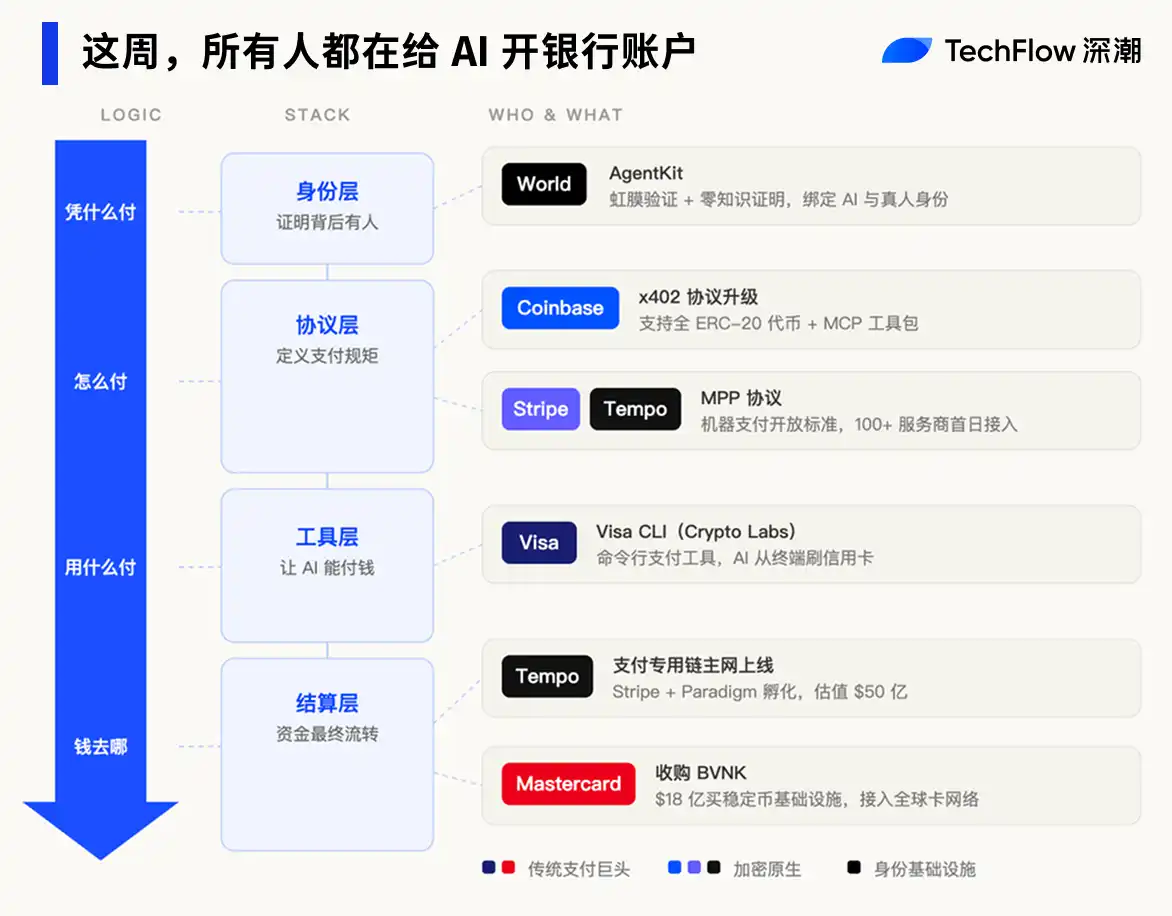
Tempo is helping AI with settlements. But settlement is just one part of the payment system. For an AI Agent to truly spend money autonomously, it also needs payment tools, funding channels, and identity verification.

Here, traditional payment companies and crypto companies are competing for the cake using their respective strengths.
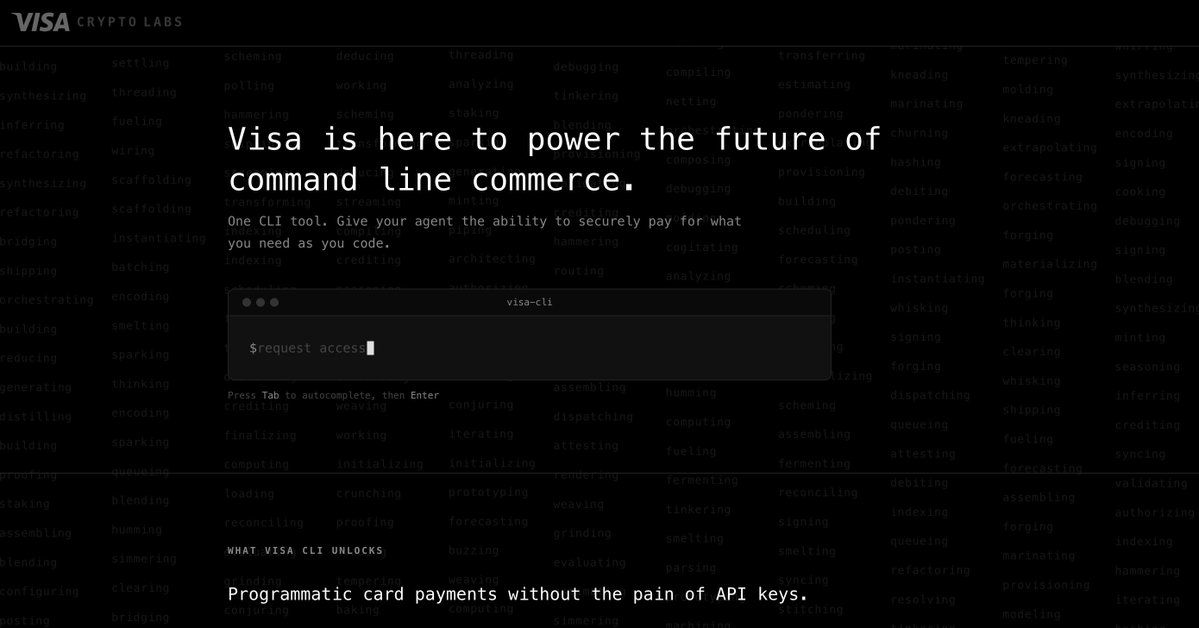
On March 18th, the same day Tempo's mainnet launched, payment giant Visa also moved. Its newly established Crypto Labs department released its first product: Visa CLI, a tool that allows AI Agents to initiate credit card payments directly from the terminal.

No API key needed, no pre-registration required. If an AI needs to buy some service while running a task, it can pay with one line of command. Visa calls this "command-line commerce."
Visa's global card network connects billions of cards and tens of millions of merchants. If AI payments can run on this existing network, it doesn't need to wait for any new infrastructure to mature.

Visa is extending the old path. Its competitor Mastercard chose another way: buying the path outright.

On March 17th, Mastercard announced the acquisition of London-based stablecoin infrastructure company BVNK for $1.8 billion. This is the largest stablecoin acquisition in the history of the crypto industry.

The purpose of this acquisition is straightforward: if AI payments are going to use stablecoins, then let those stablecoins flow through my pipes.

On the crypto-native side, the moves are equally密集 (dense).

Coinbase's x402 protocol completed a major upgrade, expanding its payment scope from a few stablecoins to all ERC-20 tokens, while also releasing the MCP toolkit, allowing developers to integrate AI tools into the payment network with one click.

The two sides seem to start from different points, but their actions point in the same direction: Traditional payment companies are embracing crypto, crypto companies are embracing AI. Ultimately, crypto infrastructure is becoming the underlying pipeline for AI payments.

One环节 (link) remains. AI can spend money, but how does the merchant know if there's a human responsible for the AI spending the money?

On March 17th, World, co-founded by Sam Altman, released AgentKit, integrated with Coinbase's x402. It does only one thing: allow the AI to prove, while paying, that there is a verified real person behind it. The merchant can confirm that someone is responsible for the transaction but cannot see who that person is.

Five days, five companies. Settlement, channels, tools, protocols, identity. Every环节 (link) has been卡位 (staked out).

AI Cake Divided, Only the Cashier Left

Over the past three years, most positions on the AI industry chain have been taken.

The model layer is the table for OpenAI, Anthropic, Google, and a number of Chinese companies. Computing power is locked down tightly by Nvidia. The application layer is a bloody red ocean from programming assistants to search engines...

Every layer is crowded, and the competitive barriers in each layer are getting higher.

But the payment layer is still relatively vacant.

It's not that no one thought of it, the timing just wasn't right. AI Agent payment has a prerequisite: AI must first have the ability to independently complete an entire task chain. If it can only chat, doesn't need to call APIs, doesn't need to buy computing power, doesn't need to hire other Agents to work, then payment is not a rigid demand.

Over the past year, this prerequisite has slowly been established.

OpenClaw allows AI to directly operate computers, the MCP protocol allows AI to access external services, and the Agent capabilities of various large models saw concentrated breakthroughs in the second half of 2025. AI changed from a "conversation tool" to a "tool that gets work done," and getting work done costs money...

The demand for spending money has arrived, but the infrastructure for spending money does not yet exist.

This is why Stripe, Visa, Mastercard, and Coinbase acted simultaneously. For traditional payment companies, this is the first time they have gained a home-field advantage in the entire AI wave. They can't make models, they can't make chips, but payment is what they've been doing for decades.

Visa's global card network connects billions of cards and tens of millions of merchants, Mastercard covers over 200 countries, Stripe processed $1.9 trillion in transactions last year. If every AI expenditure flows through these pipes, the more capable AI is, the more money they make.

For crypto companies, the logic is somewhat different.

Coinbase CEO Brian Armstrong once said something very direct: "AI can own a crypto wallet, but it can't open a bank account."

Every step of the traditional financial system confirms "who you are." Opening a bank account requires an ID card, applying for a credit card requires facial recognition, every transaction requires an SMS verification code. AI is software, not a person; it can't pass any of these checkpoints.

But crypto wallets don't need these. A private key is an account. For an AI Agent, on-chain payment is the path of least resistance.

Crypto or not, AI payment will be a new infrastructure-level market. The difference is only whose pipeline is more suitable for machines.

Road Built, Cars Not Here

The story seems all set here, five giants are in place.

But there's a number worth looking at.

Coinbase's x402 protocol is currently the earliest landed and widest-reaching AI payment protocol. According to x402scan data, the total transaction volume of the entire ecosystem in the past 24 hours is $65,400. 150,000 transactions, averaging less than 50 cents per transaction.

What infrastructure is paired with this number? Tempo is valued at $5 billion, Mastercard spent $1.8 billion to acquire BVNK, Visa specifically established a new department, Stripe personally wrote the protocol.
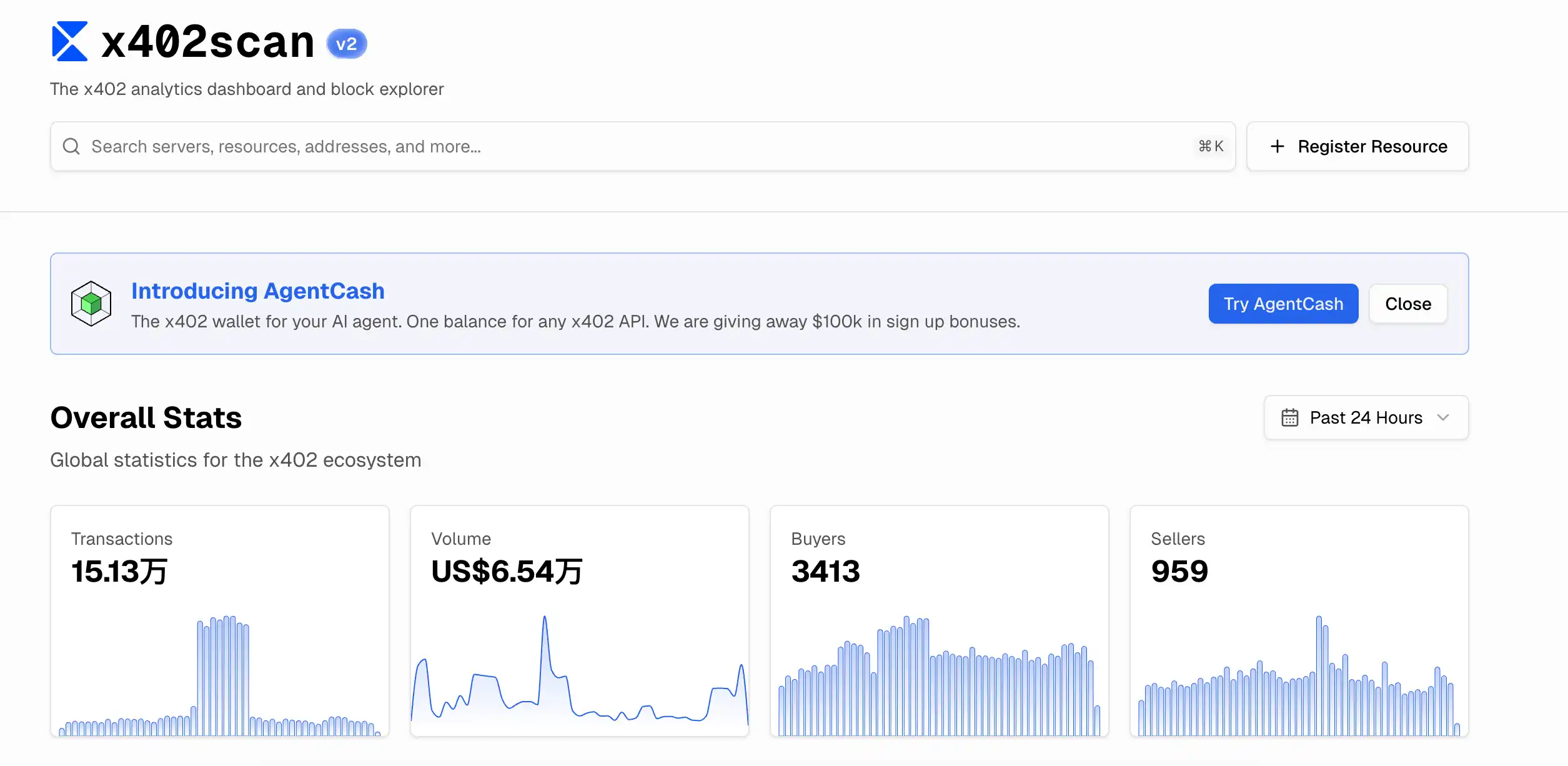
Billions in valuation infrastructure, serving a daily transaction volume akin to a roadside bubble tea shop.

All infrastructure businesses seem to have this常态 (normal state).

On the eve of the 2000 internet bubble, telecom companies laid millions of kilometers of fiber optic cables under the sea. After laying them, they found that global internet traffic only used 5% of it. Most of those companies went bankrupt, but the cables remained.

A decade later, video streaming and mobile internet filled those pipes. The road pavers didn't make money, but the road was real.

AI payment is at this stage now. The demand logic is sound: AI Agents are indeed becoming more capable, they indeed need to spend money autonomously, they indeed need a new financial infrastructure.

Everyone is on the starting line, but after the starting gun fires, they find that, for now, they are the only ones on the track.

As for whose road ultimately succeeds, and when the first truly autonomous AI transaction happens in your life, it might be faster than everyone expects, or it might be slower than everyone expects.

The only certainty is that this battle has already begun, and your wallet and mine might be the last to know.


Perguntas relacionadas

QWhat is Tempo and what is its primary purpose as described in the article?

ATempo is a new blockchain mainnet launched by Stripe and Paradigm, with a valuation of $5 billion. Its primary purpose is not to trade cryptocurrencies or engage in DeFi, but to enable 'machine-to-machine payments'—allowing AI systems to autonomously pay for services like API calls, computing power, or data without human intervention for each transaction.

QWhich major payment companies made significant moves in the AI payment space during the week mentioned in the article?

AVisa, Mastercard, and Stripe all made significant moves. Visa launched a new tool called Visa CLI for AI agents to initiate credit card payments, Mastercard acquired stablecoin infrastructure company BVNK for $1.8 billion, and Stripe co-developed the Machine Payments Protocol (MPP) for Tempo.

QWhat problem does the current payment system pose for AI agents according to the article?

AThe current payment system is designed for humans and requires identity verification steps like ID cards, facial recognition, or SMS codes—all of which AI agents cannot pass. This forces AI workflows to pause at the payment step, waiting for human approval, hindering full autonomy.

QWhat role does encryption infrastructure play in AI payments as per the article?

AEncryption infrastructure, such as blockchain and crypto wallets, provides a low-friction path for AI payments because it doesn't require human identity verification. AI agents can use private keys to hold and spend funds autonomously, making it easier for machines to transact compared to traditional banking systems.

QWhat is the current scale of AI payment transactions on Coinbase's x402 protocol, and what does this indicate about the market?

AAccording to x402scan data, the daily transaction volume on Coinbase's x402 protocol is $65,400, with 150,000 transactions averaging less than $0.50 each. This indicates that despite massive infrastructure investments and high expectations, the actual market for AI payments is still in its very early stages, similar to historical infrastructure booms where demand lags behind supply initially.

Leituras Relacionadas

Cook's Curtain Call and Ternus Takes the Helm: The Disruption and Reboot of Apple's 4 Trillion Dollar Empire

Tim Cook has officially announced he will step down as CEO of Apple in September, transitioning to executive chairman after a 15-year tenure during which he grew the company’s market value from around $350 billion to nearly $4 trillion. He will be succeeded by John Ternus, a 50-year-old hardware engineering veteran who has been groomed for the role through increasing public visibility and internal responsibility. Ternus’s appointment signals a strategic shift toward hardware and engineering leadership, with Johny Srouji—head of Apple Silicon—taking on an expanded role as Chief Hardware Officer. This consolidation aims to strengthen Apple’s core technological capabilities. However, Cook’s departure highlights a significant unresolved issue: Apple’s delayed and fragmented approach to artificial intelligence. Despite early efforts, such as hiring John Giannandrea from Google in 2018, Apple’s AI initiatives—particularly around Siri—have struggled with internal restructuring and reliance on external partnerships, including with Google. The transition comes at a critical moment as Apple faces paradigm shifts with the rise of artificial general intelligence (ASI). The company’s closed ecosystem of hardware, software, and services—once a major advantage—now presents challenges in adapting to an AI-centric world where intelligence may matter more than the device itself. Ternus must quickly articulate a clear AI strategy, possibly starting at WWDC, to reassure markets and redefine Apple’s role in a new technological era. His task is not only to maintain Apple’s operational excellence but also to reinvigorate its capacity to innovate and lead in the age of AI.

marsbitHá 2h

Cook's Curtain Call and Ternus Takes the Helm: The Disruption and Reboot of Apple's 4 Trillion Dollar Empire

marsbitHá 2h

Trading

Spot
Futuros

Artigos em Destaque

O que é $BANK

Bank AI: Um Passo Revolucionário no Futuro da Banca Introdução Em uma era marcada por avanços rápidos na tecnologia, o Bank AI está na interseção da inteligência artificial (IA) e dos serviços bancários. Este projeto inovador visa redefinir o panorama financeiro, melhorando a eficiência operacional, as medidas de segurança e as experiências dos clientes através do poder da IA. Ao embarcarmos nesta exploração do Bank AI, iremos aprofundar no que o projeto implica, suas dinâmicas operacionais, seu contexto histórico e marcos significativos. O que é o Bank AI? No seu cerne, o Bank AI representa uma iniciativa transformadora com o objetivo de integrar a inteligência artificial em várias operações bancárias. Este projeto aproveita as capacidades da IA para automatizar processos, melhorar os protocolos de gestão de risco e melhorar a interação com os clientes através de serviços personalizados. Os principais objetivos do Bank AI incluem: Automatização das Funções Bancárias: Ao aproveitar as tecnologias de IA, o Bank AI visa automatizar tarefas rotineiras, reduzindo o peso sobre os recursos humanos e aumentando a eficiência. Gestão de Risco Melhorada: O projeto utiliza algoritmos de IA para prever e identificar riscos, fortalecendo assim as medidas de segurança contra fraudes e outras ameaças. Personalização dos Serviços Bancários: O Bank AI foca em oferecer produtos e serviços financeiros ajustados, analisando dados e comportamentos dos clientes. Melhoria da Experiência do Cliente: A implementação de soluções impulsionadas por IA, como chatbots e assistentes virtuais, visa proporcionar aos usuários interações mais humanizadas, revolucionando a forma como os clientes se envolvem com os bancos. Com esses objetivos, o Bank AI posiciona-se como um ator crucial para tornar a banca mais eficiente, segura e centrada no usuário. Quem é o Criador do Bank AI? Os detalhes sobre o criador do Bank AI permanecem desconhecidos. Assim, nenhuma pessoa ou organização específica foi identificada nas informações disponíveis. O anonimato que cerca a origem do projeto levanta questões, mas não diminui a sua ambiciosa visão e objetivos. Quem são os Investidores do Bank AI? Semelhante ao criador do projeto, informações específicas sobre os investidores ou organizações que apoiam o Bank AI não foram divulgadas. Sem essas informações, é difícil delinear o apoio financeiro e institucional que pode estar impulsionando o projeto para frente. No entanto, a importância de ter uma sólida base de investimento é fundamental para sustentar o desenvolvimento em um campo tão inovador. Como Funciona o Bank AI? O Bank AI opera em várias frentes inovadoras, focando em fatores únicos que o diferenciam das estruturas bancárias tradicionais. Abaixo estão as principais características operacionais: Automatização: Ao aplicar algoritmos de aprendizado de máquina, o Bank AI automatiza vários processos manuais dentro dos bancos. Isso resulta na redução dos custos operacionais e permite que os trabalhadores humanos redirecionem os seus esforços para atividades mais estratégicas. Gestão de Risco Avançada: A integração da IA nas práticas de gestão de risco equipa os bancos com ferramentas para prever com precisão potenciais ameaças, como fraudes, garantindo que as informações e ativos dos clientes permaneçam seguros. Recomendações Financeiras Personalizadas: Através do aprendizado contínuo a partir das interações com os clientes, os sistemas de IA desenvolvem uma compreensão sutil das necessidades dos usuários, permitindo oferecer conselhos adaptados sobre decisões financeiras. Interações Melhoradas com os Clientes: Utilizando chatbots e assistentes virtuais alimentados por IA, o Bank AI permite uma experiência de cliente mais envolvente, permitindo que os usuários tenham suas dúvidas resolvidas rapidamente, reduzindo assim os tempos de espera e melhorando os níveis de satisfação. Juntas, estas características operacionais posicionam o Bank AI como um pioneiro no setor bancário, estabelecendo novos padrões para a prestação de serviços e a excelência operacional. Cronologia do Bank AI Compreender a trajetória do Bank AI requer uma análise do seu contexto histórico. Abaixo está uma cronologia que destaca marcos e desenvolvimentos importantes: Início de 2010: A conceituação da integração da IA nos serviços bancários começou a ganhar atenção à medida que instituições bancárias reconheciam os potenciais benefícios. 2018: Ocorreu um aumento significativo na implementação de tecnologias de IA, quando os bancos começaram a usar ferramentas de IA como chatbots para atendimento ao cliente básico e sistemas de gestão de risco para melhorar o tratamento de segurança. 2023: A sofisticação da IA continuou a avançar, com a introdução de IA generativa para tarefas mais complexas, como processamento de documentos e análise de investimentos em tempo real. Este ano marcou um salto significativo nas capacidades proporcionadas aos bancos pela tecnologia de IA. 2024-Estado Atual: Neste ano, o Bank AI está em uma trajetória ascendente, com pesquisas e desenvolvimentos em andamento prontos para aprimorar ainda mais as capacidades nas operações bancárias. A exploração contínua das aplicações de IA sugere desenvolvimentos emocionantes por vir. Pontos Chave Sobre o Bank AI Integração da IA na Banca: O Bank AI foca na adoção da inteligência artificial para simplificar os processos bancários e melhorar as experiências dos usuários. Automatização e Foco em Gestão de Risco: O projeto enfatiza fortemente essas áreas, visando transferir o peso das tarefas rotineiras enquanto melhora as estruturas de segurança através de análises preditivas. Soluções Bancárias Personalizadas: Ao aproveitar os dados dos clientes, o Bank AI possibilita serviços bancários ajustados que atendem às necessidades individuais dos usuários. Compromisso com o Desenvolvimento: O Bank AI permanece comprometido com contínuas pesquisas e esforços de desenvolvimento, garantindo a sua adaptabilidade e relevância contínua à medida que a tecnologia continua a evoluir. Conclusão Em resumo, o Bank AI exemplifica um passo crucial em frente na indústria bancária, aproveitando a inteligência artificial para remodelar paradigmas operacionais, melhorar a segurança e promover a satisfação do cliente. Apesar das lacunas de informação em torno do criador e dos investidores, os objetivos claros e os mecanismos funcionais do Bank AI fornecem uma base sólida para sua evolução contínua. À medida que a tecnologia de IA continua a avançar e se fundir com o setor bancário, o Bank AI está bem posicionado para impactar significativamente o futuro dos serviços financeiros, aprimorando a maneira como entendemos e interagimos com a banca.

40 Visualizações TotaisPublicado em {updateTime}Atualizado em 2024.12.03

O que é $BANK

Como comprar BANK

Bem-vindo à HTX.com!Tornámos a compra de Lorenzo Protocol (BANK) simples e conveniente.Segue o nosso guia passo a passo para iniciar a tua jornada no mundo das criptos.Passo 1: cria a tua conta HTXUtiliza o teu e-mail ou número de telefone para te inscreveres numa conta gratuita na HTX.Desfruta de um processo de inscrição sem complicações e desbloqueia todas as funcionalidades.Obter a minha contaPasso 2: vai para Comprar Cripto e escolhe o teu método de pagamentoCartão de crédito/débito: usa o teu visa ou mastercard para comprar Lorenzo Protocol (BANK) instantaneamente.Saldo: usa os fundos da tua conta HTX para transacionar sem problemas.Terceiros: adicionamos métodos de pagamento populares, como Google Pay e Apple Pay, para aumentar a conveniência.P2P: transaciona diretamente com outros utilizadores na HTX.Mercado de balcão (OTC): oferecemos serviços personalizados e taxas de câmbio competitivas para os traders.Passo 3: armazena teu Lorenzo Protocol (BANK)Depois de comprar o teu Lorenzo Protocol (BANK), armazena-o na tua conta HTX.Alternativamente, podes enviá-lo para outro lugar através de transferência blockchain ou usá-lo para transacionar outras criptomoedas.Passo 4: transaciona Lorenzo Protocol (BANK)Transaciona facilmente Lorenzo Protocol (BANK) no mercado à vista da HTX.Acede simplesmente à tua conta, seleciona o teu par de trading, executa as tuas transações e monitoriza em tempo real.Oferecemos uma experiência de fácil utilização tanto para principiantes como para traders experientes.

364 Visualizações TotaisPublicado em {updateTime}Atualizado em 2025.05.09

Como comprar BANK

Discussões

Bem-vindo à Comunidade HTX. Aqui, pode manter-se informado sobre os mais recentes desenvolvimentos da plataforma e obter acesso a análises profissionais de mercado. As opiniões dos utilizadores sobre o preço de BANK (BANK) são apresentadas abaixo.

活动图片