The Success of Robinhood Chain Proves Ethereum Is Not Dead

marsbitPublicado em 2026-07-13Última atualização em 2026-07-13

Resumo

The article argues that Robinhood's decision to build its own dedicated blockchain, Robinhood Chain, as an Ethereum Layer 2 (L2) using Arbitrum technology is a powerful endorsement of Ethereum's L1+L2 model, not a rejection of it. This move reflects a broader shift in the crypto industry from projects focused on token monetization to real-world businesses building cash-generating operations. Historically, many crypto projects chose infrastructure to support token sales and speculative value. In contrast, businesses like Robinhood and Coinbase (with Base) choose infrastructure based on commercial needs: security, liquidity, customer reach, and control. Ethereum's model provides a trusted, neutral, and liquid global settlement layer (L1) coupled with customizable, high-performance execution environments (L2s). This allows companies to maintain control and specialization without the cost and risk of building an independent L1 from scratch. The author contends that as more traditional enterprises enter the space to build sustainable businesses, they will rationally select Ethereum's L1 for maximum security and liquidity and its L2s for scalability and customization. This trend strengthens Ethereum's network effects and the utility of ETH as the native gas and asset within this expanding ecosystem. Robinhood's choice is thus seen as a landmark example of pragmatic business strategy aligning with Ethereum's architectural strengths.

Original Ryan Berckmans

Compiled / Odaily Planet Daily Golem

The previous era of the crypto industry dumped tokens via infrastructure, while its next era will choose Ethereum L1+L2 to build real businesses.

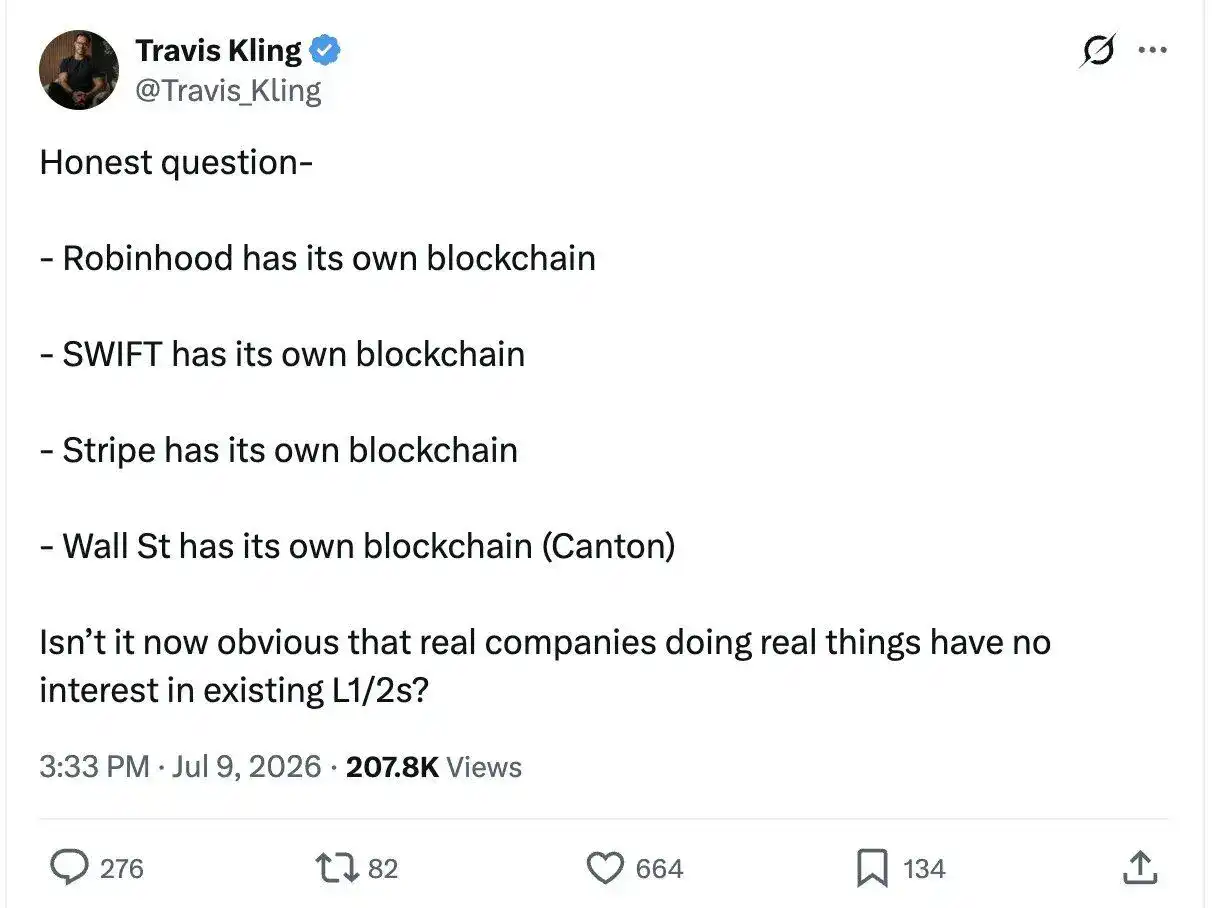
Travis Kling posed a question this week: "Is it now obvious that companies doing real business are not interested in L1/L2?" Robinhood was his first example. But on the contrary, Robinhood is almost a perfect counterexample: when entity companies make business decisions, they almost always choose the Ethereum L1+L2 model.
Robinhood chose an existing L1—Ethereum, and then built its own Ethereum L2 leveraging Arbitrum technology. Robinhood Chain uses Ethereum blobs for data availability, uses ETH as its native gas token, and its security is also provided by Ethereum.

Therefore, Robinhood has not negated Ethereum's L1+L2 model; on the contrary, the model is running on Robinhood as intended.

The "buyers" choosing Ethereum have changed. In the past, crypto projects chose public chains and technologies to sell their own tokens, while the emerging real-world on-chain economy is adopting the Ethereum L1+L2 model as the foundation for cash businesses.

As the composition of buyers changes, I believe Ethereum's advantages will become even more apparent.

The Old Crypto Economy Was Token-Centric

By "real businesses serving real users," I mean a traditional corporate model: building products customers need, earning profits by serving them, and increasing the equity value of those profits.

"Real users" here refers to consumption demand arising from ordinary economic needs, not speculative demand primarily generated by new token issuance. Crypto-native users are obviously real users. This is not a moral judgment on a protocol's usefulness or its developers' sincerity, but merely a distinction regarding the goal of operating a real economy business.

Token value can only come from three sources:

  • Cash: A reliable claim on future cash flows, similar to on-chain equity or bonds;
  • Utility: Access, control, governance, or other privileged participation rights to a valuable system. Even without cash flow, tokens that control important things clearly have value;
  • Monetary Premium: People hold the asset because they expect others to accept and recognize its value in the future. This asset is no longer merely a claim that must ultimately be exchanged for something else; it becomes a store of wealth—a terminal value asset.

The monetary premium is real but extremely difficult to sustain. It requires deep network effects in trust, liquidity, distribution, integration, and utility. Gold, the US dollar, Bitcoin, and Ethereum have all built different versions of this effect, while few other assets have achieved it.

Looking back, since programmable cryptocurrencies became popular, the vast majority of industry participants have not been ordinary cash flow businesses. Their economic goal has often been to sell a token whose value is primarily based on utility, an anticipated monetary premium, or distant promises of future cash.

Sometimes their plans were straightforward—launch a protocol and sell its token; sometimes more indirect—receive funding from a token-funded ecosystem and then cash out the tokens; sometimes a project genuinely expected future profitability, but since the token's valuation was detached from any plausible future cash, the actual business model still relied on confidence in the token itself.

This became the norm because almost every project was doing something similar, but there were exceptions.

Centralized exchanges are inherently cash transaction platforms and are naturally multi-chain, adding another chain is like adding another deposit/withdrawal channel. Some stablecoin issuers are also cash transaction businesses, initially serving crypto-native clients and now rapidly expanding into the broader economy.

But these exceptions precisely prove the point: Businesses aiming for ordinary cash transactions choose infrastructure that maximizes their business, not token value.

Different Business Goals Will Build Different Projects

A business's ultimate goal determines its technology choices.

If the goal is a cash transaction business, then blockchain is infrastructure, and the selection criteria are to reduce risk, improve the product, reach customers, and secure profits. If the goal is token monetization, then blockchain choice has more degrees of freedom. After receiving funding from a public chain, a business can choose to develop on the chain that funded it.

For example, if a protocol succeeds on Chain A, you can launch a similar protocol on Chain B so investors can price your token by comparison. Want momentum for a new token? Then a new L1, L2, appchain, gas token, governance system, or a particular tech stack can become selling points.

The problem is not technological diversity itself; the crypto industry will continue to see an explosion of applications, protocols, L2 architectures, and specialized execution environments. The problem is the tendency to turn every new idea into a sovereign, independent ecosystem (with its own L1 architecture, security validation, liquidity base, and monetary asset), regardless of whether the underlying product warrants it.

As the industry now shifts toward cash businesses, experiments continue, but they will increasingly be built on shared infrastructure. Businesses will specialize at the application layer or on L2s, while relying on the Ethereum L1 layer for settlement, security validation, liquidity maintenance, and monetary asset management. The result is not less innovation, but a balance: more diversity at the edges, more concentration at the base.

The traditional crypto economy typically chose architecture around the token it wanted to sell, while the emerging on-chain economy will choose architecture around the product it wants its customers to buy.

The Buyers Are Changing

The future of the crypto industry will be fundamentally different from the past because the "buyers" have changed.

Previous US administrations actively suppressed on-chain transaction development. Now this trend has reversed. The GENIUS Act is now in effect, providing a legal framework for payment stablecoins, and Europe's MiCA regulatory framework is fully applicable. Brokers, payment companies, banks, asset managers, and governments worldwide are formulating strategies for stablecoins, tokenization, and on-chain transactions.

This doesn't mean all regulatory issues are resolved, but at least it shows large institutions can attempt more blockchain business.

We are approaching the beginning of the S-curve for true crypto industry adoption.

When we emerge from this phase, the crypto industry and traditional finance will no longer be distinct categories. Property, money, transactions, finance, identity, and trust will all be coordinated through a network of on-chain and off-chain systems. Eventually, "Web 3" will fade away like "Web 2," and everything will simply be the internet.

As this process advances, a larger proportion of crypto market participants will be entity businesses serving ordinary consumers in the broader economy. This proportion will be reflected not just in the number of companies, but in capital volume, user numbers, asset scale, and institutional influence.

These companies are no longer crypto projects seeking a business model to support their token, but businesses using crypto technology to optimize existing or emerging cash businesses. This determines their technology choices. Infrastructure choices made for token economics do not well guide choices made for cash economics.

Entity Businesses Won't Build Infrastructure from Scratch

Typically, entity businesses have limited budgets for risky infrastructure development. They don't want consensus mechanisms, cross-chain bridges, validator economics, gas, governance tokens, and liquidity bootstrapping to become six separate side hustles. Each additional element must create customer value or it becomes a burden.

The chain should serve the business, not the business serve the chain.

Some businesses are inherently multi-chain. Exchanges, wallets, stablecoin issuers, and certain asset issuers may require broad distribution. Even then, "multi-chain" rarely means all chains are equally important. Different chains often have their own domains in terms of liquidity, issuance, settlement, product status, or deeper integration.

Most on-chain businesses need to commit to one chain or a small number of chains. Their choice typically takes three forms:

  • When on-chain businesses need maximum decentralization, credible neutrality, minimized risk, or liquidity, they use Ethereum L1 services. L1 execution is more costly because it bears the most powerful shared environment;
  • When businesses need control, customization, compliance, predictable unit economics, low latency, or high throughput, they build their own Ethereum L2. Because they can have their own dedicated chain as they wish, while maintaining a direct connection to Ethereum;
  • When businesses don't need L1 and building their own L2 isn't necessary, they typically use one or more mature shared L2s. Base, Arbitrum One, Robinhood, and other mature Ethereum L2s have become common deployment platforms.

These on-chain businesses will still bridge assets, "export products," and connect to other networks. Having a main chain doesn't mean isolation; importing, exporting, and interoperability are also core parts of on-chain business. But the main chain remains crucial. It determines the system's security, canonical state, liquidity relationships, operational model, and long-term dependencies.

Why Ethereum's L1+L2 Model Remains Useful

Ethereum separates the two major elements large enterprises need.

The L1 provides a highly decentralized, credibly neutral, and highly liquid global hub. L2s provide a market of fast, low-cost, specialized, controllable, and customizable execution environments.

The L1 remains neutral, while L2s at the edge can adapt to different operators, jurisdictions, products, and users. L2s extend Ethereum not just technically but also politically: organizations can operate their way without asking the global hub (L1) to become their private chain.

Independent L1s can offer control and performance advantages. In some cases, full sovereignty over consensus and data availability is worth it for a project, but acquiring it isn't cheap.

A new L1 must create and maintain its own security system, validator or operator set, bridges, liquidity, tooling, integrations, and reputation. It creates a new security and liquidity silo, increasing the cost and friction of interoperability with Ethereum L1 and the broader L2 economy (the dominant on-chain economic network).

For the vast majority of businesses, the value created by an independent L1 doesn't offset these costs.

A custom Ethereum L2 gets most of the business advantages a company wants from an independent L1: high TPS, control over execution, upgrades, fees, sequencing, latency, access rules, and product-specific features.

Furthermore, L2s provide advantages independent L1s don't inherently have: Ethereum for settlement and data availability, a standard L1 bridge, proximity to Ethereum's assets and capital, and a path for increasingly trust-minimized interoperability.

L2 design still matters. Admin keys, upgrade keys, proof systems, and withdrawal guarantees determine how much security users have at any moment. But even an L2 controlled by a few operators can offer users a solid settlement foundation on Ethereum L1. Companies don't need to operate and maintain their own L1 layer to run their business.

Ethereum L2s are both independent blockchains and part of the Ethereum economic system. They can own and customize their execution environment while leveraging Ethereum for settlement, data availability, and interoperability management.

L2s often deeply integrate ETH into their application economies, for example as the native Gas token. Canonical bridging models provide a trust-minimized path for capital and assets on L1 to enter the L2's "local economy." Each new L2 has a unique product interface, and Ethereum's network effects grow stronger.

Robinhood Made This Business Decision

Robinhood's development path is highly instructive.

It first launched stock tokens on the mature L2 Arbitrum One, validated the product, and understood its own needs, then launched a proprietary chain built on the Arbitrum platform.

This will likely become a standard strategy for entity businesses: build a business on a blockchain first, then upgrade to a dedicated L2 once scale, product needs, and unit economics justify it.

Robinhood Chain is customized for the financial services industry. It uses Arbitrum technology, offers 100-millisecond latency, predictable transaction pricing, high throughput, and infrastructure tailored to Robinhood's performance, security, and regulatory requirements.

At the same time, Robinhood Chain remains an Ethereum L2. It uses Ethereum blobs for data availability and uses ETH as the native gas. Its official bridge to Ethereum requires no third-party validator set. This is what it looks like when an entity business builds a real on-chain product.

Robinhood doesn't need to launch a Robinhood gas token or convince the public it's worthy of a lasting monetary premium. Robinhood itself owns stock; its economic gains come from customers, products, assets, transactions, and cash flow. Blockchain is just its infrastructure.

Using ETH as gas is a simple business decision. L2 services already use ETH to pay for L1 services. ETH is liquid, widely adopted, and the system's native token. If Robinhood used a proprietary Gas token, it would add issues of distribution, liquidity, pricing, and legality, and launching a token wouldn't improve Robinhood's core product.

Robinhood's success will depend on its application layer and the off-chain business enabled by it, not the efficiency with which it creates a new monetary asset. Therefore, when someone says Robinhood built its own blockchain and rejected existing L1 and L2 services, it's inaccurate.

Robinhood merely rejected sharing its dedicated execution environment with other projects, not Ethereum. On the contrary, it chose Ethereum as the parent chain for its proprietary blockchain.

Previously, Coinbase made a similar decision by launching Base. Coinbase is not an Ethereum maximalist, and it's well known that Brian Armstrong has publicly stated his enthusiasm for Bitcoin far exceeds that for Ethereum. Yet, when Coinbase chose infrastructure for its on-chain business, it still chose to become an Ethereum L2.

Base is precisely the strongest evidence that Ethereum's L1+L2 model is not just talk; Coinbase's decision was business-driven, not ideological.

When companies build cash businesses rather than conduct token sales, they make business decisions, and this leads them to choose infrastructure—the Ethereum L1+L2 model.

What This Means for Ethereum and ETH

This shift in participant composition is extremely bullish for Ethereum.

Historically, the blockchain competitive landscape was dominated by teams whose incentives focused on token creation, ecosystem funding, and token valuation. Looking ahead, the blockchain competitive landscape will increasingly be dominated by companies optimizing for security, customers, control, distribution, liquidity, and interoperability—all to serve cash businesses.

This shifts demand toward Ethereum's "barbell" structure: L1 for maximum risk reduction and liquidity; L2s for scaling, customization, and operator control.

Ethereum developed into a global universal platform not by forcing all companies into the same shared execution environment, but by becoming the common underlying settlement, security, liquidity, and asset layer for numerous environments.

This is also bullish for ETH. ETH's success lies in building a monetary network and global trust. ETH is an excellent staking asset and the native asset of Ethereum's global settlement layer. Across the ecosystem, it serves as collateral, a liquid asset, a treasury asset, a productive asset, and is becoming a terminal asset.

As more entity businesses build on Ethereum, they will distribute ETH to more users, integrate it into more products, and make it useful in more areas. This enhances ETH's liquidity and investor confidence, which in turn strengthens the monetary premium, which ultimately evolves into a larger network effect.

Robinhood is not an exception, but a beacon.

Real businesses use Ethereum L1 when they need the world's most neutral, lowest-risk, and most liquid shared environment. When they need control, customization, and high performance, they build their own Ethereum L2. And when their business doesn't yet justify building an independent blockchain, they deploy to mature blockchains, typically Ethereum L2s.

This is not because they are Ethereum fans, but because they are making rational business decisions.

Criptomoedas em alta

Leituras Relacionadas

Tokenized Equity Is Unbundling Venture Capital's One-Stop-Shop Financing Business

Tokenized Equity Splits VC's One-Stop Financing Business The article explores how tokenizing company shares on the blockchain fundamentally reshapes the venture capital model. Traditionally, a VC's term sheet is a bundled service providing capital, valuation, curation/signaling, network access, governance, and implied follow-on funding. Tokenized equity, where shares are natively issued and registered on-chain, enables the unbundling of these services. Securitize exemplified this by listing on the NYSE while simultaneously issuing its native stock tokens on Solana and Avalanche. This creates continuous liquidity and price discovery, allowing startups to source services separately. Market-based platforms can handle funding and valuation; specialized service providers manage cap tables, token vesting, and programmable governance; and key individuals or smaller funds can offer brand credibility and network access. While this unbundling commoditizes transactional and administrative functions, core VC value persists in areas resistant to digitization: deep value judgment, strategic guidance, and using personal reputation to attract talent, customers, and future investors. Just as record labels survived by focusing on A&R (artist discovery) after music distribution was digitized, VCs will evolve to specialize in the nuanced, human-centric aspects of startup building. Founders gain the freedom to choose which services to source from the market versus which to obtain from trusted partners, fundamentally changing early-stage decision-making.

Foresight NewsHá 55m

Tokenized Equity Is Unbundling Venture Capital's One-Stop-Shop Financing Business

Foresight NewsHá 55m

South Korean Broker's 'Below-Expectations' Forecast Triggers 12% Plunge in SK Hynix, Putting Pressure on Entire Storage Sector

South Korean brokerage KIS released a forecast for SK Hynix's Q2 2026 earnings, predicting operating profit of 60.4 trillion won, up 556% year-over-year. However, this figure was about 8% below the market consensus of 65 trillion won. The shortfall was attributed to SK Hynix's high proportion of HBM (High Bandwidth Memory) revenue. HBM is typically sold under long-term agreements (LTAs) with fixed prices, which limited the company's average selling price (ASP) growth compared to the soaring spot market prices for standard DRAM and NAND. KIS emphasized this was a methodological adjustment to include LTA pricing, not a fundamental deterioration, and maintained its buy rating and 3.8 million won target price. Nevertheless, the report triggered a sharp market sell-off. SK Hynix's stock plunged over 12%, falling below 2 million won and extending its pullback from recent highs. The sell-off spread to related assets: leveraged ETFs tracking SK Hynix and Samsung Electronics fell sharply in Hong Kong, and A-share memory stocks also declined. Analysts note the incident highlights market sensitivity to earnings misses versus high expectations. However, KIS argues the long-term investment thesis remains intact, with the industry shift toward LTAs potentially leading to more stable, sustained profitability rather than volatile quarter-to-quarter ASP gains.

链捕手Há 1h

South Korean Broker's 'Below-Expectations' Forecast Triggers 12% Plunge in SK Hynix, Putting Pressure on Entire Storage Sector

链捕手Há 1h

Trading

Spot

Artigos em Destaque

O que é ETH 2.0

ETH 2.0: Uma Nova Era para o Ethereum Introdução ETH 2.0, amplamente conhecido como Ethereum 2.0, marca uma atualização monumental à blockchain do Ethereum. Esta transição não é meramente uma mudança estética; visa melhorar fundamentalmente a escalabilidade, segurança e sustentabilidade da rede. Com uma mudança do mecanismo de consenso em Proof of Work (PoW), intensivo em energia, para um Proof of Stake (PoS) mais eficiente, o ETH 2.0 promete uma abordagem transformadora ao ecossistema blockchain. O que é ETH 2.0? ETH 2.0 é um conjunto de atualizações distintas e interconectadas focadas na otimização das capacidades e desempenho do Ethereum. Esta reformulação foi projetada para abordar desafios críticos que o mecanismo atual do Ethereum enfrentou, particularmente em relação à velocidade das transações e à congestão da rede. Objetivos do ETH 2.0 Os principais objetivos do ETH 2.0 giram em torno da melhoria de três aspectos centrais: Escalabilidade: Com o objetivo de melhorar significativamente o número de transações que a rede pode manejar por segundo, o ETH 2.0 procura ultrapassar a limitação atual de aproximadamente 15 transações por segundo, alcançando potencialmente milhares. Segurança: Medidas de segurança melhoradas são integrais ao ETH 2.0, especialmente através da resistência aprimorada contra ciberataques e da preservação do ethos descentralizado do Ethereum. Sustentabilidade: O novo mecanismo PoS foi projetado não apenas para melhorar a eficiência, mas também para reduzir drasticamente o consumo de energia, alinhando a estrutura operacional do Ethereum com considerações ambientais. Quem é o Criador do ETH 2.0? A criação do ETH 2.0 pode ser atribuída à Ethereum Foundation. Esta organização sem fins lucrativos, que desempenha um papel crucial no apoio ao desenvolvimento do Ethereum, é liderada pelo co-fundador notável Vitalik Buterin. A sua visão de um Ethereum mais escalável e sustentável tem sido a força motriz por trás desta atualização, envolvendo contribuições de uma comunidade global de desenvolvedores e entusiastas dedicados a melhorar o protocolo. Quem são os Investidores do ETH 2.0? Embora os detalhes sobre os investidores do ETH 2.0 não tenham sido tornados públicos, é sabido que a Ethereum Foundation recebe apoio de várias organizações e indivíduos no espaço da blockchain e tecnologia. Esses parceiros incluem firmas de capital de risco, empresas de tecnologia e organizações filantrópicas que compartilham um interesse mútuo em apoiar o desenvolvimento de tecnologias descentralizadas e infraestrutura de blockchain. Como Funciona o ETH 2.0? ETH 2.0 é notável por introduzir uma série de características chave que o diferenciam do seu predecessor. Proof of Stake (PoS) A transição para um mecanismo de consenso PoS é uma das mudanças de destaque do ETH 2.0. Ao contrário do PoW, que depende da mineração intensiva em energia para a verificação de transações, o PoS permite que os utilizadores validem transações e criem novos blocos de acordo com a quantidade de ETH que apostam na rede. Isso leva a uma maior eficiência energética, reduzindo o consumo em aproximadamente 99,95%, tornando o Ethereum 2.0 uma alternativa consideravelmente mais ecológica. Shard Chains As shard chains são outra inovação crítica do ETH 2.0. Estas cadeias menores operam em paralelo com a cadeia principal do Ethereum, permitindo que várias transações sejam processadas simultaneamente. Esta abordagem melhora a capacidade geral da rede, abordando preocupações de escalabilidade que têm atormentado o Ethereum. Beacon Chain No coração do ETH 2.0 está a Beacon Chain, que coordena a rede e gere o protocolo PoS. Ela atua como uma espécie de organizador: supervisiona os validadores, garante que as shards permaneçam conectadas à rede e monitora a saúde geral do ecossistema blockchain. Linha do Tempo do ETH 2.0 A jornada do ETH 2.0 tem sido marcada por vários marcos chave que traçam a evolução desta atualização significativa: Dezembro de 2020: O lançamento da Beacon Chain marcou a introdução do PoS, preparando o caminho para a migração para o ETH 2.0. Setembro de 2022: A conclusão de “The Merge” representa um momento crucial em que a rede Ethereum fez a transição com sucesso de um quadro PoW para um PoS, anunciando uma nova era para o Ethereum. 2023: O lançamento esperado das shard chains visa melhorar ainda mais a escalabilidade da rede Ethereum, solidificando o ETH 2.0 como uma plataforma robusta para aplicações e serviços descentralizados. Características Chave e Benefícios Escalabilidade Melhorada Uma das vantagens mais significativas do ETH 2.0 é a sua escalabilidade melhorada. A combinação de PoS e shard chains permite que a rede expanda a sua capacidade, permitindo que acomode um volume de transações muito maior em comparação com o sistema legado. Eficiência Energética A implementação do PoS representa um enorme passo em direção à eficiência energética na tecnologia blockchain. Ao reduzir drasticamente o consumo de energia, o ETH 2.0 não só reduz os custos operacionais, mas também se alinha mais estreitamente com os objetivos globais de sustentabilidade. Segurança Aprimorada Os mecanismos atualizados do ETH 2.0 contribuem para uma segurança melhorada em toda a rede. O uso do PoS, juntamente com medidas de controle inovadoras estabelecidas através das shard chains e da Beacon Chain, assegura um maior grau de proteção contra potenciais ameaças. Custos Mais Baixos para os Utilizadores À medida que a escalabilidade melhora, os efeitos sobre os custos de transação também serão evidentes. Aumentada a capacidade e reduzida a congestão, espera-se que isso se traduza em taxas mais baixas para os utilizadores, tornando o Ethereum mais acessível para transações do dia a dia. Conclusão ETH 2.0 marca uma evolução significativa no ecossistema da blockchain do Ethereum. Ao abordar questões fundamentais como a escalabilidade, o consumo de energia, a eficiência das transações e a segurança geral, a importância desta atualização não pode ser subestimada. A transição para o Proof of Stake, a introdução das shard chains e o trabalho fundamental da Beacon Chain são indicativos de um futuro em que o Ethereum pode atender à crescente demanda do mercado descentralizado. Em uma indústria movida pela inovação e progresso, o ETH 2.0 representa um testemunho das capacidades da tecnologia blockchain em pavimentar o caminho para uma economia digital mais sustentável e eficiente.

121 Visualizações TotaisPublicado em {updateTime}Atualizado em 2024.12.03

O que é ETH 2.0

O que é ETH 3.0

ETH3.0 e $eth 3.0: Uma Análise Profunda do Futuro do Ethereum Introdução No ambiente em rápida evolução da criptomoeda e da tecnologia blockchain, o ETH3.0, frequentemente denotado como $eth 3.0, emergiu como um tema de considerável interesse e especulação. O termo abrange dois conceitos principais que merecem esclarecimento: Ethereum 3.0: Esta representa uma potencial atualização futura destinada a aumentar as capacidades da atual blockchain do Ethereum, focando especialmente na melhoria da escalabilidade e desempenho. ETH3.0 Meme Token: Este distinto projeto de criptomoeda procura aproveitar a blockchain do Ethereum na criação de um ecossistema centrado em memes, promovendo o envolvimento na comunidade de criptomoedas. Compreender esses aspectos do ETH3.0 é essencial não apenas para entusiastas de criptomoedas, mas também para aqueles que observam as tendências tecnológicas mais amplas no espaço digital. O que é ETH3.0? Ethereum 3.0 Ethereum 3.0 é promovido como uma atualização proposta para a rede Ethereum já estabelecida, que tem sido a espinha dorsal de muitas aplicações descentralizadas (dApps) e contratos inteligentes desde a sua criação. As melhorias vislumbradas concentram-se principalmente na escalabilidade—integrando tecnologias avançadas como sharding e provas de conhecimento zero (zk-proofs). Essas inovações tecnológicas visam facilitar um número sem precedentes de transações por segundo (TPS), potencialmente alcançando milhões, abordando assim uma das limitações mais significativas enfrentadas pela tecnologia blockchain atual. A melhoria não é meramente técnica, mas também estratégica; visa preparar a rede Ethereum para uma adoção generalizada e utilidade em um futuro marcado por uma maior demanda por soluções descentralizadas. ETH3.0 Meme Token Em contraste com o Ethereum 3.0, o ETH3.0 Meme Token aventura-se por um domínio mais leve e divertido, combinando a cultura dos memes da internet com a dinâmica das criptomoedas. Este projeto permite que os usuários comprem, vendam e negociem memes na blockchain do Ethereum, proporcionando uma plataforma que fomenta o envolvimento da comunidade através da criatividade e interesses compartilhados. O ETH3.0 Meme Token visa demonstrar como a tecnologia blockchain pode interseccionar com a cultura digital, criando casos de uso que são tanto divertidos quanto financeiramente viáveis. Quem é o Criador do ETH3.0? Ethereum 3.0 A iniciativa em direção ao Ethereum 3.0 é impulsionada principalmente por um consórcio de desenvolvedores e pesquisadores dentro da comunidade Ethereum, notavelmente incluindo Justin Drake. Conhecido por suas percepções e contribuições para a evolução do Ethereum, Drake tem sido uma figura proeminente nas discussões sobre a transição do Ethereum para uma nova camada de consenso, referida como “Beam Chain”. Esta abordagem colaborativa ao desenvolvimento significa que o Ethereum 3.0 não é fruto de um único criador, mas sim uma manifestação da engenhosidade coletiva focada no avanço da tecnologia blockchain. ETH3.0 Meme Token Os detalhes sobre o criador do ETH3.0 Meme Token são atualmente indetectáveis. A natureza dos tokens de meme frequentemente leva a uma estrutura mais descentralizada e impulsionada pela comunidade, o que poderia explicar a falta de atribuição específica. Isso alinha-se com a ethos da comunidade de criptomoedas mais ampla, onde a inovação geralmente surge de esforços colaborativos em vez de esforços individuais. Quem são os Investidores do ETH3.0? Ethereum 3.0 O apoio ao Ethereum 3.0 provém principalmente da Fundação Ethereum, juntamente com uma comunidade entusiástica de desenvolvedores e investidores. Esta associação fundacional proporciona um grau significativo de legitimidade e melhora as perspectivas de uma implementação bem-sucedida, uma vez que aproveita a confiança e credibilidade construída ao longo de anos de operações de rede. Em um clima em rápida mudança no mundo das criptomoedas, o apoio da comunidade desempenha um papel crucial no impulso ao desenvolvimento e adoção, posicionando o Ethereum 3.0 como um sério candidato a futuros avanços na blockchain. ETH3.0 Meme Token Embora as fontes atualmente disponíveis não forneçam informações explícitas sobre as fundações ou organizações de investimento que apoiam o ETH3.0 Meme Token, é indicativo do modelo típico de financiamento para tokens de meme, que frequentemente depende de apoio base e engajamento da comunidade. Os investidores em tais projetos costumam consistir em indivíduos motivados pelo potencial de inovação impulsionada pela comunidade e pelo espírito de cooperação encontrado dentro da comunidade cripto. Como Funciona o ETH3.0? Ethereum 3.0 As características distintivas do Ethereum 3.0 residem em sua proposta de implementação de sharding e tecnologia zk-proof. Sharding é um método de partição da blockchain em partes menores e gerenciáveis ou “shards”, que podem processar transações simultaneamente em vez de sequencialmente. Esta descentralização do processamento ajuda a prevenir congestionamentos e garante que a rede permaneça responsiva mesmo sob carga pesada. A tecnologia de prova de conhecimento zero (zk-proof) contribui com outra camada de sofisticação ao permitir a validação de transações sem revelar os dados subjacentes envolvidos. Este aspecto não apenas melhora a privacidade, mas também aumenta a eficiência geral da rede. Há também conversas sobre a incorporação de uma Máquina Virtual Ethereum de conhecimento zero (zkEVM) nesta atualização, amplificando ainda mais as capacidades e utilidade da rede. ETH3.0 Meme Token O ETH3.0 Meme Token distingue-se ao capitalizar sobre a popularidade da cultura dos memes. Estabelece um mercado para que os usuários participem da negociação de memes, não apenas para entretenimento, mas também para potencial ganho econômico. Ao integrar recursos como staking, provisão de liquidez e mecanismos de governança, o projeto fomenta um ambiente que incentiva a interação e participação da comunidade. Ao oferecer uma mistura única de entretenimento e oportunidade econômica, o ETH3.0 Meme Token visa atrair um público diversificado, variando de entusiastas de criptomoedas a conhecedores casuais de memes. Cronologia do ETH3.0 Ethereum 3.0 11 de novembro de 2024: Justin Drake sugere a próxima atualização do ETH 3.0, centrada nas melhorias de escalabilidade. Este anúncio sinaliza o início de discussões formais sobre a futura arquitetura do Ethereum. 12 de novembro de 2024: A proposta antecipada para Ethereum 3.0 deve ser revelada no Devcon em Bangkok, preparando o cenário para um feedback mais amplo da comunidade e potenciais próximos passos no desenvolvimento. ETH3.0 Meme Token 21 de março de 2024: O ETH3.0 Meme Token é oficialmente listado no CoinMarketCap, marcando sua entrada no domínio público das criptomoedas e aumentando a visibilidade de seu ecossistema baseado em memes. Pontos Chave Em conclusão, Ethereum 3.0 representa uma evolução significativa dentro da rede Ethereum, focando em superar limitações quanto à escalabilidade e desempenho através de tecnologias avançadas. As atualizações propostas refletem uma abordagem proativa às futuras demandas e usabilidade. Por outro lado, o ETH3.0 Meme Token encapsula a essência da cultura impulsionada pela comunidade no espaço das criptomoedas, aproveitando a cultura dos memes para criar plataformas envolventes que incentivam a criatividade e participação dos usuários. Compreender os distintos propósitos e funcionalidades do ETH3.0 e $eth 3.0 é fundamental para qualquer pessoa interessada nos desenvolvimentos contínuos dentro do espaço cripto. Com ambas as iniciativas a pavimentar caminhos únicos, elas sublinham coletivamente a natureza dinâmica e multifacetada da inovação em blockchain.

124 Visualizações TotaisPublicado em {updateTime}Atualizado em 2024.12.03

O que é ETH 3.0

Como comprar ETH

Bem-vindo à HTX.com!Tornámos a compra de Ethereum (ETH) simples e conveniente.Segue o nosso guia passo a passo para iniciar a tua jornada no mundo das criptos.Passo 1: cria a tua conta HTXUtiliza o teu e-mail ou número de telefone para te inscreveres numa conta gratuita na HTX.Desfruta de um processo de inscrição sem complicações e desbloqueia todas as funcionalidades.Obter a minha contaPasso 2: vai para Comprar Cripto e escolhe o teu método de pagamentoCartão de crédito/débito: usa o teu visa ou mastercard para comprar Ethereum (ETH) instantaneamente.Saldo: usa os fundos da tua conta HTX para transacionar sem problemas.Terceiros: adicionamos métodos de pagamento populares, como Google Pay e Apple Pay, para aumentar a conveniência.P2P: transaciona diretamente com outros utilizadores na HTX.Mercado de balcão (OTC): oferecemos serviços personalizados e taxas de câmbio competitivas para os traders.Passo 3: armazena teu Ethereum (ETH)Depois de comprar o teu Ethereum (ETH), armazena-o na tua conta HTX.Alternativamente, podes enviá-lo para outro lugar através de transferência blockchain ou usá-lo para transacionar outras criptomoedas.Passo 4: transaciona Ethereum (ETH)Transaciona facilmente Ethereum (ETH) no mercado à vista da HTX.Acede simplesmente à tua conta, seleciona o teu par de trading, executa as tuas transações e monitoriza em tempo real.Oferecemos uma experiência de fácil utilização tanto para principiantes como para traders experientes.

3.3k Visualizações TotaisPublicado em {updateTime}Atualizado em 2026.06.02

Como comprar ETH

Discussões

Bem-vindo à Comunidade HTX. Aqui, pode manter-se informado sobre os mais recentes desenvolvimentos da plataforma e obter acesso a análises profissionais de mercado. As opiniões dos utilizadores sobre o preço de ETH (ETH) são apresentadas abaixo.

活动图片