The Stablecoin Wars Just Got A New Contender — And This One Has 500,000 Retail Locations

bitcoinistPublicado em 2026-06-02Última atualização em 2026-06-02

Resumo

MoneyGram, one of the world's largest cross-border payments networks, launched its own branded US dollar stablecoin, MGUSD, on June 2. This marks a strategic shift from relying on third-party stablecoins like USDC to direct control over issuance and reserves. MoneyGram is an 85-year-old mainstream financial institution with 500,000 retail locations and over 50 million annual customers, primarily serving remittance-dependent families globally. Its launch of a native stablecoin, timed with the new US regulatory framework established by the 2026 GENIUS Act, significantly normalizes digital dollar instruments for a broad, non-crypto-native demographic. This move signals the stablecoin economy's convergence with the mainstream global payments industry.

MoneyGram, one of the world’s largest cross-border payments networks, announced on June 2 the launch of MGUSD — a native US dollar stablecoin bearing the company’s own brand and designed to serve as the foundational layer for a growing suite of financial services across its global remittance network, per the company’s official press release.

The move marks a decisive shift in MoneyGram’s stablecoin strategy. Until now the Dallas-based company had built its digital dollar services on third-party infrastructure — primarily Circle’s USDC, deployed through its Stellar Development Foundation partnership to power stablecoin balance features in its consumer app across Colombia and El Salvador. MGUSD changes that equation entirely.

A branded native stablecoin hands MoneyGram direct control over issuance, reserve management, and the yield economics that previously flowed to external issuers.
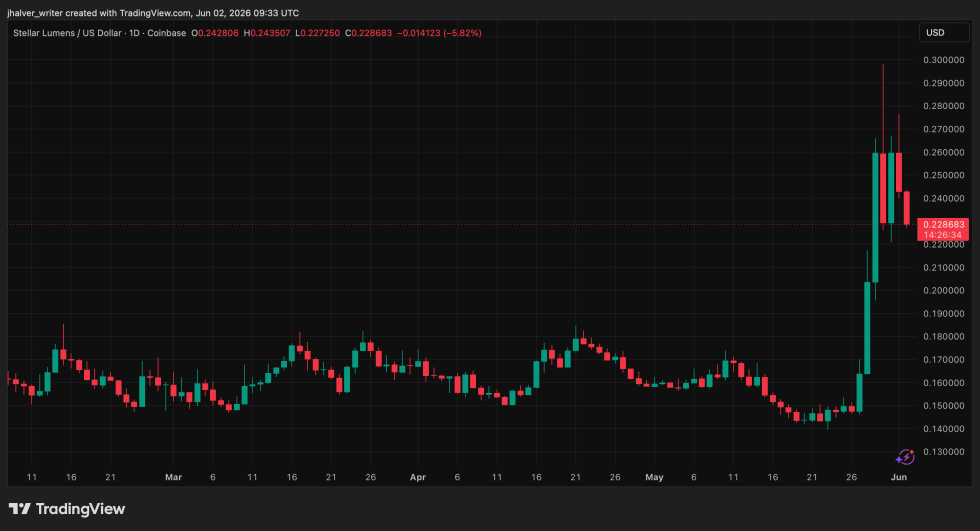
XLM's price trends to the upside on the daily chart. Source: XLMUSD Tradingview

Why This Stablecoin Matters For The Remittance Industry

MoneyGram is not a crypto-native company building a stablecoin for crypto-native users. It is a 85-year-old payments institution operating across more than 200 countries with approximately 500,000 retail locations and over 50 million customers annually — and it just issued its own digital dollar. The distinction is significant. When a company of this scale and regulatory standing launches a native stablecoin, it normalizes the instrument for the exact demographic — remittance-dependent families in Latin America, Africa, and Southeast Asia — that has historically been furthest from crypto adoption.

The timing is deliberate. The GENIUS Act, signed into law earlier in 2026, established the first formal US regulatory framework for stablecoin issuers — a development MoneyGram CEO Anthony Soohoo had publicly described as the guardrails the company needed to scale its digital dollar services confidently. MGUSD is the first major consumer-facing stablecoin launch to arrive squarely within that new regulatory window.

MoneyGram’s infrastructure buildout has been deliberate and sequential — Stellar partnership in 2021, Fireblocks treasury integration in December 2025, Tempo blockchain validator status in May 2026, and now a proprietary stablecoin. Each step has reduced its dependence on external partners and deepened its control over the digital payment stack.

This development marks a pivotal moment for the nascent sector’s convergence with mainstream global finance. A remittance giant issuing its own stablecoin — backed by decades of compliance infrastructure and half a million cash locations worldwide — is the clearest signal yet that the stablecoin economy is no longer a crypto industry story. It is a global payments industry story.

Cover image from Grok, XLM chart from Tradingview

Criptomoedas em alta

Perguntas relacionadas

QWhat is MGUSD and which company launched it?

AMGUSD is a native US dollar stablecoin launched by MoneyGram, one of the world's largest cross-border payments networks.

QHow does launching its own stablecoin (MGUSD) change MoneyGram's strategy compared to before?

APreviously, MoneyGram built its digital dollar services on third-party infrastructure like Circle's USDC. Launching its own branded stablecoin, MGUSD, gives MoneyGram direct control over issuance, reserve management, and yield economics, reducing dependence on external partners.

QWhy is MoneyGram's launch of a stablecoin significant for the remittance industry and crypto adoption?

AMoneyGram is an 85-year-old mainstream payments institution with a vast global network. Its launch of a native stablecoin normalizes the instrument for demographics like remittance-dependent families in Latin America, Africa, and Southeast Asia, who have been historically distant from crypto adoption.

QWhat recent US regulatory development is mentioned as enabling MoneyGram's stablecoin launch?

AThe GENIUS Act, signed into law earlier in 2026, established the first formal US regulatory framework for stablecoin issuers. MoneyGram's CEO stated this provided the necessary guardrails to scale its digital dollar services confidently.

QWhat key steps has MoneyGram taken in its infrastructure buildout leading to the MGUSD launch?

AMoneyGram's deliberate steps include: a Stellar partnership in 2021, Fireblocks treasury integration in December 2025, achieving Tempo blockchain validator status in May 2026, and finally launching its proprietary stablecoin, MGUSD.

Leituras Relacionadas

9.42 Million Retail Investors Compete for Changxin Technology, Who Got Allotted?

Evergreen Technology's IPO subscription results are now available. On July 20, the domestic memory chip giant announced the offline preliminary allotment results and online lottery results for its IPO. A total of approximately 9.43 million retail investors participated in the online subscription, generating 770,000 winning lots with a final winning rate of about 0.4714%, setting a record for new shares on the STAR Market. After triggering a clawback mechanism from institutional to retail investors, the online retail allocation was significantly increased to 3.851 billion shares. Simultaneously, 285 institutional investors participated in the offline subscription, ultimately receiving 2.173 billion shares at an allotment rate of approximately 0.1756%. Leading insurers and public funds were among the major recipients. Notably, Liang Wenfeng, founder of the major AI model company DeepSeek, through his quantitative investment firms Ningbo Huanfang Quantitative and Zhejiang Jiuzhang Asset, secured the largest share among private funds, with a total allotment worth approximately 175 million yuan. Estimates suggest potential profits could reach 730 million yuan if Evergreen Technology's market capitalization reaches 3 trillion yuan post-listing. The company is expected to list on July 27 and could become the highest-valued tech stock on the A-share market, with various brokerages providing valuations ranging from 1 trillion to over 4 trillion yuan. However, recent significant corrections in global tech stocks may impact its post-listing performance. (Character count: 1,196)

marsbitHá 43m

9.42 Million Retail Investors Compete for Changxin Technology, Who Got Allotted?

marsbitHá 43m

L2 'Recalibration': When L1 Becomes Its Own Rollup, What Is Ethereum's Endgame?

The article discusses the evolving relationship between Ethereum's Layer 1 (L1) and Layer 2 (L2) solutions, moving beyond the initial "L2 for scaling" model. As Ethereum L1 itself scales (increasing Gas Limit, statelessness, zkEVM), the unique value proposition of L2s shifts from merely providing cheap execution to offering differentiated features like application-specific optimization, privacy, and flexible governance. The piece explores three key themes: 1. **L2's New Role:** L2s are transitioning from a pure scaling technology to a spectrum of execution environments with varying degrees of security inheritance from Ethereum L1. 2. **Interoperability as State Trust:** Solving L2 fragmentation is less about cross-chain bridges and more about enabling faster, trust-minimized state verification between environments. This involves initiatives like faster L1 finality, intent-based architectures (Open Intents Framework), and native account abstraction. 3. **Blurring Layers:** With the potential integration of zk-proofs into L1 validation (making L1 akin to its own "Rollup") and the concept of "Native Rollups," the rigid boundary between L1 and L2 may fade. The future could be a unified system with multiple execution domains (for DeFi, gaming, privacy, etc.) sharing a common security, settlement, and state framework. In conclusion, Ethereum's goal is not to abandon L2s or re-centralize everything on L1, but to re-integrate the fragmented user experience—liquidity, accounts, applications—while preserving the scaling benefits of a multi-environment ecosystem. The endgame is a cohesive "one chain" feeling for users, powered by diverse but securely interconnected execution layers.

marsbitHá 1h

L2 'Recalibration': When L1 Becomes Its Own Rollup, What Is Ethereum's Endgame?

marsbitHá 1h

Trading

Spot

Artigos em Destaque

Como comprar ONE

Bem-vindo à HTX.com!Tornámos a compra de Harmony (ONE) simples e conveniente.Segue o nosso guia passo a passo para iniciar a tua jornada no mundo das criptos.Passo 1: cria a tua conta HTXUtiliza o teu e-mail ou número de telefone para te inscreveres numa conta gratuita na HTX.Desfruta de um processo de inscrição sem complicações e desbloqueia todas as funcionalidades.Obter a minha contaPasso 2: vai para Comprar Cripto e escolhe o teu método de pagamentoCartão de crédito/débito: usa o teu visa ou mastercard para comprar Harmony (ONE) instantaneamente.Saldo: usa os fundos da tua conta HTX para transacionar sem problemas.Terceiros: adicionamos métodos de pagamento populares, como Google Pay e Apple Pay, para aumentar a conveniência.P2P: transaciona diretamente com outros utilizadores na HTX.Mercado de balcão (OTC): oferecemos serviços personalizados e taxas de câmbio competitivas para os traders.Passo 3: armazena teu Harmony (ONE)Depois de comprar o teu Harmony (ONE), armazena-o na tua conta HTX.Alternativamente, podes enviá-lo para outro lugar através de transferência blockchain ou usá-lo para transacionar outras criptomoedas.Passo 4: transaciona Harmony (ONE)Transaciona facilmente Harmony (ONE) no mercado à vista da HTX.Acede simplesmente à tua conta, seleciona o teu par de trading, executa as tuas transações e monitoriza em tempo real.Oferecemos uma experiência de fácil utilização tanto para principiantes como para traders experientes.

347 Visualizações TotaisPublicado em {updateTime}Atualizado em 2026.06.02

Como comprar ONE

Discussões

Bem-vindo à Comunidade HTX. Aqui, pode manter-se informado sobre os mais recentes desenvolvimentos da plataforma e obter acesso a análises profissionais de mercado. As opiniões dos utilizadores sobre o preço de ONE (ONE) são apresentadas abaixo.

活动图片