Author: Bu Dong Jing
"The opportunity cost of attending college is too high. In today's tech world, everything is moving too fast. If you spend all day in school, opportunities will pass you by."
The person who said this is an 18-year-old named Sebastian Tan. He is not a rebellious student who hates learning; on the contrary, he is the kind of "chosen one" in our traditional view, holding an admission letter from Stanford University, one of the top institutions in the United States.
However, his view is not uncommon in a small circle. In Silicon Valley, the engine of global innovation, a disruptive "anti-college movement" is quietly gathering among the elite. It is no longer the sporadic, legendary story of dropping out to start a business but is evolving into a trend with theory, organization, and capital backing.
The core argument of this trend is sharp and direct: the four-year college, once seen as the golden ticket to the middle class and the American dream, is increasingly becoming an expensive, slow, and outdated waste.
Is this a case of a few geniuses speaking without empathy, or is it the prelude to a global educational revolution? Business Insider recently published an article exploring this new counter-current of the times: the widespread aversion to higher education among the new generation of tech entrepreneurs in Silicon Valley and the rise of the "skip college and start a business" trend in the industry.
The article points out that more and more young men are choosing to abandon their college education, opting instead to join tech companies or start their own ventures, encouraged by some Silicon Valley elites and businesses.
Today, let's delve deeper into what the young people and tech giants at the forefront of this wave are thinking and doing, and what ordinary people can learn from them.
The Defectors at the Stanford Crossroads
Sebastian Tan was once firmly on a glittering, golden path.
Growing up in Pittsburgh, like all ambitious peers, he saw Stanford University as the Mecca of entrepreneurship. His idol, Peter Thiel, the co-founder of PayPal and an early investor in Facebook, hailed as the "godfather of the Silicon Valley spirit," is a quintessential Stanford graduate.
The script to success seemed pre-written: get into Stanford, bask in the California sun and intellectual aura, and then start a world-changing company.
This April, he got his wish and was about to fly to Palo Alto for Stanford's grand welcome weekend for new students. Before leaving, he downloaded a book, Peter Thiel's *Zero to One*. In Silicon Valley, this book holds a status akin to the *Nine Yin Manual* in martial arts.
However, as he opened its pages, he read not just a philosophy of entrepreneurship but a disruptive worldview. In his own words, "This might be the best book I've ever read, even though I've only read a few pages."
It was also during this spring that an increasingly loud voice echoed in his ears, a voice from teenage founders and tech titans controlling trillions in capital: "The true future-makers will choose to skip college."
This idea stuck in Tan's mind like a thorn. At Stanford's "Admit Weekend," he met many peers as brilliant and confused as he was. They were among the highest scorers on national standardized tests, the perfect products of the traditional education system, yet deep down, they harbored doubts about the very system.
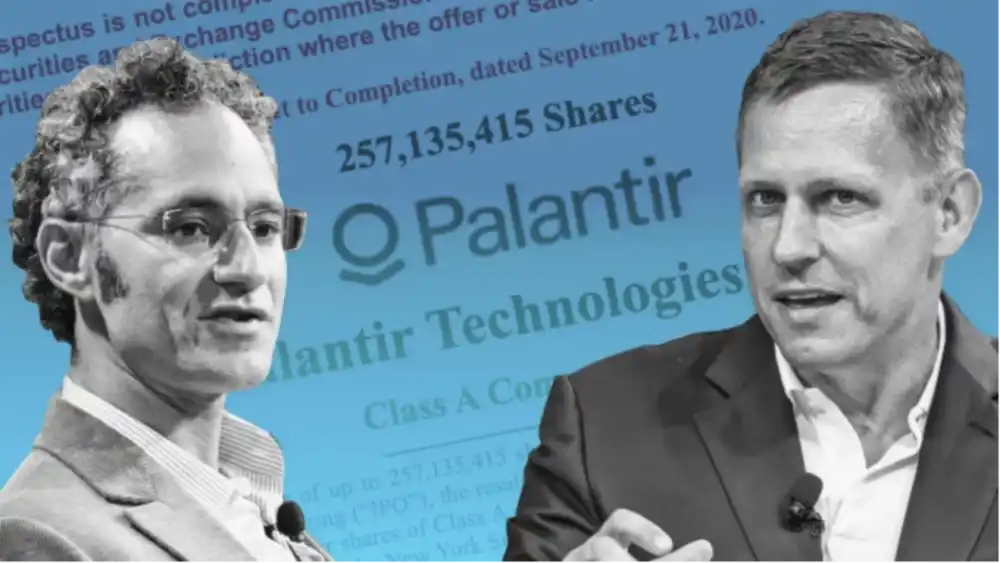
Karp and Thiel
This doubt ultimately led them to a common destination—the internship application page for Palantir, the software and defense technology giant.
This company, co-founded by Peter Thiel, launched a highly provocative program: the "Meritocracy Fellowship." Its slogan is like a declaration of war, openly challenging the world's top educational institutions:
"Skip the debt. Skip the indoctrination. Come get the Palantir Degree."
The program offers a paid, one-semester internship, with outstanding performers receiving full-time job offers. It acted like a massive magnet, attracting over 500 top high school graduates, including Tan.
In April, the decision was made. Tan made his first major act of defection: accepting Palantir's offer and deferring his Stanford admission to the distant year of 2026.
"You don't learn the practical skills needed for entrepreneurship in college," he explained. "You learn things like computer science theory. If you want to go directly into the workforce, these aren't very useful."
Tan's story is not unique. He is just one wave pushed to the forefront of this massive counter-current.
Silicon Valley's "Heretical" Creed: A Long-Planned "Anti-Intellectual" Revolution
Silicon Valley's estrangement from college has a long history. From Bill Gates and Steve Jobs to Mark Zuckerberg, the "myth" of dropping out to start a business has always been part of the spiritual totem of this land.
But today, the situation has changed qualitatively. It is no longer the spark of genius from a few individuals but a systematic movement driven by the combined forces of economics, technology, and ideology.
The standard-bearer of this movement is undoubtedly Peter Thiel.
This maverick billionaire launched the "Thiel Fellowship" over a decade ago, funding 20 to 30 young people under 22 each year with $100,000 each, on one condition: drop out of college for two years and pursue their ventures.
Thiel's aversion to higher education is comprehensive. He believes college is not only absurdly expensive, saddling young people with heavy debt, but, more importantly, it "corrupts" the best minds spiritually.
He has used an ancient Roman maxim to blast universities: "Corruptio optimi pessima"—the corruption of the best is the worst. In his view, universities, which should cultivate elites and transmit wisdom, have degenerated into the most rigid and worst institutions ideologically.
According to analysis by *Education Next*, Thiel believes universities indoctrinate students with a narrow and biased worldview, stifling true innovative spirit. This view has many adherents among Silicon Valley's elite circles.
If Thiel is the spiritual leader of this movement, then Palantir is the "military academy" putting this theory into practice.
Palantir is a big data analytics company Thiel co-founded. Many reports describe it as Silicon Valley's "new mafia" and "startup school." Many young people choose to work there rather than attend graduate school because the company itself provides an intense training system focused on big-picture thinking and practical skills. Now, this "school" is extending its recruitment directly to high school seniors.
Palantir's CEO, Alex Karp, who holds a doctorate in neoclassical social theory and was once Thiel's roommate, attacks universities with even greater ferocity. He publicly states, "Everything you learn about how the world works in school and college is intellectually wrong."
This trend quickly exploded on social media. Adam Guild, who founded a $1 billion company at 25, posted on X (formerly Twitter), garnering tens of thousands of likes: "Degrees are meaningless. Learn from people who have already built what you want to build, not from people who have never built anything."
His point is piercing: professors are in ivory towers, while real knowledge is in the hands of those who "build" the world. He even compares universities to "dropshipping" businesses:
"They [universities] slap their logo on young people who are already highly capable and intelligent, and then take credit for their success in society."
This is a brilliant and biting analogy, accurately hitting the complex feelings many have about elite school prestige. Surya Midha, co-founder of the AI recruiting platform Mercor, offers a more manifesto-like summary:
"The autodidact is the new alumnus."
In their view, the internet and AI have made knowledge acquisition unprecedentedly convenient, rendering traditional, passive classroom learning inefficient and superfluous. A degree is no longer an honor but a form of "procrastination."
Who Is Fueling the "Anti-College Movement"?
The rise of a trend is never accidental. Behind Silicon Valley's anti-college movement lies the convergence of three driving forces.
1. Economic Driver: The Unaffordable "Entry Fee"
The most practical factor is money.
College tuition in the U.S. has skyrocketed over the past few decades. In 2024, the average undergraduate graduate carries nearly $30,000 in federal student loan debt. The total cost for four years at top private universities has broken the $500,000 mark. This enormous sum is a heavy burden for any family.
Meanwhile, the rise of the tech industry, especially in AI, has made the "get rich young" myth seem within reach. Paul Graham, founder of venture capital firm Y Combinator, and others have publicly declared that now is "the best time in a decade for college students to start a company."
On one side is high sunk cost and uncertain future returns; on the other are readily available entrepreneurial tools and enthusiastic capital. For the most ambitious and talented young people, the answer to this multiple-choice question seems increasingly clear.
2. Technological Driver: AI Makes "Going Solo" Possible
Technological iteration is fundamentally dismantling the university's monopoly on knowledge.
In the past, becoming a good programmer or engineer required systematic, long-term professional training. But today, artificial intelligence and so-called "vibe coding"—a style of programming relying on intuition and AI assistance rather than strict logic—have drastically lowered the technical barrier.
A creative young person can use AI tools to build a product prototype in weeks, which might have taken a small team months in the past. As the dropout entrepreneurs say, they would rather learn from an AI trained to be like Steve Jobs than listen to a professor who has never written a single line of commercial code talk theory.
The center of gravity of knowledge is shifting from institutionalized "instruction" to personalized "exploration." The world changes too fast for university curricula to ever catch up with technological progress.
3. Cultural Driver: Backlash Against "Woke Culture" and Elitism
This is the deepest and most complex reason. Silicon Valley's anti-college movement is tightly linked to America's current culture wars.
On one hand, it is the ultimate rebellion against traditional elitism. Tech libertarians represented by Peter Thiel fundamentally distrust any large, old, centralized institution, be it government or university. They believe in individual ability and market competition—"meritocracy."
They argue that university admissions criteria, especially at Ivy League schools, have long become subjective, superficial, and opaque, full of favoritism toward specific groups.
On the other hand, it is also a strong backlash against the prevailing "woke culture" and DEI (Diversity, Equity, Inclusion) policies on American campuses.
The remarks of 22-year-old entrepreneur Sean Schneider are highly representative and controversial. He dropped out of a Christian high school to start an AI marketing company. He bluntly states that skipping college is both an efficiency calculation and an ideological choice.
"It [college] signals DEI," he says. "It signals woke and compromised institutions. At least in the circles I run in, the sentiment is that these institutions should die."
His view touches a sensitive nerve in American society. In recent years, there has been increasing discussion about the marginalization of men in the education system. Pew Research Center data shows that from 2011 to 2023, U.S. college enrollment fell by 1.2 million, of which 1 million were men.
Schneider believes the school system is better suited for women and suppresses masculine "drive." He even made the shocking statement: "As a man, you cannot gain true fulfillment while being educated long-term."
This view blends distaste for "political correctness" with a survival anxiety tinged with "manosphere" colors. It reveals a non-negligible gender dimension in this anti-college movement; it is primarily a movement led by young men.
These three forces intertwine to form a perfect storm, pushing the ancient ship of the university into unprecedented perilous waters.
Rational Return: Is College Really "In Decline"?
When the anti-college clamor is so loud, should we also listen to the other side?
Research by Harvard economist David Deming provides a sober perspective. Like a patient doctor, he prescribes a "fever reducer" for this heated debate.
First, Deming warns, "Very, very few people are truly self-taught." He compares young people relying entirely on the internet and AI for self-education to students "copying their classmates' homework"—they might solve immediate problems but lack the foundational ability to tackle the unknown.
Second, he points out that corporate-provided on-the-job education, no matter how excellent, is inherently "narrow and vocational." Its goal is to train cogs that fit the company's needs, not a complete person with broad vision and adaptability. College, especially the liberal arts education it provides,恰恰赋予学生“对新事物的开放态度”和可迁移的技能恰恰赋予学生“对新事物的开放态度”和可迁移的技能 (bestows upon students "an open attitude toward new things" and transferable skills).
Most crucial is the data. Deming notes that despite high tuition, the "college wage premium" has remained stable at 75% to 80% over the past decade. This means, for the average person, the return on investing in college is still higher than investing in the stock market, real estate, or starting a business.
Even the movement's "model project"—Palantir's fellowship program—hints at irony. Although it claims to be anti-elite, media reports reveal its admits are filled with students already accepted to top schools like Stanford, UPenn, and Columbia. Is this a subversion of elite education or another form of "cream-skimming"?
Deming raises a thought-provoking question: "For those dropout founders, the question should be, would they have done better or worse if they had gone to college?"
There is no answer. But it reminds us that we cannot only see Zuckerberg's success and ignore the countless dropouts who fail silently. What we see is always survivor bias.
The End of College, or the Growing Pains of a New Generation?
Looking around, we stand at a giant crossroads. On one side is the ancient, solemn university hall; on the other is the noisy,野蛮生长的新世界.
However, the essence of this debate may not be the binary opposition of "to go or not to go." It is more like a symptom, revealing the deep-seated crisis of our era's education system.
The modern university, born in the Middle Ages and standardized in the industrial age, with its core model—fixed four-year terms, lecture-centric knowledge transmission, standardized assessment systems—appears increasingly笨拙和迟缓 in the age of information explosion and AI崛起. It is like a finely designed steam engine asked to run on a high-speed maglev track.
Peter Thiel and his followers are like a group of impatient passengers choosing to jump off, trying to lay their own faster track. Their words may be extreme, even arrogant, but their actions act like a strong medicine, forcing the drowsy giant ship to start thinking about its course.
What we are witnessing may not be the death of the university but the剧烈阵痛 before its next morphological evolution.
"The autodidact is the new alumnus." The true meaning of this phrase is that the power center of learning is shifting. It is dispersing from institutions to individuals, shifting from passive "education" to active "learning." The internet is its library, AI its private tutor, and the real world its ultimate exam hall.
Sebastian Tan, who stood at the Stanford crossroads at the beginning of the article, ultimately did not completely burn the bridge to the past. He still plans to return to Stanford in the future. He sees the value of practice but also acknowledges the significance of a liberal arts education. Perhaps he just wants to use two years to add an "option" to his life.
He says, "My mom really wants me to go to college." This inadvertently revealed, most genuine and endearing reason lets us glimpse a touch of human warmth within this grand narrative.
No matter how fierce the storm, the ancient hall will not collapse easily. But its doors and windows have been knocked open; the wind, rain, and sunlight from outside will pour in. Future learning will no longer be confined within walls. It will become more blended, more personalized, and more lifelong.
The real challenge is no longer "whether to go to college" but: In a world where the future updates faster than the syllabus, how exactly should we learn?
No one knows the answer to this question. But the process of seeking the answer is itself the most important lesson.