The Man Who Best Promoted SOL Exits the Crypto World

marsbitPublicado em 2026-02-05Última atualização em 2026-02-05

Resumo

Kyle Samani, co-founder and managing partner of Multicoin Capital, has stepped down from his daily operational and management roles at the crypto-focused venture firm and transitioned to an advisory position. Known as one of the most vocal proponents of Solana, Samani was instrumental in Multicoin’s early and heavy investments in the blockchain, famously declaring “Solana is always the answer” and publicly criticizing Bitcoin and Ethereum. Under his leadership, Multicoin achieved extraordinary returns from Solana, though the fund also faced significant losses during market downturns. Despite his exit from Multicoin, Samani remains committed to the crypto space, particularly Solana, and will continue personal investments in the ecosystem. He will retain his role as chairman of Forward Industries, a digital asset treasury company heavily invested in SOL. Samani plans to redeem his Multicoin stake not in cash but in shares and warrants of Forward Industries to increase his exposure. His departure is driven by a growing interest in emerging technologies such as AI, longevity science, and robotics. Samani has indicated he will take time to explore these areas but remains a firm believer in crypto’s potential to reshape global finance.

Original | Odaily Planet Daily (@OdailyChina)

Author | Azuma (@azuma_eth)
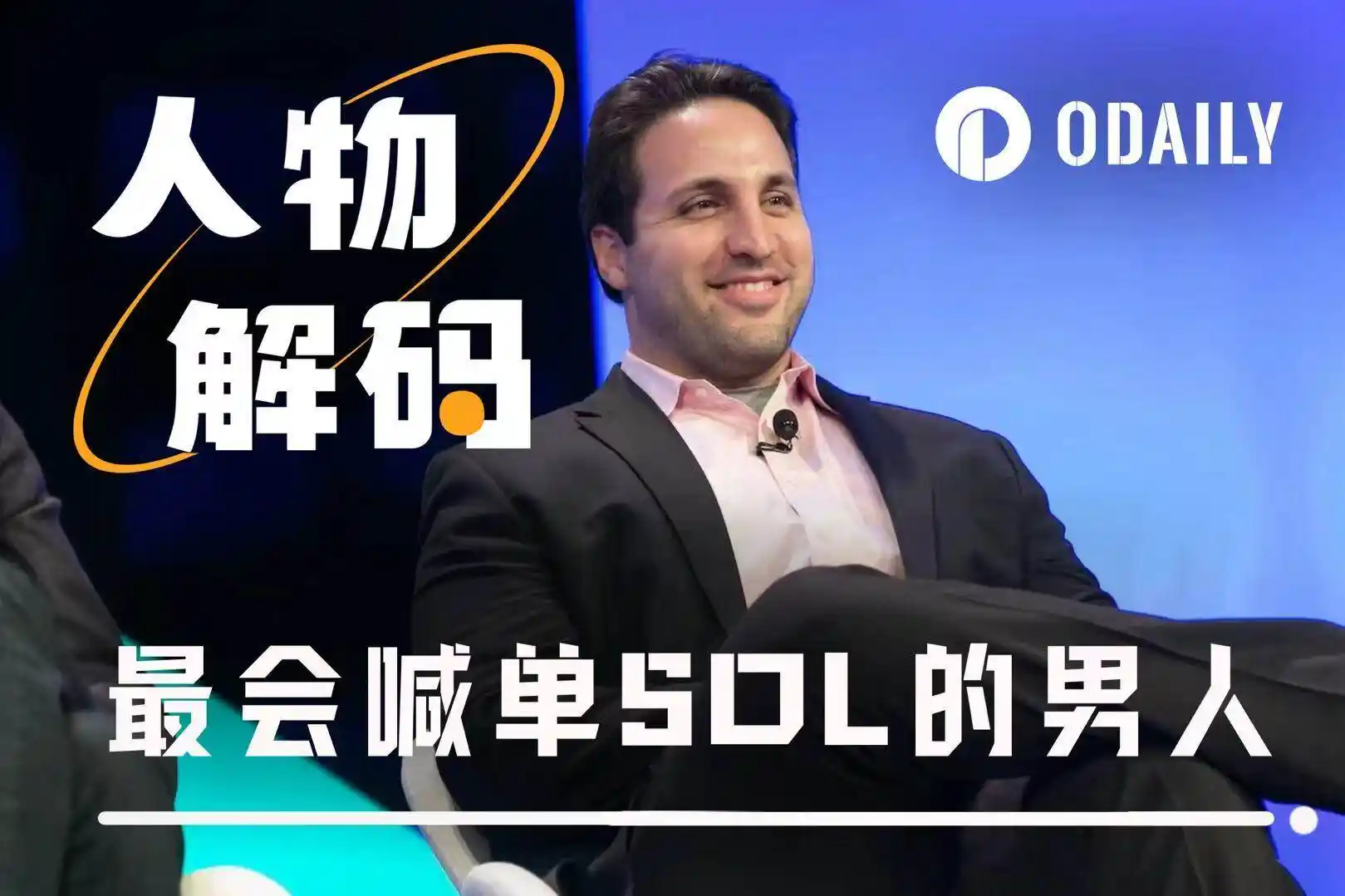
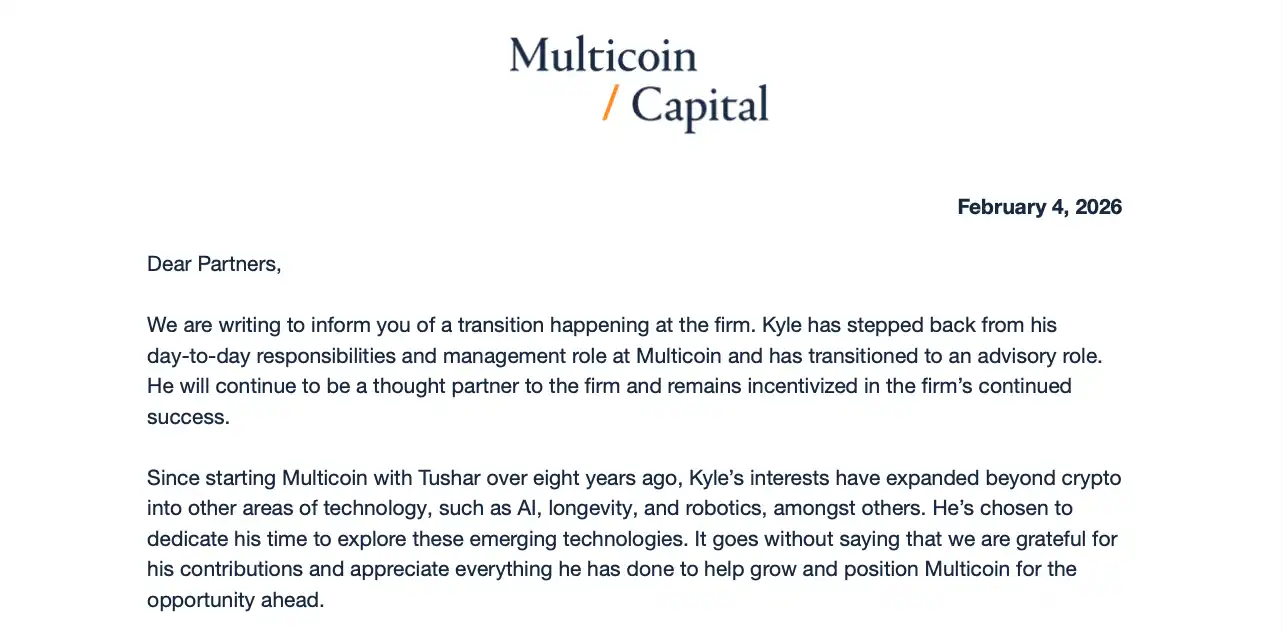
On February 4 local time, the well-known venture capital firm Multicoin Capital wrote to LPs stating that co-founder and managing partner Kyle Samani has stepped down from his daily duties and management role at Multicoin and transitioned to an advisory role.

Tushar Jain, another co-founder of Multicoin, said that Samani's interests have expanded from the cryptocurrency field to cutting-edge directions such as AI, longevity technology, and robotics, and therefore he has decided to devote more time to exploring these emerging technologies.
The Man Who Best Promoted SOL

Since co-founding Multicoin with Tushar in 2017, Samani has been one of the most active investors in the cryptocurrency field. His most classic achievement is his疯狂押注 on Solana.

Multicoin was the first venture capital firm to heavily invest in Solana. Between 2018 and 2021, Multicoin led Solana's first three rounds of financing, and Samani himself took on the role of evangelizing Solana to the crypto world. Samani is extremely adept at promoting Solana in a high-profile and provocative manner. He has publicly criticized Bitcoin for lacking practical utility, criticized Ethereum for being structurally bloated and slow to scale, emphasized that "Solana is always the answer," and firmly believed that SOL would outperform BTC and ETH in the long run.

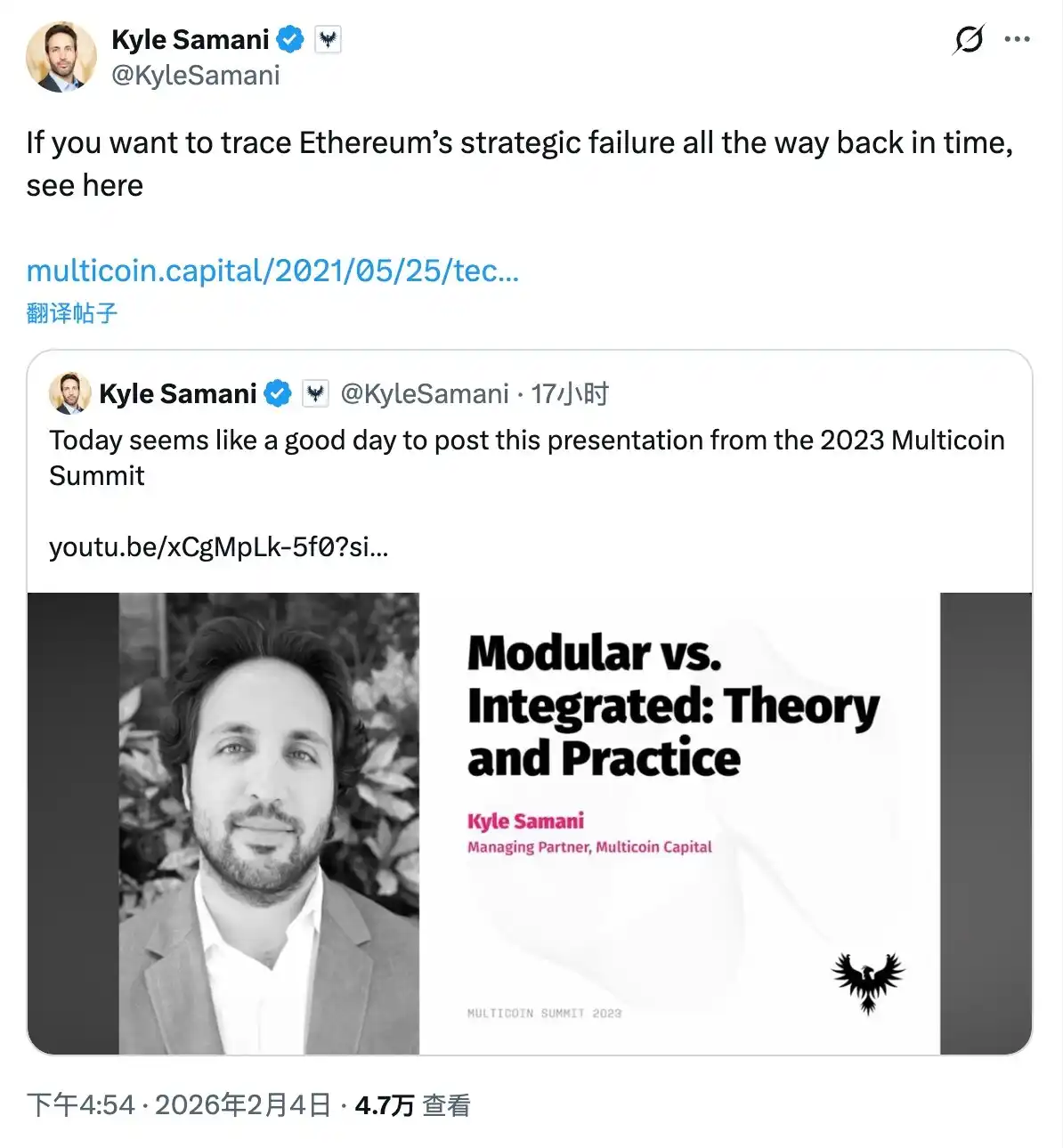
A recent example is that yesterday, Vitalik publicly admitted that Ethereum's Layer2 historical路线 had errors. Samani specifically reposted an article he wrote in 2021 comparing Ethereum and Solana's scaling paths and commented, "This is the beginning and end of Ethereum's strategic failure."
Multicoin's bet on Solana was a huge success. At the end of 2021, Samani said on The Wolf Of All Streets podcast that the firm had made an astonishing profit of 614,000% on Solana.

However, after the collapse of FTX, the entire Solana ecosystem was hit hard, and SOL一度跌至 $8, plunging the project into its darkest moment. Multicoin's profits also experienced a huge drawdown — the fund lost about 91.4% in 2022, its worst performance since inception.

But Samani and Multicoin showed an even more courageous side at this time. Instead of abandoning Solana, they continued to be driven by faith, firmly evangelizing Solana and increasing investment in Solana ecosystem projects. The final result was that Solana achieved the most amazing涅槃重生 in cryptocurrency history, and Samani and Multicoin also "regained lost ground" as SOL recovered.

After the rise of Digital Asset Treasuries (DAT) in 2025, Multicoin, together with Galaxy Digital and Jump Crypto, jointly led a $1.65 billion financing round for the DAT company Forward Industries. Forward Industries is now the largest SOL DAT on the market (holding 6.82 million SOL, worth approximately $626 million). Samani himself serves as the chairman of the board of this company.

A Madman in the Eyes of Ordinary People, the Best Investor in the Eyes of Peers

Because Samani prefers contrarian investments and his言论过于高调且极具煽动性, he is often accompanied by considerable controversy (mainly from the Ethereum ecosystem).

But in the eyes of a few VC peers, Samani is the best investor in the entire cryptocurrency field. Dragonfly Capital partner Hasseb Qureshi once said that as competitors, Dragonfly and Multicoin are always at odds, but experts recognize experts. Investment is like a sport, and Samani is the highest scorer of all time, unmatched by anyone.

Hasseb added: "This doesn't mean you have to like him. I often find him reckless and even annoying. I also often disagree with him... But Samani is a true contrarian thinker. He bets where others are unwilling to bet... Ultimately, this is the reason investors exist—to allocate capital to undervalued ideas, and Samani is one of the few non-consensus investors in our industry."

Personal Statement: Not Completely Leaving the Circle

After Multicoin's letter to LPs was announced, Samani himself also explained his job change on X.

Samani emphasized that his faith in cryptocurrency and Solana remains unchanged — "After nearly a decade of working deeply in the cryptocurrency industry, I am more convinced than ever that crypto technology will fundamentally reshape the financial system. I believe the Clarity Act will attract new participants like a tide,催生 an unprecedented wave of applications. I am still long-term bullish on the crypto field, especially the Solana ecosystem, and plan to continue making personal investments in the field while supporting companies in Multicoin's portfolio."

In addition, although he will gradually step down from Multicoin, Samani will continue to serve as chairman of the board of Forward Industries. Furthermore, Samani also mentioned that he intends to submit a redemption request to the Multicoin main fund on March 31, 2026, but will not request cash. Instead, he will redeem in kind with Forward Industries shares and warrants, to significantly increase his personal exposure to Forward Industries.

Future Direction Exploration

Multicoin's letter to LPs mentioned several new directions Samani is interested in — AI, longevity technology, and robotics.

Although it is not yet clear which specific directions Samani has identified (Samani said he will take a break for now), yesterday he reposted an article by Shayon, another partner at Multicoin, about AI titled "Disrupting the Human-AI Relationship." The core idea of the article is that instead of苦苦思索 "what AI can assist humans with," a more economically efficient direction is "how humans should assist AI," and what new investment opportunities will emerge around this shift in thinking.

Interested readers can read the original article, which may serve as a window into Samani's future thinking.


Perguntas relacionadas

QWho is Kyle Samani and what is his role change at Multicoin Capital?

AKyle Samani is the co-founder and managing partner of Multicoin Capital. He has stepped down from his day-to-day duties and management role at Multicoin and transitioned into an advisory role.

QWhat was Kyle Samani's most notable investment success in the crypto space?

AKyle Samani's most notable investment success was Multicoin Capital's heavy investment in Solana (SOL), which yielded a profit of 614,000% by late 2021.

QWhy did Kyle Samani decide to reduce his role at Multicoin Capital?

AKyle Samani decided to reduce his role because his interests have expanded beyond cryptocurrency to include emerging technologies such as AI, longevity tech, and robotics.

QWhat is Forward Industries, and what is Kyle Samani's involvement with it?

AForward Industries is a Digital Asset Treasury (DAT) company with significant holdings in SOL. Kyle Samani serves as the Chairman of the Board for Forward Industries and plans to increase his personal exposure to the company through in-kind redemptions from Multicoin's main fund.

QDespite stepping back, what does Kyle Samani plan to continue in the crypto space?

AKyle Samani plans to continue his personal investments in the crypto space, particularly in the Solana ecosystem, and will continue to support companies in Multicoin's investment portfolio.

Leituras Relacionadas

Analyzing the Impact of AI on Economic Growth and Productivity

**Title: Analyzing AI's Impact on Economic Growth and Productivity** This article examines three contrasting views on AI's influence on economic growth and productivity. **The Optimistic View** posits that AI, especially through automating R&D ("recursive self-improvement"), could dramatically accelerate growth, even triggering a technological "singularity" with explosive, potentially infinite, economic expansion. **The Moderate/Mainstream View** acknowledges AI's productivity benefits but emphasizes significant real-world constraints that could limit its impact. These include: limited cost savings per task, structural ceilings on which jobs and industries are "exposed" to AI, adoption bottlenecks (e.g., compute, energy, regulatory hurdles), and the "weak link" effect where non-automatable tasks cap overall gains. Consequently, the realized AI dividend may be far lower than optimistic projections, with estimates typically ranging from 0.1% to 1.3% annual productivity growth. **The Pessimistic View** stems from two strands. The first aligns with the moderate view but applies extremely conservative assumptions about task exposure and efficiency gains, yielding minimal projected impact. The second introduces a demand-side critique: if AI primarily replaces rather than augments labor, it could depress labor's share of income, weaken consumer demand, and create a "demand trap" that ultimately stifles growth, unless offset by redistribution policies. **The authors' assessment** is nuanced: * **Short-term (1-2 years):** AI will support growth primarily through investment spending, not significant productivity gains. * **Medium-term (3-5 years):** Three potential paths emerge based on AI demand and bottleneck severity: 1. **"Optimistic Path":** High demand, few bottlenecks. Rapid productivity gains but risk of major job displacement and social conflict without redistribution. 2. **"Moderate Path" (most likely):** High demand but significant, surmountable bottlenecks. Leads to moderate productivity gains, financial market volatility (K-shaped returns), and sectoral job losses. 3. **"Pessimistic Path":** Low demand or severe bottlenecks. Minimal productivity and growth impact, triggering financial market corrections but allowing a smoother societal transition with less labor disruption. * **Long-term:** AI holds potential for a major productivity revolution and prosperity. The conclusion stresses that no path is smooth. Technologically "optimistic" outcomes could be socially detrimental, while "pessimistic" technological diffusion might be more socially stable. Policymakers must monitor developments and prepare balanced responses to manage economic, financial, and social sustainability.

marsbitHá 2m

Analyzing the Impact of AI on Economic Growth and Productivity

marsbitHá 2m

The New Cold War is a Tech Stock War

The New Cold War is a Tech Stock War The article argues that the contemporary geopolitical and economic rivalry between the US and China represents a "New Cold War," but one fundamentally fought through technology and financial markets, not physical barriers or conventional trade. Historically, US dominance was secured through financial systems. The Soviet Union, reliant on the rigid "Transferable Ruble," was ultimately undermined by its dependency on the US dollar for oil trade. Later, Japan's semiconductor challenge was countered not just by tariffs (e.g., Plaza Accord, 301 investigations) but by binding it to US Treasury bonds. China presents a more complex, "embedded" challenger. While it holds vast dollar reserves and US debt like Japan, its industrial base is stronger and more diversified than the Soviet Union's. Surviving the initial 2018 trade war phase, the conflict has evolved into a "tech-financial war." The core battlefield is now the stock market. US tech stocks (AI, semiconductors) are treated as sovereign assets, buoyed by bipartisan national will. China is pushing to strengthen its own financial markets to convert industrial strength into financial power and fund its tech ambitions. Companies like ChangXin (semiconductors), Moonshot AI, and DJI compete not just for market share but as financial proxies for their respective systems. The new paradigm is moving from globally efficient monopolies (Apple, Google) towards companies that achieve monopolistic profits within their respective geopolitical spheres. This competition over "pricing power" and financial valuation in segmented markets defines the current era, making the stock market the primary arena for this tech-centric struggle.

marsbitHá 11m

The New Cold War is a Tech Stock War

marsbitHá 11m

RWA Weekly: Ten European Financial Institutions Establish Tokenized Asset Cooperative; Ondo Launches New Execution Network Ondo Network

RWA Weekly: European Banks Form Tokenized Asset Cooperative; Ondo Launches New Execution Network Ondo Network Covering July 24-31, 2026, the RWA sector saw a steady on-chain total value locked (TVL) of $36.8 billion, with holder count hitting a record high. However, stablecoin transfer volumes fell sharply (~30%), indicating low on-chain settlement demand. Key regulatory moves include South Korea advancing stablecoin legislation and a push to scrap crypto taxes, Kenya lowering capital requirements for stablecoin issuers, and Zimbabwe approving seven projects for its crypto sandbox. In project developments, BIS-led Project Agorá successfully tested cross-border payments with tokenized funds across six currencies. Ten major European financial institutions formed the RL1 blockchain cooperative to build tokenized asset infrastructure. Other notable updates: Aviva launched a tokenized dollar liquidity fund on XRPL, POSCO International tokenized commercial invoices on Injective, and a Brazilian farmer used tokenized cattle as collateral for a loan. Additional progress includes BNY Mellon migrating its core transfer agent operations to blockchain, Securitize gaining SEC investment advisor registration, and Tether’s compliant stablecoin USA₮ launching on Celo. Ondo Finance introduced Ondo Network, a new execution layer focused on speed and privacy, moving away from its initial chain plans. An analysis highlights that despite the growing scale of on-chain RWAs (~$32B), approximately 90% remain underutilized in DeFi, pointing to a critical challenge in unlocking liquidity and fostering real-world application beyond mere issuance.

marsbitHá 12m

RWA Weekly: Ten European Financial Institutions Establish Tokenized Asset Cooperative; Ondo Launches New Execution Network Ondo Network

marsbitHá 12m

South Korean Stock Market Sees Sharp Rebound After Forceful De-leveraging, SK Hynix Rises 30%

On July 31, South Korean stocks staged a historic rebound. The benchmark KOSPI index surged 18.27%, with chipmaker SK Hynix hitting a 30% gain limit. This followed a brutal, near-40% decline in the KOSPI over the previous month, driven largely by a deleveraging spiral involving leveraged ETFs. Analysts attributed the sharp sell-off to structural liquidity issues rather than deteriorating corporate fundamentals. The rally was triggered by a confluence of positive catalysts. Firstly, strong earnings from U.S. cloud giants Microsoft and Amazon alleviated fears of an "AI bubble burst," boosting global tech sentiment. Secondly, SK Group Chairman Chey Tae-won made a rare personal purchase of SK Hynix shares, seen as a strong vote of confidence. Thirdly, the South Korean government announced a 20 trillion won ($139 billion) AI investment fund. In response to the market turmoil, South Korean regulators are tightening controls on leveraged ETFs, admitting oversight shortcomings. Measures include raising minimum cash保证金 requirements for散户 investors and suspending new product launches. While the rebound signals eased liquidity pressure, analysts note deep structural issues remain. The market's future stability is seen as dependent on global tech capital expenditure trends and memory chip price cycles, with some viewing the surge as a technical correction rather than a definitive trend reversal.

marsbitHá 32m

South Korean Stock Market Sees Sharp Rebound After Forceful De-leveraging, SK Hynix Rises 30%

marsbitHá 32m

Trading

Spot
活动图片