How Token-Hungry is Claude Code? A Comparative Experiment Shows Up to 30x Difference Across Three Frameworks

marsbitPublicado em 2026-07-31Última atualização em 2026-07-31

Resumo

Claude Code's Token Consumption Exposed: Comparison Experiment Shows Up to 30x Difference Between Frameworks A recent experiment by the Composio team tested the same model (Kimi K3) across three different agent frameworks (Claude Code, Hermes, and Kimi Code) on 28 identical tasks. While task completion rates were similar, token consumption varied dramatically. The median token usage was approximately 61k for Kimi Code, 67k for Hermes, and a staggering 340k for Claude Code – about 6 times more than Kimi Code. For individual tasks, the maximum difference reached 30x. In terms of cost, using Claude Code averaged $2 per task compared to $0.22 for Kimi Code and $0.28 for Hermes (based on Kimi K3 pricing). Speed also differed, with Hermes being the fastest. Analysis suggests Claude Code's high token usage stems from its harness repeatedly feeding extensive context (previous messages, tool calls, command outputs, file contents) back into the model across multiple interaction rounds, significantly inflating input tokens rather than generating longer outputs. This highlights a crucial trend: the agent framework (harness) is becoming as important as the model itself for cost and efficiency. A separate study from Writer showed that simply switching the orchestration layer to their optimized harness reduced average task cost by 41% and latency by 44% across various models without sacrificing quality. The conclusion is clear: for cost-effective AI agents, optimizing the harness may yie...

Everyone says Claude Code wastes tokens, but how much exactly? Finally, someone has put numbers to it.

There was a recent interesting comparative experiment from the Composio team. They used the same model, Kimi K3, and ran it in three different agent frameworks (harnesses)—Claude Code, Hermes, and Kimi Code—testing 28 identical tasks.
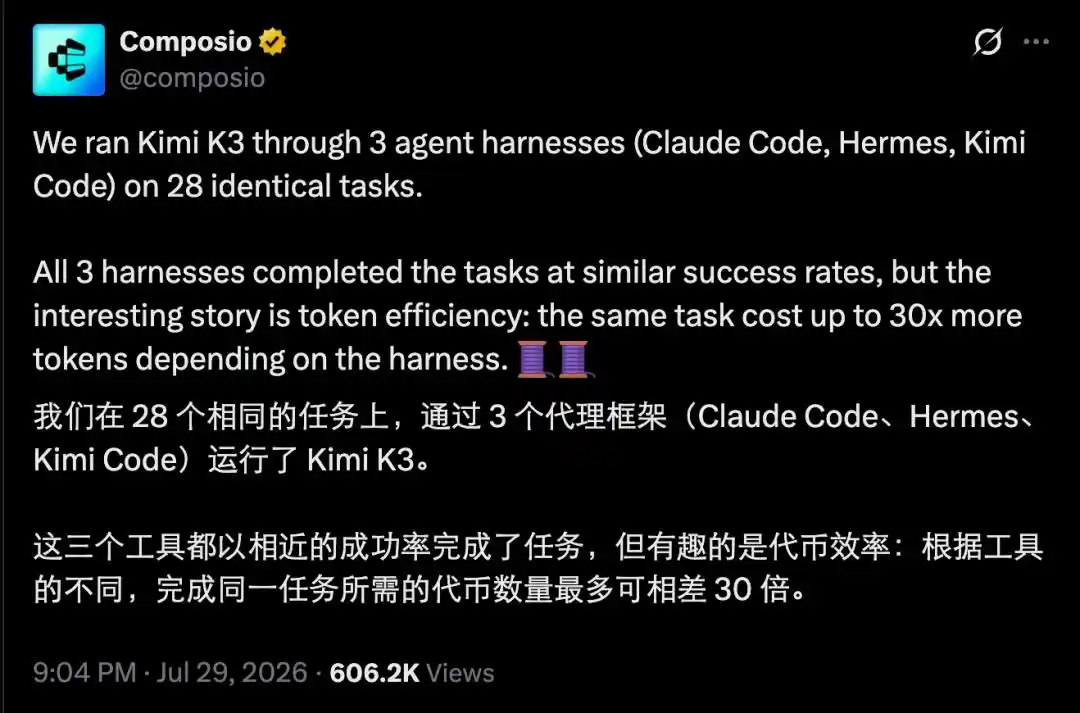
The results showed similar task success rates for the three harnesses: Kimi Code succeeded in 22 out of 28 tasks, Hermes in 21, and Claude Code in 20. The gap isn't large.

The real difference was in token consumption. For the same task, token usage across different harnesses varied by up to 30 times!

Looking at the median, Kimi Code used about 61,000 tokens, Hermes around 67,000, while Claude Code soared to 340,000—roughly 6 times that of Kimi Code.
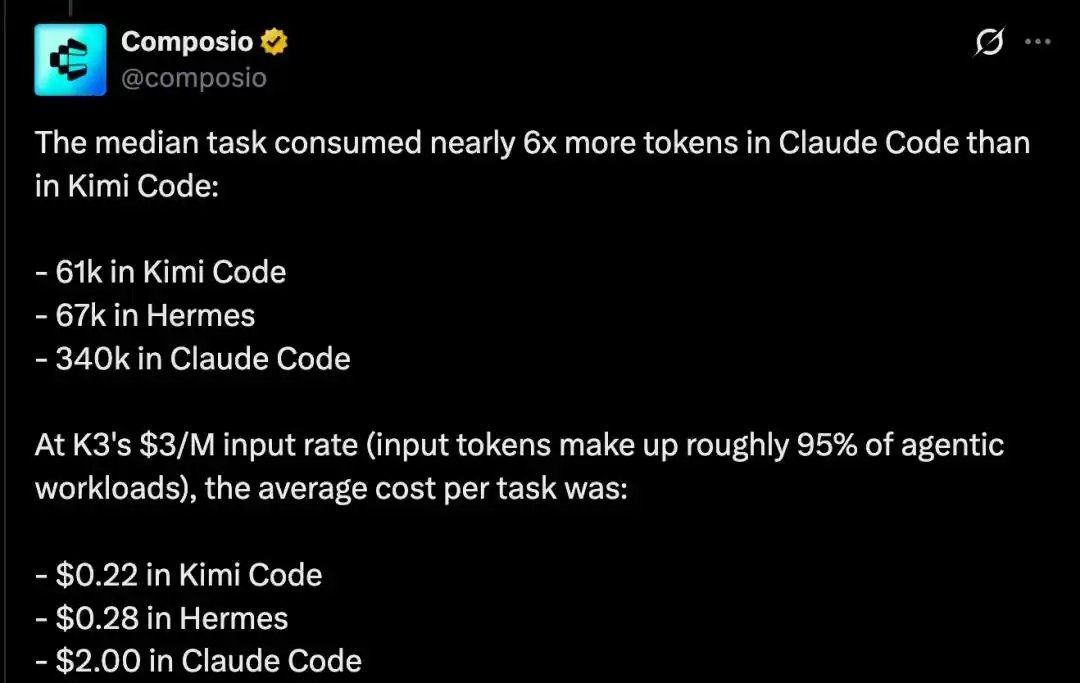
Based on the price of $3 per million input tokens for Kimi K3 (input tokens typically account for about 95% in agent workflows), the average cost per task is approximately: Kimi Code $0.22, Hermes $0.28, and Claude Code $2.00. The difference is evident.

Speed also differed. The median time: Hermes was fastest at 179 seconds; Kimi Code 297 seconds; Claude Code 348 seconds.

So, Hermes was the fastest, while Kimi Code was the most token-efficient—they didn't overlap.

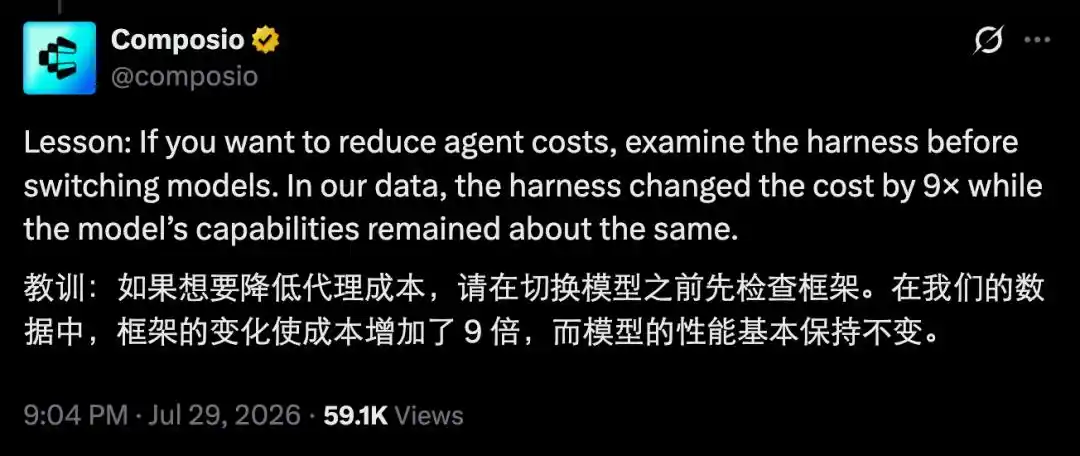
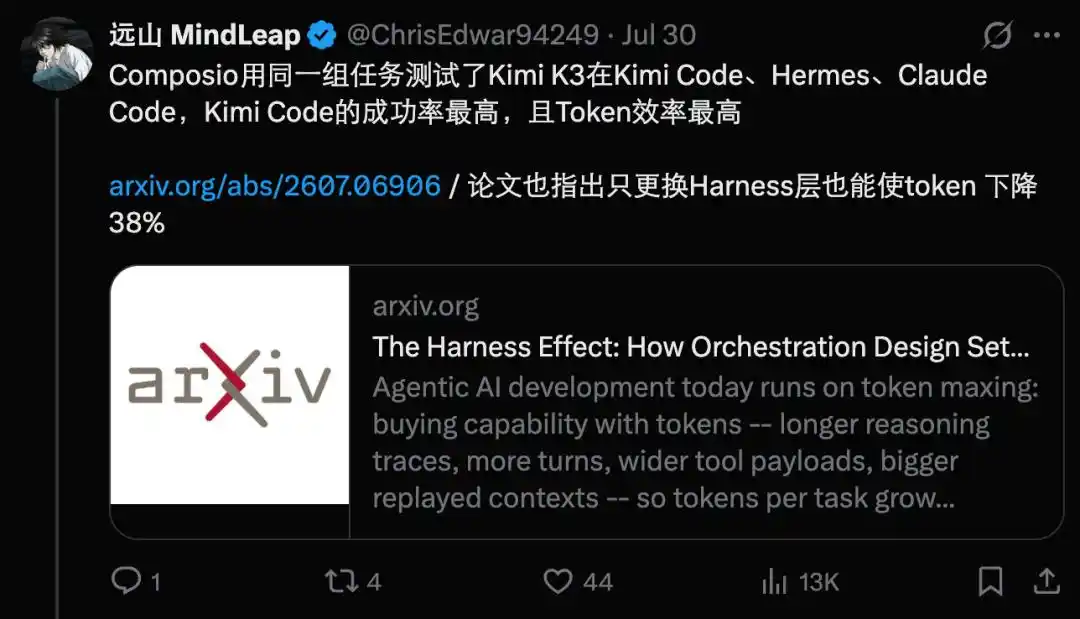
From this, the Composio team drew a straightforward conclusion: If you want to reduce agent costs, first look at which harness you're using, rather than rushing to change models. In their data, the harness itself could create a 9x cost difference, while model performance was quite similar.
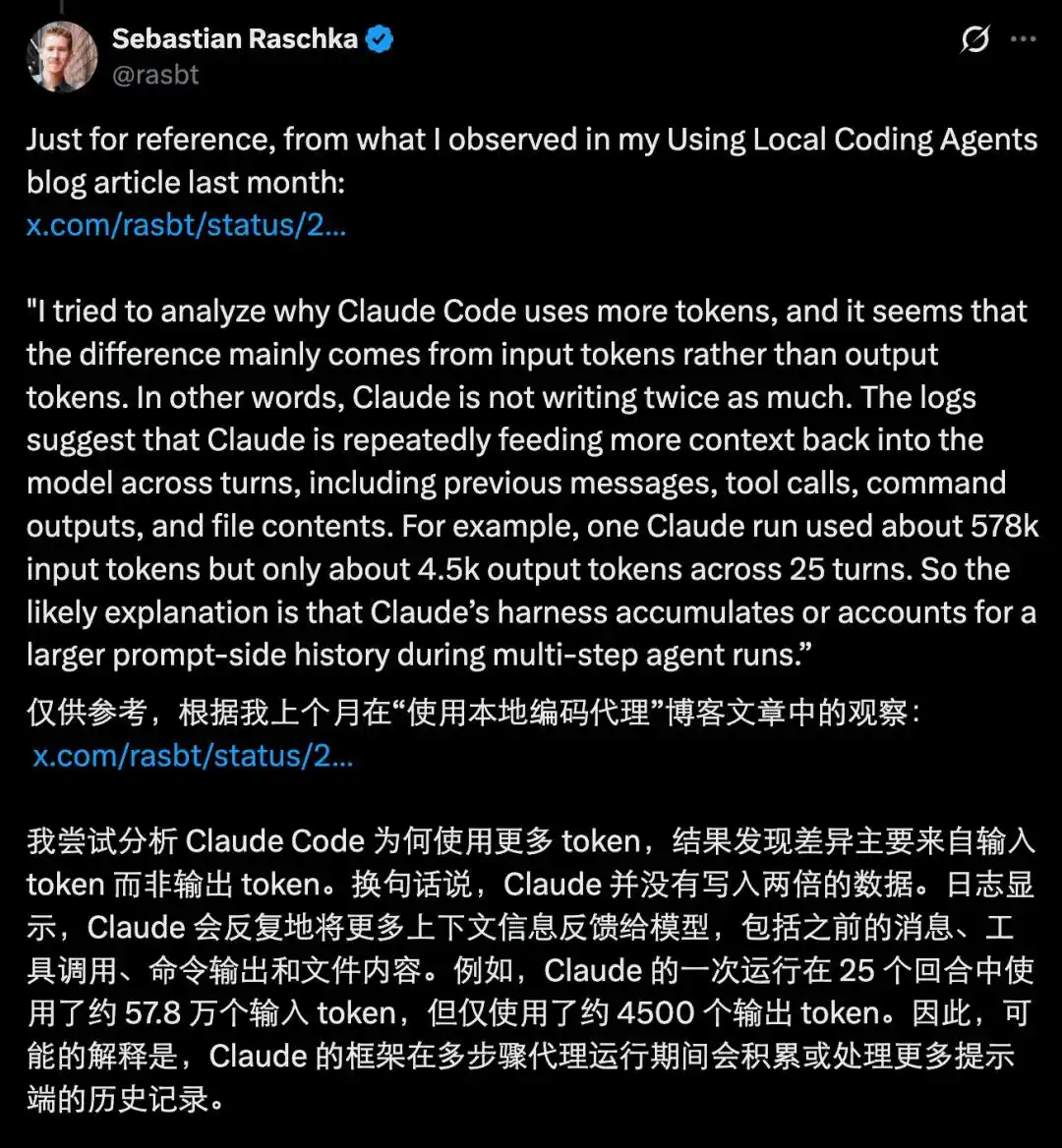
Sebastian Raschka saw the results and posted about them, saying it aligns with his previous observations using Qwen3.6: Claude Code often uses 2 to 3 times more tokens than many other harnesses, with similar success rates.
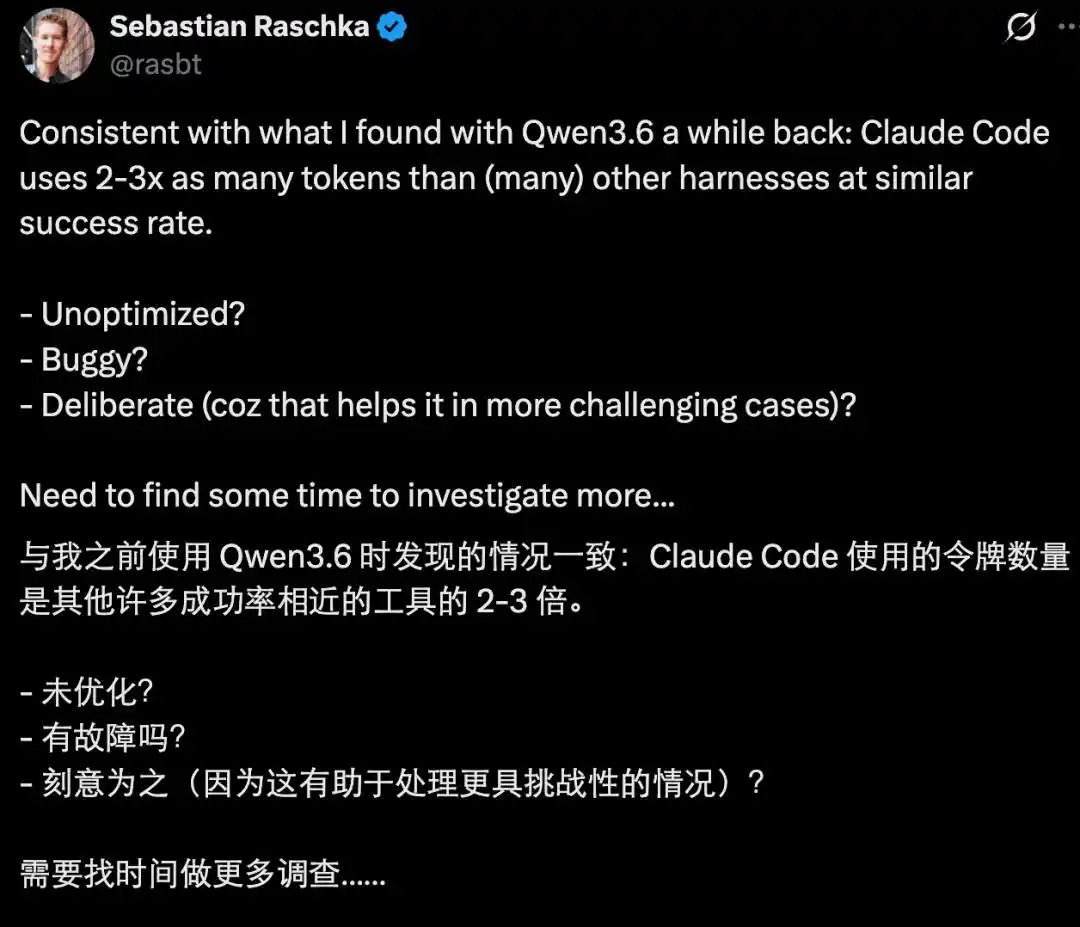
He suggested several possible reasons: Is it not optimized? Is there a bug? Or was it intentionally designed this way (perhaps aiding with harder tasks)? He said more time is needed to investigate carefully.

He then added observations from his article last month on writing a local coding agent. At that time, he analyzed why Claude Code uses more tokens and found the difference mainly stems from input tokens, not output tokens. In other words, Claude isn't writing twice as much content. Logs show that Claude's harness repeatedly feeds more context back into the model across multi-turn interactions, including previous messages, tool calls, command outputs, and file contents. For example, in one run, Claude used about 578,000 input tokens but only about 4,500 output tokens, spanning 25 turns. Thus, a more likely explanation is that Claude's harness accumulates or accounts for a larger prompt-side history during multi-step agent runs.
These test results seem to reveal an undeniable trend: The importance of the harness is now on par with the model itself.

A recent paper (from Writer, a company building an enterprise AI Agent platform) systematically highlights this point: Using controlled experiments, it demonstrates that switching the harness layer is more effective at cutting costs than switching models, benefiting all models.
Specifically, they conducted a rigorous "controlled variable" experiment: With 22 enterprise tasks and 6 base models (Claude Sonnet 4.6, Gemini 3.1, Gemini Flash 3.5, Qwen 3.6, GLM 5.1, Palmyra X6) held constant, they only replaced the orchestration layer—swapping the traditional production-grade agent loop for Writer's own Harness.

The results showed: Average task cost reduced by 41% ($0.21 → $0.12), median latency shortened by 44% (48s → 27s), token consumption decreased by 38% (14.2k → 8.8k), while task completion quality remained largely unchanged (0.78 → 0.81, considered insignificant due to small sample size). In terms of cost-effectiveness, the quality gained per dollar increased by 82%, and the number of tasks completed per million tokens jumped from 54.9 to 92.0.

So, as models become like "utilities," is the harness the air conditioner that determines your electricity bill? In other words: People used to say "the model is the product," but now it's "the harness is the product"?

Since the harness is so important, perhaps future accounting needs to be more granular.

Some point out that we need to add a "harness tax" item to existing benchmarks. Especially considering that once tool calls and retries enter a loop, this tax grows non-linearly.
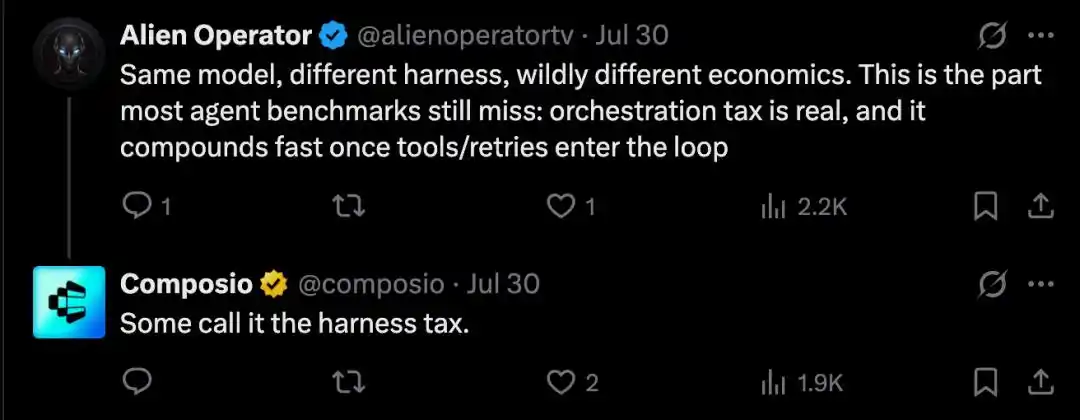
In other words, in the future agent competition, the first half is about "whether it can be done," and the second half will be about "who does the same thing more efficiently"—and the secret to saving money lies not in the model, but in the harness.

Have you had similar experiences while running agents? Feel free to discuss in the comments.

This article is from the WeChat official account "Almost Human" (ID: almosthuman2014), by Almost Human.


Perguntas relacionadas

QWhat was the main finding of the composio team's comparison experiment involving claude code, hermes, and kimi code?

AThe main finding was that while the three agent frameworks (harnesses) achieved similar task success rates, their token consumption varied drastically. The median token usage for Claude Code was about 340k tokens, roughly 6 times higher than Kimi Code's 61k tokens. The maximum difference in token usage for the same task across harnesses could reach up to 30 times.

QAccording to sebastian raschka, why might claude code consume significantly more tokens than other frameworks?

ASebastian Raschka suggested the high token consumption is primarily due to input tokens, not output tokens. He observed that Claude Code's harness tends to repeatedly feed more historical context back into the model across multiple interaction rounds, including previous messages, tool calls, command outputs, and file content.

QWhat trend is revealed by the writer company's research paper regarding agent frameworks?

AThe research paper highlights that the choice of harness (the orchestration layer) is becoming as important as the model itself. Their controlled experiment showed that simply switching to a more efficient harness could reduce average task cost by 41%, median latency by 44%, and token consumption by 38%, while maintaining similar task completion quality.

QBased on the article's data, which framework was the most cost-effective and which was the fastest in median completion time?

ABased on the median data, Kimi Code was the most cost-effective, costing about $0.22 per task. Hermes was the fastest in median completion time, taking 179 seconds.

QWhat new concept or metric does the article propose should be added to agent benchmarks?

AThe article proposes adding a "harness tax" to agent benchmarks. This concept represents the additional computational cost (in tokens, time, and money) imposed by an agent framework's design, especially considering that costs can grow non-linearly when tool calls and retries enter a loop.

Leituras Relacionadas

Stocks Fell Even More Violently Than Crypto, Where Did the Money Go?

From June to late July 2026, global stock markets, particularly technology and semiconductor stocks, experienced severe declines, with South Korea's KOSPI index facing historic circuit breakers and shedding 40% from its June peak. Key catalysts included SK Hynix's earnings miss despite record profits and competitive pressures from China's CXMT IPO. A global forced deleveraging event unfolded, devastating highly leveraged instruments like the 2x leveraged SK Hynix ETF, which lost over 80% of its value. Surprisingly, Bitcoin showed relative stability during this period, rising roughly 15% from its July low. The article clarifies this wasn't due to an inflow of equity flight capital but because Bitcoin had already undergone a significant correction in May and June, with U.S. spot Bitcoin ETFs seeing record outflows. True safe-haven flows went to gold, severing Bitcoin's short-term "digital gold" narrative. The sell-off is characterized not as an AI story collapse but a liquidity-driven清算 of crowded leveraged positions, potentially halfway through according to some analysts. For substantial capital to return to Bitcoin, the article cites necessary conditions: eased global liquidity pressure, a soft-landing Fed rate cut, and regulatory clarity from the stalled U.S. CLARITY Act. The conclusion is that Bitcoin is not a current safe haven but a pre-cleared asset. Its decoupling from tech stocks highlights its potential future role as a non-correlated asset for institutional portfolios, positioning it favorably for when global capital reallocates post-crisis.

marsbitHá 20m

Stocks Fell Even More Violently Than Crypto, Where Did the Money Go?

marsbitHá 20m

"The Final Phase Before the New Cycle". What Will Happen to Bitcoin in August

"Bitcoin Faces Crucial Test in August: Experts Predict Consolidation or Further Decline" The price of Bitcoin (BTC) is expected to remain under pressure in August, with experts anticipating either consolidation within a narrow range or a potential drop below $60,000. Despite a double-digit recovery from its July low near $58,000, BTC ended the month trading around $63,500, still roughly 50% below its October 2025 peak of $126,200. Analysts cite several headwinds: a challenging macroeconomic environment with high US interest rates and persistent inflation, which makes fixed-income assets more attractive than speculative ones like crypto. Furthermore, competition for capital is intense, with many investors favoring AI-related stocks. This is reflected in significant outflows from US spot Bitcoin ETFs, with a record $4.5 billion leaving in June and a net outflow of $5.4 billion for the first half of the year. Historically, August is a weak month for crypto, with a median return of -7.49% from 2013 to 2025. Experts also note regulatory uncertainty in the US, particularly the stalled CLARITY Act, as a dampening factor. Despite the bearish near-term outlook, several experts view the current phase as the "last phase before a new Bitcoin cycle" begins, potentially in Q4 2024. This makes it a favorable time for accumulating Bitcoin for the long term. Key price levels to watch are support at $60,000-$61,000, with a break below $58,000 potentially leading to $53,000-$55,000. A move above $67,000 could target $70,000-$75,000, though this is considered a lower probability scenario.

cryptonews.ruHá 25m

"The Final Phase Before the New Cycle". What Will Happen to Bitcoin in August

cryptonews.ruHá 25m

Trading

Spot
活动图片