The Hidden Market Makers Behind the Gold Surge: This Crypto Firm Earning Billions Annually Has Amassed 140 Tons of Gold

marsbitPublicado em 2026-01-28Última atualização em 2026-01-28

Resumo

The article reveals that Tether, the issuer of the USDT stablecoin, has accumulated approximately 140 tons of physical gold, valued at around $23 billion, making it one of the largest private holders of gold globally—surpassing many national reserves. Tether’s CEO, Paolo Ardoino, announced ambitions to become one of the world’s top “gold central banks.” The company has been aggressively purchasing gold since 2025, acquiring over 70 tons last year alone, significantly influencing gold's price surge. Tether’s gold is stored in a secure Swiss vault, and the firm is expanding its influence by hiring seasoned metal market executives, investing in gold mining royalties, and launching a gold-backed stablecoin, XAU₮, which dominates the tokenized gold market. The company’s aggressive accumulation is backed by substantial profits—$15 billion in net income in 2025—driven primarily by interest from its vast holdings of U.S. Treasuries and strategic Bitcoin investments. Tether is expanding its reach with a new federally regulated stablecoin, USAT, targeting the U.S. market. Its growing influence in both traditional finance and crypto has positioned it as a major, albeit controversial, force in global markets.

Author: Nancy, PANews

Gold is going crazy. In less than a month since the start of the year, various funds have been frantically buying, pushing gold prices to repeatedly hit new historical highs.

Amid this precious metal狂欢盛宴, an "invisible big player" has unexpectedly come into view: stablecoin giant Tether has quietly accumulated 140 tons of gold reserves.

Holding 140 Tons of Gold, Aiming to Become the World's Largest Gold Central Bank

Tether, which 'has mines at home,' is becoming a major player in the gold market.

"We will soon become one of the world's largest 'gold central banks,' so to speak." Tether CEO Paolo Ardoino recently stated unabashedly in an interview with Bloomberg.

This is not just talk. To date, Tether has accumulated approximately 140 tons of physical gold, worth about $23 billion at current prices. Typically, Tether purchases directly from Swiss refineries and top global financial institutions, with large metal orders often taking months to deliver. Upon arrival, the gold is stored in a nuclear bunker built during the Cold War in Switzerland, protected by multiple layers of heavy steel doors, and Switzerland boasts one of the world's top confidentiality systems.

In terms of scale, Tether has become the largest known holder of physical gold outside the banking systems and nations, ranking among the top 30 global gold holders, with holdings exceeding those of countries like Greece, Qatar, and Australia.

Although Tether began布局 gold assets many years ago, its large-scale entry真正 occurred in 2025. Last year alone, Tether purchased over 70 tons of gold, becoming one of the top three buyers of gold globally this year. Its procurement scale not only surpassed that of almost all single central banks except the Polish central bank but also exceeded that of many large gold ETFs.

It can be said that Tether is also a significant driver behind this year's rise in gold prices.
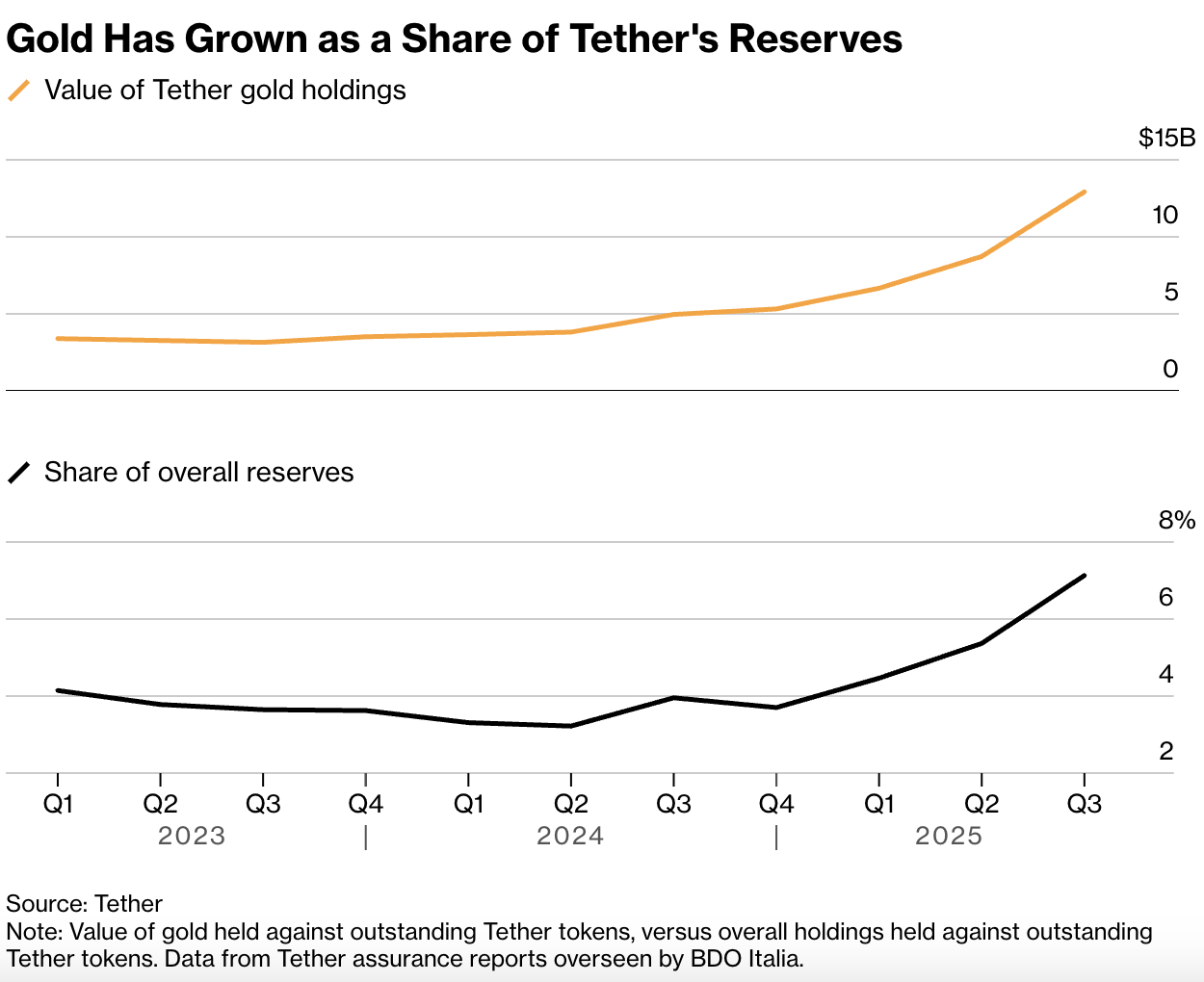
According to Ardoino, Tether's current gold procurement rate is about 1 to 2 tons per week, and it plans to maintain this pace in the coming months, "maybe slowing down, but we will assess gold demand quarterly."

But Tether's ambitions go beyond just hoarding gold. In the Bloomberg interview, Ardoino stated that Tether is evaluating the market and potential trading strategies, planning to actively trade its gold reserves to capture arbitrage opportunities. Simultaneously, the company is working on building "the world's best gold trading floor," aiming to establish stable, long-term channels for gold acquisition and compete with large banks like JPMorgan Chase and HSBC that dominate the global precious metals market.

To this end, Tether last year prominently brought on two heavyweight trading veterans: former HSBC global head of metals trading Vincent Domien, and former head of precious metals procurement for Europe, the Middle East, and Africa, Mathew O’Neill, specifically负责 expanding its gold business landscape. (Related reading: Tether's Gold Empire: The Ambition and Cracks of a 'Borderless Central Bank')

Upstream in the industry chain, Tether has also begun using its financial muscle to secure positions. Tether has successively invested in several Canadian mid-tier gold mining royalty companies, including Elemental Royalty, Metalla Royalty & Streaming, Versamet Royalties, and Gold Royalty, locking in future production capacity and revenue sharing through equity investments.

At the financial product level, Tether launched the gold-pegged stablecoin Tether Gold (XAU₮) as early as 2020. As of the end of last year, this token was backed by 16.2 tons of physical gold. Not long ago, Tether also introduced a new unit of account for XAU₮ called Scudo, where 1 Scudo represents one-thousandth of a troy ounce of gold, aiming to make gold a more usable form of payment.

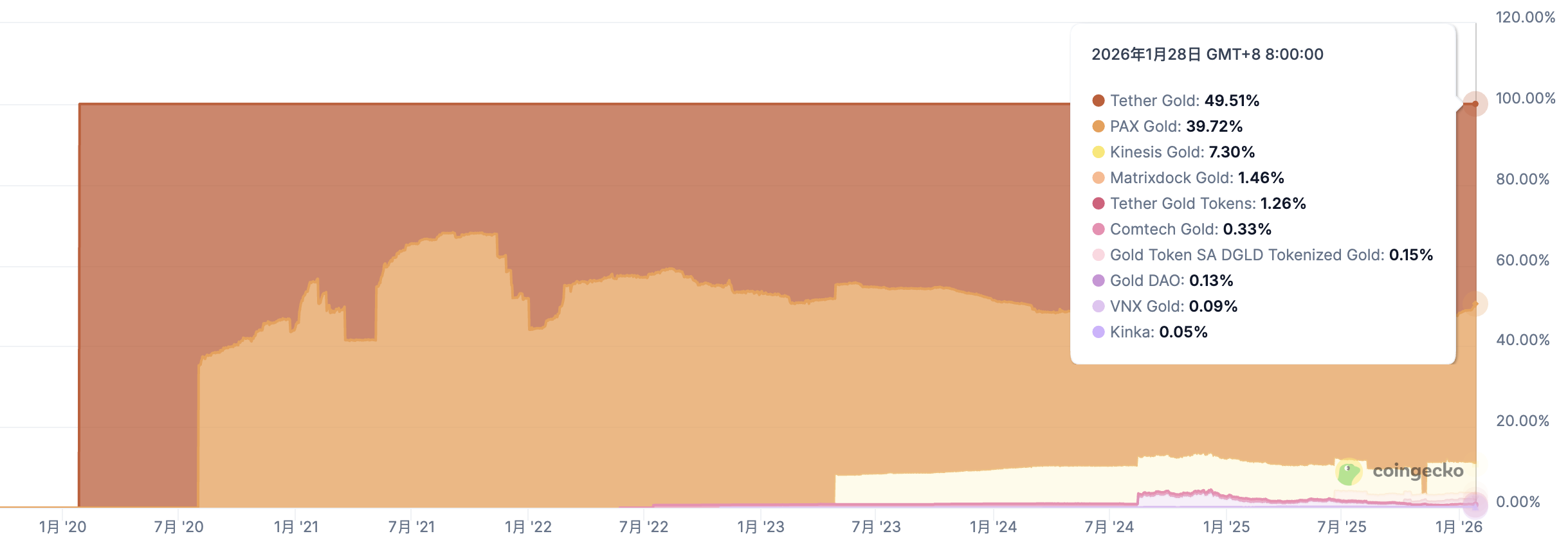
CoinGecko data shows that as of January 28, the circulating market value of XAU₮ had reached $2.7 billion, growing about 91.3% over the past year, capturing 49.5% of the tokenized gold track market share, firmly holding the top position.
From physical gold hoarding to industry chain布局, to financial product innovation, the large-scale investments by this gold enthusiast have even left traditional commodity圈 insiders baffled, with some形容 Tether as "the strangest company they have ever encountered."

But now, as gold prices continue to刷新历史 highs, Tether's bet is yielding惊人的 returns.

Earning $15 Billion Annually, Building a Capital Arsenal

The confidence behind Tether's疯狂囤积 gold comes from a high-speed运转的 "money printing machine."

According to a Fortune report, Tether generated approximately $15 billion in net profit in 2025, a significant increase from the previous year's $13 billion. This百亿 profit is supported by a global workforce of only about 200 people. Roughly calculated, the per capita profit is as high as $75 million, an efficiency level that leaves traditional financial giants in the dust.

The core of this profitability comes from the capital pool沉淀 by its stablecoin business.

Today, the US dollar stablecoin USDT issued by Tether is the most widely used stablecoin globally, with over 500 million users. CoinGecko data shows that as of January 28, 2026, the circulation of USDT issued by Tether was接近 $1870 billion, firmly holding the top spot in the stablecoin赛道. Trading activity is同样领先; Artemis Analytics data shows that in 2025, total stablecoin transaction volume grew 72% to $33 trillion, with USDT contributing $13.3 trillion, accounting for over 33%.

Building on this, Tether is further expanding the scale of its capital沉淀 through合规化.

On January 27, Tether officially launched USAT, a stablecoin regulated by the U.S. federal government. It is issued by Anchorage Digital Bank, the first federally regulated stablecoin issuer in the U.S., with Cantor Fitzgerald serving as the designated reserve custodian and preferred primary dealer, and former White House advisor Bo Hines appointed as CEO. This is seen as a key step for Tether's full-scale entry into the U.S. domestic market.

Simultaneously, leveraging its investments in content platforms like Rumble, Tether is attempting to integrate USAT business into the traffic ecosystem, thereby quickly reaching 100 million U.S. users, with a target of a $1 trillion market cap within five years. If progress is smooth, USAT could become the first真正意义上的 competitor to USDC in the U.S. market.

After obtaining an almost zero-cost liability side, Tether easily套取 interest rate differentials by allocating high-liquidity, low-risk assets.

Among these, U.S. Treasury interest is the core source of Tether's收益. In a high-interest rate cycle, U.S. Treasury interest directly amplifies Tether's profitability. Currently, Tether holds approximately $1350 billion in U.S. Treasury bonds, exceeding the holdings of sovereign nations like South Korea and making it the 17th largest holder of U.S. Treasury bonds globally.

Additionally, Tether is also a super player in Bitcoin. Since 2023, Tether has allocated up to 15% of its monthly net profit to定期 Bitcoin. Its current holdings exceed 96,000 BTC, making it one of the largest institutional holders of Bitcoin globally, with an average cost of about $51,000, far below the current market price.围绕 the Bitcoin ecosystem, Tether has also built its own mining farms, invested in mining companies, and布局 DAT (Crypto Treasury), continuously expanding its industry influence, and has一度 been the subject of overseas conspiracy theories about being a "BTC隐形操盘手." (Related reading: Caught in BTC隐形操盘手 Conspiracy Theories? Unveiling the Full Picture of Tether's Bitcoin Strategy)

Furthermore, to leverage more potential收益, Tether has开启了大撒币 mode over the past few years, extending its investment触角 to areas such as satellite communications, AI data centers, agriculture, telecommunications, and media.

Thus, an arbitrage machine spanning traditional finance and the crypto world has gradually taken shape, continuously supplying Tether with capital ammunition, becoming the chips for its large-scale bets.


Perguntas relacionadas

QHow much gold has Tether accumulated and what is its current value?

ATether has accumulated approximately 140 tons of physical gold, with a current value of about $23 billion.

QWhat is Tether's goal regarding its gold reserves, as stated by its CEO?

ATether's CEO, Paolo Ardoino, stated that the company aims to become one of the world's largest 'gold central banks'.

QWhat was Tether's net profit in 2025 and what is the primary source of this profitability?

ATether's net profit in 2025 was approximately $15 billion, primarily sourced from the interest on U.S. Treasury bonds held from its stablecoin business.

QWhat is the name of the gold-backed stablecoin issued by Tether and what is its market position?

ATether's gold-backed stablecoin is called Tether Gold (XAU₮), and it holds a 49.5% market share in the tokenized gold sector, ranking first.

QHow does Tether store its physical gold reserves and where are they located?

ATether stores its physical gold in a nuclear bunker from the Cold War era in Switzerland, which has multiple layers of heavy steel doors and top-tier confidentiality systems.

Leituras Relacionadas

South Korean Exchanges 'Battle' Regulators, Challenging the Boundaries of Enforcement and Legislation

South Korea's cryptocurrency industry is engaged in a rare, direct confrontation with regulators. The Financial Intelligence Unit (FIU), the primary anti-money laundering (AML) watchdog, has recently imposed heavy penalties on major exchanges like Upbit and Bithumb for alleged violations involving unregistered overseas VASPs and AML procedures. However, exchanges are now actively challenging these actions in court and through industry associations. In a significant shift, the Seoul Administrative Court ruled in favor of Upbit's operator, Dunamu, overturning part of an FIU-ordered business suspension. The court found the FIU's penalty criteria and justification insufficiently clear. Similarly, the court suspended the enforcement of a six-month business suspension against Bithumb pending a final ruling, citing potential irreversible harm to the exchange. Beyond legal battles, the industry is contesting proposed legislative amendments. The Digital Asset eXchange Alliance (DAXA) strongly opposes a draft rule that would mandate Suspicious Transaction Reports (STRs) for all crypto transfers over 10 million KRW (~$6,800). DAXA argues this "poison pill" clause violates legal principles and would overwhelm the STR system, increasing reports from 63,000 to an estimated 5.45 million annually for major exchanges, thereby crippling effective AML monitoring. This conflict highlights a structural tension in South Korea's crypto governance: comprehensive digital asset laws are still developing, while regulators rely heavily on AML enforcement. The industry's move from passive compliance to active legal and legislative challenges signifies a new phase, pressing for clearer rules and more proportionate enforcement. While short-term disputes may intensify, this clash could ultimately lead to a more mature and sustainable regulatory framework for South Korea's vibrant crypto market.

marsbitHá 30m

South Korean Exchanges 'Battle' Regulators, Challenging the Boundaries of Enforcement and Legislation

marsbitHá 30m

After 50x Storage Surge, Justin Sun Always Looks to the Next Decade

Sun Yuchen, known for his controversial stunts like a $30 million lunch with Warren Buffett (canceled due to a kidney stone) and eating a $6.2 million duct-taped banana, is often overshadowed by a significant fact: his decade-long track record of spotting major investment trends. In 2016, he famously advised young people to invest in Bitcoin, Nvidia, Tesla, and Tencent instead of buying property. A hypothetical $20,000 investment in Nvidia and Tesla from that list would now be worth over 50 million RMB. His latest major call was on November 6, 2025, predicting a "50x storage opportunity" tied to the AI boom, which materialized with Sandisk's stock surging nearly 50-fold by 2026. Looking ahead, Sun now focuses on the next frontier: Physical AI. He identifies four key areas: 1. **Embodied AI/Robotics**: He sees this reaching its "iPhone moment," with companies like UBTech and Galaxy General leading in commercialization. 2. **Drones**: Viewed as the first commercially viable form of Physical AI, revolutionizing sectors from warfare (e.g., AeroVironment's Switchblade) to logistics. 3. **Spatial Computing**: Beyond VR, it's about AI understanding physical space, a foundational technology for robotics and autonomous systems, exemplified by Apple's Vision Pro. 4. **Space Exploration**: After a 2025 suborbital flight with Blue Origin, Sun advocates for space as the ultimate frontier, discussing blockchain's potential role in space asset management and data transactions. His investment philosophy involves betting on entire, inevitable trends rather than single companies. For robotics, he sees Tesla (the body/manufacturer) and Nvidia (the brain/AI platform) as complementary plays. In defense drones, he highlights companies making tanks obsolete (AeroVironment) and those augmenting fighter jets (Kratos). For space, he participated in Blue Origin's flight and anticipates SpaceX's potential IPO to redefine the sector's valuation. Sun Yuchen's vision frames the next two decades not as a revolution in information flow (like the internet), but in the fundamental operation of the physical world through AI-powered robots, autonomous systems, and spatial intelligence, ultimately extending human and AI activity into space. While many still focus on conventional assets, he continues to look toward the next technological horizon.

marsbitHá 1h

After 50x Storage Surge, Justin Sun Always Looks to the Next Decade

marsbitHá 1h

The Billionaires Behind the Most Expensive Midterm Election in History

"The Most Expensive Midterm Elections and Their Billionaire Backers" This analysis details the unprecedented scale of spending in the 2026 midterm elections, highlighting the key billionaire donors shaping the political landscape. Jeff Yass, founder of Susquehanna International Group, has contributed over $81 million, ranking third among individual donors behind George Soros ($102.6M) and Elon Musk ($84.8M). Yass is a major donor to Trump's MAGA Inc. and supports school choice and various candidates. Overall, federal committees have raised over $4.7 billion this cycle, with political ad spending projected to reach $10.8 billion. Republican-aligned groups are significantly out-raising their Democratic counterparts. "Dark money" from undisclosed sources continues to grow. The core stakes involve control of Congress and policy direction for Trump's final term. Donors are also motivated by specific issues: Sergey Brin and Chris Larsen are funding opposition to a proposed California wealth tax and supporting crypto-friendly policies. Other top donors include OpenAI's Greg Brockman and his wife Anna ($50M total to MAGA Inc. and an AI-focused PAC), Richard Uihlein ($45.3M to conservative causes), venture capitalists Marc Andreessen and Ben Horowitz (each over $44M to crypto/AI PACs and MAGA Inc.), Miriam Adelson ($42.6M to GOP leadership PACs), Paul Singer ($33.9M), and Diane Hendricks ($25.8M to MAGA Inc.). The article notes that the peak fundraising period is still ahead, with major primaries approaching.

marsbitHá 1h

The Billionaires Behind the Most Expensive Midterm Election in History

marsbitHá 1h

The Largest IPO in History Is Approaching, Surpassing SpaceX, 28 Years of AI Self-Iteration, Countdown to Intelligence Explosion

"Anthropic Nears Trillion-Dollar IPO, Fueled by Explosive Growth and 2028 'Intelligence Explosion' Warning Anthropic is considering a deal valuing the AI company near $1 trillion, potentially leading to one of the largest IPOs ever and surpassing SpaceX. Its revenue has skyrocketed, with Annual Recurring Revenue (ARR) reaching $45 billion in May 2026—a 500% increase in just five months. This vertical growth curve is attributed to its key products, Claude Code and Cowork, dominating AI coding and enterprise collaboration. Beyond commercial success, co-founder Jack Clark issued a pivotal warning in an interview: there is a greater than 50% chance that by the end of 2028, AI systems will achieve recursive self-improvement—the ability to autonomously build a 'better version' of themselves, initiating an 'intelligence explosion.' This prophecy underpins the company's astronomical valuation, as the market prices in the potential for transformative and disruptive AI. Further signaling its ambition, Anthropic formed a $1.5 billion joint venture with Goldman Sachs and Blackstone, aiming to disrupt traditional consulting firms like McKinsey by deploying Claude AI for complex strategic work. This move tests AI's capacity to replace high-level cognitive labor, a precursor to its predicted autonomous evolution. The narrative presents a dual future: unprecedented economic opportunity alongside significant risks like economic restructuring and security threats. Anthropic's meteoric rise and Clark's 2028 prediction frame the coming years as a countdown to a potential technological singularity."

marsbitHá 1h

The Largest IPO in History Is Approaching, Surpassing SpaceX, 28 Years of AI Self-Iteration, Countdown to Intelligence Explosion

marsbitHá 1h

Trading

Spot
Futuros
活动图片